Disciplemaking Leaders: Live Out the Five Relationships of a Disciplemaker

Discipleship is a process that begins after conversion and continues throughout a believer’s life. Discipleship calls for our undivided attention and commitment to follow the commands of our Lord. Discipleship is not an option for any church or believer. Christ mandated it in the Great Commission. To disciple others is to obey our Lord’s command; to do otherwise is to disobey Him.

It becomes easy for every church’s disciple-making mission to get cluttered with lots of things to do. And most church leaders are very good at doing things. As a result, administration of programs replaces actual disciple making practices. As you look ahead to the next year, slow down and refresh your conviction for disciplemaking by looking to the Master himself.

How does a Jesus-centric disciplemaking conviction rescue you from a “program management” culture? Have you resigned to herding people through classes and events? Are you relying too much on better preaching? Or do you have a robust, disciple-making strategy built around life-on-life investment, like Jesus?

THE QUICK SUMMARY – Discipleship That Fits by Bobby Harrington and Alex Absalom

For far too long, the church has tried to make disciples using a one-size-fits-all approach. Some churches advocate 1-on-1 discipling, others try getting everyone into a small group, while still others training through mission trips or service projects. Yet others focus all their efforts on attracting people to a large group gathering to hear biblical teaching and preaching. But does one size really fit everyone?

Based on careful biblical study and years of experience making disciples in the local church, Bobby Harrington and Alex Absalom have identified five key relationships where discipleship happens in our lives. In each relational context we need to understand how discipleship occurs and we need to set appropriate expectations for each context.

Discipleship That Fits shows you the five key ways discipleship occurs. It looks at how Jesus made disciples and how disciples were formed in the early church. Each of the contexts is necessary at different times and in different ways as a person grows toward maturity in Christ.

Filled with examples and stories, the authors show you how to develop discipleship practices in each relational context by sharing how Jesus did it, how the early church practiced it, and how churches are discipling people today.

A SIMPLE SOLUTION

The concept of individualism in American culture has at times approached the level of idolatry, and even influenced the way we think about discipleship. After all, we can learn and grow all by ourselves, right?

The truth is Christians need relationships to grow. We don’t grow in isolation; we develop in the context of relationships with others.

Another truth is that we tend to live isolated lives. While that seems almost laughable in today’s hyper-connected society with some type of screen constantly in our faces, the sad reality is we often don’t know how to relate to people.

So how can we develop relationships that make a difference in our disciplemaking?

In the 1960s, sociologist Edward T. Hall introduced his groundbreaking studies that provided a foundation for developing relationships in the various “spaces” of our lives: public, social, personal, and intimate.

Authors Bobby Harrington and Alex Absalom develop the thought of these four spaces as the context for developing relationships that God uses to help us grow.

God disciples us in many contexts, shaping and molding hearts, minds, and lives – and calling us to imitate his example with those we lead.

The Public Context exists where people gather in the hundreds around a shared outside resource. If the resource is physically present, people will generally be at least 12 feet away from it (think of your distance from the stage if you go see a play or concert). In the environment the focus is on engaging with the outside resource, rather than building relational depth with others who also happen to be there.

The Social Context is the range between twenty and seventy people, where we share snapshots of who we are and thereby seek to build affinity with others. In this context (think of a backyard cookout) three things happen: we build neighborly relations, we start to identify those with whom we’d like to become closer friend, and we reveal elements of our identity and our journey. In terms of proximity, we will be somewhere between 4 and 12 feet apart.

The Personal Context forms in groups of four to twelve, where we feel able to share private information. Think, for instance, of good friends talking over drinks, revealing personal thoughts and feelings about their ongoing lives and relationships. Usually we are 18 inches to 4 feet apart in this context, which is both within comfortable touching distance and close enough to see the other persons as they truly are – warts, wrinkles, and all! Such acceptance and physical closeness are representative of the emotional qualities of a relationship in this context, where we experience a genuine depth of friendship.

The Transparent Context is when you are with just one or two others, making a group of two to four people, your closes to relationships. In this context, characterized by complete openness and candor, nothing is held back. This echoes the biblical idea of being “naked and yet unashamed” – an ideal we live out literally in marriage and metaphorically with our best friends. You are 0 to 18 inches apart in the closes moments of these relationships, noting that at such proximity the other person’s flaws seem to fade away (since your eyes can’t focus on them). This blurring of flaws is a wonderful metaphor for what is going on relationally at these safest depths of human engagement.

The Divine Context represents God’s direct interactions with us, his people, at a one-on-one level. Our focus shifts from cultivating relationship with others to being alone with our Creator and Redeemer as he encounters us in our inner world. We delude ourselves if we believe there can be any barriers in this place; indeed, we come face-to-face with our true selves, as reflected in the loving eyes of our heavenly Father. This communion with God in turn equips us to engage more fruitfully in each of the other four contexts.

Bobby Harrington and Alex Absalom, Discipleship That Fits

A NEXT STEP

Using the table below, conduct a personal study of Jesus and the five different contexts as outlined above.
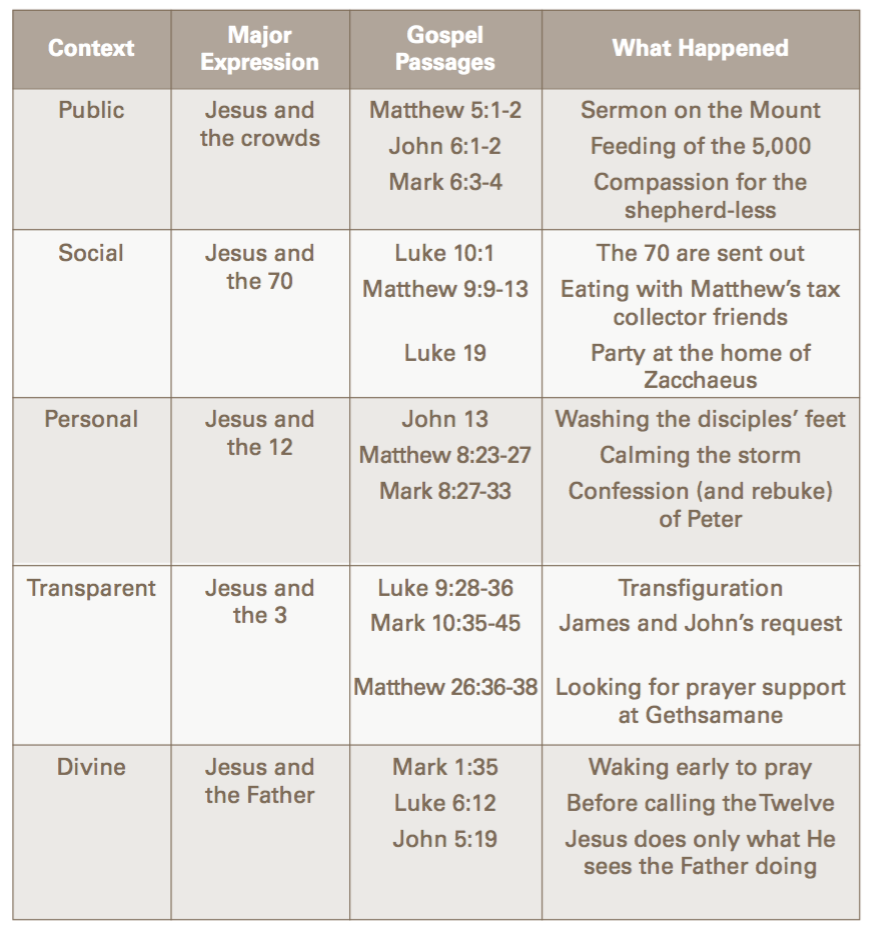
After completing this study, reflect on what you have learned about the five different types of relationships, how you have grown closer to God because of them, and how you will be better able to disciple others in his name.

What next step is God calling you to take as a result?

Excerpt taken from SUMS Remix 77-2, released October 2017.


This is part of a weekly series posting excerpts from one of the most innovative content sources in the church world: SUMS Remix book excerpts for church leaders.

SUMS Remix takes a practical problem in the church and looks at it with three solutions; each solution is taken from a different book. Additionally, a practical action step is included with each solution.

As a church leader you get to scan relevant books based on practical tools and solutions to real ministry problems, not just by the cover of the book. Each post will have the edition number which shows the year and what number it is in the overall sequence. (SUMS Remix provides 26 issues per year, delivered every other week to your inbox). 

> > Subscribe to SUMS Remix <<


Download PDF

Tags: , , ,

| What is MyVisionRoom? > | Back to Discipleship >

ABOUT THE AUTHOR

VRcurator

VRcurator

Bob Adams is Auxano's Vision Room Curator. His background includes over 23 years as an associate/executive pastor as well as 8 years as the Lead Consultant for a church design build company. He joined Auxano in 2012.

See more articles by >

COMMENTS

What say you? Leave a comment!

Recent Comments
comment_post_ID); ?> Thank you for this information. I'm going to use this article to improve my work with the Lord.
 
— Abel Singbeh
 
comment_post_ID); ?> Thank you Ed for sharing your insights into the Church Growth Movement. I have my reservations with Church Growth models because it has done more damage than good in the Body of Christ. Over the years, western churches are more focused on results, formulas and processes with little or no emphasis on membership and church discipline. Pastors and vocational leaders are burnt out because they're overworked. I do believe that the Church Growth model is a catalyst to two destructive groups: The New Apostolic Reformation and the Emerging Church. Both groups overlap and have a very loose definition. They're both focus on contemporary worship, expansion of church brand (franchising), and mobilizing volunteering members as 'leaders' to grow their ministry. Little focus on biblical study, apologetics and genuine missional work with no agenda besides preaching of the gospel.
 
— Dave
 
comment_post_ID); ?> Thank you for sharing such a good article. It is a great lesson I learned from this article. I am one of the leaders in Emmanuel united church of Ethiopia (A denomination with more-than 780 local churches through out the country). I am preparing a presentation on succession planning for local church leaders. It will help me for preparation If you send me more resources and recommend me books to read on the topic. I hope we may collaborate in advancing leadership capacity of our church. God Bless You and Your Ministry.
 
— Argaw Alemu
 

Clarity Process

Three effective ways to start moving toward clarity right now.

Choosing the Long Road to Somewhere Instead of the Short Road to Nowhere

Life is filled with tensions. I’m not just talking about the negative tensions of managing relational conflict or figuring out how to pay the bills this month. I’m talking about the positive tensions of where to apply your greatest effort. In the whirlwind of life-as-usual, in the press of demands and limitations, how do you identify what is most important? How do you know where to invest the most and best energy?

If life is full of tensions, then leadership is the ability to navigate those tensions in the most helpful and effective ways, both for ourselves and for those around us. This is never more true than when we turn to the leader’s most valuable asset: their organization’s vision, its forward-looking view of where God is leading.

Every organization in the world that strives to advance its vision beyond itself wrestles with tensions within itself:

  • The tension between delivery and development. How do we deliver what we do with excellence while we develop the next generation of leaders behind us?
  • The tension between progress and process. How do we “ship” today to the most people while we improve what we do so that more leaders can “ship” tomorrow?
  • The tension between moving people and making people. How do we efficiently funnel masses through a pattern of programs while we spend the kind of time with individuals that influences their lives?

Navigating tensions like these is how a leader makes his or her most important contribution to an organization. As the steward of the organization’s vision, the leader must choose what the organization gives its best time and attention to. It is the leader’s responsibility to decide how their organization negotiates between delivery and development, progress and process, moving people and making people.

If we are honest, too often when deadlines get urgent and budgets get tight, we reduce our vision to delivery, progress, and moving people. That is where the most and best time goes when the “tyranny of the urgent” demands it of us.

But the best determiner of whether our vision will truly create the world we hope for is not whether we deliver today or make what-have-you-done-for-me-lately progress that turns the heads of those we report to. Instead, vision becomes reality for those who invest in development and process. The future belongs to leaders whose vision is always about making people and not just moving them.

In other words, in times of greatest urgency, we leaders must make our most counterintuitive move. Instead of trying to maximize our delivery, we must try to maximize our development. Instead of concentrating on progress, we must look at our process. Instead of trying to move people, we must correct our deficiency in making people.

In short, success in attaining our vision lies not with the question we most naturally ask but with the question we almost never ask. We must shift our interest from asking “What’s next?” to asking “Who’snext?”

The unmistakable truth is that our vision is only as good as the people in whom that vision has taken root. And while development, process, and making people are never the path of quickest reward, they are the path of greatest long-term effectiveness.

If, on the other hand, we choose the short path of what most people most value, we will inevitably miss the better path of the better future that got us into our calling to begin with. So today I’m inviting you to choose the harder and longer path of vision. If we recover our focus on who’s next over what’s next, I think we will find ourselves back on the long road to somewhere instead of the short road to nowhere.

> Read more from Dave.


Let’s talk! Connect with an Auxano Navigator.

Download PDF

Tags: , ,

| What is MyVisionRoom? > | Back to Discipleship >

ABOUT THE AUTHOR

Dave Rhodes

Dave Rhodes

Dave is the Pastor of Discipleship and Movement Initiatives at Grace Fellowship Church in Atlanta, Georgia. He is the co-founder of Younique and Wayfarer, and a collaborative partner for 100 Movements, 10,000 Fathers. Before coming to Grace Fellowship, Dave served as the U.S. Team Leader for 3DM and as Lead Strategist for Wayfarer. Dave has authored several books and resources including Redefining Normal: An Open Invitation for Ordinary People Wanting to Become Extraordinary Disciples. Dave graduated from Palm Beach Atlantic University and went on to graduate from Beeson Divinity School with Master of Divinity. Dave is married to Kim and the father of 3 fabulous children—Emma, Izzie and Frankie. Normal-and-then-not-normal-fun-facts: Dave enjoys playing golf, watching college football and eating chicken wings—and maybe eating chicken wings a little too much.

See more articles by >

COMMENTS

What say you? Leave a comment!

Recent Comments
comment_post_ID); ?> Thank you for this information. I'm going to use this article to improve my work with the Lord.
 
— Abel Singbeh
 
comment_post_ID); ?> Thank you Ed for sharing your insights into the Church Growth Movement. I have my reservations with Church Growth models because it has done more damage than good in the Body of Christ. Over the years, western churches are more focused on results, formulas and processes with little or no emphasis on membership and church discipline. Pastors and vocational leaders are burnt out because they're overworked. I do believe that the Church Growth model is a catalyst to two destructive groups: The New Apostolic Reformation and the Emerging Church. Both groups overlap and have a very loose definition. They're both focus on contemporary worship, expansion of church brand (franchising), and mobilizing volunteering members as 'leaders' to grow their ministry. Little focus on biblical study, apologetics and genuine missional work with no agenda besides preaching of the gospel.
 
— Dave
 
comment_post_ID); ?> Thank you for sharing such a good article. It is a great lesson I learned from this article. I am one of the leaders in Emmanuel united church of Ethiopia (A denomination with more-than 780 local churches through out the country). I am preparing a presentation on succession planning for local church leaders. It will help me for preparation If you send me more resources and recommend me books to read on the topic. I hope we may collaborate in advancing leadership capacity of our church. God Bless You and Your Ministry.
 
— Argaw Alemu
 

Clarity Process

Three effective ways to start moving toward clarity right now.

These Three Attitudes Undermine Clarity

Wise leaders long for their teams to be filled with people who assume the posture and attitude of servant, steward, equipper, and executor. As a result, the whole team benefits and the whole organization/ministry is healthier. But what postures do leaders not want and not need on their teams? Surely there are a plethora of answers but here are three of the most common postures on a leadership team that hamper the effectiveness of the team.

1. Consultant

I am grateful for consultants. I have even served as a consultant. I believe consultants can provide incredible value to an organization. There are times when outside eyes are beneficial, when someone who can diagnose problems without being too close to the work is very helpful. Consultants are there to give wisdom, but they are not there to own the execution and implementation. Thus, when someone on a leadership team takes the posture of a consultant, the person delves out advice without being connected to the execution. When people want to advise without owning, they give the perception that are not fully committed. People on a leadership team who assume the posture of an internal consultant often have great ideas for everyone else’s area of responsibility and don’t dive deeply into their own.

2. Senator

I am grateful for senators. I have voted for senators and have even enjoyed a friendship with one. But I don’t want someone on a leadership team assuming the role of “senator.” Someone who assumes the posture of “senator” represents “their constituency” to the leadership team. The worst-case scenario is a team of senators representing departments or divisions that are moving in different directions. Instead of the team being aligned, the team acts often against one another. When a leadership team fails to commit to a shared vision and shared values, departments often have conflicting goals and plans.

3. Critic

I am grateful for critics. Ahhh, actually that is not true; I am most often not. I am deeply thankful for feedback from people I trust and respect who love me and the mission. Leaders should never be above feedback. But criticism and feedback are deeply different from one another. While the goal of feedback is to build up, the goal of criticism is often to tear down. Leaders are going to face criticism, but no wise leader wants to spend money on salaries to get it.

The best way for leaders to not foster a posture of consultant, senator, or critic on their teams is to not be those themselves. Leaders who are critical of others will attract critical people. Leaders who philosophize without executing will attract those who are allergic to getting things done. Leaders who fail to lead with overarching vision and direction will create an environment that lacks clarity.

> Read more from Eric.


Let’s talk! Connect with an Auxano Navigator.

Download PDF

Tags: , , ,

| What is MyVisionRoom? > | Back to Leadership >

ABOUT THE AUTHOR

Eric Geiger

Eric Geiger

Eric Geiger is the Senior Pastor of Mariners Church in Irvine, California. Before moving to Southern California, Eric served as senior vice-president for LifeWay Christian. Eric received his doctorate in leadership and church ministry from Southern Seminary. Eric has authored or co-authored several books including the best selling church leadership book, Simple Church. Eric is married to Kaye, and they have two daughters: Eden and Evie. During his free time, Eric enjoys dating his wife, taking his daughters to the beach, and playing basketball.

See more articles by >

COMMENTS

What say you? Leave a comment!

Recent Comments
comment_post_ID); ?> Thank you for this information. I'm going to use this article to improve my work with the Lord.
 
— Abel Singbeh
 
comment_post_ID); ?> Thank you Ed for sharing your insights into the Church Growth Movement. I have my reservations with Church Growth models because it has done more damage than good in the Body of Christ. Over the years, western churches are more focused on results, formulas and processes with little or no emphasis on membership and church discipline. Pastors and vocational leaders are burnt out because they're overworked. I do believe that the Church Growth model is a catalyst to two destructive groups: The New Apostolic Reformation and the Emerging Church. Both groups overlap and have a very loose definition. They're both focus on contemporary worship, expansion of church brand (franchising), and mobilizing volunteering members as 'leaders' to grow their ministry. Little focus on biblical study, apologetics and genuine missional work with no agenda besides preaching of the gospel.
 
— Dave
 
comment_post_ID); ?> Thank you for sharing such a good article. It is a great lesson I learned from this article. I am one of the leaders in Emmanuel united church of Ethiopia (A denomination with more-than 780 local churches through out the country). I am preparing a presentation on succession planning for local church leaders. It will help me for preparation If you send me more resources and recommend me books to read on the topic. I hope we may collaborate in advancing leadership capacity of our church. God Bless You and Your Ministry.
 
— Argaw Alemu
 

Clarity Process

Three effective ways to start moving toward clarity right now.