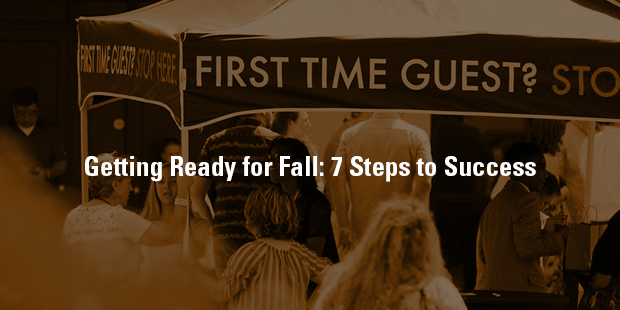
Getting Ready for Fall: 7 Steps to Success

Yes, it’s currently blazing hot in most parts of the country. But fall will be here before we know it, and with cooler weather comes an attendance surge for most churches. Families are returning from vacation, people are getting back into routines, and church parking lots and pews are fuller than they were during summer. At our church, we typically see a 30-35% attendance bump from the end of July to mid-August (there was one year that it hit 52%!).

So how can you take advantage of the next few weeks in order to be prepared for the influx of guests? Here are seven ways:

Refresh your volunteer training. 

Go back to the basics with your current vols. Remind them why your team exists. Whether you’re meeting with them in person or sending out text / email updates, spend a few minutes over the next few weekends helping them get their heads back in the game. [Related post: Need an Inexpensive Option for Team Training?]


Invite new people to serve. 

New guests mean new opportunities for your members to step up their game. Invite all of your current vols to shoulder-tap their friends. If your attendance numbers bump by 1/3 like ours, make it a personal goal to bump your volunteer numbers by the same. [Related post: 20 Ways to Get More Volunteers]


Review your systems. 

Sure, you remember last Easter or fall when a lot of people showed up and you had to seat them in the lobby or park them at the business down the street. But now, how will you prepare based on what you know? Now is the time to pull out the playbook and talk to your team about what will happen when (not if) additional space is required (and please, let’s not call it overflow. That’s what toilets do.) [Related post:10 Ways to Make Your Seating Team More Effective]


Practice your language.

How will you greet your guests when they arrive? Sure, you may cover this with your volunteers…but what about the people on stage? How will your worship leader encourage people to scoot in once worship has already started? How will your lead pastor greet the throngs, acknowledge the bump, and invite them back? How will your announcement guy give practical next steps? [Related post: Six Times to Talk to Your Guests]


Check your supplies. 

Do you have enough first time guest gifts? Worship guides? Information cards? Communion cups? Now is the time to order them. [Related post: First Time Guest Bags: An Intro]


Clean it up.

Don’t neglect your facility or your parking lot. Take a minute to walk around this week and spot what needs to be fixed or freshened up: remove those VBS posters. Weed that flower bed. Windex that lobby door. [Related post: Pick Up Your Junk]


Pray. 

This isn’t the last resort, but the first. If we believe for a moment that the guest experience rises and falls on a clean facility and well-trained volunteers, we deceive ourselves. No, we must pray for the Holy Spirit to compel people to come, to open their eyes to the gospel, and to woo them into a relationship with Jesus. [Related post: Is Your Guest Service Team in a State of Desperation?]

> Read more from Danny.


Download PDF

Tags: , ,

| What is MyVisionRoom? > | Back to Execution >

ABOUT THE AUTHOR

Danny Franks

Danny Franks

Danny Franks makes his living as a Connections Pastor at the Summit Church in Raleigh-Durham, North Carolina. He also makes a life as the husband of an out-of-his-league hottie and the dad of three cool sons and one sweet princess. His blog, dfranks.com, is a reflection of how he interacts with all of these.

See more articles by >

COMMENTS

What say you? Leave a comment!

Recent Comments
comment_post_ID); ?> Thank you for this information. I'm going to use this article to improve my work with the Lord.
 
— Abel Singbeh
 
comment_post_ID); ?> Thank you Ed for sharing your insights into the Church Growth Movement. I have my reservations with Church Growth models because it has done more damage than good in the Body of Christ. Over the years, western churches are more focused on results, formulas and processes with little or no emphasis on membership and church discipline. Pastors and vocational leaders are burnt out because they're overworked. I do believe that the Church Growth model is a catalyst to two destructive groups: The New Apostolic Reformation and the Emerging Church. Both groups overlap and have a very loose definition. They're both focus on contemporary worship, expansion of church brand (franchising), and mobilizing volunteering members as 'leaders' to grow their ministry. Little focus on biblical study, apologetics and genuine missional work with no agenda besides preaching of the gospel.
 
— Dave
 
comment_post_ID); ?> Thank you for sharing such a good article. It is a great lesson I learned from this article. I am one of the leaders in Emmanuel united church of Ethiopia (A denomination with more-than 780 local churches through out the country). I am preparing a presentation on succession planning for local church leaders. It will help me for preparation If you send me more resources and recommend me books to read on the topic. I hope we may collaborate in advancing leadership capacity of our church. God Bless You and Your Ministry.
 
— Argaw Alemu
 

Clarity Process

Three effective ways to start moving toward clarity right now.

The 10 Commandments of Welcoming Guests

Editors Note: During our August focus on Guest Experiences, we are honored to have some of the best voices in the world of Customer Experience provide guest posts for the Vision Room. As you read the content below, simply think “Guest” where you see the word “customer” – and you will benefit from the knowledge and expertise of some great minds.


Are you following the 10 Commandments of Customer Experiences? Or is it time for a confession? 

In May 2016, I spoke at CallidusCloud Connections (C3); if you’ve never been to this event, be sure to check it out this year! The topic of my session was The 7 Deadly Sins of Customer Experience. With the topic of today’s blog post, I seem to be on a bit of a spiritual customer experience journey.

In thinking about the customer experience, there are at least 10 Commandments that must be adhered to as you embark on your customer experience journey. These are essentials to ensure a successful customer experience transformation. Here’s what I’ve come up with, in no particular order.

1. Thou shalt listen to customers and act on their feedback.
This is probably two commandments, but you really can’t do one without the other. Listening to customers is, without a doubt, important to designing a great experience and to business success. Without understanding customers, their expectations, and how well we perform against those expectations, we can never correctly or appropriately redesign the experience to meet their needs. But too many companies forget that the “work” doesn’t end with listening. It’s only just begun! You must act on what you hear.

2. Thou shalt map the customer journey in order to understand the experience.
You can’t transform something you don’t understand. If you don’t know and understand what the current state of the customer experience is, how can you possibly design the desired future state? Take the time to map it, and make sure you map it so that it’s actionable: map it from the customer’s viewpoint and be sure to bring in artifacts and data that bring the journey to life.

3. Thou shalt put employees more first.

The link between the employee experience and customer experience is real. And yet, many companies still refuse to make the employee experience a priority, focusing instead on shareholder value, the bottom line, or customer experience without considering the implications a poor employee experience has on all of the above. Yes, you’re in business to create and nurture customers. But without your employees, you have no customer experience. If employees aren’t happy, satisfied, and engaged, it will be very difficult for them to delight your customers. This is known as the spillover effect, i.e., “the tendency of one person’s emotions to affect how other people around him feel.”

4. Thou shalt define and communicate the brand promise.
A brand promise is, well, a promise to your customers. Everything you do should reflect this promise. It sets expectations and defines the benefits customers can expect to receive when they engage in your services or use your products, when they experience your brand. It’s not a mission statement or a brand position. It’s meant for employees and customers. Employees at all levels live the promise and deliver on it. In order for employees to deliver on it, they must know it, i.e.,  it must be clearly communicated to them and reiterated often.

5. Thou shalt hire for attitude and train for skill.

Hiring the right people for your company is always a challenge, but it’s critical. Get the right people in the door – not just those folks who fit your culture or your values but also those who truly want to be there, for the right reasons. Define what “right” means for your company. And when you have the right people, they will attract other “right people.” While you need to define what your culture fit looks like, typically hiring people who are positive, passionate about what you do and what the role entails, and love talking to and being around people will set you on a good path. With enthusiasm and passion for the brand, employees are eager to work hard and do what it takes to contribute to, and ensure, its success.

6. Thou shalt not covet thy neighbor’s experience.
Imitation is the death of innovation. When imitating, there’s no need for innovation, right? Get motivated by what your competitors are doing, but don’t dwell on them. Don’t try to be just like them; nobody wins when you imitate. Instead, competition drives innovation, and vice versa. And innovation drives success, simply because it allows you and your competitors to offer a variety of products to meet your customers’ varying needs. When that happens, the customer wins. And then you do, too.

7. Thou shalt not proceed without getting executive commitment.
If your executives aren’t on board with developing a customer-focused and customer-centric organization, then forget it; it won’t happen. You might have localized or departmentalized efforts, but those will be siloed efforts that translate to siloed experiences for the customer. You must have global, cross-functional executive commitment; and most importantly, the CEO will lead the charge. Just know that, without executive commitment, you’ll never get resources – human, capital, or other – to execute on your customer experience strategy.

8. Thou shalt empower employees.
What does it mean to empower employees? Empowerment is all about responsibility, ownership, and accountability. It’s also about trust; the employee is given the keys to the castle and trusted to do what’s right for the customer and for the business. Empowerment means they never have to ask, “Is it OK if I do this for my customer?” Empowerment means not having to ask for permission. Because employees know. And why do they know? See the next commandment…

9. Thou shalt define a purpose, vision, and strategy.

Your purpose is your why. Why do you do what you do. Your vision is where you’re headed; the corporate vision must be aligned with the CX vision. The CX vision will be inspirational and aspirational; it will outline what you see as the future state of the customer experience. It will briefly describe the experience you plan to deliver. And it will serve as a guide to help choose future courses of action. Your strategy is how you’ll go about delivering on that vision.

10. Thou shalt communicate, communicate, communicate.

This one seems like such a no-brainer, but it’s one thing that folks need to be reminded of regularly: communication is critical to the successful execution of organizational and customer experience  transformations. Communication is a key leadership skill that must be mastered. With communication, we can instruct, motivate, convince and align the audience, drive open and candid discussions, share, and set expectations. It’s the most valuable tool in any relationship.

Bonus. Thou shalt kill bad policies and rules.
There’s one more commandment that I thought was worth adding as a bonus. In order to transform the organization and the experience, it’s imperative that we lose the “we’ve always done it that way” frame of mind. Question everything. Is there a better way to do something? Is there a stupid rule or policy in place whose origin cannot be recalled by anyone? Are there rules that make it painful for customers to do what it is that they’re trying to do? Are bad policies making it painful for employees to do their jobs well or to deliver the desired customer experience? Never let “that’s just how it’s always been done” get in the way of doing things more efficiently and with less effort.

Without a doubt, there are more customer experience commandments! Perhaps I’ll write about others in a future post. How many of these commandments have you fallen short on?

Some rules are nothing but old habits that people are afraid to change. -Therese Anne Fowler


> Read more from Annette.



Want to learn how to create an EXCEPTIONAL Guest Experience at your church? Check out Auxano’s Guest Experience Boot Camp, coming to Orlando, FL on April 3-4.

Download PDF

Tags: , , ,

| What is MyVisionRoom? > | Back to Execution >

ABOUT THE AUTHOR

Annette Franz

Annette Franz

Annette Franz is an internationally recognized customer experience thought leader, coach, consultant, and speaker. She’s on the verge of publishing her first book about putting the “customer” into customer experience. Stay tuned for that! Annette is active in the Customer Experience Professionals Association (CXPA), as: an Executive Officer on the Board of Directors, a CX Expert, and a CX Mentor. And she is a Certified Customer Experience Professional (CCXP). She is also an official member of the Forbes Coaches Council, an invitation-only community for successful business and career coaches. Members are selected based on their depth and diversity of experience.

See more articles by >

COMMENTS

What say you? Leave a comment!

Recent Comments
comment_post_ID); ?> Thank you for this information. I'm going to use this article to improve my work with the Lord.
 
— Abel Singbeh
 
comment_post_ID); ?> Thank you Ed for sharing your insights into the Church Growth Movement. I have my reservations with Church Growth models because it has done more damage than good in the Body of Christ. Over the years, western churches are more focused on results, formulas and processes with little or no emphasis on membership and church discipline. Pastors and vocational leaders are burnt out because they're overworked. I do believe that the Church Growth model is a catalyst to two destructive groups: The New Apostolic Reformation and the Emerging Church. Both groups overlap and have a very loose definition. They're both focus on contemporary worship, expansion of church brand (franchising), and mobilizing volunteering members as 'leaders' to grow their ministry. Little focus on biblical study, apologetics and genuine missional work with no agenda besides preaching of the gospel.
 
— Dave
 
comment_post_ID); ?> Thank you for sharing such a good article. It is a great lesson I learned from this article. I am one of the leaders in Emmanuel united church of Ethiopia (A denomination with more-than 780 local churches through out the country). I am preparing a presentation on succession planning for local church leaders. It will help me for preparation If you send me more resources and recommend me books to read on the topic. I hope we may collaborate in advancing leadership capacity of our church. God Bless You and Your Ministry.
 
— Argaw Alemu
 

Clarity Process

Three effective ways to start moving toward clarity right now.

Welcoming the Unchurched to Church

I recently read an article from a professional “mystery worshiper” who works with churches to help evaluate and improve their friendliness and guest relations.

It was a good and helpful article. I found myself nodding in agreement with almost all of it.

Almost.

Not every guest who ventures to visit your church is created equal. On the broadest level, there are churched guests and unchurched guests. By churched, I mean they have a church background, are relatively comfortable and familiar with church world, and are there as a consumer. The unchurched do not have a church background, are not comfortable or familiar with church world, and are there (at best) as an explorer.

What difference does this make?

Quite a bit.

Consider one of the most commonly suggested steps to making a first-time guest feel welcome: designated parking. I’ve seen this done in many ways, such as signs that direct first-time guests to turn on their headlights (and based on that, they are guided toward special parking), or signage that simply directs first-time guests toward a designated parking area.

The parking is clearly marked for “Guests” or “VIPs”. Beyond being close to the church, those parking there are often met by volunteers who greet them, offer first-time guest materials, and even escort them into the church and through any children’s ministry registration needs they might have.

It sounds impressive.

In practice it looks impressive.

But who wants this kind of treatment?

Only the churched.

Churched people want to be welcomed, recognized, get questions answered, meet staff and, yes, park in designated guest parking.

The typical first-time unchurched guest wants anything BUT recognition. They don’t want to be singled out. They don’t want to be targeted. We used to joke that they didn’t want to “say anything, sing anything, sign anything, give anything or do anything.” We find that many first-time guests do not even want to take advantage of putting their child in children’s ministry.

At least, not at first.

It’s the same with special tabs on websites for “planning your visit”, which can include preregistering your child for children’s ministry, being escorted around by a volunteer, and more.

Again, that’s good.

But for churched people.

(I couldn’t help but smile at one church’s “planning a visit” page that also housed their online giving portal. Forget “churched” or “unchurched” – I’m not sure they understood the idea of “guest.”)

So design your guest experience any way you want. Just remember to put yourself in your guest’s shoes.

And know which guest that is.


> Read more from James.

Download PDF

Tags: , , ,

| What is MyVisionRoom? > | Back to Execution >

ABOUT THE AUTHOR

James Emery White

James Emery White

James Emery White is the founding and senior pastor of Mecklenburg Community Church in Charlotte, NC, and the ranked adjunctive professor of theology and culture at Gordon-Conwell Theological Seminary, which he also served as their fourth president. He is the founder of Serious Times and this blog was originally posted at his website www.churchandculture.org.

See more articles by >

COMMENTS

What say you? Leave a comment!

Recent Comments
comment_post_ID); ?> Thank you for this information. I'm going to use this article to improve my work with the Lord.
 
— Abel Singbeh
 
comment_post_ID); ?> Thank you Ed for sharing your insights into the Church Growth Movement. I have my reservations with Church Growth models because it has done more damage than good in the Body of Christ. Over the years, western churches are more focused on results, formulas and processes with little or no emphasis on membership and church discipline. Pastors and vocational leaders are burnt out because they're overworked. I do believe that the Church Growth model is a catalyst to two destructive groups: The New Apostolic Reformation and the Emerging Church. Both groups overlap and have a very loose definition. They're both focus on contemporary worship, expansion of church brand (franchising), and mobilizing volunteering members as 'leaders' to grow their ministry. Little focus on biblical study, apologetics and genuine missional work with no agenda besides preaching of the gospel.
 
— Dave
 
comment_post_ID); ?> Thank you for sharing such a good article. It is a great lesson I learned from this article. I am one of the leaders in Emmanuel united church of Ethiopia (A denomination with more-than 780 local churches through out the country). I am preparing a presentation on succession planning for local church leaders. It will help me for preparation If you send me more resources and recommend me books to read on the topic. I hope we may collaborate in advancing leadership capacity of our church. God Bless You and Your Ministry.
 
— Argaw Alemu
 

Clarity Process

Three effective ways to start moving toward clarity right now.