Beware: The Bible is About to Threaten Your Smartphone Focus

Are apps a threat to God-focus? Yes. But it works both ways. Fight fire with fire.

If you are reading your Bible on your computer or your smartphone or your iPad, the presence of the email app and the news apps and the Facebook app threaten every moment to drag your attention away from the word of God.

True. Fight that. If your finger offends you, cut it off. Or use any other virtuous violence (Matthew 11:12) that sets you free to rivet your soul on God.

But don’t take mainly a defensive posture. Fight fire with fire.

Why should we think of the Facebook app threatening the Bible app? Why not the Bible app threatening the Facebook app, and the email app, and the RSS feeder, and the news?

Resolve that today you will press the Bible app three times during the day. No five times. Ten times! Maybe you will lose control and become addicted to Bible! Again and again get a two-minute dose of life-giving Food. Man shall not live by Facebook alone.

I’m serious. Never has God’s voice been so easily accessible. The ESV app is free. The OliveTree BibleReader app is free. And so are lots of others. Let the Bible threaten your focus. Or better:

Let the Bible bring you back to reality over and over during the day.

 Read more from John here.
Download PDF

Tags: , ,

| What is MyVisionRoom? > | Back to Culture >

ABOUT THE AUTHOR

John Piper

John Piper

John Piper is Pastor for Preaching and Vision at Bethlehem Baptist Church in Minneapolis, MN. He grew up in Greenville, SC, and studied at Wheaton College, where he first sensed God's call to enter the ministry. He went on to earn degrees from Fuller Theological Seminary (B.D.) and the University of Munich (D.Theol.). For six years he taught Biblical Studies at Bethel College in St. Paul, MN, and in 1980 accepted the call to serve as pastor at Bethlehem. John is the author of more than 40 books including Desiring God: Meditations of a Christian Hedonist and Bloodlines: Race, Cross, and the Christian. John and his wife, Noel, have four sons, one daughter, and twelve grandchildren.

See more articles by >

COMMENTS

What say you? Leave a comment!

Recent Comments
comment_post_ID); ?> Thank you for this information. I'm going to use this article to improve my work with the Lord.
 
— Abel Singbeh
 
comment_post_ID); ?> Thank you Ed for sharing your insights into the Church Growth Movement. I have my reservations with Church Growth models because it has done more damage than good in the Body of Christ. Over the years, western churches are more focused on results, formulas and processes with little or no emphasis on membership and church discipline. Pastors and vocational leaders are burnt out because they're overworked. I do believe that the Church Growth model is a catalyst to two destructive groups: The New Apostolic Reformation and the Emerging Church. Both groups overlap and have a very loose definition. They're both focus on contemporary worship, expansion of church brand (franchising), and mobilizing volunteering members as 'leaders' to grow their ministry. Little focus on biblical study, apologetics and genuine missional work with no agenda besides preaching of the gospel.
 
— Dave
 
comment_post_ID); ?> Thank you for sharing such a good article. It is a great lesson I learned from this article. I am one of the leaders in Emmanuel united church of Ethiopia (A denomination with more-than 780 local churches through out the country). I am preparing a presentation on succession planning for local church leaders. It will help me for preparation If you send me more resources and recommend me books to read on the topic. I hope we may collaborate in advancing leadership capacity of our church. God Bless You and Your Ministry.
 
— Argaw Alemu
 

Clarity Process

Three effective ways to start moving toward clarity right now.

Make Sure Your Ministry Communication is Not One Way by Asking “What Are People Hearing?”

Effective communication is one the most valuable commodities in any organization. Excellent ideas or initiatives without a corresponding level of excellence in communication will never get off the ground.

Most leaders know this. Yet many companies and churches are still riddled with employees and members who aren’t getting the messages their leaders are trying to convey.

The reason is that most of us usually stick to the base line question, “what are we communicating.” This is necessary, but it is not enough.

Real leaders aren’t satisfied or content with, “what are we saying to our people?” They go a level deeper and ask the question, “what are our people hearing?” They take responsibility not only for the message they are sending, but the message that’s being received, or the way it’s being received.

This is what separates the master vision casters from the wannabes. A lot of people will use the copout, “well I told them that, they just weren’t listening.” This completely misses the point. The goal is not to deliver a message. Anybody, from the kid in the mail room to the executive in the corner suite can do that. The goal is to make sure the intended message was actually received, understood, and responded to.

Whether or not you said it won’t determine whether or not the instruction, encouragement, or correction was acted on. Whether or not they heard it, understood it, and are able to actualize it is what is going to make the difference.

This might mean you’ll have to reorganize your communication structures. Or you might have to find multiple ways to convey your message and keep communicating it well past the point you think it should have been accurately received.

It will require extra work and patience. But that is what the leader has to do. Your job is not done until your people are hearing the exact message you want them to hear.

As a leader, as a vision caster, make sure you’re always asking the question, “What are people hearing?”, not just what are we saying.

Real leaders and master vision casters are going to look at both sides of the same coin.

Read more from Steven here.

Download PDF

Tags: , ,

| What is MyVisionRoom? > | Back to Communication >

ABOUT THE AUTHOR

Steven Furtick

Steven Furtick

Pastor Steven Furtick is the lead pastor of Elevation Church. He and his wife, Holly, founded Elevation in 2006 with seven other families. Pastor Steven holds a Master of Divinity degree from The Southern Baptist Theological Seminary. He is also the New York Times Best Selling author of Crash the Chatterbox, Greater, and Sun Stand Still. Pastor Steven and Holly live in the Charlotte area with their two sons, Elijah and Graham, and daughter, Abbey.

See more articles by >

COMMENTS

What say you? Leave a comment!

Recent Comments
comment_post_ID); ?> Thank you for this information. I'm going to use this article to improve my work with the Lord.
 
— Abel Singbeh
 
comment_post_ID); ?> Thank you Ed for sharing your insights into the Church Growth Movement. I have my reservations with Church Growth models because it has done more damage than good in the Body of Christ. Over the years, western churches are more focused on results, formulas and processes with little or no emphasis on membership and church discipline. Pastors and vocational leaders are burnt out because they're overworked. I do believe that the Church Growth model is a catalyst to two destructive groups: The New Apostolic Reformation and the Emerging Church. Both groups overlap and have a very loose definition. They're both focus on contemporary worship, expansion of church brand (franchising), and mobilizing volunteering members as 'leaders' to grow their ministry. Little focus on biblical study, apologetics and genuine missional work with no agenda besides preaching of the gospel.
 
— Dave
 
comment_post_ID); ?> Thank you for sharing such a good article. It is a great lesson I learned from this article. I am one of the leaders in Emmanuel united church of Ethiopia (A denomination with more-than 780 local churches through out the country). I am preparing a presentation on succession planning for local church leaders. It will help me for preparation If you send me more resources and recommend me books to read on the topic. I hope we may collaborate in advancing leadership capacity of our church. God Bless You and Your Ministry.
 
— Argaw Alemu
 

Clarity Process

Three effective ways to start moving toward clarity right now.

Working Through the Obstacles to Innovation in Your Church

Providing leadership in a church setting always necessitates change. Change implies something is going to be different in the future. While change and innovation are not always synonymous, they can often be used interchangeably – like in the following post by Innovation Expert Tim Kastelle. He encourages leaders to first recognize the obstacles to innovation, and then gives four ideas to help overcome these obstacles.

Obstacle 1: Competition

Probably the most common question I get about this blog is “how do you find time to write it?”

It’s the same question that I used to get about reading – where do I find time to read books?

The answer to both is the same – I make time.  One of the ways that I make time is that I don’t watch much television anymore.

You wouldn’t think that writing a blog has competition, but it does.  In order to write a post, I have to not be doing other things with my time.  So as I’m writing this, I’m not watching The Wire, even though nearly every single person I know has told me that I must.  And I’m not reading either.

If something as simple as writing a blog post has competition, then clearly you will always have competition for something as significant as moving forward with a new idea.

So that’s one big obstacle to getting your great new ideas to spread – even if there is no obvious competition, you’re competing for time, or attention, or money, or…

Obstacle 2: People that are hurt by your idea

No matter how great our idea is, or how beneficial, some people will be made worse off when it’s executed.

We like to think that our new ideas are benign, or only beneficial.

There are always innovation winners and losers.  Just as it’s important to think broadly about competition, it also pays to think broadly about who might lose when your innovative idea is executed.

Obstacle 3: Time

The first two obstacles both contribute to the third one: new ideas always spread more slowly than we expect.  New ideas always spread though an S-Curve:
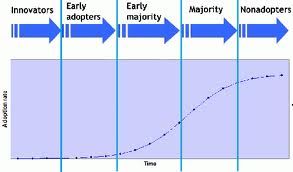
Innovation S Curve

The time it takes to work through the innovation takes time – and that often takes people by surprise.  It is a slow process because it takes time for people to hear about new ideas, it takes time to evaluate them, and it takes time to decide to adopt them.  Once all that happens, it often appears as though successful ideas are overnight successes, but that’s only because they’ve finally hit a tipping point.

How to work through these obstacles

The first issue is that you need to be aware of them.  The idea diffusion s-surve is a research finding that has been consistently supported for 60 years now – it’s is one of the most robust ideas in management research.  Yet it is still often misunderstood – just ask Kodak.

Here are four ideas for addressing this issue:

  • Think about timing.  You have to think about the timing of your idea.  If you are still at an early stage in the diffusion process, all of your attention must go to getting your idea to spread.  The right idea at the wrong time is still wrong.  This means that you need to think about things like your network of supporters, and how to best take advantage of them to spread your idea.
  • Early ideas need little bets, not big ones.  When we face an uncertain future, as we do at the start of the innovation diffusion curve, then we need to try to influence the future through experimenting.  The problem with big bets at this point in time is that they assume that we know how everything needs to work.  When we’re in time X, we don’t know this – we have to discover it.
  • Think about competition. And think about it broadly.  Competition for time, attention and money will all slow the spread of a new idea.  If people aren’t using your idea, what are they using instead?
  • Think about who loses. This is another source of resistance.  The competitors that we just considered are one source.  But also, whose routine does the new idea disrupt? People trying to maintain their current routines are a powerful force preventing the diffusion of new ideas.  You need to overcome this as well.

People often think that having a great idea is the hard part of innovating.  Most of the time, this isn’t the problem.  Getting the new idea to spread is.

If you’re serious about innovating, you will recognize – and work to overcome – the obstacles in front of you.

Read more from Tim here.

Download PDF

Tags: , ,

| What is MyVisionRoom? > | Back to Leadership >

ABOUT THE AUTHOR

Tim Kastelle

Tim Kastelle

Tim Kastelle is a Lecturer in Innovation Management in the University of Queensland Business School. He blogs about innovation at the Innovation Leadership Network.

See more articles by >

COMMENTS

What say you? Leave a comment!

Recent Comments
comment_post_ID); ?> Thank you for this information. I'm going to use this article to improve my work with the Lord.
 
— Abel Singbeh
 
comment_post_ID); ?> Thank you Ed for sharing your insights into the Church Growth Movement. I have my reservations with Church Growth models because it has done more damage than good in the Body of Christ. Over the years, western churches are more focused on results, formulas and processes with little or no emphasis on membership and church discipline. Pastors and vocational leaders are burnt out because they're overworked. I do believe that the Church Growth model is a catalyst to two destructive groups: The New Apostolic Reformation and the Emerging Church. Both groups overlap and have a very loose definition. They're both focus on contemporary worship, expansion of church brand (franchising), and mobilizing volunteering members as 'leaders' to grow their ministry. Little focus on biblical study, apologetics and genuine missional work with no agenda besides preaching of the gospel.
 
— Dave
 
comment_post_ID); ?> Thank you for sharing such a good article. It is a great lesson I learned from this article. I am one of the leaders in Emmanuel united church of Ethiopia (A denomination with more-than 780 local churches through out the country). I am preparing a presentation on succession planning for local church leaders. It will help me for preparation If you send me more resources and recommend me books to read on the topic. I hope we may collaborate in advancing leadership capacity of our church. God Bless You and Your Ministry.
 
— Argaw Alemu
 

Clarity Process

Three effective ways to start moving toward clarity right now.