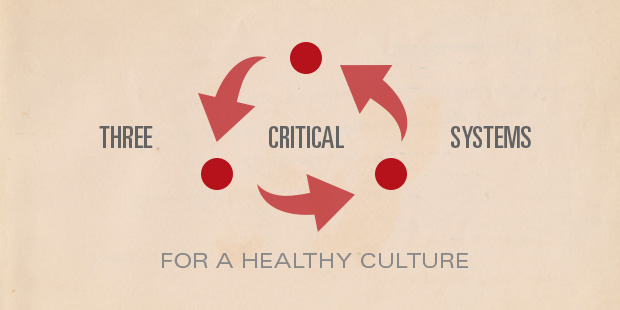
3 Critical Systems for a Healthy Culture

There are many systems in place at churches of every size, location & style; most are borne out of necessity, but some are adopted because they’ve been seen at work in other churches. While the list of church systems could be exhaustive, I’ve come to define them into three distinct but important categories. There are, of course, many, many sub-systems within these broad categories, but I believe each of the three to be vitally important to creating, maintaining and exporting a healthy culture.

The diagram below illustrates the following:

Right Fit + Right Systems = Consistent Results

Right Fit + Wrong Systems = Frustration

Wrong Fit + Right Systems = Inconsistent Results

Wrong Fit + Wrong Systems = Poor Outcomes

Systems Quadrant

I believe that it’s possible to “right fit” every person. As my good friend pastor Brad Stahl (Volunteer pastor at Gateway Church) says, “Everybody’s a ’10′ somewhere!”. The right fit with the right systems is always the goal.

Relational Responsibility System

Once you get past about 50 people that you can know well, it’s hard to keep up with the rest of the people in your sphere of influence. So, in essence, any local church with more than 50 people is, for all intents and purposes, a mega church (which is commonly associated with being “too big” for many). Today, many churches have adopted some form of an electronic database for keeping track of attendees (some still track membership – but if they’re a member, aren’t they attending & serving? Why count membership?). The practicality of an electronic ‘Rolodex’ is helpful, but ultimately insufficient.

The point of keeping up with ‘people information’ is to help facilitate relationships, so any tool that merely acts as a glorified Rolodex is only marginally useful.

Of course many companies have realized this, thus the plethora of church management software offerings for churches of every size. Every one of these software solutions has built their tool from their own bias and understanding of how they would ‘do ministry’. As a result, while many offer similar features, the reality is that the way the software works is ultimately geared towards a way of doing ministry. If you go this route (and I recommend that you do), make sure the software you choose values what you value and functions along how your church does day-to-day ministry. A quick note: there’s not a single platform that’s doing everything really well, so you’re simply choosing the one that fits >80% of your relational responsibility needs.

Stewardship System

Church finances are obviously important, but I’ve come to understand that finances are only one part of being a good steward. As such, I believe that stewardship encompasses a different mindset than is typically found in the conventional church financial office.

Being a steward is defined as a responsibility to take care of something belonging to someone else.

From shepherding people well to wisely managing finances to designating resources effectively, a stewardship system involves a holistic approach. The leader overseeing this system is both generous and wise and manages this system (and sub-systems) through the filter of being a good steward more than ensuring Account Receivable and Accounts Payable are up-to-date. Church leaders are entrusted with much, so much is required. Luke 12:48 says: “From everyone who has been given much, much will be demanded; and from the one who has been entrusted with much, much more will be asked.” The fundamental shift of leading from this paradigm changes things up.

Communications System

It’s interesting to me how much emphasis the vast majority of churches place on having an event, promotion or need shared from the platform on weekends. Announcements have their place, but the truth is that by the time something makes it to the announcements from the senior pastor (which should be very few things indeed), the audience should have had the opportunity to hear about it from at least five other methods. I don’t think enough churches are thinking about their external communications nearly enough. Email (mass group emails as well as demographic-specific campaigns), print, website, social media, word-of-mouth, advertising, groups promotion and the like are all avenues that should be strategically coordinated (editorial calendars, anyone?).

Great communication ensures the right message is getting to the right people in the right way at the right time.

In addition to external communications, churches need to also put the same effort into internal communications. Frankly, in even smaller churches, the proverbial left hand doesn’t often know what the right hand is doing. As a result, people and project details often fall through the cracks.

In both cases, a unified communications system is less about a specific tool(s) and more about defining a healthy way of communicating effectively.

Owning these three systems is critical to churches. Is your church leveraging these three important systems? Share your thoughts in the comments below or reach out to me on Twitter: @anthonycoppedge

Read more from Anthony here.

Download PDF

Tags: , , ,

| What is MyVisionRoom? > | Back to Leadership >

ABOUT THE AUTHOR

Anthony Coppedge

Anthony Coppedge

On the team at Auxano. Lover of Jesus, my wife and my kids. Unapologetic Apple fanboy. Slightly addicted to MindMaps, but in a good way.

See more articles by >

COMMENTS

What say you? Leave a comment!

Recent Comments
comment_post_ID); ?> Thank you for this information. I'm going to use this article to improve my work with the Lord.
 
— Abel Singbeh
 
comment_post_ID); ?> Thank you Ed for sharing your insights into the Church Growth Movement. I have my reservations with Church Growth models because it has done more damage than good in the Body of Christ. Over the years, western churches are more focused on results, formulas and processes with little or no emphasis on membership and church discipline. Pastors and vocational leaders are burnt out because they're overworked. I do believe that the Church Growth model is a catalyst to two destructive groups: The New Apostolic Reformation and the Emerging Church. Both groups overlap and have a very loose definition. They're both focus on contemporary worship, expansion of church brand (franchising), and mobilizing volunteering members as 'leaders' to grow their ministry. Little focus on biblical study, apologetics and genuine missional work with no agenda besides preaching of the gospel.
 
— Dave
 
comment_post_ID); ?> Thank you for sharing such a good article. It is a great lesson I learned from this article. I am one of the leaders in Emmanuel united church of Ethiopia (A denomination with more-than 780 local churches through out the country). I am preparing a presentation on succession planning for local church leaders. It will help me for preparation If you send me more resources and recommend me books to read on the topic. I hope we may collaborate in advancing leadership capacity of our church. God Bless You and Your Ministry.
 
— Argaw Alemu
 

Clarity Process

Three effective ways to start moving toward clarity right now.

Are You Building a Ministry Without God?

I wonder how long I could be successful in ministry without God? I’ve been in vocational ministry for 31 years, and I seldom encounter a situation I haven’t seen before. I have a stockpile of sermons to pull from, and many other places where I can grab a complete sermon with a moments notice. I do strategy, staffing and structure in my sleep. My experience, connections and the internet give me all the tools I need to do ministry, and do it at a very high level. God is good, but often not all that necessary.

How about you? How long could your church function, and function well, without God? You have your sermons planned through Easter, your song lists loaded into Planning Center and your small group resources online. You have well-trained volunteers and the best staff money can buy. Your IT and weekend tech have redundancies built in to handle any contingency. The people who attend your church know that they will have a quality experience every weekend regardless what might happen behind the scenes. Certainly God is welcome at your church, but is he really necessary?

Israel created an elaborate and efficient church that ran very well without God. The priests and Levites excelled at their roles, the sacrificial system was geared to handle the crowds at Passover efficiently, and the Jewish people knew their needs were met with consistency and care. 400 years after God stepped away the Jews no longer missed him. They had created a church without God.

And then one weekend he showed up. He ignored their service run down, he tore up their resource table and he violated their policies and procedures. Every time he came to a service havoc ensued. Finally they had to either completely change the way they did church or kill God. They chose to kill God.

I am all for policies, procedures, strategy, training, planning and technology. If fact, except for policies and procedures, these are the things I love the most. And I am amazed to see how effectively churches use these tools to reach people far from God and lead them into biblical discipleship. What scares me, shakes me to my core, however is how easily we can substitute the tools of worship for genuine worship. How often we find ourselves worshipping the creation rather than the creator. How many weekends we leave church feeling satisfied because the music was good, the sermon was well received and the attendance was up without even considering if God was pleased.

How long has it been since I have been on my face before God, desperate to hear from him, knowing that I am absolutely toast without him? When was the last time I was so hungry to experience the power and presence of God that I could not eat, I could not sleep until I felt the supernatural touch of his Holy Spirit? When was the last time I was so overwhelmed by the responsibility of preaching the Word that I could barely breathe?

It is not all that hard to build a ministry without God. What a terrifying place to be.

Read more from Geoff here.
Download PDF

Tags: , , ,

| What is MyVisionRoom? > | Back to Environments >

ABOUT THE AUTHOR

Geoff Surratt

Geoff Surratt

Geoff lives in Denver, Colorado with his wife Sherry (CEO of MOPS International). Geoff and Sherry have two awesome kids (Mike and Brittainy), a wonderful daughter-in-law (Hilary) and the most beautiful granddaughter on earth (Maggie Claire) Geoff has served on staff at Seacoast Church and Saddleback Church. He is now the Director of Exponential and a freelance Church Catalyst and Encourager.

See more articles by >

COMMENTS

What say you? Leave a comment!

David Good — 09/04/13 9:22 am

Great post Geoff and I couldn't agree more. I just had breakfast last week with a 92 year old man of God who has pastored all his life. He is disturbed by the plight of many of today's churches and how God is missing from much of what is called ministry today. It was great to be reminded by a great pioneer that "it's not by might, nor by power, but by my Spirit, says the Lord." Thanks for sharing your insight.

Recent Comments
comment_post_ID); ?> Thank you for this information. I'm going to use this article to improve my work with the Lord.
 
— Abel Singbeh
 
comment_post_ID); ?> Thank you Ed for sharing your insights into the Church Growth Movement. I have my reservations with Church Growth models because it has done more damage than good in the Body of Christ. Over the years, western churches are more focused on results, formulas and processes with little or no emphasis on membership and church discipline. Pastors and vocational leaders are burnt out because they're overworked. I do believe that the Church Growth model is a catalyst to two destructive groups: The New Apostolic Reformation and the Emerging Church. Both groups overlap and have a very loose definition. They're both focus on contemporary worship, expansion of church brand (franchising), and mobilizing volunteering members as 'leaders' to grow their ministry. Little focus on biblical study, apologetics and genuine missional work with no agenda besides preaching of the gospel.
 
— Dave
 
comment_post_ID); ?> Thank you for sharing such a good article. It is a great lesson I learned from this article. I am one of the leaders in Emmanuel united church of Ethiopia (A denomination with more-than 780 local churches through out the country). I am preparing a presentation on succession planning for local church leaders. It will help me for preparation If you send me more resources and recommend me books to read on the topic. I hope we may collaborate in advancing leadership capacity of our church. God Bless You and Your Ministry.
 
— Argaw Alemu
 

Clarity Process

Three effective ways to start moving toward clarity right now.

How Words Can Help Change Your Church Culture

Words create worlds.  Language shapes us and forms us.

For example:  When I say, “Let’s go to church,” what does that statement reveal about my understanding of the nature of the church?

Sometimes as leaders we are called to help people move from one deeply held perspective to another.  Words help make that shift possible.  Words build a staircase that allow people to move from where they are to where God wants to lead them.

In leading that kind of “perspective shift” at the Church, I recognized that a portion of our staircase was a little shaky.  It needed to be rebuilt.

Let me explain:  in pursuing a God-inspired vision which we call “One Church, Regional Impact” many have asked, and to some degree are still asking, “Why?”  I began to recognize that some did not understand the “Why” behind the “What”.  I realized, because of my work with Auxano, that this was a Values issue.  Words create worlds.  In this case, words articulate the answer to “Why?”

Here’s how we define Values as Missional Motives at the Church:

“In any given day there are a thousand things clamoring for our attention, a multiplicity of motivations that move us.  What we value will either direct us back toward center or divert us from what is truly worthwhile.  Values are the motivational flame of the church.  They are the shared convictions that guide actions and reveal our unique strengths.  These motives answer “Why do we do what we do at our church?”  They are springboards for daily action and filters for decision-making.  They distinguish our philosophy of ministry and shape our culture and ethos.”

the Church Leadership Guide

[Old]  Values

[New] Missional Motives – where everyday life becomes so much more

Growth – We value a lifelong journey with Jesus that results in individual growth and kingdom expansion.

Ordinary+ because ordinary people connected to Jesus share in Christ’s extraordinary mission.

Relational Service – We value people and the opportunities to meet their individual needs as an expression of the Gospel.

Step+ because simple steps guided by Jesus accelerate the impact of new life.

Authenticity – We value genuine relationships and a sincere Christian lifestyle/behavior.

Friendship+ because friendships infused with Jesus expand the reach of true community.

Creativity – We value innovation in ministry.

Generosity+ because generosity empowered by Jesus fuels a contagious, others-centered culture.

Every Person a Missionary – We value the personal privilege given to every Jesus-follower to help others live life with Jesus every day.

Home+ because a home centered on Jesus becomes the epicenter of an active life of faith.


Here are 3 reasons why we are rearticulating our values.

The Motives behind our Motivational shift:

1)  Our values could be any church’s values.

They did not clearly express OUR unique motivation.

>> Ask:  What uniquely motivates your church?


2)  They didn’t help us answer the “Why”.

We were never using our value statements as an answer for people when they asked “Why?”

>> Ask:  As a leader in your local context, what “Why” questions are you answering?


3)  The words that we chose were not catalytic or compelling.

People did not want to speak them out loud.  They did not inspire anyone to participate in creating the culture that those words were trying to shape.

>> Ask:  Are your values serving as a motivational flame for your people?


Read more from Jeff here.

Download PDF

Tags: ,

| What is MyVisionRoom? > | Back to Vision >

ABOUT THE AUTHOR

Jeff Meyer

Jeff Meyer

I am Jeff Meyer, and I start fires. Ever since that basketball game in college when I came off the bench and lit a spark for my team, I have carried the nickname "Fire Meyer." (Until that point in my career my jersey #22 never saw the floor in an actual game. Perhaps the #22 was a symbol of my life calling: 2 Timothy 2:2?) I live to see sparks ignited and connections made. I long to see the church wake up and live. I long to see Jesus-followers display passionate commitment to Jesus. Jesus' invitation to follow Him was an adventure of epic proportions. Can we recapture that today? I long to see communities transformed into healthy places of wholeness. I believe that communities are transformed when Jesus-followers are stoked and respond. Perhaps you've heard it said that the church is the hope of the world. I believe that a responsive Jesus-follower is the hope of the world. "Igniting connections" is my way of setting off some inspirational sparks; sparks that ignite a passionate response to the call of Jesus.

See more articles by >

COMMENTS

What say you? Leave a comment!

Recent Comments
comment_post_ID); ?> Thank you for this information. I'm going to use this article to improve my work with the Lord.
 
— Abel Singbeh
 
comment_post_ID); ?> Thank you Ed for sharing your insights into the Church Growth Movement. I have my reservations with Church Growth models because it has done more damage than good in the Body of Christ. Over the years, western churches are more focused on results, formulas and processes with little or no emphasis on membership and church discipline. Pastors and vocational leaders are burnt out because they're overworked. I do believe that the Church Growth model is a catalyst to two destructive groups: The New Apostolic Reformation and the Emerging Church. Both groups overlap and have a very loose definition. They're both focus on contemporary worship, expansion of church brand (franchising), and mobilizing volunteering members as 'leaders' to grow their ministry. Little focus on biblical study, apologetics and genuine missional work with no agenda besides preaching of the gospel.
 
— Dave
 
comment_post_ID); ?> Thank you for sharing such a good article. It is a great lesson I learned from this article. I am one of the leaders in Emmanuel united church of Ethiopia (A denomination with more-than 780 local churches through out the country). I am preparing a presentation on succession planning for local church leaders. It will help me for preparation If you send me more resources and recommend me books to read on the topic. I hope we may collaborate in advancing leadership capacity of our church. God Bless You and Your Ministry.
 
— Argaw Alemu
 

Clarity Process

Three effective ways to start moving toward clarity right now.

4 Steps to Community Engagement

I’ve said many times before that if the 1950s were to make a comeback, there would be all too many churches who could go on without missing a beat. The good news is that they found a ministry strategy that works. The bad news is that the people they reach are now seventy years old.

Many of these churches have succumbed to this tendency: when something works, people work it. This backfires because the more they “work it,” the more they get trapped in it. Before long, the ministry strategy is sixty years old and the church that once thrived with innovative ways to reach their community has now shriveled to a handful of people that has completely lost touch with the surrounding neighborhood. In their well-intentioned but often insular focus on strategies and programs within their own walls, they have stopped knowing the people around them in their neighborhood.

Those that are leading local church bodies today know that there is more to pastoral care than simply caring for the needs of the local congregation. While that is certainly a part of it, the church also needs to have an effective connection with the community outside the church. There should be a difference in the community because the church exists, and if it left for some reason, there should be a void that’s felt. Unfortunately, that’s not often the case. We become more about church preservation than community transformation.

When we took on the comprehensive study at LifeWay Research known as the Transformational Church Initiative, we surveyed over 7,000 churches and conducted hundreds of on-site interviews with pastors. We wanted to change the scorecard from strictly looking at numbers to one that really asks if churches and people are being changed. We found that the churches that could be known as “transformational” had a number of characteristics in common. One of those traits was that transformational churches engaged their respective communities on mission.

We found that the common thread was that these churches were willing to invest deeper in the mission than other churches. They wanted to move the mission forward. The priorities were engaging the lost, winning the lost, and maturing believers to repeat the process. What does that process look like? Four steps are clear.

The first step to engaging in God’s mission is to define success.

The standard church scorecard of bodies, budgets, and buildings is too weak. High attendance goals must be a secondary measurement. We must look to seeing that number meeting Christ, and advancing the gospel into the lives of unbelievers. Changed lives are the obsession. The goal is to see lives being transformed by the power of Christ.

The second step to engaging God’s mission is to prepare.

Churches that reach their communities will always be training their people, in a wide variety of ways, to reach out to those around them with the gospel. Modeling how to engage people far from God in relationships is a key strategy. Too many churches rely on surface-level orientation when we need training to be on mission.

The third step is providing personal leadership to believers.

The activity of community converged with the value of vibrant leadership provides the right environment to help believers move out into the mission of the church. The most valuable resource for the missional journey is real-life examples and real-time conversations. In order for churches to reach their communities, they must break the clergy caste system and place the mission in the hands of all believers. Believers will respond to the task of being on mission, because God has made us all to be on mission. The clergification of ministry confused this greatly. When we as pastors do for people what God has called them to do, everyone gets hurt and the mission is hindered.

The fourth step for engaging in God’s mission is moving into the community.

Many churches seem to struggle with building a good reputation in their neighborhood. But churches that are transformational are not waiting for the neighbors to come to them. Instead, they go out and meet the neighbors. They have abandoned the “come and see” model for the “go and tell” model.

The “come and see” mentality results in pastors who consider themselves “religious professionals who can put on a show” instead of people transformed and sent on a mission. Instead, pastors and church members should have a desire to engage their neighborhood with great passion, and a vision to change the fabric of the community around them. In Transformational Churches, 53% agree with the statement: “Our church celebrates when members serve the local city or community.” And 44% agree with “People regularly become Christians as a result of our church serving.”

The picture here is of a body of believers that celebrates not just ministry that builds up the local church, but also when the community is blessed and transformed. The opposite effect happens when the vast majority of celebration is over internal ministry engagement. One church feels like a movement into the city. The other feels like an institution seeking self-preservation.

Also, we always want to be intentionally looking for ways to engage their community at large. The mission is “out there” and not “in here.” We must go beyond evangelistic presentations in favor of a missional lifestyle. Training in evangelism is part of preparing for God’s mission, but not living it. Service is a portion of God’s mission, but not all of it. The mission of God should be so apparently active among the people of a church that the city misses them when they are not around.

This is not an abandonment of sharing the gospel in favor of acts of service only. In fact, most members of churches that engage their community are quite comfortable sharing their faith. The mission of God does not progress unless people are talking about God’s mission to save. Transformation of individuals and communities happens at the same pace that the gospel is proclaimed.

Churches that are making a difference engage people in ministry within the church and mission outside the church. The church has made a conscious decision that their existence is directly related to God’s mission of seeing people reconciled to God through Christ. A Cross-centered and resurrection-powered life no longer lives for itself. It dies daily for the kingdom mission.

Read more from Ed here.

Download PDF

Tags: , , ,

| What is MyVisionRoom? > | Back to Vision >

ABOUT THE AUTHOR

Ed Stetzer

Ed Stetzer

Ed Stetzer, Ph.D., holds the Billy Graham Chair of Church, Mission, and Evangelism at Wheaton College and serves as Executive Director of the Billy Graham Center for Evangelism. He has planted, revitalized, and pastored churches, trained pastors and church planters on six continents, holds two masters degrees and two doctorates, and has written dozens of articles and books. Previously, he served as Executive Director of LifeWay Research. Stetzer is a contributing editor for Christianity Today, a columnist for Outreach Magazine, and is frequently cited or interviewed in news outlets such as USAToday and CNN. He serves as interim pastor of Moody Church in Chicago.

See more articles by >

COMMENTS

What say you? Leave a comment!

Recent Comments
comment_post_ID); ?> Thank you for this information. I'm going to use this article to improve my work with the Lord.
 
— Abel Singbeh
 
comment_post_ID); ?> Thank you Ed for sharing your insights into the Church Growth Movement. I have my reservations with Church Growth models because it has done more damage than good in the Body of Christ. Over the years, western churches are more focused on results, formulas and processes with little or no emphasis on membership and church discipline. Pastors and vocational leaders are burnt out because they're overworked. I do believe that the Church Growth model is a catalyst to two destructive groups: The New Apostolic Reformation and the Emerging Church. Both groups overlap and have a very loose definition. They're both focus on contemporary worship, expansion of church brand (franchising), and mobilizing volunteering members as 'leaders' to grow their ministry. Little focus on biblical study, apologetics and genuine missional work with no agenda besides preaching of the gospel.
 
— Dave
 
comment_post_ID); ?> Thank you for sharing such a good article. It is a great lesson I learned from this article. I am one of the leaders in Emmanuel united church of Ethiopia (A denomination with more-than 780 local churches through out the country). I am preparing a presentation on succession planning for local church leaders. It will help me for preparation If you send me more resources and recommend me books to read on the topic. I hope we may collaborate in advancing leadership capacity of our church. God Bless You and Your Ministry.
 
— Argaw Alemu
 

Clarity Process

Three effective ways to start moving toward clarity right now.