Three Trapdoors of Volunteer Dropout

You just had another volunteer quit your team. Ouch. That hurts every time.

Your frustration with your team is mounting. Who will leave next? And what will be the excuse next time?

Before you go blaming their lack of commitment, first, take a step back and evaluate if you’re experiencing any of these three common leadership pitfalls that can lead to volunteer dropout:

Lack of preparation.
You’ve developed the habit of doing things at the last minute or are totally winging it.

Lack of preparation leads to poor performance. Poor performance leads to finger pointing. Finger pointing leads to excuses. Excuses lead to low morale. And low moral leads to a higher dropout rate of volunteers.

Lack of communication.
You’ve developed the habit of assuming people know what’s going on. As a result, people are feeling left out, frustrated and confused.

Lack of communication leads to confusion. Confusion leads to mistakes. Mistakes lead to lower confidence. Lower confidence leads to a higher dropout rate of volunteers.

Lack of systems.
Your team does the same work every week, but you don’t have a written system for how you do it. As a result, things are done at varying levels of excellence (or non-excellence) every time.

Lack of systems leads to inconsistent behaviors. Inconsistent behaviors lead to mediocrity. Mediocrity leads to lower levels of enthusiasm. Lower levels of enthusiasm lead to a higher dropout rate of volunteers.

If you’re willing to put in the time and effort it takes to break the bad habits that lead to these common leadership pitfalls, not only are you likely to see a lower dropout rate of volunteers, you may just find yourself having more volunteers than you know what to do with.

Dig Deeper:
Video: 5 Keys to Promoting Leaders Successfully
Video: 4 Things Robbing Your Time 

>Read more from Mac.


Download PDF

Tags: , ,

| What is MyVisionRoom? > | Back to Leadership >

ABOUT THE AUTHOR

Mac Lake

Mac Lake

Mac is a pioneering influence in the church planting movement. In 1997, he planted Carolina Forest Community Church (Myrtle Beach, South Carolina). In 2004, he began serving as Leadership Development Pastor at Seacoast Church (Charleston, South Carolina) where he served for over six years. In July 2010, Mac Lake joined with West Ridge Church to become the Visionary Architect for the LAUNCH Network. In 2015 Mac begin working with Will Mancini and Auxano to develop the Leadership Pipeline process. He joined Auxano full time in 2018. Mac and his wife, Cindy, live in Charleston, South Carolina and have three children, Brandon, Jordan and Brianna.

See more articles by >

COMMENTS

What say you? Leave a comment!

Recent Comments
comment_post_ID); ?> Thank you for this information. I'm going to use this article to improve my work with the Lord.
 
— Abel Singbeh
 
comment_post_ID); ?> Thank you Ed for sharing your insights into the Church Growth Movement. I have my reservations with Church Growth models because it has done more damage than good in the Body of Christ. Over the years, western churches are more focused on results, formulas and processes with little or no emphasis on membership and church discipline. Pastors and vocational leaders are burnt out because they're overworked. I do believe that the Church Growth model is a catalyst to two destructive groups: The New Apostolic Reformation and the Emerging Church. Both groups overlap and have a very loose definition. They're both focus on contemporary worship, expansion of church brand (franchising), and mobilizing volunteering members as 'leaders' to grow their ministry. Little focus on biblical study, apologetics and genuine missional work with no agenda besides preaching of the gospel.
 
— Dave
 
comment_post_ID); ?> Thank you for sharing such a good article. It is a great lesson I learned from this article. I am one of the leaders in Emmanuel united church of Ethiopia (A denomination with more-than 780 local churches through out the country). I am preparing a presentation on succession planning for local church leaders. It will help me for preparation If you send me more resources and recommend me books to read on the topic. I hope we may collaborate in advancing leadership capacity of our church. God Bless You and Your Ministry.
 
— Argaw Alemu
 

Clarity Process

Three effective ways to start moving toward clarity right now.

When You Need to Rebuild Trust

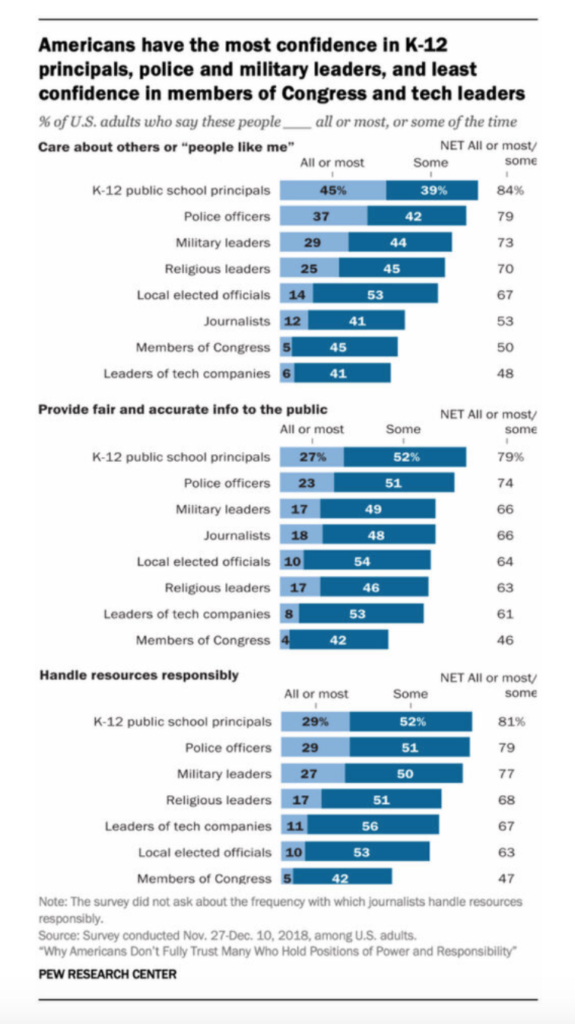
First, the good news: Religious leaders are seen as more caring, more likely to be truthful, and can be relied upon to handle resources more responsibly than members of Congress or leaders of tech companies.

Now for the bad news:

Religious leaders are seen as less caring, less truthful and less likely to handle resources responsibly than K-12 public school principals, police officers, or members of the military. Even more damning is that religious leaders fare their worst when it comes to truth-telling, falling also below journalists and local, elected officials.

Ouch.

Nothing against the members of those professions, but religious leaders should lead the way in those categories due to the nature of their role.

Of course, the larger issue is why this perception exists.

One answer is that there is a built-in mistrust toward anyone in a position of power or responsibility. But why do religious leaders fare worse than others in that position? Of particular concern is when it comes to areas of empathy, openness, integrity and accountability.

Take integrity.

Pew found that 69% of people believe that religious leaders act unethically some, if not all, of the time.

Again, ouch.

Another answer is because of the way media often presents religious leaders. Case in point: Name a positive portrayal. Having a hard time?

Exactly.

But another reason is because the media has covered legitimate stories of religious leaders who are pedophiles, embezzlers, adulterers, spouse abusers and more. A minority, to be sure, but the stain persists.

So while those on the faith side of things can pat themselves on the back that they rank higher than members of Congress or tech leaders,

… there is some serious rebuilding of trust at hand.

> Read more from James Emery White.


Download PDF

Tags: , ,

| What is MyVisionRoom? > | Back to Leadership >

ABOUT THE AUTHOR

James Emery White

James Emery White

James Emery White is the founding and senior pastor of Mecklenburg Community Church in Charlotte, NC, and the ranked adjunctive professor of theology and culture at Gordon-Conwell Theological Seminary, which he also served as their fourth president. He is the founder of Serious Times and this blog was originally posted at his website www.churchandculture.org.

See more articles by >

COMMENTS

What say you? Leave a comment!

Recent Comments
comment_post_ID); ?> Thank you for this information. I'm going to use this article to improve my work with the Lord.
 
— Abel Singbeh
 
comment_post_ID); ?> Thank you Ed for sharing your insights into the Church Growth Movement. I have my reservations with Church Growth models because it has done more damage than good in the Body of Christ. Over the years, western churches are more focused on results, formulas and processes with little or no emphasis on membership and church discipline. Pastors and vocational leaders are burnt out because they're overworked. I do believe that the Church Growth model is a catalyst to two destructive groups: The New Apostolic Reformation and the Emerging Church. Both groups overlap and have a very loose definition. They're both focus on contemporary worship, expansion of church brand (franchising), and mobilizing volunteering members as 'leaders' to grow their ministry. Little focus on biblical study, apologetics and genuine missional work with no agenda besides preaching of the gospel.
 
— Dave
 
comment_post_ID); ?> Thank you for sharing such a good article. It is a great lesson I learned from this article. I am one of the leaders in Emmanuel united church of Ethiopia (A denomination with more-than 780 local churches through out the country). I am preparing a presentation on succession planning for local church leaders. It will help me for preparation If you send me more resources and recommend me books to read on the topic. I hope we may collaborate in advancing leadership capacity of our church. God Bless You and Your Ministry.
 
— Argaw Alemu
 

Clarity Process

Three effective ways to start moving toward clarity right now.

The Hole in Your Weekend Outreach

Our churches did well in reaching the agrarian culture. We gave the farmers time to get the chores done and get to church by 11:00 am. Unfortunately, this culture began to wane around 1860 with the onset of the railroad and industrial age.

Most of our churches have worship services for the farmers who no longer exist.

We haven’t changed a lot in the past 160 years. I guess life moves slowly for a lot of churches.

In the meantime, a dramatic shift is taking place in the American workplace. More people are working on weekends, many of them on Sundays, than ever before. But most churches haven’t moved their worship day at all. It’s still on Sunday mornings.

We keep hoping the farmers will show up.

While I would not advocate abandoning Sunday worship, I wonder why so few churches offer a non-Sunday alternative. There is a huge demographic we are missing: those working on the weekends. Consider these issues:

According to a 2016 time study conducted by the Bureau of Labor Statistics, 34 percent of the workforce works on the weekend. Do the numbers. The U. S. workforce is approximately 160 million. That means over 54 million work on the weekend. Please read the preceding sentence again. 54 million. That’s staggering.

  • If someone works either day, Saturday or Sunday, they are not likely to attend Sunday services. For Saturday workers, Sunday becomes their day off after a tough work schedule.
  • The reasons for not doing weeknight services are rarely theological. If you have a biblical conviction that Sunday should be the only day to have a worship service, stick with your conviction. For the rest of you, please consider this issue prayerfully and carefully.
  • If your church has Sunday-only service or services, you are missing out on reaching one of three working persons. I really don’t think most church leaders realize how huge this number is.
  • Most churches will not do a non-Sunday service because they’ve never done it before. Such is the most common excuse of dying churches.
  • Some church leaders are rightfully concerned about leader exhaustion doing a service on a day other than Sunday. I get that. Such is the reason many leaders must view the non-Sunday service as their time of service. Many will not attend Sunday services at all. And a number of churches moving in this direction are doing so with a minimum of volunteers, such as a guitar-playing worship leader, and childcare only for the youngest kids.
  • A few churches are experimenting with Thursday evening services on long holiday weekends. They are often able to reach the members who will be traveling over the long weekend.
  • The challenges of weekend workers are exacerbated by our members who travel many weekends, by those involved in sports leagues, and by those who just see Sunday as a day off. Some may see offering an alternative service to be a compromise to culture. Others may see it as an opportunity to reach those in culture.
  • The two fastest-growing demographics working on weekends are entrepreneurs and those with more than one job. The rise of the entrepreneurial society and the gig economy virtually guarantees this weekend workforce will increase, probably substantially.

The weekend workforce is not a future trend; it is a staggering present reality.

Some churches will adjust and seek to reach these workers.

Others will continue doing business as usual.

They are likely hoping and praying the farmers will show up on Sunday morning.

> Read more from Thom.


To learn more about this topic, connect with an Auxano Navigator.

Download PDF

Tags: , , ,

| What is MyVisionRoom? > | Back to Leadership >

ABOUT THE AUTHOR

Thom Rainer

Thom Rainer

Thom S. Rainer is the founder and CEO of Church Answers, an online community and resource for church leaders. Prior to founding Church Answers, Rainer served as president and CEO of LifeWay Christian Resources. Before coming to LifeWay, he served at The Southern Baptist Theological Seminary for twelve years where he was the founding dean of the Billy Graham School of Missions and Evangelism. He is a 1977 graduate of the University of Alabama and earned his Master of Divinity and Ph.D. degrees from The Southern Baptist Theological Seminary.

See more articles by >

COMMENTS

What say you? Leave a comment!

Recent Comments
comment_post_ID); ?> Thank you for this information. I'm going to use this article to improve my work with the Lord.
 
— Abel Singbeh
 
comment_post_ID); ?> Thank you Ed for sharing your insights into the Church Growth Movement. I have my reservations with Church Growth models because it has done more damage than good in the Body of Christ. Over the years, western churches are more focused on results, formulas and processes with little or no emphasis on membership and church discipline. Pastors and vocational leaders are burnt out because they're overworked. I do believe that the Church Growth model is a catalyst to two destructive groups: The New Apostolic Reformation and the Emerging Church. Both groups overlap and have a very loose definition. They're both focus on contemporary worship, expansion of church brand (franchising), and mobilizing volunteering members as 'leaders' to grow their ministry. Little focus on biblical study, apologetics and genuine missional work with no agenda besides preaching of the gospel.
 
— Dave
 
comment_post_ID); ?> Thank you for sharing such a good article. It is a great lesson I learned from this article. I am one of the leaders in Emmanuel united church of Ethiopia (A denomination with more-than 780 local churches through out the country). I am preparing a presentation on succession planning for local church leaders. It will help me for preparation If you send me more resources and recommend me books to read on the topic. I hope we may collaborate in advancing leadership capacity of our church. God Bless You and Your Ministry.
 
— Argaw Alemu
 

Clarity Process

Three effective ways to start moving toward clarity right now.