Three Marks of a Consistent Guest Experience

Editors Note: During our August focus on Guest Experiences, we are honored to have some of the best voices in the world of Customer Experience provide guest posts for the Vision Room. As you read the content below, simply think “Guest” in terms of the “customer” the author is talking about – and you will benefit from the knowledge and expertise of some great minds.


There is an old saying in the real-estate industry: The three keys to success are location, location and location. I have a similar take on the customer service and customer service world. The three keys to customer experience success are consistency, consistency and consistency.

Of course, there is much more to delivering an amazing customer experience, but if there is something that is a non-negotiable to creating customer loyalty, it is a consistent and predictable experience – one that customers can count on every time they do business with you. The entire experience must be consistent. You can’t be great one day and just okay the next. The moment there is inconsistency, you start to lose the customer’s confidence, and ultimately you might lose the customer.

So, let’s talk about the different ways an organization delivers a consistent experience.

  1. The quality of the product or service must be consistent. Whatever the company sells must meet the expectations of the customer, every time. It doesn’t matter how good your customer service is, if the product doesn’t do what it’s supposed to do, the customer will find another company that better meets their needs.
  2. The different channels customers interact with you and your organization must be consistent. Today’s customers connect with the companies they do business with in multiple ways. The traditional way a customer communicated with a company was in person or on the phone. Then along came emails, then chat, then chatbots. And, then there are social channels and other messaging apps. This is all part of the digital revolution, and the modern customer expects to have a consistent experience regardless of the channel.
  3. The attitude of the people who work at the company must be consistent. I’m not suggesting that everyone be a clone of each other. It is the positive attitude and the effort the employees make to take care of their customers that must be consistent. It shouldn’t matter if the customer talks to John one day and Jane the next, everyone comes to work with the plan to do their very best, every day. Regardless of who picks up the phone or responds to a message, the customer will always have a good experience.

When customers talk about the consistent company, they will say things like, “They are always so helpful.” Or, something like, “They are always so friendly and knowledgeable.” When they use the word always followed by something positive about the company, you know there is consistency. Delivering a consistent experience creates confidence. Confidence can lead to trust. And, trust leads to potential loyalty.


Shep Hyken is a customer service and experience expert, award-winning keynote speaker, and New York Times bestselling business author. For information, contact 314-692-2200 or www.hyken.comFor information on The Customer Focus™ customer service training programs, go to www.thecustomerfocus.com. Follow on Twitter: @Hyken

Download PDF

Tags: , , ,

| What is MyVisionRoom? > | Back to Execution >

ABOUT THE AUTHOR

Shep Hyken

Shep Hyken

Shep Hyken, CSP, CPAE is a customer service expert, hall-of-fame speaker and New York Times and Wall Street Journal bestselling author. He works with organizations to build loyal relationships with their customers and employees. He is also the creator of The Customer Focus, a customer service training program that helps organizations develop a customer service culture and loyalty mindset. For more information contact (314) 692-2200 or www.Hyken.com.

See more articles by >

COMMENTS

What say you? Leave a comment!

Recent Comments
comment_post_ID); ?> Thank you for this information. I'm going to use this article to improve my work with the Lord.
 
— Abel Singbeh
 
comment_post_ID); ?> Thank you Ed for sharing your insights into the Church Growth Movement. I have my reservations with Church Growth models because it has done more damage than good in the Body of Christ. Over the years, western churches are more focused on results, formulas and processes with little or no emphasis on membership and church discipline. Pastors and vocational leaders are burnt out because they're overworked. I do believe that the Church Growth model is a catalyst to two destructive groups: The New Apostolic Reformation and the Emerging Church. Both groups overlap and have a very loose definition. They're both focus on contemporary worship, expansion of church brand (franchising), and mobilizing volunteering members as 'leaders' to grow their ministry. Little focus on biblical study, apologetics and genuine missional work with no agenda besides preaching of the gospel.
 
— Dave
 
comment_post_ID); ?> Thank you for sharing such a good article. It is a great lesson I learned from this article. I am one of the leaders in Emmanuel united church of Ethiopia (A denomination with more-than 780 local churches through out the country). I am preparing a presentation on succession planning for local church leaders. It will help me for preparation If you send me more resources and recommend me books to read on the topic. I hope we may collaborate in advancing leadership capacity of our church. God Bless You and Your Ministry.
 
— Argaw Alemu
 

Clarity Process

Three effective ways to start moving toward clarity right now.

The Exceptional Guest Experience, Part 1: PLACE

At Auxano, we’ve walked with more than 500 churches through a process called the Guest Perspective Evaluation. And when they’re done, they all ask, “What’s next?”

Amazingly, most church leaders don’t actually have a plan they can use to improve their Guest Experience!

Ask them about their strategy and you’ll discover it boils down to this:

We’ll be friendlier.

It’s understandable. Church leaders are too busy on the weekend to actually understand what Guests see – and experience – to really know how to make things better. After all, your church is “friendly,” right? And that is all you need to have a good Guest Experience.

But why settle for good?

An exceptional Guest Experience ministry doesn’t have to be complicated. We recommend you execute on just three things:

  1. Place
  2. Process
  3. People

Focusing on these three things will allow you to welcome first time Guests, welcome back returning Guests, and create a culture of hospitality within your church that extends your ministry beyond your walls.

The catch?

Each of these three elements shares one requirement: paying attention to details.

It’s impossible to have an exceptional Guest Experience unless you pay attention to details.

This is such an important principle that we are devoting two issues of SUMS Remix to this concept. What is SUMS Remix? It’s one of the other great parts of my job: a “book summary” published every two weeks, with each issue listing excerpts from three books addressing a challenging problem leaders face.

For the first issue, we will look at the three components of an EXCEPTIONAL Guest Experience, with lessons from the world leader in Guest Experience – the Disney organization. The second issue will highlight lessons from another area of hospitality – the pro chef’s kitchen – on how churches can provide an EXCEPTIONAL Guest Experience.

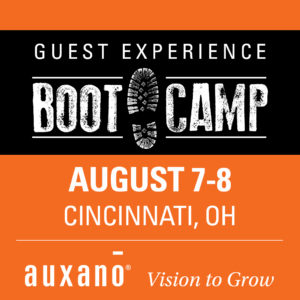
Want to learn how to create an EXCEPTIONAL Guest Experience at your church? Check out Auxano’s Guest Experience Boot Camp, coming to Cincinnati, OH August 7-8.

The PLACE where you welcome Guests

THE QUICK SUMMARYOne Little Spark, by Marty Sklar

We’ve all read about the experts: the artists, the scientists, the engineers-that special group of people known as Imagineers for The Walt Disney Company. But who are they? How did they join the team? What is it like to spend a day in their shoes?

Disney Legend Marty Sklar wants to give back to fans and answer these burning questions. When Marty was president of Walt Disney Imagineering, he created a list of principles and ideals for the team, aptly named Mickey’s Ten Commandments. Using this code of standards as his organizational flow, Marty provides readers with insights and advice from himself and dozens of hands-on Imagineers from around the globe. It’s a true insider’s look like no other!

Note: This issue of SUMS Remix was already in production when I learned of the passing of Marty Sklar on Thursday, 7/27/17. Read more about Marty here.

A SIMPLE SOLUTION

Walt Disney had long dreamed of a place where people could be immersed in the stories and films his studio was producing. He began planning that place – which would become known as Disneyland – in the 1940s.

Even a genius like Walt Disney knew he could not create such a place by himself. In 1952, he began to assemble a team to help realize his dream. Beginning with some of his most trusted animators and art directors, they approached the creation of Disneyland in the same way as they would in an art project.

Since the people who designed and built Disneyland came from the animation side of the business, they treated its settings as integral and important parts of the park from the very first. Disneyland was going to be a living movie that its guests would experience by moving through it. And, as in animated films, to make that vision come to life, the audience had to have the opportunity to become totally immersed in the experience.

How does “Place” deliver an exceptional experience? The better question is, how does it not?

Walt Disney realized that a visit to an amusement park could be like a theatrical experience – in a word, a show. Walt saw that the Guests’ sense of progressing through a narrative, of living out a story told visually, could link together the great variety of attractions he envisioned for his new kind of park. While traveling through their stories, Guests would encounter, and even interact with, their favorite Disney characters, and who would be transformed, as if by magic, from their two-dimensional film existence into this special three-dimensional story world.

Marty Sklar, who retired from the Disney organization in 2009, led the planning and creative development of nine Disney parks around the world. Part of the Disney team since 1955, Sklar has a unique perspective on the ideation and creation of the magic of place, and the importance of attention to details all along the journey.

For me, these principles have formed the standard the Imagineers have used to create the Disney park experiences around the world. When we followed them closely, we created magic.

Know your audience – Identify the prime audience for your attraction or show before you begin design

Wear your Guests’ shoes – Insist that your team members experience your creation just the way Guests do

Organize the flow of people and ideas – Make sure there is a logic and sequence in our stories and the way Guests experience them

Create a wienie (visual magnet) – Create visual “targets” that will lead Guests clearly and logically through your facility

Communicate with visual literacy – Make good use of color, shape form, texture – all the nonverbal ways of communication

Avoid overload – create turn-ons – Resist the temptation to overload your audience with too much information and too many objects

Tell one story at a time – Stick to the story line; good stories are clear, logical, and consistent

Avoid contradictions – maintain identity – Details in design or content that contradict one another confuse an audience about your story or the time period it takes place in

For every once of treatment, provide a ton of treat – Walt Disney said you can educate people, but don’t tell them you’re doing it. Make it fun!

Keep it up! (Maintain it) – In a Disney park or resort, everything must work. Poor maintenance is poor show!

Marty Sklar, One Little Spark


A NEXT STEP

As designers, the Imagineers create spaces – guided experiences that take place in carefully structured environments, allowing the Guests to see, hear, smell, touch, and taste in new ways. In effect, Imagineers transform a space into a story place.

Ultimately, the Imagineers gave Guests a place to play, something Walt believed that adults needed as much as children. The design of the Imagineers gives power to the Guests’ imagination, to transcend their everyday routine. Walt Disney insisted that Guests should “feel better because of” their experiences in Disney theme parks, thus establishing the art of the show.

For the Imagineers, that meant considering everything within and relating to the parks as design elements. To build effective story environments and assure Guest comfort, the designers realized that they always had to assume the Guests’ position and point of view, and just as Walt did, to take the Guests’ interests to heart and defend them when others didn’t think it mattered.

It is up to the designers to provide Guests with the appropriate sensory information that makes each story environment convincing. This means that design considerations go beyond the attractions themselves to the service and operations staff, transportation, restaurants, shops, rest rooms – even the trash cans.

Initially, the Imagineers used the knowledge gained from their experience in films, but they soon found that their Guests themselves would teach them what they most needed to know about theme park design and operation.

When designers see Guests in their natural states of behavior, they gain a better understanding of the space and time Guests need in a story environment.

Using “Mickey’s Ten Commandments” list above as a guide, work with your team to evaluate your current “Place.”

Write the Ten Commandments phrases down the left side of a chart tablet. Next, draw two columns on the remaining space. Label the first column with a “+” and the second column with a “-“.

Using each of the Ten Commandment phrases, walk through your current environments, listing the ones that are working in the “+” column and the ones that are not working in the “-“ column.

After finishing your work, create an action plan to improve the environments in the “-“ column. Be sure to include a timeline and leader responsible for the work.


Are you expecting Guests this weekend? Beyond a simple “yes” or “no,” the extent to which you answer this question will go a long way in determining if your first-time Guests become second-time guests.

It’s all in the details.

Excerpt taken from SUMS Remix 72-1, issued August 2017.


This is part of a weekly series posting excerpts from one of the most innovative content sources in the church world: SUMS Remix Book Summaries for church leaders.

SUMS Remix takes a practical problem in the church and looks at it with three solutions; each solution is taken from a different book. Additionally, a practical action step is included with each solution.

As a church leader you get to scan relevant books based on practical tools and solutions to real ministry problems, not just by the cover of the book. Each post will have the edition number which shows the year and what number it is in the overall sequence. (SUMS Remix provides 26 issues per year, delivered every other week to your inbox). 

>> Subscribe to SUMS Remix <<


Download PDF

Tags: , , , , ,

| What is MyVisionRoom? > | Back to Execution >

ABOUT THE AUTHOR

VRcurator

VRcurator

Bob Adams is Auxano's Vision Room Curator. His background includes over 23 years as an associate/executive pastor as well as 8 years as the Lead Consultant for a church design build company. He joined Auxano in 2012.

See more articles by >

COMMENTS

What say you? Leave a comment!

Recent Comments
comment_post_ID); ?> Thank you for this information. I'm going to use this article to improve my work with the Lord.
 
— Abel Singbeh
 
comment_post_ID); ?> Thank you Ed for sharing your insights into the Church Growth Movement. I have my reservations with Church Growth models because it has done more damage than good in the Body of Christ. Over the years, western churches are more focused on results, formulas and processes with little or no emphasis on membership and church discipline. Pastors and vocational leaders are burnt out because they're overworked. I do believe that the Church Growth model is a catalyst to two destructive groups: The New Apostolic Reformation and the Emerging Church. Both groups overlap and have a very loose definition. They're both focus on contemporary worship, expansion of church brand (franchising), and mobilizing volunteering members as 'leaders' to grow their ministry. Little focus on biblical study, apologetics and genuine missional work with no agenda besides preaching of the gospel.
 
— Dave
 
comment_post_ID); ?> Thank you for sharing such a good article. It is a great lesson I learned from this article. I am one of the leaders in Emmanuel united church of Ethiopia (A denomination with more-than 780 local churches through out the country). I am preparing a presentation on succession planning for local church leaders. It will help me for preparation If you send me more resources and recommend me books to read on the topic. I hope we may collaborate in advancing leadership capacity of our church. God Bless You and Your Ministry.
 
— Argaw Alemu
 

Clarity Process

Three effective ways to start moving toward clarity right now.

Better Than Gold: The Value of the Platinum Rule

Editors Note: During our August focus on Guest Experiences, we are honored to have some of the best voices in the world of Customer Experience provide guest posts for the Vision Room. As you read the content below, simply think “Guest” in terms of the “customer” the author is talking about – and you will benefit from the knowledge and expertise of some great minds.


Here’s another age-old debate… gold or platinum?

Personally, I prefer platinum.

Oh wait. What are we talking about? LOL.

Rules. I’m talking about rules.

I still prefer platinum!

On the heels of my recent post about imagining that you’re a human… I thought I’d take a look at which one, the Golden Rule or  the Platinum Rule, puts us into more-human and more-empathetic shoes.

You’re probably well aware of both rules I’m referring to. The Golden Rule states that you should treat others the way that you would want to be treated, while the Platinum Rule shifts the focus a bit and says that you should treat others the way that they want to be treated.

I’m positive the Platinum Rule was created by a customer experience professional! While the Golden Rule ignores the feelings of others and assumes that we all want to be treated the same way, the Platinum Rule recognizes that we don’t, that we want to be treated the way we want to be treated. It acknowledges that we all have different needs and want to be respected as individuals. It’s quite the improvement to the Golden Rule. It’s much more empathetic.

The Platinum Rule speaks to customer experience professionals. We are constantly preaching that companies need to be more empathetic and do a better job of understanding customers wants, needs, pain points, problems to solve, jobs to be done, and more… so that they can design the products and the experiences that customers want – or that solve customers problems and painpoints.

Put differently, I think the Golden Rule perpetuates inside-out thinking, while the Platinum Rule inspires outside-in thinking.

What’s the best way to perpetuate the Platinum Rule? Three ways that I write and talk about all the time are:

  1. Listen. Don’t just ask customers about the experience, listen, as well. There are a lot of different channels and ways for customers to tell you about their needs and desired outcomes and how well you are performing against their expectations. Understanding these expectations and identifying key drivers of a great customer experience are important outcomes of this exercise.
  2. Characterize. Research your customers. Identify the jobs they are trying to do. Compile key personas that represent the various types of prospects and customers that (might) buy from you or that use your products or services.
  3. Empathize. Walk in your customers’ shoes to get a clear understanding of the steps they take to do whatever job it is they are trying to do with your organization.  Map their journeys to understand the current state of the experience.

These are all critical learning exercises. We walk away from each one with a lot of knowledge about customers wants, needs, problems to solve, etc. Use that information to live the Platinum Rule with your customers.

If you still think the Golden Rule is the better rule, consider this golden rule: He who has the gold makes the rules. Your customers hold the gold, and they will spend it elsewhere if you don’t take the time to get to know them.

I’ve said it before: maybe it goes beyond those rules to just simply doing what’s right. But does that mean we need to rely on common sense? And how common is common sense? Maybe that’s the problem.

> Read more from Annette.


Learn more about the power of the Platinum Rule in your church’s first impression – connect with Guest Experience Navigator Bob Adams.

Download PDF

Tags: , , , ,

| What is MyVisionRoom? > | Back to Execution >

ABOUT THE AUTHOR

Annette Franz

Annette Franz

Annette Franz is an internationally recognized customer experience thought leader, coach, consultant, and speaker. She’s on the verge of publishing her first book about putting the “customer” into customer experience. Stay tuned for that! Annette is active in the Customer Experience Professionals Association (CXPA), as: an Executive Officer on the Board of Directors, a CX Expert, and a CX Mentor. And she is a Certified Customer Experience Professional (CCXP). She is also an official member of the Forbes Coaches Council, an invitation-only community for successful business and career coaches. Members are selected based on their depth and diversity of experience.

See more articles by >

COMMENTS

What say you? Leave a comment!

Recent Comments
comment_post_ID); ?> Thank you for this information. I'm going to use this article to improve my work with the Lord.
 
— Abel Singbeh
 
comment_post_ID); ?> Thank you Ed for sharing your insights into the Church Growth Movement. I have my reservations with Church Growth models because it has done more damage than good in the Body of Christ. Over the years, western churches are more focused on results, formulas and processes with little or no emphasis on membership and church discipline. Pastors and vocational leaders are burnt out because they're overworked. I do believe that the Church Growth model is a catalyst to two destructive groups: The New Apostolic Reformation and the Emerging Church. Both groups overlap and have a very loose definition. They're both focus on contemporary worship, expansion of church brand (franchising), and mobilizing volunteering members as 'leaders' to grow their ministry. Little focus on biblical study, apologetics and genuine missional work with no agenda besides preaching of the gospel.
 
— Dave
 
comment_post_ID); ?> Thank you for sharing such a good article. It is a great lesson I learned from this article. I am one of the leaders in Emmanuel united church of Ethiopia (A denomination with more-than 780 local churches through out the country). I am preparing a presentation on succession planning for local church leaders. It will help me for preparation If you send me more resources and recommend me books to read on the topic. I hope we may collaborate in advancing leadership capacity of our church. God Bless You and Your Ministry.
 
— Argaw Alemu
 

Clarity Process

Three effective ways to start moving toward clarity right now.