Snuffing Burnout: Rick Warren’s Advice on How to Discover a Healthy Working Rhythm and Energize Your Team

The quickest way to destroy a team is to burn them out. And you don’t have to look around the field of ministry very long to realize that the ministry is filled with burned out leaders. But it’s possible to find a healthy working rhythm and ultimately increase the effective energy with which your leaders serve without causing them to burnout.

Every minute of every day we are using up energy, and every person has a limited amount of energy. If we keep the pace high all the time, we use up the energy people have to give like the way a car with its lights left on will wind up with a dead battery.

This is especially true in times when your ministry is growing. Growth brings change, change brings problems, and problems consume a lot of emotional, physical, and spiritual energy from your leaders.

Here are seven ways to discover a good working rhythm and raise the energy level of your team.

1. Don’t expect every leader to work at the same energy level all the time.

We are all unique, and every leader serving in your ministry is wired differently. Some need more quiet and rest than others. Some work better in organized chaos while some need no chaos at all. At Saddleback, we try to hire workaholics and then force them to calm down and find a rhythm.

2. Be sensitive to external drains on energy and compensate appropriately.

Sometimes leaders have big issues and seasons of transition in their personal lives that affect the amount of energy they’re able to pour out. From health crises to marital crises to pregnancy and new babies, leaders often need time to concentrate on specific family issues.

3. Plan your year in energy cycles.

At Saddleback, we typically move through two major growth campaigns in a year. In the spring and in the fall, we set aside around eight weeks per year when we really focus on adding more small groups and really pushing people to invite their unchurched friends to some big days. Easter, Mother’s Day, and Christmas are all big days for us, as well as special events that surround some of the global issues we’re addressing.

Between campaigns and holidays, we regroup. Most years, we close our offices between Christmas and New Year. Newspring Church and Northpoint Church usually cancel their post-Christmas Sunday services to give their thousands of volunteers a breather. It’s okay that some weekends are intentionally designed to consume less energy than others.

4. Allow staff members to have flexible schedules.

We don’t watch the clock. We watch results. When staff members travel for church-related events, we want them to take a day of rest afterward. When they have evening meetings, we want them to come in later the next day. My mentor, Peter Drucker, said, “Empasize results, not activity.” Some of our Pastors work four or more services per weekend, so we want them to have a day off during the week.

5. Work smarter, not harder.

Ecclesiastes 10:10 says, “If the ax is dull, and one does not sharpen its edge, then one must exert more strength; however, the advantage of wisdom is that it brings success.” (HCSB) There are tools, techniques, and new technologies that streamline the way we do ministry. Use them. And learn from mistakes and failures to avoid wasting energy on what doesn’t work.

6. Focus on the long haul.

James Collins wrote a famous leadership book called Built to Last. Of the 12 values he articulated he found in companies that survived through three generations, ten are found in Saddleback’s original vision statement which we have had since our first year of ministry. Your church can be a mushroom, which springs up overnight, or it can be an oak tree that grows larger and stronger over time with deep roots.

7. Make the work fun!

People rarely succeed at jobs they don’t enjoy, which explains the success of companies like Google, known for their fun and creative atmospheres. The most successful people get paid to do what they like to do anyway! Saddleback Church receives thousands of phone calls every day and hundreds of thousands of emails every year, and we try to give everyone an appropriate response if at all possible. So, we keep things light.

Over the years, we’ve done Taco Tuesdays as a staff. We’ve hiked around our property during a staff meeting. Once we closed the office and we all went surfing even though none of us knew how. We’ve purposely dressed tacky on the same day. We often send the staff home after a staff meeting just for the fun of it, and I’ve been known to start a food fight or two over the years.

The kingdom of God is going to last, and your church needs to be built to last, which requires a healthy rhythm of hard work, proper rest, and a good energy consumption pattern for all the leaders involved.

This is a busy time of the year for your church; ask yourself how you can lead your team to find rest and cultivate joy so that you can head into this year of ministry stronger than ever.

Read more from Rick here.

Download PDF

Tags: , , ,

| What is MyVisionRoom? > | Back to Leadership >

ABOUT THE AUTHOR

Rick Warren

Rick Warren

Rick Warren is the founding pastor of Saddleback Church in Lake Forest, Calif., one of America's largest and most influential churches. Rick is author of the New York Times bestseller The Purpose Driven Life. His book, The Purpose Driven Church, was named one of the 100 Christian books that changed the 20th century. He is also founder of Pastors.com, a global Internet community for pastors.

See more articles by >

COMMENTS

What say you? Leave a comment!

Recent Comments
comment_post_ID); ?> Thank you for this information. I'm going to use this article to improve my work with the Lord.
 
— Abel Singbeh
 
comment_post_ID); ?> Thank you Ed for sharing your insights into the Church Growth Movement. I have my reservations with Church Growth models because it has done more damage than good in the Body of Christ. Over the years, western churches are more focused on results, formulas and processes with little or no emphasis on membership and church discipline. Pastors and vocational leaders are burnt out because they're overworked. I do believe that the Church Growth model is a catalyst to two destructive groups: The New Apostolic Reformation and the Emerging Church. Both groups overlap and have a very loose definition. They're both focus on contemporary worship, expansion of church brand (franchising), and mobilizing volunteering members as 'leaders' to grow their ministry. Little focus on biblical study, apologetics and genuine missional work with no agenda besides preaching of the gospel.
 
— Dave
 
comment_post_ID); ?> Thank you for sharing such a good article. It is a great lesson I learned from this article. I am one of the leaders in Emmanuel united church of Ethiopia (A denomination with more-than 780 local churches through out the country). I am preparing a presentation on succession planning for local church leaders. It will help me for preparation If you send me more resources and recommend me books to read on the topic. I hope we may collaborate in advancing leadership capacity of our church. God Bless You and Your Ministry.
 
— Argaw Alemu
 

Clarity Process

Three effective ways to start moving toward clarity right now.

6 Steps to Identify and Engage Your High Potential Ministry Leaders

The engine for your vision is your leadership. Period. Neglect it and you neglect your vision; lead others well and everything else will take care of itself.   – Will Mancini

Your ministry team members aren’t another resource — they are unique and talented individuals entitled to respect and the pursuit of purpose in their lives. They belong to your organization in order to perform meaningful work in a community with others of like mind to achieve their own goals and to make a difference in the world or in other peoples’ lives. And they like to feel good about and enjoy the time they spend working in those organizations.

If we truly want to bring out the best in the ministry leaders working with us and for us, we must pay attention to them, their efforts, and the results of their labor.

Michelle Smith, VP of Business Development at OC Tanner, offers six tips leaders can use to identify, re-engage, and more effectively manage high-potential team members:

1. Stimulate. Emerging leaders need stimulating work, recognition, and the chance to grow. If not, they can quickly become disengaged.

2. Test.  Explicitly test candidates for ability, engagement, and aspiration to make sure they’re able to handle the tougher roles as they develop.

3. Manage. Having organizational department leaders oversee high-potential team members only limits their access to opportunities and encourages hoarding of talent. Instead, manage these high-potential team members at a higher level.

4. Challenge. High-potential team members need to be in positions where new capabilities can—or must—be acquired.

5. Recognize. High-potential team members will be more engaged if they are recognized frequently, so offer them appropriate recognition.

6. Engage. Incorporate high-potential team members into strategic planning. Share future strategies with them and emphasize their role in making them come to fruition.

The bottom line is, don’t take your team members for granted. While engagement may be hard to sustain, it’s infinitely easier when you nurture, recognize, stretch, and develop your team.


Download PDF

Tags: , ,

| What is MyVisionRoom? > | Back to Leadership >

ABOUT THE AUTHOR

VRcurator

VRcurator

Bob Adams is Auxano's Vision Room Curator. His background includes over 23 years as an associate/executive pastor as well as 8 years as the Lead Consultant for a church design build company. He joined Auxano in 2012.

See more articles by >

COMMENTS

What say you? Leave a comment!

Recent Comments
comment_post_ID); ?> Thank you for this information. I'm going to use this article to improve my work with the Lord.
 
— Abel Singbeh
 
comment_post_ID); ?> Thank you Ed for sharing your insights into the Church Growth Movement. I have my reservations with Church Growth models because it has done more damage than good in the Body of Christ. Over the years, western churches are more focused on results, formulas and processes with little or no emphasis on membership and church discipline. Pastors and vocational leaders are burnt out because they're overworked. I do believe that the Church Growth model is a catalyst to two destructive groups: The New Apostolic Reformation and the Emerging Church. Both groups overlap and have a very loose definition. They're both focus on contemporary worship, expansion of church brand (franchising), and mobilizing volunteering members as 'leaders' to grow their ministry. Little focus on biblical study, apologetics and genuine missional work with no agenda besides preaching of the gospel.
 
— Dave
 
comment_post_ID); ?> Thank you for sharing such a good article. It is a great lesson I learned from this article. I am one of the leaders in Emmanuel united church of Ethiopia (A denomination with more-than 780 local churches through out the country). I am preparing a presentation on succession planning for local church leaders. It will help me for preparation If you send me more resources and recommend me books to read on the topic. I hope we may collaborate in advancing leadership capacity of our church. God Bless You and Your Ministry.
 
— Argaw Alemu
 

Clarity Process

Three effective ways to start moving toward clarity right now.

How to Systematically Improve Your Church’s Ministry to Volunteers

Leading volunteers is challenging. It can even seem impossible at times. And the truth is, if you’re trying to do it without a system, it will always seem impossible. The good news is that it’s possible to improve your ministry to volunteers without having to give up another night away from your family.

Here are four steps you can take to systematically improve your church’s ministry to volunteers in a way that increases engagement and multiplies the number of people willing to serve:

1.     Understand Your Existing Volunteer System

There are no universal solutions; there are only universal principles. Your system will be unique to your church because your church has different needs and resources. The first step in defining the system is determining your congregation’s status in how well you’re engaging volunteers. Once you have determined some of the needs present within your congregation, brainstorm a list of people who might be able to address them.

2. Outline Your Volunteer Engagement Strategy

After you have defined your church’s existing volunteer system, you’ll need to determine a plan for implementation and execution. Whether your church is large or small, finding a systematic way for implementing a strategy to enhance volunteer engagement will ensure your volunteers are serving in their areas of giftedness, receiving all they need to be growing, involved disciples of Jesus Christ.

3. Manage Through Online Tools

Many churches seek to implement processes without electronic tools because they fear technology will strip the heart out of the ministry. On the contrary, technology manages information and details to free you up for deeper relationships. It can help you track the status and involvement of every individual in your church. You can quickly identify those who are not serving, those who are serving in multiple positions, and those who are involved in leadership training. Online tools also allow you to communicate with individual volunteers or sub-groups. This becomes more and more important as your church grows.

4. Measure for Effectiveness

Though many people hyper-focus on data analysis, data truly is helpful in determining the effectiveness of every area of ministry, especially the development of volunteers. As attendance increases, the expectation is more people will become part of the volunteer pipeline. After implementing your new volunteer system, your church will begin to reap the benefits of a healthy culture of volunteers. Once this process is set in motion, however, you will need to consider ways to keep it in motion.

It’s time to take the guessing game out of improving the way our churches recruit, engage, and disciple volunteers. If you want to dive a little deeper into creating a systematic approach for your church’s volunteer plan and learn how to keep volunteers engaged, you can download our free eBook, “The Challenge of Leading Volunteers.”

Read more from CCB here.

Download PDF

Tags: , ,

| What is MyVisionRoom? > | Back to Environments >

ABOUT THE AUTHOR

Steve Caton

Steve Caton

Steve Caton is part of the Leadership Team at Church Community Builder. He leverages a unique background in technology, fundraising and church leadership to help local churches decentralize their processes and equip their people to be disciple makers. Steve is a contributing author on a number of websites, including the Vision Room, ChurchTech Today, Innovate for Jesus and the popular Church Community Builder Blog. He also co-wrote the eBook “Getting Disciple Making Right”. While technology is what Steve does on a daily basis, impacting and influencing the local church is what really matters to him……as well as enjoying deep Colorado powder with his wife and two sons!

See more articles by >

COMMENTS

What say you? Leave a comment!

Recent Comments
comment_post_ID); ?> Thank you for this information. I'm going to use this article to improve my work with the Lord.
 
— Abel Singbeh
 
comment_post_ID); ?> Thank you Ed for sharing your insights into the Church Growth Movement. I have my reservations with Church Growth models because it has done more damage than good in the Body of Christ. Over the years, western churches are more focused on results, formulas and processes with little or no emphasis on membership and church discipline. Pastors and vocational leaders are burnt out because they're overworked. I do believe that the Church Growth model is a catalyst to two destructive groups: The New Apostolic Reformation and the Emerging Church. Both groups overlap and have a very loose definition. They're both focus on contemporary worship, expansion of church brand (franchising), and mobilizing volunteering members as 'leaders' to grow their ministry. Little focus on biblical study, apologetics and genuine missional work with no agenda besides preaching of the gospel.
 
— Dave
 
comment_post_ID); ?> Thank you for sharing such a good article. It is a great lesson I learned from this article. I am one of the leaders in Emmanuel united church of Ethiopia (A denomination with more-than 780 local churches through out the country). I am preparing a presentation on succession planning for local church leaders. It will help me for preparation If you send me more resources and recommend me books to read on the topic. I hope we may collaborate in advancing leadership capacity of our church. God Bless You and Your Ministry.
 
— Argaw Alemu
 

Clarity Process

Three effective ways to start moving toward clarity right now.

Appreciating Volunteers – 33 Actionable Ideas

Volunteers are the life blood of your church. In fact … your church literally wouldn’t exist without them! Often it’s small actions that show your true feelings about your volunteer teams. Why not pick a few of these things off this list and try them this weekend at your church? The first step towards building healthy volunteer teams is making sure that your existing team members feel appreciated!

  1. At the beginning of every “shift” make sure team leaders cast vision for “why” their service is critical to the vision of the church.
  2. Visit every service area that you are “responsible” for this Sunday and say “thank you.”
  3. Send birthday cards.
  4. Every time a volunteer serves send a “what to expect” email three or four days before.
  5. Assign some people to spend time with new volunteers on the first weekend they serve with you.
  6. Take time out during the message to brag about how amazing your volunteers are.
  7. Get to know what’s happening in your volunteers personal lives.
  8. Make sure there is a enough work for volunteers to do when they arrive … don’t waste their time!
  9. Food … always have a meal available before or after they serve.
  10. Make it easy for your team leaders to send regular thank you notes to their team members.
  11. At the end of every “shift” take time to hear what the volunteers think could be improved on for the future.
  12. Open up leadership development opportunities for volunteers to advance in the church.
  13. Don’t impose new policy’s and procedures without at least talking them through with your team.
  14. Throw parties regularly.
  15. Write letters of reference for students volunteering with you.
  16. Read “impact emails” that you get about how great your church is to your team.
  17. Easy off ramps … don’t lock your team into perpetual service!
  18. Send out a press release to your community paper celebrating your team when they do something “above and beyond”.
  19. Make sure your volunteers are “first to know” about exciting things happening in the future of your church.
  20. Give them a team t-shirt
  21. Make sure everyone has a name tag on.
  22. Use quotes from your team members in your “annual report” … or other donor targeted communications.
  23. Calculate how many hours your volunteers have served in that last year and celebrate that!
  24. Reinforce regularly with paid staff that our #1 role is to support our volunteers.
  25. Take pictures of your volunteers serving and post them on various Social Media channels.
  26. Make sure your volunteers have the best equipment you can afford for them to work with.
  27. Create easy channels for your volunteers to communicate with the church leadership.
  28. Insist that the church reimburse them for out-of-pocket expenses.
  29. Send ‘em a hand signed Christmas card.
  30. Have good coffee and a few snacks available when they arrive.
  31. Allow some volunteers to gain more influence & take on more responsibility.
  32. Take at least one volunteer a week out every week to thank them and get to know them better.
  33. Buy 10 books that have impacted you and give them to 10 volunteers who have gone “above and beyond” recently.

Read more from Rich here.

Download PDF

Tags: , , ,

| What is MyVisionRoom? > | Back to Environments >

ABOUT THE AUTHOR

Rich Birch

Rich Birch

Thanks so much for dropping by unseminary … I hope that your able to find some resources that help you lead your church better in the coming days! I’ve been involved in church leadership for over 15 years. Early on I had the privilege of leading in one of the very first multisite churches in North Amerca. I led the charge in helping The Meeting House in Toronto to become the leading multi-site church in Canada with over 4,000 people in 6 locations. (Today they are 13 locations with somewhere over 5,000 people attending.) In addition, I served on the leadership team of Connexus Community Church in Ontario, a North Point Community Church Strategic Partner. I currently serves as Operations Pastor at Liquid Church in the Manhattan facing suburbs of New Jersey. I have a dual vocational background that uniquely positions me for serving churches to multiply impact. While in the marketplace, I founded a dot-com with two partners in the late 90’s that worked to increase value for media firms and internet service providers. I’m married to Christine and we live in Scotch Plains, NJ with their two children and one dog.

See more articles by >

COMMENTS

What say you? Leave a comment!

Recent Comments
comment_post_ID); ?> Thank you for this information. I'm going to use this article to improve my work with the Lord.
 
— Abel Singbeh
 
comment_post_ID); ?> Thank you Ed for sharing your insights into the Church Growth Movement. I have my reservations with Church Growth models because it has done more damage than good in the Body of Christ. Over the years, western churches are more focused on results, formulas and processes with little or no emphasis on membership and church discipline. Pastors and vocational leaders are burnt out because they're overworked. I do believe that the Church Growth model is a catalyst to two destructive groups: The New Apostolic Reformation and the Emerging Church. Both groups overlap and have a very loose definition. They're both focus on contemporary worship, expansion of church brand (franchising), and mobilizing volunteering members as 'leaders' to grow their ministry. Little focus on biblical study, apologetics and genuine missional work with no agenda besides preaching of the gospel.
 
— Dave
 
comment_post_ID); ?> Thank you for sharing such a good article. It is a great lesson I learned from this article. I am one of the leaders in Emmanuel united church of Ethiopia (A denomination with more-than 780 local churches through out the country). I am preparing a presentation on succession planning for local church leaders. It will help me for preparation If you send me more resources and recommend me books to read on the topic. I hope we may collaborate in advancing leadership capacity of our church. God Bless You and Your Ministry.
 
— Argaw Alemu
 

Clarity Process

Three effective ways to start moving toward clarity right now.

Leadership and Church Size Dynamics: How Strategy Changes with Growth

You must be an active subscriber to view this premium content. Subscribe or Login.

Download PDF

Tags: , ,

| What is MyVisionRoom? > | Back to Leadership >

ABOUT THE AUTHOR

Tim Keller

Timothy Keller is the founder and senior pastor of Redeemer Presbyterian Church in New York City, and the New York Times bestselling author of The Reason for God and The Prodigal God. He has also mentored young urban church planters and pastors in New York City and other cities through Redeemer City to City, which has helped launch over 200 churches in 35 global cites to date.

See more articles by >

COMMENTS

What say you? Leave a comment!

Casey Cariker — 08/08/13 9:04 pm

Thanks

Recent Comments
comment_post_ID); ?> Thank you for this information. I'm going to use this article to improve my work with the Lord.
 
— Abel Singbeh
 
comment_post_ID); ?> Thank you Ed for sharing your insights into the Church Growth Movement. I have my reservations with Church Growth models because it has done more damage than good in the Body of Christ. Over the years, western churches are more focused on results, formulas and processes with little or no emphasis on membership and church discipline. Pastors and vocational leaders are burnt out because they're overworked. I do believe that the Church Growth model is a catalyst to two destructive groups: The New Apostolic Reformation and the Emerging Church. Both groups overlap and have a very loose definition. They're both focus on contemporary worship, expansion of church brand (franchising), and mobilizing volunteering members as 'leaders' to grow their ministry. Little focus on biblical study, apologetics and genuine missional work with no agenda besides preaching of the gospel.
 
— Dave
 
comment_post_ID); ?> Thank you for sharing such a good article. It is a great lesson I learned from this article. I am one of the leaders in Emmanuel united church of Ethiopia (A denomination with more-than 780 local churches through out the country). I am preparing a presentation on succession planning for local church leaders. It will help me for preparation If you send me more resources and recommend me books to read on the topic. I hope we may collaborate in advancing leadership capacity of our church. God Bless You and Your Ministry.
 
— Argaw Alemu
 

Clarity Process

Three effective ways to start moving toward clarity right now.

Preaching with Non-Believers in Mind: Learning from Andy Stanley and Tim Keller

Last year, I read Andy Stanley’s Deep & Wide: Creating Churches Unchurched People Love to Attend and Tim Keller’s Center Church: Doing Balanced, Gospel-Centered Ministry in Your City  back to back. An odd combination, I know.

These two pastors come from different contexts (Atlanta vs. New York) and different theological streams (Baptistic non-denominational vs. confessional Presbyterian). What’s more, they approach ministry from different starting points, then employ different methods to achieve their purposes.

Despite all these differences, there is one thing Stanley and Keller agree on: preachers ought to be mindful of the unbelievers in their congregation.

Different Reasons for the Same Practice

Stanley and Keller may be worlds apart in terms of their theological vision for ministry, but they both maintain that a preacher should consider the unsaved, unchurched people in attendance.

This doesn’t mean we can’t find differences even in this area. For example, Stanley uses the terminology of “churched” and “unchurched” (which makes sense in the South), whereas Keller’s context leads him to terms like “believers” and “non-believers.”

Likewise, Stanley and Keller engage in similar practices from different vantage points. Stanley’s purpose for the weekend service is to create an atmosphere unchurched people love to attend. Keller believes evangelism and edification go together because believers and unbelievers alike need the gospel. He writes:

“Don’t just preach to your congregation for spiritual growth, assuming that everyone in attendance is a Christian; and don’t just preach the gospel evangelistically, thinking that Christians cannot grow from it. Evangelize as you edify, and edify as you evangelize.”

Whether you are closer to Stanley’s paradigm for ministry or Keller’s, you can benefit from a few suggestions for how to engage the lost people listening to you preach.

1. Acknowledge and welcome the non-believers in attendance.

Both Stanley and Keller mention the non-believers who are present. They go beyond a vague, quick welcome at the beginning of the service. Instead, these two pastors acknowledge that even though the non-believers may be uncomfortable, the church members are glad they are present. Here’s the way Stanley does it:

“If you are here for the first time and you don’t consider yourself a religious person, we are so glad you are here. Hang around here long enough and you will discover we aren’t all that religious either.”

“If you don’t consider yourself a Christian, or maybe you aren’t sure, you could not have picked a better weekend to join us.”

“If this is your first time in church or your first time in a long time, and you feel a little uncomfortable, relax. We don’t want anything from you. But we do want something for you. We want you to know the peace that comes from making peace with your heavenly Father.

“If this is your first time in church, or your first time in a long time, and you feel out of place because you think we are all good people and you are not so good, you need to know you are surrounded by people who have out-sinned you ten to one. Don’t let all these pretty faces fool you.”

Keller lets this kind of acknowledgement seep into his sermon preparation. He recommends the pastor address different groups directly, “showing that you know they are there, as though you are dialoguing with them.” Here’s an example:

“If you are committed to Christ, you may be thinking this – but the text answers that fear…”

“If you are not a Christian or not sure what you believe, then you surely must think this is narrow-minded – but the text says this, which speaks to this very issue…”

2. Assume the non-believers in attendance need help in approaching the Bible. 

For Stanley, this means explaining how to follow along with the biblical text for the sermon. It also means you teach about the Bible as you teach the Bible.

Here’s an example. Instead of saying “The Bible says…,” cite the authors instead. This way, you are giving information about who wrote the books of the Bible.

  • Option 1 – The Bible says that Jesus rose from the dead after being in the tomb for three days.
  • Option 2 – Matthew, an ex-tax collector who became one of Jesus’ followers, writes that Jesus rose from the dead and he claimed to have seen him. Not only that, Luke, a doctor who interviewed eyewitnesses, came to the conclusion that Jesus rose from the dead. He was so convinced he gave up his practice and became a church planter…

Option 2 is better because it doesn’t assume people know everything about the Bible. We should “always start on the bottom rung of the ladder.”

Likewise, Keller suggests pastors think carefully about the audience’s premises. He writes:

“Don’t assume, for example, that everyone listening trusts the Bible. So when you make a point from the Bible, it will help to show that some other trusted authority (such as empirical science) agrees with the Bible.”

While Keller’s approach is not fundamentally geared toward seekers, he still commends a seeker-comprehensible approach to worship that carefully explains the elements of the worship service.

  • Seek to worship and preach in the vernacular.
  • Explain the service as you go along.
  • Directly address and welcome nonbelievers.
  • Consider using highly skilled arts in worship.
  • Celebrate deeds of mercy and justice.
  • Present the sacraments so as to make the gospel clear.
  • Preach grace.

3. Challenge non-believers to engage the Bible by acknowledging the oddity of Christian belief and practice.

Keller believes that proper contextualization will cause the preacher to consider the way the message will fall on the ears of those in attendance. He writes:

“We must preach each passage with the particular objections of that people group firmly in mind.”

Hence, the use of “apologetic sidebars” in the sermon. Keller’s approach is to devote one of the three or four sermon points mainly to the doubts and concerns of nonbelievers.

Stanley makes a similar point:

“As a general rule, say what you suspect unbelievers are thinking. When you do, it gives you credibility. And it gives them space.”

When dealing with stringent moral commands in Scripture, Stanley will say things like:

“Today’s text may make you glad you aren’t a Christian! You may put it off indefinitely after today.”

He claims that whenever you give non-Christians an “out,” they often respond by leaning in.

Stanley uses humor as a way of disarming the audience and pushing them to engage the Bible on their own. In seeking to demolish their excuses, he will say things like, “You don’t have to believe it’s inspired to read it.” Or “You should read the Bible so you will have more moral authority when you tell people you don’t believe it.”

Likewise Keller recommends acknowledging common objections and treating the skeptics with dignity:

“Always show respect and empathy, even when you are challenging and critiquing, saying things such as, ‘I know many of you will find this disturbing.’ Show that you understand. Be the kind of person about whom people conclude that, even if they disagree with you, you are someone they can approach about such matters.”

4. Use cultural commonalities to point out worldview inconsistencies.

Keller recommends that all pastors look for two kinds of beliefs:

  • “A” beliefs – beliefs people already hold that, because of God’s common grace, roughly correspond to some parts of biblical teaching.
  • “B” beliefs – what may be called “defeater” beliefs – beliefs of the culture that lead listeners to find some Christian doctrines implausible or overtly offensive.

He explains why this is important:

One of the reasons we should take great care to affirm the “A” beliefs and doctrines is that they will become the premises, the jumping-off points, for challenging the culture… Our premises must be drawn wholly from the Bible, yet we will always find some things in a culture’s beliefs that are roughly true, things on which we can build our critique. We reveal inconsistencies in the cultural beliefs and assumptions about reality. With the authority of the Bible we allow one part of the culture – along with the Bible – to critique another part.

Conclusion

There’s no denying the significant differences between Andy Stanley and Tim Keller when it comes to theology and ministry. But we can learn from them both in how to respectfully engage the unsaved people in our midst. Keller is right:

We must avoid turning off listeners because we are cultural offensive rather than the gospel… On the other hand, our message and teaching must not eliminate the offense, the skandalon, of the cross. Proper contextualization means causing the right scandal – the one the gospel poses to all sinners – and removing all unnecessary ones.

Read more from Trevin here.

Download PDF

Tags: , , , ,

| What is MyVisionRoom? > | Back to Culture >

ABOUT THE AUTHOR

Trevin Wax

Trevin Wax

My name is Trevin Wax. I am a follower of Jesus Christ. My wife is Corina, and we have two children: Timothy (7) and Julia (3). Currently, I serve the church by working at LifeWay Christian Resources as managing editor of The Gospel Project, a gospel-centered small group curriculum for all ages that focuses on the grand narrative of Scripture. I have been blogging regularly at Kingdom People since October 2006. I frequently contribute articles to other publications, such as Christianity Today. I also enjoy traveling and speaking at different churches and conferences. My first book, Holy Subversion: Allegiance to Christ in an Age of Rivals, was published by Crossway Books in January 2010. (Click here for excerpts and more information.) My second book, Counterfeit Gospels: Rediscovering the Good News in a World of False Hope(Moody Publishers) was released in April 2011.

See more articles by >

COMMENTS

What say you? Leave a comment!

Recent Comments
comment_post_ID); ?> Thank you for this information. I'm going to use this article to improve my work with the Lord.
 
— Abel Singbeh
 
comment_post_ID); ?> Thank you Ed for sharing your insights into the Church Growth Movement. I have my reservations with Church Growth models because it has done more damage than good in the Body of Christ. Over the years, western churches are more focused on results, formulas and processes with little or no emphasis on membership and church discipline. Pastors and vocational leaders are burnt out because they're overworked. I do believe that the Church Growth model is a catalyst to two destructive groups: The New Apostolic Reformation and the Emerging Church. Both groups overlap and have a very loose definition. They're both focus on contemporary worship, expansion of church brand (franchising), and mobilizing volunteering members as 'leaders' to grow their ministry. Little focus on biblical study, apologetics and genuine missional work with no agenda besides preaching of the gospel.
 
— Dave
 
comment_post_ID); ?> Thank you for sharing such a good article. It is a great lesson I learned from this article. I am one of the leaders in Emmanuel united church of Ethiopia (A denomination with more-than 780 local churches through out the country). I am preparing a presentation on succession planning for local church leaders. It will help me for preparation If you send me more resources and recommend me books to read on the topic. I hope we may collaborate in advancing leadership capacity of our church. God Bless You and Your Ministry.
 
— Argaw Alemu
 

Clarity Process

Three effective ways to start moving toward clarity right now.

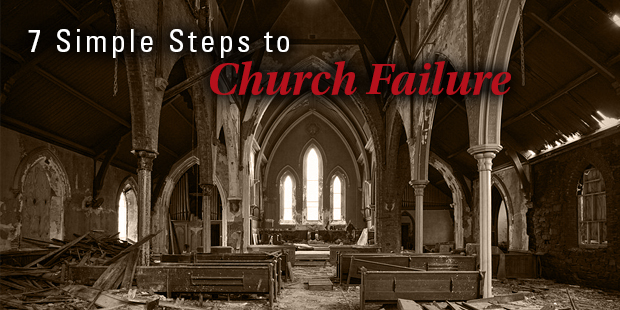
7 Steps to Church Failure

It only takes a 30-second internet search to find blog after blog listing the top 10 things your church must do to be successful, transform lives, and generally be a wonderful, fantastic place.  The myriad of blogs on the subject are both helpful and informative.  As I read them, I find myself aspiring to be a better leader.

What seems to be missing are the steps to ensure your church’s failure.  You may be asking, “Why would anyone write that blog?” The success of your church is not only about aiming at the right targets, but also about avoiding the pitfalls that can damage your ministry.  Unless we are careful, we may be sending messages about the value of people that are not what we intend.  These unintended messages can do measurable harm to your ministry and keep people from engaging.

Here are seven unintended messages that can close your doors:

  1. If they signed up for the email list, they want to hear from you.  Contact them as often as you want. I’m sure Mr. Davis is interested in the women’s prayer breakfast.
  2. Don’t sweat it if the bathrooms are dirty or the coffee runs out. This isn’t a coffee shop, and no one really means it when they say ‘it was clean enough to eat off the floor’.
  3. So what if your small groups seem like a clique? There is nothing that makes people want to be on the inside of community like feeling excluded!
  4. We need tithes to run this place.  Ask first, get to know them later. And don’t forget to use guilt frequently.
  5. Relationships are messy and hard. Instead of investing in someone’s life, let’s just plug them in to a program — the more programs the better.
  6. If people want to get connected, they will keep trying. The connections cards we printed are expensive and that’s why we call back almost half of the people who fill it out.
  7. We are in need of some volunteers. Who cares if it’s not their gifting or interest?  We have real needs right now!

While no church leader begins with the attitudes above, without the right systems and processes in place, they can begin to creep into your ministry. It only takes one or two of these attitudes to do long-term damage to your ministry.

Here are a few resources that can help prevent these attitudes from creeping into your ministry:

  1. An effective communications strategy can help you connect, engage, and inform your people. Done poorly, it can simply become noise.  Here are a few communications strategies to help cut through the noise.
  2. The first impression a visitor gets is not a worship song or a sermon. It starts in the parking lot and stretches into the atrium as they find their way into services. Creating space that is welcoming and easy to navigate is important.  Here are a few tips on optimizing your space.
  3. Moving people from casual attenders to engaged members doesn’t happen by accident.  It requires a process and an invitation.  Here is how to move people from the observer to participant.
  4. While the financial needs of the church are very real, the act of tithing is a function of discipleship and obedience to Scripture.  Here are a few ways to cultivate generosity.
  5. Transformation happens in the context of community.  The tendency to limiting engagement to being involved in a program can actually interfere with creating healthy community.  Even though relationships are messy, they’re worth the effort.
  6. Your connection card may be the most important piece of paper in your church. Don’t miss out on the value to connect with visitors.
  7. One of the best ways to retain volunteers is to plug them into roles that are a good fit for their gifts. Leading volunteers doesn’t have to be a challenge. Here are seven ways to boost your volunteer engagement.

How are you preventing these attitudes from affecting your Church?

Read more from Steve here.

Download PDF

Tags: , ,

| What is MyVisionRoom? > | Back to Leadership >

ABOUT THE AUTHOR

Steve Caton

Steve Caton

Steve Caton is part of the Leadership Team at Church Community Builder. He leverages a unique background in technology, fundraising and church leadership to help local churches decentralize their processes and equip their people to be disciple makers. Steve is a contributing author on a number of websites, including the Vision Room, ChurchTech Today, Innovate for Jesus and the popular Church Community Builder Blog. He also co-wrote the eBook “Getting Disciple Making Right”. While technology is what Steve does on a daily basis, impacting and influencing the local church is what really matters to him……as well as enjoying deep Colorado powder with his wife and two sons!

See more articles by >

COMMENTS

What say you? Leave a comment!

Recent Comments
comment_post_ID); ?> Thank you for this information. I'm going to use this article to improve my work with the Lord.
 
— Abel Singbeh
 
comment_post_ID); ?> Thank you Ed for sharing your insights into the Church Growth Movement. I have my reservations with Church Growth models because it has done more damage than good in the Body of Christ. Over the years, western churches are more focused on results, formulas and processes with little or no emphasis on membership and church discipline. Pastors and vocational leaders are burnt out because they're overworked. I do believe that the Church Growth model is a catalyst to two destructive groups: The New Apostolic Reformation and the Emerging Church. Both groups overlap and have a very loose definition. They're both focus on contemporary worship, expansion of church brand (franchising), and mobilizing volunteering members as 'leaders' to grow their ministry. Little focus on biblical study, apologetics and genuine missional work with no agenda besides preaching of the gospel.
 
— Dave
 
comment_post_ID); ?> Thank you for sharing such a good article. It is a great lesson I learned from this article. I am one of the leaders in Emmanuel united church of Ethiopia (A denomination with more-than 780 local churches through out the country). I am preparing a presentation on succession planning for local church leaders. It will help me for preparation If you send me more resources and recommend me books to read on the topic. I hope we may collaborate in advancing leadership capacity of our church. God Bless You and Your Ministry.
 
— Argaw Alemu
 

Clarity Process

Three effective ways to start moving toward clarity right now.

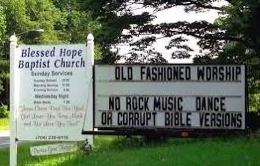
Welcome to “No” Church – 4 Steps to Reversing Your Negative Church Messaging

NoChurch1

Almost without exception, churches somewhere utilize negative messaging for very practical reasons. After all, someone parking in the wrong spot can create havoc. So it’s quite natural to put up a sign that says, “No Parking Along Curb.”

But is that the only way to get the intended result?


Screen Shot 2014-04-16 at 7.47.14 AMThe question is worth asking because studies show the impact of negative verses positive messaging on the brain. Negative messaging narrows your thought activity and focuses on actions related to the message. Positive messages on the other hand, broaden your thinking and create openness. More on this topic, from The Science of Positive Thinking.

So the big question is what kind of brain patterns do you want to create for people as they enter your church an prepare to worship the all-powerful and all-present living God and creator of the universe?

Let’s play this out for a guest coming to your church. What happens when they hit a cascade of messages like these:

  • No parking
  • Do not enter
  • For church members only
  • No skateboarding
  • No rollerblading
  • No bicycles
  • No scooters
  • No food or drink allowed
  • No talking
  • No trespassing
  • No running
  • No mobile phones
  • No signs allowed
  • No posters
  • No advertising
  • No parking along the curb

Essentially you create what we call the “No Church” church dynamic. Enough negative messaging and you might as well be saying…Screen Shot 2014-04-19 at 12.00.27 PM

  • Don’t come here
  • Don’t relax
  • Don’t worship
  • Don’t find God

Sounds laughable, doesn’t it. It wouldn’t if you could feel the influence of multi-stages of negative messaging from the perspective of someone totally new to church.

What can you do about this dilemma? Four things:

Step #1: Inventory your negative messages. List every one, walking from your entrance of your church to the worship center or sanctuary.

Step #2: Ask how important the prohibition message really is. I once worked with a church that prohibited the use of the ball field on their campus. Is that really worth it?

Step #3: Consider a positive message instead. This might not be obvious at first glance, but explore options as a team. Can a “No parking along curb” sign be replaced with a “Please keep traffic flowing” sign?

Step #4:  Use your negative message  with a point of humor. Why not have fun if you must communicate a negative message? The classic illustration is the “Thou shalt not park here” sign. What other ideas have you seen?

And, if you have any other funny negative messages, please share!

Read more from Will.

Download PDF

Tags: , ,

| What is MyVisionRoom? > | Back to Communication >

ABOUT THE AUTHOR

Will Mancini

Will Mancini

Will Mancini wants you and your ministry to experience the benefits of stunning, God-given clarity. As a pastor turned vision coach, Will has worked with an unprecedented variety of churches from growing megachurches and missional communities, to mainline revitalization and church plants. He is the founder of Auxano, creator of VisionRoom.com and the author of God Dreams and Church Unique.

See more articles by >

COMMENTS

What say you? Leave a comment!

Recent Comments
comment_post_ID); ?> Thank you for this information. I'm going to use this article to improve my work with the Lord.
 
— Abel Singbeh
 
comment_post_ID); ?> Thank you Ed for sharing your insights into the Church Growth Movement. I have my reservations with Church Growth models because it has done more damage than good in the Body of Christ. Over the years, western churches are more focused on results, formulas and processes with little or no emphasis on membership and church discipline. Pastors and vocational leaders are burnt out because they're overworked. I do believe that the Church Growth model is a catalyst to two destructive groups: The New Apostolic Reformation and the Emerging Church. Both groups overlap and have a very loose definition. They're both focus on contemporary worship, expansion of church brand (franchising), and mobilizing volunteering members as 'leaders' to grow their ministry. Little focus on biblical study, apologetics and genuine missional work with no agenda besides preaching of the gospel.
 
— Dave
 
comment_post_ID); ?> Thank you for sharing such a good article. It is a great lesson I learned from this article. I am one of the leaders in Emmanuel united church of Ethiopia (A denomination with more-than 780 local churches through out the country). I am preparing a presentation on succession planning for local church leaders. It will help me for preparation If you send me more resources and recommend me books to read on the topic. I hope we may collaborate in advancing leadership capacity of our church. God Bless You and Your Ministry.
 
— Argaw Alemu
 

Clarity Process

Three effective ways to start moving toward clarity right now.