St. Andrews Presbyterian is Restoring the Whole Family of God

Restarting the Conversation for Long-range Vision

When it comes to vision statements, many church leaders have lost interest. And for good reason–most vision statements are generic and useless. I like to say that your church really doesn’t need a vision statement, it needs a visionary state of mind. Yet, there needs to be a way to cultivate that state of mind. Your team does need some ideas on paper to become a sort of “mental charging station” for themselves and other leaders.  Think of a vivid vision statement as “base camp” for the team to assemble around, in order to take “vision casting treks” and “meaning excursions” all day long; that is the daily work of ministry.

So how do you get this vision thing right? What does success look like?  I answer the question for you in my new book God Dreams. More than that, I created a step-by-step guide for church teams.

To inspire you along the way, here is a case study from St. Andrew’s Presbyterian Church in Newport Beach, CA, led by Rich Kannwischer. Before we jump into their “Restoring the Whole Family of God” vision, let’s clarify what it is we are looking at.

First, it is a vivid description example of a long-range vision or what I call a “beyond-the-horizon” vision. Many have abandoned thinking long as discipline as a result of the constant changes of culture and technology. But for the church, there are many foundational reasons why leadership should think long-range. Here are twelve of them.

Second, it is only one fourth of what you need to have a complete visionary plan. This is the start – the long-range context to visionary plan. There are three other horizons to develop and the plan is eventually anchored in four immediate action initiatives in the next 90 days. To see the model for visionary planning check out how the Horizon Storyline works.

St. Andrew’s Vision: Welcome Home – Restoring the Whole Family of God

By the year 2020, we will see Saint Andrew’s transformed from a house of God to a home in Christ. In order to make this dream a reality, we will be putting our house in order, creating space to belong, extending the family, and renovating lives, one disciple at a time.

By putting our financial house in order, Saint Andrew’s can move forward in the freedom of a fresh start and new opportunities to welcome others to a home in Christ.

As we create space to belong, those we are welcoming feel at home. When you feel at home, you become free to be yourself. You relax, you get comfortable, and you want to stay and talk about what really matters. Our 2020 vision is that our campus feels like home and becomes home to many more families in our community.

Saint Andrew’s has a rich history of starting new ministries that have flourished and leveraged our reach for Christ—here, near, and far. By extending the family, our 2020 vision includes a new wave of mission innovation—planting new churches, extending our impact through technology, and giving more than one hundred homeless children in Orange County a permanent home.

By renovating lives through a discipleship institute, we will create a robust and replicable model for growing believers, guiding countless others in our mission of following Jesus Christ to lead lives that reveal God’s goodness.

Church: St. Andrew’s Presbyterian Church, Newport Beach, CA

Pastor: Richard Kannwischer

Vision Template: Spiritual formation that includes need adoption

>>>> Buy God Dreams >>>>

Download PDF

Tags: , , , , ,

| What is MyVisionRoom? > | Back to Vision >

ABOUT THE AUTHOR

Will Mancini

Will Mancini

Will Mancini wants you and your ministry to experience the benefits of stunning, God-given clarity. As a pastor turned vision coach, Will has worked with an unprecedented variety of churches from growing megachurches and missional communities, to mainline revitalization and church plants. He is the founder of Auxano, creator of VisionRoom.com and the author of God Dreams and Church Unique.

See more articles by >

COMMENTS

What say you? Leave a comment!

Recent Comments
comment_post_ID); ?> Thank you for this information. I'm going to use this article to improve my work with the Lord.
 
— Abel Singbeh
 
comment_post_ID); ?> Thank you Ed for sharing your insights into the Church Growth Movement. I have my reservations with Church Growth models because it has done more damage than good in the Body of Christ. Over the years, western churches are more focused on results, formulas and processes with little or no emphasis on membership and church discipline. Pastors and vocational leaders are burnt out because they're overworked. I do believe that the Church Growth model is a catalyst to two destructive groups: The New Apostolic Reformation and the Emerging Church. Both groups overlap and have a very loose definition. They're both focus on contemporary worship, expansion of church brand (franchising), and mobilizing volunteering members as 'leaders' to grow their ministry. Little focus on biblical study, apologetics and genuine missional work with no agenda besides preaching of the gospel.
 
— Dave
 
comment_post_ID); ?> Thank you for sharing such a good article. It is a great lesson I learned from this article. I am one of the leaders in Emmanuel united church of Ethiopia (A denomination with more-than 780 local churches through out the country). I am preparing a presentation on succession planning for local church leaders. It will help me for preparation If you send me more resources and recommend me books to read on the topic. I hope we may collaborate in advancing leadership capacity of our church. God Bless You and Your Ministry.
 
— Argaw Alemu
 

Clarity Process

Three effective ways to start moving toward clarity right now.

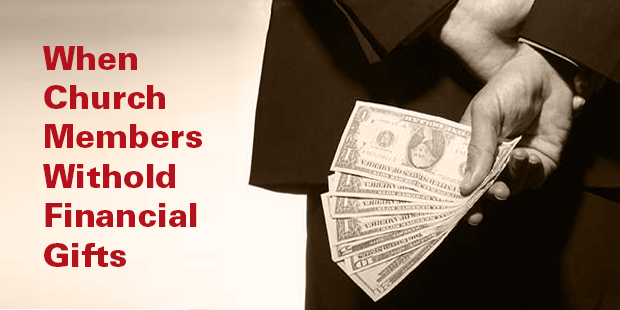
When Church Members Withhold Financial Gifts

The story is too common, but I hear such stories repeatedly. My most recent conversation was with a church leader where an affluent church member offered to make a large contribution to the renovation of the worship center. He had one stipulation: the worship center had to be named in memory of his late mother. The leader politely declined. The affluent member did not make the donation. To the contrary, he began withholding all of his gifts to the church.

Almost every pastor and church leader has some story about members withholding their financial gifts as an act of protest about the direction of the church and its leadership. I have never known such a situation that had any positive affect. Such is the reason I offer nine concerns about this practice.

  1. It assumes that we are the actual owners of our finances. That is unbiblical thinking. God gives to us everything we have. We are the stewards of these gifts. Such is the reason we use the word “stewardship.”
  2. No church is perfect. If every member protested about an imperfection in a local congregation, no church would ever receive funds. This selfish act is not the way to resolve concerns.
  3. This practice is divisive. One of the most precious resources of any congregation is unity. The withholding of financial gifts is an act of disunity and divisiveness.
  4. It is controlling. The church member who withholds financial gifts seeks to get his or her way. Such is not the spirit of Paul’s words in Philippians 2:3: “Do nothing out of rivalry or conceit, but in humility consider others as more important than yourselves.”
  5. It is self-serving. When Paul penned 1 Corinthians 12, he emphasized how we are to function in the body of Christ. Our motive for serving is for Christ and others before ourselves.
  6. It is demoralizing. Paul wrote in Romans 14:19, “So we must pursue what promotes peace and builds up one another.” This practice has the opposite effect.
  7. It backs church leaders into a corner. Leaders have one of two options. They can yield to the church member and thus affirm a sinful practice. Or they can refuse to yield and continue the conflict that was started by the member. It is a lose-lose situation.
  8. If the church member truly has serious disagreements with the direction of the church, he or she should pursue other paths. They can address their concerns with leaders in the church directly. If members still have serious concerns and no resolution seems possible, it may be best to go to another church. It is much healthier to give to another church than to withhold from your present church.
  9. This practice never has a positive outcome. Even if the member gets his or her way, unity and trust are broken at many levels. The body of Christ is always wounded by this practice.

This topic is both sensitive and challenging.

> Read more from Thom.

Download PDF

Tags: , , ,

| What is MyVisionRoom? > | Back to Resourcing >

ABOUT THE AUTHOR

Thom Rainer

Thom Rainer

Thom S. Rainer is the founder and CEO of Church Answers, an online community and resource for church leaders. Prior to founding Church Answers, Rainer served as president and CEO of LifeWay Christian Resources. Before coming to LifeWay, he served at The Southern Baptist Theological Seminary for twelve years where he was the founding dean of the Billy Graham School of Missions and Evangelism. He is a 1977 graduate of the University of Alabama and earned his Master of Divinity and Ph.D. degrees from The Southern Baptist Theological Seminary.

See more articles by >

COMMENTS

What say you? Leave a comment!

Lynn — 03/03/16 8:48 am

Your experience has given me hope. Thank you

Rick — 02/11/16 1:39 pm

Misguided member to be sure. Best course of action for pastors is to preach God's pure word, plant the seed, and God will bring the increase.

Fr. James Wozniak — 02/11/16 7:49 am

This article reminds me of an experience I had. In my third year at the parish I pastor I needed to make some staff changes. During that process I was constantly praying for insight and enlightenment. Some old time parishioners did like that I was making these changes. They did not like the growth that was happening and did not want any change. This group parisioners decided to protest by only putting a dollar a week in the collection. The most incredible thing happened, during the weeks they were protesting the parish collection went up by over 5%. Now as any pastor can tell you all collections fluctuate, but while people are deliberately trying to hurt the parish or more to the point hurt me, this was a blessing. This reminded me that if I pray and I try to do what I believe God is telling me to do, God will take care or me and my people. Pastors that are trying to do God's will, put God's will first and don't be bullied by people trying to lead you away from God's will.

Bruce — 04/27/15 1:55 pm

Whoa ! This is a two way street ! Unity is give, take & compromise unless if comes down to doctrine, there is NO wiggle room in doctrine. Needs and Wants can be very opinionated and the cause of much contention between the Lay and Clergy. Jesus and Paul did not have Gilded Pulpits and the masses did not have cushy padded "Lazy-Boys" Needs and wants have to be looked at very closely, so personal sacrifice has to be observed on both sides. Wants = Greed, Needs = Humility and content.

Recent Comments
comment_post_ID); ?> Thank you for this information. I'm going to use this article to improve my work with the Lord.
 
— Abel Singbeh
 
comment_post_ID); ?> Thank you Ed for sharing your insights into the Church Growth Movement. I have my reservations with Church Growth models because it has done more damage than good in the Body of Christ. Over the years, western churches are more focused on results, formulas and processes with little or no emphasis on membership and church discipline. Pastors and vocational leaders are burnt out because they're overworked. I do believe that the Church Growth model is a catalyst to two destructive groups: The New Apostolic Reformation and the Emerging Church. Both groups overlap and have a very loose definition. They're both focus on contemporary worship, expansion of church brand (franchising), and mobilizing volunteering members as 'leaders' to grow their ministry. Little focus on biblical study, apologetics and genuine missional work with no agenda besides preaching of the gospel.
 
— Dave
 
comment_post_ID); ?> Thank you for sharing such a good article. It is a great lesson I learned from this article. I am one of the leaders in Emmanuel united church of Ethiopia (A denomination with more-than 780 local churches through out the country). I am preparing a presentation on succession planning for local church leaders. It will help me for preparation If you send me more resources and recommend me books to read on the topic. I hope we may collaborate in advancing leadership capacity of our church. God Bless You and Your Ministry.
 
— Argaw Alemu
 

Clarity Process

Three effective ways to start moving toward clarity right now.

The Secret to Overcoming Reluctance to Capital Campaigns

Beginning today is a new series routinely posting content from one of the most innovative content sources in the church world: SUMS Remix Book Summaries for church leaders.  SUMS Remix takes a practical problem in the church and looks at it with three solutions; and each solution is taken from a different book. As a church leader you get to scan relevant books based on practical tools and solutions to real ministry problems, not just by the cover of the book. Each post will have the edition number which shows the year and what number it is in the overall sequence. (SUMS provides 26 editions per year, delivered every other week to your inbox). 

>>> You can purchase a subscription to SUMS Remix here >>>

So what is Andy Stanley’s Killer Secret to Church Fundraising? It is using a powerful biblical principle and metaphor to reframe the believer’s opportunity to live a generous life. Here is the way we unpacked it last year in SUMS Remix:

PROBLEM STATEMENT  of Edition 1.7:  We have leaders who are reluctant to do another campaign. 

You have probably done capital campaigns before and many church goers are tired of the same old-school campaigns year after year. (By the way, that’s why we started Auxano campaigns as a vision-based resourcing service.)

Rallying people to a better future is not new.  Building leaders and directing energy is baseline to the human enterprise. But the church is still the HARDEST PLACE ON PLANET EARTH to focus. Whether it’s a breakout of congregational opinions, the rampant “sin of niceness” or a plague of risk aversion, getting the vision done is more fantasy than testimony.

Solution 1: Focus on the dynamics of fear vs. faith by using the biblical image of sowing seeds.

FieldsofGoldTHE QUICK SUMMARY

Fields of Gold is a practical and inspirational book based on the principle of sowing and reaping. If we sow fear, what will be our harvest? And conversely, if we sow faith, what will we grow?

In the book Andy Stanley unpacks our irrational fears about money, helping us to discover that generous giving is actually an invitation for our heavenly Father to get involved in our finances and resupply us with enough seed to sow generously throughout our lifetime.

A SIMPLE SOLUTION

Many people would like to be generous givers. But the realities of steadily rising prices of everyday goods, shrinking retirement funds, and an uncertain world economy give us pause. The questions come like a rushing whirlwind, burying good intentions:

  • How much can I afford to give?
  • What if I give away too much?
  • What if there s not enough left for me?

As Christians, we know that we should give but sometimes it’s so hard to take that step of faith and let go when it comes to our finances. Under the growing pressures to make ends meet each month, it’s easy to become irrational in our thinking about God, his faithfulness, and our role as stewards of his resources.

That line of irrational thinking quickly leads to a fear that obscures both our thinking and the facts of how we know God wants us to handle our finances.

If we truly believe that God is who he says he is we have no reason to fear. Doesn’t it make sense to trust the God of the Universe with your finances? Isn’t it time to put aside the worry and start living in confidence?

When you begin to view your wealth from God’s perspective, you’ll see that the thing to fear isn’t giving away too much, but sowing too little.

It’s important to realize that fear and faith often go hand in hand. By nature, when you pursue a growing faith you increase your exposure to potential fears.

It’s no accident that the Bible addresses this condition head-on. There’s no drought when it comes to verses designed to help us let go of our fears and embrace our God-given calling to be generous stewards rather than fearful owners. In Matthew 6:33, Jesus assures us that when we seek His kingdom first with our seed, we need not fear being wiped out: … “he will give you all you need from day to day if you live for him and make the Kingdom of God your primary concern.” (NLT)

When you begin to view your wealth from God’s perspective, you’ll see that the thing to fear isn’t giving away too much, but sowing too little.

You see, when we respond in fear to an invitation from God, we forfeit the reward of being faithful stewards. Sowing in faith results in an eternal crop. Cowering in fear yields empty fields.

Stepping outside your comfort zone is not careless irresponsibility, but a necessary act of obedience.

– Andy Stanley, Fields of Gold

A NEXT STEP

Fear and faith are parallel concepts that must live constantly in tension. Doubt and indecision are actually ingredients for both our fears and our faith. If everything was a certainty, where does faith come in? Our faith is engaged when we stand on the edge of the unknown. By relying less on the visible and more on the invisible, we begin to exercise our faith. And in that moment of faith, we often are vulnerable to fear. When it comes to giving, many Christians know they should give, but our fear of “what could be” overtakes our faith.

The answer to this challenge comes in the biblical metaphor of sowing. God provides for us (seeds). But seeds weren’t made for holding; they were made for sowing. Unless we sow our seeds, we will never know the harvest they will bring.

Overcoming the tension of our fear and faith requires a simple, but profound change in our concept of ownership. Answer these two questions:

  • Who really owns your possessions?
  • Who’s calling the shots for you financially?

If we truly understand and believe that God owns it all, we have no basis for fear. And, if God also is the source of all our wealth, and is in charge its increase and decrease, then we have no reason not to give.

The path to a secure financial future is to get God involved as soon as possible. The sooner you become a sower of seeds and not a hoarder, the sooner you will reap the harvest.

Once we realize that it really is better to give than to receive, there’s no limit to what God will do with our gifts.

Taken from SUMS Remix 7, published February 2015.

>>> You can purchase a subscription to SUMS Remix here >>>

Download PDF

Tags: , , , ,

| What is MyVisionRoom? > | Back to Resourcing >

ABOUT THE AUTHOR

Will Mancini

Will Mancini

Will Mancini wants you and your ministry to experience the benefits of stunning, God-given clarity. As a pastor turned vision coach, Will has worked with an unprecedented variety of churches from growing megachurches and missional communities, to mainline revitalization and church plants. He is the founder of Auxano, creator of VisionRoom.com and the author of God Dreams and Church Unique.

See more articles by >

COMMENTS

What say you? Leave a comment!

Recent Comments
comment_post_ID); ?> Thank you for this information. I'm going to use this article to improve my work with the Lord.
 
— Abel Singbeh
 
comment_post_ID); ?> Thank you Ed for sharing your insights into the Church Growth Movement. I have my reservations with Church Growth models because it has done more damage than good in the Body of Christ. Over the years, western churches are more focused on results, formulas and processes with little or no emphasis on membership and church discipline. Pastors and vocational leaders are burnt out because they're overworked. I do believe that the Church Growth model is a catalyst to two destructive groups: The New Apostolic Reformation and the Emerging Church. Both groups overlap and have a very loose definition. They're both focus on contemporary worship, expansion of church brand (franchising), and mobilizing volunteering members as 'leaders' to grow their ministry. Little focus on biblical study, apologetics and genuine missional work with no agenda besides preaching of the gospel.
 
— Dave
 
comment_post_ID); ?> Thank you for sharing such a good article. It is a great lesson I learned from this article. I am one of the leaders in Emmanuel united church of Ethiopia (A denomination with more-than 780 local churches through out the country). I am preparing a presentation on succession planning for local church leaders. It will help me for preparation If you send me more resources and recommend me books to read on the topic. I hope we may collaborate in advancing leadership capacity of our church. God Bless You and Your Ministry.
 
— Argaw Alemu
 

Clarity Process

Three effective ways to start moving toward clarity right now.

Kingsland Baptist is Transforming Ten Thousand Homes

Restarting the Conversation for Long-range Vision

When it comes to vision statements, many church leaders have lost interest. And for good reason–most vision statements are generic and useless. I like to say that your church really doesn’t need a vision statement, it needs a visionary state of mind. Yet, there needs to be a way to cultivate that state of mind. Your team does need some ideas on paper to become a sort of “mental charging station” for themselves and other leaders.  Think of a vivid vision statement as “base camp” for the team to assemble around, in order to take “vision casting treks” and “meaning excursions” all day long; that is the daily work of ministry.

So how do you get this vision thing right? What does success look like?  I answer the question for you in my new book God Dreams. More than that, I created a step-by-step guide for church teams.

To inspire you along the way, here is a case study from Kingsland Baptist Church in Katy, TX, led by Ryan Rush. Before we jump into their “Transforming Ten Thousand Homes” vision, let’s clarify what it is we are looking at.

First, it is a vivid description example of a long-range vision or what I call a “beyond-the-horizon” vision. Many have abandoned thinking long as discipline as a result of the constant changes of culture and technology. But for the church, there are many foundational reasons why leadership should think long-range. Here are twelve of them.

Second, it is only one fourth of what you need to have a complete visionary plan. This is the start – the long-range context to visionary plan. There are three other horizons to develop and the plan is eventually anchored in four immediate action initiatives in the next 90 days. To see the model for visionary planning check out how the Horizon Storyline works.

Kingsland’s Vision: Transforming Ten Thousand Homes

The family has been ordained by God as the foundational place for faith to take root and grow. The decline in a healthy home life, then, is a crisis with far-reaching implications that must not be taken lightly. This cultural decline of a healthy home life is a problem too great for political or educational efforts for change. We must turn instead to spiritual revival, and we are convinced that God has prepared Kingsland for this important moment in history.

We believe that the only hope for family restoration is the power of the gospel of Jesus Christ. God has uniquely positioned Kingsland with the passion, resources, and leadership to make a significant impact on home life in the next decade. We envision ten thousand homes transformed as they are:

  • Invited to enjoy five intentional meals each week with the entire household.
  • Invited to live the Twelve Habits of True Fulfillment in Jesus (our mission measures from our Vision Frame).
  • Invited to embrace the grace offered through Jesus.

We see mealtime as the catalyst for facilitating systemic change in the lives of all ten thousand homes and will endeavor to use those meals as the first step in transformation.

Church: Kingsland Baptist Church, Katy, TX

Pastor: Ryan Rush

Vision Template: Spiritual formation that creates targeted transformation

>>>> Buy God Dreams >>>>

Download PDF

Tags: , , , , , , , ,

| What is MyVisionRoom? > | Back to Vision >

ABOUT THE AUTHOR

Will Mancini

Will Mancini

Will Mancini wants you and your ministry to experience the benefits of stunning, God-given clarity. As a pastor turned vision coach, Will has worked with an unprecedented variety of churches from growing megachurches and missional communities, to mainline revitalization and church plants. He is the founder of Auxano, creator of VisionRoom.com and the author of God Dreams and Church Unique.

See more articles by >

COMMENTS

What say you? Leave a comment!

Recent Comments
comment_post_ID); ?> Thank you for this information. I'm going to use this article to improve my work with the Lord.
 
— Abel Singbeh
 
comment_post_ID); ?> Thank you Ed for sharing your insights into the Church Growth Movement. I have my reservations with Church Growth models because it has done more damage than good in the Body of Christ. Over the years, western churches are more focused on results, formulas and processes with little or no emphasis on membership and church discipline. Pastors and vocational leaders are burnt out because they're overworked. I do believe that the Church Growth model is a catalyst to two destructive groups: The New Apostolic Reformation and the Emerging Church. Both groups overlap and have a very loose definition. They're both focus on contemporary worship, expansion of church brand (franchising), and mobilizing volunteering members as 'leaders' to grow their ministry. Little focus on biblical study, apologetics and genuine missional work with no agenda besides preaching of the gospel.
 
— Dave
 
comment_post_ID); ?> Thank you for sharing such a good article. It is a great lesson I learned from this article. I am one of the leaders in Emmanuel united church of Ethiopia (A denomination with more-than 780 local churches through out the country). I am preparing a presentation on succession planning for local church leaders. It will help me for preparation If you send me more resources and recommend me books to read on the topic. I hope we may collaborate in advancing leadership capacity of our church. God Bless You and Your Ministry.
 
— Argaw Alemu
 

Clarity Process

Three effective ways to start moving toward clarity right now.

How to Move People from the Sidelines to Full Engagement in Your Next Capital Campaign

My first memory of a capital campaign forms the image of a 2×3 foot poster neatly taped to a wall with a hand-drawn thermometer on it. I was ten years old and my church was raising $50,000 (an inconceivable sum and thus an insurmountable goal) to “save the camp.” I still remember my surprise when success was announced. What had I missed? Is a camp really worth $50,000? Somewhat awestruck I asked myself, “Who among us has that kind of money to spare?”

As a Vision Clarity Lead Navigator with Auxano, I also help clients with capital campaigns from a clarity first perspective. I’ve found that the two questions I asked myself as a ten-year-old get more sophisticated, but they don’t really change. Until our folks internalize why we are doing this project right now, they will be watching from the sidelines wondering why we’re talking about money (again) and who is going to step up.

A Clarity First, Vision-based Capital Campaign prioritizes why and how the project will advance your church’s mission. Follow the classic campaign principle to make the project clear, but make sure the vision that is driving it shines clearer. A clear and properly ordered connection between your vision and the project will not only help you reach your campaign goals, but it can also prevent the project from replacing the church’s vision. A building-first vision has long been a danger to the people of God and transforms a necessary provision of your vision into a significant obstacle. At worst, a congregation can lose its identity entirely and degenerate into a not-for-profit charity or construction company.

Vision Casting for a Campaign:

  • Frame the campaign in the context of God’s action in the history of the church.
  • Show how the project will help you advance the church’s mission.
  • Paint a vivid picture of the better future the project can help to create.
  • Connect your congregation emotionally with why we are doing this now.
  • Each person has a place in making the project happen.
  • Your mission is part of the larger Great Commission.

From three-minute conversations, to an entire sermon series, we want our folks to envision a better future and see how they can help make it happen.

Thinking back over the decades since my first memory of the $50,000 campaign to save the camp, I can see that I had no better ability as a ten-year-old to understand the real world value of $50,000 than I did a camp. However, if someone could have given me a glimpse into the future for me to see the role that camp was going to play in my spiritual formation (and thousands of others) over the following decades…the camp would have become priceless and $50,000 would have been transformed from an inconceivable sum into a mission-critical objective.

> Read more from Mike

Download PDF

Tags: , , , ,

| What is MyVisionRoom? > | Back to Resourcing >

ABOUT THE AUTHOR

Mike Gammill

See more articles by >

COMMENTS

What say you? Leave a comment!

Recent Comments
comment_post_ID); ?> Thank you for this information. I'm going to use this article to improve my work with the Lord.
 
— Abel Singbeh
 
comment_post_ID); ?> Thank you Ed for sharing your insights into the Church Growth Movement. I have my reservations with Church Growth models because it has done more damage than good in the Body of Christ. Over the years, western churches are more focused on results, formulas and processes with little or no emphasis on membership and church discipline. Pastors and vocational leaders are burnt out because they're overworked. I do believe that the Church Growth model is a catalyst to two destructive groups: The New Apostolic Reformation and the Emerging Church. Both groups overlap and have a very loose definition. They're both focus on contemporary worship, expansion of church brand (franchising), and mobilizing volunteering members as 'leaders' to grow their ministry. Little focus on biblical study, apologetics and genuine missional work with no agenda besides preaching of the gospel.
 
— Dave
 
comment_post_ID); ?> Thank you for sharing such a good article. It is a great lesson I learned from this article. I am one of the leaders in Emmanuel united church of Ethiopia (A denomination with more-than 780 local churches through out the country). I am preparing a presentation on succession planning for local church leaders. It will help me for preparation If you send me more resources and recommend me books to read on the topic. I hope we may collaborate in advancing leadership capacity of our church. God Bless You and Your Ministry.
 
— Argaw Alemu
 

Clarity Process

Three effective ways to start moving toward clarity right now.

The Church Values of Mark Driscoll’s New Church Plant, The Trinity Church

It has been said that your greatest strengths reflect your greatest weaknesses.

Mark Driscoll grew a wildly successful church in Seattle–Mars Hill–with a strong following locally and nationally through his speaking, books and the Acts 29 church planting network.

A little over a year ago, Mars Hills closed down and the 12 sites of the large megachurch become autonomous. You can read the entire story but I’ll boil it down to one word: grit. It attracted people to pastor Mark; it led to the tragic failure of the church. In the end he was too harsh as a leader.

The year before things started unraveling, I was with Mark in the Catalyst Conference greenroom. My son, Jacob happened to be there with me. I wanted Jacob to get some advice from Mark as he started his journey to college. It was good advice but it was bold, blazing and borderline crass. I was glad Mark said what he said. It was appropriate to three men talking about manly stuff. It was edgy. Your greatest strengths reflect your greatest weaknesses.

I have always said that your success develops your confidence and your failures develop your convictions. As I read the guiding principles of Mark Driscoll’s new church, I couldn’t help but notice how his previous failures are informing his new church values system. Same grit, new love.

At Auxano we walk with churches to build our their top 4-6 values that we define as the shared convictions that guide the actions and reveal the strengths of the church. This is one side of the Vision Frame. Many times the deepest window to our values is our own failures. It reveals lines that we never want to cross again. Here are the top 10 reasons why you should state your church values.

What does this mean now for Mark Driscoll? As he pours the foundation for a fresh start, here are five questions that The Trinity Church will use in making decisions:

  1. How is God glorified through this?
  2. Does this contribute to church health?
  3. Are lives being transformed?
  4. Are people learning the Bible?
  5. Are people in relationship?

In addition here are eleven phrases or statements that he aspires to embed into the culture of the church. I consider this to be an extended list of church values that he will be refining.

  • ???? Pray first
  • ???? The pedals on our bike are Bible teaching and relationships
  • ❤️ Loving relationships are the mark of good theology
  • ???? Fun is fundamental
  • ???? Build people up, don’t beat people up
  • ???? God is our Father and we are a family of multiple generations
  • ???? Children are a blessing
  • ???? We do things with excellence or we don’t do them at all
  • ????‍????‍????‍???? The family that serves together grows closer
  • ???? Nothing beats people meeting Jesus
  • ???? Vision requires provision

Personally I am proud of Mark for stating the obvious and working to create a new culture:

Build people up, don’t beat people up

All through the website you see a new softness; a new attention to love and healthy relationships. Even the use of emoticons signals a shift (or maybe a lack of resources). When it boils all down, it looks like Trinity Church has one mission driving the big idea the new start: We open our Bibles to learn. We open our lives to love.

Who among us doesn’t need grace for life and room to learn from our mistakes? (Whether they be highly visible or not). My prayer is that God will richly bless the new vision of The Trinity Church.

By the way,  how are you doing stating your own core convictions and ministry values? What cultural lines have been crossed that need to be re-clarified with your leadership team?

Download PDF

Tags: , , , , ,

| What is MyVisionRoom? > | Back to Vision >

ABOUT THE AUTHOR

Will Mancini

Will Mancini

Will Mancini wants you and your ministry to experience the benefits of stunning, God-given clarity. As a pastor turned vision coach, Will has worked with an unprecedented variety of churches from growing megachurches and missional communities, to mainline revitalization and church plants. He is the founder of Auxano, creator of VisionRoom.com and the author of God Dreams and Church Unique.

See more articles by >

COMMENTS

What say you? Leave a comment!

Recent Comments
comment_post_ID); ?> Thank you for this information. I'm going to use this article to improve my work with the Lord.
 
— Abel Singbeh
 
comment_post_ID); ?> Thank you Ed for sharing your insights into the Church Growth Movement. I have my reservations with Church Growth models because it has done more damage than good in the Body of Christ. Over the years, western churches are more focused on results, formulas and processes with little or no emphasis on membership and church discipline. Pastors and vocational leaders are burnt out because they're overworked. I do believe that the Church Growth model is a catalyst to two destructive groups: The New Apostolic Reformation and the Emerging Church. Both groups overlap and have a very loose definition. They're both focus on contemporary worship, expansion of church brand (franchising), and mobilizing volunteering members as 'leaders' to grow their ministry. Little focus on biblical study, apologetics and genuine missional work with no agenda besides preaching of the gospel.
 
— Dave
 
comment_post_ID); ?> Thank you for sharing such a good article. It is a great lesson I learned from this article. I am one of the leaders in Emmanuel united church of Ethiopia (A denomination with more-than 780 local churches through out the country). I am preparing a presentation on succession planning for local church leaders. It will help me for preparation If you send me more resources and recommend me books to read on the topic. I hope we may collaborate in advancing leadership capacity of our church. God Bless You and Your Ministry.
 
— Argaw Alemu
 

Clarity Process

Three effective ways to start moving toward clarity right now.

Asbury UMC Moves from Coasting to Making a Difference

Restarting the Conversation for Long-range Vision

When it comes to vision statements, many church leaders have lost interest. And for good reason–most vision statements are generic and useless. I like to say that your church really doesn’t need a vision statement, it needs a visionary state of mind. Yet, there needs to be a way to cultivate that state of mind. Your team does need some ideas on paper to become a sort of “mental charging station” for themselves and other leaders.  Think of a vivid vision statement as “base camp” for the team to assemble around, in order to take “vision casting treks” and “meaning excursions” all day long; that is the daily work of ministry.

So how do you get this vision thing right? What does success look like?  I answer the question for you in my new book God Dreams. More than that, I created a step-by-step guide for church teams.

To inspire you along the way, here is a case study from Asbury United Methodist Church in Raleigh, NC, led by Terry Bryant. Before we jump into their “Coasting or Difference Making?” vision, let’s clarify what it is we are looking at.

First, it is a vivid description example of a long-range vision or what I call a “beyond-the-horizon” vision. Many have abandoned thinking long as discipline as a result of the constant changes of culture and technology. But for the church, there are many foundational reasons why leadership should think long-range. Here are twelve of them.

Second, it is only one fourth of what you need to have a complete visionary plan. This is the start – the long-range context to visionary plan. There are three other horizons to develop and the plan is eventually anchored in four immediate action initiatives in the next 90 days. To see the model for visionary planning check out how the Horizon Storyline works.

Asbury’s Vision: Coasting or Difference Making?

Summary: In the next five years, every person who calls our church home will be linking arms in difference-making relationships. We will focus efforts on two needs—hunger and education—in the three concentric-circle ministry areas (in the geography of Acts 1:8).

We live in a highly educated, thriving, and dynamic culture in North Raleigh. What we experience far too often is that while we are constantly busy, we often feel like we are coasting through life. We always have stuff to do but seldom feel like we are making a difference. So we will move from coasting to engaging gears, moving past meaningless self-centered activity and accelerating new and practical ways of living out our faith. We will be salt and light to our neighbors (Matt. 5:13–16).

Strengthened through our common worship and group engagement, we intend to be difference makers in our local community and world through two key areas of focus: First, being on mission to end hunger, recognizing the call of our Lord, “For I was hungry and you gave me something to eat” (Matt. 25:35 NIV). Second, being on mission to improving underresourced education centers, recognizing the call of Scripture to “train up a child in the way he should go” (Prov. 22:6). We are going to become a place where it becomes inescapable that to be part of Asbury is to respond relationally and tangibly to these needs in our community and world.

*We intend to do this specifically through relational involvement and service with the Asbury Preschool, Lynn Road Elementary, and our partners in Haiti (Hearts and Hands for Haiti). We will accomplish this through mentoring children, encouraging educators, improving school campuses, and engaging with parents. We see hundreds of unchurched parents and children from the Asbury Preschool finding new life in Christ at Asbury. We see thousands of pounds of fresh produce donated locally. We see not only hundreds of Asbury’s people visiting Haiti and engaging with children there but also sending millions of meals to Haiti. We see hundreds at Asbury serving as lion pals in our mentoring program for children. We see hundreds of backpacks filled with food for children on the weekend. That our Lord might proclaim, “You loved me when you packaged that meal, you walked with me when you grabbed the hand of an underresourced student and served, you blessed me when you received that family into my church” (Matt. 25).

*Jerusalem and Judea (Asbury Preschool), Samaria (Lynn Road), ends of the earth (Haiti) (Acts 1:8).

Church: Asbury United Methodist Church, Raleigh, NC

Pastor: Terry Bryant

Vision Template: Need adoption in harness with geographic saturation

>>>> Buy God Dreams >>>>

Download PDF

Tags: , , , , , ,

| What is MyVisionRoom? > | Back to Vision >

ABOUT THE AUTHOR

Will Mancini

Will Mancini

Will Mancini wants you and your ministry to experience the benefits of stunning, God-given clarity. As a pastor turned vision coach, Will has worked with an unprecedented variety of churches from growing megachurches and missional communities, to mainline revitalization and church plants. He is the founder of Auxano, creator of VisionRoom.com and the author of God Dreams and Church Unique.

See more articles by >

COMMENTS

What say you? Leave a comment!

Recent Comments
comment_post_ID); ?> Thank you for this information. I'm going to use this article to improve my work with the Lord.
 
— Abel Singbeh
 
comment_post_ID); ?> Thank you Ed for sharing your insights into the Church Growth Movement. I have my reservations with Church Growth models because it has done more damage than good in the Body of Christ. Over the years, western churches are more focused on results, formulas and processes with little or no emphasis on membership and church discipline. Pastors and vocational leaders are burnt out because they're overworked. I do believe that the Church Growth model is a catalyst to two destructive groups: The New Apostolic Reformation and the Emerging Church. Both groups overlap and have a very loose definition. They're both focus on contemporary worship, expansion of church brand (franchising), and mobilizing volunteering members as 'leaders' to grow their ministry. Little focus on biblical study, apologetics and genuine missional work with no agenda besides preaching of the gospel.
 
— Dave
 
comment_post_ID); ?> Thank you for sharing such a good article. It is a great lesson I learned from this article. I am one of the leaders in Emmanuel united church of Ethiopia (A denomination with more-than 780 local churches through out the country). I am preparing a presentation on succession planning for local church leaders. It will help me for preparation If you send me more resources and recommend me books to read on the topic. I hope we may collaborate in advancing leadership capacity of our church. God Bless You and Your Ministry.
 
— Argaw Alemu
 

Clarity Process

Three effective ways to start moving toward clarity right now.