Cultural & Religious Cheat Sheet

For the past week, I’ve blogged quite a bit on statistics and their use. I’ve discussed the misuse of stats, how to discern which stats are good and which are not, and even presented some new research on pastors’ views of the election and the use of stats.

You’ve responded with good questions and robust discussion (especially on my Facebook page). Through it all, I found a common theme in your tweets and comments: Where do I find accurate stats? While I can’t vouch for every research study conducted at every research firm under the sun, there are many trustworthy sources out there. You know their names, and I consider many of their leaders personal friends.

Since many of you use stats (as the research I presented yesterday showed) and want trustworthy ones to use, I thought I would share these stats I compiled for the Exponential Conference held this past April. These are as up-to-date as I could make them. But like any stat, they could be updated and changed. So before you use them, be discerning and verify them from the source listed in parentheses.

WORLD STATISTICS

• World population is over 7 billion people and growing at over 80 million per year (Population Media Center)
• Facebook has 1 billion monthly active users (Facebook)
• If the world were 100 people (100people.org)

  • 33 Christians, 22 Muslims, 14 Hindus, 7 Buddhists
  • 77 people would have a place to shelter them from the wind and the rain, but 23 would not
  • 1 would be dying of starvation, 15 would be undernourished, 21 would be overweight
  • 48 would live on less than $2 USD per day
  • 87 would have access to safe drinking water, 13 would use unimproved water


UNITED STATES STATISTICS

• 827,609 abortions in 2007 (most recent data) (CDC)

Finance (endoftheamericandream.com)

  • Average household debt in the United States has now reached a level of 136% of average household income
  • Over the last decade, the number of Americans without health insurance has risen from about 38 million to about 52 million
  • Total U.S. credit card debt is more than 8 times larger o than it was just 30 years ago
  • Americans now owe more than $904 billion on student loans, which is a new all-time record high
  • 1.5 million Americans filed for bankruptcy in 2010. That represented the fourth yearly increase in bankruptcy filings in a row

Medication (endoftheamericandream.com)

  • 11% of women take antidepressants (highest in the world)
  • Children are three times more likely to be prescribed antidepressants than Europe.

Sexually Transmitted Disease (SimplexLove.com)

  • One in five people in the United States has an STD.
  • Two-thirds of all STDs occur in people 25 years of age or younger.
  • One in four new STD infections occurs in teenagers.

We’re Number 1! or USA! USA! (endoftheamericandream.com)

  • Highest incarceration rate and the largest total prison population
  • Highest divorce rate in the world
  • Highest teen pregnancy rate
  • Most obese
  • More school shootings
  • Highest child abuse death rate
  • Produces more pornography
  • Gets more plastic surgery

PEOPLE ARE LOOKING (LifeWay Research)

• 88% of Americans agree “There is more to life than the physical world and society”
• 76% of Americans agree “There is an ultimate purpose and plan for every person’s life”
• 67% of Americans agree “A major priority in my life is finding my deeper purpose”
• 78% of Americans agree “It is important that I pursue a higher purpose and meaning for my life”

PEOPLE ARE BELIEVING (Pew Research Forum)

• 88% of American believe in God or a universal spirit
• 75% of Americans pray at least one a week

PEOPLE ARE WAITING

• 41% of the formerly churched said they would return to the local church if a friend or acquaintance invited them (LifeWay Research)
• 63% of Americans are willing to receive information about a local church from a family member (LifeWay Research)
• 56% are willing to receive it from friend or neighbor (LifeWay Research)

Read more from Ed here.

Download PDF

Tags: , ,

| What is MyVisionRoom? > | Back to Culture >

ABOUT THE AUTHOR

Ed Stetzer

Ed Stetzer

Ed Stetzer, Ph.D., holds the Billy Graham Chair of Church, Mission, and Evangelism at Wheaton College and serves as Executive Director of the Billy Graham Center for Evangelism. He has planted, revitalized, and pastored churches, trained pastors and church planters on six continents, holds two masters degrees and two doctorates, and has written dozens of articles and books. Previously, he served as Executive Director of LifeWay Research. Stetzer is a contributing editor for Christianity Today, a columnist for Outreach Magazine, and is frequently cited or interviewed in news outlets such as USAToday and CNN. He serves as interim pastor of Moody Church in Chicago.

See more articles by >

COMMENTS

What say you? Leave a comment!

Recent Comments
comment_post_ID); ?> Thank you for this information. I'm going to use this article to improve my work with the Lord.
 
— Abel Singbeh
 
comment_post_ID); ?> Thank you Ed for sharing your insights into the Church Growth Movement. I have my reservations with Church Growth models because it has done more damage than good in the Body of Christ. Over the years, western churches are more focused on results, formulas and processes with little or no emphasis on membership and church discipline. Pastors and vocational leaders are burnt out because they're overworked. I do believe that the Church Growth model is a catalyst to two destructive groups: The New Apostolic Reformation and the Emerging Church. Both groups overlap and have a very loose definition. They're both focus on contemporary worship, expansion of church brand (franchising), and mobilizing volunteering members as 'leaders' to grow their ministry. Little focus on biblical study, apologetics and genuine missional work with no agenda besides preaching of the gospel.
 
— Dave
 
comment_post_ID); ?> Thank you for sharing such a good article. It is a great lesson I learned from this article. I am one of the leaders in Emmanuel united church of Ethiopia (A denomination with more-than 780 local churches through out the country). I am preparing a presentation on succession planning for local church leaders. It will help me for preparation If you send me more resources and recommend me books to read on the topic. I hope we may collaborate in advancing leadership capacity of our church. God Bless You and Your Ministry.
 
— Argaw Alemu
 

Clarity Process

Three effective ways to start moving toward clarity right now.

7 Reasons Your Project Stumbles

Not as catchy a title as Maslow’s Hierarchy of Needs, but I hope you’ll walk through this with me:

I can outline a strategy for you, but if you don’t have the tactics in place or you’re not skilled enough to execute, it won’t matter if the strategy is a good one.

Your project’s success is going to be influenced in large measure by the reputation of the people who join in and the organization that brings it forward. That’s nothing you can completely change in a day, but it’s something that will change (like it or not) every day.

None of this matters if you and your team don’t persist, and your persistence will largely be driven by the desire you have to succeed, which of course is relentlessly undermined by the fear we all wrestle with every day.

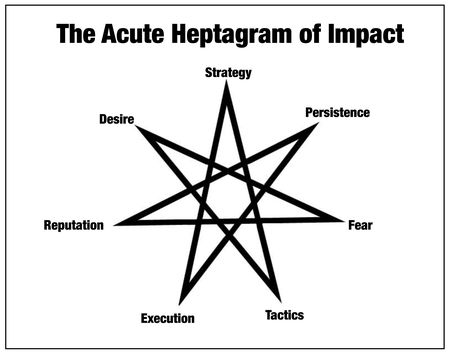
These seven elements:

  • Strategy
  • Tactics
  • Execution
  • Reputation
  • Persistence
  • Desire
  • Fear

These seven elements make up the seven points of the acute heptagram of impact. If your project isn’t working, it’s almost certainly because one or more of these elements aren’t right. And in my experience, it’s all of them. We generally pick the easiest and safest one to work on (probably tactics) without taking a deep breath and understanding where the real problem is.

Feel free to share the AHI, but please don’t have it tattooed on your hip or anything.

Read more from Seth here.

Download PDF

Tags: , ,

| What is MyVisionRoom? > | Back to Leadership >

ABOUT THE AUTHOR

Seth Godin

See more articles by >

COMMENTS

What say you? Leave a comment!

Recent Comments
comment_post_ID); ?> Thank you for this information. I'm going to use this article to improve my work with the Lord.
 
— Abel Singbeh
 
comment_post_ID); ?> Thank you Ed for sharing your insights into the Church Growth Movement. I have my reservations with Church Growth models because it has done more damage than good in the Body of Christ. Over the years, western churches are more focused on results, formulas and processes with little or no emphasis on membership and church discipline. Pastors and vocational leaders are burnt out because they're overworked. I do believe that the Church Growth model is a catalyst to two destructive groups: The New Apostolic Reformation and the Emerging Church. Both groups overlap and have a very loose definition. They're both focus on contemporary worship, expansion of church brand (franchising), and mobilizing volunteering members as 'leaders' to grow their ministry. Little focus on biblical study, apologetics and genuine missional work with no agenda besides preaching of the gospel.
 
— Dave
 
comment_post_ID); ?> Thank you for sharing such a good article. It is a great lesson I learned from this article. I am one of the leaders in Emmanuel united church of Ethiopia (A denomination with more-than 780 local churches through out the country). I am preparing a presentation on succession planning for local church leaders. It will help me for preparation If you send me more resources and recommend me books to read on the topic. I hope we may collaborate in advancing leadership capacity of our church. God Bless You and Your Ministry.
 
— Argaw Alemu
 

Clarity Process

Three effective ways to start moving toward clarity right now.

Why Plant Churches in the South?

As someone who speaks and writes quite often about church planting, there are a few specific questions I’m asked more frequently. One that always seems to arise is “Why plant churches in the South?” It’s a good question.

First, let me say that if you are not sure where to plant a church, I’d encourage you to consider international planting first. In other words, think about planting a church in the 10/40 window. If God does not want you there, think about planting in one of the megacities in North America. If not there, what about reaching the lost in rural (and unchurched) Maine or Montana (or lost of other similar areas)? If still not there, then at that point– maybe– you should consider the South.

It’s not that I don’t love the South– I just don’t think that everyone needs to plant there, and a disproportionate number of people say that God has called them to the South, forcing me to choose between the idea that God is not good at math or that church planters are going where there are already a lot of believers.

So, why plant churches in the South? And, obviously, why am I not taking my own advice?

Well, the short (and probably snarky) answer is simply “Why not?” But that obviously doesn’t begin to cover the multiple intricacies of the question. So let me attempt to cover a few of those.

First, on a personal note, what I described above is what I did. First, we considered planting internationally, but the Lord did not call us there (though we are involved and seek to send others). So, we went to a city (Buffalo). Then later we went to Erie, PA. Then, my life got a little crazy and I started being a seminary professor, researcher, whatever. So, now, I am planting a church in the South because that is where I live, I love my neighbors, they need Jesus, and I am a pastor. So, we planted Grace Church.

But, I also encourage others to plant churches in the South– and I’d like lots more (as long as you go through the process I mentioned above!). The fact is, God is calling many people to plant churches in the South. Here’s why:

1. There are still lost people in the South. Yes, we have more churches per capita in the southern states than in other regions of the country. And yes, the South is known as the Bible Belt. But that doesn’t mean everyone understands the gospel here or knows Christ as their savior. I assure you, that is not the case. The church our team planted here in the Nashville area is located in Hendersonville. That city alone has 61,000 residents in the area. But only 13,000 attend a Christian church on a given Sunday (which, by the way, does not mean we are 80% unchurched; it means that, on a given Sunday, about 20% of people go to church). However, if more than half of the people in my community are not in a church, I think there is plenty of room to plant another one. There are some other great churches in Hendersonville, but 48,000 people are still out there on a given Sunday– that’s just in my area! So the harvest is still white– in Nashville, Birmingham, Atlanta, Charlotte, Baton Rouge, Little Rock, Louisville, and everywhere in between.

2. It’s easier to birth a baby than to raise the (unwilling) dead. I’m a strong believer in church revitalization, so don’t take my comments out of context. I think (and could be wrong) that I have done more research on church revitalization and written more books on the subject than any active researcher in North America. Every denomination needs both a planting and a revitalization strategy. But many times the churches who need revitalization don’t want it. They want their community to change while they remain the same. But the community is always changing. New church plants are needed to match the changing landscape and composition of every neighborhood, whether that is in Augusta, Maine or Augusta, Georgia. So, we need to birth new babies if dying churches don’t want to be revitalized, and we need to help revitalize the churches that are willing..

3. Planting promotes revitalization. This may seem counterintuitive, but it is not. When churches are planted, other churches nearby often see what they are doing, learn from them, and engage their community with new enthusiasm. For example, I remember (way back in the day) when I planted a new church in a suburb of Erie, PA, we were the only contemporary church in town. Within a year of our launch, two other churches had started contemporary services and were reaching the young adults who, prior to that, were not engaged in their churches. Within a few more years, others followed– and, today, some of those services have exploded as new families have been reached.

4. Church planting not only encourages evangelism, but discipleship as well. While evangelism and reaching the lost is obviously a goal of church planting, many times discipleship of believers also increases. In most church plants, members are called to take on more than in more established churches. Involvement typically leads to a deepening of faith. Spiritual “muscles” are “worked out” in church planting and the result is usually a deeper, stronger faith. Not only does the church grow, but the people grow as well.

5. New churches reach people that established churches do not. A couple of months ago, I made a joke and asked if there were any yankees (or maybe non-Southerners) in the crowd (don’t remember the exact words). But, I do remember that more than half of the attendees raised their hands, much to my surprise. When I asked several, they explained why. As new people in the community, they found it hard to connect in established churches, but here they found relationships in the church plant and are now growing in their faith (or taking steps toward faith).

6. The work is not finished. This ties into point one, but deserves its own point. We are called to go and make disciples. The word “go” means to keep going. There is no end to our mission on this side of eternity. If the work is not finished– and it won’t be until the return of Christ– then we should be working.

We all have a context of ministry in which God has placed us. Because of my job I live in Nashville. Because I live in Nashville, I meet people without Christ– and they need a new church. So, mine happens to be in Middle Tennessee. Maybe yours is in the Midwest. If you’re called to plant, plant where you can bring glory to God no matter where that is. Whether your are in Jackson, MS, or Jackson Hole, WY, there are still people who need the gospel.

Download PDF

Tags: , ,

| What is MyVisionRoom? > | Back to Process >

ABOUT THE AUTHOR

Ed Stetzer

Ed Stetzer

Ed Stetzer, Ph.D., holds the Billy Graham Chair of Church, Mission, and Evangelism at Wheaton College and serves as Executive Director of the Billy Graham Center for Evangelism. He has planted, revitalized, and pastored churches, trained pastors and church planters on six continents, holds two masters degrees and two doctorates, and has written dozens of articles and books. Previously, he served as Executive Director of LifeWay Research. Stetzer is a contributing editor for Christianity Today, a columnist for Outreach Magazine, and is frequently cited or interviewed in news outlets such as USAToday and CNN. He serves as interim pastor of Moody Church in Chicago.

See more articles by >

COMMENTS

What say you? Leave a comment!

Recent Comments
comment_post_ID); ?> Thank you for this information. I'm going to use this article to improve my work with the Lord.
 
— Abel Singbeh
 
comment_post_ID); ?> Thank you Ed for sharing your insights into the Church Growth Movement. I have my reservations with Church Growth models because it has done more damage than good in the Body of Christ. Over the years, western churches are more focused on results, formulas and processes with little or no emphasis on membership and church discipline. Pastors and vocational leaders are burnt out because they're overworked. I do believe that the Church Growth model is a catalyst to two destructive groups: The New Apostolic Reformation and the Emerging Church. Both groups overlap and have a very loose definition. They're both focus on contemporary worship, expansion of church brand (franchising), and mobilizing volunteering members as 'leaders' to grow their ministry. Little focus on biblical study, apologetics and genuine missional work with no agenda besides preaching of the gospel.
 
— Dave
 
comment_post_ID); ?> Thank you for sharing such a good article. It is a great lesson I learned from this article. I am one of the leaders in Emmanuel united church of Ethiopia (A denomination with more-than 780 local churches through out the country). I am preparing a presentation on succession planning for local church leaders. It will help me for preparation If you send me more resources and recommend me books to read on the topic. I hope we may collaborate in advancing leadership capacity of our church. God Bless You and Your Ministry.
 
— Argaw Alemu
 

Clarity Process

Three effective ways to start moving toward clarity right now.

What’s the Deal with the Church Growth Movement, Part 3

In my last post I highlighted three negative unintentional outcomes of the Church Growth Movement. I champion missiologists like Donald McGavran, Win Arn, and others who wanted a missiological focus. I don’t blame them for all of the negative outcomes of Church Growth thinking. Our American consumer-driven culture, as well as an unhealthy obsession with success, has resulted in a formula-based approach to God’s mission. The movement became less missiological and more Americanized, particularly under the leadership of Peter Wagner.

The obsession with formulas and numerical results pre-dates McGavran and Arn, but it might help to see the history. A Mississippi clothing salesman, Arthur Flake, designed an approach to reaching people in the early 1920’s. His five principles became known as “Flake’s Formula.” The short version of the formula was enlarge, enlist, train, provide space, and go after people. Many denominations experienced incredible results through Sunday School, much of which is credited to Flake’s influence. He taught, among other things, that is you get __ leaders, you will get __ new attendees– and he was right. New leaders tend to gather new folks– that’s why we start new small groups.

So, if I think Flake was right, why bring him up? Well, the questions about Flake’s Formula are not questions about Arthur Flake. Neither are my questions about his lasting impact on adult Sunday School work in countless churches since the 1920’s. The danger is when we misappropriate ideas and the successful practices of others to become driven primarily by formulas. Often our desire to be successful can overshadow the mission of God in our community. Our obsession… our scorecard must always must be shaped by a desire to see lives transformed by the power of Christ, not just to run certain mathematical formulas to grow.

So, it’s hardly new in the Church Growth Movement (launched in the 50s, after Flake’s ideas). However, then soon the Church Growth Movement expanded and the formulas flourished. As I see it, the focus of many in the Church Growth Movement was more on formulas than on faithfulness.

Yet, formulas themselves are not the problem, nor are methods, but methodological mania is. When formulas ruled the day, soon everyone had a new formula to sell. Formulas became the focus and experts flew the country focusing on steps, formulas, and guaranteed results.

Two things happened. First, the formulas over-promised and under-delivered. In a sense, the movement lost much of its credibility because many tried the formulas and did not have the fruit– I would say because they did not have the evangelistic passion seen in the movement’s founders. In other words, Church Growth formulas without evangelistic passion leads to frustration and failure– as it should.

Second, the formulas became too much of a focus. You see, ultimately, I think that many in the Church Growth Movement lost their way because they confused tools with goals. The formulas became the goals, which is why the Church Growth Movement was embraced by people and movements that no longer believed in, for example, conversions (so central in McGarvan’s thinking). You did not need to believe in conversions, you just needed to implement these formulas, and your religious organization would grow.

So, where do we go today? Why do I believe that you should still value the movement?

Well, for one example, formulas still matter. You should shoot for 80% involvement of your church in small groups, for example, and 60% of your church serving, etc. That’s part of the reason why I am thankful for the Church Growth Movement (and you should be as well). Actually, I will explain next time why you are greatly influenced by it without knowing it– and you should be glad.

Before the Church Growth Movement, many people did not care if they church was growing, if it was reaching converts, and if people were involved and serving. It may sound strong to say that many did not care, but it was often accurate. Before the Church Growth Movement, things like the “remnant mentality” kept many thinking that they should just pray and preach and leave strategic thinking up to God. Thankfully, most don’t think that way today (though, regrettably, I still find it in some places, particularly among the most theologically minded, who are turned off by pragmatism.)

However, formulas are our servants and not our masters. We do research (and create formulas) from a theological grid with a missiological focus. That’s something that many of the early thinkers of the movement did, and some have tried to keep that focus throughout. For example, Gary McIntosh has both worked in the field, but also brought critical thinking about how to see the Church Growth Movement in his book Evaluating the Church Growth Movement.

So, feel free to share your comments, criticism, and disagreements in the comments. I will post one more installment in this series that will focus on the things we have learned from the movement and why it still matters.

Read previous parts of this series here: Part 1; Part 2.

Read more from Ed here.

Download PDF

Tags: , ,

| What is MyVisionRoom? > | Back to Vision >

ABOUT THE AUTHOR

Ed Stetzer

Ed Stetzer

Ed Stetzer, Ph.D., holds the Billy Graham Chair of Church, Mission, and Evangelism at Wheaton College and serves as Executive Director of the Billy Graham Center for Evangelism. He has planted, revitalized, and pastored churches, trained pastors and church planters on six continents, holds two masters degrees and two doctorates, and has written dozens of articles and books. Previously, he served as Executive Director of LifeWay Research. Stetzer is a contributing editor for Christianity Today, a columnist for Outreach Magazine, and is frequently cited or interviewed in news outlets such as USAToday and CNN. He serves as interim pastor of Moody Church in Chicago.

See more articles by >

COMMENTS

What say you? Leave a comment!

Dave — 12/11/23 7:16 am

Thank you Ed for sharing your insights into the Church Growth Movement. I have my reservations with Church Growth models because it has done more damage than good in the Body of Christ. Over the years, western churches are more focused on results, formulas and processes with little or no emphasis on membership and church discipline. Pastors and vocational leaders are burnt out because they're overworked. I do believe that the Church Growth model is a catalyst to two destructive groups: The New Apostolic Reformation and the Emerging Church. Both groups overlap and have a very loose definition. They're both focus on contemporary worship, expansion of church brand (franchising), and mobilizing volunteering members as 'leaders' to grow their ministry. Little focus on biblical study, apologetics and genuine missional work with no agenda besides preaching of the gospel.

Gary Westra — 04/15/14 8:40 pm

I love Ed's writings and heart. I am frustrated by these articles, however. Much of the missiological basis of the Church Growth Movement are not mentioned, and the origination of the formulas are not substantiated. Also, the Movement via Wagner, started mentioning the importance of health over 3o years ago. I wish these articles were better researched and less sweeping in their generalizations. Things like E1, E2, E3 evangelism, group multiplication, relational networks, faith, health, and the care to measure the right things are largely missing here. Perhaps Ed has earned the right to generalize, but I still was disappointed. But keep researching Ed! Ed and Thom have continued on in the spirit of the movement by doing quality research, and for that I am deeply grateful.

Recent Comments
comment_post_ID); ?> Thank you for this information. I'm going to use this article to improve my work with the Lord.
 
— Abel Singbeh
 
comment_post_ID); ?> Thank you Ed for sharing your insights into the Church Growth Movement. I have my reservations with Church Growth models because it has done more damage than good in the Body of Christ. Over the years, western churches are more focused on results, formulas and processes with little or no emphasis on membership and church discipline. Pastors and vocational leaders are burnt out because they're overworked. I do believe that the Church Growth model is a catalyst to two destructive groups: The New Apostolic Reformation and the Emerging Church. Both groups overlap and have a very loose definition. They're both focus on contemporary worship, expansion of church brand (franchising), and mobilizing volunteering members as 'leaders' to grow their ministry. Little focus on biblical study, apologetics and genuine missional work with no agenda besides preaching of the gospel.
 
— Dave
 
comment_post_ID); ?> Thank you for sharing such a good article. It is a great lesson I learned from this article. I am one of the leaders in Emmanuel united church of Ethiopia (A denomination with more-than 780 local churches through out the country). I am preparing a presentation on succession planning for local church leaders. It will help me for preparation If you send me more resources and recommend me books to read on the topic. I hope we may collaborate in advancing leadership capacity of our church. God Bless You and Your Ministry.
 
— Argaw Alemu
 

Clarity Process

Three effective ways to start moving toward clarity right now.

What’s the Deal with the Church Growth Movement, Part 2

As I continue my series about the Church Growth Movement I want to look at three ways the Church Growth Movement evolved. As I said previously, it is easy to take issue with something that was birthed in the 60’s (Volkswagen vans and the Beatles were not all bad). But the misapplication of the principles always happens when you get beyond the headwaters of a movement. Although the Church Growth Movement was well intended, all the results have not been good. Here are three ways the Church Growth Movement evolved that was not helpful to mission of God in North America.

1) Americanization of the Movement – When the movement became americanized, there were consequences. Some Church Growth leaders sounded like sales consultants. Some reminded me of greatest pitchman in history, the late Billy Mayes. I see him swinging his arms passionately, in his blue denim shirt, pitching the power of Oxiclean. A money back guarantee was included, of course. Some (certainly not all) Church Growth leaders, as with good pitchmen, address a pain point. The pain point that birthed the Church Growth Movement was “Are you tired of the lack of results at growing your church in spite of your best efforts?” The answer, it appears, was better plans.

To be honest, we Americans are guilty of turning anything good into a business. The Church Growth movement is no exception. In The Church Between Gospel and Culture, Richard Halverson wrote, “When the Greeks got the gospel they turned it into a philosophy, when the Romans got it they turned it into a government, when the Europeans got it they turned it into a culture; when the Americans got it they turned it into an enterprise.” An unfortunate by-product of the Church Growth Movement is that growing God’s church can be as simple as 1-2-3 with guaranteed results. I call it methodological mania. Some in the Church Growth Movement lost their way when they became more driven by methodological mania than by a central focus on mission.

2) A New Kind of Mission Station Mentality – I have heard the church called a mission outpost in a positive sense. I agree the church is a mission outpost if you are describing a place from which missionaries are sent across the street and around the world. But McGavran took issue with an approach to the mission of God that resulted in missionary isolationism. Another unintended dark side of Church Growth is that it produced another mission station mentality. Our best hopes focused on making the church so attractive that even a lost person would want to come inside to discover Jesus. What happened however, for the most part, is that we made the church become a great place to be for Christians or a “warehousing effect.” With all our best intentions we must guard against, yes, that’s right, guard against making our church “the place to be.” We must avoid “come and see” mentality that tempts our people to “do life” at church 24/7.

The church can never become the place where I live, work, and play. My neighborhood is where real people live. I am not sent by God to a church facility, ever how convenient and impressive it may be. I am sent away from the church gathered to my tribe and household with the Good News of the Gospel. That is where transformational movements take place that engage every man, woman, and child with the Gospel. So, too many in church growth focused on the barn, rather than how we might live on mission among the white fields. When focusing too much on the barn, we sometimes forget that the wheat will not harvest itself.

3) A Sociological Phenomenon – Much of Church Growth theory was based on sociology– and sociology is not a bad thing. We use sociology in missiology because we can understand social structures. For example, in missiology, we understand the sociological realities of the people are are trying to reach. We know, for example, that some cultures see family in a certain way and we take that into account.

Thus, the focus became (at times) focused on using sociological tools and realities to reach people. As such, evangelism was mistakenly depersonalized by making it the responsibility of the institutional church as it engaged its society rather than individuals who were reaching and serving others. Bricks, mortar, and programs do not take away my responsibility to be a living epistle in my neighborhood through word and deed. The end result was, as I see it, too much sociology and not enough focus on the mission itself.

Now, it is important to note that all three of these problems were caused, in some ways, by reactions to the issues before them. For example, I believe that the missio dei movement (1950-1970) gave birth to the Church Growth Movement (1960-1990) which gave birth a the missional church movement (1990-today). Though I do not have the space here to unpack that all here, I think it is important to note that most of the Church Growth proponents, were asking questions about how best to reach more people for Jesus when many in the mainline traditions had lost that focus (when the missio dei became so overwhelmingly focused on societal transformation– see an earlier blog post here).

In my next post I will conclude my series by telling you how the Kingdom of God has gained because of the Church Growth Movement.

Read Part 1 of this series here; read Part 3 here.

Read more from Ed here.
Download PDF

Tags: , ,

| What is MyVisionRoom? > | Back to Vision >

ABOUT THE AUTHOR

Ed Stetzer

Ed Stetzer

Ed Stetzer, Ph.D., holds the Billy Graham Chair of Church, Mission, and Evangelism at Wheaton College and serves as Executive Director of the Billy Graham Center for Evangelism. He has planted, revitalized, and pastored churches, trained pastors and church planters on six continents, holds two masters degrees and two doctorates, and has written dozens of articles and books. Previously, he served as Executive Director of LifeWay Research. Stetzer is a contributing editor for Christianity Today, a columnist for Outreach Magazine, and is frequently cited or interviewed in news outlets such as USAToday and CNN. He serves as interim pastor of Moody Church in Chicago.

See more articles by >

COMMENTS

What say you? Leave a comment!

Recent Comments
comment_post_ID); ?> Thank you for this information. I'm going to use this article to improve my work with the Lord.
 
— Abel Singbeh
 
comment_post_ID); ?> Thank you Ed for sharing your insights into the Church Growth Movement. I have my reservations with Church Growth models because it has done more damage than good in the Body of Christ. Over the years, western churches are more focused on results, formulas and processes with little or no emphasis on membership and church discipline. Pastors and vocational leaders are burnt out because they're overworked. I do believe that the Church Growth model is a catalyst to two destructive groups: The New Apostolic Reformation and the Emerging Church. Both groups overlap and have a very loose definition. They're both focus on contemporary worship, expansion of church brand (franchising), and mobilizing volunteering members as 'leaders' to grow their ministry. Little focus on biblical study, apologetics and genuine missional work with no agenda besides preaching of the gospel.
 
— Dave
 
comment_post_ID); ?> Thank you for sharing such a good article. It is a great lesson I learned from this article. I am one of the leaders in Emmanuel united church of Ethiopia (A denomination with more-than 780 local churches through out the country). I am preparing a presentation on succession planning for local church leaders. It will help me for preparation If you send me more resources and recommend me books to read on the topic. I hope we may collaborate in advancing leadership capacity of our church. God Bless You and Your Ministry.
 
— Argaw Alemu
 

Clarity Process

Three effective ways to start moving toward clarity right now.

What’s the Deal with the Church Growth Movement, Part 1

Today, I begin a blog series that takes a closer look at the Church Growth Movement. Our approach to church today has been shaped by this movement whether we are conscious of it or not. Good and bad have evolved from the early days. By taking a closer look at the movement I hope we can learn and become more focused on lostness issues in America. So where were the thoughts and dreams of the early voices in the Church Growth Movement?

Now, church growth (as attendance) is not the same as Church Growth (as a movement). Most people would be in favor of growing a church, but Church Growth has become controversial (see the Google search on the movement to see how many links are to critiques).

So, what is Church Growth (when using capital letters). The American Society of Church Growth (now the Great Commission Research Network) defines it as:

Church growth is that discipline which investigates the nature, function, and health of Christian churches, as they relate to the effective implementation of the Lord’s Great Commission to make disciples of all peoples (Mt. 28:19-20). It is a spiritual conviction, yet it is practical, combining the eternal principles of God’s Word with the practical insights of social and behavioral sciences.
Over the next few weeks, I want to talk a look at the movement, starting with the person widely seen as the founder of the movement.

Donald McGavran, was a missiologist and third generation missionary born in India. He is universally considered the father of the Church Growth Movement. He was, interestingly, a missiologist and that was related to his emphasis.

As a missiolgist, when he suggested the need to transition our strategy from “people” to “peoples” in his work Bridges of God in 1954, it impacted his views (and the Church Growth Movement) in big ways. His study of groups (or peoples) on how they respond, undergirded the movement’s emphasis on statistics, sociology, analysis, and more.

Let me say that I am a fan of Donald McGavran. We may learn more by understanding what McGavran was not saying, particularly from the beginning. For example, McGavran took on the most popular, long standing approach to international missions and evangelism. He declared the “mission station approach,” that had existed for over 150 years, was ineffective for reaching the masses. He determined that by measurement– he analyzed and came to statistical conclusions that undergirded his missiological decisions that led to the Church Growth Movement.

For background, the mission station approach encouraged new converts to leave their tribe and isolate themselves. They took advantage of Western churches, hospitals, and schools (goods and services) established on international mission fields. He did not deny the positive outcomes through this approach but called for a “new pattern” when it comes to results (peoples being converted to Christ):

A new pattern is at hand, which, while new, is as old as the Church itself. It is a God-designed pattern by which not ones but thousands will acknowledge Christ as Lord, and grow into full discipleship as people after people, clan after clan, tribe after tribe and community after community are claimed for and nurtured in the Christian faith.(Bridges of God 331,332). Other names that shaped the early thinking of the church growth movement included Win Arn and C. Peter Wagner. (More on them, particularly Wagner, later and how they altered the direction of the movement.)

But, before discussing these leaders and the movement, it’s important to understand the heart of what they were thinking. In moving the Church Growth lens to the West, they wrestled with the question: “How do we reach peoples (as opposed to a few random individuals) with the gospel in the U.S.?” Church growth thinkers, simply put, were trying to answer the question a different way in light of the struggles of churches in the West.

Some people I know would respond to the question of our missionary ineffectiveness with “Well, you don’t need to worry about that. Just read the Bible and preach the gospel, and leave the results up to God.” But that response is, in my view, not the best.

What if you were to take two missionaries and send them to the Pokot in Africa? Then you told one of them, “Preach the gospel, love people, but learn the culture. Learn how the people work, think, live, and speak.” Then you say to the other missionary, “Listen, just preach the gospel and love people.” You would find very different results between the two missionaries don’t you think? Both of them preached the gospel and loved people, but they engaged their culture on different levels.

McGavran’s challenge was to dig into existing relational networks. Do not encourage believers to isolate themselves from their greatest place of Gospel influence– their family and neighbors. That was a missiology question and it assumes that missiology (with its research, sociology, and cultural understanding) has some value.

Obviously, I think there is much we can learn from the Church Growth Movement. However, in my next post I will talk about three unfortunate outcomes of Church Growth thinking.

Read Part 2 of this series here.

Read more from Ed here.

Download PDF

Tags: , ,

| What is MyVisionRoom? > | Back to Vision >

ABOUT THE AUTHOR

Ed Stetzer

Ed Stetzer

Ed Stetzer, Ph.D., holds the Billy Graham Chair of Church, Mission, and Evangelism at Wheaton College and serves as Executive Director of the Billy Graham Center for Evangelism. He has planted, revitalized, and pastored churches, trained pastors and church planters on six continents, holds two masters degrees and two doctorates, and has written dozens of articles and books. Previously, he served as Executive Director of LifeWay Research. Stetzer is a contributing editor for Christianity Today, a columnist for Outreach Magazine, and is frequently cited or interviewed in news outlets such as USAToday and CNN. He serves as interim pastor of Moody Church in Chicago.

See more articles by >

COMMENTS

What say you? Leave a comment!

Recent Comments
comment_post_ID); ?> Thank you for this information. I'm going to use this article to improve my work with the Lord.
 
— Abel Singbeh
 
comment_post_ID); ?> Thank you Ed for sharing your insights into the Church Growth Movement. I have my reservations with Church Growth models because it has done more damage than good in the Body of Christ. Over the years, western churches are more focused on results, formulas and processes with little or no emphasis on membership and church discipline. Pastors and vocational leaders are burnt out because they're overworked. I do believe that the Church Growth model is a catalyst to two destructive groups: The New Apostolic Reformation and the Emerging Church. Both groups overlap and have a very loose definition. They're both focus on contemporary worship, expansion of church brand (franchising), and mobilizing volunteering members as 'leaders' to grow their ministry. Little focus on biblical study, apologetics and genuine missional work with no agenda besides preaching of the gospel.
 
— Dave
 
comment_post_ID); ?> Thank you for sharing such a good article. It is a great lesson I learned from this article. I am one of the leaders in Emmanuel united church of Ethiopia (A denomination with more-than 780 local churches through out the country). I am preparing a presentation on succession planning for local church leaders. It will help me for preparation If you send me more resources and recommend me books to read on the topic. I hope we may collaborate in advancing leadership capacity of our church. God Bless You and Your Ministry.
 
— Argaw Alemu
 

Clarity Process

Three effective ways to start moving toward clarity right now.

The Top 3 Approaches to a Multisite Church Website

The multisite revolution is underway as more churches nationwide are choosing to launch new campuses. According to Outreach Magazine, 75 of the 100 Largest Churches in America are multisite. There are myriad reasons to explain this transition, the biggest one being the cost efficiency to broaden the church’s reach. Regardless of why, the trend continues.

The idea of “one church, multiple locations” isn’t new to the local church. In fact, it’s as old as the New Testament itself. Perhaps that’s why multisite churches baptize more people, have more volunteers, and produce more diverse communities than single-site churches.

With all the positives, having multiple sites creates unique and specific challenges for churches seeking to organize content, provide value, and accomplish missional goals with their website.

At MonkDev we help thousands of churches use technology to further the gospel. Lately, more of our clients are coming from a multisite community. We partner with these churches to help build out a web strategy that appropriately translates their organization’s mission online. (If that interests you, click here to learn about our Web Strategy Services for Churches.)

We want to spend the next few weeks exploring multisite web presence trends. We’ll unpack one example each week. This week, I’ll provide a brief outline of the specific examples we’re seeing in multisite communities.

Here they are from least common to most:

Trend #1: Universal Website – Multicampus Information

The least common method is to have a universal website representing the entire church while listing information for different campuses in the navigation. This approach works well in a densely-populated area where events throughout the week are available to all and are less “campus” dependent.

The challenge here is usability. This approach requires users to determine what context the content or events apply to. If they aren’t familiar with your community, they may choose not to participate at all.

Trend #2: Standalone Campus Websites

This method works well when one church has multiple locations with separate preaching pastors and/or leadership teams. A church can convey that, while they are bound together in mission, each location has a unique identity. Locations have greater autonomy in developing their web presence.

The challenge presented with this approach is website management. Many church teams struggle with keeping content fresh on one site. Managing multiple websites can add significant content challenges. Be sure to keep cost in mind!

Trend #3: Universal Website – Campus Select Option

This approach is the most common of the three we’ve listed. The biggest benefit here is clearly identifying your site locations and asking you user to self-identify with one of them. Teams managing the website also benefit from keeping church branding uniform. Content is managed easier with this approach, as one person can push content to multiple sites.

Conversely, if you’re not working with a CMS (a content management system like Ekklesia360) with this strategy, you run the risk of duplicating content, pages, etc.


Conclusion on Multisite Web Presence Strategies

Churches who choose multisite have much to think about. According to our own research, 51% of members and visitors stated the church’s website was somewhat to very important in their decision to attend the church. That number, by the way, keeps increasing.

If you’re a member of a multisite community, or even considering it, this blog series will be important for you to follow in the weeks ahead.

To begin this series, go here.

Read more from Justin here.
 

Download PDF

Tags: , , , ,

| What is MyVisionRoom? > | Back to Communication >

ABOUT THE AUTHOR

Justin Wise

See more articles by >

COMMENTS

What say you? Leave a comment!

Recent Comments
comment_post_ID); ?> Thank you for this information. I'm going to use this article to improve my work with the Lord.
 
— Abel Singbeh
 
comment_post_ID); ?> Thank you Ed for sharing your insights into the Church Growth Movement. I have my reservations with Church Growth models because it has done more damage than good in the Body of Christ. Over the years, western churches are more focused on results, formulas and processes with little or no emphasis on membership and church discipline. Pastors and vocational leaders are burnt out because they're overworked. I do believe that the Church Growth model is a catalyst to two destructive groups: The New Apostolic Reformation and the Emerging Church. Both groups overlap and have a very loose definition. They're both focus on contemporary worship, expansion of church brand (franchising), and mobilizing volunteering members as 'leaders' to grow their ministry. Little focus on biblical study, apologetics and genuine missional work with no agenda besides preaching of the gospel.
 
— Dave
 
comment_post_ID); ?> Thank you for sharing such a good article. It is a great lesson I learned from this article. I am one of the leaders in Emmanuel united church of Ethiopia (A denomination with more-than 780 local churches through out the country). I am preparing a presentation on succession planning for local church leaders. It will help me for preparation If you send me more resources and recommend me books to read on the topic. I hope we may collaborate in advancing leadership capacity of our church. God Bless You and Your Ministry.
 
— Argaw Alemu
 

Clarity Process

Three effective ways to start moving toward clarity right now.

Multisite Church Website Approach 1: Keep It Under One Roof

Multisite church planting has gone mainstream. As goes the church, so goes the website. We’re going to go in-depth with the Universal Website with Multicampus Information approach.

As we stated in the introduction to this series, the advantage to this type of site is having all the information under one digital content roof. It works extremely well in densely-populated areas where events throughout the week are available to all and are less campus dependent.

In most cases, the reasons for going multisite revolve around cost efficiency to broaden reach. Why have people drive 30 minutes to a campus when they can drive five and bring more of their neighbors with them?

If, however, a church is in a densely populated area, and mass transit is readily available, the geographical area to work within is much smaller.

Mutlisite communities like this can “blend together” without the need for developing separate identities for each campus. A member might participate in the men’s ministry at one campus and worship at another. Why? The campus for men’s ministry is closer to their work and the worship community campus is closer to their house. Convenience plays a larger factor in church attendance than most would care to admit.

Here are a few examples to consider as you map out your multisite website. While these churches are located in larger population centers, this approach can also be adapted for smaller communities. (For instance, The Leadership Network released a survey that said the median size today for a multisite church is 1,300 attendees.)

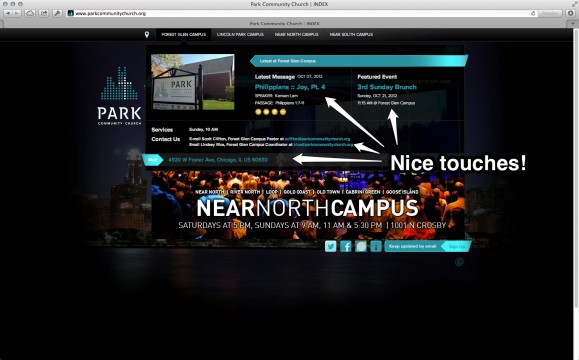
Park Community Church – Chicago, IL

When you click the campus links at the top of the page, Park Community Church shows you a “snapshot” for each location.

Each site displays the latest message, a featured event, contact information, and physical address. Great for gauging which location is most relevant for the user.


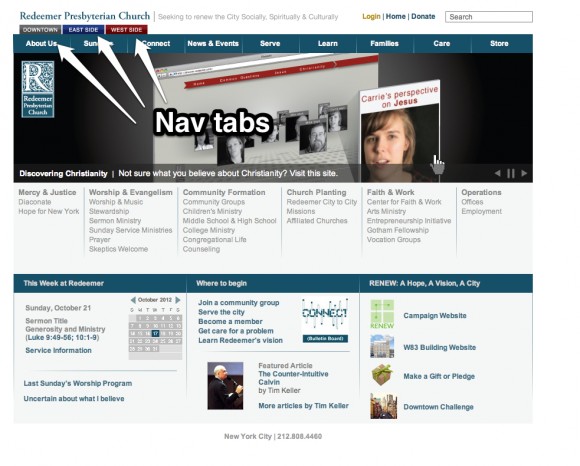
Redeemer Presbyterian Church – New York City, NY

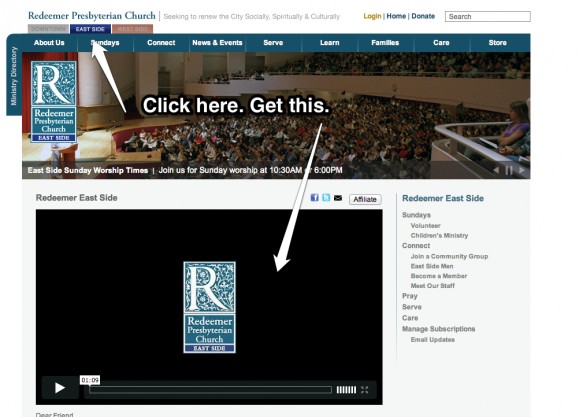
Redeemer Presbyterian gathers all of their campus information onto one main site. The upper left corner allows users to sift through content for each campus using tabs. The benefit of this approach having all church-related content under one “roof.” The URL is fantastic as well!


Woodlands Church – Woodlands, TX

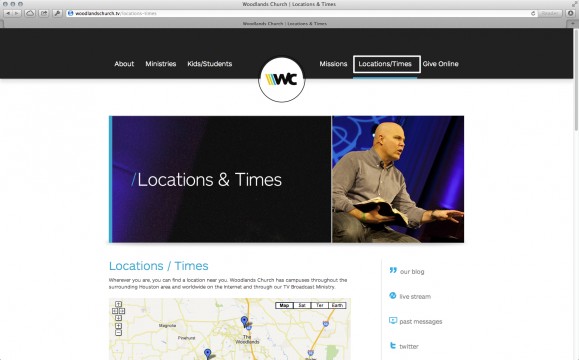
Woodlands Church lists all of their campuses on one page, giving the addresses, phone numbers, and service times for each location.

Once you’ve located a campus that works, you can view the events for that location. Best feature? The ability to filter events by ministry areas. This approach keeps users in one location, cutting down on distraction and location confusion.

Conclusion

If you’re looking for an easy to way to start with a multisite church website, this approach may be best for you. Leave the microsite and stand-alone site planning for later.

Read the Introduction to this series here; read Part 2 here.
Read more from Justin here.

Download PDF

Tags: , , , , ,

| What is MyVisionRoom? > | Back to Communication >

ABOUT THE AUTHOR

Justin Wise

See more articles by >

COMMENTS

What say you? Leave a comment!

Recent Comments
comment_post_ID); ?> Thank you for this information. I'm going to use this article to improve my work with the Lord.
 
— Abel Singbeh
 
comment_post_ID); ?> Thank you Ed for sharing your insights into the Church Growth Movement. I have my reservations with Church Growth models because it has done more damage than good in the Body of Christ. Over the years, western churches are more focused on results, formulas and processes with little or no emphasis on membership and church discipline. Pastors and vocational leaders are burnt out because they're overworked. I do believe that the Church Growth model is a catalyst to two destructive groups: The New Apostolic Reformation and the Emerging Church. Both groups overlap and have a very loose definition. They're both focus on contemporary worship, expansion of church brand (franchising), and mobilizing volunteering members as 'leaders' to grow their ministry. Little focus on biblical study, apologetics and genuine missional work with no agenda besides preaching of the gospel.
 
— Dave
 
comment_post_ID); ?> Thank you for sharing such a good article. It is a great lesson I learned from this article. I am one of the leaders in Emmanuel united church of Ethiopia (A denomination with more-than 780 local churches through out the country). I am preparing a presentation on succession planning for local church leaders. It will help me for preparation If you send me more resources and recommend me books to read on the topic. I hope we may collaborate in advancing leadership capacity of our church. God Bless You and Your Ministry.
 
— Argaw Alemu
 

Clarity Process

Three effective ways to start moving toward clarity right now.

Multisite Church Website Approach 2: Standalone Sites

We continue our Multisite Church Website series this week by looking at “Standalone Sites.” This is when churches choose to create separate sites for each one of their campuses. (By contrast, you might want to revisit last week’s post on churches who keep all campuses under one digital “roof.”)

This method works well when one church has multiple locations with separate preaching pastors and/or leadership teams. A church can convey that, while they are bound together in mission, each location has a unique identity. Locations have greater autonomy in developing their web presence.

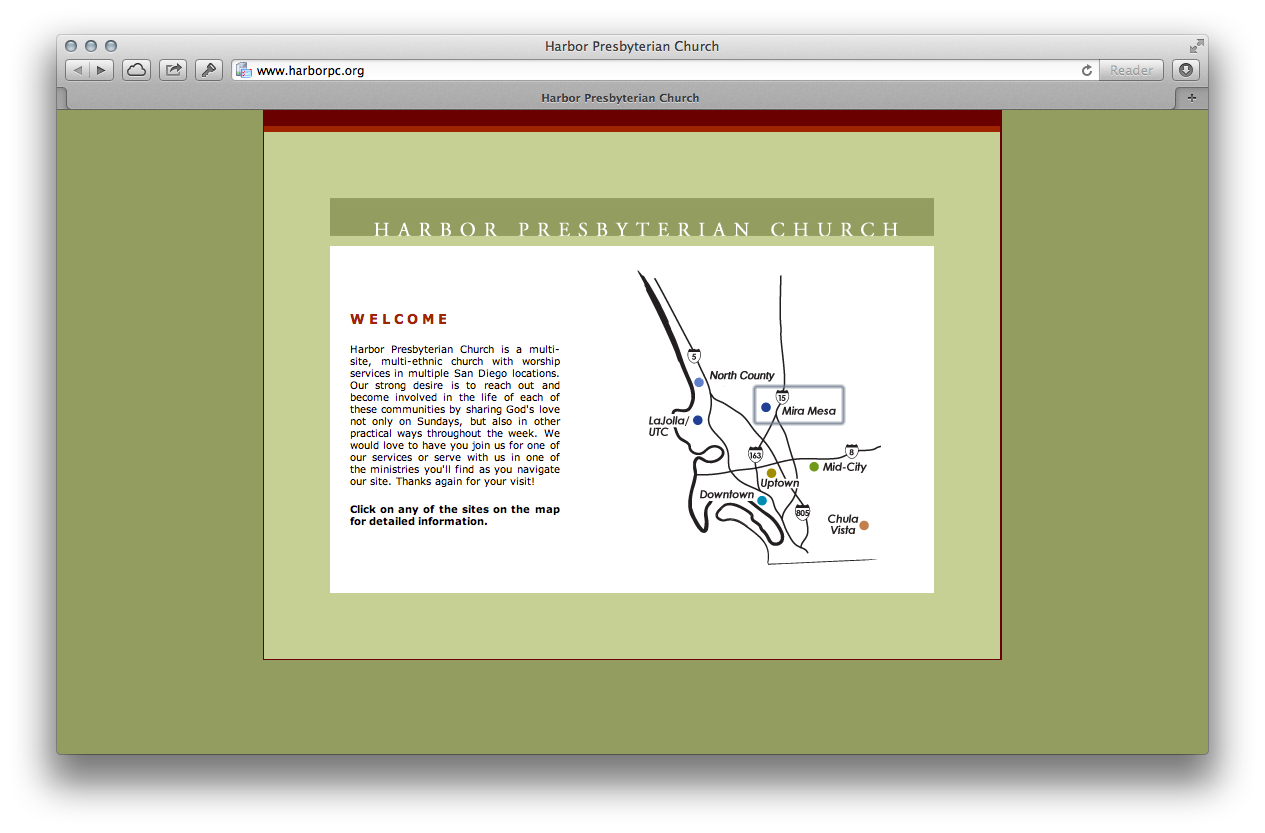
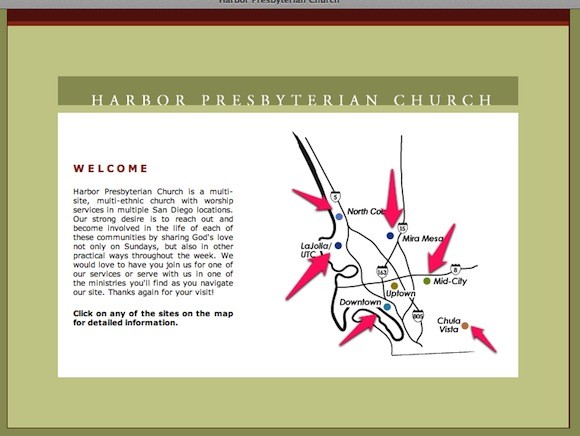
We are working with Harbor Presbyterian here in San Diego to implement this strategy. Harbor chose this method because while it’s one church community, each campus has its own preaching pastor and leadership team.

At Harbor, each campus serves as a local area church with shared central services. Additionally, each campus has its own visual brand, contextualizing each campus for the communities they seek to reach. The church has seven locations and is launching new ones each year, with some being as far as an hour apart.

Here’s what their main site looks like. Note the different locations:


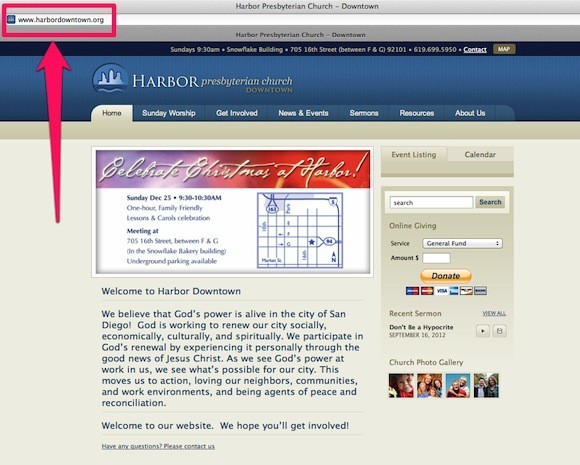
The Chula Vista site:


It should be noted that this approach requires a healthy amount of resources. With separate sites, each online outpost must be managed individually. Content creation, design, and updates must be accounted for on each site.

Aside from Harbor, here are a few more examples of churches who use the “Standalone Site” approach for their multisite website strategy.


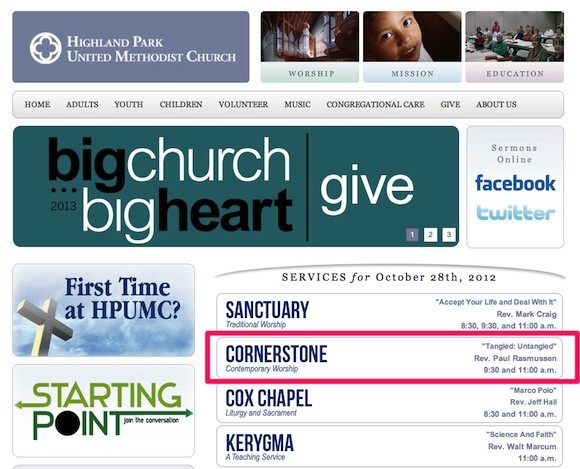
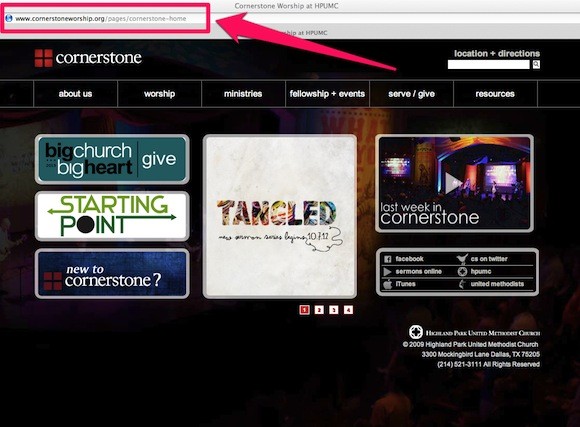
Multisite Church Website Example – Highland Park

While Highland doesn’t have a true standalone solution, I chose to include it because each campus site is designed differently. Visually, they’re telling the user these faith communities are different. Some of campuses have their own microsite while others exist as a page on the main site. The giveaway is the URL structure.

Here’s the main site:


Here’s the page for one of their more modern worship communities.


Multisite Church Website Example – Woodlands United Methodist

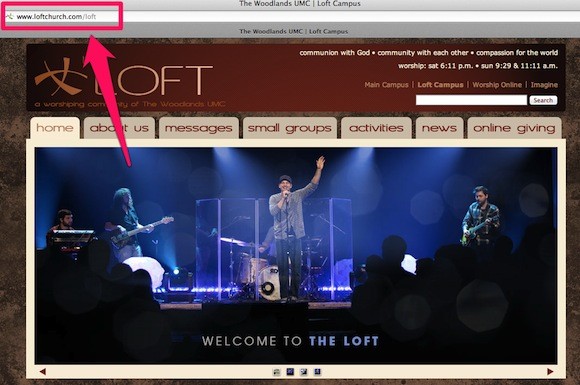
The Woodlands has a structure similar to Highland Park. The separate campus has it’s own website, URL, and theme. Visually speaking there are similarities between the main site and the Loft campus. They are distinct enough to communicate a difference.

The main site.


The Loft Campus site.


Conclusion

The Standalone Solution would work well for churches who have more of a distributed ministry model. Each campus would be responsible for updating its own content, sermons, events, and ministry info. The downside? It can take more internal resources to manage and execute effectively.

To read the previous posts in this series: Introduction; Part 1. To read Part 3, go here.
To read more from Justin, go here.
Download PDF

Tags: , , , , ,

| What is MyVisionRoom? > | Back to Communication >

ABOUT THE AUTHOR

Justin Wise

See more articles by >

COMMENTS

What say you? Leave a comment!

Recent Comments
comment_post_ID); ?> Thank you for this information. I'm going to use this article to improve my work with the Lord.
 
— Abel Singbeh
 
comment_post_ID); ?> Thank you Ed for sharing your insights into the Church Growth Movement. I have my reservations with Church Growth models because it has done more damage than good in the Body of Christ. Over the years, western churches are more focused on results, formulas and processes with little or no emphasis on membership and church discipline. Pastors and vocational leaders are burnt out because they're overworked. I do believe that the Church Growth model is a catalyst to two destructive groups: The New Apostolic Reformation and the Emerging Church. Both groups overlap and have a very loose definition. They're both focus on contemporary worship, expansion of church brand (franchising), and mobilizing volunteering members as 'leaders' to grow their ministry. Little focus on biblical study, apologetics and genuine missional work with no agenda besides preaching of the gospel.
 
— Dave
 
comment_post_ID); ?> Thank you for sharing such a good article. It is a great lesson I learned from this article. I am one of the leaders in Emmanuel united church of Ethiopia (A denomination with more-than 780 local churches through out the country). I am preparing a presentation on succession planning for local church leaders. It will help me for preparation If you send me more resources and recommend me books to read on the topic. I hope we may collaborate in advancing leadership capacity of our church. God Bless You and Your Ministry.
 
— Argaw Alemu
 

Clarity Process

Three effective ways to start moving toward clarity right now.

Multisite Church Website Approach 3: Campus Select Option

We conclude our series on Multisite Church Websites with the most common approach of the three, the Universal Website with a campus select option.

One of the most well-known examples of this approach comes from The Village Church in Flower Mound, TX. Let’s jump right in, shall we?

Here’s how you’re greeted the first time you visit the church’s website:

Before you go any further into the site, you’re asked to pick a default campus. This approach works best if you identify clearly where the various campuses are located, as The Village Church has done.

f someone is visiting the site for the first time, they may know nothing about your church and simply want to find the location that’s closest to them. This approach helps them do that immediately and then tailors the web experience for them moving forward.

After you pick a location for The Village Church, your browser automatically remembers your choice each time you come back. If you need to change campuses, you can. Just use the campus selector at the top.

The biggest benefit to this approach is clearly identifying your site locations and asking you user to self-identify with one of them. Teams managing the website also benefit from keeping church branding uniform. Content is managed easier with this approach, as one person can push content to multiple sites.

Here are some other examples of churches using the Universal Website with campus select option:

Biltmore Baptist Church

As you hover over each location, it displays when services are held, what the physical location is, and a link to Google maps. In the case of the online campus, it displays a countdown timer that shows when the next service will go live. Very helpful.

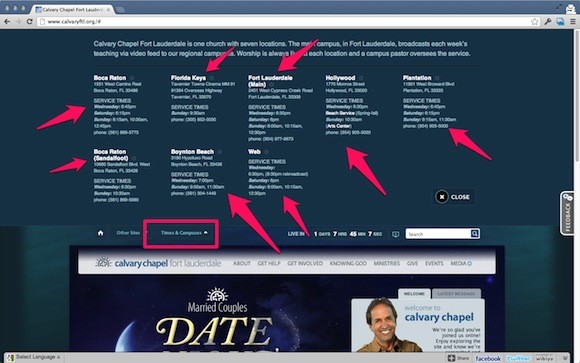
Calvary Chapel Fort Lauderdale

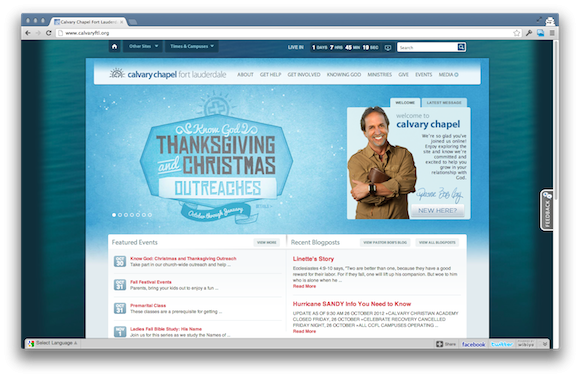
Calvary Chapel Fort Lauderdale helps you to immediately identify what location is nearest/most relevant for you. The “Times & Campuses” tab is prominently displayed in the navigation.

Click on it and you get this beautiful mega nav drop down:

Once you’ve found the church nearest you, you can quickly get to know who is behind each location without having to leave the page.

Conclusion

Building an online presence for multisite churches takes considerable planning, resources, and attention. Coordinating communication efforts across locations, whether two or 20, means forming an organizational-wide strategy and sticking to it. Ministry can, and does, happen online. Help your multisite church accomplish goals by having the right online strategy in place.

This concludes the series. To read prior posts: Introduction; Part 1; Part 2.

Read more from Justin here.

Download PDF

Tags: , , , , ,

| What is MyVisionRoom? > | Back to Communication >

ABOUT THE AUTHOR

Justin Wise

See more articles by >

COMMENTS

What say you? Leave a comment!

Recent Comments
comment_post_ID); ?> Thank you for this information. I'm going to use this article to improve my work with the Lord.
 
— Abel Singbeh
 
comment_post_ID); ?> Thank you Ed for sharing your insights into the Church Growth Movement. I have my reservations with Church Growth models because it has done more damage than good in the Body of Christ. Over the years, western churches are more focused on results, formulas and processes with little or no emphasis on membership and church discipline. Pastors and vocational leaders are burnt out because they're overworked. I do believe that the Church Growth model is a catalyst to two destructive groups: The New Apostolic Reformation and the Emerging Church. Both groups overlap and have a very loose definition. They're both focus on contemporary worship, expansion of church brand (franchising), and mobilizing volunteering members as 'leaders' to grow their ministry. Little focus on biblical study, apologetics and genuine missional work with no agenda besides preaching of the gospel.
 
— Dave
 
comment_post_ID); ?> Thank you for sharing such a good article. It is a great lesson I learned from this article. I am one of the leaders in Emmanuel united church of Ethiopia (A denomination with more-than 780 local churches through out the country). I am preparing a presentation on succession planning for local church leaders. It will help me for preparation If you send me more resources and recommend me books to read on the topic. I hope we may collaborate in advancing leadership capacity of our church. God Bless You and Your Ministry.
 
— Argaw Alemu
 

Clarity Process

Three effective ways to start moving toward clarity right now.