Have You Considered a Ministry Connections Concierge at Your Church?

How do you help people make meaningful connections when they attend your church? One of the most frustrating things in finding a church has been figuring how to connect with other attenders. My wife had a great idea the other day and I wanted to pass it on before it slips into the abyss forgetfulness that is my brain. What if you had a Connection Concierge?

Most people are familiar with the Concierge at an upscale hotel. Their job is to help hotel guests buy tickets, make dinner reservations or suggest day trip destinations; basically to ensure the guest has a positive experience while they are in town. Here is a typical conversation with a Concierge:

“Can you help us find a nice place to eat tonight?”

“Absolutely. What kind of food are you in the mood for?”

“Italian sounds good”

“Excellent, here are three nice Italian restaurants in the area. I highly recommend Guido’s, their lasagna is amazing. Would you  like me to make a reservation?”

“That would be great, thanks!”

“My pleasure”

Wouldn’t it be cool to have a Concierge available at your church? A conversation might go like this:

“We’re new to the church and we’re wondering how we could connect?”

“I’d love to help you with that! Can you tell me a little about your family?”

“We are empty nesters and we just moved to town. We’d love to meet other people around our age”

“Excellent. Let me suggest two or three ways we can help. First, we have a Newcomers Gathering next weekend, here’s a flyer about that. We also several couples groups that meet in homes. Let me show you a list on our website. I highly recommend the Smith’s group which meets on Friday nights in the Oaks Subdivision, they are a lot of fun and love welcoming new attenders. Could I assist with an introduction?”

“We probably need to think about it?”

“Absolutely. Please stop back by any weekend and we’d be glad to help you make a connection. Thanks for stopping by!”

Ideally there are be several trained volunteers who man a Concierge desk each weekend as well as be available at the end of events like Newcomers, Membership Class, Meet the Pastor to help people take next steps. The goal is to provide easy onramps for people with a desire to serve and/or connect at the church beyond sign up sheets or simply answering questions at a Welcome Center.

I think there is huge potential, I just wish I had thought of it.

Read more from Geoff here.

Download PDF

Tags: , ,

| What is MyVisionRoom? > | Back to Process >

ABOUT THE AUTHOR

Geoff Surratt

Geoff Surratt

Geoff lives in Denver, Colorado with his wife Sherry (CEO of MOPS International). Geoff and Sherry have two awesome kids (Mike and Brittainy), a wonderful daughter-in-law (Hilary) and the most beautiful granddaughter on earth (Maggie Claire) Geoff has served on staff at Seacoast Church and Saddleback Church. He is now the Director of Exponential and a freelance Church Catalyst and Encourager.

See more articles by >

COMMENTS

What say you? Leave a comment!

Recent Comments
comment_post_ID); ?> Thank you for this information. I'm going to use this article to improve my work with the Lord.
 
— Abel Singbeh
 
comment_post_ID); ?> Thank you Ed for sharing your insights into the Church Growth Movement. I have my reservations with Church Growth models because it has done more damage than good in the Body of Christ. Over the years, western churches are more focused on results, formulas and processes with little or no emphasis on membership and church discipline. Pastors and vocational leaders are burnt out because they're overworked. I do believe that the Church Growth model is a catalyst to two destructive groups: The New Apostolic Reformation and the Emerging Church. Both groups overlap and have a very loose definition. They're both focus on contemporary worship, expansion of church brand (franchising), and mobilizing volunteering members as 'leaders' to grow their ministry. Little focus on biblical study, apologetics and genuine missional work with no agenda besides preaching of the gospel.
 
— Dave
 
comment_post_ID); ?> Thank you for sharing such a good article. It is a great lesson I learned from this article. I am one of the leaders in Emmanuel united church of Ethiopia (A denomination with more-than 780 local churches through out the country). I am preparing a presentation on succession planning for local church leaders. It will help me for preparation If you send me more resources and recommend me books to read on the topic. I hope we may collaborate in advancing leadership capacity of our church. God Bless You and Your Ministry.
 
— Argaw Alemu
 

Clarity Process

Three effective ways to start moving toward clarity right now.

Are You a Smart or Healthy Church Leader?

You must be an active subscriber to view this premium content. Subscribe or Login.

Download PDF

Tags: , , ,

| What is MyVisionRoom? > | Back to Vision >

ABOUT THE AUTHOR

Will Mancini

Will Mancini

Will Mancini wants you and your ministry to experience the benefits of stunning, God-given clarity. As a pastor turned vision coach, Will has worked with an unprecedented variety of churches from growing megachurches and missional communities, to mainline revitalization and church plants. He is the founder of Auxano, creator of VisionRoom.com and the author of God Dreams and Church Unique.

See more articles by >

COMMENTS

What say you? Leave a comment!

Recent Comments
comment_post_ID); ?> Thank you for this information. I'm going to use this article to improve my work with the Lord.
 
— Abel Singbeh
 
comment_post_ID); ?> Thank you Ed for sharing your insights into the Church Growth Movement. I have my reservations with Church Growth models because it has done more damage than good in the Body of Christ. Over the years, western churches are more focused on results, formulas and processes with little or no emphasis on membership and church discipline. Pastors and vocational leaders are burnt out because they're overworked. I do believe that the Church Growth model is a catalyst to two destructive groups: The New Apostolic Reformation and the Emerging Church. Both groups overlap and have a very loose definition. They're both focus on contemporary worship, expansion of church brand (franchising), and mobilizing volunteering members as 'leaders' to grow their ministry. Little focus on biblical study, apologetics and genuine missional work with no agenda besides preaching of the gospel.
 
— Dave
 
comment_post_ID); ?> Thank you for sharing such a good article. It is a great lesson I learned from this article. I am one of the leaders in Emmanuel united church of Ethiopia (A denomination with more-than 780 local churches through out the country). I am preparing a presentation on succession planning for local church leaders. It will help me for preparation If you send me more resources and recommend me books to read on the topic. I hope we may collaborate in advancing leadership capacity of our church. God Bless You and Your Ministry.
 
— Argaw Alemu
 

Clarity Process

Three effective ways to start moving toward clarity right now.

Changing Culture in Your Church, Part 1: 5 Principles for Interdependent Leadership

What does it take for an organization to set and execute strategy in a complex and interdependent world? Collaborative work across boundaries is increasingly seen as a requirement — but collaboration in most organizations is not a natural act. A shift in thinking, alongside a change in behaviors, is usually needed for genuinely collaborative work. But history and experience suggest that accepted change management techniques are not up to the task of transforming the way we work.What’s needed is a culture change process that combines leadership strategy with the organization’s strategy. Here’s an approach based on five principles.

Principle #1: Culture change is a guided, public-learning process. People cannot simply be “managed” into change. Culture change requires guides who become trusted partners, help steer change and engage in a learning process.Public learning includes truth-telling, revealing mistakes, admission of not having all the answers, and of sharing confusion and even uncomfortable emotions. This is an inside-out experience of our imagination, emotions and human spirit. Executive team members must confront the risks they take and the vulnerability they feel in change that triggers fear, uncertainty and anxiety. But with proper guidance, they can discover that change also holds innovation, creativity and joy.

Principle #2: Executives leaders do the change work first. Executives must lead by engagement and example in the transformation process. Senior leaders must own and model the new behaviors before immersing larger numbers of key leaders in the change process. Developing senior leadership’s capability to deal with increasing complexity is core work — not a sideline activity.

Principle #3: Develop vertical capability. Dealing with the increased complexity across organizational boundaries requires more mature minds, developing from dependent to independent to interdependent leadership cultures. We call this the vertical framework for changing leadership culture. This allows people to grow increasingly capable of sophistication in the face of complexity.

Principle #4: Leadership culture changes by advancing beliefs and practices simultaneously. Best beliefs drive best practices drive best beliefs — like an infinity loop, beliefs and practices are mutual and interdependent. Advancing to a next stage in leadership culture requires developing a self-reinforcing web of beliefs and practices — and our work develops both beliefs and practices in parallel.

Principle #5: Sustainable culture change is a learn-as-you-go process embedded in the work of the organization. Leaders need to learn new beliefs by inventing and testing new practices — new ways of working together. Learning is a core practice and culture work is equally important as the work in technical systems and processes. Culture development is the work and not a separate “training exercise.”

Based on these five principles, we’ve seen executives, leadership teams and entire organizations “grow bigger minds” — and create an organizational culture capable of learning, changing and succeeding in uncertain, complex times.

Coming: Part 2 – 4-Phase Culture-Change Process.

Read more from CCL here.

Download PDF

Tags: , , ,

| What is MyVisionRoom? > | Back to Leadership >

ABOUT THE AUTHOR

Center for Creative Leadership

The Center for Creative Leadership (CCL®) offers what no one else can: an exclusive focus on leadership education and research and unparalleled expertise in solving the leadership challenges of individuals and organizations everywhere. We equip clients around the world with the skills and insight to achieve more than they thought possible through creative leadership.

See more articles by >

COMMENTS

What say you? Leave a comment!

Recent Comments
comment_post_ID); ?> Thank you for this information. I'm going to use this article to improve my work with the Lord.
 
— Abel Singbeh
 
comment_post_ID); ?> Thank you Ed for sharing your insights into the Church Growth Movement. I have my reservations with Church Growth models because it has done more damage than good in the Body of Christ. Over the years, western churches are more focused on results, formulas and processes with little or no emphasis on membership and church discipline. Pastors and vocational leaders are burnt out because they're overworked. I do believe that the Church Growth model is a catalyst to two destructive groups: The New Apostolic Reformation and the Emerging Church. Both groups overlap and have a very loose definition. They're both focus on contemporary worship, expansion of church brand (franchising), and mobilizing volunteering members as 'leaders' to grow their ministry. Little focus on biblical study, apologetics and genuine missional work with no agenda besides preaching of the gospel.
 
— Dave
 
comment_post_ID); ?> Thank you for sharing such a good article. It is a great lesson I learned from this article. I am one of the leaders in Emmanuel united church of Ethiopia (A denomination with more-than 780 local churches through out the country). I am preparing a presentation on succession planning for local church leaders. It will help me for preparation If you send me more resources and recommend me books to read on the topic. I hope we may collaborate in advancing leadership capacity of our church. God Bless You and Your Ministry.
 
— Argaw Alemu
 

Clarity Process

Three effective ways to start moving toward clarity right now.

Practicing Ministry Alignment in Your Church

Alignment is the arrangement of all ministries and staff around the same simple process. Alignment to the process means that all ministry departments submit and attach themselves to the same overarching process.

Alignment ensures the entire church body is moving in the same direction, and in the same manner.

When a church is fully aligned, all ministries are operating from the same ministry blueprint. The ministries not only embrace the simple process, but they are engaged in it. Each ministry department mirrors the process in that particular area.

Without alignment, the church can be a multitude of subministries. In this case each ministry has its own leaders who are only passionate about their specific ministry. They rarely identify with the entire church but are deeply committed to their own philosophy of ministry.

In a church that lacks alignment, everyone is competing for the same space, resources, volunteers, and time on the calendar.

In a church that lacks alignment, it does not feel like one body. It feels more like a building that houses a wide variety of ministries.

All churches naturally drift away from alignment.

Most of the times it is not addressed. The reasons vary. For one, it is painful to do so because committed people who have been around for a long time are passionate about their particular way of doing ministry. Sadly, they are more passionate for their area than for the church as a whole. Addressing misalignment also takes time and energy. It costs something to address it.

Unfortunately, it costs more not to address misalignment.

When misalignment on a car is not addressed, the results are damaging. Tires can blow out while driving. Damage to the wheels can occur. The same is true for a church. When misalignment is not addressed, there is damage.

Without alignment, complexity is certain.

Simple churches practice alignment. They intentionally fight the drift into misalignment. They insist that each staff member and each ministry embrace and execute their simple ministry process.

Read more from Eric here.

Download PDF

Tags: , ,

| What is MyVisionRoom? > | Back to Vision >

ABOUT THE AUTHOR

Eric Geiger

Eric Geiger

Eric Geiger is the Senior Pastor of Mariners Church in Irvine, California. Before moving to Southern California, Eric served as senior vice-president for LifeWay Christian. Eric received his doctorate in leadership and church ministry from Southern Seminary. Eric has authored or co-authored several books including the best selling church leadership book, Simple Church. Eric is married to Kaye, and they have two daughters: Eden and Evie. During his free time, Eric enjoys dating his wife, taking his daughters to the beach, and playing basketball.

See more articles by >

COMMENTS

What say you? Leave a comment!

Sanyu Roberts — 08/29/15 7:51 pm

I am humbled, and for that reason would love to thank God for Eric Geiger, a minister in the present times where the church so much requires alignment. On the 28th of December 2014, God spoke to me concerning the issue of Alignment in church, self alignment for ministers and since then, I have carried the message to whoever cares. So then, I was curious to find out about which ministers of God have the same message and when I googled "which ministers have addressed the issue of alignment in church today?", I was able to come across Eric's message. I would so much love to connect with Vision Room even more. May the good lord bless you. Sanyu Roberts Director/Founder Rescue Foundation for Children at Risk(REFCAR)

Recent Comments
comment_post_ID); ?> Thank you for this information. I'm going to use this article to improve my work with the Lord.
 
— Abel Singbeh
 
comment_post_ID); ?> Thank you Ed for sharing your insights into the Church Growth Movement. I have my reservations with Church Growth models because it has done more damage than good in the Body of Christ. Over the years, western churches are more focused on results, formulas and processes with little or no emphasis on membership and church discipline. Pastors and vocational leaders are burnt out because they're overworked. I do believe that the Church Growth model is a catalyst to two destructive groups: The New Apostolic Reformation and the Emerging Church. Both groups overlap and have a very loose definition. They're both focus on contemporary worship, expansion of church brand (franchising), and mobilizing volunteering members as 'leaders' to grow their ministry. Little focus on biblical study, apologetics and genuine missional work with no agenda besides preaching of the gospel.
 
— Dave
 
comment_post_ID); ?> Thank you for sharing such a good article. It is a great lesson I learned from this article. I am one of the leaders in Emmanuel united church of Ethiopia (A denomination with more-than 780 local churches through out the country). I am preparing a presentation on succession planning for local church leaders. It will help me for preparation If you send me more resources and recommend me books to read on the topic. I hope we may collaborate in advancing leadership capacity of our church. God Bless You and Your Ministry.
 
— Argaw Alemu
 

Clarity Process

Three effective ways to start moving toward clarity right now.

Understanding the Biblical Symmetry in Your Discipleship Process

I believe there is biblical symmetry in how we enter missionally and how we make disciples by joining them to invite us into this life on mission. That symmetry is best explained by looking at a language device known as a chiasm.

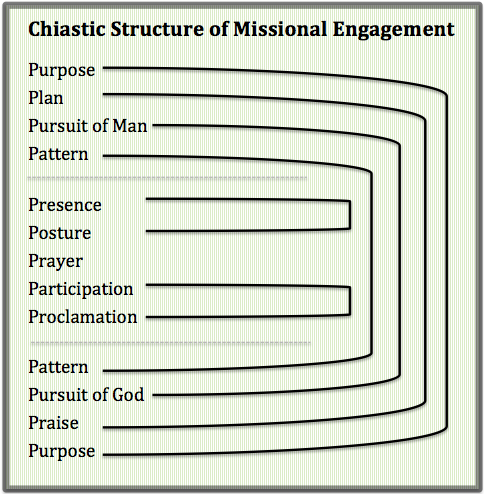
A chiasm is simply a learning device to draw connections and parallels in concentric fashion, usually working from the outside in. Examples would be ABC-CBA (the two A’s parallel, the two B’s parallel, and the two C’s parallel). This is also a way of drawing emphasis, usually the center being the most important pairs of parallels.

Reflecting with my disciple-making team, I believe there is a chiastic structure to missional discipleship.  In order to make the parallels memorable, all of the parts of the structure begin with the letter “P” (and all Southern Baptists say a hearty “amen”). Here’s the chiastic structure:

Chiastic-Structure-of-Missional-Discipleship

MISSIONAL

Last week, I wrote about “owning my own square mile” based on coming to terms with God’s purposes and providence/plan for my life. I genuinely believe that a high view of God’s sovereignty does not marginalize mission but actually mobilizes mission. God’s purpose is that His people who represent Him on earth–His character, His Ways, and His gospel. God has a plan to bring about His eternal purposes culminating in the glorification of His Son from every nation, tongue, and tribe. That plan is through the local church to proclaim the gospel of God which brings about the obedience of faith to those becoming like Christ in all things. God is the great Evangelist who plans salvation (Father), purchases salvation (Son), and personalizes salvation (Holy Spirit).

As a disciple of Jesus, I’m called to follow Him on mission to love God and love others, to become a fisher of men, laborer in His harvest field, ambassador of His gospel, and soldier in His army. My life should be characterized by the pursuit of man–of sinners far from God–who become the object of my affection, the subject of my prayers, and the prospect of kingdom advance. In order for this pursuit of man to become meaningful, I must pattern my life after the priority of the kingdom of God and making the gospel of first importance. Because I have been sent into the world by Jesus (John 20:21), my life should reflect a pattern indicating a pursuit for sinners because of God’s purposeful and providential placement.

At the heart of the missional discipleship chiasm is incarnational mission. Jesus entered into our world by taking on flesh and living among us. There was a nearness to God in the incarnation that made his immanence accommodating to our neediness. The same is true for Jesus’ disciples. We pattern our lives as sent disciples of Jesus on mission to have a presence in the midst of the people we are called to reach. We enter into the world, not becoming worldly in the sinful sense but in the practical sense (what John Stott called “holy worldliness“), interweaving our lives in the fabric of the community. There’s a going aspect of mission as well as a dwelling aspect of mission. When a there is a patterned life of being present in the community, disciples of Jesus display a posture of humble, sacrificial living. We are not postured as better or privileged but as forgiven and filled with gratitude. Like Jesus, we want to serve, not be served, to go to them, not expect them to come to us, to have a towel and basin as our calling card, not our protagonist positions against all the sinful things sinners do.  This is the “incarnational” component (presence and posture).

The mission component at the center has to do with participation (a visible presentation of the gospel) and proclamation (a verbal presentation of the gospel). As disciples of Jesus, we called to show (participate) and share (proclaim) the Gospel of the kingdom, calling sinners to repent and believe while living a lifestyle of repentance and faith. The earthly ministry of Jesus, as well as the early church, demonstrated a healthy balance of word and deed. Having a presence and posture isn’t enough, but it does position a disciple to have perpetual opportunities for meaningful participation in, and sincere proclamation of, the gospel of Jesus Christ.

At the very center of the chiastic structure is prayer. That is because there prayer is the genesis of missional discipleship. Jesus saw the expansive need of the multitudes of people and called His disciples to pray to the Lord of the harvest. Before the calling of disciples in Matthew 10 was the call to pray in Matthew 9. Before Pentecost in Acts 2 was prayer in the upper room in Acts 1. Before there is any real demonstration of life on mission making disciples of Jesus, there will be a life deeply marked by prayer. This kind of life is simply impossible left to our own resources. I don’t care how gifted you are. Jesus said, “Apart from me you can do nothing” (John 15:5). Prayer turns us away from a life of unbelief, arguing about our incompetencies and justifying our disobedience to a life of faith, embracing God’s provision and promise of the Holy Spirit to empower us supernaturally.

DISCIPLESHIP

Here’s where the chiasm finds its parallel and symmetrical balance. Through the gospel, sinners are saved and called to a life of following Jesus. What does that look like? Where do these new believers begin? The nearest and clearest thing to them will be the person who shared and showed the gospel to them. The new disciple of Jesus learns what it is like to know and follow God by knowing and following the pattern of Christians investing in their life. This is the second layer of living a patterned life. As I mentioned above, the first layer is missional–we pattern our lives because we have been sent on mission for the global and glorious purposes of God. The second layer is discipleship–we pattern our lives because we serve as a template and guide of what it means to live “in Christ” and have all areas brought under His Lordship.

When new Christians follow the faithful pattern of gospel-driven disciples, they will grow in grace and knowledge of Jesus, cultivating a passion and pursuit of God. Their spiritual pacesetters are encouraging and challenging them to go hard after God and make it their life’s ambition to know and enjoy Him. At one level, disciples of Jesus are characterized by a passionate pursuit of man (missionally); at another level, disciples of Jesus are characterized by a passionate pursuit of God (discipleship). It is not either-or but both-and. You cannot have one without the other.

When disciples of Jesus are utterly satisfied with all that God is for them in Christ, their lives will demonstrate a “sacrifice of praise“. They will exhibit the truth that we are a royal priesthood and holy nation to “declare the praises of Him who called us out of darkness and into His marvellous light.” Indeed, everything in discipleship conforms to the plan to make us into the image of Jesus Christ, all owed to “the praise of His glorious grace.” Missional discipleship redounds to the praise and celebration of Jesus Christ–Redeemer, Savior, King.

We begin with God’s purpose to mobilize us on mission. We end with God’s purpose to unite all things in Christ. What God began, He will certainly complete. He does all things well. Our purpose is to make, mature, mobilize, and multiply disciples on mission because our missionary God will not cease working through His church until His eternal purposes are complete. If you don’t have a high view of God’s purpose, you will not be mobilized on mission. You will also not be a devoted disciple-maker. Missional discipleship has at its bookends God’s glory, and at its heart the prayerful cry, “Hallowed be your name. Your kingdom come, your will be done, on earth as it is in heaven!”

So there you go. That’s the chiastic structure of missional discipleship. It’s one thing to lay hold of it conceptually; it’s another thing to lay hold of it experientially. Which reminds me, I need to take some time to pray.

Read more from Timmy here.

Download PDF

Tags: , ,

| What is MyVisionRoom? > | Back to Process >

ABOUT THE AUTHOR

Timmy Brister

In the “real world,” I am the founder and president of Gospel Systems, Inc, a 501(c)(3) non-profit organization focused on creating and sustaining delivery systems for the advancement of the gospel around the world. In 2010, I started a delivery system called PLNTD – a network for church planting and revitalization focusing on resourcing, relational community, residencies in local churches, and regional networks. In 2012, I started an international delivery system call The Haiti Collective which focuses on equipping indigenous churches through church partnerships in order to care for orphans, make disciples, train leaders, and plant churches in Haiti. In addition to serving as the executive director of these organizations, I have served for 12 years in pastoral ministry with churches in Alabama, Kentucky, and Florida. My passion is to see healthy, growing churches take ownership of the Great Commission to the end that disciples are making disciples, leaders are developed and deployed, and churches are planting churches here and around the world. This is the driving passion of my life and prayer that God would be so glorified in making His name great in our generation.

See more articles by >

COMMENTS

What say you? Leave a comment!

Mr. Kelly E McClelland — 05/18/13 2:02 pm

Bravo! Glad to be able to connect in the SWFL Cohort soon. You have put a ton of thought into this and I hope to learn more! Great way to present all the connections and help put some handles on a huge topic!

Recent Comments
comment_post_ID); ?> Thank you for this information. I'm going to use this article to improve my work with the Lord.
 
— Abel Singbeh
 
comment_post_ID); ?> Thank you Ed for sharing your insights into the Church Growth Movement. I have my reservations with Church Growth models because it has done more damage than good in the Body of Christ. Over the years, western churches are more focused on results, formulas and processes with little or no emphasis on membership and church discipline. Pastors and vocational leaders are burnt out because they're overworked. I do believe that the Church Growth model is a catalyst to two destructive groups: The New Apostolic Reformation and the Emerging Church. Both groups overlap and have a very loose definition. They're both focus on contemporary worship, expansion of church brand (franchising), and mobilizing volunteering members as 'leaders' to grow their ministry. Little focus on biblical study, apologetics and genuine missional work with no agenda besides preaching of the gospel.
 
— Dave
 
comment_post_ID); ?> Thank you for sharing such a good article. It is a great lesson I learned from this article. I am one of the leaders in Emmanuel united church of Ethiopia (A denomination with more-than 780 local churches through out the country). I am preparing a presentation on succession planning for local church leaders. It will help me for preparation If you send me more resources and recommend me books to read on the topic. I hope we may collaborate in advancing leadership capacity of our church. God Bless You and Your Ministry.
 
— Argaw Alemu
 

Clarity Process

Three effective ways to start moving toward clarity right now.

Five Primary Sources of Distraction in Ministry

Yesterday’s post on “opportunity creep” introduced a common problem for pastors. It’s easy for opportunity after opportunity to press in and vie for the precious little time God has given you.

The first step to dealing with opportunity creep is to identify the sources of opportunities in way that repositions them as distractions. If we don’t understand that most opportunities are distractions in disguise, it will be hard to say “no” to the next seemingly “good” thing. See if these sources clarify the point:

Opportunity Becomes Distraction #1: The New is Askew

Who doesn’t love something new? Especially for us creative types its easy to feel the rush of the next. But the lure of the new can drive us to do too much at the same time, or too much to fast. The opportunistic personalities among us will look for the next ministry “find” before going deeper with what we already have. This week I was with a church that lamented, “Our people aren’t clear about who we are because we re-package ourselves every six months.” In short, make sure the next new thing is a deeply “you thing.”

Opportunity Becomes Distraction #2 Off-Mission Permission

In the desire for more ministry its easy to say “yes” to the ideas of well-meaning members. The problem is that most of their ministry aspirations are misdirected because they want to create more church structure and programming rather than living out their gifts and calling in life. The church very quickly becomes over-programmed and under-discipled.  The “more is more” default mode of program-permission clutters a simple discipleship experience in and through the church. Helping people dream big for Jesus is beautiful, overcomplicating church is not.

Opportunity Becomes Distraction #3: Funny Money

There is nothing more freeing than an abundance of resources, unless it comes with the proverbial attached string. Beware of that check-cutting, money-slinging individual—whether its a new member of an influential elder—that’s ready to fund the next thing (that they brought to the table.) If a new idea is connected to designated giving, always ask, “Would our vision really have taken us in this direction?” If people are not willing to subordinate their giving to the existing vision of the church, than it’s probably as distraction in disguise. (Sorry to break the bad news.)

Opportunity Becomes Distraction #4: Knowledge Trafficking

I enjoy learning as do most called into vocational ministry. But when our pursuit of knowledge outpaces our put-in-use of knowledge we’ll get used to living with distraction. To make matters worse, now you can get a direct feed of whatever-you-want-to-learn, whenever-you-want-to-learn through the fifty devises in your life. Don’t let your smart phone turn you into a not-so-smart leader. One of the greatest benefits of organizational and personal clarity, by the way, is the ability to ruthlessly filter out non-relevant new data.

Opportunity Becomes Distraction #5: Platform Jacking

The last source of distraction meddles a bit more than the others. Platform jacking is when we divert too time and energy to gaining influence through opportunities outside of direct day-to-day ministry responsibilities. There is certainly nothing wrong with wanting to “bless the capital ‘C’ church”— a noble aspiration for sure! Yet I am amazed at how quickly the favor of God on a pastor can back-fire on the mission of the ministry.  The success of the local church can become a “success distraction” for the pastor who spends increasing amounts of time growing his or her platform. Most of us have seen this in someone else, so just be discerning for yourself.

Read more from Will here.

Download PDF

Tags: ,

| What is MyVisionRoom? > | Back to Vision >

ABOUT THE AUTHOR

Will Mancini

Will Mancini

Will Mancini wants you and your ministry to experience the benefits of stunning, God-given clarity. As a pastor turned vision coach, Will has worked with an unprecedented variety of churches from growing megachurches and missional communities, to mainline revitalization and church plants. He is the founder of Auxano, creator of VisionRoom.com and the author of God Dreams and Church Unique.

See more articles by >

COMMENTS

What say you? Leave a comment!

Recent Comments
comment_post_ID); ?> Thank you for this information. I'm going to use this article to improve my work with the Lord.
 
— Abel Singbeh
 
comment_post_ID); ?> Thank you Ed for sharing your insights into the Church Growth Movement. I have my reservations with Church Growth models because it has done more damage than good in the Body of Christ. Over the years, western churches are more focused on results, formulas and processes with little or no emphasis on membership and church discipline. Pastors and vocational leaders are burnt out because they're overworked. I do believe that the Church Growth model is a catalyst to two destructive groups: The New Apostolic Reformation and the Emerging Church. Both groups overlap and have a very loose definition. They're both focus on contemporary worship, expansion of church brand (franchising), and mobilizing volunteering members as 'leaders' to grow their ministry. Little focus on biblical study, apologetics and genuine missional work with no agenda besides preaching of the gospel.
 
— Dave
 
comment_post_ID); ?> Thank you for sharing such a good article. It is a great lesson I learned from this article. I am one of the leaders in Emmanuel united church of Ethiopia (A denomination with more-than 780 local churches through out the country). I am preparing a presentation on succession planning for local church leaders. It will help me for preparation If you send me more resources and recommend me books to read on the topic. I hope we may collaborate in advancing leadership capacity of our church. God Bless You and Your Ministry.
 
— Argaw Alemu
 

Clarity Process

Three effective ways to start moving toward clarity right now.

A Disciple is Someone Who Knows What Time It Is

You can’t obey Jesus’ command to go and make disciples if you don’t know what Jesus means by “disciple.” And you won’t know what Jesus means by disciple unless you watch the the way He portrayed discipleship in His teaching, particularly in His parables.

What do we find when we examine the portrait of a disciple in Jesus’ parables? A consistent emphasis on the disciple’s need to do two things:

  1. Understand the current eschatological moment.
  2. Live accordingly.

In other words, discipleship is portrayed in terms of “wisdom,” and wisdom is defined by living in light of “what time it is.”

Take a look at some examples…

The Wise and Foolish Builders (Matthew 7:24-27)

The parable that closes Jesus’ most famous sermon ends with a vision of discipleship that places final judgment front and center.

The contrast between the wise and foolish builders is the climactic finale to Jesus’ Sermon on the Mount, because it demonstrates the seriousness of what is at stake. The storm that threatens the two buildings is divine judgment.

Rarely do we begin our explanation of “making disciples” with the idea of final judgment. This element of Jesus’ teaching is often shuffled to the side as an unpopular component of our theological confession. But the parables of Matthew challenge viewing discipleship in these terms: knowing what time it is and bringing one’s life in line with eschatological reality.

Human lives matter. Human choices matter. Eternity hangs in the balance.

The Foolish Bridesmaids (Matthew 25:1-13)

Just as the two builders are contrasted in terms of wisdom and foolishness, the bridesmaids are also contrasted in the same manner.

The disciple of Christ is not the one who self-identifies as a Christian, but the one who is prepared for Christ’s coming. One of the lessons here is that discipleship cannot be summed up in appearances, but in the exercise of wisdom that leads one to live in light of the kingdom of God.

In both stories, judgment exposes foolishness, both the faulty foundation of the foolish builder and the lack of preparation from the foolish bridesmaids. Discipleship is formed and described within the context of eschatological preparation.

The Parable of the Talents (Matt 25:14-30)

A disciple must be a good steward of the gifts of God in the present while waiting for the Master’s return. The disciples commended as “good and faithful servants” are those who live with eschatological anticipation, choosing to invest in ways that maximize the king’s resources. Even though the primary point is stewardship, discipleship is seen through the lens of eschatological anticipation.

The Unmerciful Servant (Matt 18:21-35)

The Parable of the Unmerciful Servant is prompted by Peter’s question to Jesus about how many times he is obligated to forgive someone who wrongs him. Jesus’ reply of “seventy times seven” is not a rhetorical trick, but rather a reference to the end of exile, the “seventy-times-seven” years prophesied in Daniel (9:24-27) before God’s deliverance will take effect.

So, a disciple forgives not only because he has been forgiven, but also because of what time it is. In the eschatological day of jubilee, debts are released and debtors are freed from their burdens. The kingdom changes everything.

New Wine in Old Wineskins (Matt 9:17)

Jesus’ analogy of putting new wine into old wineskins is a reference to the overlap of eras, referring to the coming kingdom which will no longer be contained by the exclusivistic tendencies of God’s chosen people who have lost their saltiness and who have failed to be a light to the nations.

The Faithful Servant (Matt 24:42-51)

Jesus speaks of a faithful servant whose anticipation for his master’s return leads him to alter his priorities. In this analogy, discipleship is not a generic faithfulness to God’s commands, but a specific faithfulness formed by the disciple’s understanding of what time it is and what the future holds. The vision of the future affects the disciple’s actions in the present.

Two Implications for Church Leaders

1. Eschatology gives eternal significance to our ethical choices.

Too often, disciple-making is reduced to information regarding the ethics of the kingdom. Moral formation is reduced to making proper ethical choices as laid out in Christ’s straightforward teaching.

However, the parables of Jesus focus on ethical choices made in light of the eschatological reality of God’s in-breaking kingdom. Wisdom is defined in large part by the proper understanding of “what time it is.”

Unfortunately, church leaders often relegate the study of eschatology to timetables and charts that lead to endless debates on the details of Christ’s second coming. Though end-times speculation should be avoided, the vision of final judgment, Christ’s return, and the promised new heavens and new earth must be ever before the eyes of believers. When we divorce ethics from eschatology, we fail to communicate the eternal significance of the disciple’s choices.

2. Eschatology gives eternal significance to our missional activity.

Fundamental to one’s view of any number of contemporary debates over holistic mission, social work and evangelism is one’s view of eschatology. To neglect the unpopular teaching about the wrath of God, Christ’s many warnings against hell, or the role of works in final justification is to settle for a shrunken view of ethical choices and a moralistic understanding of religious identity.

The reality of final judgment keeps a holistic view of disciple-making truly holistic in that it protects social work from degenerating into nothing more than seeking to make the world a better place, and it keeps evangelistic efforts from neglecting the social responsibility to live in ways that demonstrate submission to King Jesus.

Read more from Trevin here.

Download PDF

| What is MyVisionRoom? > | Back to Process >

ABOUT THE AUTHOR

Trevin Wax

Trevin Wax

My name is Trevin Wax. I am a follower of Jesus Christ. My wife is Corina, and we have two children: Timothy (7) and Julia (3). Currently, I serve the church by working at LifeWay Christian Resources as managing editor of The Gospel Project, a gospel-centered small group curriculum for all ages that focuses on the grand narrative of Scripture. I have been blogging regularly at Kingdom People since October 2006. I frequently contribute articles to other publications, such as Christianity Today. I also enjoy traveling and speaking at different churches and conferences. My first book, Holy Subversion: Allegiance to Christ in an Age of Rivals, was published by Crossway Books in January 2010. (Click here for excerpts and more information.) My second book, Counterfeit Gospels: Rediscovering the Good News in a World of False Hope(Moody Publishers) was released in April 2011.

See more articles by >

COMMENTS

What say you? Leave a comment!

Recent Comments
comment_post_ID); ?> Thank you for this information. I'm going to use this article to improve my work with the Lord.
 
— Abel Singbeh
 
comment_post_ID); ?> Thank you Ed for sharing your insights into the Church Growth Movement. I have my reservations with Church Growth models because it has done more damage than good in the Body of Christ. Over the years, western churches are more focused on results, formulas and processes with little or no emphasis on membership and church discipline. Pastors and vocational leaders are burnt out because they're overworked. I do believe that the Church Growth model is a catalyst to two destructive groups: The New Apostolic Reformation and the Emerging Church. Both groups overlap and have a very loose definition. They're both focus on contemporary worship, expansion of church brand (franchising), and mobilizing volunteering members as 'leaders' to grow their ministry. Little focus on biblical study, apologetics and genuine missional work with no agenda besides preaching of the gospel.
 
— Dave
 
comment_post_ID); ?> Thank you for sharing such a good article. It is a great lesson I learned from this article. I am one of the leaders in Emmanuel united church of Ethiopia (A denomination with more-than 780 local churches through out the country). I am preparing a presentation on succession planning for local church leaders. It will help me for preparation If you send me more resources and recommend me books to read on the topic. I hope we may collaborate in advancing leadership capacity of our church. God Bless You and Your Ministry.
 
— Argaw Alemu
 

Clarity Process

Three effective ways to start moving toward clarity right now.