Seven Leadership Traps to Avoid

A lot of ministries begin with a bang, then explode with new growth. But after the initial growth, they plateau. I have seen this repeated thousands of times from pastors I’ve talked with over the years.

God doesn’t want ministries to stagnate. Not only does he want them to succeed, but he also wants us to succeed as ministry leaders.

To help us achieve this goal, God has given us examples of errors to avoid — seven common traps of leadership that Satan is most likely to use to keep your ministry from becoming all that God wants it to be.

1. You stop growing personally

Whenever you find yourself resisting a new way of doing something, defending the status quo, or opposing a change that God has told you to make, watch out — you’re about to lose your place of leadership.

What’s the key to overcoming this leadership trap? You must continue developing your skills, your character, your perspective, your vision, your heart for God, and your dependence upon him.

Never stop learning. Read and reread the Bible. Listen to podcasts and sermons. Read books and blogs and magazines. Attend conferences and seminars. Keep feeding yourself!

2. You stop caring

The leader who stops having a passion for ministry won’t last long. This is one of the subtlest traps in ministry — you go through the motions of serving the Lord because you know it’s the right thing to do, but your heart is not in it. That’s no way to serve God.

If you’ve found yourself in this trap, there’s hope. If you want to recover your heart for people, you must do the things you did in the beginning.

Start acting the way you used to act when you were passionate about ministry. Even if you don’t feelpassionate, act passionately.

It’s easier to act your way into a feeling than it is to feel your way into an action. If you act loving, those feelings will come back. So, do the things that originally brought you joy in ministry.

3. You stop listening

Learn to listen and be sensitive to others. Encourage the people you serve in ministry to talk to you. Let them tell you about their problems, their troubles, their fears, their aspirations, their dreams, and their hurts. Be open to suggestions and constructive criticism, and look for other perspectives.

4. You get distracted

Many things can distract you from ministry. Personal or health problems can distract you. Competing interests can distract you. Finances can distract you. Things that you think are fun and good and wonderful can distract you. Satan doesn’t care if you aren’t sinning while distracted, because as long as you’re distracted, you aren’t doing what God wants you to do.

But God wants us to stay focused. Never forget your mission. The Bible says in Luke 9:62, “No man, having put his hand to the plough, and looking back, is fit for the kingdom of God” (KJV).

Stay focused. Don’t get distracted.

5. You get complacent

Complacency is the enemy of a good leader. If God says go for it, stick your neck out! Never stop depending on the Lord. Stop coasting. Take some risks in faith. Push the envelope. Attempt something that cannot be accomplished in the power of the flesh. Say to yourself, “What am I going to try in my ministry this next year that I know is bound to fail unless God bails me out?” Unless God is your only safety net, you’re not truly living by faith. Depend on the Lord.

6. You become arrogant

I’ve seen this again and again. When a leader becomes arrogant, it leads to ruin. When you think that everything depends on you, when you don’t think you need the Lord’s help in your ministry because you’ve got it all together, watch out.

If you sense that you’ve become prideful and arrogant about your leadership, humble yourself. Submit your heart to God for softening, and bow before his greatness.

7. You fail to delegate

When a ministry plateaus, God is telling you that you’ve reached the limit of what he’s empowered you to do by yourself. You need to move from doing to delegating.

Involve other people in your ministry. Move from being a minister to a manager of ministers. Managing is a ministry in itself. D. L. Moody said it like this: “I’d rather put 10 men to work than do the work of 10 men.”

If you avoid these seven traps, you’ll go a long way toward building a ministry that lasts.

> Read more from Rick.


Download PDF

Tags: ,

| What is MyVisionRoom? > | Back to Leadership >

ABOUT THE AUTHOR

Rick Warren

Rick Warren

Rick Warren is the founding pastor of Saddleback Church in Lake Forest, Calif., one of America's largest and most influential churches. Rick is author of the New York Times bestseller The Purpose Driven Life. His book, The Purpose Driven Church, was named one of the 100 Christian books that changed the 20th century. He is also founder of Pastors.com, a global Internet community for pastors.

See more articles by >

COMMENTS

What say you? Leave a comment!

Recent Comments
comment_post_ID); ?> Thank you for this information. I'm going to use this article to improve my work with the Lord.
 
— Abel Singbeh
 
comment_post_ID); ?> Thank you Ed for sharing your insights into the Church Growth Movement. I have my reservations with Church Growth models because it has done more damage than good in the Body of Christ. Over the years, western churches are more focused on results, formulas and processes with little or no emphasis on membership and church discipline. Pastors and vocational leaders are burnt out because they're overworked. I do believe that the Church Growth model is a catalyst to two destructive groups: The New Apostolic Reformation and the Emerging Church. Both groups overlap and have a very loose definition. They're both focus on contemporary worship, expansion of church brand (franchising), and mobilizing volunteering members as 'leaders' to grow their ministry. Little focus on biblical study, apologetics and genuine missional work with no agenda besides preaching of the gospel.
 
— Dave
 
comment_post_ID); ?> Thank you for sharing such a good article. It is a great lesson I learned from this article. I am one of the leaders in Emmanuel united church of Ethiopia (A denomination with more-than 780 local churches through out the country). I am preparing a presentation on succession planning for local church leaders. It will help me for preparation If you send me more resources and recommend me books to read on the topic. I hope we may collaborate in advancing leadership capacity of our church. God Bless You and Your Ministry.
 
— Argaw Alemu
 

Clarity Process

Three effective ways to start moving toward clarity right now.

3 Qualities of a Self-Controlled Leader

Every time I see a homemade chocolate chip cookie fresh out of the oven my self-control is pushed to its limits.

What’s your temptation?

What about the more serious kinds of temptations leaders face when it comes to self-control?

Under pressure it’s easy to be swayed by your own emotions, make reactionary decisions, or be tempted to trade long term success for more immediate rewards.

Self-control is the ninth and last in the list of fruit of the Holy Spirit. It has always appeared to me like an out of place add-on at the end of a list of positive attributes.

22 But the fruit of the Spirit is love, joy, peace, forbearance, kindness, goodness, faithfulness, 23 gentleness and self-control.

Galatians 5:22-23

It appears like it’s the only fruit that is defense and the other eight are offense.

But I’ve learned to see self-control not as the caboose at the end of a powerful train, but the backstop. Without it, the others may easily be lost.

Love may be the engine that pulls the locomotive, but self-control is what keeps it on the tracks.

Without self-control, a leader will be sidelined, derailed, or perhaps taken out of ministry.

You may need self-control to win over anger, discouragement or speaking too quickly. Another leader may need self-control for their thought life, managing money or how they use their authority.

None of us escape the great need for consistent self-control.

What is the area you have greatest need to exercise self-control?

Developing self-control:

1) Embrace the significance of life’s daily trades.

All of life consists of daily trades, and over your lifetime the wisdom of your trades becomes very evident.

I’ve made some poor trades along the way. Like trading my potential safety and the well-being of others in order to arrive somewhere faster. Yup. Speeding. Not cool, but I’ve done it.

That may seem like a relatively minor “poor” trade, but not really. I’m just banking on not getting caught. That’s the dark side of making bad trades. Hoping you won’t get caught, or at least no consequence or penalty.

There are more serious trades, but in the moment we can rationalize that they are minor. Like making an optional big purchase when you should be saving money.

It’s always about the bigger picture, and self-control or lack thereof is always involved.

In leadership it might be trading frustration for patience toward an employee, or trading lazy for study in developing a sermon. It might be trading a hurtful word for an encouraging word, or trading compassion instead of comfort.

Most of life is won or lost in these daily trades. These decisions develop patterns that determine the course and outcomes of your life and leadership.

2) Engage the wisdom of pay now and play later.

If you play now you will pay later. It’s not possible to alter the reality of that life principle. This is true in all areas of life, especially leadership.

The wisdom of delayed gratification (pay now play later) is a significant part of making smart daily trades. Self-control and smart daily trades go hand and hand to help you exercise discipline now and enjoy more freedoms later.

Think long-term, values-driven and character-based to build the right foundation to support self-control. This kind of “pay now” character yields the life and leadership you desire.

Discipline now rewards you with the freedom and options that allow you to live well and lead well.

Resist the desire to play now, and lean into the exponential dividends of discipline today. This paves the way for greater rewards in the future.

3) Ask God to help you do what you can’t do.

When it comes to self-control I think God wants to see some effort on my part. If I ask God to remove the need for any work, or even struggle on my part, there is no process that leads to maturity.

The process toward spiritual maturity requires that I face and handle real life tensions that don’t have easy solutions. That’s when God steps in.

As we pray and ask for help, God is eager to grant the power of the Holy Spirit that helps provide the self-control we need. Ultimately, this strengthens the first eight in the list of the fruit of the spirit.

It’s always been about a divine partnership. You do your part, God does His. It’s not works, it’s grace.

The quest is not for perfect leadership or discipline for the sake of discipline. Leaders with great self-control are still human beings who make mistakes, and fall short on occasion.

The point is that the seldom spoken of # 9 in the list of the fruits of the spirit, may just be a quiet key to much of your long term health and success as a leader.

> Read more from Dan.


Download PDF

Tags: , , ,

| What is MyVisionRoom? > | Back to Leadership >

ABOUT THE AUTHOR

Dan Reiland

Dan Reiland

Dr. Dan Reiland serves as Executive Pastor at 12Stone Church in Lawrenceville, Georgia. He previously partnered with John Maxwell for 20 years, first as Executive Pastor at Skyline Wesleyan Church in San Diego, then as Vice President of Leadership and Church Development at INJOY. He and Dr. Maxwell still enjoy partnering on a number of church related projects together. Dan is best known as a leader with a pastor's heart, but is often described as one of the nations most innovative church thinkers. His passion is developing leaders for the local church so that the Great Commission is advanced.

See more articles by >

COMMENTS

What say you? Leave a comment!

Recent Comments
comment_post_ID); ?> Thank you for this information. I'm going to use this article to improve my work with the Lord.
 
— Abel Singbeh
 
comment_post_ID); ?> Thank you Ed for sharing your insights into the Church Growth Movement. I have my reservations with Church Growth models because it has done more damage than good in the Body of Christ. Over the years, western churches are more focused on results, formulas and processes with little or no emphasis on membership and church discipline. Pastors and vocational leaders are burnt out because they're overworked. I do believe that the Church Growth model is a catalyst to two destructive groups: The New Apostolic Reformation and the Emerging Church. Both groups overlap and have a very loose definition. They're both focus on contemporary worship, expansion of church brand (franchising), and mobilizing volunteering members as 'leaders' to grow their ministry. Little focus on biblical study, apologetics and genuine missional work with no agenda besides preaching of the gospel.
 
— Dave
 
comment_post_ID); ?> Thank you for sharing such a good article. It is a great lesson I learned from this article. I am one of the leaders in Emmanuel united church of Ethiopia (A denomination with more-than 780 local churches through out the country). I am preparing a presentation on succession planning for local church leaders. It will help me for preparation If you send me more resources and recommend me books to read on the topic. I hope we may collaborate in advancing leadership capacity of our church. God Bless You and Your Ministry.
 
— Argaw Alemu
 

Clarity Process

Three effective ways to start moving toward clarity right now.

Understanding GenZ: Know Their Personality

How can you be more effective about reaching and leading the generation after the Millennials?

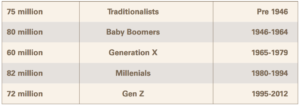
Born between 1995 and 2012, at 72.8 million strong, Gen Zers are making their presence known. It is the generation that is now collectively under the age of 25. They’re radically different from the Millennials, yet no one seems to have been talking much about them until recently.

While there has been a great deal of conversation about “fixing” the Millennial generation, we are in danger of missing the next generation as they step into the workplace – and leadership roles at our churches.

As a group, on one hand they have been notorious about dropping out from your church. On they other hand, they make up a significant part of both your ministry participants and prospects.

They are also beginning to step into very visible leadership roles in your church.

So what does Gen Z look like, and what does that mean for your church?

THE QUICK SUMMARY – David Stillman and Jonah Stillman, Gen Z @ Work

A generations expert and author of When Generations Collide and The M-Factor teams up with his 17-year-old son to introduce the next influential demographic group to join the workforce—Generation Z—in this essential study, the first on the subject.

Based on the first national studies of Gen Z’s workplace attitudes; interviews with hundreds of CEOs, celebrities, and thought leaders on generational issues; cutting-edge case studies; and insights from Gen Zers themselves, Gen Z @ Work offers the knowledge today’s leaders need to get ahead of the next gaps in the workplace and how best to recruit, retain, motivate, and manage Gen Zers. Ahead of the curve, Gen Z @ Work is the first comprehensive, serious look at what the next generation of workers looks like, and what that means for the rest of us.

A SIMPLE SOLUTION

In order to begin to understand Gen Z, you first need to put them into perspective with the rest of the population at large:

Then, there is the conundrum of what to call them. Words matter, and once attached, are hard to change. Each of the generations prior to Gen Z were named, and for various reasons, Gen Z seems to be the one most favored.

But don’t be mistaken – Gen Z is not a “label” to be applied to the millions of individuals born between 1995 and 2012, all with very unique differences. It’s a name – but it represents some very interesting characteristics.

A new generation is starting to hit our workforce, yet no one seems to be talking about it. Until now.

In order to pioneer a dialogue about what they will be like in the workplace, here are seven key traits of Gen Z

Phigital: Gen Z is the first generation born into a world where every physical aspect (people and places) has a digital equivalent.

Hyper-Custom: Gen Z has always worked hard at identifying and customizing their own brand for the world to know. Their ability to customize everything has created an expectation that there is an intimate understanding of their behaviors and desires.

Realistic: Growing up during the aftermath of 9/11, with terrorism part of everyday life, as well as living through a severe recession early on, has created a very pragmatic mindset when it comes to planning and preparing for the future.

FOMO: Gen Z suffers from an intense fear of missing out on anything. The good news is that they will stay on top of all trends and competition. The bad news is that Gen Z will always worry that they aren’t moving ahead fast enough and in the right direction.

Weconomists: From Uber to Airbnb, Gen Z has only known a world with a shared economy. Gen Z will push the workplace to break down internal and external silos to leverage the collective in new convenient and cost-effective ways.

DIY: Gen Z is the do-it-yourself generation. Having grown up on YouTube, which can teach them how to do just about anything, Gen Z believes that they can do just about anything themselves.

Driven: With parents who drilled into them that participation is not a real reward and that there are winners and losers, a recession that pulled the rug out from their predecessors, and a rate of change that is hard to keep up with, it is no wonder that Gen Z is one driven generation.

David Stillman and Jonah Stillman, Gen Z @ Work

A NEXT STEP

If you want to know more about Gen Z in your church, start at the source. Even with the wide range of ages, it would be informative to sit down with a group of Gen Zers and have a dialogue with them:

  • What do they like to do with free time?
  • Who is their favorite celebrity?
  • What kind of music and entertainment do they regularly listen to?
  • What brands do they like the best?
  • What apps do they use most on their phones?
  • What colleges do they want to go to, if at all?
  • What is most important to them right now?

Another goldmine of information on Gen Zers? Teachers! Take a few teachers out to lunch and ask them:

  • What do they see happening with this generation, as they become young adults and leaders in the world?
  • What were their biggest struggles in working with Gen Z?
  • What gaps do they see in current societal needs that Gen Zers may struggle with?
  • For those teachers who have been around awhile, what were the biggest differences between Gen Z and Millennials (born 1980-1994)?

Finally, take a look at the list of seven traits above. Which is most important to you in terms of ministry with Gen Z? Share that with your team and encourage them to be on the lookout for Gen Zers who have this trait, and how it can be used in your churches ministry.

On the flip side, take a look at the list again, looking for the least important trait. Recognizing that it may be important to others, dialogue with your team how this trait can be strengthened with the Gen Zers you minister with.

Excerpt taken from SUMS Remix #70-1, released July 2017.


This is part of a weekly series posting content from one of the most innovative content sources in the church world: SUMS Remix Book Summaries for church leaders.

SUMS Remix takes a practical problem in the church and looks at it with three solutions; each solution is taken from a different book. Additionally, a practical action step is included with each solution.

As a church leader you get to scan relevant books based on practical tools and solutions to real ministry problems, not just by the cover of the book. Each post will have the edition number which shows the year and what number it is in the overall sequence. (SUMS Remix provides 26 issues per year, delivered every other week to your inbox). 

>> Subscribe to SUMS Remix <<

Download PDF

Tags: , , ,

| What is MyVisionRoom? > | Back to Leadership >

ABOUT THE AUTHOR

VRcurator

VRcurator

Bob Adams is Auxano's Vision Room Curator. His background includes over 23 years as an associate/executive pastor as well as 8 years as the Lead Consultant for a church design build company. He joined Auxano in 2012.

See more articles by >

COMMENTS

What say you? Leave a comment!

Recent Comments
comment_post_ID); ?> Thank you for this information. I'm going to use this article to improve my work with the Lord.
 
— Abel Singbeh
 
comment_post_ID); ?> Thank you Ed for sharing your insights into the Church Growth Movement. I have my reservations with Church Growth models because it has done more damage than good in the Body of Christ. Over the years, western churches are more focused on results, formulas and processes with little or no emphasis on membership and church discipline. Pastors and vocational leaders are burnt out because they're overworked. I do believe that the Church Growth model is a catalyst to two destructive groups: The New Apostolic Reformation and the Emerging Church. Both groups overlap and have a very loose definition. They're both focus on contemporary worship, expansion of church brand (franchising), and mobilizing volunteering members as 'leaders' to grow their ministry. Little focus on biblical study, apologetics and genuine missional work with no agenda besides preaching of the gospel.
 
— Dave
 
comment_post_ID); ?> Thank you for sharing such a good article. It is a great lesson I learned from this article. I am one of the leaders in Emmanuel united church of Ethiopia (A denomination with more-than 780 local churches through out the country). I am preparing a presentation on succession planning for local church leaders. It will help me for preparation If you send me more resources and recommend me books to read on the topic. I hope we may collaborate in advancing leadership capacity of our church. God Bless You and Your Ministry.
 
— Argaw Alemu
 

Clarity Process

Three effective ways to start moving toward clarity right now.

Address This or Lose Your Strength

The common leadership counsel to focus on your strengths is wise, with one important caveat. Your weaknesses must be addressed and brought to an acceptable norm or they will overshadow your strengths. Yes, focus on your strengths, but your weaknesses cannot be so overwhelming as to debilitate your leadership credibility. In his book, The Leadership Code, Dave Ulrich challenges leaders to be at least average in key disciplines of leadership or their weakness will crush them. Yet many leaders choose to ignore their weaknesses completely for the following two reasons:

1. We think our strengths are stronger than they are.

One primary reason leaders ignore their weaknesses is they overestimate their strengths. Overestimating your strengths is often synonymous with underestimating your weaknesses. A leader who overestimates his/her own strengths can unwisely ignore his/her weaknesses. The leader can shrug off the need to address certain leadership deficiencies because the leader assumes, “but I am so very strong in this area.” Having a higher view of oneself than one should always leads to foolish decision-making.

2. We hate to admit we are weak.

To address our weaknesses, we must first admit we have them, and we hate to admit we are weak. Pride keeps leaders from admitting their weaknesses and addressing them. Pride always hampers our effectiveness and our learning. But wise leaders admit their weaknesses, rely on others, and seek to grow and mature.

Of all leaders, Christian leaders should be the first to admit and address their weaknesses. Our faith is not for the strong, but for the weak. And we are all weak. We became Christians by recognizing our weakness, our inability to qualify ourselves to stand before God, and by relying on God for His mercy and grace. We continue in the faith by humbly depending on God’s strength, not by standing in our own. We live as Christians by walking in community with others who hold us up, who encourage us, and by refusing to live independently from others.

The cross has already shown us to be weak. Therefore, we can freely admit our weaknesses and seek to grow.

Download PDF

Tags: , ,

| What is MyVisionRoom? > | Back to Leadership >

ABOUT THE AUTHOR

Eric Geiger

Eric Geiger

Eric Geiger is the Senior Pastor of Mariners Church in Irvine, California. Before moving to Southern California, Eric served as senior vice-president for LifeWay Christian. Eric received his doctorate in leadership and church ministry from Southern Seminary. Eric has authored or co-authored several books including the best selling church leadership book, Simple Church. Eric is married to Kaye, and they have two daughters: Eden and Evie. During his free time, Eric enjoys dating his wife, taking his daughters to the beach, and playing basketball.

See more articles by >

COMMENTS

What say you? Leave a comment!

Recent Comments
comment_post_ID); ?> Thank you for this information. I'm going to use this article to improve my work with the Lord.
 
— Abel Singbeh
 
comment_post_ID); ?> Thank you Ed for sharing your insights into the Church Growth Movement. I have my reservations with Church Growth models because it has done more damage than good in the Body of Christ. Over the years, western churches are more focused on results, formulas and processes with little or no emphasis on membership and church discipline. Pastors and vocational leaders are burnt out because they're overworked. I do believe that the Church Growth model is a catalyst to two destructive groups: The New Apostolic Reformation and the Emerging Church. Both groups overlap and have a very loose definition. They're both focus on contemporary worship, expansion of church brand (franchising), and mobilizing volunteering members as 'leaders' to grow their ministry. Little focus on biblical study, apologetics and genuine missional work with no agenda besides preaching of the gospel.
 
— Dave
 
comment_post_ID); ?> Thank you for sharing such a good article. It is a great lesson I learned from this article. I am one of the leaders in Emmanuel united church of Ethiopia (A denomination with more-than 780 local churches through out the country). I am preparing a presentation on succession planning for local church leaders. It will help me for preparation If you send me more resources and recommend me books to read on the topic. I hope we may collaborate in advancing leadership capacity of our church. God Bless You and Your Ministry.
 
— Argaw Alemu
 

Clarity Process

Three effective ways to start moving toward clarity right now.

Mind The Gap: Bringing Generations to Lead Together

If you’ve tried to lead employees who are under the age of 40, you’ve probably noticed things aren’t as easy as they used to be. (And they were actually never that easy.)

If you’re under 40 and are working for an over-40 boss, you’re probably restraining your eye-rolls as you notice that people just don’t seem to understand you.

Younger leaders tend to love flexibility, the freedom to work remotely when they want,  the ability to call some shots and the ability to develop a side-hustle, all of which seems to either baffle or frustration older leaders.

Many (not all, but many) older leaders would rather see team members have one job (no side-hustle), do their work from the office, be available after hours just in case, and earn a seat at the table before they give much input. And they don’t get the lack of loyalty that they feel a lot of younger adults display.

All of which frustrates younger leaders.

I run into this tension every time I talk to leaders about how the workplace is changing.

Over-40 leaders are smart to study how things are changing so they stay relevant. After all, the gap between how quickly you change and how quickly things change is called irrelevance.

Younger leaders are smart to understand the tension because it will make for far less frustration on their part, and help them advance in the organizations they’re a part of.

I’m an over-fifty leader who’s worked in offices in business and church, in a hybrid environment where some work is remote and some is done in an office, and now run a 100% virtual company that handles my speaking, writing and podcasting. In addition, almost all of my team members these days are pretty much Millennials or Generation Z.

Here are five things I’ve noticed about a changing workplace, and how older and younger leaders can get along better at work.

1. The Idea Of An Office Gets More Dated Every Year

Every once in awhile you have this moments when you realize how rapidly culture is changing.

A few years ago I was driving through Dallas and saw some office towers going up, and I thought to myself “I’ll bet one day our kids and grandkids drive by office towers and say ‘Did people actually used to have to go to a building to get their work done? Why?’ (Kind of like the Blockbuster days, when you had to go to a store to get a movie on a disk to watch it, and get hit with late fees if you failed to return it on time.)

One of the reasons offices used to make sense for everyone a generation ago is because the means of production were stored at the office. Your company held the typewriters, meeting spaces, computers, paper, pens, phones, copiers, fax machines and all the things private citizens didn’t usually have. There was a clear line between work life and home life.

Now there’s a very good chance you’re holding almost everything you need to do your job in your hand. Plus your phone, tablet and laptop travel with you everywhere. What about meeting spaces, you ask.  Well, between coffee shops, co-working spaces and restaurants, the need for offices has plummeted.

Older leaders still think about ‘going to work’ because that’s how they cut their teeth.

Younger leaders realize you don’t go to work; the work goes to them because they are the work. As a result, they love to work remotely at least some of the time—from home, from a coffee shop.

Older leaders often see this as lazy. Younger leaders see this as normal.

As Bryan Miles has pointed out about virtual culture on my leadership podcast, remote workers aren’t lazy; lazy workers are lazy.

If you have a lazy worker…deal with it. But often remote work can be far more efficient. There are fewer water cooler conversations, fewer random and useless meetings, fewer interruptions and less distraction.

So does that means offices are gone forever?

No. In a hybrid company that allows some remote work, core hours are a great idea where everyone is in the office, say, on a set day or in a set window to improve team interaction or for meetings. But beyond that, an office isn’t nearly as necessary as it used to be.

2. 8-4 Doesn’t Make Sense Anymore

One of the challenges is that office work took its early cues from manufacturing.

It make total sense if you have a car assembly plant (or a coffee shop, or a retail store) to have workers show up exactly on time for a shift. Because offices at one time owned the means of production (see above) it kind of made sense to the same thing.

But where most of the work is relational, informational and flexible (i.e. almost all white collar office jobs), 8-4 no longer makes sense. After all, unless you’re on the reception desk or doing some kind of work tied to fix hours, you can do most things any time.

Yet far too many older leaders are stuck in a mindset that people have to be in the building at set hours.

As a result, too many people show up at 8 (or 8:05 or 8:15) for no particular reason. It can create a clock-watching culture (is it 4:30 yet? Do I get paid for this lunch???) where your team is in a set place for no discernible rationale.

So here’s the question for leaders: are you paying your team to show up or are you paying your team to produce?

If you’re paying your team to show up, that’s one thing.

But if you pay them to produce, outside of fixed meetings and shared team time, why not let them choose how and when to produce?

Here’s what’s changed: The old economy paid people to show up. The new economy pays people to produce.

As I share in my productivity course,  The High Impact Leader, some of your team’s best productivity might happen when no one’s in the office or working. So why stifle that and make them show up because someone decided that’s when they should work?

3. Most Young Workers Work For Themselves

While they may not articulate it, most Millennials approach life as though they are working for themselves, not for you, whether you hire them as employees or on contract.  (We’ll see about Gen Z. I wonder if this trend will accelerate even more.)

Sure, that might sound strange, but hang on and try to get into their head space for a minute.

First, any younger leader realizes they will likely NOT work for the same organization for 40 years and retire. Not only are the pension plans of the 60s and 70s long gone, but the workforce changes so quickly that most younger leaders expect to have multiple careers throughout their life, not just multiple jobs in different organizations.

Second, thanks to technology, the start-up culture is huge. Many leaders realize they can start things far easier than people could a generation a year ago. You can influence the world through your keyboard, your phone or a microphone. It used to cost millions to launch something. Now you can launch something on a Saturday morning for the price of a phone.

Third, we live (rightly or wrongly) in an era of personal branding. Couples have logos and fonts. And almost everyone wants to express their style through fashion, design, photography or lifestyle

What this means is that most Millennials has subconsciously realized they have to create a life plan that’s independent of any employer or organization.

This isn’t fatal to any organization once you understand it.

What it means though, as a leader, manager or boss, is that you need to come alongside them and help them realize their objectives.

If you see those life objectives as competing with your objectives, you’ll lose them. If they see that you want them to win, they’ll hang around a long time.

Here’s the bottom line with young leaders: If you help Millennials win, you’ll both win. If you merely want them to help you win, you’ll lose.

4. The Side-Hustle And Gig Economy Are Here To Stay

So you hire a young worker only to find out he or she has a design business on the side, or that they’re writing a book or launching a podcast or starting a blog.

What do you do?

Are they being disloyal? Do you rope them in and tell them to give you 100% of their time?

Well, a few things.

First, you don’t own 100% of anyone. Any leader who tries to micro-manage the entire lives of their employees won’t have employees for long. You’re really only managing 25% of any full time employee’s life anyway (40ish hours of 168 hours).

Controlling bosses in the future will have less and less to control all the time.

Second, the side-hustle is here to stay because the gig economy (freelancing) is here to stay.

63% of free-lancers today say they started by choice, not by necessity.

By 2027, the gig economy will be over 50% of the economy.

The majority of Millennials are already freelancers. (Source: Forbes.)

So to think you’re going to have a work force that has one job and stays with you forever really puts you back in 1965.

Brian Houston, founder of Hillsong, has some incredible insights on how to keep young and talented leaders over the long haul. Hillsong has done an exceptional job of keeping great talent and giving them freedom to express themselves in their lives and in their leadership.

His advice? If you want eagles, raise the ceiling.

5. The Cause Is More Compelling Than You Are

Older bosses need to realize that most young leaders really do want to work. They just want meaningful work.

You know the stereotype: Millennials want to change the world and believe they can do it.

Again, before you roll your eyes, remember (older leaders), you raised them to have values like these. And some of them are doing it. So cut the cynicism.

What this means though is that your mission is more important than ever.

Leaders who want to preserve the institution, pad the bottom line, or simply grow the organization will always struggle to attract and keep young leaders.

For the church, this should be easy. If you’re truly mission-driven (you want to reach people or impact your community), your ethos has an instant appeal to younger adults. Just keep the mission central.

If you’re in business, profit won’t be nearly the motivator that cause is. If you don’t know what your cause is, figure it out.

Similarly, you might think of yourself as a great leader people want to work with (actually, that’s usually a sign you’re not a great leader), but I promise you Millennials aren’t that impressed with you.

The best way to attract and keep young leaders is to work withthem to accomplish a greater purpose.

Leaders, if the mission isn’t bigger than you, you need a new mission.

So…Older Leaders And Younger Leaders: Some Tips

This sounds like a bit of a show down but I promise you it doesn’t have to be.

For older leaders the most important shift to make is to manage outcomes, not process. Don’t value leaders for showing up. Value them for what they contribute.

Don’t tell them how to get it done, just hold them accountable for getting it done.

Leaders who manage the what and why and flex on the how will have a bright future.

The old paradigm told people to be at their desks and sit up straight. The new paradigm says ‘value me for what I contribute.”

Leaders who manage outcomes and rally people toward a higher mission will always have a steady supply of young leaders lining up to work with them. I share some additional insights about working with Millennials in this post.

What about younger workers?

Well, first of all, flexibility by your boss is not permission to be lazy. Hustle hard, but produce.

Second, gain influence by being ridiculously great at what you do. If you want to know how to gain influence when you’re not in charge, check out this interview with Clay Scroggins.

What Do You See?

What are the frustrations you experience as a younger or older leader?

> Read more from Carey.


Download PDF

Tags: , , , ,

| What is MyVisionRoom? > | Back to Leadership >

ABOUT THE AUTHOR

Carey Nieuwhof

Carey Nieuwhof

Carey Nieuwhof is lead pastor of Connexus Community Church and author of the best selling books, Leading Change Without Losing It and Parenting Beyond Your Capacity. Carey speaks to North American and global church leaders about change, leadership, and parenting.

See more articles by >

COMMENTS

What say you? Leave a comment!

Recent Comments
comment_post_ID); ?> Thank you for this information. I'm going to use this article to improve my work with the Lord.
 
— Abel Singbeh
 
comment_post_ID); ?> Thank you Ed for sharing your insights into the Church Growth Movement. I have my reservations with Church Growth models because it has done more damage than good in the Body of Christ. Over the years, western churches are more focused on results, formulas and processes with little or no emphasis on membership and church discipline. Pastors and vocational leaders are burnt out because they're overworked. I do believe that the Church Growth model is a catalyst to two destructive groups: The New Apostolic Reformation and the Emerging Church. Both groups overlap and have a very loose definition. They're both focus on contemporary worship, expansion of church brand (franchising), and mobilizing volunteering members as 'leaders' to grow their ministry. Little focus on biblical study, apologetics and genuine missional work with no agenda besides preaching of the gospel.
 
— Dave
 
comment_post_ID); ?> Thank you for sharing such a good article. It is a great lesson I learned from this article. I am one of the leaders in Emmanuel united church of Ethiopia (A denomination with more-than 780 local churches through out the country). I am preparing a presentation on succession planning for local church leaders. It will help me for preparation If you send me more resources and recommend me books to read on the topic. I hope we may collaborate in advancing leadership capacity of our church. God Bless You and Your Ministry.
 
— Argaw Alemu
 

Clarity Process

Three effective ways to start moving toward clarity right now.