Learn to Talk WITH People, Not AT Them

Hit a wall? So many ambitious and talented leaders plateau and even regress once they “reach the top” of the ladder, mountain or organizational structure they’ve been climbing. There’s a simple reason this can happen, and it sometimes come down to conversation.

Top leaders still face new mountains to climb – engaging a broader audience of potential partners – both inside and outside the company to make change happen. While some top leaders tend to be great talkers, and are natural pitchmen for their visions and strategies, many plateau when it comes to connecting deeply. They’ve learned to talk at people, not with them, and it can hold them and their projects back.

To reverse course, you must tap into Conversational Intelligence, a framework for knowing which conversations trigger different brain activities for constructive communication. Research has shown that engaging conversations trigger the brain’s prefrontal cortex, a section that enables trust and good judgement, reducing fears and threats. This opens the door to more innovative and creative results with others, now and in the future. When people co-create – they feel ownership for the results; they feel more accountable, they are willing to work harder to bring the ideas to fruition and they produce higher levels of productivity at work. Through co-creating conversations, we can connect with others in healthy and productive ways, something vital for mutual success.

Leaders looking for their next step would do well to remember the word “aspire” has a Latin root: “to breathe.” To achieve more, ideas need to flow freely and to fuel us. We can then breathe in a coherent, collaborative way we aspire together, and our capabilities increase.

To ensure you’re engaging in co-creating conversations, apply these four tips.

1. When you meet someone new. Say, “I’m so glad I met you!” Or “You look familiar!” Our brains are designed to be social. The need to belong is more powerful than the need for safety. Feeling rejected activates our fear networks and increases the level of cortisol, which moves us into protective behaviors. A sense of inclusion reduces protective cortisol levels while increasing oxytocin and promoting bonding.

2. When you brainstorm with a diverse group. Say, “thank you” or “That’s a great point.” Reaching out to connect and appreciate others’ perspectives, even if you don’t agree, elevates trust, or feeling like a friend, thus creating a larger framework for thinking together. Make sure to appreciate others’ contributions, comment on how their idea has helped you, and let them know how much you appreciate their thinking. Appreciation reshapes our neural networks, activating a larger framework of neurons in our brain that enables higher levels of seeing, hearing, and thinking broader and bigger.

3. When you want to persuade someone. Say nothing – at first. Put yourself in your listener’s shoes. Empathy activates the mirror neuron network located in the prefrontal cortex or Executive Brain. When we mirror each other, we can see and experience the world through each other’s eyes. This activates higher oxytocin production, which facilitates bonding, collaboration and co-creation and elevates trust and openness. We become comfortable sharing what is really on our minds.

4. When you need to solve a difficult problem. Say, “Tell me your thoughts,” and listen to connect. When we are uncertain, both the distrust and trust networks are activated at the same time. We more easily fall into groupthink to be safe in the crowd, or we close up for fear we will look weak. Make it safe to be transparent about what you are uncertain about. Don’t penalize those who speak up – encourage them to share. Conversational Intelligence is the ability to master the power of connection to enhance your relationships and gain better business and personal results.

Remember, Conversational Intelligence helps you become smarter at navigating your social highway. It’s not about how smart you are, but how open you are to learning effective conversational rituals that prime the brain for trust, partnership, and mutual success. Entrepreneurs who put relationships before tasks can build bridges for connection that lead to real greatness.

> Read more from Judith.

Download PDF

Tags: , , , ,

| What is MyVisionRoom? > | Back to Communication >

ABOUT THE AUTHOR

Judith Glaser

Judith Glaser

Judith E. Glaser is the CEO of Benchmark Communications and the chairman of The Creating WE Institute. She is the author of six books, including Creating WE (Platinum Press, 2005) and Conversational Intelligence (BiblioMotion, 2013), and a consultant to Fortune 500 companies.

See more articles by >

COMMENTS

What say you? Leave a comment!

Recent Comments
comment_post_ID); ?> Thank you for this information. I'm going to use this article to improve my work with the Lord.
 
— Abel Singbeh
 
comment_post_ID); ?> Thank you Ed for sharing your insights into the Church Growth Movement. I have my reservations with Church Growth models because it has done more damage than good in the Body of Christ. Over the years, western churches are more focused on results, formulas and processes with little or no emphasis on membership and church discipline. Pastors and vocational leaders are burnt out because they're overworked. I do believe that the Church Growth model is a catalyst to two destructive groups: The New Apostolic Reformation and the Emerging Church. Both groups overlap and have a very loose definition. They're both focus on contemporary worship, expansion of church brand (franchising), and mobilizing volunteering members as 'leaders' to grow their ministry. Little focus on biblical study, apologetics and genuine missional work with no agenda besides preaching of the gospel.
 
— Dave
 
comment_post_ID); ?> Thank you for sharing such a good article. It is a great lesson I learned from this article. I am one of the leaders in Emmanuel united church of Ethiopia (A denomination with more-than 780 local churches through out the country). I am preparing a presentation on succession planning for local church leaders. It will help me for preparation If you send me more resources and recommend me books to read on the topic. I hope we may collaborate in advancing leadership capacity of our church. God Bless You and Your Ministry.
 
— Argaw Alemu
 

Clarity Process

Three effective ways to start moving toward clarity right now.

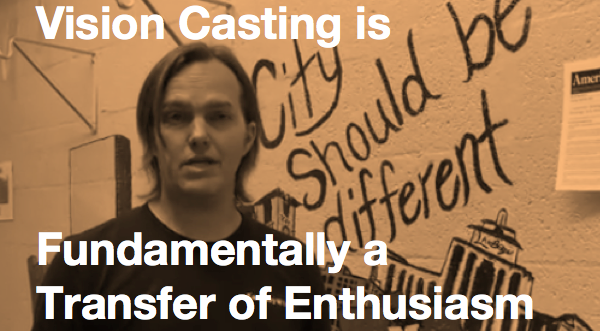
Vision Casting is Fundamentally a Transfer of Enthusiasm

I am grateful for Paul Pettefer– a pastor and missional entrepreneur who has applied the principles of Church Unique and God Dreams with great skill. As a natural visionary, Paul wants his focus to be a clear as a possible. As a natural evangelist, Paul wants to spread the word every day. He is totally in touch with God’s vision for his life. As a result he reaches thousands more with vision than the average guy in ministry.

Paul lives for the “city to be different” in Lake Charles, Louisiana. (TheCityShouldBeDifferent.com) He wants to see the gospel invade his city. He does this through initiatives like his laundry business, a job-finding ministry, and by cooking the best BBQ in the city as an excuse to talk about Jesus. Spend time with Paul and you will never forget his vision.  Paul recently posted a review of my new book,  God Dreams. One principle popped into my mind as I read his review:

Vision casting is fundamentally a transfer of enthusiasm.

Sometimes it’s hard to get excited about the concept of vision or practice of planning because we have lost touch with a passion for the future. Paul reminded me that it’s not that hard to pump up your enthusiasm. Reaching more people doesn’t start with reaching more people; it starts with cultivating deeper personal passion about what God has called you to do. Increase the wattage and more people will see the light.

What’s the one incredible simply step to reach thousands more with vision? Start by dramatically increasing your enthusiasm. It’s actually not that hard. Follow Paul’s recommendation. Grab a tool and grab some friends. Get God Dreams and talk about it with your team. Listen to Paul’s passionate plea as one pastor to other pastors:

While God Dreams is great for Every Influencer in the church, I’ll tailor this encouragement for the Senior Pastor: Leading a church, being the guy at the tip of the spear, it’s not for the faint of heart. I congratulate you on following Jesus thus far! Your job requires a lot from you. The urgent needs are pressing, relentless. I know you have established rhythms that bring you joy in ministry and others that foster productivity.

I AM HERE TO URGE YOU TO MAKE A RHYTHM FOR VISIONARY PLANNING…

God Dreams is your best resource to go next on that journey.

My friend Will Mancini is handing you the field-proven fruit of his well over 10,000 hours of leading church leaders to amplify their efforts toward this rewarding end. You will not find a more insightful guide to help you navigate from the meandering pools of the generic to the Flowing Spring of Visionary Clarity.

I’ve had your job, as a Church Planter, and I’ve worked for you, as a college pastor at a large church. I know the pressure you are under to have all the answers. Breathe in the provision that our Heavenly Father has for you in God Dreams. I am hereby giving you permission to release sole custody of preparing all the Vision stuff on your own! Maybe Vision is your best thing, and you coach others in your circles on vision. Sweet! Buy 5 copies, because God Dreams will soon be your go-to resource for helping your friends! If Leading or Serving or Teaching is your best strength, then God Dreams will help you and your team build on what you have to discover the narrative God is doing with your church and how to draw that out so your entire church catches on. What will they catch on to? The Bigger Narrative of God’s Vision for your church, a compelling picture of your future.

Come on, you know you dream at night about dozens, hundreds of people in your church developing an animating passion for carrying the ball of the Kingdom forward in your church! You have the passion for it. You have the people there. And you’ve done a great sermon series. Then another. And another. By all means, keep those great sermons coming! What your people need is for you to make more space for Visionary Planning, to capture the story of how God is going to use your church, specifically, uniquely, inspirationally! Maybe for such a time as this our Heavenly Father is giving you God Dreams, to walk with you to build this Larger, God-Size Narrative of what He is wanting to do in your church, in your city, in your day. The enemy you must fight, the one that keeps people clapping but not engaging, is (at least partly) a generic vision. As Will says, there are no snowflakes alike, no people alike, and no churches alike. The Stunning Clarity of Vision that God wants to give you, well, it’s available.

Do yourself a huge favor. Buy this book today. Read it the week it arrives. Then come down to Lake Charles next year and we’ll eat a BBQ dinner at the Rib Shack Barbecue and you can tell me, with a huge smile of your face, how God has uncorked the animating passion in the people of your church through the stunning clarity of your new Visionary Planning.

If you are interested in buying God Dreams or reading some of the first 30 reviews, go here. If you want to check out the God Dreams resource site, go here.

> Read more from Will.

Download PDF

Tags: , , , ,

| What is MyVisionRoom? > | Back to God Dreams >

ABOUT THE AUTHOR

Will Mancini

Will Mancini

Will Mancini wants you and your ministry to experience the benefits of stunning, God-given clarity. As a pastor turned vision coach, Will has worked with an unprecedented variety of churches from growing megachurches and missional communities, to mainline revitalization and church plants. He is the founder of Auxano, creator of VisionRoom.com and the author of God Dreams and Church Unique.

See more articles by >

COMMENTS

What say you? Leave a comment!

Recent Comments
comment_post_ID); ?> Thank you for this information. I'm going to use this article to improve my work with the Lord.
 
— Abel Singbeh
 
comment_post_ID); ?> Thank you Ed for sharing your insights into the Church Growth Movement. I have my reservations with Church Growth models because it has done more damage than good in the Body of Christ. Over the years, western churches are more focused on results, formulas and processes with little or no emphasis on membership and church discipline. Pastors and vocational leaders are burnt out because they're overworked. I do believe that the Church Growth model is a catalyst to two destructive groups: The New Apostolic Reformation and the Emerging Church. Both groups overlap and have a very loose definition. They're both focus on contemporary worship, expansion of church brand (franchising), and mobilizing volunteering members as 'leaders' to grow their ministry. Little focus on biblical study, apologetics and genuine missional work with no agenda besides preaching of the gospel.
 
— Dave
 
comment_post_ID); ?> Thank you for sharing such a good article. It is a great lesson I learned from this article. I am one of the leaders in Emmanuel united church of Ethiopia (A denomination with more-than 780 local churches through out the country). I am preparing a presentation on succession planning for local church leaders. It will help me for preparation If you send me more resources and recommend me books to read on the topic. I hope we may collaborate in advancing leadership capacity of our church. God Bless You and Your Ministry.
 
— Argaw Alemu
 

Clarity Process

Three effective ways to start moving toward clarity right now.

The Wayfinding Design Process

The job of the wayfinding designer is to present information in public spaces that helps facilitate a seamless guest experience.

 – David Gibson, The Wayfinding Handbook

When people attempt to navigate a place for the first time, they face a series of decisions as they follow a path to their destination. There is a sequential pattern to this wayfinding process – in effect, a series of questions that people ask themselves along the way. Before starting the design process, the wayfinding designer must anticipate guest patterns, understand that logic, and apply it in the planning phase. Then work can begin on a framework for the wayfinding design program.

Here’s a scenario that’s probably familiar to many of you:

WDWEntranceSign

Imagine you are driving your family of five into Walt Disney World for the first time. As you approach the main entrance, you look up to see the sign. Most likely, you have excited children talking, laughing, or maybe singing “Let It Go.” In addition, you are listening to both your wife and your GPS instructions, trying to decide which one to follow.

Just after you drive through this sign, you immediately begin to see other signs – lots of signs!

Once you are in Walt Disney World proper, you have to locate your Resort, or maybe you are going to one of the Parks first. You approach one, feeling a mixture of hesitance and excitement: Am I going in the right direction? Is the resort I want to go to? Once in the parking lot, if there is no clear entrance marked, are you going in the right door? And once inside, How do you find the registration desk you are looking for?

At each stage in this sequence, the Guest must make decisions based on the available, and readily visible, information. The job of the wayfinding designer is to present information in public spaces that helps facilitate a seamless guest experience. In other words, the necessary sequence of movement should feel as effortless and simplified as possible so that ten steps seem to require only two or three.

The designer’s challenge is to determine where to locate signs, what they should say, and how they should say it. Thoughtful research and analysis help the designer understand a complex public place, such as a hospital or a campus or a subway system. In the process of tracing the guest’s path, the designer attempt to uncover the hidden logic of the place. Once that is clear, the designer can develop a strategic framework for the wayfinding system.

NEWS FLASH: All of the above statements are also true in churches.

When Guests come to your facilities, do they know how to drive into the parking lots? Do they know which building they are going to? Do they know which door to enter? Can they easily determine where they need to go once they step inside the building?

Church leaders must think like wayfinding designers in order to help Guests and members have a seamless guest experience while on your campus. Nothing less than excellence should be the goal.

Part Three: Sign Language

Part One: Why Wayfinding Matters: What We Can Learn from Disney Culture

Information for this series of posts comes primarily from The Wayfinding Handbook by David Gibson. It is an excellent resource for leaders who want to apply the art and science of wayfinding to their organizations.


Download PDF

Tags: ,

| What is MyVisionRoom? > | Back to Communication >

ABOUT THE AUTHOR

Bob Adams

Bob Adams

Bob is an absolute fanatic about Guest Experiences, growing up watching his father serve customers at the gas station he built and operated for 44 years. Bob is continually connecting with corporate leaders in the customer experience world, learning and then translating practices for ChurchWorld. He writes, speaks, and consults on the topic frequently. Vocationally, Bob has a dual role at Auxano, a clarity first consulting firm serving the church. As Vision Room Curator and Digital Engagement Leader he researches, edits, writes and publishes online content. As Guest Experience Navigator, he leverages his passion, providing Guest Perspective Evaluations and Guest Experience Blueprints. Bob and his wife Anita have been married for 40 years. They have 4 children, 3 daughters-in-law, 1 son-in-law, and 5 grandchildren.

See more articles by >

COMMENTS

What say you? Leave a comment!

Recent Comments
comment_post_ID); ?> Thank you for this information. I'm going to use this article to improve my work with the Lord.
 
— Abel Singbeh
 
comment_post_ID); ?> Thank you Ed for sharing your insights into the Church Growth Movement. I have my reservations with Church Growth models because it has done more damage than good in the Body of Christ. Over the years, western churches are more focused on results, formulas and processes with little or no emphasis on membership and church discipline. Pastors and vocational leaders are burnt out because they're overworked. I do believe that the Church Growth model is a catalyst to two destructive groups: The New Apostolic Reformation and the Emerging Church. Both groups overlap and have a very loose definition. They're both focus on contemporary worship, expansion of church brand (franchising), and mobilizing volunteering members as 'leaders' to grow their ministry. Little focus on biblical study, apologetics and genuine missional work with no agenda besides preaching of the gospel.
 
— Dave
 
comment_post_ID); ?> Thank you for sharing such a good article. It is a great lesson I learned from this article. I am one of the leaders in Emmanuel united church of Ethiopia (A denomination with more-than 780 local churches through out the country). I am preparing a presentation on succession planning for local church leaders. It will help me for preparation If you send me more resources and recommend me books to read on the topic. I hope we may collaborate in advancing leadership capacity of our church. God Bless You and Your Ministry.
 
— Argaw Alemu
 

Clarity Process

Three effective ways to start moving toward clarity right now.

Why Wayfinding Matters: What We Can Learn from Disney Culture

Walt Disney World is aptly named:

Spanning 40 square miles, Walt Disney World Resort is approximately the size of San Francisco, or nearly twice the size of Manhattan. The property features:

  • Four theme parks
  • Two water adventure parks
  • 35 resort hotels (26 owned and operated by Walt Disney World, including seven Disney Vacation Club properties)
  • 63 holes of golf on four courses
  • Two full-service spas
  • Disney’s Wedding Pavilion
  • ESPN Wide World of Sports complex
  • Disney Springs, an entertainment-shopping-dining complex

On an average day, there are approximately 250,000 people on Walt Disney World Resort property – including Cast Members, other employees and guests.

Walt Disney World Cast Members come from all over the world, representing more than 80 nationalities and speaking more than 50 different languages.

All of which begs the question:

How do people find their way around Walt Disney World?

Wayfinding design provides guidance and the means to help people feel at ease in their surroundings.

– David Gibson, The Wayfinding Handbook

In the 1980s, the design firm Sussman/Prejza was engaged to reimagine the wayfinding and signage system for Walt Disney World (and also for the developing Euro Disney project, now known as Disneyland Paris).

Established in 1968, Sussman/Prejza works with its clients to develop memorable identities and branding, based upon research and graphic archeology. Abstract stories are woven into the visual product, creating a sense of place and memories that users retain and remember. S/P’s work has pushed the boundaries of environmental graphic design to meld cohesively with architecture, civic planning, and landscape design.

The recognized trailblazer in this discipline, Sussman/Prejza’s expertise can be seen in civic, cultural, corporate, sports, institutional, entertainment and retail projects around the globe.

At Walt Disney World, all Guests arrive by highway or freeway, so the main task of Sussman/Prejza was to develop a vehicular signing system that would be “unique in spirit, clean, easy-to-follow, and capable of being expanded as the area continued to grow.”

The theme park was divided into several major “districts.” A hierarchy of signs was established to first lead Guests toward a specific district, and once there, toward a distinct destination. The 1,000-sign system (now greatly expanded) includes large freeway signs, major and minor road directional, regulatory signs, gateways, and bus graphics.

SPAreaMap

In order to develop a wayfinding system that would cover an area so large while at the same time stay flexible enough for growth, Sussman/Prejza started with a basic color palette and shape guide.

SPPalette

The color palette consists of lavender, blue, and green, chosen to emphasize the black, red, and gold used to create Mickey Mouse. Of the various shapes, the “mouse ears” reinforce the iconic symbol used to represent Mickey Mouse.

Great wayfinding systems employ explicit signs and information as well as implicit symbols and landmarks that together communicate with accuracy and immediacy. Over the last thirty years, wayfinding design has matured to become an essential component of buildings and spaces, helping make sense of a sometimes-overwhelming task: getting from here to there.

What do wayfinding clients need?

The examples below illustrate the range of design projects. The complexity of the project grows in direct proportion to the scale and challenges of the client’s property.

  • Individual sign – a single landmark or feature sign
  • Wayfinding for building complexes – exterior and interior signage for a group of buildings
  • System signage – signage for multiple locations, branches, or franchises operated by one owner or manager, ranging from park systems to consumer banks
  • Open space signage – exterior signage for individual parks, streets, or plazas; for trails and greenways; for urban downtowns
  • Campus wayfinding – wayfinding system for a group of buildings operating together on one site
  • Building signage – signage for an individual structure, exterior and/or interior

Successful wayfinding design depends on understanding three variables:

  1. The nature of the client organization
  2. The people with whom the organization communicates
  3. The type of environment in which the system is installed

Wayfinding in ChurchWorld

As a leader in ChurchWorld, you may be saying, “This is all well and good, but we’re not even meeting our budget or having enough volunteers to serve in our ministries, or …”

People will always need to know where they are, how to reach their destination, what is happening there, and how to exit.

Of all places, shouldn’t the church be clear about wayfinding?

Part Two: The Wayfinding Design Process

Information for this series comes primarily from The Wayfinding Handbook by David Gibson. It is an excellent resource for leaders who want to understand and apply the art and science of wayfinding to their organization.

Download PDF

Tags: ,

| What is MyVisionRoom? > | Back to Communication >

ABOUT THE AUTHOR

Bob Adams

Bob Adams

Bob is an absolute fanatic about Guest Experiences, growing up watching his father serve customers at the gas station he built and operated for 44 years. Bob is continually connecting with corporate leaders in the customer experience world, learning and then translating practices for ChurchWorld. He writes, speaks, and consults on the topic frequently. Vocationally, Bob has a dual role at Auxano, a clarity first consulting firm serving the church. As Vision Room Curator and Digital Engagement Leader he researches, edits, writes and publishes online content. As Guest Experience Navigator, he leverages his passion, providing Guest Perspective Evaluations and Guest Experience Blueprints. Bob and his wife Anita have been married for 40 years. They have 4 children, 3 daughters-in-law, 1 son-in-law, and 5 grandchildren.

See more articles by >

COMMENTS

What say you? Leave a comment!

Recent Comments
comment_post_ID); ?> Thank you for this information. I'm going to use this article to improve my work with the Lord.
 
— Abel Singbeh
 
comment_post_ID); ?> Thank you Ed for sharing your insights into the Church Growth Movement. I have my reservations with Church Growth models because it has done more damage than good in the Body of Christ. Over the years, western churches are more focused on results, formulas and processes with little or no emphasis on membership and church discipline. Pastors and vocational leaders are burnt out because they're overworked. I do believe that the Church Growth model is a catalyst to two destructive groups: The New Apostolic Reformation and the Emerging Church. Both groups overlap and have a very loose definition. They're both focus on contemporary worship, expansion of church brand (franchising), and mobilizing volunteering members as 'leaders' to grow their ministry. Little focus on biblical study, apologetics and genuine missional work with no agenda besides preaching of the gospel.
 
— Dave
 
comment_post_ID); ?> Thank you for sharing such a good article. It is a great lesson I learned from this article. I am one of the leaders in Emmanuel united church of Ethiopia (A denomination with more-than 780 local churches through out the country). I am preparing a presentation on succession planning for local church leaders. It will help me for preparation If you send me more resources and recommend me books to read on the topic. I hope we may collaborate in advancing leadership capacity of our church. God Bless You and Your Ministry.
 
— Argaw Alemu
 

Clarity Process

Three effective ways to start moving toward clarity right now.

Say It Again: You Can Never Repeat Your Vision Too Much

And again I say unto you, it is easier for a camel to go through the eye of a needle, than for a rich man to enter into the kingdom of God.
Matthew 19:24

I find it interesting that Jesus would have to say anything again. You would think that the Son of God wouldn’t have to repeat himself for people to get the message. Once should have been enough.

But throughout the gospels there are instances where Jesus finds the need to say something again, and he then either builds on something he had said before or gives it a slightly different interpretation. It’s the same essential message. Only expanded, clarified, or taught in a new way.

I think Jesus knew something that every leader has to grasp: you can never repeat your vision too much. There isn’t a single leader who has cast their vision enough. No matter how many times you’ve said it, there’s always someone out there who hasn’t gotten it. Or someone who has lost it.

No one can hold onto any vision indefinitely without reinforcement and repetition. It doesn’t matter how compelling it is. Was any vision ever more compelling than the one Jesus laid out? Yet even he found the need to say it again.

And you’re going to need to as well.

People inevitably lose sight of why they’re doing what they’re doing. They get distracted by the practical realities of getting their work done. They lose the enthusiasm they had when the vision was fresh in their minds.

It happened to the disciples who were with Jesus day and night for three years. So it’s definitely going to happen to people you see for only a few hours a day. Or in the case of pastors, only once or twice a week.

This doesn’t mean you simply have to verbally state your vision or mission statement over and over to your people. You can repeat yourself without being repetitive. Find fresh ways to cast the same vision you have been casting for years. Explore new angles from which you can communicate the heartbeat of your church or organization.

You might have an incredible vision that has the potential to ignite passion in people’s souls and move them into action. Be excited about it. Be thankful for it. Never compromise it.

But it isn’t better than Jesus’. If Jesus had to repeat himself, what makes us think we can do anything less?

No matter how compelling your vision is, say it again.


Want to learn more about communicating your vision – over and over? Connect with an Auxano Navigator and start a conversation with our team.

Download PDF

Tags: , , , ,

| What is MyVisionRoom? > | Back to Communication >

ABOUT THE AUTHOR

Steven Furtick

Steven Furtick

Pastor Steven Furtick is the lead pastor of Elevation Church. He and his wife, Holly, founded Elevation in 2006 with seven other families. Pastor Steven holds a Master of Divinity degree from The Southern Baptist Theological Seminary. He is also the New York Times Best Selling author of Crash the Chatterbox, Greater, and Sun Stand Still. Pastor Steven and Holly live in the Charlotte area with their two sons, Elijah and Graham, and daughter, Abbey.

See more articles by >

COMMENTS

What say you? Leave a comment!

Recent Comments
comment_post_ID); ?> Thank you for this information. I'm going to use this article to improve my work with the Lord.
 
— Abel Singbeh
 
comment_post_ID); ?> Thank you Ed for sharing your insights into the Church Growth Movement. I have my reservations with Church Growth models because it has done more damage than good in the Body of Christ. Over the years, western churches are more focused on results, formulas and processes with little or no emphasis on membership and church discipline. Pastors and vocational leaders are burnt out because they're overworked. I do believe that the Church Growth model is a catalyst to two destructive groups: The New Apostolic Reformation and the Emerging Church. Both groups overlap and have a very loose definition. They're both focus on contemporary worship, expansion of church brand (franchising), and mobilizing volunteering members as 'leaders' to grow their ministry. Little focus on biblical study, apologetics and genuine missional work with no agenda besides preaching of the gospel.
 
— Dave
 
comment_post_ID); ?> Thank you for sharing such a good article. It is a great lesson I learned from this article. I am one of the leaders in Emmanuel united church of Ethiopia (A denomination with more-than 780 local churches through out the country). I am preparing a presentation on succession planning for local church leaders. It will help me for preparation If you send me more resources and recommend me books to read on the topic. I hope we may collaborate in advancing leadership capacity of our church. God Bless You and Your Ministry.
 
— Argaw Alemu
 

Clarity Process

Three effective ways to start moving toward clarity right now.

5 Strategies to Minimize the Downside of Staff Tenure

There are a plethora of upsides to staff tenure. You learn the organization over time. You understand the context better and better. You build relationships with the team and the people you are serving. For the most part, tenure makes leaders more effective.

But there is a major downside to tenure; leaders can lose their fresh eyes. When a leader first enters a context, the opportunities and challenges are seen more clearly. Granted, they are often seen through inexperienced and naïve eyes, but they are still seen. Over time, leaders get inoculated to the problems in their own cultures. The same happens in our personal lives. When you first move into a house, you notice the hole in the garage. If you don’t fix it soon, you get used to it. Over time, you don’t even notice it.

So how can a leader minimize the inevitable downside of tenure? Here are five ways to get fresh eyes on the organization/ministry you are leading.

1. Hire from the outside.

John Kotter says if you want to change the culture, hire from outside. If you want to keep the culture, hire from within. Developing your own leaders is ideal as culture is crystalized and people see a path for growth in the organization. However, even in a healthy culture that excels in developing their own leaders, occasionally hiring from the outside helps leaders keep fresh eyes.

2. Look through the eyes of new leaders.

Even if promoting from within, a newly minted leader has fresh and valuable perspective. Press into their perspective.

3. Listen to the questions of new team members.

Culture is often learned by new members when they accidentally break a cultural norm and receive correction or are affirmed for fulfilling one. Thus, they ask questions to learn more about “how things really work around here.” Those questions give leaders, often isolated by layers of organization, an idea of “how things really work around here.”

 4. Bring in a strategic outsider.

While a strategic outsider cannot own the execution and the culture, a strategic outsider can provide valuable perspective. My friend and colleague Will Mancini uses the term often to describe the services of Auxano. If you are a ministry leader needing some strategic outside perspective, I highly recommend them.

5. Read outside your discipline.

Reading outside of what you normally read gives you new perspective. And then you can, with great intentionality, look with fresh eyes once again.

These five ways can help, but ultimately leaders must choose to have fresh eyes. Occasionally (and privately), it is good for leaders to resign in their minds. Walk into the office with fresh eyes. Evaluate with a fresh perspective. Look again with the optimism you held when you first accepted the responsibility of leading.

> Read more from Eric.


Learn more about overcoming the downside of staff tenure. Connect with an Auxano Navigator and start a conversation with our team.

Download PDF

Tags: , ,

| What is MyVisionRoom? > | Back to Leadership >

ABOUT THE AUTHOR

Eric Geiger

Eric Geiger

Eric Geiger is the Senior Pastor of Mariners Church in Irvine, California. Before moving to Southern California, Eric served as senior vice-president for LifeWay Christian. Eric received his doctorate in leadership and church ministry from Southern Seminary. Eric has authored or co-authored several books including the best selling church leadership book, Simple Church. Eric is married to Kaye, and they have two daughters: Eden and Evie. During his free time, Eric enjoys dating his wife, taking his daughters to the beach, and playing basketball.

See more articles by >

COMMENTS

What say you? Leave a comment!

Recent Comments
comment_post_ID); ?> Thank you for this information. I'm going to use this article to improve my work with the Lord.
 
— Abel Singbeh
 
comment_post_ID); ?> Thank you Ed for sharing your insights into the Church Growth Movement. I have my reservations with Church Growth models because it has done more damage than good in the Body of Christ. Over the years, western churches are more focused on results, formulas and processes with little or no emphasis on membership and church discipline. Pastors and vocational leaders are burnt out because they're overworked. I do believe that the Church Growth model is a catalyst to two destructive groups: The New Apostolic Reformation and the Emerging Church. Both groups overlap and have a very loose definition. They're both focus on contemporary worship, expansion of church brand (franchising), and mobilizing volunteering members as 'leaders' to grow their ministry. Little focus on biblical study, apologetics and genuine missional work with no agenda besides preaching of the gospel.
 
— Dave
 
comment_post_ID); ?> Thank you for sharing such a good article. It is a great lesson I learned from this article. I am one of the leaders in Emmanuel united church of Ethiopia (A denomination with more-than 780 local churches through out the country). I am preparing a presentation on succession planning for local church leaders. It will help me for preparation If you send me more resources and recommend me books to read on the topic. I hope we may collaborate in advancing leadership capacity of our church. God Bless You and Your Ministry.
 
— Argaw Alemu
 

Clarity Process

Three effective ways to start moving toward clarity right now.