7 Ways to Make Sure Your Guests Have the Best Experience Possible

Would you like every guest who attends your church to become an active and fruitful member?

I know. Dumb question.

It’s really a rhetorical question since all church leaders and members would respond with a resounding “Yes!”

So we tried something rather radical to find out what gives church guests a good experience. We asked them. The question was very straightforward: “What would you advise churches to do so that guests can have the best experience possible?” Here are their seven top responses:

  1. “Make sure your signage is clear and helpful in the parking lot. Our family of six rarely gets ready on Sunday morning without some level of conflict. I come to church stressed. I don’t need to be stressed further by not knowing where to go in the parking lot.”
  2. “Provide clear signage to entry points to the church. I am new to our area, so our family has been visiting churches. I have really been surprised how many churches do not have signs that clearly point to where we are to enter.”
  3. “Have a manned information booth [or table] right where we enter. Some churches put their information person or booth in such far out places that they are not useful at all.”
  4. “Greet me casually, not in a contrived stand and greet time. The stand and greet time is so artificial. I know how friendly a church is by the greetings I get when I enter and when I leave.”
  5. “Show me where to take my children. Even better, take me to where I am to take my children.”
  6. “Sit with me. I’ve been in some churches where we were avoided like the plague. No one sat with us.”
  7. “Explain things I might not understand. Even though I’ve been in church for over ten years, every church is a bit different. If your church does something that is not typical, let us guests know both the ‘what’ and the ‘why.’”

We can speculate what guests would like, or we can listen to them. We took the latter path and gleaned some nuggets of helpful information. Let us know what you think.

Read more from Thom.


Want to learn how to create an EXCEPTIONAL Guest Experience at your church? Check out Auxano’s Guest Experience Boot Camp in Cincinnati, OH on August 7-8.


Download PDF

Tags: , ,

| What is MyVisionRoom? > | Back to Execution >

ABOUT THE AUTHOR

Thom Rainer

Thom Rainer

Thom S. Rainer is the founder and CEO of Church Answers, an online community and resource for church leaders. Prior to founding Church Answers, Rainer served as president and CEO of LifeWay Christian Resources. Before coming to LifeWay, he served at The Southern Baptist Theological Seminary for twelve years where he was the founding dean of the Billy Graham School of Missions and Evangelism. He is a 1977 graduate of the University of Alabama and earned his Master of Divinity and Ph.D. degrees from The Southern Baptist Theological Seminary.

See more articles by >

COMMENTS

What say you? Leave a comment!

Recent Comments
comment_post_ID); ?> Thank you for this information. I'm going to use this article to improve my work with the Lord.
 
— Abel Singbeh
 
comment_post_ID); ?> Thank you Ed for sharing your insights into the Church Growth Movement. I have my reservations with Church Growth models because it has done more damage than good in the Body of Christ. Over the years, western churches are more focused on results, formulas and processes with little or no emphasis on membership and church discipline. Pastors and vocational leaders are burnt out because they're overworked. I do believe that the Church Growth model is a catalyst to two destructive groups: The New Apostolic Reformation and the Emerging Church. Both groups overlap and have a very loose definition. They're both focus on contemporary worship, expansion of church brand (franchising), and mobilizing volunteering members as 'leaders' to grow their ministry. Little focus on biblical study, apologetics and genuine missional work with no agenda besides preaching of the gospel.
 
— Dave
 
comment_post_ID); ?> Thank you for sharing such a good article. It is a great lesson I learned from this article. I am one of the leaders in Emmanuel united church of Ethiopia (A denomination with more-than 780 local churches through out the country). I am preparing a presentation on succession planning for local church leaders. It will help me for preparation If you send me more resources and recommend me books to read on the topic. I hope we may collaborate in advancing leadership capacity of our church. God Bless You and Your Ministry.
 
— Argaw Alemu
 

Clarity Process

Three effective ways to start moving toward clarity right now.

Don’t Put Your Guests First at Your Organization – Part 1

Editor’s Note: During our August focus on Guest Experiences, we are honored to have some of the best voices in the world of Customer Experience provide guest posts for the Vision Room. As you read the content below, simply think “Guest” where you see the word “customer” – and you will benefit from the knowledge and expertise of some great minds.


In this first part of a two-part series, I’ll outline some important ways to ensure that your company is putting the customer at the center of all it does.

Why are companies in business? For customers, right? To create and to nurture a customer, to be specific. And, yet, we still see some dismal statistics about how many companies don’t focus on the customer experience or think they focus on the customer experience but really don’t. In research published by Bain, they reported that:

  • only 50% of management teams tailor their products and services to the needs of customers
  • only 30% organize the functions of their company to deliver superior customer experiences
  • only 30% maintain effective customer feedback loops

Temkin Group recently reported that 67% of large companies rate themselves as being good at soliciting customer feedback, but only 26% rate themselves as being good about making changes based on the insights.

These are dismal statistics. How do we turn this around?

If you haven’t yet started to focus on the needs of the customer, where should you begin?  What can you do to turn the tide?

First you must decide. And then, when you’re ready to put the customer at the center of all you do, there are six important steps to take to get started:

1.    Identify the customer
2.    Understand the customer
3.    Outline the customer lifecycle
4.    Map the customer journey
5.    Listen to your customers
6.    Socialize the insights/findings

Step 1: Identify the Customer 

Knowing who the customer is seems like a no-brainer, but you’d be surprised by how many companies have never gone through the exercise of identifying the customer. In a B2B organization, for example, customers can be many and varied; look within each customer or partner organization at the people you interact with, e.g., purchasing, product, support, accounting, end-users, etc. to identify your customer. The company is not the customer; the people you interact with within the company are. Not having a clear understanding of who the customer is hampers any further steps in this process.

Step 2: Understand the Customer 
Once you’ve identified who your customers are, you must understand them and their needs. How do they interact with your organization? Why do they buy products and services from you? What are their needs? What problems are they trying to solve? What are they trying to achieve?

A tool to use to answer all of these questions is personas. Personas are fictional characters created to describe your ideal prospect or actual customer. They are derived through primary research – research that can then also be used for your customer journey maps in Step 4. They are specific to your business, not to the industry. The descriptions include vivid narratives, images, and other items that help companies understand the needs of the customer (contextual insights) and outline feelings, motivations, goals, behaviors, challenges, likes, dislikes, objections, and interests that drive buying (or other) decisions. Each persona includes a human face and name. Used properly, personas keep the customer alive and front and center for the entire organization. They tie in nicely to your journey maps and are necessary to begin that exercise.

A hardware client of mine developed supplier personas in order to better understand the different supplier personnel with which they interact. Different supplier types and different roles within a supplier company have different needs and interact differently with your organization; understanding those then allows you to create a better experience for all involved. For their personas, we looked at the different roles within supplier companies and came up with six primary personas: operations management, logistics, production schedulers, inventory management, shipping, and accounting. A lot of research went into defining these personas, which were then used to develop journey maps that laid out the experience they had when trying to achieve whatever it was each did with the client. These personas were then used to better manage supplier relationships and to design a better supplier experience with the client, one more personalized to each specific role/persona. The client saw a remarkable uptick in supplier satisfaction, and hence retention, as a result of this increased understanding.

Step 3: Outline the Customer Lifecycle 
The lifecycle map shows the phases of the customer’s relationship with your company. It’s high level and good for understanding the overall relationship the customer has with the organization, from before he’s even considered a customer through when he is no longer a customer. It typically includes these stages: Need, Awareness, Consideration, Selection/Purchase, Experience, Loyalty, Advocacy, Engagement, Raving Fans. And, unfortunately, Exit. It’s not necessarily linear and often circles back on itself.

It’s great to understand the lifecycle at this high level before moving on to the next step. Lifecycle maps, while important to nurturing the overall customer relationship, are a natural first step to identifying listening needs along the lifecycle; however, to get to the heart of the matter, to really understand when and where to listen and to really design a better customer experience, you must dive deeper into the lifecycle stages, inventory the touchpoints, and map the customer journey, which I’ll discuss further in Step 4.

In my next post, I’ll wrap up the other three steps you can take to ensure that customers are front and center in your organization.

When a brand connects with their customer, that in some ways is the easy part, the hard part is keeping the customer at the center after the success/profits comes flooding in. Success can breed complacency, success can breed arrogance. -Anna Farmery

Read more from Annette.


Want to learn how to create an EXCEPTIONAL Guest Experience at your church? Check out Auxano’s Guest Experience Boot Camp, coming to Orlando, FL on April 3-4.

Download PDF

Tags: , ,

| What is MyVisionRoom? > | Back to Execution >

ABOUT THE AUTHOR

Annette Franz

Annette Franz

Annette Franz is an internationally recognized customer experience thought leader, coach, consultant, and speaker. She’s on the verge of publishing her first book about putting the “customer” into customer experience. Stay tuned for that! Annette is active in the Customer Experience Professionals Association (CXPA), as: an Executive Officer on the Board of Directors, a CX Expert, and a CX Mentor. And she is a Certified Customer Experience Professional (CCXP). She is also an official member of the Forbes Coaches Council, an invitation-only community for successful business and career coaches. Members are selected based on their depth and diversity of experience.

See more articles by >

COMMENTS

What say you? Leave a comment!

Recent Comments
comment_post_ID); ?> Thank you for this information. I'm going to use this article to improve my work with the Lord.
 
— Abel Singbeh
 
comment_post_ID); ?> Thank you Ed for sharing your insights into the Church Growth Movement. I have my reservations with Church Growth models because it has done more damage than good in the Body of Christ. Over the years, western churches are more focused on results, formulas and processes with little or no emphasis on membership and church discipline. Pastors and vocational leaders are burnt out because they're overworked. I do believe that the Church Growth model is a catalyst to two destructive groups: The New Apostolic Reformation and the Emerging Church. Both groups overlap and have a very loose definition. They're both focus on contemporary worship, expansion of church brand (franchising), and mobilizing volunteering members as 'leaders' to grow their ministry. Little focus on biblical study, apologetics and genuine missional work with no agenda besides preaching of the gospel.
 
— Dave
 
comment_post_ID); ?> Thank you for sharing such a good article. It is a great lesson I learned from this article. I am one of the leaders in Emmanuel united church of Ethiopia (A denomination with more-than 780 local churches through out the country). I am preparing a presentation on succession planning for local church leaders. It will help me for preparation If you send me more resources and recommend me books to read on the topic. I hope we may collaborate in advancing leadership capacity of our church. God Bless You and Your Ministry.
 
— Argaw Alemu
 

Clarity Process

Three effective ways to start moving toward clarity right now.

Welcome All Your Guests, But Focus on the One

As guest services practitioners, it’s time for us to admit something.

The ministry of serving guests is relatively easy, in the grand scheme of things: design a system. Invite volunteers to serve in the system. Execute the system week after week. Lather. Rinse. Repeat.

I say that it’s easy because, after all, we are ministering to the masses. Blocks of people move through our pre-engineered process. They go from point A to point B, guided by our unseen hands as we help take them from a place of connection to a place of commitment.

Creating an inviting environment for guests is pretty simple, because guests plural are nameless, faceless entities.

But what if this weekend – rather than saying we’re here to serve our guests – we looked for a particular guest to serve?

What if we moved past the many to see the one?

What if we set aside our systems and struck up a friendship?

What if we stopped making assumptions about what our guests want and stop to discover what one person needs?

What if we breathed a silent prayer as we walk down a sidewalk or make our way through the lobby, asking the Holy Spirit to reveal to us the one person he’s putting in our path?

What if we asked the question, “Who am specifically serving today? Right now? In this moment?”


So…who are you here for?

> Read more from Danny.


Download PDF

Tags: , , ,

| What is MyVisionRoom? > | Back to Execution >

ABOUT THE AUTHOR

Danny Franks

Danny Franks

Danny Franks makes his living as a Connections Pastor at the Summit Church in Raleigh-Durham, North Carolina. He also makes a life as the husband of an out-of-his-league hottie and the dad of three cool sons and one sweet princess. His blog, dfranks.com, is a reflection of how he interacts with all of these.

See more articles by >

COMMENTS

What say you? Leave a comment!

Recent Comments
comment_post_ID); ?> Thank you for this information. I'm going to use this article to improve my work with the Lord.
 
— Abel Singbeh
 
comment_post_ID); ?> Thank you Ed for sharing your insights into the Church Growth Movement. I have my reservations with Church Growth models because it has done more damage than good in the Body of Christ. Over the years, western churches are more focused on results, formulas and processes with little or no emphasis on membership and church discipline. Pastors and vocational leaders are burnt out because they're overworked. I do believe that the Church Growth model is a catalyst to two destructive groups: The New Apostolic Reformation and the Emerging Church. Both groups overlap and have a very loose definition. They're both focus on contemporary worship, expansion of church brand (franchising), and mobilizing volunteering members as 'leaders' to grow their ministry. Little focus on biblical study, apologetics and genuine missional work with no agenda besides preaching of the gospel.
 
— Dave
 
comment_post_ID); ?> Thank you for sharing such a good article. It is a great lesson I learned from this article. I am one of the leaders in Emmanuel united church of Ethiopia (A denomination with more-than 780 local churches through out the country). I am preparing a presentation on succession planning for local church leaders. It will help me for preparation If you send me more resources and recommend me books to read on the topic. I hope we may collaborate in advancing leadership capacity of our church. God Bless You and Your Ministry.
 
— Argaw Alemu
 

Clarity Process

Three effective ways to start moving toward clarity right now.

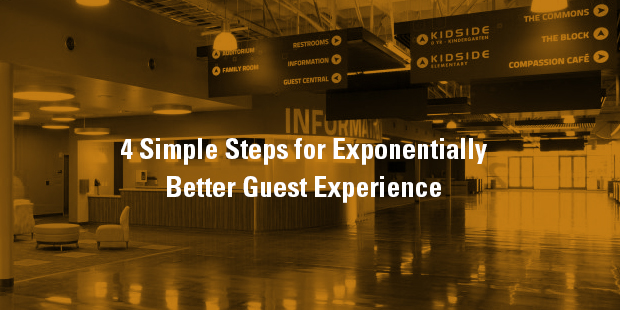
4 Simple Steps for Exponentially Better Guest Experience

What would it look like if this coming Sunday morning, your church’s entire Guest Services Ministry Team didn’t show? Imagine no neon-vested minions directing traffic or over-caffeinated greeters guiding guests. I wonder if the scene might border on apocalyptic, with panicked pastors pacing the hallways, pandemonium in the parking lot and zombie-eyed parents with kids in tow left to fend for themselves?

What if you were forced to rely solely upon your facility’s design to guide each guest?

Think about it: could every visitor flawlessly navigate an entire Sunday morning experience intuitively or would the self-guided experience result in a blundered debacle? And what happens to those people, often first-timers, who want to navigate your building on their own and manage to skillfully evade your welcome team each week? You know it happens.

Here’s the cold hard truth: if newcomers are unable to intuitively navigate your facility, it indicates you’ve got a huge design problem on your hands. Because good design always makes usability more intuitive. And intuitive environments empower great guest experiences.

Often, churches use their guest services ministry as a duct tape to patch the holes of defective design. It’s true– your building may need a complete overhaul. But maybe you could begin to curate a better guest experience now by making your building a little more intuitive.

HERE ARE FOUR OF THE MOST BASIC RULES TO CURATING A MORE INTUITIVE GUEST EXPERIENCE:
1. POINT THE WAY

Thoughtful “way-finding” and quality signage is absolutely the best way to curate a more intuitive experience. Clear and strategic directional signs that guide and move people through ministry environments will empower guests to take control of their own spiritual experience from day one.

Guest Experience
Eastside Christian Church – Anaheim, CA

Keep in mind that “way-finding” doesn’t always demand a huge ugly directional sign mounted to the wall. Sometimes, the best label is a strong branded space that intuitively directs your guests. For example, your main entry door should be unmistakable – no sign required. Four-year-olds should intuitively know where they belong and be naturally drawn to your kids’ environment.

Guest Experience
Eastside Christian Church – Anaheim, CA
2. SIMPLIFY THE OPTIONS

Some of the best apps on your phone only contain 2-4 buttons on your screen at a time. The app may organize the library of a billion songs, yet there are still only 2-4 choices available. Simplicity is what makes complexity usable.

The parking lot is a great place to begin thinking about simplifying the user’s options. Add a dozen orange cones to reduce a driver’s turn choices and forge a unified traffic flow (and for the record, the need of traffic cones could indicates poor parking design).

Guest Experience
Calvary Baptist Church – St College, PA
3. DEVELOP MINISTRY DISTRICTS

Another way to simplify complexity is to consolidate what you have. Think about it, grocery stores group all of the dairy, meat and bread into their own individual districts. It’s what makes finding hamburger so intuitive. Home improvement stores have both plumbing and painting districts. It’s even likely that your socks and jeans don’t live in the same dresser drawer but have their own “districts.”

If you want to make your building more intuitive, then your ministries should also be grouped into similar districts throughout your building. For example, children should all be together in their own secure district that is visually differentiated from all the other parts of the building. Additionally, there should be a youth district, worship district, admin district and connecting space.

Guest Experience
Calvary Baptist Church – St College, PA
4. FAVOR CLARITY OVER CREATIVITY

Guests crave simplicity and clarity. So, for heaven’s sake, make sure the names of your environments actually describe what they are. As a guest, I just want to know where the coffee is and where to drop off my kids. So when you use the greek word for “coffee” to name coffee corner or some creative nonsensical jib jab to brand your kids check-in, it’s not helpful (even though it may be super creative).

Guest Experience
Bayside Church – Roseville, CA

Know where to get creative and where to use common sense design patterns. And when it comes to creating intuitive spaces, always favor clarity over creativity.


Download PDF

Tags: , , ,

| What is MyVisionRoom? > | Back to Execution >

ABOUT THE AUTHOR

Dave Milam

Dave Milam

Dave Milam is a visioneer, strategist and visual storyteller whose right brained style of delivery helps his listener connect in a uniquely immersive way. As a member of the Visioneering Studios team, Dave equips leaders by leveraging art and science to launch inspired vision into reality.

See more articles by >

COMMENTS

What say you? Leave a comment!

Recent Comments
comment_post_ID); ?> Thank you for this information. I'm going to use this article to improve my work with the Lord.
 
— Abel Singbeh
 
comment_post_ID); ?> Thank you Ed for sharing your insights into the Church Growth Movement. I have my reservations with Church Growth models because it has done more damage than good in the Body of Christ. Over the years, western churches are more focused on results, formulas and processes with little or no emphasis on membership and church discipline. Pastors and vocational leaders are burnt out because they're overworked. I do believe that the Church Growth model is a catalyst to two destructive groups: The New Apostolic Reformation and the Emerging Church. Both groups overlap and have a very loose definition. They're both focus on contemporary worship, expansion of church brand (franchising), and mobilizing volunteering members as 'leaders' to grow their ministry. Little focus on biblical study, apologetics and genuine missional work with no agenda besides preaching of the gospel.
 
— Dave
 
comment_post_ID); ?> Thank you for sharing such a good article. It is a great lesson I learned from this article. I am one of the leaders in Emmanuel united church of Ethiopia (A denomination with more-than 780 local churches through out the country). I am preparing a presentation on succession planning for local church leaders. It will help me for preparation If you send me more resources and recommend me books to read on the topic. I hope we may collaborate in advancing leadership capacity of our church. God Bless You and Your Ministry.
 
— Argaw Alemu
 

Clarity Process

Three effective ways to start moving toward clarity right now.

Create a Compelling Culture of Hospitality

Do your greeters truly welcome, or do they simply open doors and hand out bulletins?

A common picture at many churches this weekend would look something like this: a couple of people – maybe even a literal couple – stand outside the church’s main entrance. Depending on the weather, they may actually be inside the doors. As people approach the door, they open it and give a brief “hello” or “good morning” or some other similar platitude. Across the lobby, at the doors to the sanctuary or auditorium or large gathering room used for worship, the scene is repeated. Only, this time, the doors are usually propped open and an usher is standing there with a stack of bulletins, giving them out as people enter.

After all, isn’t that the purpose of greeters and ushers? Don’t they have a job description that outlines what they do each weekend?

Danny Franks, Connections Pastor at Summit RDU, gives a brief and compelling argument that hospitality teams serve more than just a utilitarian purpose. While acknowledging the importance of system and process, he challenges us to look at the beauty of hospitality:

The beauty of guest services is that it serves as a signpost to the gospel. Our planning and strategizing and vision casting and volunteer recruiting may indeed reduce combustion points and increase efficiency, but that shouldn’t be the reason we do it. Guest services should ultimately point to the kindness of Jesus. Our hospitality should be a catalyst.

What about your church? Your hospitality teams, in whatever form and name you give them, are literally the first face of your church as guests engage your campus and worship environments. What kind of gospel-impression are they making?

Create a compelling culture of hospitality.

THE QUICK SUMMARY – It’s My Pleasure, by Dee Ann Turner

Businesses are built by growing relationships with customers. Culture is created by the stories those relationships tell. Two of the most important differentiators of a business are its talent and its culture. Talent energized by a compelling culture will drive organizational success and provide innovative growth opportunities for both the business and the individual.

Based on her more than thirty years at Chick-fil-A©, most of which have been spent as Vice President, Corporate Talent, Dee Ann Turner shares how Chick-fil-A© has built a devoted talent and fan base that spans generations. It’s My Pleasure tells powerful stories and provides practical applications on how to develop extraordinary talent able to build and/or stimulate a company’s culture.

A SIMPLE SOLUTION

The title of the book used in this solution is no stranger to a large, and growing, segment of the U.S. population. Made popular by eager and energetic team members at Chick-fil-A© restaurants, it is their response to a customer saying thank you, or some variation of that phrase.

But underneath that phrase is much more. It not only represents a value established by Chick-fil-A© founder Truett Cathy, it is also instilled as a company value taking many shapes, and most importantly, reflects the culture of Chick-fil-A©.

And it’s a good place to begin taking a look at the culture of your hospitality teams.

Creating a strong, compelling culture requires intentionality and vision.

Culture is the soul of the organization. It is the way we envision, engage, and experience others within an organization. Culture defines the values and behaviors that are acceptable and expected. Culture can be an elusive concept to describe, but at Chick-fil-A, we call it living life together.

It is far easier to create a compelling culture from the beginning than to rebrand a struggling culture later, so it’s an essential beginning to any organization.

To build a compelling culture, your organization must take several steps:

  1. A compelling culture begins with a clear purpose for existing.
  2. A compelling culture must have a challenging mission.
  3. A compelling culture must have core values.
  4. A compelling culture has guiding principles.

It’s never too late to help your team or organization strengthen your culture. Start your strategy with the WHY through defining your purpose. Continue with the WHAT in developing your mission and then focus your efforts day in and day out on the HOW through constant commitment to your core values and guiding principles. With unwavering focus and discipline to the process, you can create a compelling culture for your organization.

Dee Ann Turner, It’s My Pleasure

A NEXT STEP

The minute you follow instructions, you’re no longer an artist.

– Seth Godin

For our purposes, take the quote above to the next step: There’s an art to connecting with people as a part of a hospitality team. Yes, you have to understand what you do as a greeter or usher, but there is a more important WHY behind those actions.

On separate sheets of a chart tablet, list Dee Ann Turner’s four steps for creating a compelling culture listed above, one per sheet.

During a designated leadership team session set aside just for this exercise, work through each of the steps, listing the comments of your team in response to the steps.

After you have listed them, go back and get a group consensus for each step.

Now, extend these steps to your hospitality teams inserting the phrase “of our hospitality teams” and ranking each of the four steps with a 1 (not present at all) to a 5 (always present).

At the next opportunity, review each of the four steps and their rankings with your hospitality team leaders. First, celebrate those steps your team has identified with a 4 or 5 ranking, and encourage your leaders to share your celebration with their teams.

Next, brainstorm how steps with a 1, 2, or 3 ranking can be moved to a 4 ranking. List the responses, and challenge the leaders to take the top three in each group and work with their teams in moving this ranking up.


Taken from SUMS Remix 46-1, published August 2016


This is part of a weekly series posting content from one of the most innovative content sources in the church world: SUMS Remix Book Summaries for church leaders. SUMS Remix takes a practical problem in the church and looks at it with three solutions; and each solution is taken from a different book. As a church leader you get to scan relevant books based on practical tools and solutions to real ministry problems, not just by the cover of the book. Each post will have the edition number which shows the year and what number it is in the overall sequence. (SUMS provides 26 issues per year, delivered every other week to your inbox). 

Subscribe to SUMS Remix <<


Want to learn more about training your teams? Check out Auxano’s Guest Experience Boot Camp in Cincinnati, OH on August 7-8.


Download PDF

Tags: , , , , ,

| What is MyVisionRoom? > | Back to Execution >

ABOUT THE AUTHOR

VRcurator

VRcurator

Bob Adams is Auxano's Vision Room Curator. His background includes over 23 years as an associate/executive pastor as well as 8 years as the Lead Consultant for a church design build company. He joined Auxano in 2012.

See more articles by >

COMMENTS

What say you? Leave a comment!

Recent Comments
comment_post_ID); ?> Thank you for this information. I'm going to use this article to improve my work with the Lord.
 
— Abel Singbeh
 
comment_post_ID); ?> Thank you Ed for sharing your insights into the Church Growth Movement. I have my reservations with Church Growth models because it has done more damage than good in the Body of Christ. Over the years, western churches are more focused on results, formulas and processes with little or no emphasis on membership and church discipline. Pastors and vocational leaders are burnt out because they're overworked. I do believe that the Church Growth model is a catalyst to two destructive groups: The New Apostolic Reformation and the Emerging Church. Both groups overlap and have a very loose definition. They're both focus on contemporary worship, expansion of church brand (franchising), and mobilizing volunteering members as 'leaders' to grow their ministry. Little focus on biblical study, apologetics and genuine missional work with no agenda besides preaching of the gospel.
 
— Dave
 
comment_post_ID); ?> Thank you for sharing such a good article. It is a great lesson I learned from this article. I am one of the leaders in Emmanuel united church of Ethiopia (A denomination with more-than 780 local churches through out the country). I am preparing a presentation on succession planning for local church leaders. It will help me for preparation If you send me more resources and recommend me books to read on the topic. I hope we may collaborate in advancing leadership capacity of our church. God Bless You and Your Ministry.
 
— Argaw Alemu
 

Clarity Process

Three effective ways to start moving toward clarity right now.

10 Questions You Need to Be Asking Your Team – About You

If you are like me, you are constantly looking around for the best next move to grow as a leader.

I frequently ask why, when, what, and how while looking to enhance who I am as a leader, how my team can improve, and ensure the why is staying at the center of what we do as a team.

I work hard to create a healthy environment with my team that gives everyone permission to provide feedback. From time to time, I will “formally” sit down and invite feedback with specific questions. I recently sat down with one of my employees and asked them 10 specific questions that invited helpful feedback. I walked away encouraged and challenged of where I can improve. In fact, I will sit down with another employee tomorrow and ask the same 10 questions.

“Don’t ask for feedback. Invite it.”
— Claire Lew, CEO, Know Your Company

What if the best next move for you was simply sitting down with your employee(s) and inviting feedback? Try it.

1. Have I ever said or done anything that robbed you of your passion and energy?

2. Is there anything I do that gets in the way of your ability or your willingness to do your job?

3. Do you feel like you have the latitude you need to make decisions that are important to your role?

4. Do you receive encouragement from me that inspires you?

5. Do you ever feel like your voice is not heard or your opinion is not valued?

6. What can I do to help make (insert your organization) the best place you’ve ever worked?

7. What three things do you wish I would continue to do, do more, or stop doing?

8. What’s it like to be on the other side of me:
• In work situations?
• Personally?

9. What could I do personally to help you be more successful?

10.What is my blind spot?

“Your best next move both personally and professionally could come by asking your employee(s) about you. Think of it as getting curious about being on the other side of you.”


> Read more from Jason.

Download PDF

Tags: , , ,

| What is MyVisionRoom? > | Back to Leadership >

ABOUT THE AUTHOR

Jason Young

Jason Young

I love growing leaders, building volunteer teams, designing guest experiences and being strategic about how they intersect. I am the Director of Guest Services for North Point Ministries. You can also find me helping organizations and churches. I have worked with Ford, LifeChurch.tv, LifeWay, Growing Leaders, PossibleNOW, The Fellowship, WinShape, Loganville Christian Academy, First Baptist Church Woodstock, Chick-fil-A, Catalyst and others. I have fun reading, watching movies, hiking, and visiting Disney World. I live in Atlanta, GA.

See more articles by >

COMMENTS

What say you? Leave a comment!

Recent Comments
comment_post_ID); ?> Thank you for this information. I'm going to use this article to improve my work with the Lord.
 
— Abel Singbeh
 
comment_post_ID); ?> Thank you Ed for sharing your insights into the Church Growth Movement. I have my reservations with Church Growth models because it has done more damage than good in the Body of Christ. Over the years, western churches are more focused on results, formulas and processes with little or no emphasis on membership and church discipline. Pastors and vocational leaders are burnt out because they're overworked. I do believe that the Church Growth model is a catalyst to two destructive groups: The New Apostolic Reformation and the Emerging Church. Both groups overlap and have a very loose definition. They're both focus on contemporary worship, expansion of church brand (franchising), and mobilizing volunteering members as 'leaders' to grow their ministry. Little focus on biblical study, apologetics and genuine missional work with no agenda besides preaching of the gospel.
 
— Dave
 
comment_post_ID); ?> Thank you for sharing such a good article. It is a great lesson I learned from this article. I am one of the leaders in Emmanuel united church of Ethiopia (A denomination with more-than 780 local churches through out the country). I am preparing a presentation on succession planning for local church leaders. It will help me for preparation If you send me more resources and recommend me books to read on the topic. I hope we may collaborate in advancing leadership capacity of our church. God Bless You and Your Ministry.
 
— Argaw Alemu
 

Clarity Process

Three effective ways to start moving toward clarity right now.

Making Engagement Contagious

Are you happy to have “satisfied” Guests? The better question should be, “Are your Guests ‘engaged’”?

Guest engagement may be a goal of your hospitality ministry, but there’s another type of engagement you must first address: team engagement.

On a recent Guest Experience field trip to Walt Disney World, I spent 3 days observing Cast Members, talking with them, and photo-documenting their interactions with Guests.

Disney Cast Members know about engagement.

This set of photos illustrates what I am talking about.


A large crowd of Guests have just watched Captain Jack Sparrow‘s Pirate Tutorial and now they are headed to experience the Pirates of the Caribbean attraction. Your attention is first drawn to the Guests, but look in the background, and you will see a Cast Member, one of the hosts for this attraction. It’s her role to usher as many Guests into the attraction as quickly as she can.

She has a smile and a downward glance…


…because that’s where her center of attention – her engagement – is directed.


At this moment, the Cast Member is not concerned about the large number of Guests coming her way, or the number of Guests she needs to move through the lines – she is only concerned about the two Guests right in front of her.

You can bet that the two young Guests were grateful for the help they got from this Cast Member. As a result, they were more fully engaged with the experience to come.

The success of this interaction, which took just a few seconds in one attraction in one of Walt Disney World’s multiple theme parks, resorts, and water parks, is repeated hundreds of thousands of times each day.

As a result, the experience at Walt Disney World is consistently given some of the highest customer (Guest) service marks in any industry worldwide. Measured another way, Disney has a Guest return rate of about 70% (Be Our Guest, p. 5), which is very high.  Of course, the Disney organization is a business, so the bottom line is very important to them. But for over 60 years, the Disney organization has realized that front line equals bottom line.

The success of Disney’s front line in engaging Guests determines their bottom line.

Another way of looking at engagement is in emotional connections. As J. Jeff Kober asks,

How do you create, anticipate, and carry through that one moment in your organization so that it can come alive each and every time it happens? How to you train your team members not to answer the obvious, but rather seek to understand your Guests?                  – The Wonderful World of Customer Service

Engagement of the Guest may occur on the front line, but that engagement is only made possible because Cast Members are first engaged by Disney culture in the importance and value of Guests. From the initial interviews throughout the hiring process, the onboarding, and through ongoing on-the-job-training, Cast Members realize that “We train them to be aware that they’re there mainly to help the Guest” (Walt Disney).

Guest engagement starts with team engagement.


Application to ChurchWorld

Your church is not a business seeking to have return customers who will in turn spend more money. But your church IS interested in welcoming Guests and members who will encounter God, become connected, develop relationships, and serve God in ministries in your church and in their daily lives.

Now that’s a bottom line worth investing in!

So the question becomes, how are you developing engaged team members?

Read more from Bob.


Want to learn more about training your teams? Check out Auxano’s Guest Experience Boot Camp in Cincinnati, OH on August 7-8.


Download PDF

Tags: , , , , ,

| What is MyVisionRoom? > | Back to Execution >

ABOUT THE AUTHOR

Bob Adams

Bob Adams

Bob is an absolute fanatic about Guest Experiences, growing up watching his father serve customers at the gas station he built and operated for 44 years. Bob is continually connecting with corporate leaders in the customer experience world, learning and then translating practices for ChurchWorld. He writes, speaks, and consults on the topic frequently. Vocationally, Bob has a dual role at Auxano, a clarity first consulting firm serving the church. As Vision Room Curator and Digital Engagement Leader he researches, edits, writes and publishes online content. As Guest Experience Navigator, he leverages his passion, providing Guest Perspective Evaluations and Guest Experience Blueprints. Bob and his wife Anita have been married for 40 years. They have 4 children, 3 daughters-in-law, 1 son-in-law, and 5 grandchildren.

See more articles by >

COMMENTS

What say you? Leave a comment!

Recent Comments
comment_post_ID); ?> Thank you for this information. I'm going to use this article to improve my work with the Lord.
 
— Abel Singbeh
 
comment_post_ID); ?> Thank you Ed for sharing your insights into the Church Growth Movement. I have my reservations with Church Growth models because it has done more damage than good in the Body of Christ. Over the years, western churches are more focused on results, formulas and processes with little or no emphasis on membership and church discipline. Pastors and vocational leaders are burnt out because they're overworked. I do believe that the Church Growth model is a catalyst to two destructive groups: The New Apostolic Reformation and the Emerging Church. Both groups overlap and have a very loose definition. They're both focus on contemporary worship, expansion of church brand (franchising), and mobilizing volunteering members as 'leaders' to grow their ministry. Little focus on biblical study, apologetics and genuine missional work with no agenda besides preaching of the gospel.
 
— Dave
 
comment_post_ID); ?> Thank you for sharing such a good article. It is a great lesson I learned from this article. I am one of the leaders in Emmanuel united church of Ethiopia (A denomination with more-than 780 local churches through out the country). I am preparing a presentation on succession planning for local church leaders. It will help me for preparation If you send me more resources and recommend me books to read on the topic. I hope we may collaborate in advancing leadership capacity of our church. God Bless You and Your Ministry.
 
— Argaw Alemu
 

Clarity Process

Three effective ways to start moving toward clarity right now.

Engage First Time Guests with One Simple Action

Email is one of the easiest ways to initiate a connection with first-time guests to your church. However, many churches either fail to use it or fail to maximize its capabilities if they do.

Here are seven tips to maximize your church’s use of email to follow up with first-time guests.

  1. Send a welcome email within 24 hours. Timing is important. I’m not advocating that the first time guest should still be in the parking lot when the email hits their inbox. But if they visit on the weekend, an email before lunch on Monday would be best. This shows the guest that they are a priority to the church.
  2. Send all your welcome emails from a generic church address that uses the name of the church. I recently received a welcome email from a church I visited—but I missed it because it came from a staff member I didn’t know. His name showed up, but since I didn’t recognize the name of the sender, I thought it was spam at first. Had the sender name been the name of the church, I would have recognized it immediately.
  3. Use an engaging subject line. Try to stay away from generic subject lines like “Thanks” or “Thanks for visiting” if possible. Use something more engaging or personal like “We are so glad you visited _____ Church yesterday” or “It was good to see you at _____ Church this weekend.” Just be careful about the length. Anything over 65 characters might get truncated in smart phone notifications and apps. Make your email stand out so that the guest feels compelled to open it.
  4. A template is ok, but be sure to include relevant information. You can send the same email to everyone who visited if you’d like. However, include only relevant information to guests. They don’t need a full event schedule or small group directory in the body of the email—include links to those instead. And for those of you who opt to use a mass email for all guests: use either an email program like MailChimp or ConvertKit or use the Bcc: function. Do not include everyone who visited in the To: or CC: fields. One final note, if you can personalize the email to the individual guest based on their family’s make-up, that’s always best. I realize you may not have enough information for that, but if you do, take the time and make the effort. It will likely pay off.
  5. Prompt the guest for a follow-up action. In the body of the email, offer action steps for the guest to take. Prompt them to find out more about specific ministries or next steps classes. By providing information and opportunities for engagement on the front end, you’re more likely to retain those guests.
  6. Use email sequences if the guest take action. This is where using a service like MailChimp or ConvertKit can really pay off. You can set up email sequences with information about certain ministries, which trigger when the guest clicks on a link in the initial email. These sequences shouldn’t be overwhelming or pressure-packed. But they can be highly informative and engaging for the guest when done correctly.
  7. If possible, check your future records for a second visit. Want to know if things are working? Create a way to measure your return rate and retention rate of guests. If a guest has kids who are checked into childcare, this is an easy metric to track. If they are adults attending worship service only, it’s a bit more difficult. For those, you’d need to track membership class or small group attendance records.

Should email be the only way to follow up with guests? Probably not. Personal contacts always are better than electronic ones, but email can be a starting point for your church to use to get first-time guests engaged to a point where the pastor, staff, or lay leaders can meet with them personally.

Does your church use email to contact first-time guests? If so, do you have an email service you use?

> Read more from Jonathan.


Download PDF

Tags: , , , ,

| What is MyVisionRoom? > | Back to Execution >

ABOUT THE AUTHOR

Jonathan Howe

Jonathan Howe serves as vice president of communications for the Southern Baptist Convention's Executive Committee. He oversee all SBC Executive Committee communications including SBC.net, SBC LIFE, Baptist Press, social media initiatives and other media and messaging strategies. Howe was formerly the Director of Strategic Initiatives at LifeWay Christian Resources. Connect with Jonathan on Twitter at @Jonathan_Howe.

See more articles by >

COMMENTS

What say you? Leave a comment!

Recent Comments
comment_post_ID); ?> Thank you for this information. I'm going to use this article to improve my work with the Lord.
 
— Abel Singbeh
 
comment_post_ID); ?> Thank you Ed for sharing your insights into the Church Growth Movement. I have my reservations with Church Growth models because it has done more damage than good in the Body of Christ. Over the years, western churches are more focused on results, formulas and processes with little or no emphasis on membership and church discipline. Pastors and vocational leaders are burnt out because they're overworked. I do believe that the Church Growth model is a catalyst to two destructive groups: The New Apostolic Reformation and the Emerging Church. Both groups overlap and have a very loose definition. They're both focus on contemporary worship, expansion of church brand (franchising), and mobilizing volunteering members as 'leaders' to grow their ministry. Little focus on biblical study, apologetics and genuine missional work with no agenda besides preaching of the gospel.
 
— Dave
 
comment_post_ID); ?> Thank you for sharing such a good article. It is a great lesson I learned from this article. I am one of the leaders in Emmanuel united church of Ethiopia (A denomination with more-than 780 local churches through out the country). I am preparing a presentation on succession planning for local church leaders. It will help me for preparation If you send me more resources and recommend me books to read on the topic. I hope we may collaborate in advancing leadership capacity of our church. God Bless You and Your Ministry.
 
— Argaw Alemu
 

Clarity Process

Three effective ways to start moving toward clarity right now.

1 Key to Serving Your Guests Well

Editors Note: During our August focus on Guest Experiences, we are honored to have some of the best voices in the world of Customer Experience provide guest posts for the Vision Room. As you read the content below, simply think “Guest” where you see the word “customer” – and you will benefit from the knowledge and expertise of some great minds.


Some of you may be familiar with the 1970’s and 80’s hit TV show M*A*S*H, based on the novel and movie by the same name. The series premiered in 1972 and played for eleven seasons. While, most refer to the show as a sitcom, some view it more as a “dramedy” than a comedy series because of the heavy dramatic setting, which was a medical unit in the Korean War. Sure, there were a lot of laughs, but the message behind the show was very serious. So, what does all of this have to do with customer service?

One of the characters, Corporal Walter “Radar” O’Reilly, played by Gary Burghoff, set a standard for customer service. He worked for Colonel Potter, who ran the unit. It was always a good laugh when Colonel Potter barked out a request for a file and Radar was walking into his office with the file before the Colonel finished his request. It was as if he could read minds, or as his nickname indicates, as if he had radar.

This reminded me of an interview I had with a potential employee that was applying to be my assistant here at Shepard Presentations. I asked her what her definition of a good assistant would be. She actually didn’t give me the answer I thought I might get. She said, “Radar O’Reilly.” She said, that’s the kind of assistant I want to be – knowing what you want before you even ask for it.

Whether it’s for the job of an assistant to an executive or assisting a customer, one of the attributes of someone who delivers outstanding customer service is the ability to anticipate a customer’s needs – like Radar, knowing what he or she wants before they ask.

It doesn’t take E.S.P., Extra Sensory Perception, which is the ability to read minds. It takes what I call E.A.P., or Extra Awareness Perception, the ability to know more, because you are aware and pay close attention. That’s really all this is; paying close attention to your customers, their behaviors, their habits and more. When you start to study your customers and know them that well, you’ll be able to anticipate or predict, with uncanny accuracy, what they will ask for next – sometimes even before they know they need to ask.

So, as we think about Radar O’Reilly’s uncanny ability to anticipate what Colonel Potter will ask for next time, think about what your customers are going to ask for next. I’ll bet your guess is more accurate than you think. Take the initiative and deliver a standard of customer service that would make Radar proud. The result will be… customer amazement!

Shep Hyken is a customer service expert, keynote speaker and New York Times bestselling business author. For information contact or www.hyken.com. For information on The Customer Focus™ customer service training programs go to www.thecustomerfocus.com. Follow on Twitter: @Hyken

(Copyright © MMXVII, Shep Hyken)


Want to learn how to create an EXCEPTIONAL Guest Experience at your church? Check out Auxano’s Guest Experience Boot Camp, coming to Orlando, FL on April 3-4.

Download PDF

Tags: , , ,

| What is MyVisionRoom? > | Back to Execution >
ABOUT THE AUTHOR

Shep Hyken

Shep Hyken

Shep Hyken, CSP, CPAE is a customer service expert, hall-of-fame speaker and New York Times and Wall Street Journal bestselling author. He works with organizations to build loyal relationships with their customers and employees. He is also the creator of The Customer Focus, a customer service training program that helps organizations develop a customer service culture and loyalty mindset. For more information contact (314) 692-2200 or www.Hyken.com.

See more articles by >

COMMENTS

What say you? Leave a comment!

Recent Comments
comment_post_ID); ?> Thank you for this information. I'm going to use this article to improve my work with the Lord.
 
— Abel Singbeh
 
comment_post_ID); ?> Thank you Ed for sharing your insights into the Church Growth Movement. I have my reservations with Church Growth models because it has done more damage than good in the Body of Christ. Over the years, western churches are more focused on results, formulas and processes with little or no emphasis on membership and church discipline. Pastors and vocational leaders are burnt out because they're overworked. I do believe that the Church Growth model is a catalyst to two destructive groups: The New Apostolic Reformation and the Emerging Church. Both groups overlap and have a very loose definition. They're both focus on contemporary worship, expansion of church brand (franchising), and mobilizing volunteering members as 'leaders' to grow their ministry. Little focus on biblical study, apologetics and genuine missional work with no agenda besides preaching of the gospel.
 
— Dave
 
comment_post_ID); ?> Thank you for sharing such a good article. It is a great lesson I learned from this article. I am one of the leaders in Emmanuel united church of Ethiopia (A denomination with more-than 780 local churches through out the country). I am preparing a presentation on succession planning for local church leaders. It will help me for preparation If you send me more resources and recommend me books to read on the topic. I hope we may collaborate in advancing leadership capacity of our church. God Bless You and Your Ministry.
 
— Argaw Alemu
 

Clarity Process

Three effective ways to start moving toward clarity right now.

Develop Specific Training to Produce Engaged and Guest-Focused Leaders

How does Disney develop the world’s most engaged, loyal, and Guest-centric employees, year after year?

The simple explanation for Disney’s success can be attributed to the levels of support and clarity of purpose found in Disney’s employee training.

Training cannot be limited to ‘Here’s what you need to do, now go do it.’ That’s not good enough.Training needs to instill a spirit, a feeling, an emotional connection.Training means creating an environment of thinking and feeling.

– Van France, founder of Disney University

The message from Van France and the many who worked with him is unwavering. Success is predicated on the following:

  • Having a seat at the leadership table
  • Being a valued part of the organizational culture
  • Moving well beyond providing merely short-lived programs
  • Being incessantly creative and willing to try new approaches to keep the message relevant, fresh, and engaging

THE QUICK SUMMARY – Disney U, by Doug Lipp

When it comes to world-class employees, few organizations rival Disney. Famous for their friendliness, knowledge, passion, and superior customer service, Disney’s employees have been fueling the iconic brand’s wild success for more than 50 years.

How has Disney succeeded in maintaining such a powerful workforce for so many years? Why are so many corporations and executives drawn to study how Disney continues to exemplify service and leadership standards?

The Disney University, founded by Van France, trains the supporting cast that helps create the world-famous Disney Magic. Now, for the first time, the secrets of this exemplary institution are revealed. In Disney U, Doug Lipp examines how Van perpetuated Walt Disney’s timeless company values and leadership lessons, creating a training and development dynasty. It contains never-before-told stories from numerous Disney legends. These pioneers share behind-the-scenes success stories of how they helped bring Walt Disney’s dream to life.

To this day, the Disney University continues to turn out some of the most engaged, loyal, and customer-centered employees the business world has ever seen. Using the lessons outlined in Disney U will set your organization on a path of sustained success.

A SIMPLE SOLUTION

After Disneyland had been open for seven years, Van realized the 1955 model of orientation and cast member training that had been so successful during Disneyland’s early years was no longer sufficient. He faced a paradox: preserving the past while preparing for the future.

France knew that he needed to identify and preserve the components of orientation and training that had led to such heady success during Disneyland’s first seven years:

  • Friendly environment
  • Creative presentations
  • Useful content

He had to balance these fundamentals while preparing cast members – including managers – for a much more complex future, driven by the following factors:

  • Consistency – everyone must attend the new-hire orientation program
  • Systems – specific on-the-job training must follow the orientation program
  • Continuing education – supervisors and managers needed leadership and communication- skills training

The time was right for Van to build a bridge to the future of training for Disneyland. The time was right for the Disney University.

Even the lowest-tech, bare-boned and budget-challenged training program will get the job done as long as hearts and minds are captured. Training programs reflect organizational values and health.

Despite the resources at their disposal, too many training departments struggle to provide an educational experience that survives beyond the walls of those very classrooms or the pages of their training manuals. And too many training departments fail to get employees’ support of concepts, strategies, guidelines, rules, regulations, ideas and procedures presented during training. To overcome these problems, the heads of organizations and training departments might first address these questions:

  • “Why aren’t the standard operating procedures of our company followed?”
  • “Why is it so hard to sustain the momentum we had during training?”
  • “Does the training team have a seat at the corporate table?”

The content of training programs, the individuals who teach, the employees who attend, and the way employees are supported outside the classroom reveal much about organizational culture. Many organizations would benefit by simply looking at what their training activities (or lack of training activities) are telling them.

1) Is innovation encouraged? To what extent is creative, out-of-the-box thinking fostered, both in the training environment and on the job?

2) Is organizational support found at every level? Are leaders, from C-level executives to front-line supervisors, aligned with the training team? Is their support overt and enthusiastic? Do Operations and Training staff collaborate to ensure effectiveness of content and delivery methods?

3) Is employee education valued and non-negotiable? Or, is training the first thing cut when budgets are tight?

4) Is entertainment incorporated into training and education initiatives? Is training engaging and practical? Are experiential training techniques that have enough “shock value” (simulations, role-plays, exercises) employed to get maximum involvement from all trainees … even the introverts? Entertainment, effectively used, has a place in virtually any training environment; it helps transform theory into action and boring into memorable.

Yes, the Disney University benefits from having iconic mascots such as Mickey Mouse and Donald Duck. More important, the Disney University enjoys the Four Essentials outlined above. How many of these Essentials does your training team enjoy?

– Doug Lipp, Disney U

A NEXT STEP

What Are Your Circumstances?

Identify: How do you set the stage for success to ensure sustained enthusiasm for team development?

  • What values in your organization are nonnegotiable? Identify them.
  • Why are those values in place?
  • What benefits do the values provide your organization and team members, even the parking lot greeters?
  • Which values are the strongest? Which are the weakest?

Apply: How are the values of your organization brought to life?

  • How are they communicated to team members? How often? By whom?
  • Does everyone know the values?
  • What happens when these values aren’t upheld? Are there consequences? Exceptions?
  • How can the values be more effectively conveyed throughout your organization?

Training leaders to be Guest-focused has to be an inside-out proposition (starting from your core values) with top-down implementation starting from your senior leadership team. Set aside time in your next team meeting to review your values and craft a next step for including Guest welcoming training as you:

  • Hire new staff;
  • Meet regularly with staff and leadership teams;
  • Recruit new volunteers in each ministry;
  • Welcome members into your church

We have drawn exclusively from the Disney organization to demonstrate how to create a memorable Guest Experience because they are an unquestioned leader in creating an unforgettable first impression. We understand why some organizations may be reluctant to use these concepts, but take a moment to think beyond the Disney organization to focus on the potential impact of the principles suggested above.

Creating a memorable Guest Experience is an important first step in your next first-time Guest returning again, and prayerfully realizing the transformational power of Jesus Christ as a fully-involved member of your church.


Taken from SUMS Remix 20-3, published August 2016


This is part of a weekly series posting content from one of the most innovative content sources in the church world: SUMS Remix Book Summaries for church leaders. SUMS Remix takes a practical problem in the church and looks at it with three solutions; and each solution is taken from a different book. As a church leader you get to scan relevant books based on practical tools and solutions to real ministry problems, not just by the cover of the book. Each post will have the edition number which shows the year and what number it is in the overall sequence. (SUMS provides 26 issues per year, delivered every other week to your inbox). 

Subscribe to SUMS Remix <<


Want to learn more about training your teams? Check out Auxano’s Guest Experience Boot Camp in Cincinnati, OH on August 7-8.


Download PDF

Tags: , , , , ,

| What is MyVisionRoom? > | Back to Execution >

ABOUT THE AUTHOR

VRcurator

VRcurator

Bob Adams is Auxano's Vision Room Curator. His background includes over 23 years as an associate/executive pastor as well as 8 years as the Lead Consultant for a church design build company. He joined Auxano in 2012.

See more articles by >

COMMENTS

What say you? Leave a comment!

Recent Comments
comment_post_ID); ?> Thank you for this information. I'm going to use this article to improve my work with the Lord.

 
— Abel Singbeh
 
comment_post_ID); ?> Thank you Ed for sharing your insights into the Church Growth Movement. I have my reservations with Church Growth models because it has done more damage than good in the Body of Christ. Over the years, western churches are more focused on results, formulas and processes with little or no emphasis on membership and church discipline. Pastors and vocational leaders are burnt out because they're overworked. I do believe that the Church Growth model is a catalyst to two destructive groups: The New Apostolic Reformation and the Emerging Church. Both groups overlap and have a very loose definition. They're both focus on contemporary worship, expansion of church brand (franchising), and mobilizing volunteering members as 'leaders' to grow their ministry. Little focus on biblical study, apologetics and genuine missional work with no agenda besides preaching of the gospel.
 
— Dave
 
comment_post_ID); ?> Thank you for sharing such a good article. It is a great lesson I learned from this article. I am one of the leaders in Emmanuel united church of Ethiopia (A denomination with more-than 780 local churches through out the country). I am preparing a presentation on succession planning for local church leaders. It will help me for preparation If you send me more resources and recommend me books to read on the topic. I hope we may collaborate in advancing leadership capacity of our church. God Bless You and Your Ministry.
 
— Argaw Alemu
 

Clarity Process

Three effective ways to start moving toward clarity right now.