Stay Grounded in the Basics to Avoid Boredom in Your Work

A challenge for communicators is to continually tackle the work we do, regardless of how fun and exciting it is. Sometimes, it’s downright boring. This is the final part of a five-part series tackling boring vs. fun in church communication. 

Kelvin Co to write this series because his editor was struggling with this very issue. He volunteered to help his church do communication, excited by the prospects. But the reality became drudgery and progressed slowed to a halt. He was faced with the boring vs. the fun.

Kelvin has shared four strategies for tackling this: Embrace them, build your credibility, prevent the boring and empower volunteers. A final strategy is to stay grounded as communicators and as Christians.

Read how Kelvin encourages communicators to stay grounded here.

Begin the series here.

Read more from Kelvin here.

Download PDF

Tags: , , ,

| What is MyVisionRoom? > | Back to Communication >

ABOUT THE AUTHOR

Kelvin Co

See more articles by >

COMMENTS

What say you? Leave a comment!

Recent Comments
comment_post_ID); ?> Thank you for this information. I'm going to use this article to improve my work with the Lord.
 
— Abel Singbeh
 
comment_post_ID); ?> Thank you Ed for sharing your insights into the Church Growth Movement. I have my reservations with Church Growth models because it has done more damage than good in the Body of Christ. Over the years, western churches are more focused on results, formulas and processes with little or no emphasis on membership and church discipline. Pastors and vocational leaders are burnt out because they're overworked. I do believe that the Church Growth model is a catalyst to two destructive groups: The New Apostolic Reformation and the Emerging Church. Both groups overlap and have a very loose definition. They're both focus on contemporary worship, expansion of church brand (franchising), and mobilizing volunteering members as 'leaders' to grow their ministry. Little focus on biblical study, apologetics and genuine missional work with no agenda besides preaching of the gospel.
 
— Dave
 
comment_post_ID); ?> Thank you for sharing such a good article. It is a great lesson I learned from this article. I am one of the leaders in Emmanuel united church of Ethiopia (A denomination with more-than 780 local churches through out the country). I am preparing a presentation on succession planning for local church leaders. It will help me for preparation If you send me more resources and recommend me books to read on the topic. I hope we may collaborate in advancing leadership capacity of our church. God Bless You and Your Ministry.
 
— Argaw Alemu
 

Clarity Process

Three effective ways to start moving toward clarity right now.

You Have to Earn the Privilege to Keep From Being Boring

A challenge for communicators is to continually tackle the work we do, regardless of how fun and exciting it is. Sometimes, it’s downright boring. This is part four of a five-part series tackling boring vs. fun in church communication.

One of the most fun and fulfilling things we get to do in church communication is to come up with and roll out cool, creative new ways for promoting our ministries. There is never a shortage of great new ideas and opportunities that would bring us much joy and satisfaction to work on and implement. What a gift and privilege.

We should never take for granted that we must earn the privilege to keep doing what we do. Our credibility or track record is what affords us this privilege.

Read how Kelvin suggests we build our credibility over time here.

Read Part 3 of the series here.

Read more from Kelvin here.

Download PDF

Tags: , , ,

| What is MyVisionRoom? > | Back to Communication >

ABOUT THE AUTHOR

Kelvin Co

See more articles by >

COMMENTS

What say you? Leave a comment!

Rod Thorpe — 10/11/16 12:56 pm

I feel "unqualified" as a lay minister, no seminary, but 50 years teaching Sunday School, and now at 84, I teach in 3 nursing homes each week. Thank you, thank you for your VERY helpful articles. You give me lots of help I need, but don't know where to find it. I "translate" church to mean our fellowship, or "circle of friends"...we have about 60 each week. They cannot go to church...so we take church to them. God bless you, friend.

Recent Comments
comment_post_ID); ?> Thank you for this information. I'm going to use this article to improve my work with the Lord.
 
— Abel Singbeh
 
comment_post_ID); ?> Thank you Ed for sharing your insights into the Church Growth Movement. I have my reservations with Church Growth models because it has done more damage than good in the Body of Christ. Over the years, western churches are more focused on results, formulas and processes with little or no emphasis on membership and church discipline. Pastors and vocational leaders are burnt out because they're overworked. I do believe that the Church Growth model is a catalyst to two destructive groups: The New Apostolic Reformation and the Emerging Church. Both groups overlap and have a very loose definition. They're both focus on contemporary worship, expansion of church brand (franchising), and mobilizing volunteering members as 'leaders' to grow their ministry. Little focus on biblical study, apologetics and genuine missional work with no agenda besides preaching of the gospel.
 
— Dave
 
comment_post_ID); ?> Thank you for sharing such a good article. It is a great lesson I learned from this article. I am one of the leaders in Emmanuel united church of Ethiopia (A denomination with more-than 780 local churches through out the country). I am preparing a presentation on succession planning for local church leaders. It will help me for preparation If you send me more resources and recommend me books to read on the topic. I hope we may collaborate in advancing leadership capacity of our church. God Bless You and Your Ministry.
 
— Argaw Alemu
 

Clarity Process

Three effective ways to start moving toward clarity right now.

Using a New Transformational Discipleship Tool in Your Church

Have you found yourself wondering if your church is making authentic disciples?  Or ever will?  Have you recognized that a lot of what passes for discipleship is really about information and behavior modification?  If you’re ready for a new approach, you might want to take a look at the Transformational Discipleship DVD.

I recently reviewed the challenging new book by the same name, written by Eric Geiger, Michael Kelley, and Philip Nation.  Intended to guide church leaders through a discussion and then start conversations that lead to implementing the principles, the DVD provides a catalyst that will help teams focus and engage in a process that could bring change and foster a culture in which people genuinely grow in Christian faith.

A four session study, the segments average 30 minutes in length and feature teaching by the authors along with panel discussions.  An included viewing guide and discussion starter questions make it easy to implement; creating an opportunity for the kind of experience that will lead to new discipleship possibilities for your church.

Used as a companion to the book, the DVD is a resource that will move your team in a new direction as you re-imagine discipleship in your congregation.  Session one provides an overview of the project as well as key learnings from experts in the area of discipleship.  Sessions two, three, and four provide additional insight into the key concept of the book, the transformational sweet spot (formed by the intersection of truth given by healthy leaders to someone in a vulnerable posture).

I’ve found the discipleship question, “How do we truly make disciples?” to be one of my most common questions.  Watching the segments of the Transformational Discipleship DVD, I found myself thinking that this is a resource that will help jump-start a new conversation in many churches.  Sure to generate the kinds of discussions that could change the trajectory of your congregation, you’ll want to take a look at the Transformational Discipleship DVD.

Read more from Mark here.

Download PDF

Tags: , , ,

| What is MyVisionRoom? > | Back to Process >

ABOUT THE AUTHOR

Mark Howell

Mark Howell

I’m the Pastor of Communities at Canyon Ridge Christian Church in Las Vegas, Nevada. I’m also LifeWay’s Small Group Specialist. I’m the the founder of SmallGroupResources.net, offering consulting and coaching services that help churches across North America launch, build and sustain healthy small group ministries. In addition, I’m the guy behind MarkHowellLive.com, SmallGroupResources.net, StrategyCentral.org and @MarkCHowell.

See more articles by >

COMMENTS

What say you? Leave a comment!

Recent Comments
comment_post_ID); ?> Thank you for this information. I'm going to use this article to improve my work with the Lord.
 
— Abel Singbeh
 
comment_post_ID); ?> Thank you Ed for sharing your insights into the Church Growth Movement. I have my reservations with Church Growth models because it has done more damage than good in the Body of Christ. Over the years, western churches are more focused on results, formulas and processes with little or no emphasis on membership and church discipline. Pastors and vocational leaders are burnt out because they're overworked. I do believe that the Church Growth model is a catalyst to two destructive groups: The New Apostolic Reformation and the Emerging Church. Both groups overlap and have a very loose definition. They're both focus on contemporary worship, expansion of church brand (franchising), and mobilizing volunteering members as 'leaders' to grow their ministry. Little focus on biblical study, apologetics and genuine missional work with no agenda besides preaching of the gospel.
 
— Dave
 
comment_post_ID); ?> Thank you for sharing such a good article. It is a great lesson I learned from this article. I am one of the leaders in Emmanuel united church of Ethiopia (A denomination with more-than 780 local churches through out the country). I am preparing a presentation on succession planning for local church leaders. It will help me for preparation If you send me more resources and recommend me books to read on the topic. I hope we may collaborate in advancing leadership capacity of our church. God Bless You and Your Ministry.
 
— Argaw Alemu
 

Clarity Process

Three effective ways to start moving toward clarity right now.

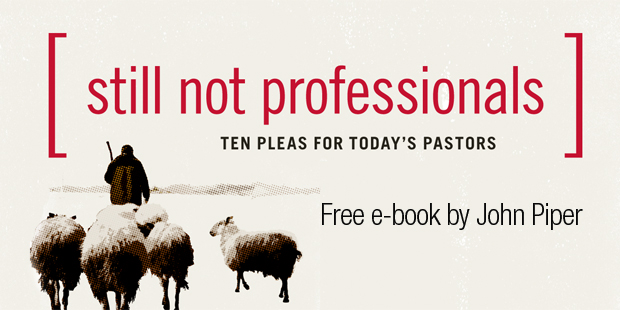
Still Not Professionals – an eBook by John Piper

Still Not Professionals: Ten Pleas for Today’s Pastors is a celebration and extension of John Piper’s Brothers, We Are Not Professionals. With two brief exhortations from Piper and eight others from veteran pastors, this short ebook aims to strengthen and challenge Christians in general, and pastors in particular, for the labor of everyday life and ministry. The contributors were asked to express their “heart of hearts” for fellow leaders.

You’ll find these chapters tap into profound human themes, in both the pastor and his flock, and will be of use, we hope, beyond the North American context of the contributors.

Download your copy of Still Not Professionals here.

Find more from John Piper here.

Download PDF

Tags: , , ,

| What is MyVisionRoom? > | Back to Leadership >

ABOUT THE AUTHOR

John Piper

John Piper

John Piper is Pastor for Preaching and Vision at Bethlehem Baptist Church in Minneapolis, MN. He grew up in Greenville, SC, and studied at Wheaton College, where he first sensed God's call to enter the ministry. He went on to earn degrees from Fuller Theological Seminary (B.D.) and the University of Munich (D.Theol.). For six years he taught Biblical Studies at Bethel College in St. Paul, MN, and in 1980 accepted the call to serve as pastor at Bethlehem. John is the author of more than 40 books including Desiring God: Meditations of a Christian Hedonist and Bloodlines: Race, Cross, and the Christian. John and his wife, Noel, have four sons, one daughter, and twelve grandchildren.

See more articles by >

COMMENTS

What say you? Leave a comment!

Recent Comments
comment_post_ID); ?> Thank you for this information. I'm going to use this article to improve my work with the Lord.
 
— Abel Singbeh
 
comment_post_ID); ?> Thank you Ed for sharing your insights into the Church Growth Movement. I have my reservations with Church Growth models because it has done more damage than good in the Body of Christ. Over the years, western churches are more focused on results, formulas and processes with little or no emphasis on membership and church discipline. Pastors and vocational leaders are burnt out because they're overworked. I do believe that the Church Growth model is a catalyst to two destructive groups: The New Apostolic Reformation and the Emerging Church. Both groups overlap and have a very loose definition. They're both focus on contemporary worship, expansion of church brand (franchising), and mobilizing volunteering members as 'leaders' to grow their ministry. Little focus on biblical study, apologetics and genuine missional work with no agenda besides preaching of the gospel.
 
— Dave
 
comment_post_ID); ?> Thank you for sharing such a good article. It is a great lesson I learned from this article. I am one of the leaders in Emmanuel united church of Ethiopia (A denomination with more-than 780 local churches through out the country). I am preparing a presentation on succession planning for local church leaders. It will help me for preparation If you send me more resources and recommend me books to read on the topic. I hope we may collaborate in advancing leadership capacity of our church. God Bless You and Your Ministry.
 
— Argaw Alemu
 

Clarity Process

Three effective ways to start moving toward clarity right now.

Even Fun Will Become Boring

A challenge for communicators is to continually tackle the work we do, regardless of how fun and exciting it is. Sometimes, it’s downright boring. This is part three of a five-part series tackling boring vs. fun in church communication. 

Cool new ideas or projects have a powerful pull on creative people. We are naturally drawn to work on them and give them our energy and attention. And there’s never a shortage of projects and opportunities that entice us.

How do we choose? How do we determine what is worth our time?

First, we must remember that the fun will become boring. The things we consider boring today were once new and exciting projects. Guess what will eventually happen to that new social media channel, smartphone app, document, form or communication project? It will have to be managed, maintained and sustained. It will become boring, a pain and then neglected.

Read how Kelvin uses a series of questions to prevent the fun from becoming boring here.

Read Part 2 in this series here.

Read more from Kelvin here.

Download PDF

Tags: , , ,

| What is MyVisionRoom? > | Back to Communication >

ABOUT THE AUTHOR

Kelvin Co

See more articles by >

COMMENTS

What say you? Leave a comment!

Recent Comments
comment_post_ID); ?> Thank you for this information. I'm going to use this article to improve my work with the Lord.
 
— Abel Singbeh
 
comment_post_ID); ?> Thank you Ed for sharing your insights into the Church Growth Movement. I have my reservations with Church Growth models because it has done more damage than good in the Body of Christ. Over the years, western churches are more focused on results, formulas and processes with little or no emphasis on membership and church discipline. Pastors and vocational leaders are burnt out because they're overworked. I do believe that the Church Growth model is a catalyst to two destructive groups: The New Apostolic Reformation and the Emerging Church. Both groups overlap and have a very loose definition. They're both focus on contemporary worship, expansion of church brand (franchising), and mobilizing volunteering members as 'leaders' to grow their ministry. Little focus on biblical study, apologetics and genuine missional work with no agenda besides preaching of the gospel.
 
— Dave
 
comment_post_ID); ?> Thank you for sharing such a good article. It is a great lesson I learned from this article. I am one of the leaders in Emmanuel united church of Ethiopia (A denomination with more-than 780 local churches through out the country). I am preparing a presentation on succession planning for local church leaders. It will help me for preparation If you send me more resources and recommend me books to read on the topic. I hope we may collaborate in advancing leadership capacity of our church. God Bless You and Your Ministry.
 
— Argaw Alemu
 

Clarity Process

Three effective ways to start moving toward clarity right now.

Introducing Transformational Discipleship

If you’re looking for discipleship resources that will give direction to your approach, Transformational Discipleship: How People Really Grow by Eric Geiger, Michael Kelley and Philip Nation ought to be on your reading list.

A research driven project, the book is based on the discoveries of an extensive research project launched by Lifeway in 2010 “to survey believers about their spiritual lives and level of maturity.” Specifically, the research was designed “to uncover what kind of discipleship is truly transformational.”  Building on the Transformational Church survey and the research behind Brad Waggoner’s book The Shape of Faith to Come, the research focused on “major areas of life where spiritual maturity takes place.”

The combined research identified eight attributes of discipleship that point to spiritual health; biblical factors that consistently show up in the life of a maturing believer.  The eight attributes are:

  • Bible Engagement
  • Obeying God and Denying Self
  • Serving God and Others
  • Sharing Christ
  • Exercising Faith
  • Seeking God
  • Building Relationships
  • Unashamed

In addition to the eight attributes, a key discovery of the research is referred to as the Transformational Sweet Spot.  Using the metaphor of the sweet spot on a tennis racket or a baseball bat, the transformational sweet spot is formed by the intersection of truth given by healthy leaders to someone in a vulnerable posture.

There are a number of very good aspects to Transformational Discipleship.  The first 63 pages provide a thorough theological overview of the concept.  This is essential reading for a church staff or leadership team.  Parts 1, 2, and 3 provide an insight packed examination of the individual ingredients of the transformational sweet spot.

Not intended as a model, the authors instead have assembled the kind of thinking that just might uncover the framework that makes authentic disciples; not just knowledge or moral behavior, but the “ongoing renewal of the heart.”  Sounds good, doesn’t it?  Transformational Discipleship is resource that will absolutely open your eyes to new ways of thinking about how transformation happens and where to focus your design and effort.

Download PDF

Tags: , , ,

| What is MyVisionRoom? > | Back to Process >

ABOUT THE AUTHOR

Mark Howell

Mark Howell

I’m the Pastor of Communities at Canyon Ridge Christian Church in Las Vegas, Nevada. I’m also LifeWay’s Small Group Specialist. I’m the the founder of SmallGroupResources.net, offering consulting and coaching services that help churches across North America launch, build and sustain healthy small group ministries. In addition, I’m the guy behind MarkHowellLive.com, SmallGroupResources.net, StrategyCentral.org and @MarkCHowell.

See more articles by >

COMMENTS

What say you? Leave a comment!

Recent Comments
comment_post_ID); ?> Thank you for this information. I'm going to use this article to improve my work with the Lord.
 
— Abel Singbeh
 
comment_post_ID); ?> Thank you Ed for sharing your insights into the Church Growth Movement. I have my reservations with Church Growth models because it has done more damage than good in the Body of Christ. Over the years, western churches are more focused on results, formulas and processes with little or no emphasis on membership and church discipline. Pastors and vocational leaders are burnt out because they're overworked. I do believe that the Church Growth model is a catalyst to two destructive groups: The New Apostolic Reformation and the Emerging Church. Both groups overlap and have a very loose definition. They're both focus on contemporary worship, expansion of church brand (franchising), and mobilizing volunteering members as 'leaders' to grow their ministry. Little focus on biblical study, apologetics and genuine missional work with no agenda besides preaching of the gospel.
 
— Dave
 
comment_post_ID); ?> Thank you for sharing such a good article. It is a great lesson I learned from this article. I am one of the leaders in Emmanuel united church of Ethiopia (A denomination with more-than 780 local churches through out the country). I am preparing a presentation on succession planning for local church leaders. It will help me for preparation If you send me more resources and recommend me books to read on the topic. I hope we may collaborate in advancing leadership capacity of our church. God Bless You and Your Ministry.
 
— Argaw Alemu
 

Clarity Process

Three effective ways to start moving toward clarity right now.

Neighborhood Transitions and the Local Church, Part 4

So far we’ve looked at two options churches typically consider when the neighborhood in which they are located goes through change. The first was to to create a true multicultural church. Those options are often the most common, especially relocating, but they also leave out a third scenario which is becoming more common in large metropolitan culture: multilingual neighborhood churches.

I should add that these are broad categories. You could start another campus, relocate part of the congregation, and be a multilingual multisite. Or, you should move to multicultural ministry AND have language congregations as well. You get the point– these are broad categories.

However, if the community transition is dealing with more distant cultures that speak different languages, an important third response is to create a multilingual church or different congregations meeting in the same buidling (and, better yet, part of the same church).

I once preached at a church in Boston that had five languages represented in the church. They had a multilingual church with different language congregations. In the midst of this, however, they were clearly one, unified church They shared an elder board containing people from each of the congregations who prayed together, worked together, and led together along the way.

I think that the best scenario is not relocation (option 1), though I understand there are times and situations when that it the best thing to do– and congregations need to listen to the leadership of the Lord. The church is not a building and, if the church has moved far from its building, something has to be done with the building. So, if you relocate, start another church and ministry in the building the Lord gave you.

However, I think multicultural transition is a better choice, either in one multicultural congregation (option 2) or in multiple congregations in one facility or (even better) one church (option 3). With that in mind, let me conclude with some thoughts that are applicable to both options 2 and 3.

Practically speaking, how can this pursuit for a genuine multicultural community in a transitional neighborhood be accomplished? Based on my own limited experience, and more broad experience researching and consulting with churches, I see five foundational steps:

  1. Begin to build leadership reflective of the community. When we were planting our church in Buffalo, our neighborhood was about 40 percent African-American, 30 percent Anglo, and the rest was a mix of other races. We tried to model those percentages in our leadership from the very beginning. The community responded.
  2. Intentionally engage ethnicities present. Multicultural engagement will not happen by accident. A strategic plan should be created. Intentionally seek sufficient knowledge and background about the culture from someone who knows this information.
  3. Move beyond tokenism and give actual representative leadership.Disingenuity will be spotted a mile away. Multicultural leadership must be present across the church: in worship, administration, and teaching to name a few areas.
  4. Consider calling a pastor that is reflective of the predominant ethnicity of the community. Ultimately, it is God’s call who to place as pastor, but be intentional, however, to broaden the search to include candidates from a number of different backgrounds.
  5. Reflect the values of the Kingdom of God. Above all else, our church, and the people that make it up, needs to be a picture of Heaven on Earth. Only through God’s grace, love, and guidance can this kind of miracle happen. I can’t think of too many other images that can better illustrate what Jesus Christ can do in the hearts and minds of people who love Him first and each other second.


Since pursuing a multicultural setting goes against individuals’ natural tendencies toward homogeneity, church growth WILL be slower. Nevertheless, when God gives the opportunity to move to multiculturalism, take the risk and make the commitment. When changed lives are the fruit, it’s worth it.

This is the final post in a series of 4; read the rest here: Part 1, Part 2, and Part 3.

Read more from Ed here.

Download PDF

Tags: , , ,

| What is MyVisionRoom? > | Back to Vision >

ABOUT THE AUTHOR

Ed Stetzer

Ed Stetzer

Ed Stetzer, Ph.D., holds the Billy Graham Chair of Church, Mission, and Evangelism at Wheaton College and serves as Executive Director of the Billy Graham Center for Evangelism. He has planted, revitalized, and pastored churches, trained pastors and church planters on six continents, holds two masters degrees and two doctorates, and has written dozens of articles and books. Previously, he served as Executive Director of LifeWay Research. Stetzer is a contributing editor for Christianity Today, a columnist for Outreach Magazine, and is frequently cited or interviewed in news outlets such as USAToday and CNN. He serves as interim pastor of Moody Church in Chicago.

See more articles by >

COMMENTS

What say you? Leave a comment!

Recent Comments
comment_post_ID); ?> Thank you for this information. I'm going to use this article to improve my work with the Lord.
 
— Abel Singbeh
 
comment_post_ID); ?> Thank you Ed for sharing your insights into the Church Growth Movement. I have my reservations with Church Growth models because it has done more damage than good in the Body of Christ. Over the years, western churches are more focused on results, formulas and processes with little or no emphasis on membership and church discipline. Pastors and vocational leaders are burnt out because they're overworked. I do believe that the Church Growth model is a catalyst to two destructive groups: The New Apostolic Reformation and the Emerging Church. Both groups overlap and have a very loose definition. They're both focus on contemporary worship, expansion of church brand (franchising), and mobilizing volunteering members as 'leaders' to grow their ministry. Little focus on biblical study, apologetics and genuine missional work with no agenda besides preaching of the gospel.
 
— Dave
 
comment_post_ID); ?> Thank you for sharing such a good article. It is a great lesson I learned from this article. I am one of the leaders in Emmanuel united church of Ethiopia (A denomination with more-than 780 local churches through out the country). I am preparing a presentation on succession planning for local church leaders. It will help me for preparation If you send me more resources and recommend me books to read on the topic. I hope we may collaborate in advancing leadership capacity of our church. God Bless You and Your Ministry.
 
— Argaw Alemu
 

Clarity Process

Three effective ways to start moving toward clarity right now.

One Lesson of Zig Ziglar’s Legacy that will Change Your Life

Zig Ziglar died November 28 2012 at the age of 86. He was motivational maven with millions of followers. His twenty-plus books, uber-positive style, and Christian influence are manifested clearly through his ubiquitously sticky quotes. Dave Ramsey tweeted yesterday, “What’s your favorite Zig Ziglar quote?” Here are my favorites with regard to vision and clarity.

As the rest-in-peace tweets and favorite quotes filled the social air waves, I found myself asking, “Was there a special secret to Ziglar’s success?” I believe so.

If you trace Ziglar’s career in sales, one thing is abundantly clear: He was a great salesman because he was a great student; a student of people, a student of life and a student of other salespeople. In fact his success at its core was driven by his continual intake and carnivorous digestion.  Think about it for a minute. Does someone as prolific and successful as Ziglar just sit around thinking of quotes to write? Of course not. Rather, the accelerated learning-living-learning cycle just keeps snowballing. The wisdom, combined with the opportunity to teach others over decades and decades gets remixed and refined into powerful, unforgettable nuggets.

Remember, most very successful people can conveniently stop learning because of the fruits of their success. But a few successful people keep pouring the jet fuel of continued learning to really take them to the top.

One thumbprint of Ziglar’s appetite for learning is the preface of his 2003 updated edition of Secrets of Closing the Sale:

Over the past fifty years it has been my privilege to be in as many actual sales situations, selling goods, products, services or job opportunities as virtually anyone who ever carried the tile of salesperson. Additionally it has been my privilege to share the platform with and learn from some of the greatest speakers and sales trainers our country has produced.

He goes on to name twenty-six individuals. And continues…

Over these fifty years I have been a pack rat. I have taken copious notes from many great trainers. In addition I have clipped innumerable sales articles from newspapers and magazines and have learned much by watching salespeople in action. My library includes books and manuals from the greatest writers and trainers of the last fifty years, and I have over a thousand hours of recordings from these and other speakers.

The lesson that Ziglar’s life inspires me with is simple. Never stop learning. Once you master a category, the real master keeps learning even more. What’s keeping you from reaching the top of what God is calling you to do? Look first to what stops your learning. When was the last time you took copious notes at something that you considered yourself to be really, really good at?

You will find a lot of Ziglar quotes if you look, but his greatest secret is not the most citied quote:

“Life is a classroom — only those who are willing to be lifelong learners will move to the head of the class.”  – Zig Ziglar

Download PDF

Tags: , , ,

| What is MyVisionRoom? > | Back to Leadership >

ABOUT THE AUTHOR

Will Mancini

Will Mancini

Will Mancini wants you and your ministry to experience the benefits of stunning, God-given clarity. As a pastor turned vision coach, Will has worked with an unprecedented variety of churches from growing megachurches and missional communities, to mainline revitalization and church plants. He is the founder of Auxano, creator of VisionRoom.com and the author of God Dreams and Church Unique.

See more articles by >

COMMENTS

What say you? Leave a comment!

Recent Comments
comment_post_ID); ?> Thank you for this information. I'm going to use this article to improve my work with the Lord.
 
— Abel Singbeh
 
comment_post_ID); ?> Thank you Ed for sharing your insights into the Church Growth Movement. I have my reservations with Church Growth models because it has done more damage than good in the Body of Christ. Over the years, western churches are more focused on results, formulas and processes with little or no emphasis on membership and church discipline. Pastors and vocational leaders are burnt out because they're overworked. I do believe that the Church Growth model is a catalyst to two destructive groups: The New Apostolic Reformation and the Emerging Church. Both groups overlap and have a very loose definition. They're both focus on contemporary worship, expansion of church brand (franchising), and mobilizing volunteering members as 'leaders' to grow their ministry. Little focus on biblical study, apologetics and genuine missional work with no agenda besides preaching of the gospel.
 
— Dave
 
comment_post_ID); ?> Thank you for sharing such a good article. It is a great lesson I learned from this article. I am one of the leaders in Emmanuel united church of Ethiopia (A denomination with more-than 780 local churches through out the country). I am preparing a presentation on succession planning for local church leaders. It will help me for preparation If you send me more resources and recommend me books to read on the topic. I hope we may collaborate in advancing leadership capacity of our church. God Bless You and Your Ministry.
 
— Argaw Alemu
 

Clarity Process

Three effective ways to start moving toward clarity right now.

What’s Boring for You May Be a Home Run for Someone Else

A challenge for communicators is to continually tackle the work we do, regardless of how fun and exciting it is. Sometimes, it’s downright boring. This is part two of a five-part series tackling boring vs. fun in church communication. 

There are times when we simply have to suck it up and deal with the “boring” to be able to do the “fun” parts of church communication. But grunting through what we don’t like or are not wired to do is not smart for the organization, sustainable for our team or healthy for us personally… even if we have positive attitudes about it.

Read the rest of Kelvin’s post here.

Read Part 1 here.

Read more from Kelvin here.

Download PDF

Tags: , , ,

| What is MyVisionRoom? > | Back to Communication >

ABOUT THE AUTHOR

Kelvin Co

See more articles by >

COMMENTS

What say you? Leave a comment!

Recent Comments
comment_post_ID); ?> Thank you for this information. I'm going to use this article to improve my work with the Lord.
 
— Abel Singbeh
 
comment_post_ID); ?> Thank you Ed for sharing your insights into the Church Growth Movement. I have my reservations with Church Growth models because it has done more damage than good in the Body of Christ. Over the years, western churches are more focused on results, formulas and processes with little or no emphasis on membership and church discipline. Pastors and vocational leaders are burnt out because they're overworked. I do believe that the Church Growth model is a catalyst to two destructive groups: The New Apostolic Reformation and the Emerging Church. Both groups overlap and have a very loose definition. They're both focus on contemporary worship, expansion of church brand (franchising), and mobilizing volunteering members as 'leaders' to grow their ministry. Little focus on biblical study, apologetics and genuine missional work with no agenda besides preaching of the gospel.
 
— Dave
 
comment_post_ID); ?> Thank you for sharing such a good article. It is a great lesson I learned from this article. I am one of the leaders in Emmanuel united church of Ethiopia (A denomination with more-than 780 local churches through out the country). I am preparing a presentation on succession planning for local church leaders. It will help me for preparation If you send me more resources and recommend me books to read on the topic. I hope we may collaborate in advancing leadership capacity of our church. God Bless You and Your Ministry.
 
— Argaw Alemu
 

Clarity Process

Three effective ways to start moving toward clarity right now.

A Picture of Vision

The other day, as I was boarding an early morning flight out of Hobby Airport in Houston, I looked out the window and had a great view of the early morning sun shimmering on the downtown skyline. It was beautiful. Here’s the picture.


Now I’m guessing that you’re not rushing to book a trip to Houston based on this picture. You’re probably even wondering why I posted it. The reason is that it tells us a lot about vision.

  1. The vision is often much more clear to the visionary than to others. My picture doesn’t convey what I witnessed. In the same way, many visionary leaders get very excited about the vision that God has given them, but others don’t grasp it. People need to have a meaningful, tangible experience with the vision, not just hear you talk about it. What are you doing to help others to see, taste, and touch the vision that God has for your congregation?
  2. Visionaries often don’t see the obstacles. When I first glanced out the window at Hobby, I didn’t even notice all the clutter in the foreground. Once I took the picture, it was much more obvious. Some visionary leaders never have that experience – they see the ultimate goal very clearly, but they completely overlook the more immediate things that stand in the way. Who in your life lovingly helps you identify the barriers to the vision?
  3. Those who see the obstacles can kill a vision. It’s obvious that I can’t cut across the tarmac to get to the distant skyline, but that doesn’t mean that getting there is impossible. We’ve all known people who immediately list all the reasons that something can’t be done. It’s important to think about the “how” questions, because these help translate the vision into meaningful steps and identify issues to be addressed. If you are that detail-oriented person, do you use your strengths in positive, helpful ways?


What does your vision picture look like? Which of these three areas do you need to work on?

Download PDF

Tags: ,

| What is MyVisionRoom? > | Back to Vision >

ABOUT THE AUTHOR

Mike Bonem

See more articles by >

COMMENTS

What say you? Leave a comment!

Recent Comments
comment_post_ID); ?> Thank you for this information. I'm going to use this article to improve my work with the Lord.
 
— Abel Singbeh
 
comment_post_ID); ?> Thank you Ed for sharing your insights into the Church Growth Movement. I have my reservations with Church Growth models because it has done more damage than good in the Body of Christ. Over the years, western churches are more focused on results, formulas and processes with little or no emphasis on membership and church discipline. Pastors and vocational leaders are burnt out because they're overworked. I do believe that the Church Growth model is a catalyst to two destructive groups: The New Apostolic Reformation and the Emerging Church. Both groups overlap and have a very loose definition. They're both focus on contemporary worship, expansion of church brand (franchising), and mobilizing volunteering members as 'leaders' to grow their ministry. Little focus on biblical study, apologetics and genuine missional work with no agenda besides preaching of the gospel.
 
— Dave
 
comment_post_ID); ?> Thank you for sharing such a good article. It is a great lesson I learned from this article. I am one of the leaders in Emmanuel united church of Ethiopia (A denomination with more-than 780 local churches through out the country). I am preparing a presentation on succession planning for local church leaders. It will help me for preparation If you send me more resources and recommend me books to read on the topic. I hope we may collaborate in advancing leadership capacity of our church. God Bless You and Your Ministry.
 
— Argaw Alemu
 

Clarity Process

Three effective ways to start moving toward clarity right now.