You Can’t Love a City if You Don’t Know a City, Part 4

I’ve been working through some idea about researching a city in order to reach a city.

In part 2, I introduced a case study of church planting in Baltimore / Washington. This study is an unpublished report on the current state of church planting in the Washington DC and Baltimore Corridor focuses on identifying the church plants and who is planting them.

I found it fascinating and one helpful element to understanding what God is doing in a city.

Here is more from that study.

—————————————————————————————

Church Planting in Washington DC / Baltimore Corridor

New Church Plants Identified

Church planting has continued to expand over the last five years.

  • 274 churches were identified that have started in the last 5 years
  • It is estimated that as many as 70 churches or a quarter of the total of the new churches have not been identified. These churches are usually independent, non-English speaking, small denominations, or house churches, etc…


The Following Questions Relate to the 274 Identified Churches.
Who are Planting Churches?

Denominations/associations lead the way over all other efforts combined in the planting of churches.

222 churches were planted by denominations/associations 81%
31 by national and local networks 11%
54 by church planting churches (have planted 3 or more churches) 20%
47 are independent plants 17%

The total adds up to over 274 and over 100% because of co-sponsoring between church planting churches, networks, and denominations.

What Denominations/Associations are Planting Churches?

22 denominations/associations were identified for planting churches. Southern Baptists are starting 49% of the new churches.
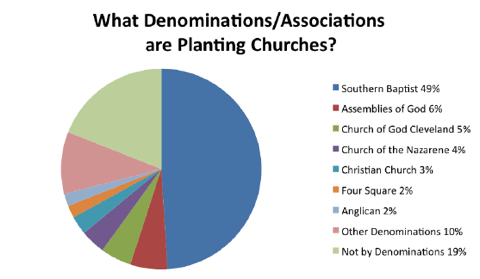
133 by Southern Baptist 49%
17 by Assemblies of God 6%
14 by Church of God Cleveland 5%
10 by Church of the Nazarene 4%
9 by Christian Church 3%
6 by Foursquare 2%
6 by Anglican 2%
27 by other denominations/associations 10%
52 not by denominations 19%
What Networks are Planting Churches?

National networks are just getting established in the area. Although few in number, the pastors generally have more training, are better funded, and experience a higher survivability rate.

8 by Baltimore/Washington Christian Church network **
5 by Ecclesia *
3 by Stadia
3 by Orchard
2 by Acts 29
2 by ARC *
2 by Liberty
2 by New Thing
2 by Redeemer City to City *
2 by SENT **
1 by Kairos
1 by Virginia Evangelizing Fellowship
0 by Calvary
0 by Launch
by Mosaic *
by Vision 360
* National Network with a local representative
**Local Network

Who are the Church Planting Churches (churches planting 3 or more churches in our metro areas in the last 5 years)?

Although other churches were church planting churches 10, 15, or 20 years ago, most of these became church planting churches in the last 5 years. These church planting churches have been identified.

5 Capital Baptist Church, Annandale, VA
5 Mountain Christian, Jappa, MD** ***
5 New Life Christian, Chantilly, VA** ***

4 National Community Church, DC*
4 New Life Wesleyan Church, Waldorf, MD
4 Northwest Baptist Church, Reisterstown, MD

3 Capitol Hill Baptist Church, DC***
3 Church of the Resurrection, DC***
3 Grace Fellowship Church, Timonium, MD**
3 McLean Bible Church, VA*
3 Frontline of McLean Bible Church, VA*
3 by The Gathering of McLean Bible Church, VA*
3 Pathways Church, Bel Air, MD
3 The Falls Church, Falls Church, VA***
3 Word of Life Int. Church, Ashburn, MD

*Churches who are planting exclusively through multi-site locations.
**Churches planting through multi-site locations and new churches
***Churches with internship/residency programs for new church planting pastors

“For God did Not Give Us a Spirit of Timidity, But a Spirit of Power, of Love and of Self-Discipline.” 2 Timothy 1:7

—————————————————————————————

I find the list interesting. The people involved in the research tend to be non-denominational (with a Restoration / Independent Christian streak) so they are not generally denominational apologists. Thus, the overwhelming number of church plants being denominational is worth noting. When you combine Southern Baptists (who planted almost half) and Pentecostals (Assemblies of God, Church of God Cleveland, and Foursquare), you see a strong majority of the churches. Also of note: the lack of plants from mainline denominations.

Now, they may have missed some plants (though they worked hard to identify them), but I found this interesting. Networks get a lot of press and are doing great things, but denominations are doing much of the planting in this area. (It is probably helpful to note that the SBC targeted this region through something called Strategic Focus Cities, a denominational church planting initiative, and that probably increased the SBC numbers more than you would see in another city).

Read more on this series: Part 1; Part 2; Part 3; Part 5.

Read more from Ed here.

Download PDF

Tags: , ,

| What is MyVisionRoom? > | Back to Vision >

ABOUT THE AUTHOR

Ed Stetzer

Ed Stetzer

Ed Stetzer, Ph.D., holds the Billy Graham Chair of Church, Mission, and Evangelism at Wheaton College and serves as Executive Director of the Billy Graham Center for Evangelism. He has planted, revitalized, and pastored churches, trained pastors and church planters on six continents, holds two masters degrees and two doctorates, and has written dozens of articles and books. Previously, he served as Executive Director of LifeWay Research. Stetzer is a contributing editor for Christianity Today, a columnist for Outreach Magazine, and is frequently cited or interviewed in news outlets such as USAToday and CNN. He serves as interim pastor of Moody Church in Chicago.

See more articles by >

COMMENTS

What say you? Leave a comment!

Recent Comments
comment_post_ID); ?> Thank you for this information. I'm going to use this article to improve my work with the Lord.
 
— Abel Singbeh
 
comment_post_ID); ?> Thank you Ed for sharing your insights into the Church Growth Movement. I have my reservations with Church Growth models because it has done more damage than good in the Body of Christ. Over the years, western churches are more focused on results, formulas and processes with little or no emphasis on membership and church discipline. Pastors and vocational leaders are burnt out because they're overworked. I do believe that the Church Growth model is a catalyst to two destructive groups: The New Apostolic Reformation and the Emerging Church. Both groups overlap and have a very loose definition. They're both focus on contemporary worship, expansion of church brand (franchising), and mobilizing volunteering members as 'leaders' to grow their ministry. Little focus on biblical study, apologetics and genuine missional work with no agenda besides preaching of the gospel.
 
— Dave
 
comment_post_ID); ?> Thank you for sharing such a good article. It is a great lesson I learned from this article. I am one of the leaders in Emmanuel united church of Ethiopia (A denomination with more-than 780 local churches through out the country). I am preparing a presentation on succession planning for local church leaders. It will help me for preparation If you send me more resources and recommend me books to read on the topic. I hope we may collaborate in advancing leadership capacity of our church. God Bless You and Your Ministry.
 
— Argaw Alemu
 

Clarity Process

Three effective ways to start moving toward clarity right now.

You Can’t Love a City if You Don’t Know a City, Part 3

This is part 3 of a series on city research entitled, “You Can’t Love a City if You Don’t Know a City.”

When working in city research, you have to consider what to include. Many important things can and should be studied: language and immigration, poverty, church plants, church closures, parachurch presence, crime, etc. All of these are helpful, but I will try to share what a very basic project could involve. (Tomorrow, I will look again at an example of a church planting study. And, thanks to several comments in the last post as well as a few emails, I will also give you examples of other things that groups study.)

But, let me say at first that such research tends to be a multidenominational, regional effort. In most cases, no one denomination is well-suited to undertake the task. (Unless you are the Assemblies of God in Springfield, MO, where they have their headquarters and two, count ’em, TWO Bible colleges.)

It is not just that doing this research needs multiple denominations, it can actually help build unity and help churches focus on a common mission. Research is an area where churches can naturally partner without many theological concerns (like in church planting, for example).

We have found this works best when a city has a coalition or roundtable of pastors and churches working together, developing a plan, and implementing that research plan. The importance of this group is seen in:


  1. Praying together for your city.
  2. Working together to utilize the data and to share it with the rest of the churches in the city.
  3. Mobilizing individual believers, small groups, individual churches and churches working together to meet needs and share Jesus Christ is a task that is bigger than just a few churches.
  4. Determining how to fund the research – this is the equivalent of doing two national studies, only they are being focused on your city. Examples of ways to fund the research:
  • Shared equally by the coalition of churches
  • Shared by an expanded group of churches
  • Donors passionate about the city

As we look at doing city research, we want to have a good look at the churches and the people. For us, we want to create a benchmark survey of residents and a survey of churches. A benchmark study enables us to see if we really are making progress as we reach and serve our community.

For example, many city strategies are filled with enthusiasm about what they think they are doing, but often it is just enthusiasm without impact. They see people doing things, but they have no way to tell if they are making a difference. By tracking things every few years, we can see if we are making progress.

There are many ways to do this, but I will share two: the resident survey and the church survey.

One way to do a resident survey is through a “random digit dial” (RDD) phone survey of residents asking about their interests/affinities, their attitudes about local Christian churches, their religious preference and church attendance, their religious beliefs and specifically if they their about and relationship with Christ.

This provides a reading on the vitality of the churches in that metro area, the receptivity of people to the Gospel, and their affinities. The affinity groups provide tangible entry points that individual believers, small groups, or churches could seek to reach (more on that later). Since around 100 affinities are identified there are many avenues to motivate and mobilize believers to reach the lost right around them.

The church survey can be mailed to all Christian churches in the metro area and asks questions about who the church is reaching (number of new commitments to Jesus Christ and the age, education, ethnicity, and income of attendees), involvement of attendees in ministry, and how the church is seeking to reach people in their community. This helps the local city churches to know who is working in their community.

The end result is to get Christians, pastors, and churches thinking about their context more discerningly. We have found that the research PROCESS actually helps motivate churches for mission. And, to do it together.

It is fascinating to me to see how seldom churches communicate with each other. By surveying the churches, you learn more about who is already at work.

Studies like this enable them to learn who their co-laborers are in the harvest AND what that harvest field looks like.

Read previous parts of this series here: Part 1; Part 2; read Part 4.

Read more from Ed here.

Download PDF

Tags: , ,

| What is MyVisionRoom? > | Back to Vision >

ABOUT THE AUTHOR

Ed Stetzer

Ed Stetzer

Ed Stetzer, Ph.D., holds the Billy Graham Chair of Church, Mission, and Evangelism at Wheaton College and serves as Executive Director of the Billy Graham Center for Evangelism. He has planted, revitalized, and pastored churches, trained pastors and church planters on six continents, holds two masters degrees and two doctorates, and has written dozens of articles and books. Previously, he served as Executive Director of LifeWay Research. Stetzer is a contributing editor for Christianity Today, a columnist for Outreach Magazine, and is frequently cited or interviewed in news outlets such as USAToday and CNN. He serves as interim pastor of Moody Church in Chicago.

See more articles by >

COMMENTS

What say you? Leave a comment!

Recent Comments
comment_post_ID); ?> Thank you for this information. I'm going to use this article to improve my work with the Lord.
 
— Abel Singbeh
 
comment_post_ID); ?> Thank you Ed for sharing your insights into the Church Growth Movement. I have my reservations with Church Growth models because it has done more damage than good in the Body of Christ. Over the years, western churches are more focused on results, formulas and processes with little or no emphasis on membership and church discipline. Pastors and vocational leaders are burnt out because they're overworked. I do believe that the Church Growth model is a catalyst to two destructive groups: The New Apostolic Reformation and the Emerging Church. Both groups overlap and have a very loose definition. They're both focus on contemporary worship, expansion of church brand (franchising), and mobilizing volunteering members as 'leaders' to grow their ministry. Little focus on biblical study, apologetics and genuine missional work with no agenda besides preaching of the gospel.
 
— Dave
 
comment_post_ID); ?> Thank you for sharing such a good article. It is a great lesson I learned from this article. I am one of the leaders in Emmanuel united church of Ethiopia (A denomination with more-than 780 local churches through out the country). I am preparing a presentation on succession planning for local church leaders. It will help me for preparation If you send me more resources and recommend me books to read on the topic. I hope we may collaborate in advancing leadership capacity of our church. God Bless You and Your Ministry.
 
— Argaw Alemu
 

Clarity Process

Three effective ways to start moving toward clarity right now.

You Can’t Love a City if You Don’t Know a City, Part 2

Last week, I started a new series on city research and analysis. I will be taking several approaches, with examples and case studies along the way. And, feel free to suggest resources in the comments that would be helpful to include.

Part of knowing a city is knowing its churches. I will share more on that later from three separate studies, but knowing a cities church plants generally requires a different approach. Recently, Todd Wilson shared what I think is one of the best studies of its kinds– looking at church planting in a region.

The study, Church Planting in the Washington DC and Baltimore Corridor area, was put together by by Ron Johnson, Director of Accelerate. Accelerate is an alliance of church planting churches, networks, and denominations for the purpose of accelerating church planting in the Washington/Baltimore corridor.

I will be sharing it in several parts. First is an introduction to the report. See my comments at the end.

The State of Church Planting in the Washington DC / Baltimore Corridor 2005-2010
Why this Research?

A group of like-minded church planting leaders and ministries in the Washington – Baltimore metro area is seeking to collaboratively support church planting. The group seeks to champion the cause of church planting while minimizing organizational structures and overhead. These leaders are seeking to continue the work God is already doing through each of them while also looking for ways to work collaboratively to enhance the effectiveness of church planting in the geographic area.

The group is coming together as the Accelerate Alliance. The Accelerate mission is to:

  • Attract, inspire and equip Kingdom-minded leaders and
  • Connect them so they can
  • Collaborate with their time, talent and treasure to
  • Accelerate the creation of healthy, reproducing faith communities resulting in transformed lives and transformed communities

The first step in discerning the approach and strategy of Accelerate was to research and discover what God is already doing in church planting in the Washington DC / Baltimore metropolitan areas. A primary goal of the initial research was to discover how best to accelerate church planting in the area.

The vision for Accelerate was conceived and birthed by New Life Christian Church who has funded the initial work on Accelerate via Ron Johnson’s (the Director) time. Accelerate is a pilot initiative closely aligned with New Life and with Exponential (a non-profit national ministry that exists to champion church planting and who runs the Exponential Conference).

Healthy church plants start with spiritually, physically, and emotionally healthy church planters. We anticipate that the best path to accelerating planting in our area is through serving church planters. These findings will help guide us to determine how we best fulfill our mission and therefore advance the Kingdom.

Survey / Research Approach

Research was conducted to identify as many of the new churches planted in the last 5 years in the Washington DC / Baltimore metro area as possible. Denominational and network leaders were called, searches on the internet were conducted, school systems were asked for names of churches meeting in schools, and church planters were asked what other church planters they knew. 81 phone interviews were conducted with church planters, pastors of church planting churches and denominational leaders. There were 25 appointments with church planters. 15 church services were also attended to get a feel for the ministries of the new churches.

As part of the research questions were asked to discern the tensions and needs of church planters.

A team of church planting influencers from denominations, networks, church planting churches, and church planters met to review what was being learned and offer input toward meeting the needs of church planters.

Acknowledgments

This was an exhaustive search involving nearly 1/2 year of a person’s effort. However some limitations were recognized:

  • It is difficult finding and connecting with many churches under five years old. For example, over half of the churches meeting in schools in one county did not have an EIN number with the government, a web site, a yellow pages listing, or a white pages listing
  • It is difficult identifying non-English language / nationality churches because of the language barrier and they often do not use traditional advertising. Some of the non-English / nationality churches are use to maintaining a low profile in their own countries, so they take the same posture in the US
  • Many new churches remain under the care and financial oversight of a sponsoring church so records of them are more difficult to find
  • New independent churches with bi-vocational pastors are often hard to identify
  • The scope of the survey does not identify smaller faith communities like house churches that are not meeting in public places or can’t be found publically
  • These numbers represent surviving churches and don’t reflect others that did not make it to five years.

Observations of Demographic Populations that are Growing the Most

The diversity of the population continues to grow as people move here from all over the country and the world. Although different populations are often concentrated in areas, the population of the Washington DC / Baltimore corridor is one of the most integrated of cities in the country. The “church” often lags behind the culture in its response to demographic shifts.

These points are made by observation and talking to other church/denominational leaders. The 2010 census data detail is not yet published and the 2000 census would not reflect a lot of this change.

These demographic populations are growing the most.

  • Outer suburbs – although the economy slowdown greatly slowed down this trend
  • Hispanic population both in inner cities and older suburbs
  • Suburban African America population in Maryland
  • One denominational leader pointed to a growing African population in the city replacing the African Americans moving to the suburbs (this does not show up in a census study)
  • First generation immigrants in older suburbs and inner city whose first language is not English
  • 1.5 and 2nd generation children of immigrants everywhere who straddle culture but who experience life primarily in English
  • Urban centers with many high rise apartments especially near subway stops that are filled with young adults who are predominantly Caucasian, but also Asian and African American
  • Although the inner city poor population is not growing, it is becoming increasingly isolated from the church as thriving inner-city African American churches move to the suburbs to follow their constituents who are becoming middle class

This type of study is not intended to give you percents like a poll does, but it is an important and helpful approach in research. They have given their methodology (and you should be skeptical when research has no methodology). They have told you their limitations (and if they know those, it is a better project). The end result is a helpful look at planing in this area… more soon on that this week.

The next post on this case study will focus on the Executive Summary, who is planting churches, and the role of denominations and networks in church planting.

Interested in this series? Read Part 1 here; go to Part 3 here.

Read more from Ed here.

Download PDF

Tags: , ,

| What is MyVisionRoom? > | Back to Vision >

ABOUT THE AUTHOR

Ed Stetzer

Ed Stetzer

Ed Stetzer, Ph.D., holds the Billy Graham Chair of Church, Mission, and Evangelism at Wheaton College and serves as Executive Director of the Billy Graham Center for Evangelism. He has planted, revitalized, and pastored churches, trained pastors and church planters on six continents, holds two masters degrees and two doctorates, and has written dozens of articles and books. Previously, he served as Executive Director of LifeWay Research. Stetzer is a contributing editor for Christianity Today, a columnist for Outreach Magazine, and is frequently cited or interviewed in news outlets such as USAToday and CNN. He serves as interim pastor of Moody Church in Chicago.

See more articles by >

COMMENTS

What say you? Leave a comment!

Recent Comments
comment_post_ID); ?> Thank you for this information. I'm going to use this article to improve my work with the Lord.
 
— Abel Singbeh
 
comment_post_ID); ?> Thank you Ed for sharing your insights into the Church Growth Movement. I have my reservations with Church Growth models because it has done more damage than good in the Body of Christ. Over the years, western churches are more focused on results, formulas and processes with little or no emphasis on membership and church discipline. Pastors and vocational leaders are burnt out because they're overworked. I do believe that the Church Growth model is a catalyst to two destructive groups: The New Apostolic Reformation and the Emerging Church. Both groups overlap and have a very loose definition. They're both focus on contemporary worship, expansion of church brand (franchising), and mobilizing volunteering members as 'leaders' to grow their ministry. Little focus on biblical study, apologetics and genuine missional work with no agenda besides preaching of the gospel.
 
— Dave
 
comment_post_ID); ?> Thank you for sharing such a good article. It is a great lesson I learned from this article. I am one of the leaders in Emmanuel united church of Ethiopia (A denomination with more-than 780 local churches through out the country). I am preparing a presentation on succession planning for local church leaders. It will help me for preparation If you send me more resources and recommend me books to read on the topic. I hope we may collaborate in advancing leadership capacity of our church. God Bless You and Your Ministry.
 
— Argaw Alemu
 

Clarity Process

Three effective ways to start moving toward clarity right now.

Warning: If Your Brand is You

Here’s a principle you need to understand in leading a church, team or organization.

I see many church planters, pastors, and other leaders who build their organization closely around their own identity. They brand the church or the organization, very closely associated with their personality.

When you think of the church…you can’t help but think of them.

In fact, you may think of them even more than you do the church.

It has their flavor, their culture, their stamp. That happens naturally in leadership. It’s unavoidable to an extent. People like to follow a leader. People follow a person. But, these leaders seem to do so purposefully.

I’m not saying that’s wrong. It is certainly one option. I even encourage personal branding in this post. And it often works.

(Unless, of course, it’s done out of arrogance or in the case of the church it’s done at the exclusion of the real brand of a church…Jesus!)

But here is the warning…

If you brand something around you….

It will be harder to hand off should you ever or when you ever need to.

You can build a brand around your name, your personality, your particular flavor…

You can probably be successful at it…maybe even more successful at it.

The problem is that when you build around yourself…when you don’t give others a seat at the table of leadership…when you don’t let others share the “brand”…

…and then you leave.

What happens to the brand?

It often leaves with the one it was branded upon. Then others have to build a new brand.

Makes sense, right?

I’m not saying it’s impossible to brand around a person…lots of organizations have…some continue to be successful…it’s just more difficult. Take this blog for example. Who else wants the brand, right?

If you want the vision to last long after you are gone…

Build your brand around a vision that is bigger than you….known for more than just your name.

Read more from Ron here.
Download PDF

Tags: , , ,

| What is MyVisionRoom? > | Back to Communication >

ABOUT THE AUTHOR

Ron Edmondson

Ron Edmondson

As pastor at Immanuel Baptist Church a church leader and the planter of two churches, I am passionate about planting churches, but also helping established churches thrive. I thrive on assisting pastors and those in ministry think through leadership, strategy and life. My specialty is organizational leadership, so in addition to my role as a pastor, as I have time, I consult with church and ministry leaders. (For more information about these services, click HERE.)

See more articles by >

COMMENTS

What say you? Leave a comment!

Recent Comments
comment_post_ID); ?> Thank you for this information. I'm going to use this article to improve my work with the Lord.
 
— Abel Singbeh
 
comment_post_ID); ?> Thank you Ed for sharing your insights into the Church Growth Movement. I have my reservations with Church Growth models because it has done more damage than good in the Body of Christ. Over the years, western churches are more focused on results, formulas and processes with little or no emphasis on membership and church discipline. Pastors and vocational leaders are burnt out because they're overworked. I do believe that the Church Growth model is a catalyst to two destructive groups: The New Apostolic Reformation and the Emerging Church. Both groups overlap and have a very loose definition. They're both focus on contemporary worship, expansion of church brand (franchising), and mobilizing volunteering members as 'leaders' to grow their ministry. Little focus on biblical study, apologetics and genuine missional work with no agenda besides preaching of the gospel.
 
— Dave
 
comment_post_ID); ?> Thank you for sharing such a good article. It is a great lesson I learned from this article. I am one of the leaders in Emmanuel united church of Ethiopia (A denomination with more-than 780 local churches through out the country). I am preparing a presentation on succession planning for local church leaders. It will help me for preparation If you send me more resources and recommend me books to read on the topic. I hope we may collaborate in advancing leadership capacity of our church. God Bless You and Your Ministry.
 
— Argaw Alemu
 

Clarity Process

Three effective ways to start moving toward clarity right now.

7 Practices to Grow a Culture of Innovation

Innovators working on solving problems and coming up with creative solutions rely on crafting the right questions. Leaders who are helping others to grow and innovate are always trying to craft the best questions to make a difference.

In The Pause Principle:  Step Back to Lead Forward, Kevin Cashman identifies and discusses Seven Practices to Grow a Culture of Innovation(Pages 128-129) that will not only help your team grow, but will force them to own their unique learning experiences.

Here they are:

1. Be on-Purpose: Take the time to clarify your motivating values and compelling purpose, individually and collectively. Purpose fuels energy and drive to go beyond what us, and it continues until something extraordinary has been created.

2. Question and Listen: Step back to be open and curious by using the language of innovation: questioning and listening. Strive to ask the extra question to challenge yourself and others to go deeper and stretch further.

3. Risk Experimentation: Have the courage to accelerate through failure by building momentum and speed through new learning. Experimentation steers us to our eventual destination through its roadblocks, twists, and turns, as long as we are learning agile and creative enough to persist.

4. Reflect and Synthesize: Set aside time, in the manner that works for you, for integration and synthesis of ideas, options, concerns, and initiatives. Identify your best way to daily or weekly “cut through all the clutter” to gain clarity and reveal new possibilities.

5. Consider Inside-Out and Outside-In Dynamics: Step back to consider the forces shaping the future by looking at both internal and external cues. Foster optimal creativity internally and consider competitive, global, and futuristic dynamics in an integrated manner.

6. Foster Generativity: Take the time to connect, coach, mentor, and develop your people. Constructively challenge their thinking, strategy, and behavior through the lens of innovation…Grow your people to grow a culture of innovation.

7. Be Authentic: The innovation potential of your teams or organization will be directly proportional to your innovation embodiment. Make sure your behaviors are not unknowingly limiting a culture of innovation.

Read a review of  The Pause Principle.

Read more from Bob here.

Download PDF

Tags: , , ,

| What is MyVisionRoom? > | Back to Leadership >

ABOUT THE AUTHOR

Bob Morris

See more articles by >

COMMENTS

What say you? Leave a comment!

Josh — 05/02/17 4:32 am

Bring it on :)

Recent Comments
comment_post_ID); ?> Thank you for this information. I'm going to use this article to improve my work with the Lord.
 
— Abel Singbeh
 
comment_post_ID); ?> Thank you Ed for sharing your insights into the Church Growth Movement. I have my reservations with Church Growth models because it has done more damage than good in the Body of Christ. Over the years, western churches are more focused on results, formulas and processes with little or no emphasis on membership and church discipline. Pastors and vocational leaders are burnt out because they're overworked. I do believe that the Church Growth model is a catalyst to two destructive groups: The New Apostolic Reformation and the Emerging Church. Both groups overlap and have a very loose definition. They're both focus on contemporary worship, expansion of church brand (franchising), and mobilizing volunteering members as 'leaders' to grow their ministry. Little focus on biblical study, apologetics and genuine missional work with no agenda besides preaching of the gospel.
 
— Dave
 
comment_post_ID); ?> Thank you for sharing such a good article. It is a great lesson I learned from this article. I am one of the leaders in Emmanuel united church of Ethiopia (A denomination with more-than 780 local churches through out the country). I am preparing a presentation on succession planning for local church leaders. It will help me for preparation If you send me more resources and recommend me books to read on the topic. I hope we may collaborate in advancing leadership capacity of our church. God Bless You and Your Ministry.
 
— Argaw Alemu
 

Clarity Process

Three effective ways to start moving toward clarity right now.

Innovation Big and Small

Can big companies innovate?

Of course they can. Even though that question has been getting asked a lot recently, it’s not really a very interesting one.  It actually goes back at least to Schumpeter, who thought about the issue throughout most of his career.  He famously changed his mind on the question of big versus small, mainly because the process of innovation changed during that forty year period.

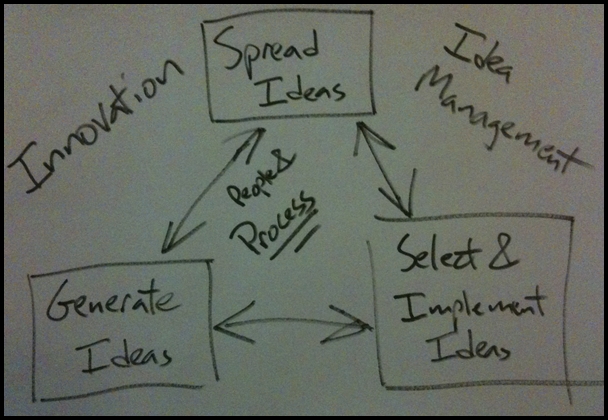
A much more interesting and useful question is: what can my organization do to be more innovative?  The point is that innovation is not deterministic – you’re not doomed if you’re big, and you’re not automatically innovative if you’re small.  The critical issue to figure out how innovation fits with your strategy and then what skills and processes you need to innovate in your particular context.

Size becomes important when you think about context – the way that you innovate will be different if you are big than it will be if you are small.  No matter what the context, innovation is a process – it’s the process of idea management.  I’ve pictured it something like this:

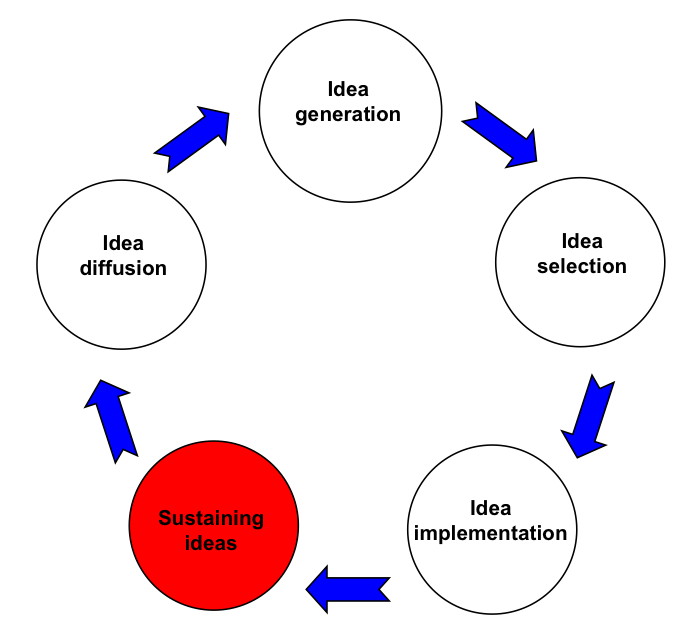
However, in the excellent report on public sector innovation in Australia, Empowering Change (downloadable here), led by Alex Roberts, they had a slightly different version of this model.  It was adapted from a report on public sector innovation from Deloitte, and theirs looks like this:


I made the fourth circle red, because that is the one that I’ve always had some trouble getting my head around.  But some of my recent discussions have given me some insights into this.  The report describes Sustaining Ideas as “keeping the innovative initiative going and integrating it, which includes monitoring and adapting where necessary .”

This ends up being one of the key areas where innovation is different for big and small organisations.  If you are a startup, you don’t need to worry too much about sustaining innovation initiatives.  If you fail to do this, you go out of business.  Simple enough.

But if you’re big, you have plenty of other things to worry about.  You have quarterly objectives to meet.  You have other processes you need to make more efficient.  And so on.  Not so simple.  So if you’re big, and you’re trying to innovate, a lot of effort needs to go into this part of the idea management process.

So while big firms can indeed innovate, this means that they need to manage the process differently – there’s no one-size-fits-all solution – sorry!  If you’re big, what are some of the things that you should do?  Here are some ideas:

  • Increase your innovation speed. If you’re going to innovate like the small, agile organisations, then you need to act more agile yourself.  Here’s Phillips again, in a different post on the importance of velocity in innovation:
    If these assumptions are true, then VELOCITY, as defined as speed in a specific direction, becomes very important for a firm’s ability to grow and compete. Relying on long product life cycles is not an option. Customers will demand new products, new features at an ever increasing rate. Firms can’t simply “dump” older technologies and products into “developing” markets because those market too understand the product/feature acceleration and reject older products.

    Phillips recommends innovating your product development process, making innovation a core part of your strategy, and building executive support for this vision as the three critical steps to achieve this.
  • Open up!Think about the five steps in the innovation process model.  What are big firms good at?  They are great at getting things to market – that’s how they’re big.  So they have idea diffusion covered pretty well.  But this is often a huge problem for smaller organisations.  They might have brilliant ideas, that have been executed very well, but they can’t get anyone to pay attention to them.  How do they get around this? Collaborate.That’s the point that Ralph Ohr raised in his recent post, and Scott Anthony makes a similar point:

  • WSJ: Are you saying startups are no longer capable of innovation?
    Anthony: I don’t want to go so far as to say startups are pointless. But today, the second a startup has had a taste of success, the race is on, because anyone can copy them.
    WSJ: What’s in store for these smaller companies then?
    Anthony: They have to recognize their success can’t be predicated on the stupidity or slowness of big companies. It might be time to start thinking about partnering with a big company instead of just being pirates.
  • Get to know your customers deeply. Often, big firms resist innovation because they think that they know best.  But one of the things that they can do with their extra resources is invest more in learning what their customers really need.  And you don’t do this through focus groups – you build deeper knowledge than that. One way to do this is to follow the customer home – as Soren Kaplan explains:

  • Intuit’s innovation success is tied to a value for finding and savoring customer surprises–unexpected insights about customer needs, problems, and desired experiences that can’t be anticipated or pre-defined. That’s why the company does customer “follow-me-homes,” where everyone from CEO Brad Smith to engineers and marketers immerse themselves in the customer’s natural environment to see how things are working (or not) in the real world.

This is actually one of the techniques of ethnography, something that PARC has been investing in over the past few years. Ellen Isaacs from PARC talks about how this works:
With ethnography, you’re more interested in what people do than what they say (usually two different things), and you’re more likely to come out of it with answers to questions you didn’t know to ask. At its best, ethnography uncovers “aha!” insights that transform thinking. But since nobody knows know what they’ll learn, there’s no guarantee — and that makes people nervous.

The issue isn’t big versus small.  And size doesn’t determine whether or not you can innovate.

The question to address is: What’s best for us?  And the key point is that the answer will probably be different if you’re big.

Download PDF

Tags: , , ,

| What is MyVisionRoom? > | Back to Leadership >

ABOUT THE AUTHOR

Tim Kastelle

Tim Kastelle

Tim Kastelle is a Lecturer in Innovation Management in the University of Queensland Business School. He blogs about innovation at the Innovation Leadership Network.

See more articles by >

COMMENTS

What say you? Leave a comment!

Recent Comments
comment_post_ID); ?> Thank you for this information. I'm going to use this article to improve my work with the Lord.
 
— Abel Singbeh
 
comment_post_ID); ?> Thank you Ed for sharing your insights into the Church Growth Movement. I have my reservations with Church Growth models because it has done more damage than good in the Body of Christ. Over the years, western churches are more focused on results, formulas and processes with little or no emphasis on membership and church discipline. Pastors and vocational leaders are burnt out because they're overworked. I do believe that the Church Growth model is a catalyst to two destructive groups: The New Apostolic Reformation and the Emerging Church. Both groups overlap and have a very loose definition. They're both focus on contemporary worship, expansion of church brand (franchising), and mobilizing volunteering members as 'leaders' to grow their ministry. Little focus on biblical study, apologetics and genuine missional work with no agenda besides preaching of the gospel.
 
— Dave
 
comment_post_ID); ?> Thank you for sharing such a good article. It is a great lesson I learned from this article. I am one of the leaders in Emmanuel united church of Ethiopia (A denomination with more-than 780 local churches through out the country). I am preparing a presentation on succession planning for local church leaders. It will help me for preparation If you send me more resources and recommend me books to read on the topic. I hope we may collaborate in advancing leadership capacity of our church. God Bless You and Your Ministry.
 
— Argaw Alemu
 

Clarity Process

Three effective ways to start moving toward clarity right now.

People First, Data Second

When I’m talking with church leaders about technology, the conversation often begins with questions about the kind of data we can track and report on. I know that it frustrates some of those leaders that I always flip the conversation to focus on people.

I know data is important. It helps us understand where we are and how we’re doing. But the reason data is important is because it helps make our church communities stronger. Before we create systems to measure the numbers, we need to make sure our focus is on the people. Before we ask, “How many did we have?” we should want to know, “Who was there and who was missing—and why?”

Church Community Builder, or any church management system, was never intended to be just about numbers. In the church context, the most powerful data emerges when we focus on people first. Focusing on the technology, before we focus on the community it is supposed to support, misses the point.

Here are four guidelines for focusing on people first and data second:

  • Church technology must be used to track “faces.”
    Just entering head-counts for attendance is not sufficient. You need to know WHO is doing what and when. This is about individuals not mass numbers.
  • Church technology must be well integrated to seamlessly record activity and life events.
    Data silos only open up cracks for people to fall through. The more your systems are disconnected or complicated, the easier it is to lose track of important information. If the data you’re analyzing is wrong or incomplete, you won’t know who’s missing or even who’s new.
  • Church leaders must be empowered by tools that help them steward and lead.
    If your Sunday school teachers or small group leaders have to call church staff to access and update information about their groups, it probably won’t happen much. They will also have no effective way to record spur of the moment information they learn in a random conversation. That’s a potentially huge missed opportunity. They need to be able to log in, access information, and update it whenever changes occur.
  • Key activities other than attendance must be measured and managed to discover what is happening in your church.
    There are so many factors in the “engagement” equation besides attendance. If you watch these things, over time, you will get objective and relevant data to help you measure the overall health of your entire church—not just your Sunday morning service.

Here are a few things you should measure in order to gauge engagement and the depth of your church community:

  • Worship and Small Group Involvement
  • Assimilation
  • Contributions
  • Volunteering
  • Event attendance and follow up
  • Communications

If each of these areas are consistently measured and updated, patterns will emerge, people won’t fall through the cracks, and church leadership will be able to see a clear picture of what is happening within the Body.

Bottom line: We must first care for people. Data worth analyzing is accrued when we stop looking at people as numbers and start looking at numbers as people. Leveraging technology helps people connect with the church and with other people. Building community comes first. Then, meaningful data will emerge.

What has been most eye-opening since you started consistently using a system to track ministry effectiveness?

Read more from Steve here.

Download PDF

Tags: , ,

| What is MyVisionRoom? > | Back to Process >

ABOUT THE AUTHOR

Steve Caton

Steve Caton

Steve Caton is part of the Leadership Team at Church Community Builder. He leverages a unique background in technology, fundraising and church leadership to help local churches decentralize their processes and equip their people to be disciple makers. Steve is a contributing author on a number of websites, including the Vision Room, ChurchTech Today, Innovate for Jesus and the popular Church Community Builder Blog. He also co-wrote the eBook “Getting Disciple Making Right”. While technology is what Steve does on a daily basis, impacting and influencing the local church is what really matters to him……as well as enjoying deep Colorado powder with his wife and two sons!

See more articles by >

COMMENTS

What say you? Leave a comment!

Recent Comments
comment_post_ID); ?> Thank you for this information. I'm going to use this article to improve my work with the Lord.
 
— Abel Singbeh
 
comment_post_ID); ?> Thank you Ed for sharing your insights into the Church Growth Movement. I have my reservations with Church Growth models because it has done more damage than good in the Body of Christ. Over the years, western churches are more focused on results, formulas and processes with little or no emphasis on membership and church discipline. Pastors and vocational leaders are burnt out because they're overworked. I do believe that the Church Growth model is a catalyst to two destructive groups: The New Apostolic Reformation and the Emerging Church. Both groups overlap and have a very loose definition. They're both focus on contemporary worship, expansion of church brand (franchising), and mobilizing volunteering members as 'leaders' to grow their ministry. Little focus on biblical study, apologetics and genuine missional work with no agenda besides preaching of the gospel.
 
— Dave
 
comment_post_ID); ?> Thank you for sharing such a good article. It is a great lesson I learned from this article. I am one of the leaders in Emmanuel united church of Ethiopia (A denomination with more-than 780 local churches through out the country). I am preparing a presentation on succession planning for local church leaders. It will help me for preparation If you send me more resources and recommend me books to read on the topic. I hope we may collaborate in advancing leadership capacity of our church. God Bless You and Your Ministry.
 
— Argaw Alemu
 

Clarity Process

Three effective ways to start moving toward clarity right now.

The Laws of Subtraction: How to Innovate in the Age of Excess Everything

“Our businesses are more complicated and difficult to manage than ever. Our economy is more uncertain than ever. Our resources are scarcer than ever. There is endless choice and feature overkill in all but the best experiences. Everybody knows everything about us. The simple life is a thing of the past. Everywhere, there’s too much of the wrong stuff, and not enough of the right. The noise is deafening, the signal weak. Everything is too complicated and time-sucking.

Welcome to the age of excess everything. Success in this new age looks different, and demands a new and singular skill: Subtraction.

Subtraction is defined simply as the art of removing anything excessive, confusing, wasteful, unnatural, hazardous, hard to use, or ugly—and the discipline to refrain from adding it in the first place.”

Click here to download Matthew’s Change This manifesto on “The Laws of Subtraction.”

Download PDF

Tags: , , ,

| What is MyVisionRoom? > | Back to Leadership >

ABOUT THE AUTHOR

Matthew May

In addition to The Laws of Subtraction, Matthew E. May is the author of four previous manifestos. He is also the author of three awardwinning books: The Elegant Solution, In Pursuit of Elegance, and The Shibumi Strategy. A popular speaker, creativity coach, and close advisor on innovation and design strategy to companies such as ADP, Edmunds, Intuit, and Toyota, he is a regular contributor to the American Express OPEN Forum Idea Hub and the founder of Edit Innovation, an ideas agency based in Los Angeles.

See more articles by >

COMMENTS

What say you? Leave a comment!

Recent Comments
comment_post_ID); ?> Thank you for this information. I'm going to use this article to improve my work with the Lord.
 
— Abel Singbeh
 
comment_post_ID); ?> Thank you Ed for sharing your insights into the Church Growth Movement. I have my reservations with Church Growth models because it has done more damage than good in the Body of Christ. Over the years, western churches are more focused on results, formulas and processes with little or no emphasis on membership and church discipline. Pastors and vocational leaders are burnt out because they're overworked. I do believe that the Church Growth model is a catalyst to two destructive groups: The New Apostolic Reformation and the Emerging Church. Both groups overlap and have a very loose definition. They're both focus on contemporary worship, expansion of church brand (franchising), and mobilizing volunteering members as 'leaders' to grow their ministry. Little focus on biblical study, apologetics and genuine missional work with no agenda besides preaching of the gospel.
 
— Dave
 
comment_post_ID); ?> Thank you for sharing such a good article. It is a great lesson I learned from this article. I am one of the leaders in Emmanuel united church of Ethiopia (A denomination with more-than 780 local churches through out the country). I am preparing a presentation on succession planning for local church leaders. It will help me for preparation If you send me more resources and recommend me books to read on the topic. I hope we may collaborate in advancing leadership capacity of our church. God Bless You and Your Ministry.
 
— Argaw Alemu
 

Clarity Process

Three effective ways to start moving toward clarity right now.

Gospel, Culture, and Mission: An Interview with Tim Keller

Tim Keller’s new book, Center Church: Doing Balanced, Gospel-Centered Ministry in Your City may be the most important book he has written. It’s the size of a textbook because of how expansive its vision is. These 400 pages capture the essence of Keller’s theological vision, worked out over decades of pastoral ministry in New York City. As I read the book, I had to keep sharpening pencils because of my extensive underlining.

Today, I welcome Tim to the blog for a conversation about some of the important topics addressed in Center Church

Trevin Wax: Tim, you speak of “gospel renewal” as something bestowed by the Spirit and also something we work toward. How would you define “gospel renewal” and how do we seek something only God can give?

Tim Keller: We who are Calvinists that believe in the free offer of the gospel regularly ask people to seek something only God can give. Not only would we say only God can give salvation, but we would say that you can’t even want salvation unless God gives it. Yet we call people to repent and believe. I see no reason why we can’t call people to seek gospel renewal and revival even though only God can give it.

If you look back at theologians who have written on revival, they wrestle with this very issue. Is it merely something you can pray for (which, by the way, is something you are doing to seek revival), or are there other things you can do (like recover clear gospel preaching, etc.)?

As in all ministry, a balance must be struck between pessimistic passivity on the one hand and the frantic assumption that you can create revival on the other.

Trevin Wax: In a recent comment on your book, Scot McKnight described your definition of the gospel as thoroughly “soterian” – meaning, it is focused on individual salvation that comes by grace through faith. In your defense, I’d say you give significant space to unpacking the gospel’s implications in light of Christ’s lordship.

Why is it important to keep individual salvation at the center of our thinking about the gospel? And do you sense a tension between a focus on individual salvation and the resurrection-centered, kingship-focused sermons we see in Acts?

Tim Keller: Scot and I disagree on this. But yes, I do think individual salvation needs to be kept central.

In Romans 8 Paul speaks of the renewal of creation—its liberation from decay—something that shows that ultimately God’s salvation means the renewal of the whole world, not just the salvation of individual souls. Yet in verse 21 Paul says that the creation will be brought into our freedom and glory as children of God—the glory that we as individuals have received through faith in Jesus Christ.

So rather than saying—as many do—that the main point of the gospel is cosmic salvation, and our individual salvation(s) are just part of that, it might be more accurate to say it’s the other way around. It may be that cosmic renewal is a fruit of our individual, personal salvation.

Because I read Romans 8 the way I do—I see substitutionary atonement and justification as not something that comes along with the bigger story but as the point of the spear of the Big Story.

Trevin Wax: You argue that in our evangelistic efforts, we should put forth a compelling challenge of competing worldviews. Along these lines, you recommend distinguishing between a culture’s “A” doctrines from its “B” doctrines as we make a case for Christianity. Can you elaborate on what you mean by “A” and “B” doctrines? 

Tim Keller: What I mean is that a genuinely persuasive argument does not merely tell you that you are wrong about everything. It doesn’t just beat on you from the outside. It comes inside your belief system, as it were, and affirms something you believe strongly. And then it says—well if you believe this (A) then why in the world can’t you see that B is true?

So for example when speaking to a group of atheists who believe strongly in human rights, you make the case that if we simply evolved by accident there is no scientific or other basis for a belief that every human being is equal in dignity—in fact, science gives evidence of the opposite. Then you conclude “if your premise (that there is no God) leads you to conclude something you know isn’t true (that human beings do not all have equal rights and dignity) then why not change your premise?” If you take time to listen to persuasive arguments, you will see they usually do this.

Trevin Wax: I benefited from the balance on display in your explanation of four common ways many Christians relate to culture (Transformationists, Relevants, Counterculturalists, Two Kingdoms). At the end of this section, you left the question open-ended, advocating for different strategies based on cultural context and personal giftings. How did you come to the conclusion that all four views have strengths and weaknesses that need to be held in tension with the others?

Tim Keller: Don Carson’s book Christ and Culture Revisited looks at the 5 models of Christ-and-culture laid out by Niebuhr. They don’t perfectly line up with my four, but Don’s argument was that outside of the “Christ of Culture” model (the view of older Liberal Christianity) all the models had biblical warrant, yet that meant that any of the models taken too exclusively would be leaving out the biblical insights of the other models.

So in the end I say that you should choose the model that seems to best fit your time, place, and personal affinities, but be very careful to use the insights and tools of the other models to keep yourself from imbalance.

Trevin Wax: The term “missional” is often used today in a variety of ways – some of which contradict each other. You maintain a place for the word “missional,” but want to be specific about what it means and does not mean. How would you define “missional?”

Tim Keller: I think that the word “missional” is useful because it means something more (though not less) than being very evangelistic. It means recognizing the post-Christian character of our western society, and revamping everything we do in accord with that.

We no longer have cultural institutions imparting respect for the Bible and the church in the general population so that the average person:

  1. pays attention to the church,
  2. seeks it out for milestone moments like baptisms, weddings, funerals, and
  3. understands what you mean by terms like God, sin, heaven, hell, right and wrong.

This means revamping how you preach, how you instruct, how you evangelize—everything. Notice how differently Paul (in Acts) preached to pagans than he did in synagogues where people were steeped in the Scripture.

So I’m not ready to abandon the term missional.  There are very different views of how to be the church now in our post-Christian culture, but we should be making the effort rather than simply doing business as usual.

Trevin Wax: There is a current discussion going on in gospel-centered circles about the “mission of the church,” and particularly, the nature of “making disciples.” What aspects of this discussion have encouraged you? How would you weigh in and speak to some of the deficiencies you see in this discussion?

Tim Keller: I’m good with saying that the mission of the church is basically to “make disciples.” I like it because it safeguards the centrality of what the church alone can really do—bring people to faith in Christ. But I might differ with others on what those disciples look like.

I’d say you haven’t discipled someone if they only have been equipped to evangelize and bring people to church.  If they are truly discipled, they must be motivated and equipped to love their neighbors, to do justice and mercy.  And they also must be equipped to integrate their faith with their work, namely, to engage culture.

One problem I see is that many churches that insist that the church’s job is to only to make disciples do virtually nothing to help disciples grow in these areas, even though it is clearly part of the biblical job description for individual believers.  Put another way—the job of the institutional church gathered is not to change social structures/culture, but to create disciples (who comprise the ‘organic’ church dispersed) who will change social structures and the culture.

Read more from Trevin here.

Download PDF

Tags: , , ,

| What is MyVisionRoom? > | Back to Culture >

ABOUT THE AUTHOR

Trevin Wax

Trevin Wax

My name is Trevin Wax. I am a follower of Jesus Christ. My wife is Corina, and we have two children: Timothy (7) and Julia (3). Currently, I serve the church by working at LifeWay Christian Resources as managing editor of The Gospel Project, a gospel-centered small group curriculum for all ages that focuses on the grand narrative of Scripture. I have been blogging regularly at Kingdom People since October 2006. I frequently contribute articles to other publications, such as Christianity Today. I also enjoy traveling and speaking at different churches and conferences. My first book, Holy Subversion: Allegiance to Christ in an Age of Rivals, was published by Crossway Books in January 2010. (Click here for excerpts and more information.) My second book, Counterfeit Gospels: Rediscovering the Good News in a World of False Hope(Moody Publishers) was released in April 2011.

See more articles by >

COMMENTS

What say you? Leave a comment!

Recent Comments
comment_post_ID); ?> Thank you for this information. I'm going to use this article to improve my work with the Lord.
 
— Abel Singbeh
 
comment_post_ID); ?> Thank you Ed for sharing your insights into the Church Growth Movement. I have my reservations with Church Growth models because it has done more damage than good in the Body of Christ. Over the years, western churches are more focused on results, formulas and processes with little or no emphasis on membership and church discipline. Pastors and vocational leaders are burnt out because they're overworked. I do believe that the Church Growth model is a catalyst to two destructive groups: The New Apostolic Reformation and the Emerging Church. Both groups overlap and have a very loose definition. They're both focus on contemporary worship, expansion of church brand (franchising), and mobilizing volunteering members as 'leaders' to grow their ministry. Little focus on biblical study, apologetics and genuine missional work with no agenda besides preaching of the gospel.
 
— Dave
 
comment_post_ID); ?> Thank you for sharing such a good article. It is a great lesson I learned from this article. I am one of the leaders in Emmanuel united church of Ethiopia (A denomination with more-than 780 local churches through out the country). I am preparing a presentation on succession planning for local church leaders. It will help me for preparation If you send me more resources and recommend me books to read on the topic. I hope we may collaborate in advancing leadership capacity of our church. God Bless You and Your Ministry.
 
— Argaw Alemu
 

Clarity Process

Three effective ways to start moving toward clarity right now.

What Storytelling Means for Your Brand

 What does Cinderella have in common with Fight Club?

Lots, according to Jon King, Story Worldwide’s Chief Storyteller. During the ‘Storytelling for Brands’ session at our London office last   week, part of Social Media Week London, we shared Story’s brand-centred approach to narrative content.


We draw our inspiration from the most important study of storytelling ever done, The Hero with a Thousand Faces, by Joseph Campbell.   Campbell’s insights have influenced and guided the approach, which he called the hero’s journey and which is used in all forms of narrative, including classic films from Cinderella to Fight Club.

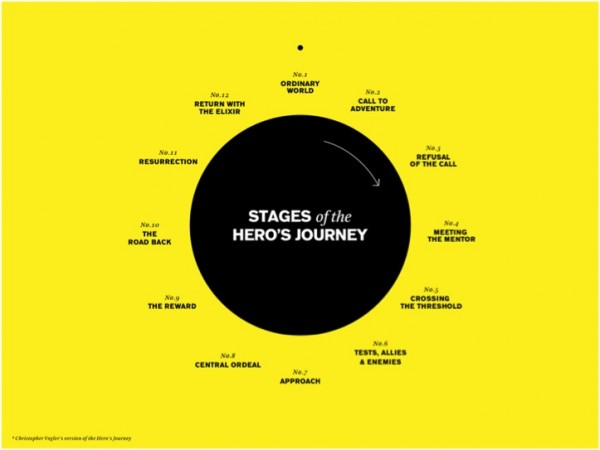
The Hero’s Journey is a model story format—honed by the knowledge contained in myriad cultures and history—which follows remarkably consistent rules that reflect profound human needs. It explains the narrative structure found in the great myths, timeless fairy tales and modern action films. Here’s how Cinderella’s story maps directly onto the Hero’s Journey:

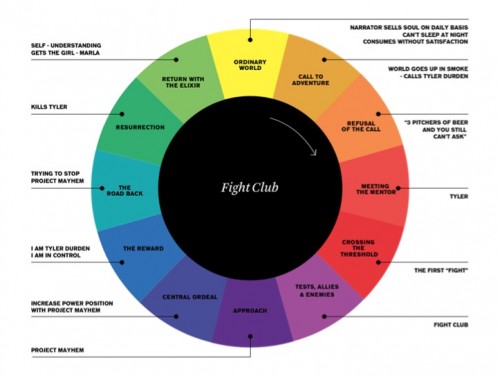
And, surprisingly, Fight Club can be mapped to exactly the same pattern (spoiler alert!!):

SO WHAT DOES THIS MEAN FOR BRANDS?

Brands are stories, effectively. At their most successful, these stories powerfully narrate the relationship between the brands and their audience(s). The most powerful brand stories, like the most engaging fairy tales, speak to fulfilling deep, unmet emotional desires.

Humans are psychologically hardwired to respond to meta-narratives that have been informed by human culture and history: the long journey home, marrying outside your tribe, the quest…It’s a search for meaning that defines what we are and want to be.

Through digital and social media, using maturing social-listening and search techniques, we can uncover and understand meta-conversations across cultures in a way that was not possible even five years ago. Tapping into these conversations reveals the current mind-sets of different audience segments and reveals their deeper unsatisfied emotional needs, providing a rich seam of consumer insight that brands can use to learn the best way to position and promote their stories to create value for themselves as well as their consumers.

Once marketers understand which aspect of the brand consumers really identify and engage with, the next step is to plan and shape the conversation between brand and audience over time. This content plan’s sole purpose is to bring the brand’s story to life across every touchpoint between consumer and brand, in the real and digital worlds.

In the Social Media Week session, we shared some of our latest thinking on the social multiplier effect (Kirk Cheyfitz will be publishing more on this topic soon)—which is the process of using digital to leverage a brand’s fans so they make the brand story genuinely contagious, delivering exponential return for the brand and lowering media spend dramatically.

According to Nielsen, recommendations are roughly twice as trusted as advertising. Add to this Forrester Research’s recent studies of how social fans share brand stories through their networks, and you’ll see the beginnings of the compound multiplier effect. But greater trust and greater reach are totally dependent on how interesting, credible, useful and, most of all, contagious the content is as well as where it’s shared and promoted.

THE ROLE OF TRADITIONAL ADVERTISING

This is not to say that we should dismiss years of established traditional advertising knowledge and practice. Traditional advertising still has a role to play, as has been proven by one or two stunningly effective long-term brand campaigns—Sainsbury’s ‘Try Something New Today’ being a perfect case in point. A few years ago, Sainsbury’s deployed a simple but rich ‘big idea’ to impressive effect across its brand ecosystem, extending it across everything from integrated comms to internal staff engagement. The campaign makes an eloquent case for the age-old marketing practice of delving deep into a brand to uncover an idea so broad and powerful that people, consumers and staff, can’t help but listen and act.

But brand work like this, despite London’s prominent place in the global advertising industry, is the exception rather than the rule. It is noteworthy precisely because it is rare and because it depends heavily on constant support by large amounts of paid media.

So think how valuable, for both brand and consumers, a rich and satisfying brand story can be, and how powerful its impact can be as it is spread across the media ecosystem by brand advocates who share with their far-flung social networks using the latest developments in social and mobile. Such contagious brand stories spread on their own as a matter of routine, gaining currency by tapping into ongoing conversations and multiplying across social networks at extremely low cost. That is the present and, increasingly, the future of the new advertising. And that is a story every brand will find well worth telling.

So what’s your story?

Download PDF

Tags: , ,

| What is MyVisionRoom? > | Back to Communication >

ABOUT THE AUTHOR

Jon Thomas

See more articles by >

COMMENTS

What say you? Leave a comment!

Recent Comments
comment_post_ID); ?> Thank you for this information. I'm going to use this article to improve my work with the Lord.
 
— Abel Singbeh
 
comment_post_ID); ?> Thank you Ed for sharing your insights into the Church Growth Movement. I have my reservations with Church Growth models because it has done more damage than good in the Body of Christ. Over the years, western churches are more focused on results, formulas and processes with little or no emphasis on membership and church discipline. Pastors and vocational leaders are burnt out because they're overworked. I do believe that the Church Growth model is a catalyst to two destructive groups: The New Apostolic Reformation and the Emerging Church. Both groups overlap and have a very loose definition. They're both focus on contemporary worship, expansion of church brand (franchising), and mobilizing volunteering members as 'leaders' to grow their ministry. Little focus on biblical study, apologetics and genuine missional work with no agenda besides preaching of the gospel.
 
— Dave
 
comment_post_ID); ?> Thank you for sharing such a good article. It is a great lesson I learned from this article. I am one of the leaders in Emmanuel united church of Ethiopia (A denomination with more-than 780 local churches through out the country). I am preparing a presentation on succession planning for local church leaders. It will help me for preparation If you send me more resources and recommend me books to read on the topic. I hope we may collaborate in advancing leadership capacity of our church. God Bless You and Your Ministry.
 
— Argaw Alemu
 

Clarity Process

Three effective ways to start moving toward clarity right now.