Turning Ideas into Reality, Part 2

Organization Not Optional

Once an idea is recorded, we are now getting into territory where personal preference becomes more of a factor than before. Getting your ideas down isn’t optional. The process you use to organize them is. Ultimately, go with whatever you’re comfortable with and understand. If you can’t use your system, there’s no point in having it.

My own preference is using a spreadsheet with multiple tabs covering different categories and platforms of communication (e.g. blog ideas, sermon illustrations, leadership teaching, staff meeting teachings). Once a week I sit down with my assistants and list every idea I’ve had over the past week with the main idea, any scriptures I want to use with it, and the category or platform it belongs in. Each idea is then listed chronologically within its assigned category. This way, I can see all of the resources I have within a particular area and have access to the freshest concepts within it.

Whatever method you go with, keep in mind that your organizational preference is optional. Being organized isn’t. Many pastors use the excuse that they’re not naturally organized. Translated, that means, “I’m too lazy to take the time to make my ideas more accessible.” When God has given you inspiration, there is no excuse for mishandling it. Even if it doesn’t come naturally for you. Do the hard work. If nothing else, find someone who is more organized and empower them to do it for you according to your preferred design.

Execution Matters Most

Ideas are overrated. Execution is what really matters. Ideas become reality because of something you do. Not because they are written down. So it’s essential that you have some kind of a system to make sure your thoughts are being filtered into your sermons, blogs, staff teachings, and any other place where you have a platform. If not, all you have done is buried them in a document rather than in your memory.

In my case, I have an assistant who regularly goes through my spreadsheet and makes sure the strongest ideas are being implemented in their respective areas. For example, when it comes time to plan out our sermons for the year, he has access to every single series idea I’ve envisioned up to that point. If we want to do a series on giving, everything I need on that topic is put in front of me.

You might not have the luxury of having a paid staff member to help you do all of this. But don’t let this stop you. Find a volunteer. Or set aside a set time in your calendar every week and do it yourself. The dividends it pays far outweigh the time and energy you will ever put into it.

And remember that it’s not ultimately about efficiency. This is about learning to harness the infinite sum of knowledge and inspiration that is at our disposal because of the God we serve.

Considering the fact that we have a God who is constantly at work to reveal Himself, there should not be another group on the planet that is coming up with better ideas than the people he has chosen to use as his instruments of revelation. Let’s not waste what we have at our disposal.

Read Part 1 of this series here.

Read more from Steven here.

Download PDF

Tags: , ,

| What is MyVisionRoom? > | Back to Leadership >

ABOUT THE AUTHOR

Steven Furtick

Steven Furtick

Pastor Steven Furtick is the lead pastor of Elevation Church. He and his wife, Holly, founded Elevation in 2006 with seven other families. Pastor Steven holds a Master of Divinity degree from The Southern Baptist Theological Seminary. He is also the New York Times Best Selling author of Crash the Chatterbox, Greater, and Sun Stand Still. Pastor Steven and Holly live in the Charlotte area with their two sons, Elijah and Graham, and daughter, Abbey.

See more articles by >

COMMENTS

What say you? Leave a comment!

Recent Comments
comment_post_ID); ?> Thank you for this information. I'm going to use this article to improve my work with the Lord.
 
— Abel Singbeh
 
comment_post_ID); ?> Thank you Ed for sharing your insights into the Church Growth Movement. I have my reservations with Church Growth models because it has done more damage than good in the Body of Christ. Over the years, western churches are more focused on results, formulas and processes with little or no emphasis on membership and church discipline. Pastors and vocational leaders are burnt out because they're overworked. I do believe that the Church Growth model is a catalyst to two destructive groups: The New Apostolic Reformation and the Emerging Church. Both groups overlap and have a very loose definition. They're both focus on contemporary worship, expansion of church brand (franchising), and mobilizing volunteering members as 'leaders' to grow their ministry. Little focus on biblical study, apologetics and genuine missional work with no agenda besides preaching of the gospel.
 
— Dave
 
comment_post_ID); ?> Thank you for sharing such a good article. It is a great lesson I learned from this article. I am one of the leaders in Emmanuel united church of Ethiopia (A denomination with more-than 780 local churches through out the country). I am preparing a presentation on succession planning for local church leaders. It will help me for preparation If you send me more resources and recommend me books to read on the topic. I hope we may collaborate in advancing leadership capacity of our church. God Bless You and Your Ministry.
 
— Argaw Alemu
 

Clarity Process

Three effective ways to start moving toward clarity right now.

Turning Ideas into Reality, Part 1

Yesterday I told you I would be giving you access to my system for recording, cataloging, and implementing my ideas. After writing it out, I’ve decided it’s much too long for one blog post. I don’t want to shortchange you by reducing it, so I’ve divided it in two. The second half will be posted tomorrow. Here is the first half of the process:

The Birth of the Idea

The genesis of any system for getting your ideas from your mind to reality starts with the initial moment of inspiration. I’ve found that these moments occur in two different ways.

Sometimes they will appear out of nowhere. I’ll be doing something that requires zero creativity, yet one of the most creative ideas I’ve ever had will come to me. You’ll find that your subconscious is often working harder than your conscious mind ever will. Collecting random bits of information and making connections you never would. When God decides to use it to present you with something fresh, be ready.

Others come through learned observation. What I mean is that you have to train yourself to become aware of everything around you and its illustrative and revelatory potential. The books I read are no longer just for my own personal edification. They are goldmines for ideas. Every conversation I have, my favorite memories from family vacations, everything has the potential to birth an idea inside of me. Because God has created the world, everything around us possesses the possibility of more fully revealing the One who created it. Or giving us insight into the way His creation is designed to work. So keep your eyes open.

The first source of inspiration requires little to no work. The second may require intensive examination and reflection. Both are required if you want to maximize your mind’s full potential.

Get it Down.

The next step is crucial. It’s the one most pastors never get to and why most ideas never see the light of day. Ingrain this instruction in your head: write everything down.

Record every creative impulse. Every good idea. Every bad idea. Every possible vision initiative. Every potential illustration. When you’re reading, if the author says something in a fresh way that could illustrate one of your own concepts, record it immediately. Don’t highlight the sentence and hope you remember to flip back and find it later. You won’t.

Write it on a napkin. Record it on your phone. Write it on your iPad. Tatoo it on your arm if you have to. Whatever you have to do, just get it down. Some of your best sermon ideas were never preached because they weren’t written down. You thought you’d remember. You didn’t.

I write most of my thoughts in a Moleskin. But I’ll also do whatever it takes. I’ve called my own voicemail before and left a message just so I wouldn’t lose an idea.

However I end up recording it, I follow up and transfer it to either my computer or my iPad to make the second half of the process more efficient. We’ll pick up there tomorrow.

For now, keep your eyes open for every little piece of inspiration God gives you. And have a pen ready.

Read Part 2 here.

Read more from Steven here.

Download PDF

Tags: , ,

| What is MyVisionRoom? > | Back to Leadership >

ABOUT THE AUTHOR

Steven Furtick

Steven Furtick

Pastor Steven Furtick is the lead pastor of Elevation Church. He and his wife, Holly, founded Elevation in 2006 with seven other families. Pastor Steven holds a Master of Divinity degree from The Southern Baptist Theological Seminary. He is also the New York Times Best Selling author of Crash the Chatterbox, Greater, and Sun Stand Still. Pastor Steven and Holly live in the Charlotte area with their two sons, Elijah and Graham, and daughter, Abbey.

See more articles by >

COMMENTS

What say you? Leave a comment!

Recent Comments
comment_post_ID); ?> Thank you for this information. I'm going to use this article to improve my work with the Lord.
 
— Abel Singbeh
 
comment_post_ID); ?> Thank you Ed for sharing your insights into the Church Growth Movement. I have my reservations with Church Growth models because it has done more damage than good in the Body of Christ. Over the years, western churches are more focused on results, formulas and processes with little or no emphasis on membership and church discipline. Pastors and vocational leaders are burnt out because they're overworked. I do believe that the Church Growth model is a catalyst to two destructive groups: The New Apostolic Reformation and the Emerging Church. Both groups overlap and have a very loose definition. They're both focus on contemporary worship, expansion of church brand (franchising), and mobilizing volunteering members as 'leaders' to grow their ministry. Little focus on biblical study, apologetics and genuine missional work with no agenda besides preaching of the gospel.
 
— Dave
 
comment_post_ID); ?> Thank you for sharing such a good article. It is a great lesson I learned from this article. I am one of the leaders in Emmanuel united church of Ethiopia (A denomination with more-than 780 local churches through out the country). I am preparing a presentation on succession planning for local church leaders. It will help me for preparation If you send me more resources and recommend me books to read on the topic. I hope we may collaborate in advancing leadership capacity of our church. God Bless You and Your Ministry.
 
— Argaw Alemu
 

Clarity Process

Three effective ways to start moving toward clarity right now.

The Importance of Moving People

Great preachers and leaders know how to move people.

As soon as I say that I know that the first thing that comes to many people’s minds is emotional manipulation. After all, when unchurched people say they really liked your sermon they usually say that it really moved them. And in their minds they’re probably talking about pure emotion. Maybe intellectual curiosity.

But that’s not what I mean. Anyone can do that and it doesn’t guarantee any kind of positive growth in the lives of the people you’re preaching to and leading.

What I mean is the concept of moving people further along in their lives. Advancing them beyond their current level of development. Beyond their current walk with God.

I like that concept. That image. And it’s something that I think all pastors should strive after. Pastors have to know how to move people. And they have to know how to move them on two tracks – 1) individually and 2) corporately.

The words you speak should move people on a personal level. It should grip their hearts and make application to their lives personally. If you don’t move the individual and you’re only casting broad vision to the church as a whole, you’re only going to preach to the highest commitment level people and your church isn’t going to go very far.

For example, you can make the greatest pitch for the greatest capital campaign in church history. But if the individual people and families in your church aren’t moved to live lives of generosity, the thermometer on your stage is going nowhere.

You have to move the people to move the church.

But you also have to move the church as a whole in the right direction. You should always have a direction the church needs to move in corporately. A common goal that you want the collective efforts of the individual people in your church aimed at. If you don’t, the church won’t advance.

Going back to our example, it’s not enough just to move people to tithe. What you have to do is figure out where God wants to take your church. What it’s going to take financially to get there. And then cast a compelling vision that moves individual people to get on board to make it happen.

You have to move the church to move the people.

Good preachers and leaders are great at moving individuals.
Good preachers and leaders are great at moving churches.

Great preachers and leaders are great at both.

Download PDF

Tags: , , ,

| What is MyVisionRoom? > | Back to Process >

ABOUT THE AUTHOR

Steven Furtick

Steven Furtick

Pastor Steven Furtick is the lead pastor of Elevation Church. He and his wife, Holly, founded Elevation in 2006 with seven other families. Pastor Steven holds a Master of Divinity degree from The Southern Baptist Theological Seminary. He is also the New York Times Best Selling author of Crash the Chatterbox, Greater, and Sun Stand Still. Pastor Steven and Holly live in the Charlotte area with their two sons, Elijah and Graham, and daughter, Abbey.

See more articles by >

COMMENTS

What say you? Leave a comment!

Recent Comments
comment_post_ID); ?> Thank you for this information. I'm going to use this article to improve my work with the Lord.
 
— Abel Singbeh
 
comment_post_ID); ?> Thank you Ed for sharing your insights into the Church Growth Movement. I have my reservations with Church Growth models because it has done more damage than good in the Body of Christ. Over the years, western churches are more focused on results, formulas and processes with little or no emphasis on membership and church discipline. Pastors and vocational leaders are burnt out because they're overworked. I do believe that the Church Growth model is a catalyst to two destructive groups: The New Apostolic Reformation and the Emerging Church. Both groups overlap and have a very loose definition. They're both focus on contemporary worship, expansion of church brand (franchising), and mobilizing volunteering members as 'leaders' to grow their ministry. Little focus on biblical study, apologetics and genuine missional work with no agenda besides preaching of the gospel.
 
— Dave
 
comment_post_ID); ?> Thank you for sharing such a good article. It is a great lesson I learned from this article. I am one of the leaders in Emmanuel united church of Ethiopia (A denomination with more-than 780 local churches through out the country). I am preparing a presentation on succession planning for local church leaders. It will help me for preparation If you send me more resources and recommend me books to read on the topic. I hope we may collaborate in advancing leadership capacity of our church. God Bless You and Your Ministry.
 
— Argaw Alemu
 

Clarity Process

Three effective ways to start moving toward clarity right now.

The Vision Veil

When Moses came down from Mount Sinai with the tablets (the 2nd time around), his face was lit up with the glory of God. His countenance was so radiant that he had to cover his face with a veil. The people couldn’t handle the level of God’s presence that Moses had experienced. A full disclosure of the revelation would have blown them away.

Sometimes you’ll have an encounter with God that’s so intense you can’t reveal it to everyone in your life. I’m not talking about some spooky out of body shake and quake bark like a dog fall into a trance encounter with God. This has very practical implications.

When you make a commitment to live for Christ with greater commitment, people who know you really well may doubt your sincerity or ability to change. Even the disciples were freaked out by the possibility of assimilating Paul-their former persecutor-into their posse.

Sometimes God plants a vision in your heart so outrageous that you need to keep it to yourself for a while. Joseph would have done well to internalize his dream instead of giving his brothers ammunition to launch against him.

Sometimes God speaks to you in the form of an impression that your human vocabulary can’t communicate-even to the people closest to you. When Mary realized the child inside of her was the very Son of God, she treasured the truth in her heart. She couldn’t declare it with her mouth yet. This was between her and God-for now.

Be aware that in life and leadership, sometimes you’ll feel out of place when you come down from the mountain after meeting with God. It may take time for the people surrounding you to get adjusted to the new reality. Sometimes you’ll have to cover your vision with a veil until what you’ve seen becomes clear to others too. Don’t take it as an insult. Don’t question the validity of your revelation.

Just thank God that your vision is too luminous for human eyes to behold.

It’s a sign of a very bright future.

Download PDF

Tags: , ,

| What is MyVisionRoom? > | Back to Vision >

ABOUT THE AUTHOR

Steven Furtick

Steven Furtick

Pastor Steven Furtick is the lead pastor of Elevation Church. He and his wife, Holly, founded Elevation in 2006 with seven other families. Pastor Steven holds a Master of Divinity degree from The Southern Baptist Theological Seminary. He is also the New York Times Best Selling author of Crash the Chatterbox, Greater, and Sun Stand Still. Pastor Steven and Holly live in the Charlotte area with their two sons, Elijah and Graham, and daughter, Abbey.

See more articles by >

COMMENTS

What say you? Leave a comment!

Recent Comments
comment_post_ID); ?> Thank you for this information. I'm going to use this article to improve my work with the Lord.
 
— Abel Singbeh
 
comment_post_ID); ?> Thank you Ed for sharing your insights into the Church Growth Movement. I have my reservations with Church Growth models because it has done more damage than good in the Body of Christ. Over the years, western churches are more focused on results, formulas and processes with little or no emphasis on membership and church discipline. Pastors and vocational leaders are burnt out because they're overworked. I do believe that the Church Growth model is a catalyst to two destructive groups: The New Apostolic Reformation and the Emerging Church. Both groups overlap and have a very loose definition. They're both focus on contemporary worship, expansion of church brand (franchising), and mobilizing volunteering members as 'leaders' to grow their ministry. Little focus on biblical study, apologetics and genuine missional work with no agenda besides preaching of the gospel.
 
— Dave
 
comment_post_ID); ?> Thank you for sharing such a good article. It is a great lesson I learned from this article. I am one of the leaders in Emmanuel united church of Ethiopia (A denomination with more-than 780 local churches through out the country). I am preparing a presentation on succession planning for local church leaders. It will help me for preparation If you send me more resources and recommend me books to read on the topic. I hope we may collaborate in advancing leadership capacity of our church. God Bless You and Your Ministry.
 
— Argaw Alemu
 

Clarity Process

Three effective ways to start moving toward clarity right now.

A High-Level Leadership Question

I want to give you a simple, high-level leadership question you can ask every day that could significantly enhance the way you lead. This question is for everybody. Corporate executives. Low-level managers. Teachers. Parents. Teenagers. Anyone who has any measure of influence.

How can I help you succeed at something today?

It’s simple, but this question could change the standard approach to leadership that many people take:

Cast vision. Set goals. Demand success. Wait for results.

Sounds good and authoritative. Something a leader would do. But the problem is that sometimes the deck is stacked against your people from the get go. Sometimes for one reason or another, they can’t accomplish what you’re asking for and what they genuinely want to give you. And because they can’t succeed, neither can the goals or vision you’re striving after.

Before the success of your goals can be realized, the success of the people you lead must be prioritized.

Servant leadership has often been misunderstood. It isn’t doing menial tasks that take you away from your sweet spot. Servant leadership is essentially about equipping and empowering. Not scrubbing toilets. It’s about doing everything in your power to put the people you lead in a position where they can succeed.

And their success benefits everyone.

  • They gain confidence in themselves and in your dedication to them.
  • You are setup for success because they have been successful.
  • The vision you have cast becomes attainable.

Make a commitment today to start asking how you can set others up for success.

If you’re a boss, ask your people if the systems you have in place are unnecessarily obstructing them from doing their job well.
If you’re a parent, rather than just demanding that your child do better in school, ask them how you can help them ace that upcoming test.
If you’re a husband, ask how you can create space for your wife to recharge spiritually so she can be everything she needs to be.

The question might create extra work for you. But the dividends it will pay will be worth it.

Read more from Steven here.

Download PDF

Tags: , ,

| What is MyVisionRoom? > | Back to Leadership >

ABOUT THE AUTHOR

Steven Furtick

Steven Furtick

Pastor Steven Furtick is the lead pastor of Elevation Church. He and his wife, Holly, founded Elevation in 2006 with seven other families. Pastor Steven holds a Master of Divinity degree from The Southern Baptist Theological Seminary. He is also the New York Times Best Selling author of Crash the Chatterbox, Greater, and Sun Stand Still. Pastor Steven and Holly live in the Charlotte area with their two sons, Elijah and Graham, and daughter, Abbey.

See more articles by >

COMMENTS

What say you? Leave a comment!

Recent Comments
comment_post_ID); ?> Thank you for this information. I'm going to use this article to improve my work with the Lord.
 
— Abel Singbeh
 
comment_post_ID); ?> Thank you Ed for sharing your insights into the Church Growth Movement. I have my reservations with Church Growth models because it has done more damage than good in the Body of Christ. Over the years, western churches are more focused on results, formulas and processes with little or no emphasis on membership and church discipline. Pastors and vocational leaders are burnt out because they're overworked. I do believe that the Church Growth model is a catalyst to two destructive groups: The New Apostolic Reformation and the Emerging Church. Both groups overlap and have a very loose definition. They're both focus on contemporary worship, expansion of church brand (franchising), and mobilizing volunteering members as 'leaders' to grow their ministry. Little focus on biblical study, apologetics and genuine missional work with no agenda besides preaching of the gospel.
 
— Dave
 
comment_post_ID); ?> Thank you for sharing such a good article. It is a great lesson I learned from this article. I am one of the leaders in Emmanuel united church of Ethiopia (A denomination with more-than 780 local churches through out the country). I am preparing a presentation on succession planning for local church leaders. It will help me for preparation If you send me more resources and recommend me books to read on the topic. I hope we may collaborate in advancing leadership capacity of our church. God Bless You and Your Ministry.
 
— Argaw Alemu
 

Clarity Process

Three effective ways to start moving toward clarity right now.

Do You Trust Your Pilot?

Can you remember a time when you were flying in a plane and it made a sudden turn that made you feel scared, helpless, and wondering if you could trust the pilots to get you to your destination safely? Do you remember feeling out of control, as someone else was in charge and your fate was in their hands?

Working for an organization, including a church or ministry, is kind of like a plane in flight. The senior leaders are up front getting data from private channels and have a perspective out the windshield that no one else has. Most people on the proverbial plane are going about their lives without considering the competency of the pilots’ leading, until there is a hard turn and they feel it.

A commercial pilot in our church explained these turns as “bank angles” where one wing stoops down. He said that the response of the passengers directly correlates to the degree of the turn. For example:

  • 25–30 degrees: 1.1–1.2 g-force on the body, most people won’t feel a thing.
  • 45 degrees: 1.5 g-force, people start to feel it.
  • 60 degrees: 2-2.5 g-force, people really feel it and start to freak out.
  • 70–80 degrees: Around 5 g-force, people start getting tunnel vision as the blood rushes out of their eyes.

Ideally, an organization makes as many 25–30 degree turns as possible. If so, there can be ongoing changes and course corrections without people freaking out and panicking, running through the proverbial cabin. But, sometimes a really hard turn simply has to be made. Those on the plane usually don’t understand why, because they neither have the data nor see the reality that’s confronting the pilots flying the plane. Those on the plane have five basic options on how they will respond when the organizational plane makes a hard-banked angle turn:

1. JUMP OUT OF THE PLANE

Stand up, freak out, make a scene, grab a parachute, and jump out of the plane with your résumé in hand hoping to land a job somewhere else. If you are really freaked out and negative, you can try and take as many passengers with you as possible, which is in your mind some kind of heroic act.

Read the rest of Mark’s post here.

Read more from Mark here.


Download PDF

Tags: , , ,

| What is MyVisionRoom? > | Back to Leadership >

ABOUT THE AUTHOR

Mark Driscoll

See more articles by >

COMMENTS

What say you? Leave a comment!

Recent Comments
comment_post_ID); ?> Thank you for this information. I'm going to use this article to improve my work with the Lord.
 
— Abel Singbeh
 
comment_post_ID); ?> Thank you Ed for sharing your insights into the Church Growth Movement. I have my reservations with Church Growth models because it has done more damage than good in the Body of Christ. Over the years, western churches are more focused on results, formulas and processes with little or no emphasis on membership and church discipline. Pastors and vocational leaders are burnt out because they're overworked. I do believe that the Church Growth model is a catalyst to two destructive groups: The New Apostolic Reformation and the Emerging Church. Both groups overlap and have a very loose definition. They're both focus on contemporary worship, expansion of church brand (franchising), and mobilizing volunteering members as 'leaders' to grow their ministry. Little focus on biblical study, apologetics and genuine missional work with no agenda besides preaching of the gospel.
 
— Dave
 
comment_post_ID); ?> Thank you for sharing such a good article. It is a great lesson I learned from this article. I am one of the leaders in Emmanuel united church of Ethiopia (A denomination with more-than 780 local churches through out the country). I am preparing a presentation on succession planning for local church leaders. It will help me for preparation If you send me more resources and recommend me books to read on the topic. I hope we may collaborate in advancing leadership capacity of our church. God Bless You and Your Ministry.
 
— Argaw Alemu
 

Clarity Process

Three effective ways to start moving toward clarity right now.

Obedience is Not an Easy Decision for Believers

Throughout 2012, we have been releasing groundbreaking new research from LifeWay Research’s Transformational Discipleship study. In the study, we were able to identify eight attributes which consistently show up in the lives of believers who are progressing in spiritual maturity.

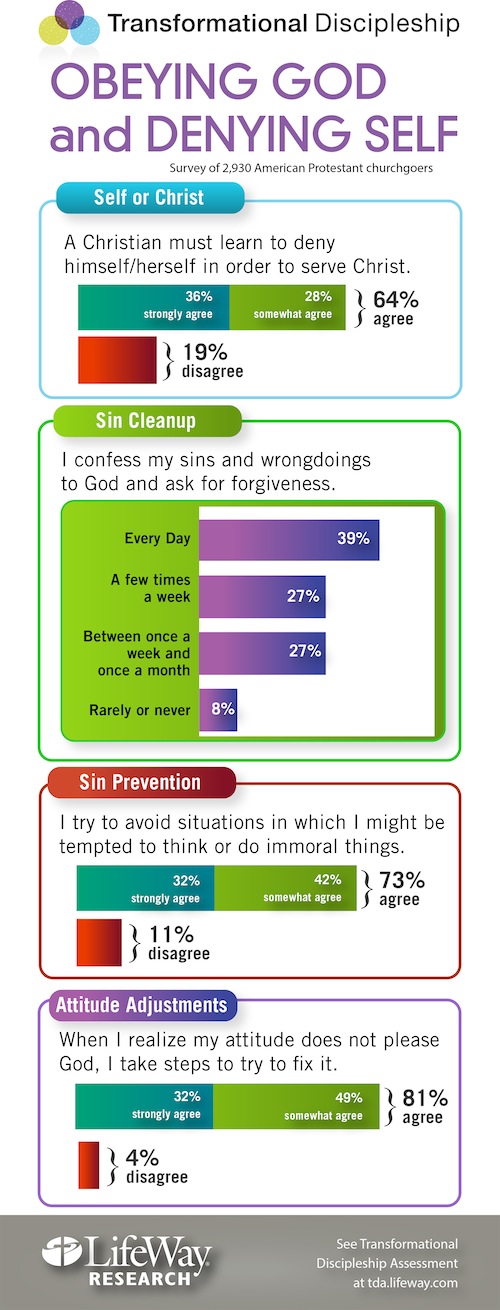
The latest data released focuses on the need to make personal, sacrificial decisions in order to better obey Christ, or as we have titled it “Obeying God and Denying Self”. The study found that less than one-third of churchgoers strongly agree they are following through in specific aspects of obedience.

From the release:

The survey reveals 64 percent of churchgoers agree with the statement: “A Christian must learn to deny himself/herself in order to serve Christ.” Nineteen percent disagree with the statement.

The survey measures confession of sins and asking God for forgiveness as one component of ‘Obeying God and Denying Self.’ When asked how often, if at all, they personally “confess…sins and wrongdoings to God and ask for forgiveness,” 39 percent indicate every day and 27 percent say at least a few times a week. Eight percent of respondents say they rarely or never confess sins and wrongdoings to God and ask forgiveness.

Sin was not only addressed after the fact – the survey also asked individual churchgoers how proactive they are in avoiding sin with the statement: “I try to avoid situations in which I might be tempted to think or do immoral things.” Three-fourths agree with the statement, but only 32 percent strongly agree. Ten percent disagree, and 16 percent responded indifferently.

The survey also examines an individual’s inclination to adjust their attitude through the statement: “When I realize my attitude does not please God, I take steps to try to fix it.” More than 80 percent agree with the statement, but only 32 percent strongly agree. Fifteen percent neither agree nor disagree, and four percent disagree.

Actions that can positively impact the scores of individuals on the Obeying God and Denying Self attribute were identified as:

  • Attending a worship service;
  • Making a decision to obey or follow God with an awareness that choosing His way may in some way be costly;
  • Being discipled or mentored one-on-one by a more spiritually mature Christian;
  • Reading the Bible or a book about what is in the Bible;
  • Praying for the spiritual status of unbelieving acquaintances;
  • Setting aside time for prayer of any kind.

Obeying God and Denying Self is also the only one of the eight attributes of discipleship that was predicted by more frequent worship attendance.

These findings on obeying God and denying self are part of the largest discipleship study of its kind. Results from each of the eight attributes of spiritual maturity will continue to be released over the coming months.

To help pastors, churches and individuals measure spiritual development, LifeWay Research used the study’s data to develop a questionnaire for believers, called the Transformational Discipleship Assessment (TDA). This online evaluation delivers both individual and group reports on spiritual maturity using the eight factors of biblical discipleship. The TDA also provides helpful and practical suggestions on appropriate next steps for spiritual development.

Download PDF

Tags: , , ,

| What is MyVisionRoom? > | Back to Process >

ABOUT THE AUTHOR

Ed Stetzer

Ed Stetzer

Ed Stetzer, Ph.D., holds the Billy Graham Chair of Church, Mission, and Evangelism at Wheaton College and serves as Executive Director of the Billy Graham Center for Evangelism. He has planted, revitalized, and pastored churches, trained pastors and church planters on six continents, holds two masters degrees and two doctorates, and has written dozens of articles and books. Previously, he served as Executive Director of LifeWay Research. Stetzer is a contributing editor for Christianity Today, a columnist for Outreach Magazine, and is frequently cited or interviewed in news outlets such as USAToday and CNN. He serves as interim pastor of Moody Church in Chicago.

See more articles by >

COMMENTS

What say you? Leave a comment!

Recent Comments
comment_post_ID); ?> Thank you for this information. I'm going to use this article to improve my work with the Lord.
 
— Abel Singbeh
 
comment_post_ID); ?> Thank you Ed for sharing your insights into the Church Growth Movement. I have my reservations with Church Growth models because it has done more damage than good in the Body of Christ. Over the years, western churches are more focused on results, formulas and processes with little or no emphasis on membership and church discipline. Pastors and vocational leaders are burnt out because they're overworked. I do believe that the Church Growth model is a catalyst to two destructive groups: The New Apostolic Reformation and the Emerging Church. Both groups overlap and have a very loose definition. They're both focus on contemporary worship, expansion of church brand (franchising), and mobilizing volunteering members as 'leaders' to grow their ministry. Little focus on biblical study, apologetics and genuine missional work with no agenda besides preaching of the gospel.
 
— Dave
 
comment_post_ID); ?> Thank you for sharing such a good article. It is a great lesson I learned from this article. I am one of the leaders in Emmanuel united church of Ethiopia (A denomination with more-than 780 local churches through out the country). I am preparing a presentation on succession planning for local church leaders. It will help me for preparation If you send me more resources and recommend me books to read on the topic. I hope we may collaborate in advancing leadership capacity of our church. God Bless You and Your Ministry.
 
— Argaw Alemu
 

Clarity Process

Three effective ways to start moving toward clarity right now.

Renegades Write the Rules

Amy Jo Martin (@AmyJoMartin) has written a book about connecting. About being human. Renegades Write the Rules is about how to connect with other people using the medium of social media. But you’ll find you can apply the principles in many other ways too.

She stresses the importance of just being you. Especially when it comes to exposing yourself using social media, that can be an uncomfortable place. “We all have the tendency toward the creation of a veneered version of our brands that we think is more acceptable, more compelling, more marketable to our audience. … Ultimately it makes you less human.”

You begin by using social media to listen; to find out what matters to your audience. And then consistently deliver it.

Importantly she notes, “Being excellent still earns an audience these days, but to keep them and attract more requires giving them something more personal….Without the ability to nurture loyalty through human connection, your brand’s value relies solely on performance.” Let that sink in. People don’t buy your what, they buy your why. 

Martin takes you through 8 essential renegade rules using good examples from her own experience and the organizations and people she has worked with like Dwayne Johnson (@TheRock), Shaq (@shaq), and Tony Hsieh (@TonyHsieh). Her philosophy is that “Renegades experiment and fail early so when everyone else jumps on the bandwagon, their best practices are being polished while others’ are just starting to fail. Sometimes it’s not about being the best or smartest; it’s about being the first to try and the first to learn from failure.”

I found all of the chapters helpful, but one of my favorite sections came in the appendix. Martin shares fifteen lessons she wishes she had known from the beginning. Here are eight of them:

  1. Where passion, skill, and purpose collide, bliss resides.
  2. Beware of the shiny object syndrome (SOS). It’s important to know the difference between an opportunity and a distraction.
  3. You can color outside the lines without crossing the line. Disruption and destruction have two different outcomes.
  4. Learn how to push your own buttons. It’s important to motivate and inspire yourself. Everyone else is busy.
  5. A five-degree shift changes your entire trajectory.
  6. Your hustle factor is often your differentiating factor. Work hard.
  7. Learn to control your thoughts and you will be free.
  8. Don’t forget the importance of your personal brand. Your personality, confidence, and the way you conduct yourself define your brand. You can always improve it.
Download PDF

Tags: , , , ,

| What is MyVisionRoom? > | Back to Communication >

ABOUT THE AUTHOR

Michael McKinney

See more articles by >

COMMENTS

What say you? Leave a comment!

Recent Comments
comment_post_ID); ?> Thank you for this information. I'm going to use this article to improve my work with the Lord.
 
— Abel Singbeh
 
comment_post_ID); ?> Thank you Ed for sharing your insights into the Church Growth Movement. I have my reservations with Church Growth models because it has done more damage than good in the Body of Christ. Over the years, western churches are more focused on results, formulas and processes with little or no emphasis on membership and church discipline. Pastors and vocational leaders are burnt out because they're overworked. I do believe that the Church Growth model is a catalyst to two destructive groups: The New Apostolic Reformation and the Emerging Church. Both groups overlap and have a very loose definition. They're both focus on contemporary worship, expansion of church brand (franchising), and mobilizing volunteering members as 'leaders' to grow their ministry. Little focus on biblical study, apologetics and genuine missional work with no agenda besides preaching of the gospel.
 
— Dave
 
comment_post_ID); ?> Thank you for sharing such a good article. It is a great lesson I learned from this article. I am one of the leaders in Emmanuel united church of Ethiopia (A denomination with more-than 780 local churches through out the country). I am preparing a presentation on succession planning for local church leaders. It will help me for preparation If you send me more resources and recommend me books to read on the topic. I hope we may collaborate in advancing leadership capacity of our church. God Bless You and Your Ministry.
 
— Argaw Alemu
 

Clarity Process

Three effective ways to start moving toward clarity right now.

A Vision Backer’s Audition

The other week I saw an interesting facet about the production of plays that I think applies beautifully to the all-important practice of casting vision.

Sometimes a new play or film needs outside investment to get off the ground. When this is the case, the creators and organizers of it make a small presentation of the play called a backers’ audition for a group of people who could fund it.

If they win support, the production goes forward. If not, it stalls or falls apart.

When it comes to casting the vision God has put in our hearts, every time we’re presenting it to people it’s like a backers’ audition. Every person you cast your vision to isn’t just a person you’re informing about what you’re doing. They’re people who could potentially back it. Be a part of it. Invest their lives into it. And therefore make it happen. Or make it stall or fall apart if they don’t get behind it.

And we’re not just talking about their money. But also their time. Their energy. Even their lives.

Are we approaching these opportunities with our best shot or are we just throwing it together and hoping it sticks?

In the early days of your vision, you can’t just hope that it sticks. Otherwise, it’s never going to get off the ground. The key differentiating factor between visions that become a reality and those that remain good ideas are backers.

Everyone has passion for their own vision. But it’s those who can instill it into other people who see it come to pass.
Everyone is willing to throw money at their own vision. But it’s those who can get others to do the same who eat past the first month.

What God has called you to do is too important to give a mediocre presentation of it. When you’re presenting and casting your vision, always put your best foot forward. You never know, these could be the people you spend the rest of your life with chasing the dream God has placed inside of you. Don’t let them walk away easily because of poor presentation.

Before you give your next backers’ audition, ask yourself these questions:

  • Is the presentation of your vision compelling?
  • Is it sticky?
  • Is the vision clear? Could they sum it up and give it back to you after you’re done?
  • Is your presentation of it so short that people can’t get the full picture of what you want to do? Or so long that they lose interest long before you’re done?
  • After hearing it, is it something people would want to sacrifice for just to be a part of it?
Download PDF

Tags: , ,

| What is MyVisionRoom? > | Back to Vision >

ABOUT THE AUTHOR

Steven Furtick

Steven Furtick

Pastor Steven Furtick is the lead pastor of Elevation Church. He and his wife, Holly, founded Elevation in 2006 with seven other families. Pastor Steven holds a Master of Divinity degree from The Southern Baptist Theological Seminary. He is also the New York Times Best Selling author of Crash the Chatterbox, Greater, and Sun Stand Still. Pastor Steven and Holly live in the Charlotte area with their two sons, Elijah and Graham, and daughter, Abbey.

See more articles by >

COMMENTS

What say you? Leave a comment!

Recent Comments
comment_post_ID); ?> Thank you for this information. I'm going to use this article to improve my work with the Lord.
 
— Abel Singbeh
 
comment_post_ID); ?> Thank you Ed for sharing your insights into the Church Growth Movement. I have my reservations with Church Growth models because it has done more damage than good in the Body of Christ. Over the years, western churches are more focused on results, formulas and processes with little or no emphasis on membership and church discipline. Pastors and vocational leaders are burnt out because they're overworked. I do believe that the Church Growth model is a catalyst to two destructive groups: The New Apostolic Reformation and the Emerging Church. Both groups overlap and have a very loose definition. They're both focus on contemporary worship, expansion of church brand (franchising), and mobilizing volunteering members as 'leaders' to grow their ministry. Little focus on biblical study, apologetics and genuine missional work with no agenda besides preaching of the gospel.
 
— Dave
 
comment_post_ID); ?> Thank you for sharing such a good article. It is a great lesson I learned from this article. I am one of the leaders in Emmanuel united church of Ethiopia (A denomination with more-than 780 local churches through out the country). I am preparing a presentation on succession planning for local church leaders. It will help me for preparation If you send me more resources and recommend me books to read on the topic. I hope we may collaborate in advancing leadership capacity of our church. God Bless You and Your Ministry.
 
— Argaw Alemu
 

Clarity Process

Three effective ways to start moving toward clarity right now.

The Rise of the Nones

Recently, the Pew Forum released, and USAToday’s ever-vigilant Cathy Grossman reported on, another study that I think is helpful for us to understand the context in which we live. In the study, they indicate that the number of Americans with no religious affiliation (identified as the “Nones,” as in “none of the above”) is climbing.

I had the opportunity to look at the data beforehand, and was not particularly shocked by it, though many will likely trumpet this as a huge shift. It’s not. This is simply the natural progression of what is taking place in our context.

A big part of what is happening is that the “Nominals”– and by that I mean nominal mainliners primarily, but nominal evangelicals as well– are shifting and becoming the “Nones.” This makes sense, as the cultural currency (in other words, the value a society places on identifying as a Christian) is decreasing. And thus, we see a movement away from Christian identity as a cultural value.

I’ve written on multiple occasions about how the term Christian is used. Most recently I talked about “census Christians” (census Christians are those who, when filling out a form, pick “Christian” rather than “Hindu” or “Jew”) and “churchgoing Christians” (churchgoing Christians considering themselves Christians because they occasionally attend a church.) I believe that this move is primarily the result of people who are “census” and “churchgoing Christians” shifting to the category of those who don’t have any identification at all– the Nones.

Furthermore, I don’t think this is all bad. As I’ve discussed on The Exchange (see the entire episode here, as well as a short clip here), there is great opportunity in being able to speak with more definition and clarity about what a Christian is, and is not.

So, should we be alarmed? First, one of the characteristics of faiths like mine is that we tend to see opportunity in everything. Furthermore, being a monotheist, all monotheist faiths tend to see what goes around them either as the blessing of God or in some sense the judgment of God. So in other words, when the people of Israel in the Old Testament saw bad news and were in crisis, they did not believe that there was no God. They simply believed that God was disciplining them. So, in that great tradition, I think that God is teaching us something through this difficulty. I think God has a lesson here for our churches.

As such, I think it’s fair to say three things:

  • First, we continue to lose what some have called our home-field advantage. On a growing basis, identifying oneself as a Christian is not a means to societal advancement but can actually be a means to societal rejection.
  • Second, the “squishy middle” is collapsing. Nominalism will go its way. I believe the future of Christianity in North America will look more like the present-day Pacific Northwest, as I have explained here.
  • Third, and finally, it is still a vast overstatement to see this as a collapse of the Christian faith in North America. The reality is that evangelicals have been relatively steady as a percent of the population over the last few years, however there is still great cause for concern here– and for action.

For me, it is both a concern and an opportunity.

I am concerned that people are moving away from any religious memory that so many churches, particularly seeker churches, could appeal to. In other words, you can’t bring the Nones back to church– they simply don’t find it appealing.

I see an opportunity for churches to clearly state what a Christian is, as others are no longer claiming that title as frequently. Furthermore, teaching believers to live on mission in their contexts, rather than just to bring their friends to church, is how we will reach the Nones.

So, as society moves away from Christian identification, let’s meet them on the road and say, “We did not believe in that expression of Christianity anyway. Let me tell you about Jesus and how he changes everything.”

Download PDF

Tags: , ,

| What is MyVisionRoom? > | Back to Vision >

ABOUT THE AUTHOR

Ed Stetzer

Ed Stetzer

Ed Stetzer, Ph.D., holds the Billy Graham Chair of Church, Mission, and Evangelism at Wheaton College and serves as Executive Director of the Billy Graham Center for Evangelism. He has planted, revitalized, and pastored churches, trained pastors and church planters on six continents, holds two masters degrees and two doctorates, and has written dozens of articles and books. Previously, he served as Executive Director of LifeWay Research. Stetzer is a contributing editor for Christianity Today, a columnist for Outreach Magazine, and is frequently cited or interviewed in news outlets such as USAToday and CNN. He serves as interim pastor of Moody Church in Chicago.

See more articles by >

COMMENTS

What say you? Leave a comment!

Recent Comments
comment_post_ID); ?> Thank you for this information. I'm going to use this article to improve my work with the Lord.
 
— Abel Singbeh
 
comment_post_ID); ?> Thank you Ed for sharing your insights into the Church Growth Movement. I have my reservations with Church Growth models because it has done more damage than good in the Body of Christ. Over the years, western churches are more focused on results, formulas and processes with little or no emphasis on membership and church discipline. Pastors and vocational leaders are burnt out because they're overworked. I do believe that the Church Growth model is a catalyst to two destructive groups: The New Apostolic Reformation and the Emerging Church. Both groups overlap and have a very loose definition. They're both focus on contemporary worship, expansion of church brand (franchising), and mobilizing volunteering members as 'leaders' to grow their ministry. Little focus on biblical study, apologetics and genuine missional work with no agenda besides preaching of the gospel.
 
— Dave
 
comment_post_ID); ?> Thank you for sharing such a good article. It is a great lesson I learned from this article. I am one of the leaders in Emmanuel united church of Ethiopia (A denomination with more-than 780 local churches through out the country). I am preparing a presentation on succession planning for local church leaders. It will help me for preparation If you send me more resources and recommend me books to read on the topic. I hope we may collaborate in advancing leadership capacity of our church. God Bless You and Your Ministry.
 
— Argaw Alemu
 

Clarity Process

Three effective ways to start moving toward clarity right now.