Compelling Environments

Having designed hundreds of strategies during the last decade, I find that there are three dominant environments that every local church is attempting to create: worship environments, connecting environments, and serving environments. Each one plays a significant role in transmitting and realizing the vision. Most important, amid a missional reorientation we must acknowledge that our environments have tended to be an end and not a means to Christian mission. The missional leader must constantly show that the church gathered is actually a time of preparation for “being the church” outside its walls.

First, you need to remember that before you think you are casting vision, you already are – by how you worship.

The pattern of weekly worship and Sabbath was embedded into the fabric of early church culture. Every church has some environment for worship. The question is, How does your vision integrate into your worship? What aspects of the vision are communicated during the worship experience? How do the elements and order of worship communicate values? How does the vision itself affect the design of the worship space? The vision of raw simplicity in a Quaker meetinghouse is a stark contrast to a large downtown stained-glass sanctuary.

Worship keeps our grandest visions God-centered and Jesus focused.

Second, everything must be integrated relationally.

What would church be without relationships? Every church draws people into some kind of setting where the “one anothers” of Scripture are applied. The groups may be tight-knit, gender accountability groups of three to six, or they may be thirty to forty people in an on-campus adult Bible Fellowship. Your Kingdom Concept and your Vision Frame reflect some basic unit of community through which relationships can form and thrive.

This makes the connecting environment, in most cases, the locus of both spiritual formation and vision discovery. Group members may hear about the vision in other church venues, but the rubber must meet the road in the most time-relationship-intensive environment. If they don’t get the vision in the connecting environment, the vision won’t stick.

Third, your church must learn to serve inside out.

Because God has given spiritual gifts for the edification of the body (Ephesians 4), the church is incomplete and immature unless individual members are serving one another. Every church has environments of service: leading in worship instructing children, or welcoming guests, to name a few. The Vision Frame should guide how the church builds its serving environments.

The missional mind-set pushes the envelope on how we think about service. Do we serve people only after we somehow convince them to come onto our holy environment, or do we push out into the community and demonstrate the love of Jesus in their midst. There has been growing emphasis on two dynamics related to service. One is a shared project with other community participants. Another dynamic is what Michael Frost and Alan Hirsch call “proximity spaces,” which they define as “places or events where Christians and not-yet Christians can interacts meaningfully with one another.”

The bottom line is this: we have to get out of our church boxes if we are going to effectively model the lifestyle of Jesus, who engaged and served people who were deeply embedded in their spaces.

Download PDF

Tags: , , ,

| What is MyVisionRoom? > | Back to Environments >

ABOUT THE AUTHOR

Will Mancini

Will Mancini

Will Mancini wants you and your ministry to experience the benefits of stunning, God-given clarity. As a pastor turned vision coach, Will has worked with an unprecedented variety of churches from growing megachurches and missional communities, to mainline revitalization and church plants. He is the founder of Auxano, creator of VisionRoom.com and the author of God Dreams and Church Unique.

See more articles by >

COMMENTS

What say you? Leave a comment!

Recent Comments
comment_post_ID); ?> Thank you for this information. I'm going to use this article to improve my work with the Lord.
 
— Abel Singbeh
 
comment_post_ID); ?> Thank you Ed for sharing your insights into the Church Growth Movement. I have my reservations with Church Growth models because it has done more damage than good in the Body of Christ. Over the years, western churches are more focused on results, formulas and processes with little or no emphasis on membership and church discipline. Pastors and vocational leaders are burnt out because they're overworked. I do believe that the Church Growth model is a catalyst to two destructive groups: The New Apostolic Reformation and the Emerging Church. Both groups overlap and have a very loose definition. They're both focus on contemporary worship, expansion of church brand (franchising), and mobilizing volunteering members as 'leaders' to grow their ministry. Little focus on biblical study, apologetics and genuine missional work with no agenda besides preaching of the gospel.
 
— Dave
 
comment_post_ID); ?> Thank you for sharing such a good article. It is a great lesson I learned from this article. I am one of the leaders in Emmanuel united church of Ethiopia (A denomination with more-than 780 local churches through out the country). I am preparing a presentation on succession planning for local church leaders. It will help me for preparation If you send me more resources and recommend me books to read on the topic. I hope we may collaborate in advancing leadership capacity of our church. God Bless You and Your Ministry.
 
— Argaw Alemu
 

Clarity Process

Three effective ways to start moving toward clarity right now.

Duplicatable Process

For a leader, the maxim is true: it’s not about what you can do, but what you can duplicate. At some point your vision must transcend your skills and be deposited into the basic reproducible habits of the entire congregation.

There are three processes to start thinking about about: (1) How do people move through your strategy? (2) How do your people do the work of evangelism? (3) How does your church body multiply itself?

First, remember that programs don’t attract people; people attract people.

As the leader you want to lubricate the gears of this process. This means motivating people to do whatever it takes to help others move through your strategy. It’s like building a customer service impulse into every heart and hand that calls your church home. Churches talk all the time about assimilation as an important function. Don’t miss the opportunity to leverage your vision generally, and your strategy specifically, to make assimilation a function of culture through micro steps that everyone can take.

Second, give your people reproducible steps, skills, tools, and processes for them to become evangelists.

Keep in mind that we are not talking about formulaic approaches. What we are talking about is more in line with the eloquent plea of authors Michael Frost and Alan Hirsch in The Shaping of Things to Come: “We yearn for something richer and more complex, more dangerous. The one-size-fits-all to church mission and evangelism must be abandoned. Fewer and fewer churches seem to be developing evangelistic ministries specifically contextualized to the geographic area or subculture in which they are living.” These words are apt, remind us that knowing our local predicament is essential in creatively, yet thoughtfully, engaging our culture.

Third, you must decide how you duplicate.

One of the values of the missional church is healthy orientation toward kingdom growth over the necessary growth of one local church. On the basis of your Kingdom Concept and your Vision Frame, you must decide what size is best, what timing is best, and what kind of multiplication is best.

There are many questions to ask about the duplication process, making it critically important that the process be tied to the vision.

Download PDF

Tags: , , ,

| What is MyVisionRoom? > | Back to Process >

ABOUT THE AUTHOR

Will Mancini

Will Mancini

Will Mancini wants you and your ministry to experience the benefits of stunning, God-given clarity. As a pastor turned vision coach, Will has worked with an unprecedented variety of churches from growing megachurches and missional communities, to mainline revitalization and church plants. He is the founder of Auxano, creator of VisionRoom.com and the author of God Dreams and Church Unique.

See more articles by >

COMMENTS

What say you? Leave a comment!

Recent Comments
comment_post_ID); ?> Thank you for this information. I'm going to use this article to improve my work with the Lord.
 
— Abel Singbeh
 
comment_post_ID); ?> Thank you Ed for sharing your insights into the Church Growth Movement. I have my reservations with Church Growth models because it has done more damage than good in the Body of Christ. Over the years, western churches are more focused on results, formulas and processes with little or no emphasis on membership and church discipline. Pastors and vocational leaders are burnt out because they're overworked. I do believe that the Church Growth model is a catalyst to two destructive groups: The New Apostolic Reformation and the Emerging Church. Both groups overlap and have a very loose definition. They're both focus on contemporary worship, expansion of church brand (franchising), and mobilizing volunteering members as 'leaders' to grow their ministry. Little focus on biblical study, apologetics and genuine missional work with no agenda besides preaching of the gospel.
 
— Dave
 
comment_post_ID); ?> Thank you for sharing such a good article. It is a great lesson I learned from this article. I am one of the leaders in Emmanuel united church of Ethiopia (A denomination with more-than 780 local churches through out the country). I am preparing a presentation on succession planning for local church leaders. It will help me for preparation If you send me more resources and recommend me books to read on the topic. I hope we may collaborate in advancing leadership capacity of our church. God Bless You and Your Ministry.
 
— Argaw Alemu
 

Clarity Process

Three effective ways to start moving toward clarity right now.

Intentional Communication

Every day, your church stewards thousands of moments of truth. Every time a member talks to a neighbor, someone drives by the church facility, a ministry email goes out, or Facebook page is liked, some interaction on behalf of the church has transpired. Every time these events happen, the church’s vision glows brighter or dims in the tiniest little increments. The leader’s role is to crank up the wattage. The visionary cares too much about the message to let it just blow in the wind, unattended. Rather, he grabs his message and affixes it to a kite for all to see.

This can happen only with a tremendous amount of intentionality in the complex discipline of church communications.

There are three places I recommend church leaders to start:

First, remember that you either grab attention or hold nothing.

Today we have more secondary screens than ever: iPads, and smartphones (in addition to our computers and TVs). Each of these digital portals, has multiple channels that each reach for attention. They wave at you, scream at you and entice you. If your church has something to say you have to compete with attention scarcity like never before.

Second, we must communicate vision visually.

Churches today pump out communications all day long and miss the opportunity to constantly reflect and reinforce the vision. Yes, your church needs to brand — it’s not a four-letter word imported from the corporate world. Branding is about taking your Kingdom Concept and Vision Frame, and communicating them with consistent consistency across all communication platforms. The baseline of your visual brand contains three components: Logo, tagline and graphic identity.

Third, church leaders can broadcast their position.

The use of organizational communication and marketing should never replace the essence of a missional heartbeat: a life-oriented, conversation-driven, love-lavished pursuit of those whom Jesus misses most. But Jesus’ famous sermon was not “ in the valley ” but “on the mount. ” Jesus positioned himself to broadcast his message. If we propose to advance the gospel in and through the culture, we can’t afford to see the cultural use of communication as an enemy but as an ally. Use of social media and even traditional marketing tools can be a powerful support to personal evangelism.

These are exciting times to steward the most important message to be heard.

Download PDF

Tags: , , ,

| What is MyVisionRoom? > | Back to Communication >

ABOUT THE AUTHOR

Will Mancini

Will Mancini

Will Mancini wants you and your ministry to experience the benefits of stunning, God-given clarity. As a pastor turned vision coach, Will has worked with an unprecedented variety of churches from growing megachurches and missional communities, to mainline revitalization and church plants. He is the founder of Auxano, creator of VisionRoom.com and the author of God Dreams and Church Unique.

See more articles by >

COMMENTS

What say you? Leave a comment!

Recent Comments
comment_post_ID); ?> Thank you for this information. I'm going to use this article to improve my work with the Lord.
 
— Abel Singbeh
 
comment_post_ID); ?> Thank you Ed for sharing your insights into the Church Growth Movement. I have my reservations with Church Growth models because it has done more damage than good in the Body of Christ. Over the years, western churches are more focused on results, formulas and processes with little or no emphasis on membership and church discipline. Pastors and vocational leaders are burnt out because they're overworked. I do believe that the Church Growth model is a catalyst to two destructive groups: The New Apostolic Reformation and the Emerging Church. Both groups overlap and have a very loose definition. They're both focus on contemporary worship, expansion of church brand (franchising), and mobilizing volunteering members as 'leaders' to grow their ministry. Little focus on biblical study, apologetics and genuine missional work with no agenda besides preaching of the gospel.
 
— Dave
 
comment_post_ID); ?> Thank you for sharing such a good article. It is a great lesson I learned from this article. I am one of the leaders in Emmanuel united church of Ethiopia (A denomination with more-than 780 local churches through out the country). I am preparing a presentation on succession planning for local church leaders. It will help me for preparation If you send me more resources and recommend me books to read on the topic. I hope we may collaborate in advancing leadership capacity of our church. God Bless You and Your Ministry.
 
— Argaw Alemu
 

Clarity Process

Three effective ways to start moving toward clarity right now.

Developing Leadership

Spiritual leaders are the carriers of God ’s DNA in the church, the shapers of a church ’s vision and core values. They are influencers of what the church embodies. The key to radical discipleship is the development of trainer – coaches that carry the DNA to the edges of the movement.

—   Michael Slaughter

The first of the five circles in the Integration Model is leadership. How will you use vision to recruit leaders, develop leaders, structure people, and divide your attention among the right leaders? Take leaders out of the equation and the visionary is a daydreamer.

The implications of these questions are so huge for leadership development, we want the Vision Room content to focus beyond the good leadership books, principles and “Maxwellisms” out there. All too often the topic of leadership development is disconnected from your church’s unique vision.

As a starting point with leadership development, I encourage pastors to consider three basic principles:

First, when it comes to hiring, get people who get the vision.

Are you doing everything you can up front to ensure the chemistry and culture fit with potential staff?

Second, let strategy determine structure.

Once you have the strategy articulated and pictured, you must go back and revise your organizational structure.  If you don’t strategy becomes impotent. Why? Because no leader wakes up with a specific responsibility (and accountability) connected to your church’s strategy component.

Third, lead leaders.

Every church I know has people who do ministry. Some of the better churches I know grow leaders. But the best churches actually lead leaders; that is, they have a leadership pipeline that is continually filling and developing people.  They have a leadership culture.

May God bless your leadership development efforts.


Download PDF

Tags: , , , ,

| What is MyVisionRoom? > | Back to Leadership >

ABOUT THE AUTHOR

Will Mancini

Will Mancini

Will Mancini wants you and your ministry to experience the benefits of stunning, God-given clarity. As a pastor turned vision coach, Will has worked with an unprecedented variety of churches from growing megachurches and missional communities, to mainline revitalization and church plants. He is the founder of Auxano, creator of VisionRoom.com and the author of God Dreams and Church Unique.

See more articles by >

COMMENTS

What say you? Leave a comment!

Recent Comments
comment_post_ID); ?> Thank you for this information. I'm going to use this article to improve my work with the Lord.
 
— Abel Singbeh
 
comment_post_ID); ?> Thank you Ed for sharing your insights into the Church Growth Movement. I have my reservations with Church Growth models because it has done more damage than good in the Body of Christ. Over the years, western churches are more focused on results, formulas and processes with little or no emphasis on membership and church discipline. Pastors and vocational leaders are burnt out because they're overworked. I do believe that the Church Growth model is a catalyst to two destructive groups: The New Apostolic Reformation and the Emerging Church. Both groups overlap and have a very loose definition. They're both focus on contemporary worship, expansion of church brand (franchising), and mobilizing volunteering members as 'leaders' to grow their ministry. Little focus on biblical study, apologetics and genuine missional work with no agenda besides preaching of the gospel.
 
— Dave
 
comment_post_ID); ?> Thank you for sharing such a good article. It is a great lesson I learned from this article. I am one of the leaders in Emmanuel united church of Ethiopia (A denomination with more-than 780 local churches through out the country). I am preparing a presentation on succession planning for local church leaders. It will help me for preparation If you send me more resources and recommend me books to read on the topic. I hope we may collaborate in advancing leadership capacity of our church. God Bless You and Your Ministry.
 
— Argaw Alemu
 

Clarity Process

Three effective ways to start moving toward clarity right now.

Seven Suggestions for Dealing with Differences of Opinion in Your Church

At a recent conference the three of us on the panel (all pastors) were asked the question, “As a layperson, should I start a grassroots movement to change my church?” All three of us basically said, “No.” Following the conference I got a long and heated email from someone who was very upset with my answer. He thought I was guilty of clericalism and gave no place for the laity to know anything, do anything, or ever question the pastor. That was certainly not what I said, nor, so far as I can tell, what most people thought we were communicating. But his concerns got my blogging juices flowing. The initial question about forming a grassroots movement to change a local church is one I’ve gotten in one form or another several times in the past five years. So perhaps it would be helpful to spell out my answer in a little more detail.

The Situation

Here’s the kind of situation I’ve been presented with many times. It’s what I assumed was behind the question at this recent conference.

You are at a church that doesn’t share your theology or seems to be heading in the wrong theological direction. Naturally, you are concerned and want to do something about it. You are sad to see your church change for the worse or sad to see your church less than what it should be. You wonder what you can do to help get things on track.

This situation usually arises for one of two reasons. Either you have recently come to a better theological understanding yourself and now see deficiencies in your pastor and in your church which you didn’t see before, or your church recently brought in a new pastor who is setting things on a different theological trajectory. There are, of course, variations to these two scenarios. Maybe you were brought on staff at a theologically weak church. Maybe your pastor has been drifting in recent years. Maybe your church just allowed something you disagree with (or just disallowed something you agree with). There are several permutations to the problem, but the basic contours stay the same: either you’ve changed or the church has changed, and the result in both cases is that the two aren’t lining up like they used to.

So what should you do?

Seven Suggestions

1. Pray for a humble heart. Make sure you aren’t being censorious. Check for plank-in-eye syndrome. Be sure you are giving your pastor and your church the benefit of the doubt. Ask the Lord for an open heart and an open mind.

2. Take note of your position. How you think about laboring for change in your church, and how you think of whether to work for change at all, has everything to do with your position in the church. Have you been at the church for decades or did you join two months ago? Have you proved yourself as a faithful servant in the body? Are you one of the official leaders of the church? An informal leader? A staff member? One of the others elders or pastors? The more designated authority you have–either by virtue of office, by virtue of maturity, or by virtue of years of service–the more you should do to work for change. The less you have, the less you should try to do.

3. Try to discern the relative importance of your concerns. Are you upset about preferences or about something more serious? Are your concerns about the character of your pastor or his personality? Are your theological concerns weighty or trivial? And if they are weighty, are they up for discussion in your church? If you’ve come to the Reformed faith in the midst of a Wesleyan church you have no business trying to make that congregation in the image of the Westminster Confession. Likewise, people in confessional churches (e.g., Reformed, Presbyterian, Lutheran) should not be surprised when their pastors teach the faith expressly laid down in their historic tradition.

4. Don’t talk up your concerns. Beware of building up an ever expanding circle of discontents. You may have to talk to a few persons for counsel. You may even know many other likeminded persons in the congregation. But your goal must not be to create a church within a church.

5. Consider encouraging your pastor with positive reinforcement. Find what you can commend and commend it. If your pastor is in need of more theological precision and development you may be able to give him good books to read–not usually polemical books championing your agenda, but positive devotional and theological works that give him a taste for sound doctrine. Maybe you can nudge your pastor toward a good conference or even take him to one yourself. If he is young or simply drifting a bit, your pastor may be open to gentle strengthening and redirection.

6. Consider prayerfully the course of direct confrontation. The pastor is not beyond correction. He can make mistakes. He can fall into error. He can get off track. He can grow proud. If after prayerful reflection you conclude that your concerns are serious and the trajectory worsening, set up a time to talk to your pastor or elders directly. I’ve never begrudged anyone coming to me with thoughtful concerns in a kind, humble way. Sometimes I agree with them. Sometimes I disagree. But I’m glad when they come to me or one of the elders directly.

7. Consider when it is time to leave. If your new theological convictions are out of step with the entire history and identity of the church, it’s best not to strategize for underground change. If a new pastor has come in and is moving things in a very different direction–with the full knowledge and blessing of the elders and with enthusiasm from most of the congregation–it’s best not to start a grassroots movement for reformation. If you’ve tried direct communication and the pastor or leaders tell you, in effect, “Thank you, but we see things a different way,” it’s best not to fight them tooth and nail. If David did not lay a hand on Saul as the Lord’s anointed, we should be very cautious about launching a guerrilla movement to take down our duly-appointed pastors and elders.

In rare occasions where the theological differences amount to heresy (or are clearly out of bounds with your confessional documents), or when your personal concerns relate to scandalous behavior, you may pursue church discipline and file charges, but only if you are following the steps of Matthew 18. In most cases where members are concerned with the direction of the church, the issues are important but not so egregious as to merit a formal process of discipline. In these instances, after working through steps 1-6 (and doing so with patience, not in a fit of passion), the concerned church member can either peaceably submit or quietly leave.

Summing Up

Please hear what I am saying and not saying. I’m not saying you shouldn’t talk to your pastor or work for change. I’m not saying the local congregation is the personal fiefdom for the pastor. I’m not saying pastors can’t learn much from laypeople in the congregation. What I am saying is that practically you should not spend your life trying to do what has very little chance of success, theologically you should obey and respect your leaders, and spiritually you should not be divisive.

And lest this sound like I’m trying to protect my turf as a pastor, let me make clear that I am not addressing this question because it is a live issue in my congregation. I’m thinking of good folks in other churches who largely share my theology and have the very good desire to influence their local church for good. That’s what I took to be the context for the question at the conference. I want to commend these brothers and sisters for their discernment and encourage them in prizing theological depth and integrity. But we should also remember that seeking the things that make for “unity, purity, and peace” (as our membership vows put it), sometimes entails being peaceable enough to find unity with another body that has the purity you are looking for.

Read more from Kevin here.

Download PDF

Tags: , ,

| What is MyVisionRoom? > | Back to Leadership >

ABOUT THE AUTHOR

Kevin DeYoung

I am the Senior Pastor at University Reformed Church(RCA) in East Lansing, Michigan, near Michigan State University. I’ve been the pastor there since 2004. I was born in Chicagoland, but grew up mostly in the Grand Rapids, Michigan area. I root for da Bears, da Bulls, da Blackhawks, the White Sox, and the Spartans. I have been married to Trisha since January 2002. We live in East Lansing and have five young children.

See more articles by >

COMMENTS

What say you? Leave a comment!

Recent Comments
comment_post_ID); ?> Thank you for this information. I'm going to use this article to improve my work with the Lord.
 
— Abel Singbeh
 
comment_post_ID); ?> Thank you Ed for sharing your insights into the Church Growth Movement. I have my reservations with Church Growth models because it has done more damage than good in the Body of Christ. Over the years, western churches are more focused on results, formulas and processes with little or no emphasis on membership and church discipline. Pastors and vocational leaders are burnt out because they're overworked. I do believe that the Church Growth model is a catalyst to two destructive groups: The New Apostolic Reformation and the Emerging Church. Both groups overlap and have a very loose definition. They're both focus on contemporary worship, expansion of church brand (franchising), and mobilizing volunteering members as 'leaders' to grow their ministry. Little focus on biblical study, apologetics and genuine missional work with no agenda besides preaching of the gospel.
 
— Dave
 
comment_post_ID); ?> Thank you for sharing such a good article. It is a great lesson I learned from this article. I am one of the leaders in Emmanuel united church of Ethiopia (A denomination with more-than 780 local churches through out the country). I am preparing a presentation on succession planning for local church leaders. It will help me for preparation If you send me more resources and recommend me books to read on the topic. I hope we may collaborate in advancing leadership capacity of our church. God Bless You and Your Ministry.
 
— Argaw Alemu
 

Clarity Process

Three effective ways to start moving toward clarity right now.

10 Steps in Preparing a Powerful Presentation

The talks I give usually take me a comfortable 45 minutes but in a recent TED talk I needed to get the insights out in 18 minutes. The culling process forces you to convey only the most important information for spreading your idea. The amount of rehearsal time is inversely proportionate to the length of the talk. The shorter the talk, the longer the rehearsal time. In this case, for an 18-minute talk, we took approximately 18 hours to rehearse. An hour a minute? That’s probably fair for someone who’s a professional presenter like me. A less seasoned speaker may need more!

These 18-minute talks are hard to do. It’s easier to blather on for an hour than talk for a tight 18 minutes knowing that if you go over, you (literally) will get the hook.

I delivered one talk at TEDxEast and was thrilled to look up at the clock just as it was ticking down with :06 seconds left on the clock. Victory! Then, I delivered a similar talk at the INK conference in India but was restricted to 15 minutes. Even though I practiced like mad and timed it to a perfect 14 and a half minutes, I was medicated for a severe chest cold and my time somehow spread and I got the dreaded “hook” because I ran one minute over, but would have run two minutes over if I hadn’t had tip #10 in place.

Here are the ten steps I went through in rehearsing for my talks.

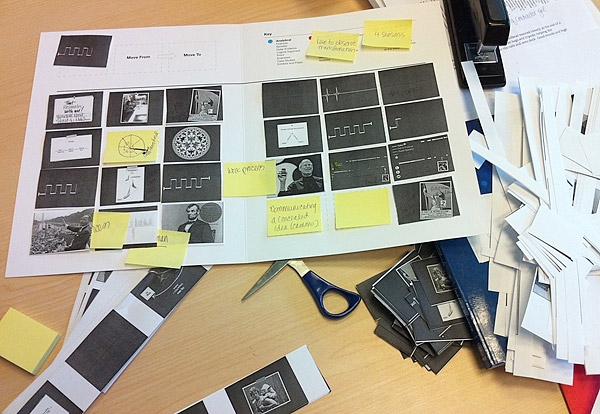
1. Print your current slide deck as 9-up handouts. The 9-up format is conveniently the same size as the smallest sticky note. I arranged and re-arranged my message and added sticky notes until I was happy with the flow. I also made sure I cut at least half the slides I use for my 40 minute talk.


I trimmed and trimmed and trimmed until I felt like it was close to 18 minutes. During this process it became clear to me that my big idea could be communicated much more effectively than it had been.

2. Solicit feedback. Assemble a handful of people you trust to give honest feedback on your mini little sticky note slide deck. Verbally run the ideas by these folks (doesn’t have to be a formal presentation.) The purpose for having them look at all the slides at once is you want feedback on the “whole”, not the parts. Have them give you feedback on the content you’ve chosen and whether they think it will resonate with the TED audience. I did this four times–twice each with my ExComm Manager and twice with my company President. After they added their insights, I was ready to have the slides digitally produced.

3. Rehearse with a great (honest) communicator. In my case, I rehearsed with my ExComm Manager. She is very good at rehearsing me and became a trusted coach. She would say “When you say it that way, it can be interpreted differently than you intended”, “When you use that term, you come across derogatory”, “I thought that when you said it last time it was better, you said…”. She worked hard tracking phrases and rounds of what was said. Honesty is the best policy. Make sure your coach is not afraid to speak up. 18 minutes goes by fast–you love your material and you want to include all of it–-but for a TED-format talk you need someone you trust to help you murder your darlings.

4. Close the loop. A lot of times, as the presenter, you know your material so well that you think you’re making each key point clear. You might not be. Your coach should make sure you are telling people why. It’s the “why” around our ideas that make them spread, not the “how”. Articulate the why so your audience understands what’s magnificent about your big idea.

5. Practice with clock counting up. The first few times, rehearse with the clock counting up. That’s because if you go over, you need to know how much you’re over. Do NOT be looking at the clock at this time. Have your coach look at it because you don’t want to remember any of the timestamps in your mind. Finish your entire talk and then have your coach tell you how much you need to trim. One minute, three minutes. Keep practicing until you’re consistently within 18 minutes. Your coach should be able to tell you to trim 30 seconds here or add 15 seconds there so that your content is weighted toward the most important information.

6. Practice with clock counting down. Once you’re within the timeframe, begin practicing with the clock counting down. You need to set a few places in your talk where you benchmark a time stamp. Calculate where you need to be in the content in six-minute increments. You should know roughly where you should be at 6, 12 and 18 minutes. You should know the slide you should be on and what you’re saying so that you will know immediately from the stage if you’re on time or running over.

7. Noteworthy. Your coach is there to jot down what you say well and what you don’t. They should work from a printout of the slides and write phrases you say well so they can be added to your script. They should help capture phrases so you can type them into your notes.

8. Don’t be camera shy. Videotape some of your final practices. It doesn’t have to be the best setup ever–we used our Flip camera on a tripod in the hotel–you just need to feel like something’s at stake. It helps you get used to looking at the camera, and you can review the video to look at your stage presence, eye contact, gestures plus identify any expressions that need modification. Also, if you do an especially good practice run, you can go back and listen to the audio and add the best snippets to your slide notes.

9. Do one more FULL timed rehearsal right before you walk on stage. This is where I blew it in India. I practiced fully several times that morning but didn’t feel it necessary to pull out a timer. I confess, I didn’t time it for a week, but rehearsed like mad. It would have been even better if I’d rehearsed via Skype with my coach. I would have averted a disaster.

10. Have two natural ending points. I wanted to accuse the India show operators of not really giving me a full 15 minutes on the clock. But I was the one who blew it. It might have been the meds I was on for my chest cold, but my timer was *blinking* before I was done. Fortunately, I’d embedded two natural places to end my talk. I had an ending that made the talk complete and I stopped there. What I didn’t have time to get to was the inspirational ending that would have had them on their feet and screaming (well, they did end up on their feet, they just weren’t screaming.)

Follow these steps and you will be able to transform your presentation into an engaging journey.

Read more from Nancy here.

Learn powerful presentation skills from her resources here.

Download a concise summary of Nancy’s book “Resonate” here.

Download PDF

Tags: , , , , ,

| What is MyVisionRoom? > | Back to Communication >

ABOUT THE AUTHOR

Nancy Duarte

Nancy Duarte

Nancy Duarte is a communication expert who has been featured in Fortune, Forbes, Fast Company, Wired, Wall Street Journal, New York Times, The Economist, LA Times and on CNN. Her firm, Duarte, Inc., is the global leader behind some of the most influential visual messages in business and culture and has created more than a quarter of a million presentations. As a persuasion specialist, she cracked the code for effectively incorporating story patterns into business communications. Resonate, her second book, spent nearly a year on Amazon’s top 100 business book bestsellers list. Nancy has 20 years of experience working with global companies and thought leaders, and she has influenced how the world perceives some of the most important brands and entities, including Apple, Cisco, Facebook, GE, Google, HP, TED, Twitter, and the World Bank. She is the author of two award-winning books. Resonate: Present Visual Stories that Transform Audiences identifies the hidden story structures inherent in great communication, and it spent more than 300 days on Amazon’s top 100 business book bestsellers list. Slide:ology: The Art and Science of Creating Great Presentations teaches readers to think visually and has been translated into eight languages. Her third book, released in the fall of 2012, is titled HBR Guide to Persuasive Presentations, which gives readers the tools and confidence they need to master public speaking.

See more articles by >

COMMENTS

What say you? Leave a comment!

Craig Hadden (@RemotePoss) — 07/13/14 8:18 am

I really like the tip about having 2 natural end points. I research extensively for my own presentation blog, and I've never heard that exact tip before.

Recent Comments
comment_post_ID); ?> Thank you for this information. I'm going to use this article to improve my work with the Lord.
 
— Abel Singbeh
 
comment_post_ID); ?> Thank you Ed for sharing your insights into the Church Growth Movement. I have my reservations with Church Growth models because it has done more damage than good in the Body of Christ. Over the years, western churches are more focused on results, formulas and processes with little or no emphasis on membership and church discipline. Pastors and vocational leaders are burnt out because they're overworked. I do believe that the Church Growth model is a catalyst to two destructive groups: The New Apostolic Reformation and the Emerging Church. Both groups overlap and have a very loose definition. They're both focus on contemporary worship, expansion of church brand (franchising), and mobilizing volunteering members as 'leaders' to grow their ministry. Little focus on biblical study, apologetics and genuine missional work with no agenda besides preaching of the gospel.
 
— Dave
 
comment_post_ID); ?> Thank you for sharing such a good article. It is a great lesson I learned from this article. I am one of the leaders in Emmanuel united church of Ethiopia (A denomination with more-than 780 local churches through out the country). I am preparing a presentation on succession planning for local church leaders. It will help me for preparation If you send me more resources and recommend me books to read on the topic. I hope we may collaborate in advancing leadership capacity of our church. God Bless You and Your Ministry.
 
— Argaw Alemu
 

Clarity Process

Three effective ways to start moving toward clarity right now.

Ministry Innovation Requires a Bias Toward Action

Dwight Towers wrote a post last week reminding us that a lot of people have their ideas rejected not because everyone else is stupid, but because their ideas aren’t actually very good.  He was basically taking on the commonly used Galileo’s Gambit, which goes like this:

They made fun of Galileo, and he was right.
They make fun of me, therefore I am right.

This is obviously a logical fallacy.  Carl Sagan’s response to this idea was:

But the fact that some geniuses were laughed at does not imply that all who are laughed at are geniuses. They laughed at Columbus, they laughed at Fulton, they laughed at the Wright brothers. But they also laughed at Bozo the Clown.

It’s easiest to hold this view when your idea is just an idea – the best way to work around it is to try your idea out.  This is because the value of an idea is often only found once we try to use it.  There is often a huge lag between when we first see a new idea and when we really find out what it is good for – this is when we are working through business model innovation.  In his great book Pasteur’s Quadrant, Donald Stokes says this:

…the notable examples from the annals of technology, detailed by Rosenberg and others, in which it took many years for a new technology to find its most important commercial uses.  The steam engine was initially seen as a device for pumping water from mines and only later as a power plant for movable ships or carriages.  The railroad was initially seen as a feeder of good for canal transport and only later as a fully articulated system of transportation in its own right. The radio was initially seen as a “wireless” substitute for the electric telegraph for communicating between two ponits that could not be connected by wire, such as ship to shore, and only later as a means of “broadcasting” communication to a mass audience.  Indeed, this is is an almost universal phenomenon in the evolution of technology.  New technological paradigms seldom spring full-blown from the minds of their inventors, and when they do, as in the case of Arthur Clarke’s vision of communications satellites, the visionary is unlikely to be the person who makes the technological dream come true.

Stokes is arguing in the book for a reconceptualisation of research.  For quite a while now we have tended to view research as either basic – concerned with discovering new knowledge, but not with use – from applied – concerned only with use.  Stokes instead argues that a great deal of important research comes from work that considers both knowledge discovery and use.

There are a couple of important points here.

First, it’s not enough to have a great idea – you have to actually try it out to find out if it’s any good.  That is how you avoid the Galileo Gambit.

Second, even if the idea works, we often don’t know what it’s actually good for.  To discover this, we have to put it into use.

Consequently, the best innovation comes when we are concerned with both discovery and use.

Put it all together, and it means that innovation requires a bias towards action.

Read more from Tim here.

Download PDF

Tags: , ,

| What is MyVisionRoom? > | Back to Leadership >

ABOUT THE AUTHOR

Tim Kastelle

Tim Kastelle

Tim Kastelle is a Lecturer in Innovation Management in the University of Queensland Business School. He blogs about innovation at the Innovation Leadership Network.

See more articles by >

COMMENTS

What say you? Leave a comment!

Recent Comments
comment_post_ID); ?> Thank you for this information. I'm going to use this article to improve my work with the Lord.
 
— Abel Singbeh
 
comment_post_ID); ?> Thank you Ed for sharing your insights into the Church Growth Movement. I have my reservations with Church Growth models because it has done more damage than good in the Body of Christ. Over the years, western churches are more focused on results, formulas and processes with little or no emphasis on membership and church discipline. Pastors and vocational leaders are burnt out because they're overworked. I do believe that the Church Growth model is a catalyst to two destructive groups: The New Apostolic Reformation and the Emerging Church. Both groups overlap and have a very loose definition. They're both focus on contemporary worship, expansion of church brand (franchising), and mobilizing volunteering members as 'leaders' to grow their ministry. Little focus on biblical study, apologetics and genuine missional work with no agenda besides preaching of the gospel.
 
— Dave
 
comment_post_ID); ?> Thank you for sharing such a good article. It is a great lesson I learned from this article. I am one of the leaders in Emmanuel united church of Ethiopia (A denomination with more-than 780 local churches through out the country). I am preparing a presentation on succession planning for local church leaders. It will help me for preparation If you send me more resources and recommend me books to read on the topic. I hope we may collaborate in advancing leadership capacity of our church. God Bless You and Your Ministry.
 
— Argaw Alemu
 

Clarity Process

Three effective ways to start moving toward clarity right now.

Why New Pastors Meet Resistance to Change, Part 2

In a previous post, I discussed why people in the church resist change. If you lead well, then resistance to change will eventually shift to an acceptance of the necessity of change. Even when people accept the idea of change, however, the actual implementation of the change effort can be painful. For example, most Americans agree something needs to change at the IRS. I doubt we’ll see any lawmaker defend the current state of the agency on cable news stations. Does this general acceptance mean enduring change will now happen quickly? I have my doubts.

New pastors often encounter a strong contingent within their congregations who accept the need for change, even the enduring cultural change I mentioned in the previous post. The size of this group depends upon the church, but they are inevitably there. As your tenure lengthens, this group should grow as more people begin to trust your discernment. Conversely, if this group is shrinking, then stop reading and start building better relationships. Leading change while your reputation diminishes is a suicide mission. Assuming you have done the legwork to get most people accepting the need for change, why might this change effort still meet resistance?

Most organizations are too complex for one person to lead a change effort. The median church size is approximately 75 people. Any organization of 75—church or not—is a complex system of relationships, opinions, maturity (or immaturity), and attitudes. Is it feasible that one person can lead a change effort at the IRS? No way. And it’s just as feasible that you alone are going to be the cause and effect at your church. Lone rangers are just that—they work alone. And you don’t wear a mask. Your church knows where you live. Enduring cultural change only happens if it is led (not just accepted) by a coalition of those with positional power, expertise, experience, and credibility. In short, if key members are not on board, then it’s unlikely your change effort lasts in the culture of the church.

Change efforts come with a cost. While we often refer to the cliché synergy of change efforts, the reality is many changes are zero-sum: You must sacrifice one area to gain in another area. For example, if you change a church to be more flexible, then it often leads to a decrease in efficiency. Flexibility adds options, and more options mean more decisions, which reduces efficiency. For instance, if you allow for multiple types of small groups in your church (i.e. open and closed), then you are more flexible. However, managing multiple types of small groups takes more time and is less efficient. Enduring cultural change occurs when a coalition of leaders agree on what is to be sacrificed in order to enact the change.

The pace of change is just as important as the change itself. Do you create a crisis to ramrod sudden change? If so, then you must be willing to intimidate and act forcibly. Do you allow for gradualism? Some changes can happen over time, but these changes may also slowly evolve in a way unintended. Let me give you a few examples to help answer these questions.

  • Move quickly through change with doctrine and discipline issues. These issues have little middle ground. A person either believes in a specific doctrine or not. A person is either repentant or he is not. For example, you should not slowly remove a group leader if she outright denies a primary tenet of the church. Such change must happen quickly.
  • Move through change in stages with structural, staff, and non-biblical issues. It’s unwise (if not sheer stupidity) to restructure the staff in your first month before you even have a grasp everyone’s job descriptions and callings. Learn the current system—and more importantly the people within the system—before radicalizing it.
  • Move slowly through change if it’s your first church. You may be right about many things that need to change, but you are likely wrong about how to change them. If you don’t think you need leadership experience to change a church, then you need more experience. Don’t learn the hard way.

Lastly, change is not the most important role for church leaders. Don’t attempt change if you haven’t learned to love the people of the church and the community. If you haven’t had supper with a dozen members, you’re not ready to lead change. If you don’t know the name of the deacon chairman’s spouse, you’re not ready to lead change. If you can’t succinctly describe your group structure, you’re not ready to lead change. Pastors, you cannot lead a church forward unless you love your church where it is now, not where you hope it will be in the future. Change is important. But true change does not happen without love.

Read Part 1 here.

Read more from Sam here.

Download PDF

Tags: , , ,

| What is MyVisionRoom? > | Back to Leadership >

ABOUT THE AUTHOR

Sam Rainer III

Sam serves as lead pastor of West Bradenton Baptist Church. He is also the president of Rainer Research, and he is the co-founder/co-owner of Rainer Publishing. His desire is to provide answers for better church health. Sam is author of the book, Obstacles in the Established Church, and the co-author of the book, Essential Church. He is an editorial advisor/contributor at Church Executive magazine. He has also served as a consulting editor at Outreach magazine. He has written over 150 articles on church health for numerous publications, and he is a frequent conference speaker. Before submitting to the call of ministry, Sam worked in a procurement consulting role for Fortune 1000 companies. Sam holds a B.S. in Finance and Marketing from the University of South Carolina, an M.A. in Missiology from Southern Seminary, and a Ph.D. in Leadership Studies at Dallas Baptist University.

See more articles by >

COMMENTS

What say you? Leave a comment!

Recent Comments
comment_post_ID); ?> Thank you for this information. I'm going to use this article to improve my work with the Lord.
 
— Abel Singbeh
 
comment_post_ID); ?> Thank you Ed for sharing your insights into the Church Growth Movement. I have my reservations with Church Growth models because it has done more damage than good in the Body of Christ. Over the years, western churches are more focused on results, formulas and processes with little or no emphasis on membership and church discipline. Pastors and vocational leaders are burnt out because they're overworked. I do believe that the Church Growth model is a catalyst to two destructive groups: The New Apostolic Reformation and the Emerging Church. Both groups overlap and have a very loose definition. They're both focus on contemporary worship, expansion of church brand (franchising), and mobilizing volunteering members as 'leaders' to grow their ministry. Little focus on biblical study, apologetics and genuine missional work with no agenda besides preaching of the gospel.
 
— Dave
 
comment_post_ID); ?> Thank you for sharing such a good article. It is a great lesson I learned from this article. I am one of the leaders in Emmanuel united church of Ethiopia (A denomination with more-than 780 local churches through out the country). I am preparing a presentation on succession planning for local church leaders. It will help me for preparation If you send me more resources and recommend me books to read on the topic. I hope we may collaborate in advancing leadership capacity of our church. God Bless You and Your Ministry.
 
— Argaw Alemu
 

Clarity Process

Three effective ways to start moving toward clarity right now.

Using the Physical Attributes of Your Campus to Intentionally Communicate Your Story

“I ask all of our first time guests why they decided to come to our church and 90% of them said they were driving by and were intrigued by our site and our new building, and that is all thanks to the creativity of Visioneering Studios.”

David Garison, Lead Pastor,  Northside Christian Church, Spring, Texas

Northside Christian

If you were driving down a road in your town and saw the above building, would you be intrigued?  Would you want to check it out? As you look at that picture, who do you think this building meant to attract?  Who was the primary target to get sucked in by the design and amenities?

If you said MEN…then you would be correct. But not just any man, a mid “thirty something” man.  And why would a church focus on that age group and gender?  It is actually pretty simple for the leadership at Northside Christian.

They believe that if they can attract men in their mid thirties, they will likely bring their wife and 3 +/- children as well. In most cases, it is easier to engage the entire family if the husband/father is leading the charge and is compelled to attend. For most men, there is too much talk about love (especially loving another man….YUK), surrender, “feeling” and a whole host of other words and songs that are just not appealing.

So what did this church decided to do?  They were intentional about communicating a story and message to the target they wanted to attract.  They made the conscious decision to put “bait on the hook” as they fulfilled their calling to be fishers of men.  The attractional elements of the physical campus was intended to be appealing to those they were trying to reach just like the worm, minnow or lure are on a fishing hook.  If you going fishing for bass, you would not leave the bait at home.  Yes, it is possible to catch a fish on a bare hook…but it less likely and it is much harder and far less rewarding.  So why do we think it is wrong to put “bait” on the hook when we are fishing for souls? Given some recent responses to my other posts on “story”, I am sure some of  you are saying “But the Holy Spirit is the only thing we need…he will draw them in…why should we try to manipulate.” While I am in complete agreement that the Holy Spirit will move in a persons heart to take action, God  also gave us eyes…ears…noses…and other sensory attributes that he uses to influence us.

For this church, they decided to use several types of bait…here are a few examples:

1. The overall design is that of a lodge or “man cave”.  It is very masculine and appealing to a man. It makes me want to go hang out, how about you?

Norhtside 1

2. The materials are “manly”.  From the stone to the exposed wood grains to the exposed metal to the car license plates used to clad a section of the facility (above pic), the materials scream MAN!  Women are generally drawn in by color…but men are attracted to materials.

3. They took the “bait on the hook” concept and developed a fishing hole in front of the building that is open to the public…that they actually stock with fish.  Again, the idea is that a mid-30 year old man with 3 kids would bring the kids to the fishing hole (i.e. a WELL…see this post for more on that concept) even if they have never gone to the “church”…or what we might refer to as the Temple experience.

Northside 2

4. Amenities…besides the fishing hole, this church has been deliberate in the location of their exterior public spaces.  Even if you are not interested in fishing, but looking for a place to site outside by a gentle waterfall to read or you have those 3 young kids and need to get them out from under mom’s feet and blow out some pent up energy, this campus shouts…COME HERE.  The playground is open to the public and the outside sitting areas and tables are inviting to anybody just looking for a place to hang and do life with others. In addition, they were judiciously placed on the front side of the campus so they are visible to people passing by…more bait!

Visioneering has just finished Phase II for this church and the new kids space continues this theme and attractional relationship with their community. You can see why “Your Kids Won’t Want to Leave”, on the blog by Jody Forehand….which is another form of “bait”.

Are you ready to go fishing for your community?   Is your church more interested in “cleaning” fish or catching them?  If it is the later, make sure you have the right bait.

Read more from Tim here.

Download PDF

Tags: , , , , ,

| What is MyVisionRoom? > | Back to Communication >

ABOUT THE AUTHOR

Tim Cool

Tim Cool

Tim Cool is the Founder and Chief Solutions Officer of Cool Solutions Group, a company leading organizations to be intentional with the planning, development and life cycle management of the facilities God has entrusted them. Tim has assisted nearly 400 churches over the past 28 years, throughout the United States, with their facility’s needs. Tim has been married to his best friend, Lisa, for 29 years and resides in Charlotte, NC with their 17-year-old triplets. They are active members at Elevation Church.

See more articles by >

COMMENTS

What say you? Leave a comment!

Ron Furgerson — 06/12/13 12:07 pm

This definitely qualifies as a "Cool" article. Thanks. <

Recent Comments
comment_post_ID); ?> Thank you for this information. I'm going to use this article to improve my work with the Lord.
 
— Abel Singbeh
 
comment_post_ID); ?> Thank you Ed for sharing your insights into the Church Growth Movement. I have my reservations with Church Growth models because it has done more damage than good in the Body of Christ. Over the years, western churches are more focused on results, formulas and processes with little or no emphasis on membership and church discipline. Pastors and vocational leaders are burnt out because they're overworked. I do believe that the Church Growth model is a catalyst to two destructive groups: The New Apostolic Reformation and the Emerging Church. Both groups overlap and have a very loose definition. They're both focus on contemporary worship, expansion of church brand (franchising), and mobilizing volunteering members as 'leaders' to grow their ministry. Little focus on biblical study, apologetics and genuine missional work with no agenda besides preaching of the gospel.
 
— Dave
 
comment_post_ID); ?> Thank you for sharing such a good article. It is a great lesson I learned from this article. I am one of the leaders in Emmanuel united church of Ethiopia (A denomination with more-than 780 local churches through out the country). I am preparing a presentation on succession planning for local church leaders. It will help me for preparation If you send me more resources and recommend me books to read on the topic. I hope we may collaborate in advancing leadership capacity of our church. God Bless You and Your Ministry.
 
— Argaw Alemu
 

Clarity Process

Three effective ways to start moving toward clarity right now.

9 Secrets of Dynamic Weekly Team Emails for Ministry Leaders

Sending out a weekly email to your team is an effective way to make sure that your people are focused on the same thing going into the weekend. A good weekly email is part logistics reminder part talking points and part motivational propaganda. If you don’t currently send out weekly emails to your teams it would be a great practice to start getting into! Here are some critical factors to consider when sending out weekly team emails to people at your church:

  • Predictable Time. // Pick a time during the week and try to stick to sending it then. For me, I think sending these emails out on Thursday mornings fit well into the rhythm of our work flow. Everything is (generally) settled for this coming weekend and it gives people time to digest it before the weekend.
  • Lead With Vision. // Make sure a piece of the email points back to why we are doing this work. Remind people about the reason for the church’s existence. Share a quick “win” from the weekend before. The more you can draw direct lines to what is happening this weekend to the “big picture” the better.
  • Use Pictures. // We live in a post literate world … communicate with pictures.  😉
  • High Information Density. // People are going to be receiving this email every week and so you need to make it worth their while to open it up.  Avoid lots of fluff but rather attempt to pack it full with as much helpful information as possible. Write it and then edit it to find ways to say the same thing but with less words.
  • No Surprises! // Make sure to focus on things that might be different or out of the ordinary for the team so they aren’t caught off guard. Look for “variance” in your weekend experiences and take extra time explaining those details to your team.
  • Skimable & Deep Dive. // Format the email in such a way that people can quickly skim over the topics and then pause to dive deep into those areas that impact them the most. Provide links and attachments for people who want to go even deeper with more information. The team should be able to quickly gather the “big ideas” for the weekend but those people who want more details can access those as well.
  • Track the Usage. // Find a way to track if people are opening your email and clicking on the links provided.  For me I use Boomerang for Gmail to do this … it let’s me “secretly” track how many opens each email gets and what people are clicking on. (Email systems like Constant Contact, Emma or Aweber do this as well.) Keep an eye on the usage patterns of your emails and adjust what you are doing so more people open and use it.
  • Leave Some Gifts. // Occasionally leave some development resources for your team as a “P.S.” to your email. Even if your team doesn’t download them and use them it’s a simple way to show appreciation to your team. The keeners on your team will download those resources and will love checking your emails to see what new goodies you have every week!
  • Mix it Up. // There is a balance making your emails predictable so your people know “how to use” them and also making sure they don’t get stuck in a rut. If every email was so different it would make it harder for your people to find the information they are looking for but it’s also fun to add some different elements every once and a while. Put in a cartoon from something that made you smile about church leadership. Shoot a “selfie video” talking about what’s coming up on that big weekend. Include a free MP3 with a song that inspired you about what your church is talking about.

Here some examples of weekly emails that I’ve sent to my team: [This one was from a month ago.] [Here is the one I sent the week after Easter … always a tough weekend to keep people motivated!]

Read more from Rich here.

Download PDF

Tags: , , , ,

| What is MyVisionRoom? > | Back to Communication >

ABOUT THE AUTHOR

Rich Birch

Rich Birch

Thanks so much for dropping by unseminary … I hope that your able to find some resources that help you lead your church better in the coming days! I’ve been involved in church leadership for over 15 years. Early on I had the privilege of leading in one of the very first multisite churches in North Amerca. I led the charge in helping The Meeting House in Toronto to become the leading multi-site church in Canada with over 4,000 people in 6 locations. (Today they are 13 locations with somewhere over 5,000 people attending.) In addition, I served on the leadership team of Connexus Community Church in Ontario, a North Point Community Church Strategic Partner. I currently serves as Operations Pastor at Liquid Church in the Manhattan facing suburbs of New Jersey. I have a dual vocational background that uniquely positions me for serving churches to multiply impact. While in the marketplace, I founded a dot-com with two partners in the late 90’s that worked to increase value for media firms and internet service providers. I’m married to Christine and we live in Scotch Plains, NJ with their two children and one dog.

See more articles by >

COMMENTS

What say you? Leave a comment!

Recent Comments
comment_post_ID); ?> Thank you for this information. I'm going to use this article to improve my work with the Lord.
 
— Abel Singbeh
 
comment_post_ID); ?> Thank you Ed for sharing your insights into the Church Growth Movement. I have my reservations with Church Growth models because it has done more damage than good in the Body of Christ. Over the years, western churches are more focused on results, formulas and processes with little or no emphasis on membership and church discipline. Pastors and vocational leaders are burnt out because they're overworked. I do believe that the Church Growth model is a catalyst to two destructive groups: The New Apostolic Reformation and the Emerging Church. Both groups overlap and have a very loose definition. They're both focus on contemporary worship, expansion of church brand (franchising), and mobilizing volunteering members as 'leaders' to grow their ministry. Little focus on biblical study, apologetics and genuine missional work with no agenda besides preaching of the gospel.
 
— Dave
 
comment_post_ID); ?> Thank you for sharing such a good article. It is a great lesson I learned from this article. I am one of the leaders in Emmanuel united church of Ethiopia (A denomination with more-than 780 local churches through out the country). I am preparing a presentation on succession planning for local church leaders. It will help me for preparation If you send me more resources and recommend me books to read on the topic. I hope we may collaborate in advancing leadership capacity of our church. God Bless You and Your Ministry.
 
— Argaw Alemu
 

Clarity Process

Three effective ways to start moving toward clarity right now.