3 Tips to Leverage Your Capacity for New Ministry Ideas

Suppose you’re invited to participate in a brainstorming session. The facilitator says that “every idea counts” and invites you to propose as many ideas as you can in the next 15 minutes. You feel rushed. You suppress ideas you think won’t get support. You narrow your own limited list of ideas, offering just a sample to the group. The facilitator posts yours and your colleagues’ ideas, inviting everyone to vote for which is best. Of course, not everyone is on board with the winning idea and while some give in, most aren’t sure about the new direction the meeting has taken.

Therein lies the rub. Our tried-and-true ideation processes can actually dampen the creativity companies are working so hard to create. To promote real innovation, we need to stop giving lip service to new thinking, get away from the need to reach consensus and instead nurture approaches that truly forge new ground.

The resistance to change and real innovation is natural. It’s driven by some deep-seated forces that we need to recognize to foster new thinking.

  • Force #1: Need for inclusion and connection: When we are brainstorming with others, the need to agree, feel included and to think the same way others do. Real innovation requires divergence and expanding our ideas into the far recesses of our brain that may be less comfortable or familiar.
  • Force #2: Being Right: Thinking the same thoughts repeatedly lulls us into a sense of comfort. Thinking we know the “correct” answer reinforces feelings of intelligence and good judgment. We may not even realize we are in a repetitive loop, or experiencing status quo thinking. Instead, we feel good that we got it right.
  • Force #3: Mental Grooves: Thinking repetitive thoughts etches “grooves” into the brain. The brain then reinforces what it knows, perhaps at the expense of what is new and novel. Along these well-trodden paths, brain structure serves to link learning to behavior in predictable ways. Yet getting into those parts of the brain forges new connections—both at the idea level and at the level of the brain tissue itself.

To up our innovation game we have to think differently. We rarely pay enough attention to leveraging our capacity to form new ideas, test, refine, and advocate for new concepts. Here are 3 tips to do just that:

>> Tip 1: Prime your brain with trigger words. We need to prime our brains to freely generate and express ideas, not suppress them. So, state the problem or challenge you are working on. Find trigger words related to your challenge to get your juices flowing. Sleep on it, watch a movie, and go to a park. Give the body something to do while the mind wanders freely. Then put yourself to work.

If you’re in a group, consider listing trigger words in two columns on a white board and asking colleagues to look for connections between the words that otherwise wouldn’t be obvious. Invite people to generate as many ideas as they can for a few minutes, and then conduct your brainstorming session with your brains primed to think differently.

Related: Break Out the Office Cake. It Could Change Your Company.

>> Tip 2: Think of the worst idea. Remove the fear of making mistakes, feeling stupid or safe or receiving negative feedback. No idea is a bad idea. In fact, research shows that what appears after ‘the worst idea’ can become a trigger for the best ideas no one has thought of before.

Related: Stop Having the Same Conversation Again and Again

>> Tip 3: Let it flow. Don’t wait for inspiration or settle for perfect solutions. Instead, generate a wealth of ideas with others. When you’re inclined to stop, or judge your ideas, keep going. Don’t get caught in your usual patterns and instead open up your mind to a ‘non-judgmental’ state where your ideas and others’ ideas can connect. If you are feeling anxious, uncomfortable, or lost in uncharted territory, know you are on the right track.

Related: Read This Before Your Next Hard Conversation

Remember: Most innovative ideas come through experimentation and discovery. Prime your brain and set the stage for the most amazing new novel and exciting ideas to emerge. In the process you’ll learn to learn to trust innovation instincts – yours and everyone else’s.

> Read more from Judith here.

Download PDF

Tags: , , ,

| What is MyVisionRoom? > | Back to Leadership >

ABOUT THE AUTHOR

Judith Glaser

Judith Glaser

Judith E. Glaser is the CEO of Benchmark Communications and the chairman of The Creating WE Institute. She is the author of six books, including Creating WE (Platinum Press, 2005) and Conversational Intelligence (BiblioMotion, 2013), and a consultant to Fortune 500 companies.

See more articles by >

COMMENTS

What say you? Leave a comment!

Recent Comments
comment_post_ID); ?> Thank you for this information. I'm going to use this article to improve my work with the Lord.
 
— Abel Singbeh
 
comment_post_ID); ?> Thank you Ed for sharing your insights into the Church Growth Movement. I have my reservations with Church Growth models because it has done more damage than good in the Body of Christ. Over the years, western churches are more focused on results, formulas and processes with little or no emphasis on membership and church discipline. Pastors and vocational leaders are burnt out because they're overworked. I do believe that the Church Growth model is a catalyst to two destructive groups: The New Apostolic Reformation and the Emerging Church. Both groups overlap and have a very loose definition. They're both focus on contemporary worship, expansion of church brand (franchising), and mobilizing volunteering members as 'leaders' to grow their ministry. Little focus on biblical study, apologetics and genuine missional work with no agenda besides preaching of the gospel.
 
— Dave
 
comment_post_ID); ?> Thank you for sharing such a good article. It is a great lesson I learned from this article. I am one of the leaders in Emmanuel united church of Ethiopia (A denomination with more-than 780 local churches through out the country). I am preparing a presentation on succession planning for local church leaders. It will help me for preparation If you send me more resources and recommend me books to read on the topic. I hope we may collaborate in advancing leadership capacity of our church. God Bless You and Your Ministry.
 
— Argaw Alemu
 

Clarity Process

Three effective ways to start moving toward clarity right now.

7 Reasons that Proactive Churches Get Legal Advice

I recently got to know David Middlebrook of the Church Law Group. My eyes were reopened to the scope of legal implications for the church. Because I like to focus my energies on vision, I frankly don’t think very much about the legal ramifications of church leadership. What struck me however is this: Legal negligence as a church leader leaves your vision susceptible.

Here are my seven take-aways:

#1  Don’t ignore governance. Sometime a gap grows between the way you practically get things done and the ways things are legally outlined to get done. You church has a by-laws and some kind of “birth certificate” as a legal entity. When is the last time you visited these documents and aligned them to current reality or made them more functional?

#2  Guard your church’s real “vault”—your children. Almost 80% of churches that get taken to trial do so around the safety of children. Many churches to background checks on your children’s workers? That’s a good first step but there is a lot more you can do. Things like designing interview protocols and ongoing regular training to name a few. In the end, your church’s reputation, financial resources and mission are all at risk if you leave your vault unprotected.

#3  Rethink sources of liability in everyday ministry.  I was shocked when David shared stories of how churches can be liable from policies on pastoral counseling  to physical injuries on your church’s campus. Do you know where your liabilities might be in these areas?

#4  Stay on top of employment law.  Most churches not only have employees but different kinds. And these are subject to the state and federal employment lays. The key reminder is simply this: If you have a problem down the road with how you have misapplied employment law, ignorance is not a defense.

#5  Structure well to serve the community. Its not uncommon for churches to start or be connected with business or non-profit entities from bookstores to food pantries. Two weeks ago I visited a church that built a water park for the community. When missional initiatives are born or spun off from the church, make sure you have done the due diligence on creating the right strategy, legally.

#6  Be creative with integrity. Every sermon, or original music composition or  homemade  children’s curriculum is content that is technically regulated by law. Many churches have not considered the full implications or this reality. How will these content sources will be distributed, regulated or protected? What is your vision for the content you create?

#7  Keep the peace with biblical authority. Churches have opportunities to adopt faith-based conflict resolutions that can significantly prevent or deter more difficult litigation situations. Have these mediation alternatives been totally explored and integrated into your church?

How can you best address these kinds of questions? Perhaps you should invite attorney’s in your church to refresh or reevaluate on one or more of the topics listed above. Or you can have lawyers in your church vet the value of working with a church-focused group like David Middlebrook’s team.

Don’t leave your vision susceptible! 

> Read more from Will here

Download PDF

Tags: , ,

| What is MyVisionRoom? > | Back to Leadership >

ABOUT THE AUTHOR

Will Mancini

Will Mancini

Will Mancini wants you and your ministry to experience the benefits of stunning, God-given clarity. As a pastor turned vision coach, Will has worked with an unprecedented variety of churches from growing megachurches and missional communities, to mainline revitalization and church plants. He is the founder of Auxano, creator of VisionRoom.com and the author of God Dreams and Church Unique.

See more articles by >

COMMENTS

What say you? Leave a comment!

Recent Comments
comment_post_ID); ?> Thank you for this information. I'm going to use this article to improve my work with the Lord.
 
— Abel Singbeh
 
comment_post_ID); ?> Thank you Ed for sharing your insights into the Church Growth Movement. I have my reservations with Church Growth models because it has done more damage than good in the Body of Christ. Over the years, western churches are more focused on results, formulas and processes with little or no emphasis on membership and church discipline. Pastors and vocational leaders are burnt out because they're overworked. I do believe that the Church Growth model is a catalyst to two destructive groups: The New Apostolic Reformation and the Emerging Church. Both groups overlap and have a very loose definition. They're both focus on contemporary worship, expansion of church brand (franchising), and mobilizing volunteering members as 'leaders' to grow their ministry. Little focus on biblical study, apologetics and genuine missional work with no agenda besides preaching of the gospel.
 
— Dave
 
comment_post_ID); ?> Thank you for sharing such a good article. It is a great lesson I learned from this article. I am one of the leaders in Emmanuel united church of Ethiopia (A denomination with more-than 780 local churches through out the country). I am preparing a presentation on succession planning for local church leaders. It will help me for preparation If you send me more resources and recommend me books to read on the topic. I hope we may collaborate in advancing leadership capacity of our church. God Bless You and Your Ministry.
 
— Argaw Alemu
 

Clarity Process

Three effective ways to start moving toward clarity right now.

9 Numbers That Indicate Healthy Church Growth

You are a lead pastor. You primarily occupy your time with casting vision, teaching Scripture, and leading your staff. But did you also know that you have a responsibility to play The Numbers Game?

If people matter to you, then numbers should too. Why? Because numbers are indicators that help leaders challenge or validate what they know to be true.

It’s more than measuring attendance and giving. It’s about leveraging every strategy, process, tool, and leadership position necessary to make sure no one falls through the cracks.

The Numbers Game—when properly measured and tracked—offers you valuable intelligence about the health and vitality of every facet of your church’s community-building efforts:

  1. Attendance. Tracking small group and event attendance is equally important, and it’s recommended that you track the faces who show up, not just the total numbers.
  2. Volunteers. By connecting volunteering to other factors like attendance, giving, serving, and leading, you’ll find those who volunteer tend to be more engaged overall.
  3. Missional Participation. Who is getting involved and who isn’t? Who has expressed a desire in missions but hasn’t participated?
  4. Online Activity. Where are people spending their time on your church’s website, and how are they using your site? This is vital to your overall Web strategy.
  5. Financial Giving. What does your church’s giving report tell you about growth? Watch for dramatic variances in giving over time. It is a sign of spiritual activity …or inactivity.
  6. Event Outcomes. It is necessary to connect every event to life change. What happened as a result of your investment of time, energy, and resources into an event.
  7. Assimilation. We typically push people through our one-hour new members class and then tell them to call us if they need us. How can we be sure no one falls through the cracks? How do our members behave differently than our attendees?
  8. Growth. Where is growth taking place? What age groups? What ministries? Why? This is important for future resource investment planning.
  9. Attrition. Why are people leaving your church? Speculation isn’t a good idea. We need to be asking and recording what we learn. While this might uncover painful experiences, it can lead to some very critical changes we might not have ever considered before.

Retention is a numbers game—and one you don’t want to lose. It isn’t about keeping people from leaving by external means or manipulation. It’s better than that. Retention is about engaging people in community to create meaningful relationships and to ensure people stick.

For a detailed look at how to measure and improve each of these numbers in your church, check out our eBook, “The Numbers Game: 9 Measurements that Will Increase Your Church’s Retention Factor.”

How many of these numbers does your church measure as a way to monitor and improve your retention strategy and grow your church in a healthy way?

Read more from Church Community Builder here.
Download PDF

Tags: , ,

| What is MyVisionRoom? > | Back to Vision >

ABOUT THE AUTHOR

Church Community Builder

See more articles by >

COMMENTS

What say you? Leave a comment!

Adam B. Embry — 12/09/14 3:29 pm

Helpful metrics! Would you happen to know what the average number of website visits and average time spent on a church website would define a healthy church?

Recent Comments
comment_post_ID); ?> Thank you for this information. I'm going to use this article to improve my work with the Lord.
 
— Abel Singbeh
 
comment_post_ID); ?> Thank you Ed for sharing your insights into the Church Growth Movement. I have my reservations with Church Growth models because it has done more damage than good in the Body of Christ. Over the years, western churches are more focused on results, formulas and processes with little or no emphasis on membership and church discipline. Pastors and vocational leaders are burnt out because they're overworked. I do believe that the Church Growth model is a catalyst to two destructive groups: The New Apostolic Reformation and the Emerging Church. Both groups overlap and have a very loose definition. They're both focus on contemporary worship, expansion of church brand (franchising), and mobilizing volunteering members as 'leaders' to grow their ministry. Little focus on biblical study, apologetics and genuine missional work with no agenda besides preaching of the gospel.
 
— Dave
 
comment_post_ID); ?> Thank you for sharing such a good article. It is a great lesson I learned from this article. I am one of the leaders in Emmanuel united church of Ethiopia (A denomination with more-than 780 local churches through out the country). I am preparing a presentation on succession planning for local church leaders. It will help me for preparation If you send me more resources and recommend me books to read on the topic. I hope we may collaborate in advancing leadership capacity of our church. God Bless You and Your Ministry.
 
— Argaw Alemu
 

Clarity Process

Three effective ways to start moving toward clarity right now.

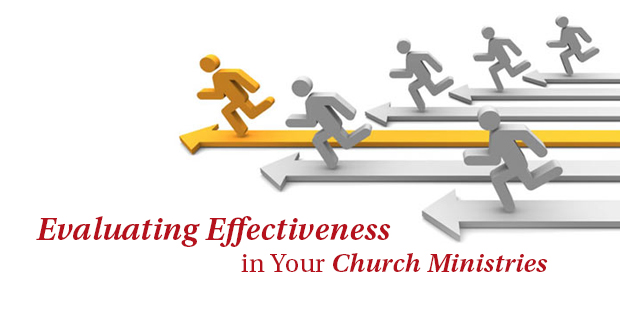
Evaluating Effectiveness in Your Church Ministries

Winston Churchill was an amazing leader, diplomat, and politician. One of the most notable parts of his legacy, however, is his collection of inspiring, and often humorous, quotations.

For example, Lady Astor, the first woman Parliament member, told him at a weekend house party, “Winston, if I were married to you I’d put poison in your coffee.” He quickly replied, “Nancy, if I were married to you I’d drink it.”

One of my favorite Churchill quotations is, “However beautiful the strategy, you should occasionally look at the results.” Ironically, he may not have said it… but, regardless, I couldn’t agree more, especially when it comes to evaluating our effectiveness in ministry.

Do we need a scorecard?

Pastors and church leaders may be able to intricately explain their discipleship strategy in sixty seconds flat, but we need more information than just a description of what it is. The best question to ask is not, “What is your strategy?” but rather, “Is your strategy working?” This leads to the question of whether or not we need to have a “scorecard” in ministry.

Do we really need to count how many people came, raised their hands, or gave? I would say, “Yes,” with the caveat that such a scorecard isn’t everything. You can be a biblically faithful church, doing everything God tells you to do, and shrink, often due to external factors such as, for example, a surrounding community in decline.

Shrinking shouldn’t be our desire, however. We want to see God’s Kingdom grow and we want to do all we can to work with Him to make that happen. A scorecard can be an effective tool in that process.

What should be on our scorecard?

If we agree with Churchill and believe we should examine the results of our strategy, the question becomes exactly what will measure to determine our ministry effectiveness. Answering that question is perhaps the biggest challenge of all.

I think there is a two-fold answer to this question. There are certain data that are quantitative and easy to assess each week. These would include areas like conversions, attendance, baptisms, etc. They can be compiled on a dashboard of sorts, and can give a pastor a quick snapshot of overall church health. While these obviously matter in assessing the overall picture of a church, they are not the only things that matter.

In addition to this quick dashboard, we should also be measuring growth in areas like discipleship, missional living, and participating in a small community.

Having a lot of converts is great, but are they changed? Are they living as new believers, serving within and outside the church, and sharing with others about Christ? If not, then ultimately, we’re not completing the task. That’s why these more in-depth areas need to be on the scorecard as well.

How do we measure the subjective areas?

But if we want to evaluate these types of issues, how can we do that accurately? In the churches where I’ve been involved, we use a spiritual formation assessment tool. We have used such tools for “dashboard categories” (e.g., small group involvement, attendance, giving), this measures issues in much bigger categories (e.g., community involvement, serving within the church, personal devotions). Because it’s a regular measurement, each individual can quickly go in and see how he or she is doing compared to last year, and it can also roll up congregationally so that we can have an eye on the progress we’re making in every area of our church’s life.

The data is both self-reported, as be presented by various church leaders. For example, our small groups are encouraged to participate in a corporate mission project once a month. We ask our leaders to regularly communicate to us to let us know what’s going on with their ongoing ministry and mission. In this way, if we assess our congregation’s community involvement, for example, at 50 percent, we set a goal of 60 percent for the next year, and we actually have a way of tracking and assessing that goal.

There are several different tools you can use to lead your church through this type of assessment. At LifeWay Research, we have developed the Transformation Church Assessment Tool, which helps churches analyze how well they are doing in seven factors that research indicated were part of healthy churches. We also have the Transformational Discipleship Assessment, based on extensive research that discovered eight attributes that consistently show up in the life of maturing believers.

At the end of the day, a scorecard is just that. It’s a simple tool to help us best live out the mission that has been entrusted to us. Regardless of the results that are presented, we need to remember another Churchill quote, “Never give in. Never give in. Never, never, never, never—in nothing great or small, large or petty—never give in . . .”

Our mission is too great to settle for anything less.

>> Read more from Ed.

Download PDF

Tags: , , ,

| What is MyVisionRoom? > | Back to Leadership >

ABOUT THE AUTHOR

Ed Stetzer

Ed Stetzer

Ed Stetzer, Ph.D., holds the Billy Graham Chair of Church, Mission, and Evangelism at Wheaton College and serves as Executive Director of the Billy Graham Center for Evangelism. He has planted, revitalized, and pastored churches, trained pastors and church planters on six continents, holds two masters degrees and two doctorates, and has written dozens of articles and books. Previously, he served as Executive Director of LifeWay Research. Stetzer is a contributing editor for Christianity Today, a columnist for Outreach Magazine, and is frequently cited or interviewed in news outlets such as USAToday and CNN. He serves as interim pastor of Moody Church in Chicago.

See more articles by >

COMMENTS

What say you? Leave a comment!

Recent Comments
comment_post_ID); ?> Thank you for this information. I'm going to use this article to improve my work with the Lord.
 
— Abel Singbeh
 
comment_post_ID); ?> Thank you Ed for sharing your insights into the Church Growth Movement. I have my reservations with Church Growth models because it has done more damage than good in the Body of Christ. Over the years, western churches are more focused on results, formulas and processes with little or no emphasis on membership and church discipline. Pastors and vocational leaders are burnt out because they're overworked. I do believe that the Church Growth model is a catalyst to two destructive groups: The New Apostolic Reformation and the Emerging Church. Both groups overlap and have a very loose definition. They're both focus on contemporary worship, expansion of church brand (franchising), and mobilizing volunteering members as 'leaders' to grow their ministry. Little focus on biblical study, apologetics and genuine missional work with no agenda besides preaching of the gospel.
 
— Dave
 
comment_post_ID); ?> Thank you for sharing such a good article. It is a great lesson I learned from this article. I am one of the leaders in Emmanuel united church of Ethiopia (A denomination with more-than 780 local churches through out the country). I am preparing a presentation on succession planning for local church leaders. It will help me for preparation If you send me more resources and recommend me books to read on the topic. I hope we may collaborate in advancing leadership capacity of our church. God Bless You and Your Ministry.
 
— Argaw Alemu
 

Clarity Process

Three effective ways to start moving toward clarity right now.

A Vague Vision Means 100 Things to 100 People

So you have a vision for the future. Virtually every leader does.

But how do you know whether your vision is going to catch on—whether it will capture the imagination of people and actually move them forward into a different future?

I mean that’s a tall order.

And any leader who’s even spent a few minutes up front casting vision has asked themselves whether their vision will catch on or not.

Sometimes even after you unveil the vision, you live for months waiting and wondering whether it is resonating widely or whether it’s simply going to fizzle and die.

Is there a way to know whether your vision will catch on, or whether it will sputter on before it dies out?

I think there is.

8 Signs Your Vision Isn’t Going to Catch On

In my experience, a vision needs at least 8 ingredients for it to resonate with people. This isn’t scientific…it’s just experience.

I know when things haven’t caught on the way I had hoped in the past, I’ve gone back to these elements to ensure they were in place.

Hopefully they can help you craft a clear and compelling vision for your organization  or ministry area that resonates.

Here are 8 signs your vision isn’t going to catch on:

1. It’s not scripturally sound.

I think the most compelling characteristic of a great vision is that it’s biblically sound.

I take a bit of heat in the comments section on my blog for not citing scripture in all my posts or telling people to pray about things, but I promise you that’s the foundation of what I believe and how I try to lead. It’s just if I said that every single time, it would be a bit redundant. I want to talk about the things in these posts that are easy for leaders to miss or overlook.

But let’s go there. Scripture resonates. If you want your vision to resonate, base it on scripture.

It might not always resonate right away (look at the prophets). But ultimately it will.

Can you build a compelling vision without scripture? Well yes you can. Otherwise there would be no successful movements or groups outside the Christian tradition. Nor would there be cults or political movements or businesses that succeed in casting vision outside faith parameters.

Finally, having a scripturally sound vision will help you lead with integrity. It reminds you of your accountability to God for the leadership with which you’ve been entrusted.

And it will sustain you in the good seasons and bad seasons. Fads come and go. But the Word of God stands forever.

Great vision simply expresses timeless truth in a timely way.

2. No one else is excited. As in no one.

A good sign your vision is going to fail is that no one else is excited about it.

If you’re getting a universal flat stare from everyone around you, or a universal thumbs down, you should pay attention.

Yes, you might be the one faithful person left on the planet and everyone else might be wrong.

Or you might be wrong, or misguided.

It’s probably the latter.

3. You’re not passionate about it.

Sometimes you just don’t feel passionate about a vision. I promise you, people can tell.

You might be able to get traction around something you’re not passionate about, but not for long. It will fizzle as you fizzle.

My team is so aware of this now that they regularly ask me if I’m passionate about a major goal we’re setting together as an organization. Because they know if I’m not, we’ll just spin our wheels as an organization until I am.

Same is true of what ever you lead. Your people will never be more passionate your vision than you are.  Which might explain #2 above.

4. It’s not specific.

Specificity (say that three times out loud) inspires action.

It is very difficult to rally people around an unspecific vision.

Our vision is to create a church unchurched people love to attend. The beauty of that vision is it’s clear. And naturally, the problem with the vision is that’s it’s clear. Not everyone loves it.

Which is perfect for us. We want to get specific traction with Christian who have unchurched people on their hearts and with unchurched people in our community. Our church isn’t for everyone.  (You can read more on why your church isn’t for everyone here.)

If your vague vision (like, say “Love God. Love People.”) is too vague to rally anyone, it will mean a hundred things to a hundred people and, as a result, it will be very difficult to align people around it.

5. You can’t get it down to a 30 second elevator pitch version.

You know the elevator pitch, where all your months/years of strategic planning and vision come down to your ability to pitch your idea to someone in the 30 seconds you have together in an elevator?

Many leaders choke when asked to define their vision in 30 seconds or less.

We say things like “Well, it’s more complicated/nuanced than that.”

Or “It’s really about 5 things and demands more time.”

If it’s about 5 things, it’s about nothing.

And if it’s complicated to you, I promise it’s far too complicated to them.

6.  It doesn’t challenge the status quo.

Every compelling vision challenges the status quo.

If yours doesn’t, you’re not actually leading people anywhere.

7. It’s provoked zero opposition.

 As much as we all dislike opposition, a great vision will always have some.

If you’re vision hasn’t provoked any opposition, it’s likely because it doesn’t propose anything significant.

The best way to incite zero opposition is, of course, to do nothing significant.

8. You don’t hear it echoed.

Even if you overcome all the points of opposition, you still might not have an effective vision if you don’t hear it echoed.

The vision absolutely needs to come from your mouth again and again, but if it only comes from your mouth, you probably don’t have a vision that’s going anywhere.

Until the vision lives in the hearts and lips of the people you lead, you really don’t have a vision that will carry your organization into the future.

So what do you do if you realize you don’t have a compelling vision?

Retreat.   Rethink.   Relaunch.

And when you and your team roll out your next iteration, just watch to ensure that:

1. It’s scripturally sound.

2. It excites people.

3. It excites you.

4. It’s specific.

5. You’ve got a 30 second elevator pitch version.

6. It challenges the status quo.

7. There’s some opposition.

8. You hear it echoed.

If you want more, you can pick up a copy of my book about how to lead change through opposition here.

Andy Stanley also wrote about how to make vision stick that you can get here.

How about you?

What makes for a compelling vision in your view?

>> Read more from Carey.

Download PDF

Tags: ,

| What is MyVisionRoom? > | Back to Vision >

ABOUT THE AUTHOR

Carey Nieuwhof

Carey Nieuwhof

Carey Nieuwhof is lead pastor of Connexus Community Church and author of the best selling books, Leading Change Without Losing It and Parenting Beyond Your Capacity. Carey speaks to North American and global church leaders about change, leadership, and parenting.

See more articles by >

COMMENTS

What say you? Leave a comment!

Recent Comments
comment_post_ID); ?> Thank you for this information. I'm going to use this article to improve my work with the Lord.
 
— Abel Singbeh
 
comment_post_ID); ?> Thank you Ed for sharing your insights into the Church Growth Movement. I have my reservations with Church Growth models because it has done more damage than good in the Body of Christ. Over the years, western churches are more focused on results, formulas and processes with little or no emphasis on membership and church discipline. Pastors and vocational leaders are burnt out because they're overworked. I do believe that the Church Growth model is a catalyst to two destructive groups: The New Apostolic Reformation and the Emerging Church. Both groups overlap and have a very loose definition. They're both focus on contemporary worship, expansion of church brand (franchising), and mobilizing volunteering members as 'leaders' to grow their ministry. Little focus on biblical study, apologetics and genuine missional work with no agenda besides preaching of the gospel.
 
— Dave
 
comment_post_ID); ?> Thank you for sharing such a good article. It is a great lesson I learned from this article. I am one of the leaders in Emmanuel united church of Ethiopia (A denomination with more-than 780 local churches through out the country). I am preparing a presentation on succession planning for local church leaders. It will help me for preparation If you send me more resources and recommend me books to read on the topic. I hope we may collaborate in advancing leadership capacity of our church. God Bless You and Your Ministry.
 
— Argaw Alemu
 

Clarity Process

Three effective ways to start moving toward clarity right now.

A Vague Vision Means 100 Things to 100 People

So you have a vision for the future. Virtually every leader does.

But how do you know whether your vision is going to catch on—whether it will capture the imagination of people and actually move them forward into a different future?

I mean that’s a tall order.

And any leader who’s even spent a few minutes up front casting vision has asked themselves whether their vision will catch on or not.

Sometimes even after you unveil the vision, you live for months waiting and wondering whether it is resonating widely or whether it’s simply going to fizzle and die.

Is there a way to know whether your vision will catch on, or whether it will sputter on before it dies out?

I think there is.

8 Signs Your Vision Isn’t Going to Catch On

In my experience, a vision needs at least 8 ingredients for it to resonate with people. This isn’t scientific…it’s just experience.

I know when things haven’t caught on the way I had hoped in the past, I’ve gone back to these elements to ensure they were in place.

Hopefully they can help you craft a clear and compelling vision for your organization  or ministry area that resonates.

Here are 8 signs your vision isn’t going to catch on:

1. It’s not scripturally sound.

I think the most compelling characteristic of a great vision is that it’s biblically sound.

I take a bit of heat in the comments section on my blog for not citing scripture in all my posts or telling people to pray about things, but I promise you that’s the foundation of what I believe and how I try to lead. It’s just if I said that every single time, it would be a bit redundant. I want to talk about the things in these posts that are easy for leaders to miss or overlook.

But let’s go there. Scripture resonates. If you want your vision to resonate, base it on scripture.

It might not always resonate right away (look at the prophets). But ultimately it will.

Can you build a compelling vision without scripture? Well yes you can. Otherwise there would be no successful movements or groups outside the Christian tradition. Nor would there be cults or political movements or businesses that succeed in casting vision outside faith parameters.

Finally, having a scripturally sound vision will help you lead with integrity. It reminds you of your accountability to God for the leadership with which you’ve been entrusted.

And it will sustain you in the good seasons and bad seasons. Fads come and go. But the Word of God stands forever.

Great vision simply expresses timeless truth in a timely way.

2. No one else is excited. As in no one.

A good sign your vision is going to fail is that no one else is excited about it.

If you’re getting a universal flat stare from everyone around you, or a universal thumbs down, you should pay attention.

Yes, you might be the one faithful person left on the planet and everyone else might be wrong.

Or you might be wrong, or misguided.

It’s probably the latter.

3. You’re not passionate about it.

Sometimes you just don’t feel passionate about a vision. I promise you, people can tell.

You might be able to get traction around something you’re not passionate about, but not for long. It will fizzle as you fizzle.

My team is so aware of this now that they regularly ask me if I’m passionate about a major goal we’re setting together as an organization. Because they know if I’m not, we’ll just spin our wheels as an organization until I am.

Same is true of what ever you lead. Your people will never be more passionate your vision than you are.  Which might explain #2 above.

4. It’s not specific.

Specificity (say that three times out loud) inspires action.

It is very difficult to rally people around an unspecific vision.

Our vision is to create a church unchurched people love to attend. The beauty of that vision is it’s clear. And naturally, the problem with the vision is that’s it’s clear. Not everyone loves it.

Which is perfect for us. We want to get specific traction with Christian who have unchurched people on their hearts and with unchurched people in our community. Our church isn’t for everyone.  (You can read more on why your church isn’t for everyone here.)

If your vague vision (like, say “Love God. Love People.”) is too vague to rally anyone, it will mean a hundred things to a hundred people and, as a result, it will be very difficult to align people around it.

5. You can’t get it down to a 30 second elevator pitch version.

You know the elevator pitch, where all your months/years of strategic planning and vision come down to your ability to pitch your idea to someone in the 30 seconds you have together in an elevator?

Many leaders choke when asked to define their vision in 30 seconds or less.

We say things like “Well, it’s more complicated/nuanced than that.”

Or “It’s really about 5 things and demands more time.”

If it’s about 5 things, it’s about nothing.

And if it’s complicated to you, I promise it’s far too complicated to them.

6.  It doesn’t challenge the status quo.

Every compelling vision challenges the status quo.

If yours doesn’t, you’re not actually leading people anywhere.

7. It’s provoked zero opposition.

 As much as we all dislike opposition, a great vision will always have some.

If you’re vision hasn’t provoked any opposition, it’s likely because it doesn’t propose anything significant.

The best way to incite zero opposition is, of course, to do nothing significant.

8. You don’t hear it echoed.

Even if you overcome all the points of opposition, you still might not have an effective vision if you don’t hear it echoed.

The vision absolutely needs to come from your mouth again and again, but if it only comes from your mouth, you probably don’t have a vision that’s going anywhere.

Until the vision lives in the hearts and lips of the people you lead, you really don’t have a vision that will carry your organization into the future.

So what do you do if you realize you don’t have a compelling vision?

Retreat.   Rethink.   Relaunch.

And when you and your team roll out your next iteration, just watch to ensure that:

1. It’s scripturally sound.

2. It excites people.

3. It excites you.

4. It’s specific.

5. You’ve got a 30 second elevator pitch version.

6. It challenges the status quo.

7. There’s some opposition.

8. You hear it echoed.

If you want more, you can pick up a copy of my book about how to lead change through opposition here.

Andy Stanley also wrote about how to make vision stick that you can get here.

How about you?

What makes for a compelling vision in your view?

>> Read more from Carey.

Download PDF

Tags: ,

| What is MyVisionRoom? > | Back to Vision >

ABOUT THE AUTHOR

Carey Nieuwhof

Carey Nieuwhof

Carey Nieuwhof is lead pastor of Connexus Community Church and author of the best selling books, Leading Change Without Losing It and Parenting Beyond Your Capacity. Carey speaks to North American and global church leaders about change, leadership, and parenting.

See more articles by >

COMMENTS

What say you? Leave a comment!

Recent Comments
comment_post_ID); ?> Thank you for this information. I'm going to use this article to improve my work with the Lord.
 
— Abel Singbeh
 
comment_post_ID); ?> Thank you Ed for sharing your insights into the Church Growth Movement. I have my reservations with Church Growth models because it has done more damage than good in the Body of Christ. Over the years, western churches are more focused on results, formulas and processes with little or no emphasis on membership and church discipline. Pastors and vocational leaders are burnt out because they're overworked. I do believe that the Church Growth model is a catalyst to two destructive groups: The New Apostolic Reformation and the Emerging Church. Both groups overlap and have a very loose definition. They're both focus on contemporary worship, expansion of church brand (franchising), and mobilizing volunteering members as 'leaders' to grow their ministry. Little focus on biblical study, apologetics and genuine missional work with no agenda besides preaching of the gospel.
 
— Dave
 
comment_post_ID); ?> Thank you for sharing such a good article. It is a great lesson I learned from this article. I am one of the leaders in Emmanuel united church of Ethiopia (A denomination with more-than 780 local churches through out the country). I am preparing a presentation on succession planning for local church leaders. It will help me for preparation If you send me more resources and recommend me books to read on the topic. I hope we may collaborate in advancing leadership capacity of our church. God Bless You and Your Ministry.
 
— Argaw Alemu
 

Clarity Process

Three effective ways to start moving toward clarity right now.

Show Them How to Live: Training Disciples in the Way Jesus Lived, Part 2

(continued from Part 1)

> The Bottom Line for Living Now

Here’s the bottom line: Jesus has called all who believe in Him to be His disciples. Our goal is to become like Him and represent Him in the world. Our identity is not defined by what we do but what He has done on our behalf. Our identity as a disciple does not turn on when we are in a “house of worship”. It is on all the time because “this is my Father’s world.”

Disciples of Jesus need a biblical metric for evaluating their lives, and church programs, activities, and events do not meet that standard. One of the roles I lead in during our gatherings is connecting with new people who attend for the first time. Occasionally, new people will ask the question, “What kind of programs do you offer? What kind of activities can we get involved in?” These are the questions of consumers from the culture of Christendom. Churches do them no service by giving them a way to be busy and yet experience no life change. Churches do themselves no favor by thinking they need to “sell their church” to such people. What these people need is to be taught how to live by a church who are committed to living out their identity as “a royal priesthood, a holy nation, a people for God’s own possession”.

When churches replace activities, programs, and events with gospel, community, and mission, the efficient system will be replaced with a glorious mess where Christ is in control, not the consumer. Instead of feeling the need to be the “best show” in town, churches are freed to offer the best grace of our beautiful Savior. Religious people in the system of Christendom know that it is a safe place to hide, a sure place of never truly being known. Disciples who live by repentance and faith have no fear of being known for who they truly are because they are living in the good of the gospel, not the shaky goodness of their religious checklist. For the church, we are not so concerned about disciples attending our stuff as much as we seeing them live their lives in the world around them. Let’s get rid of celebrating the props of religious performance and celebrate a life well lived through humble praxis!

> Show Them How to Live

I am convinced that most churches are missing the point at the most fundamental level of Christian living. For most of my life, I was never taught how to live as a disciple of Jesus. Perhaps that is because no one else around me was taught that either. We just did what everyone else did, and got busy at it. But it does not have to be this way! Christians learn to live by living out their lives in light of the gospel with a gospel community on mission in the world around them. Enough with teaching Christians how to act as Christians on Sunday. We need a view of disciple-making that trains Christians how to walk “in his steps” wherever and whenever that journey takes them.

Consider the questions that are being asked, especially about what is not being asked or talked about. How much of our lives are “off the table” because we have divorced everyday living from our identity as a disciple of Jesus? Consider the content of Christian conversation, especially if people are talking about how they are discovering new areas in their lives that are being brought under the Lordship of Jesus Christ as they grow in repentance and faith. Consider the subject of people’s prayer requests, especially if they are about matters tangential at best to their life, relationships, and involvement in the world. And consider what followers of Jesus are satisfied with, especially if they are more comfortable with being a consumer of religious activities than a disciples consumed with Jesus.

There are teenagers right now in your life who need to know how to live in a world full of temptation, peer pressure, and acceptance. There are young professionals in your life who need to know how to live in a world telling them life is about making a living, being successful, and moving up the ladder. There are young families in your life who need to know how to raise their children not to be Pharisees but disciplined and trained in a gospel-formative way. I could go on. But this kind of living does not get accessed by taking the pill or checking in once a week on Sunday. They need to be shown how to live by people who are living it out. It’s messy. It’s hard. But it’s glorious. Jesus came that we might have life, and that we might have it in full (John 10:10). Let us teach disciples to know what that means and live that out!

Read Part 1.

Read more from Timmy here.

Download PDF

Tags: , ,

| What is MyVisionRoom? > | Back to Process >

ABOUT THE AUTHOR

Timmy Brister

In the “real world,” I am the founder and president of Gospel Systems, Inc, a 501(c)(3) non-profit organization focused on creating and sustaining delivery systems for the advancement of the gospel around the world. In 2010, I started a delivery system called PLNTD – a network for church planting and revitalization focusing on resourcing, relational community, residencies in local churches, and regional networks. In 2012, I started an international delivery system call The Haiti Collective which focuses on equipping indigenous churches through church partnerships in order to care for orphans, make disciples, train leaders, and plant churches in Haiti. In addition to serving as the executive director of these organizations, I have served for 12 years in pastoral ministry with churches in Alabama, Kentucky, and Florida. My passion is to see healthy, growing churches take ownership of the Great Commission to the end that disciples are making disciples, leaders are developed and deployed, and churches are planting churches here and around the world. This is the driving passion of my life and prayer that God would be so glorified in making His name great in our generation.

See more articles by >

COMMENTS

What say you? Leave a comment!

Melissa — 01/31/14 10:24 am

Just what I need. THANK YOU for sharing your heart!

Recent Comments
comment_post_ID); ?> Thank you for this information. I'm going to use this article to improve my work with the Lord.
 
— Abel Singbeh
 
comment_post_ID); ?> Thank you Ed for sharing your insights into the Church Growth Movement. I have my reservations with Church Growth models because it has done more damage than good in the Body of Christ. Over the years, western churches are more focused on results, formulas and processes with little or no emphasis on membership and church discipline. Pastors and vocational leaders are burnt out because they're overworked. I do believe that the Church Growth model is a catalyst to two destructive groups: The New Apostolic Reformation and the Emerging Church. Both groups overlap and have a very loose definition. They're both focus on contemporary worship, expansion of church brand (franchising), and mobilizing volunteering members as 'leaders' to grow their ministry. Little focus on biblical study, apologetics and genuine missional work with no agenda besides preaching of the gospel.
 
— Dave
 
comment_post_ID); ?> Thank you for sharing such a good article. It is a great lesson I learned from this article. I am one of the leaders in Emmanuel united church of Ethiopia (A denomination with more-than 780 local churches through out the country). I am preparing a presentation on succession planning for local church leaders. It will help me for preparation If you send me more resources and recommend me books to read on the topic. I hope we may collaborate in advancing leadership capacity of our church. God Bless You and Your Ministry.
 
— Argaw Alemu
 

Clarity Process

Three effective ways to start moving toward clarity right now.