Why Great Leaders Must Be Vulnerable

You don’t know it all. There are limits to your knowledge, ability, and energy. And while the competitive nature of our culture, which often sneaks into our lives in ministry, would have us to hid all of our weaknesses in fear, there is tremendous power in becoming vulnerable with people.

Deciding to become vulnerable is risky. As church leaders, there will be people in our congregations who don’t want us to be human. They would prefer that we wear a halo and pretend that we’re never really tempted to sin in the same ways that they are. They feel safer if we, as spiritual leaders, are immune to the crass realities of life.

But when we hide our weaknesses, three big problems arise:

  • Our weaknesses get worse, feeding off of the shame and secrecy.
  • We become dishonest and hypocritical.
  • The truth inevitably comes out and people are disillusioned as a result.

So is bearing our vulnerability worth the risk? Absolutely. Here are some important reasons why vulnerability is a forgotten virtue of great leadership…

1. It’s emotionally healthy.

Maintaining an image of perfection requires enormous amounts of emotional energy. One of the reasons we sometimes get so stressed out and depressed is because we’re working so hard to stay behind the facade and keep everyone convinced that we’re strong.

If you are worried about your image, you are heading for burnout. Keeping people happy and impressing others is terribly exhausting, and it’s always temporary. Eventually, people get to know our weaknesses all at once.

Being real and vulnerable, on the other hand, is liberating. It’s freeing. In fact, it’s really the only way to live. James 5:16 says, “Confess your sins to each other and pray for each other so that you may be healed” (NLT). We need to confess our sins to God to be forgiven, but we also need to talk about our weaknesses with others to find healing.

In fact, some faults won’t budge until you confess them to others.

2. It’s spiritually empowering.

James also says, “God opposes the proud, but gives grace to the humble” (James 4:6 NLT). It is impossible to lead in ministry without the grace of God. And how do you find the grace you need? You find it by humbling yourself before God and others.

Remember, pride prevents power! 

3. It’s relationally attractive.

Everybody is wearing a mask, and it’s what we expect others to do as well. When we choose to throw our masks away, we surprise people with our authenticity. Being real is the fastest way to endear yourself to others.

We tend to love people who area real, honest, humble, and vulnerable and we tend to despise people who are deceitful, arrogant, and hypocritical. Paul told the Thessalonian believers, “We loved you so much that we shared with you not only God’s Good News, but our own lives, too” (1 Thessalonians 2:8 NLT).

When you share your strengths, you create competition. But when you share your weaknesses, you create community. You let people know, we’re all in this together.

Pastors are often incredibly lonely people. Why? I believe it’s in large part because they’re so afraid of the cost of being vulnerable.

4. It’s a mark of leadership.

We only follow leaders we trust. The first requirement for effective leadership is credibility, and the more honest you are, the more credible you become.

Real leaders lead by example. They go first. If your desire is that the church, group, or organization you’re leading be a place where people are open, you must be the first to open up.

You must decide whether you want to impress people (which you can do from a distance) or influencepeople (which you can only do up close).                                                                                      

5. It increases the impact of your preaching.

The concept of preaching from our vulnerability is something I’ve written about before because it’s a really big idea. In the previous generation of great preachers, we usually asked what’s the most powerful way to preach this? Now, we should be asking what’s the most personal way to preach this?

You will always be more effective as a personal witness and a storyteller than as a skilled orator. As you preach and lead, try to answer these questions…

  • What struggles and weaknesses should I share with others?
  • What progress am I making that others could learn from?
  • What am I currently learning, especially from my failures?

Remember this: The minister is the message.

> Read more from Rick.

Download PDF

Tags: , ,

| What is MyVisionRoom? > | Back to Leadership >

ABOUT THE AUTHOR

Rick Warren

Rick Warren

Rick Warren is the founding pastor of Saddleback Church in Lake Forest, Calif., one of America's largest and most influential churches. Rick is author of the New York Times bestseller The Purpose Driven Life. His book, The Purpose Driven Church, was named one of the 100 Christian books that changed the 20th century. He is also founder of Pastors.com, a global Internet community for pastors.

See more articles by >

COMMENTS

What say you? Leave a comment!

Recent Comments
comment_post_ID); ?> Thank you for this information. I'm going to use this article to improve my work with the Lord.
 
— Abel Singbeh
 
comment_post_ID); ?> Thank you Ed for sharing your insights into the Church Growth Movement. I have my reservations with Church Growth models because it has done more damage than good in the Body of Christ. Over the years, western churches are more focused on results, formulas and processes with little or no emphasis on membership and church discipline. Pastors and vocational leaders are burnt out because they're overworked. I do believe that the Church Growth model is a catalyst to two destructive groups: The New Apostolic Reformation and the Emerging Church. Both groups overlap and have a very loose definition. They're both focus on contemporary worship, expansion of church brand (franchising), and mobilizing volunteering members as 'leaders' to grow their ministry. Little focus on biblical study, apologetics and genuine missional work with no agenda besides preaching of the gospel.
 
— Dave
 
comment_post_ID); ?> Thank you for sharing such a good article. It is a great lesson I learned from this article. I am one of the leaders in Emmanuel united church of Ethiopia (A denomination with more-than 780 local churches through out the country). I am preparing a presentation on succession planning for local church leaders. It will help me for preparation If you send me more resources and recommend me books to read on the topic. I hope we may collaborate in advancing leadership capacity of our church. God Bless You and Your Ministry.
 
— Argaw Alemu
 

Clarity Process

Three effective ways to start moving toward clarity right now.

Every Environment Tells a Story

Every day, your church stewards thousands of moments of truth. Every time a member talks to a neighbor, someone drives by the church facility, a ministry email goes out, a pastor’s business card is left on a desk, some interaction on behalf of the church has transpired. Every time these events happen, the church’s vision grows brighter or dims in the tiniest little increments.

The leader’s role is to crank up the wattage.

Tell your story in every environment with compelling consistency.

THE QUICK SUMMARY Unique, by Phil Cooke

Today’s culture is more connected than any time in history, but all of this connectivity comes with a price. We live in a world that’s become cluttered, distracted, and disrupted by social media, with the average person receiving as many as 5,000 messages a day in one form or another. If you’re a pastor, nonprofit leader, artist, filmmaker, entrepreneur, or creative professional in this hyper-connected, highly distracted world, how do you get your unique idea, project, or vision on the radar of the people who need to respond?

In Unique, Phil Cooke, a highly respected media producer and consultant, addresses both the challenges and the opportunities of branding and social media in the 21st century. If you have a vision or message to share with the world, Unique provides a blueprint to cut through the clutter, communicate your story, and impact your audience.

A SIMPLE SOLUTION

To maximize your ability to connect, you must invest time, mental energy, and resources to really discover and articulate your uniqueness — your vision, your essence, your story.

Stories inspire and capture imagination. Stories connect on personal and emotional levels. They help us develop relational connections.

That’s why it is so important for your communication toolbox to say who you uniquely are— what differentiates your church from the crowd.

The combination of the right words with powerful imagery compels engagement, insight, and memorability.

Most churches haven’t developed their story and leveraged great design to share it. Don’t miss the opportunity to tell your church’s story with design so you can really extend your reach. Shouldn’t the church connect and build relationships in every way possible?

At its core, branding is simply the art of surrounding a product, organization, or person with a powerful and compelling story. At its most basic level, branding provides answers to the simple human need to differentiate one thing from another.

The goal of branding is to win the hearts and minds of the largest audience possible and imprint an indelible story around your vision.

The power of these stories and the hold they exert over our lives is remarkable, and many would say the power of story is embedded in our genetic makeup. From the ancient days of the Israelite storytellers who recited the epic chronicles of Abraham, Isaac, and Jacob, to the writers, preachers, and filmmakers of today, we are a story-driven people, and we use stories to make sense of life.

Stories work because we want to experience the emotions, feelings, and passions of others who have encountered the challenges we face each day.

During Jesus’ short time of ministry on earth, He had to teach a message that wouldn’t simply change people during His lifetime, but transform the world for ages to come. If you had faced that challenge, what would you have done?

Jesus did what many pastors in that position would probably consider a career killer: He started telling stories. Most of Jesus’ stories were just everyday people doing everyday things. They weren’t particularly exciting, romantic, or even thrilling.

Stories drill deeply into your brain and explode later with meaning. Sometimes the meaning comes when you least expect it. Stories impact audiences because each person interprets the story in light of his or her own personal situation and experience. As a result, the impact is far greater than a simple object lesson or teaching session.

In many cases, you can interchangeably use the words “brand,” “story,” “identity,” and, sometimes, “reputation.” Branding is about building trust and loyalty and extending your relationships far beyond a single transaction.

Stories are the central focus of the art of branding.

Phil Cooke, Unique

A NEXT STEP

How well does your brand tell your story?

Here’s a question for you: What’s the Nike brand all about? If you said “Just Do It” you would be incorrect – that’s their tagline. Their brand is really their mission – “Bring inspiration and innovation to every athlete* in the world.” (By the way, the * is further explained by Nike as “If you have a body you are an athlete.”)

To help understand how your brand tells your story, watch this 5 ½ minute video from Nike with your leadership team.

After watching the video, discuss these questions with your team:

  • How much more important, and eternal, is the mandate of the church than a shoe company?
  • How well defined and well lived, and resultantly effective, is our church at telling our story?
  • Does our story create movement and reflect the heart of God for the church or is it just words on a website or worship service bulletin?

Many pastors tend to be skeptical of investing time and resources into working on statements of identity like mission or values or taglines, especially when things around church “feel” like they are going well enough.

When any organization lives their mission, the results are seen – and life change becomes possible. The marketing video from Nike sums up why, for them, people living out their mission is more important than people knowing their tagline. And shows how good they actually are at living it, better than most churches.

What are three stories of life change that capture the essence of your church’s brand? How does your church’s mission statement move beyond generic statements to reflect these examples of your unique calling?


With the Gospel at the center of everything we do, the church, by its nature, is a message-centric organization. Jesus, the greatest story-teller of all time knew, before science showed us, that people are simply hard-wired to respond to story and images. And today’s world is becoming ever-increasingly visual, with selfies, Facebook, Twitter, and Instagram.

Consider this: there are hundreds of little moments of truth – touchpoints of connectivity – that happen each day.

Each of these are opportunities to share the message of the gospel. Are you going to make them or miss them?

Just by being more intentional with your brand, you really can capture more “makes” than “misses.”

When the communication gets cluttered, tell your story in every environment with compelling consistency.


Taken from SUMS Remix 26-2, published October 2015


This is part of a weekly series posting content from one of the most innovative content sources in the church world: SUMS Remix Book Summaries for church leaders. SUMS Remix takes a practical problem in the church and looks at it with three solutions; and each solution is taken from a different book. As a church leader you get to scan relevant books based on practical tools and solutions to real ministry problems, not just by the cover of the book. Each post will have the edition number which shows the year and what number it is in the overall sequence. (SUMS provides 26 issues per year, delivered every other week to your inbox). 

> Subscribe to SUMS Remix <<

Download PDF

Tags: , ,

| What is MyVisionRoom? > | Back to Communication >

ABOUT THE AUTHOR

VRcurator

VRcurator

Bob Adams is Auxano's Vision Room Curator. His background includes over 23 years as an associate/executive pastor as well as 8 years as the Lead Consultant for a church design build company. He joined Auxano in 2012.

See more articles by >

COMMENTS

What say you? Leave a comment!

Recent Comments
comment_post_ID); ?> Thank you for this information. I'm going to use this article to improve my work with the Lord.
 
— Abel Singbeh
 
comment_post_ID); ?> Thank you Ed for sharing your insights into the Church Growth Movement. I have my reservations with Church Growth models because it has done more damage than good in the Body of Christ. Over the years, western churches are more focused on results, formulas and processes with little or no emphasis on membership and church discipline. Pastors and vocational leaders are burnt out because they're overworked. I do believe that the Church Growth model is a catalyst to two destructive groups: The New Apostolic Reformation and the Emerging Church. Both groups overlap and have a very loose definition. They're both focus on contemporary worship, expansion of church brand (franchising), and mobilizing volunteering members as 'leaders' to grow their ministry. Little focus on biblical study, apologetics and genuine missional work with no agenda besides preaching of the gospel.
 
— Dave
 
comment_post_ID); ?> Thank you for sharing such a good article. It is a great lesson I learned from this article. I am one of the leaders in Emmanuel united church of Ethiopia (A denomination with more-than 780 local churches through out the country). I am preparing a presentation on succession planning for local church leaders. It will help me for preparation If you send me more resources and recommend me books to read on the topic. I hope we may collaborate in advancing leadership capacity of our church. God Bless You and Your Ministry.
 
— Argaw Alemu
 

Clarity Process

Three effective ways to start moving toward clarity right now.

Four Keys for Improving Your Assimilation Process

If you ask 100 church leaders to define assimilation, you’ll probably get 100 different answers. Some might say it’s all about creating relationships. Others might say it’s when a new member joins the church.

For us, the best way to define assimilation is with a metaphor. In the same way that an engine is composed of multiple parts all working together to move a vehicle in one direction, effective assimilation is a system that involves many different areas working together to move people from first-time visitors to fully engaged members. It’s a process that begins with a person’s first visit to the church (for any reason) and ends when that person becomes connected to the people, ministries, and programs that drive the mission.

We’ve identified four keys to help you improve and streamline your assimilation process.

  1. Evaluate your current process, it’s important

It is often the case in ministry that there is so much to do and too little time. Sometimes all you can do is barely keep your head afloat. It can seem daunting to imagine having the time to stop, strategize, and learn a new system. However, taking the time to think through your church assimilation process might be the single most effective choice you can make in your ministry. Having a systematic approach to your assimilation process is imperative to ensuring that no one is overlooked and that your church is not leaking people. It’s tough to know whether your assimilation process is providing enough opportunity for life change without taking a step back and evaluating your process.

  1. Identify the primary areas that need attention

After having evaluated your church’s current assimilation process, what are some of the areas that need immediate attention? What role do each of these play in ensuring your church’s growth keeps… well, growing?

Each church’s assimilation process will be unique.

However, after working with many of our church partners at Church Community Builder we have identified four primary areas or processes that often need attention: Hospitality, Information Gathering, Follow-Up, and Connection.

  1. Develop a strategy for improving your church’s assimilation process

Take time to intentionally invest in a plan that;s going to improve your church’s overall health and growth. A process is something that can be measured and monitored; the same should be true of your assimilation strategy. Here are some ways we’ve seen churches benefit from greater intentionality around assimilation:

  • They end up mapping out how a new visitor is integrated into their community. This helps them remember the new visitor experiences.
  • They develop a process that can be replicated and reproduced. These are critical to the success of your ministry, and should regularly be assessed and tweaked.
  • They’re able to measure what’s working and what isn’t. You can’t manage what you don’t measure.
  • They place a higher percentage of attenders into small groups. Active small group participants are more likely to be faithful givers, volunteers, and lay leaders.
  • They have greater success connecting people with volunteer opportunities that match their passions and abilities. Just filling slots leads to burnout; matching people to positions leads to breakthrough.
  • Their churches are producing active leaders instead of frozen chosen. They make it more comfortable for people to get involved that just sit and consume.
  • They discover ministry opportunities they didn’t know existed. God has given your members unique gifts and a purpose that he wants to fulfill through your church. That purpose might be something you hadn’t considered before. 
  1. Leverage technology to measure the results of your process.

Your church management system has the ability to make assimilation more efficient and effective. In addition to helping you distribute workloads, it can provide a place for recording and measuring the effectiveness of your process. The larger your church becomes, the more moving pieces there are, and the more you can your staff will need to depend on robust technology designed to accelerate the rate your people grow, connect, and engage with the long-term vision and development of your church.

A healthy church maximizes the assimilation process

There’s a quote that reads: “If you want something you’ve never had before, you have to do something you’ve never done before.” And there’s probably a list of things that you’d like to do to help your church reach more people and move those people along the pathway of discipleship. However, you can’t keep doing the same things and expecting different results. Discipleship suffers without a good assimilation process that facilitates moving people into a deeper relationship with Christ, people struggle to connect, first-time visitors are discouraged as there is nothing in place for them to move forward and connect with the church and it’s vision, and your backdoor remains just as open as your frontdoor.

The end result: overall church health decays because there is no plan in place to help people keep growing.

Maybe your assimilation process needs a quick pulse check, maybe it needs some surgery, or even a complete overhaul, one thing we know for certain is that it is essential to building a thriving ministry.

The more powerful the assimilation process, the more powerful your church will be.

Here are some practical next steps you can take today:

  • Outline your church’s assimilation process. Document it.
  • Assess the effectiveness of your current process. How are you doing in the 4 primary areas we identified?
  • Put the necessary changes in motion

Learn more about improving your assimilation process – connect with an Auxano Navigator today.


> Read more from Church Community Builder.

Download PDF

Tags: , ,

| What is MyVisionRoom? > | Back to Discipleship >

ABOUT THE AUTHOR

Church Community Builder

See more articles by >

COMMENTS

What say you? Leave a comment!

Recent Comments
comment_post_ID); ?> Thank you for this information. I'm going to use this article to improve my work with the Lord.
 
— Abel Singbeh
 
comment_post_ID); ?> Thank you Ed for sharing your insights into the Church Growth Movement. I have my reservations with Church Growth models because it has done more damage than good in the Body of Christ. Over the years, western churches are more focused on results, formulas and processes with little or no emphasis on membership and church discipline. Pastors and vocational leaders are burnt out because they're overworked. I do believe that the Church Growth model is a catalyst to two destructive groups: The New Apostolic Reformation and the Emerging Church. Both groups overlap and have a very loose definition. They're both focus on contemporary worship, expansion of church brand (franchising), and mobilizing volunteering members as 'leaders' to grow their ministry. Little focus on biblical study, apologetics and genuine missional work with no agenda besides preaching of the gospel.
 
— Dave
 
comment_post_ID); ?> Thank you for sharing such a good article. It is a great lesson I learned from this article. I am one of the leaders in Emmanuel united church of Ethiopia (A denomination with more-than 780 local churches through out the country). I am preparing a presentation on succession planning for local church leaders. It will help me for preparation If you send me more resources and recommend me books to read on the topic. I hope we may collaborate in advancing leadership capacity of our church. God Bless You and Your Ministry.
 
— Argaw Alemu
 

Clarity Process

Three effective ways to start moving toward clarity right now.

The Risk and Rewards of Pastoral Facebook Pages

While advocating for social media and online engagement by pastors and church staff, I’m continually asked about parameters for engagement. The problem is that every situation is unique. There’s not a one-size-fits-all recommendation for social media and online engagement by pastors and church staff.

Facebook is different than Twitter, and both of those are different than the world of blogging. Since Facebook is the most popular platform, it is often the most used and most abused by church members. A pastor or church staff member on Facebook can be a valuable resource to church members as well as a big target.

The Pros

There are many positives for pastors and church staff who are active on Facebook.

  1. Your members are there. Because it’s the most used platform, your church members are likely to be there, too. It makes communication easier for you and the church.
  2. Your members can see that you have a life outside of church. Because of the ease of sharing pictures and events from your everyday life, members can get to know more about you as a person. They get to see that you have a life outside of your job at the church.
  3. You are easy to connect with and contact. Because of the ease of connection on Facebook, church members and community members can connect with you and, by extension, the church. Facebook can become a great outreach tool if you connect well with those in the church and community through its platform.

The Cons

Ironically, the positives that Facebook can bring you online can also be negatives.

  1. Your members are there. Church members can see everything you say or do online. Things can easily be misconstrued, misinterpreted, or misrepresented. I’ve seen something as simple as changing ones profile picture lead to an inquisition about searching for a new job.
  2. Your members can see that you have a life outside of church. Churches are often busy. Church staffs are often even busier. But what about that one event not in your area of ministry that you choose not to attend? The one you skipped for your kid’s play or for a trip with lifelong friends? You can almost expect someone to be upset you chose something else over him or her. It’s not fair. It’s not right. But it will likely happen.
  3. You are easy to connect with and contact. For many pastors or church staff members, their busiest time on Facebook is often Sunday mornings. People often post or message them about being out of town or being sick or needing someone to fill in. Because of the ease of access, Facebook connections are subject to abuse by church members at times.

You might expect me to weigh the pros and cons and determine whether or not you should be on the platform—but that is for you to decide. As for me, even with the cons, the positives of Facebook and the opportunities it presents for ministry far outweigh the temporary frustrations of the negatives.


Learn more about the power of social media for your ministry. Connect with an Auxano Navigator.


> Read more from Jonathan.

Download PDF

Tags: , ,

| What is MyVisionRoom? > | Back to Communication >

ABOUT THE AUTHOR

Jonathan Howe

Jonathan Howe serves as vice president of communications for the Southern Baptist Convention's Executive Committee. He oversee all SBC Executive Committee communications including SBC.net, SBC LIFE, Baptist Press, social media initiatives and other media and messaging strategies. Howe was formerly the Director of Strategic Initiatives at LifeWay Christian Resources. Connect with Jonathan on Twitter at @Jonathan_Howe.

See more articles by >

COMMENTS

What say you? Leave a comment!

Recent Comments
comment_post_ID); ?> Thank you for this information. I'm going to use this article to improve my work with the Lord.
 
— Abel Singbeh
 
comment_post_ID); ?> Thank you Ed for sharing your insights into the Church Growth Movement. I have my reservations with Church Growth models because it has done more damage than good in the Body of Christ. Over the years, western churches are more focused on results, formulas and processes with little or no emphasis on membership and church discipline. Pastors and vocational leaders are burnt out because they're overworked. I do believe that the Church Growth model is a catalyst to two destructive groups: The New Apostolic Reformation and the Emerging Church. Both groups overlap and have a very loose definition. They're both focus on contemporary worship, expansion of church brand (franchising), and mobilizing volunteering members as 'leaders' to grow their ministry. Little focus on biblical study, apologetics and genuine missional work with no agenda besides preaching of the gospel.
 
— Dave
 
comment_post_ID); ?> Thank you for sharing such a good article. It is a great lesson I learned from this article. I am one of the leaders in Emmanuel united church of Ethiopia (A denomination with more-than 780 local churches through out the country). I am preparing a presentation on succession planning for local church leaders. It will help me for preparation If you send me more resources and recommend me books to read on the topic. I hope we may collaborate in advancing leadership capacity of our church. God Bless You and Your Ministry.
 
— Argaw Alemu
 

Clarity Process

Three effective ways to start moving toward clarity right now.

The Slow Leak of Leadership Influence

If a leader loses influence, it rarely evaporates instantly.

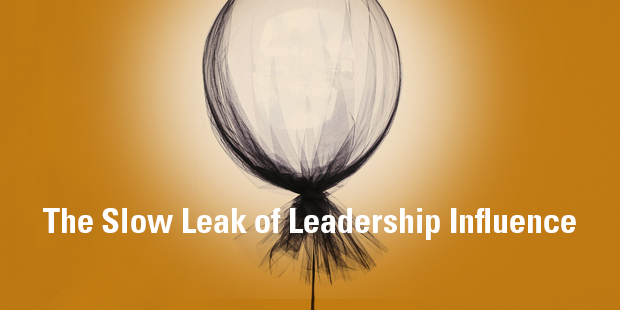
It’s usually more like a pin-sized hole in a balloon. The leak is so slow it’s barely perceptible. The balloon flies high at first – seemingly tugging on its string. Then it slowly begins to drop. In few days, you wake up and see the balloon laying on the floor, and much smaller than it used to be.

There are rare circumstances, such as a moral failure, that result in the loss of influence overnight. In the vast majority of situations, it’s subtle and slow. Unfortunately, sometimes it’s not noticed until it’s too late.

Whether it’s the pastor, someone on staff, or a volunteer leader, the issue is the same. The person is leading in such a way that he or she is losing influence and is often unaware. They may have been coached, but feel the issue is “not a big deal” and resist change. The result is decreasing influence.

The following examples are the most common “pin holes” for the loss of influence. Keep in mind these are not “problem leaders.” They are often good at what they do and in most cases people like them.

The issue may stem from a blind spot, lack of wisdom or maturity, or perhaps just lack of good and honest coaching. Whatever the case may be, each of these examples must be corrected as quickly as possible.

3 subtle ways a leader loses influence

1) Constant questioning, without offering solutions.

Asking questions is a good thing.

Asking the right questions at the right time is a practice of great leaders.

But something very different happens when a leader seems to question everything with more of a spirit of criticism rather than helpfulness. Let’s be honest; it doesn’t take much talent to spot problems. It doesn’t require a genius to point out what’s not working.

It takes a leader to come up with creative solutions. It also takes a capable leader, committed to the vision, to help make those solutions become a reality. That’s the best way to stop that influence leak.

Then an interesting thing happens. The more solutions a leader puts into play, the greater permission the people give that leader to ask more questions – even hard questions! It’s because that leader has earned it, and his or her influence is rising.

2) Stretching authority, without producing results.

Taking the initiative is a good thing.

Exercising leadership authority beyond the bounds of your formal responsibility is great when the church benefits.

However, when a leader shows up “large and in charge” but ends up more talk than results, a slow leak in influence is guaranteed.

It’s natural for strong leaders to push the envelope, and sometimes a few feathers get ruffled. That happens. But when a leader pushes the scope of his or her authority, and yet nothing of consequence happens to advance the mission, people quickly tire of that.

The better plan is to lead at the edge of your given authority, perhaps stretch it just a little, but only as you help make things happen. And as you do, it’s likely that more authority will be given to you, as you consistently produce results.

This will cause your influence to rise.

3) Making progress, without caring for people.

Moving the ball down the field is a good thing.

Taking new territory to advance the mission is the reason you have a position of leadership.

But few things in the local church will diminish your influence more than not tending to relationships. Everyone wants to win, and because of that, they will (temporarily) tolerate a less than caring leader if that leader can help achieve success. In this case, your influence is decreasing ever so slowly and subtly. Almost imperceptibly.

All leaders, however, hit a season where progress is not made. It’s in those times that the people will allow your influence to leak much more quickly. The hole in the balloon becomes large.

Progress is important, and a good leader wants to lead successfully, but that process must always include a genuine care and concern for people. As leaders, we must want more for the people than from them.

Loving the people gives you permission to lead them, and when cared for, they will help lead the way to the desired dreams and vision of the church.

I pray these thoughts are helpful to you and your leadership.


> Read more from Dan.

Download PDF

Tags: , , ,

| What is MyVisionRoom? > | Back to Leadership >

ABOUT THE AUTHOR

Dan Reiland

Dan Reiland

Dr. Dan Reiland serves as Executive Pastor at 12Stone Church in Lawrenceville, Georgia. He previously partnered with John Maxwell for 20 years, first as Executive Pastor at Skyline Wesleyan Church in San Diego, then as Vice President of Leadership and Church Development at INJOY. He and Dr. Maxwell still enjoy partnering on a number of church related projects together. Dan is best known as a leader with a pastor's heart, but is often described as one of the nations most innovative church thinkers. His passion is developing leaders for the local church so that the Great Commission is advanced.

See more articles by >

COMMENTS

What say you? Leave a comment!

Recent Comments
comment_post_ID); ?> Thank you for this information. I'm going to use this article to improve my work with the Lord.
 
— Abel Singbeh
 
comment_post_ID); ?> Thank you Ed for sharing your insights into the Church Growth Movement. I have my reservations with Church Growth models because it has done more damage than good in the Body of Christ. Over the years, western churches are more focused on results, formulas and processes with little or no emphasis on membership and church discipline. Pastors and vocational leaders are burnt out because they're overworked. I do believe that the Church Growth model is a catalyst to two destructive groups: The New Apostolic Reformation and the Emerging Church. Both groups overlap and have a very loose definition. They're both focus on contemporary worship, expansion of church brand (franchising), and mobilizing volunteering members as 'leaders' to grow their ministry. Little focus on biblical study, apologetics and genuine missional work with no agenda besides preaching of the gospel.
 
— Dave
 
comment_post_ID); ?> Thank you for sharing such a good article. It is a great lesson I learned from this article. I am one of the leaders in Emmanuel united church of Ethiopia (A denomination with more-than 780 local churches through out the country). I am preparing a presentation on succession planning for local church leaders. It will help me for preparation If you send me more resources and recommend me books to read on the topic. I hope we may collaborate in advancing leadership capacity of our church. God Bless You and Your Ministry.
 
— Argaw Alemu
 

Clarity Process

Three effective ways to start moving toward clarity right now.

5 Reasons Encouragement is a Non-Negotiable

If you read any leadership book, you are likely to be encouraged to encourage the people you lead. If you have served with an encouraging leader, you know the impact the encouragement makes on the morale of the team, the focus of the people, and the commitment to one other. Here are five reasons leaders must encourage:

1. Teams can drift.

Some have defined courage as sticking to one’s core beliefs or convictions. Thus, in this regard, to encourage is to prod people to continue sticking to their core beliefs and convictions. Leaders must encourage the team they lead to stay focused on the mission and to live their collective core convictions. Without encouragement, mission drift is inevitable.

2. Disunity can fester.

Because people are different, with unique personalities and perspectives, disagreements are certain when people work alongside one another. But disagreements don’t need to degenerate into disunity. A leader who encourages the team to unite around a larger agenda proactively fights against the disunity that can fester.

3. Distractions can overwhelm.

Many have pointed out that information is increasing at a relentless pace, and those we lead are bombarded with tons of messages and a plethora of information. Without encouragement, minds are easily distracted from what is most important. Leaders must encourage those they lead to remember the sacred why behind all the work and the essential aspects of the work.

4. Work gets discouraging

While work is a gift from God, it has been marred by the fall, just like everything else in creation. God told Adam that work would be painful (Genesis 3:17). Because work can be discouraging, morale will suffer without leaders who offer encouragement.

5. Hearts grow cold.

When leaders don’t encourage those they lead, hearts grow cold. The writer of the Book of Hebrews challenged Christians to “encourage each other daily, while it is still called today, so that none of you is hardened by sin’s deception.” Encouragement is the antidote for a hard heart.

How can leaders be more encouraging? By first being encouraged by Christ. An encourager has an encouraged heart. If being united with Christ encourages our hearts, we will encourage others.

> Read more from Eric.

Download PDF

Tags: , , ,

| What is MyVisionRoom? > | Back to Leadership >

ABOUT THE AUTHOR

Eric Geiger

Eric Geiger

Eric Geiger is the Senior Pastor of Mariners Church in Irvine, California. Before moving to Southern California, Eric served as senior vice-president for LifeWay Christian. Eric received his doctorate in leadership and church ministry from Southern Seminary. Eric has authored or co-authored several books including the best selling church leadership book, Simple Church. Eric is married to Kaye, and they have two daughters: Eden and Evie. During his free time, Eric enjoys dating his wife, taking his daughters to the beach, and playing basketball.

See more articles by >

COMMENTS

What say you? Leave a comment!

Recent Comments
comment_post_ID); ?> Thank you for this information. I'm going to use this article to improve my work with the Lord.
 
— Abel Singbeh
 
comment_post_ID); ?> Thank you Ed for sharing your insights into the Church Growth Movement. I have my reservations with Church Growth models because it has done more damage than good in the Body of Christ. Over the years, western churches are more focused on results, formulas and processes with little or no emphasis on membership and church discipline. Pastors and vocational leaders are burnt out because they're overworked. I do believe that the Church Growth model is a catalyst to two destructive groups: The New Apostolic Reformation and the Emerging Church. Both groups overlap and have a very loose definition. They're both focus on contemporary worship, expansion of church brand (franchising), and mobilizing volunteering members as 'leaders' to grow their ministry. Little focus on biblical study, apologetics and genuine missional work with no agenda besides preaching of the gospel.
 
— Dave
 
comment_post_ID); ?> Thank you for sharing such a good article. It is a great lesson I learned from this article. I am one of the leaders in Emmanuel united church of Ethiopia (A denomination with more-than 780 local churches through out the country). I am preparing a presentation on succession planning for local church leaders. It will help me for preparation If you send me more resources and recommend me books to read on the topic. I hope we may collaborate in advancing leadership capacity of our church. God Bless You and Your Ministry.
 
— Argaw Alemu
 

Clarity Process

Three effective ways to start moving toward clarity right now.

Learning to Live a Healthy, Biblical Lifestyle

Who takes care of the caregiver?

In your role of a leader and servant to your church, you probably push yourself to a point of exhaustion and beyond, rationalizing that you don’t have time for diets or exercise or that you will catch up on sleep later.

The reality is that the more you neglect your personal health, the less effective you actually are at caring for the spiritual health of others. Nodding off during meetings, eating greasy fast food while you drive, and collapsing on the couch during family time after work can be as destructive and sinful to your ministry as a moral failure.

Many leaders struggle with caring for their own health and well-being, and have become defeated and frustrated through the years as quick-fixes and January resolutions have come and gone. It is easier, and way more fun, to give in and neglect your own health.

Solution – Learn to live a healthy, biblical lifestyle

THE QUICK SUMMARY – The Daniel Plan, by Rick Warren, Daniel Amen, and Mark Hyman

During an afternoon of baptizing over 800 people, Pastor Rick Warren realized it was time for change. He told his congregation he needed to lose weight and asked if anyone wanted to join him. He thought maybe 200 people would sign up, instead he witnessed a movement unfold as 15,000 people lost over 260,000 pounds in the first year. With assistance from medical and fitness experts, Pastor Rick and thousands of people began a journey to transform their lives.

Here s the secret sauce: The Daniel Plan is designed to be done in a supportive community relying on God’s instruction for living. When it comes to getting healthy, two are always better than one. Our research has revealed that people getting healthy together lose twice as much weight as those who do it alone. God never meant for you to go through life alone and that includes the journey to health. The Daniel Plan shows you how the powerful combination of faith, fitness, food, focus, and friends will change your health forever, transforming you in the most head-turning way imaginably-from the inside out.

A SIMPLE SOLUTION

Making big and lasting changes in our lives is never easy – especially when it comes to something as personal as health, fitness, and lifestyle issues. In this area, especially around the first of the year, we are excited and firm in our resolve to begin the new year with healthier habits, including diet, exercise, and lifestyle. But oftentimes, those resolutions are forgotten as life continues – often at a faster pace.

The key to long-lasting success in any endeavor – including becoming healthier – is all about developing habits (see this SUMS Remix for help) (link to Remix 16). New, positive habits can replace old, self-defeating behaviors.

Of course, the problem is that old habits are difficult to change! Here are three reasons why it is so hard to develop new habits:

  • Most have lived with our unhealthy habits for years and we are comfortable with them.
  • Most of us are so comfortable with bad habits we identify with them.
  • Most unhealthy habits seem rewarding to us – and what gets rewarded gets recognized.

It’s no wonder we have difficulty breaking bad habits and developing new, good ones!

What’s needed is a simple, straightforward way to assess your current health, make wise decisions in several key areas of your life, and gather a few friends who will take the journey with you.

Maybe it’s time to consider The Daniel Plan.

The Essentials are a pathway to much more than improved physical health. Each of the Essentials holds up your life, enlivens your body, enriches your mind, and fills your heart.

The Daniel Plan is based on five Essentials: faith, food, fitness, focus, and friends.

Faith – God’s power is the key to any transformational change in our lives, including our health. He wants us to plug into that power so that we can live and move the way He intended.

Food – You will be invited to eat natural foods that bring vitality and energy to your body and mind. As you slowly introduce real whole fresh food, your body will respond automatically and heal, and chronic symptoms will fade into memory. The Daniel Plan introduces you to a whole new world of fresh fruits and vegetables, beans, whole grains, nuts, seeds, eggs, chicken, fish, lean animal products, and spices.

Fitness – Leading health and wellness organizations such as the American College of Sports Medicine have discovered that moving your body even just a little bit on a regular basis impacts not only your physical health, but also your intellectual, emotional, social, financial, and spiritual health.

Focus – When your brain works right, you work right. When your brain is healthy, your ability to focus increases and you make better decisions. So many distractions compete for your attention, so it is important for you to renew your mind and focus on God’s plan and priorities for your life.

Friends – When it comes to your health, every body needs a buddy. Consider what your journey toward whole health would be like if you did it in community. Research shows that people getting healthy together lose twice as much weight as those who do it alone. That success dramatically increases when you are connected with others, receiving constant encouragement to stay focused and motivated toward your goals.

Rick Warren, The Daniel Plan

A NEXT STEP

No matter what shape you are, what age you are, or where you want to go, everyone has the same starting point: where you are right now. Your “right now” is going to be very different from others so you need to make this journey to better health your journey.

Here are a couple of questions to get you started:

  • How is your overall health?
  • What changes do you want to start with?

Using The Daniel Plan website (see link below), download the Essentials Survey.

Work through the survey, completing the questions on each of the five Essentials described above. Use the results as a benchmark as you begin the intentional journey to better health and well-being.

Rather than jumping into all five Essentials at once, use the results of the Essentials Survey to begin with one or two Essentials. As you work in those areas and improve, add one additional Essential at a time.

As a leader in the local church, the temptation may be to walk this journey toward health in isolation from your church body. The rationale comes from the “never let them see you struggle” lies that we believe make us a better leader. Find 2-3 trusted lay leaders and invite them to walk the Daniel Plan with you. If you are in a Small Group – and why wouldn’t you be? – consider walking through this study with your group. Your example and willingness to be publicly open with improvement in health will likely be a catalyst for growth in others of your congregation.

If you choose to follow The Daniel Plan as an intentional journey, take the Essentials Survey several months after beginning, and again at the end to help measure your progress.


Taken from SUMS Remix 27-1, published November 2016


This is part of a weekly series posting content from one of the most innovative content sources in the church world: SUMS Remix Book Summaries for church leaders. SUMS Remix takes a practical problem in the church and looks at it with three solutions; and each solution is taken from a different book. As a church leader you get to scan relevant books based on practical tools and solutions to real ministry problems, not just by the cover of the book. Each post will have the edition number which shows the year and what number it is in the overall sequence. (SUMS provides 26 issues per year, delivered every other week to your inbox). 

> Subscribe to SUMS Remix <<

Download PDF

Tags: , , , ,

| What is MyVisionRoom? > | Back to Leadership >

ABOUT THE AUTHOR

VRcurator

VRcurator

Bob Adams is Auxano's Vision Room Curator. His background includes over 23 years as an associate/executive pastor as well as 8 years as the Lead Consultant for a church design build company. He joined Auxano in 2012.

See more articles by >

COMMENTS

What say you? Leave a comment!

Recent Comments
comment_post_ID); ?> Thank you for this information. I'm going to use this article to improve my work with the Lord.
 
— Abel Singbeh
 
comment_post_ID); ?> Thank you Ed for sharing your insights into the Church Growth Movement. I have my reservations with Church Growth models because it has done more damage than good in the Body of Christ. Over the years, western churches are more focused on results, formulas and processes with little or no emphasis on membership and church discipline. Pastors and vocational leaders are burnt out because they're overworked. I do believe that the Church Growth model is a catalyst to two destructive groups: The New Apostolic Reformation and the Emerging Church. Both groups overlap and have a very loose definition. They're both focus on contemporary worship, expansion of church brand (franchising), and mobilizing volunteering members as 'leaders' to grow their ministry. Little focus on biblical study, apologetics and genuine missional work with no agenda besides preaching of the gospel.
 
— Dave
 
comment_post_ID); ?> Thank you for sharing such a good article. It is a great lesson I learned from this article. I am one of the leaders in Emmanuel united church of Ethiopia (A denomination with more-than 780 local churches through out the country). I am preparing a presentation on succession planning for local church leaders. It will help me for preparation If you send me more resources and recommend me books to read on the topic. I hope we may collaborate in advancing leadership capacity of our church. God Bless You and Your Ministry.
 
— Argaw Alemu
 

Clarity Process

Three effective ways to start moving toward clarity right now.

Strategize Your Way to Better Communication

Communication is a key component to leadership. If you are communicating, then you are leading in some way. Here are five principles that you can begin using immediately to help you communicate, and thus lead, better.

  1. Use positive language. Draw people to your point by inspiring them. If you paint a brighter future, people will desire to listen and follow. A quick listen to great speeches like Lincoln’s Gettysburg Address or Martin Luther King Jr.’s “I Have a Dream” speech faced the difficulties of the present day. But they also move on to describe the promise of something greater.
  1. Avoid alarmism. Leading through times of crisis is necessary. Creating a constant environment of crisis is demotivating. Eventually, if every circumstance is a cause for alarm, people will stop listening and simply give up hope. Change is inevitable and and it is always accompanied by a cost. However, you can help people through it by not sounding the crisis alarm with your language.
  1. State how it is easy to understand what we are doing. The constant use of phrases like “This is tough to understand” or “This will be hard for some people to do” becomes principles to follow rather than warnings to help. Instead, as you prepare, plan out simple steps for everyone listening to follow through on easy actions.
  1. Use more simple words. Speakers and leaders read so much on the subject matter in which they lead that the natural tendency is to get bored with the standard language and a slight obsession with new words that accompany their discipline. Remember that your audience has not done the same. It is fine to introduce a new vocabulary to your audience but you must do so in such a way that it does not distract from your core message. Instead, use more simple language than complex so that you are immediately and easily understood.
  1. Tell great stories. Everyone loves a great story and stories are everywhere. You can write an original illustration, adapt a real-life situation, use a historical narrative, or find something from the recent news headlines. Telling great stories will help the audience connect all of the principles you teach to the every day life that they lead.

Read more from Philip.


Would you like to learn more about improving your communications? Connect with an Auxano Navigator and start a conversation with our team.

Download PDF

Tags: , ,

| What is MyVisionRoom? > | Back to Communication >

ABOUT THE AUTHOR

Philip Nation

Philip Nation

serve as the Director of Advancement and Global Impact Churches with the Baptist World Alliance and frequently speak at churches and conferences. I earned a Master of Divinity from Beeson Divinity School and a Doctor of Ministry from Southeastern Baptist Theological Seminary. In 2010-2012, I was the national spokesperson for the Back to Church Sunday campaign from Outreach. Over the years, I’ve served as a pastor, minister of education, and a church planter. My latest published work is the video-based Bible study Pursuing Holiness: Applications from James. In 2016, I published Habits for Our Holiness: How the Spiritual Disciplines Grow Us Up, Draw Us Together, and Send Us Out with Moody Publishers. I’ve coauthored two other books: Compelled: Living the Mission of God and Transformational Discipleship: How People Really Grow. I was also the general editor of The Mission of God Study Bible. Along the way, I have written the small-group studies Storm Shelter: Psalms of God’s Embrace, Compelled by Love: The Journey to Missional Living and Live in the Word, plus contributed to The Great Commission Resurgence: Fulfilling God’s Mandate in Our Lifetime.

See more articles by >

COMMENTS

What say you? Leave a comment!

Recent Comments
comment_post_ID); ?> Thank you for this information. I'm going to use this article to improve my work with the Lord.
 
— Abel Singbeh
 
comment_post_ID); ?> Thank you Ed for sharing your insights into the Church Growth Movement. I have my reservations with Church Growth models because it has done more damage than good in the Body of Christ. Over the years, western churches are more focused on results, formulas and processes with little or no emphasis on membership and church discipline. Pastors and vocational leaders are burnt out because they're overworked. I do believe that the Church Growth model is a catalyst to two destructive groups: The New Apostolic Reformation and the Emerging Church. Both groups overlap and have a very loose definition. They're both focus on contemporary worship, expansion of church brand (franchising), and mobilizing volunteering members as 'leaders' to grow their ministry. Little focus on biblical study, apologetics and genuine missional work with no agenda besides preaching of the gospel.
 
— Dave
 
comment_post_ID); ?> Thank you for sharing such a good article. It is a great lesson I learned from this article. I am one of the leaders in Emmanuel united church of Ethiopia (A denomination with more-than 780 local churches through out the country). I am preparing a presentation on succession planning for local church leaders. It will help me for preparation If you send me more resources and recommend me books to read on the topic. I hope we may collaborate in advancing leadership capacity of our church. God Bless You and Your Ministry.
 
— Argaw Alemu
 

Clarity Process

Three effective ways to start moving toward clarity right now.

5 Ways Taking Care of Your Body Also Takes Care of Your Mind

I recently read Spark: The Revolutionary New Science of Exercise and the Brain and walked away from the read more convinced in the importance of exercise. While we often think of exercise as critical to a healthy body, it is also essential for a strong mind. In his book, Dr. John Ratey offers a compelling case for exercise significantly and positively impacting our mental health, growth, and capacity. While he does not discount exercise for the sake of caring for your body, he argues, “Exercise is the single most powerful tool to optimize your brain function.”

The case study that nudged Ratey to write the book comes from Naperville, Illinois. Naperville District 203 is known as the fittest school district in the nation, and one of the smartest. Years ago, as maverick physical education teachers piloted scheduled running and exercise sessions before school started, the students in those sessions saw their grades dramatically improve. As the strategy spread, “guidance counselors began suggesting that students schedule their hardest subjects immediately after gym to capitalize on the beneficial effects of exercise.” Exercise, according to Ratey, directly lifted the student’s test scores and academic performance.

When it comes to stewarding our minds well, here are five ways exercise helps (all taken from Ratey’s research and book):

  1. Exercise increases learning ability: As we exercise, our minds are put in a better position to receive and apply new information.
  1. Exercise lowers the impact of stress: Exercise puts stress on your mind and body and trains your mind to handle stress better by teaching you that you can manage and master it.
  1. Exercise lowers sensitivity to anxiety: Anxiety is going to bombard leaders, but exercise builds a resistance to it. Ratey writes, “When we increase our heart rate and breathing in the context of exercise, we learn that these physical signs don’t necessarily lead to an anxiety attack. We become more comfortable with the feeling.”
  1. Exercise helps fight depression: While I am not naively suggesting merely to “read your Bible and run a mile and you will be fine,” exercise can help fight depression. According to Ratey, “Exercise influences the same chemicals that antidepressants do.” In other words, exercise is a form of medicine.
  1. Exercise increases memory capacity: A fascinating study, highlighted in Spark, was conducted by neurologist Scott Small, who put volunteers on a three-month exercise regimen and then took pictures of their brains. He discovered that the capillary volume in the memory area of the brain increased by 30 percent! 

Leaders sometimes think of exercise as a tool to help them steward their bodies, but the reality is that exercise is also a tool to steward our minds better. We are integrated people, and taking care of our bodies cannot be separated from taking care of our minds. Plato said it this way:

In order for man to succeed in life, God provided him with two means, education and physical activities. Not separately, one for the soul and the other for the body, but for the two together.

Download PDF

Tags: , ,

| What is MyVisionRoom? > | Back to Leadership >

ABOUT THE AUTHOR

Eric Geiger

Eric Geiger

Eric Geiger is the Senior Pastor of Mariners Church in Irvine, California. Before moving to Southern California, Eric served as senior vice-president for LifeWay Christian. Eric received his doctorate in leadership and church ministry from Southern Seminary. Eric has authored or co-authored several books including the best selling church leadership book, Simple Church. Eric is married to Kaye, and they have two daughters: Eden and Evie. During his free time, Eric enjoys dating his wife, taking his daughters to the beach, and playing basketball.

See more articles by >

COMMENTS

What say you? Leave a comment!

Recent Comments
comment_post_ID); ?> Thank you for this information. I'm going to use this article to improve my work with the Lord.
 
— Abel Singbeh
 
comment_post_ID); ?> Thank you Ed for sharing your insights into the Church Growth Movement. I have my reservations with Church Growth models because it has done more damage than good in the Body of Christ. Over the years, western churches are more focused on results, formulas and processes with little or no emphasis on membership and church discipline. Pastors and vocational leaders are burnt out because they're overworked. I do believe that the Church Growth model is a catalyst to two destructive groups: The New Apostolic Reformation and the Emerging Church. Both groups overlap and have a very loose definition. They're both focus on contemporary worship, expansion of church brand (franchising), and mobilizing volunteering members as 'leaders' to grow their ministry. Little focus on biblical study, apologetics and genuine missional work with no agenda besides preaching of the gospel.
 
— Dave
 
comment_post_ID); ?> Thank you for sharing such a good article. It is a great lesson I learned from this article. I am one of the leaders in Emmanuel united church of Ethiopia (A denomination with more-than 780 local churches through out the country). I am preparing a presentation on succession planning for local church leaders. It will help me for preparation If you send me more resources and recommend me books to read on the topic. I hope we may collaborate in advancing leadership capacity of our church. God Bless You and Your Ministry.
 
— Argaw Alemu
 

Clarity Process

Three effective ways to start moving toward clarity right now.

Five Challenges to Healthy Church Growth

Every year another two million American adults become less receptive to the gospel, and less receptive to churches.

Every year.

That is one of the nuggets I took from the Pew Research work on the “Nones” when they first released the data in 2012. Pew has continued to follow the religious commitment level of Americans. From 2007 to 2014, over 12 million American adults have moved from a high level of religious commitment to a low level of commitment. They just skipped the medium level of commitment altogether.

Cultural Christianity is dying.

One no longer has to be a Christian or in a church to be accepted by society. That relatively easy pool of prospective attendees for our churches is disappearing.

But most churches keep doing what they’ve always done.

As a consequence, they are reaching fewer. They are declining.

Why?

The answer to that question is too complex for a simple blog post, but let me provide five high-level responses for now.

  1. Church members are not being intentionally relational with those who are not in church. The old way of church outreach was more transactional; today it requires the development of relationships. Most church members will not take that step. Many don’t know how to take that step.
  2. Many churches are stuck in the past. While we never compromise the gospel and the Word, our methodologies must reflect an awareness of our culture, and a willingness to be missionaries to that culture. Sadly, too many church members are unwilling to make changes. Church, for them, is about their needs and their preferences.
  3. Church members are not regularly inviting people to church. Yes, it can be that simple. Many of the religiously unaffiliated will come to church if we invite them. But it’s difficult for them to respond to an invitation if they never get one.
  4. Many church members fail to act like Christians on social media. Unbelievers are watching us on Facebook and Twitter. And many of us are more likely to show our rear ends than Christian love. Social media is where the unchurched reside. And they constantly see our petty quarrels, our venomous politics, and our self-serving attitudes. Look at this blog post about what non-Christians think about us. I wrote it in 2013, but the comments still come in from unbelievers.
  5. If they come to church, they only have a mediocre experience. The religiously unaffiliated do visit our churches from time to time. But, more often than not, they see our holy huddles and our lukewarm greetings. Most will not return.

Growth is indeed more difficult in most of our churches today. We no longer have the large pool of cultural Christians from which to draw. But we can reach them. We must reach them.

We will have to treat our membership in our churches as missionaries to the community instead of country club membership. Biblical membership is not about getting our perks, privileges, and preferences. It’s about sacrificing self for the gospel.

Then, and only then, will we see our churches start growing again.


Knowing how to grow a church shouldn’t be a mystery. But the busyness of ministry, combined with the clutter of church growth ideas, leaves many pastors with more questions than answers. As a result, progress is slow, people are scattered, and the work of ministry feels less meaningful than you thought it would. Connect with an Auxano Navigator to learn more about a process that leads to growth.


> Read more from Thom.

Download PDF

Tags: , ,

| What is MyVisionRoom? > | Back to Vision >

ABOUT THE AUTHOR

Thom Rainer

Thom Rainer

Thom S. Rainer is the founder and CEO of Church Answers, an online community and resource for church leaders. Prior to founding Church Answers, Rainer served as president and CEO of LifeWay Christian Resources. Before coming to LifeWay, he served at The Southern Baptist Theological Seminary for twelve years where he was the founding dean of the Billy Graham School of Missions and Evangelism. He is a 1977 graduate of the University of Alabama and earned his Master of Divinity and Ph.D. degrees from The Southern Baptist Theological Seminary.

See more articles by >

COMMENTS

What say you? Leave a comment!

Recent Comments
comment_post_ID); ?> Thank you for this information. I'm going to use this article to improve my work with the Lord.
 
— Abel Singbeh
 
comment_post_ID); ?> Thank you Ed for sharing your insights into the Church Growth Movement. I have my reservations with Church Growth models because it has done more damage than good in the Body of Christ. Over the years, western churches are more focused on results, formulas and processes with little or no emphasis on membership and church discipline. Pastors and vocational leaders are burnt out because they're overworked. I do believe that the Church Growth model is a catalyst to two destructive groups: The New Apostolic Reformation and the Emerging Church. Both groups overlap and have a very loose definition. They're both focus on contemporary worship, expansion of church brand (franchising), and mobilizing volunteering members as 'leaders' to grow their ministry. Little focus on biblical study, apologetics and genuine missional work with no agenda besides preaching of the gospel.
 
— Dave
 
comment_post_ID); ?> Thank you for sharing such a good article. It is a great lesson I learned from this article. I am one of the leaders in Emmanuel united church of Ethiopia (A denomination with more-than 780 local churches through out the country). I am preparing a presentation on succession planning for local church leaders. It will help me for preparation If you send me more resources and recommend me books to read on the topic. I hope we may collaborate in advancing leadership capacity of our church. God Bless You and Your Ministry.
 
— Argaw Alemu
 

Clarity Process

Three effective ways to start moving toward clarity right now.