The Power of Clarity in Your Church’s Vision

Tears were streaming down his face as he silently wept:

“I can see it so clearly… I just haven’t had the ability to put it into words… which makes people think I don’t know where we are going.”

Clarity is powerful.

One of my most favorite things to do through my work with Church Simple is to help church leaders clearly communicate what it is that they are called to… and then helping them do it.  In this case, the process was incredibly moving.

I am becoming convinced that the church in this country is not lacking of vision… it is the rare church leader that does not have a vision for where God is taking them.  What I think is missing in many churches is a sense of clarity when it comes to that vision: a way to express it clearly, concisely, and with authority.

Vision statements can be incredibly powerful tools to rally your congregation around your calling… or they can be incredibly obtuse statements that make people yawn in powerful new ways.  The difference is how you approach crafting your vision statement, and whether you are making a statement, or calling to action.  I fully believe that we have been called to action by the great commission and great commandment… and should be calling our people to action as well.  With this in mind, here are four qualities of a great vision statement:

  • Vivid.  Paint a picture.  Be clear about where you are going and what it will look like.  If your people do not fully understand what your vision statement is calling them to, you will never achieve it.
  • Inspiring.  I am sick of boring vision statements.  If you want me to fully invest myself in the vision and mission of your church you need to call me to something bigger than myself, something worthy of the time, talents, and treasure that I will be sacrificing in order to make it happen.  Don’t tell me what we are, tell me where we are going… and make it a big deal.
  • Memorable.  The school that I worked with in Baltimore had a vision statement that took up a full sheet of paper (actually they had two, posted on opposite walls… but that is a bigger problem for another time).  If you were to ask teachers, administrators, or anyone involved in the school to recite, or paraphrase, either of those statements you would have gotten a blank stare.  Your vision statement needs to be clear and concise in order for it to be memorable.  Vision statements that aren’t memorable are worse than having no vision statement at all.
  • Preachable.  If you can not point back to your church’s vision statement during your sermon on a regular basis it is useless.  The power of a vision statement is its ability to clearly define who you are as a church and where you are going.  If you are not referring back to it regularly, it may be time to ask yourself whether you, and your vision, are headed in the same direction.

What makes YOUR church’s vision statement great?

If you are looking for more thoughts on church vision, you need to check out what Will Mancini is up to, or buy his book.  Either way, this is too important to not do well.

Read more from Matt here.

Download PDF

Tags: , , , ,

| What is MyVisionRoom? > | Back to Vision >

ABOUT THE AUTHOR

Matt Steen

See more articles by >

COMMENTS

What say you? Leave a comment!

Recent Comments
comment_post_ID); ?> Thank you for this information. I'm going to use this article to improve my work with the Lord.
 
— Abel Singbeh
 
comment_post_ID); ?> Thank you Ed for sharing your insights into the Church Growth Movement. I have my reservations with Church Growth models because it has done more damage than good in the Body of Christ. Over the years, western churches are more focused on results, formulas and processes with little or no emphasis on membership and church discipline. Pastors and vocational leaders are burnt out because they're overworked. I do believe that the Church Growth model is a catalyst to two destructive groups: The New Apostolic Reformation and the Emerging Church. Both groups overlap and have a very loose definition. They're both focus on contemporary worship, expansion of church brand (franchising), and mobilizing volunteering members as 'leaders' to grow their ministry. Little focus on biblical study, apologetics and genuine missional work with no agenda besides preaching of the gospel.
 
— Dave
 
comment_post_ID); ?> Thank you for sharing such a good article. It is a great lesson I learned from this article. I am one of the leaders in Emmanuel united church of Ethiopia (A denomination with more-than 780 local churches through out the country). I am preparing a presentation on succession planning for local church leaders. It will help me for preparation If you send me more resources and recommend me books to read on the topic. I hope we may collaborate in advancing leadership capacity of our church. God Bless You and Your Ministry.
 
— Argaw Alemu
 

Clarity Process

Three effective ways to start moving toward clarity right now.

5 Actions to Help You Overcome Struggles in Ministry Leadership

Struggle is a part of any human endeavor and leadership is no different. The problem is we view struggle as a negative. But struggle is how we grow. Without them we can’t reach our full potential as leaders.

We like to think of our leaders as flawless. We like to be perceived as flawless—or at least we like people to think we have everything under control. But as Joe Badaracco has pointed out, “leadership is a struggle by flawed human beings to make some important human values real and effective in the world as it is.”

It may sound counterintuitive, but considering the benefits illuminated by Stephen Snyder in Leadership and the Art of Struggle, we should welcome it as an important element of the leadership process and our own personal development. Snyder writes that we should face struggle “head on—not hiding from it or feeling shame—because struggle is the gateway to learning and growth.” It can also help us to discover our purpose and meaning and develop the adaptive energy necessary to sustain our leadership for a lifetime.

Struggles have three defining characteristics:

Change: Every struggle is triggered by some type of change.

Tensions: Change creates a natural set of tensions.

Being out of Balance: Change and its ensuing tensions throw a leader off balance. This may happen without us even being aware of it, but acknowledgement of it is central to regaining control.

In the world we live in today, this is a common occurrence often leading to burnout unless we learn to see struggle through a different lens. Snyder recommends the following 5 actions to overcome those struggles:

  1. Adopt a growth mindset. The first step in accomplishing this is through reflection—being aware of what is going on around you. Snyder’s former colleague at Microsoft, Frank Gaudette, used to say: “I reserve the right to wake up smarter every day.” A good mantra to make our own.
  2. Center your mind, body and spirit. We all need some way to anchor ourselves and gain perspective that we practice daily like exercise and diet, prayer, connecting with nature, meditation, and/or journaling.
  3. Build your support community. “Create a community of people whom you can connect and bond with and from whom you can seek advice and feedback.”
  4. Overcome your blind spots. Blind spots by their very nature are hard to recognize. And they are frustrating because they blind us from seeing why people may be responding to us in counterproductive ways—leading us to finger pointing rather than personal responsibility. “Blind spots,” writes Snyder, “are the product of an overactive automatic mind and an underactive reflective mind.” A fairly common blind spot Snyder calls the Conflict Blind Spot. This blind spot can cause someone to interpret every interaction through a distorted lens. It reinforces the perception that the other person is wrong and we are right.
  5. Recommit, pivot, or leap. When we struggle we have essentially three options. The first is to recommit and stay the course. The second is to pivot and make a course correction. And third is to leap into uncharted territory far beyond our comfort zone. Choosing the right option requires that we examine ourselves and determine which choice is most consistent with our personal values or mission statement.

Every struggle is a chance to learn and to confront who we are and what we are becoming. Seen in that light, they are a gift. And our ability to deal with our own struggles effectively has an impact on those around us. Not only does it create a more positive environment to function in, but it provides a constructive example for others to follow.

Snyder has written an outstanding and practical book to help us to rethink the challenges and problems we face along the way. One of the best you’ll ever read on the topic.

Read more from Michael here.

Download PDF

Tags: , , ,

| What is MyVisionRoom? > | Back to Leadership >

ABOUT THE AUTHOR

Michael McKinney

See more articles by >

COMMENTS

What say you? Leave a comment!

Recent Comments
comment_post_ID); ?> Thank you for this information. I'm going to use this article to improve my work with the Lord.
 
— Abel Singbeh
 
comment_post_ID); ?> Thank you Ed for sharing your insights into the Church Growth Movement. I have my reservations with Church Growth models because it has done more damage than good in the Body of Christ. Over the years, western churches are more focused on results, formulas and processes with little or no emphasis on membership and church discipline. Pastors and vocational leaders are burnt out because they're overworked. I do believe that the Church Growth model is a catalyst to two destructive groups: The New Apostolic Reformation and the Emerging Church. Both groups overlap and have a very loose definition. They're both focus on contemporary worship, expansion of church brand (franchising), and mobilizing volunteering members as 'leaders' to grow their ministry. Little focus on biblical study, apologetics and genuine missional work with no agenda besides preaching of the gospel.
 
— Dave
 
comment_post_ID); ?> Thank you for sharing such a good article. It is a great lesson I learned from this article. I am one of the leaders in Emmanuel united church of Ethiopia (A denomination with more-than 780 local churches through out the country). I am preparing a presentation on succession planning for local church leaders. It will help me for preparation If you send me more resources and recommend me books to read on the topic. I hope we may collaborate in advancing leadership capacity of our church. God Bless You and Your Ministry.
 
— Argaw Alemu
 

Clarity Process

Three effective ways to start moving toward clarity right now.

Is Discipleship the Totality of All Your Church Does in Ministry?

Eric Geiger continues his 2013 Discipleship Interview Series with Trevin Wax below. Trevin serves as the managing editor of The Gospel Project and is a prolific blogger.

Discipleship is such a broad term, often a junk-drawer term that has been used to describe many things. How do you define it?

For a lot of church leaders, discipleship is the follow-up to evangelism. That is, evangelism is entering into the church through faith in the gospel, and then discipleship takes you to the next level. Biblically, I don’t think we can separate the two. Discipleship in the Scriptures is about learning to follow Jesus in light of who He is and what He has done, and then making other disciples who follow Jesus as well. We’re not just called to be “disciples,” but to be “disciple-making disciples.”

There are elements of discipleship that need to be stressed today, as they were stressed in Jesus’ teaching. For example, in many of His parables, the portrait of a disciple is one who joyfully renounces some of the most precious things in this world for the sake of the kingdom – a treasure more precious than anything else. There’s a picture of joyful sacrifice at the heart of discipleship.

We also see a number of examples in the Gospels where discipleship could be defined as “knowing what time it is.” In other words, living on earth as citizens of heaven, looking at the world in light of the coming Day of Judgment and bringing our lives in line with that reality.

How do you articulate the holy tension in God’s role in transformation and the believer’s role?

I don’t believe we should look at transformation as if it were a “tension.” Rather, God is working in us and through us to accomplish His good purposes for us and for the world. It’s not “Let go, and let God,” because the Bible clearly teaches we are to put forth effort in our spiritual growth. And yet, the message isn’t “Just try harder” either, because the Bible clearly teaches that our efforts are Spirit-driven. I think we get off track in this area when we make conceive of Christian obedience more in terms of “life for God” than in terms of “life with God.” Put another way, it’s our life with God that undergirds and empowers anything we do for God. Obedience takes place within the context of relationship.

Do you see distinction between personal discipleship (a believer on his own) and corporate discipleship (a believer does in the community)?

I wouldn’t call it a distinction, but different elements of the same thing. We tend to stress personal discipleship today – the image of a Christian on their knees in private prayer or reading the Bible quietly in the morning. Private prayer and Bible reading are important elements to our growth, of course, but let’s not underestimate the power of growth within the Christian community. Loving one another. bearing with one another. Forgiving one another. Serving one another. Witnessing with one another to the lost. Singing together. Etc. There are many “one-another” passages in the Bible. Growing spiritually means fulfilling those passages. Without the Christian community, how are we able to obey King Jesus in this area?

In your mind, is discipleship one aspect of church ministry or the totality of all a church does?

It is the totality of all a church does. The formation of disciple-making disciples should be at the heart of everything we do. Discipleship is not implementing a program, but imitating the Savior who empowers us by His Spirit to engage others with the gospel.

Read more from Eric here.

Read more from Trevin here.

Download PDF

Tags: , , ,

| What is MyVisionRoom? > | Back to Process >

ABOUT THE AUTHOR

Eric Geiger

Eric Geiger

Eric Geiger is the Senior Pastor of Mariners Church in Irvine, California. Before moving to Southern California, Eric served as senior vice-president for LifeWay Christian. Eric received his doctorate in leadership and church ministry from Southern Seminary. Eric has authored or co-authored several books including the best selling church leadership book, Simple Church. Eric is married to Kaye, and they have two daughters: Eden and Evie. During his free time, Eric enjoys dating his wife, taking his daughters to the beach, and playing basketball.

See more articles by >

COMMENTS

What say you? Leave a comment!

Recent Comments
comment_post_ID); ?> Thank you for this information. I'm going to use this article to improve my work with the Lord.
 
— Abel Singbeh
 
comment_post_ID); ?> Thank you Ed for sharing your insights into the Church Growth Movement. I have my reservations with Church Growth models because it has done more damage than good in the Body of Christ. Over the years, western churches are more focused on results, formulas and processes with little or no emphasis on membership and church discipline. Pastors and vocational leaders are burnt out because they're overworked. I do believe that the Church Growth model is a catalyst to two destructive groups: The New Apostolic Reformation and the Emerging Church. Both groups overlap and have a very loose definition. They're both focus on contemporary worship, expansion of church brand (franchising), and mobilizing volunteering members as 'leaders' to grow their ministry. Little focus on biblical study, apologetics and genuine missional work with no agenda besides preaching of the gospel.
 
— Dave
 
comment_post_ID); ?> Thank you for sharing such a good article. It is a great lesson I learned from this article. I am one of the leaders in Emmanuel united church of Ethiopia (A denomination with more-than 780 local churches through out the country). I am preparing a presentation on succession planning for local church leaders. It will help me for preparation If you send me more resources and recommend me books to read on the topic. I hope we may collaborate in advancing leadership capacity of our church. God Bless You and Your Ministry.
 
— Argaw Alemu
 

Clarity Process

Three effective ways to start moving toward clarity right now.

Understanding Trends in Church Websites: Mobile First is Growing

If you wanted to predict the future of the web, how would you go about doing it? Further, what if you wanted to know how people accessed and utilized their church’s website?

For starters, you take a look at the hard data. We’ve been collecting data on 50+ churches for over three years and the data, dear friends, is astounding. If I told you everything we’re uncovering through these analytics, your head might explode.

But, not one to disappoint, here’s a peek into where we’re going.

We wanted to know, with a degree of certainty, what the trends were surrounding church websites. Take viewing location, for instance. The data we’ll be looking at in this post measures four areas:

  1. Mobile
  2. Computer
  3. Tablet
  4. Others

Here at Monk, we’re definitely seeing a trend with churches wanting to design for mobile-first. We worked with The Village Church recently to create a site-wide responsive design. If you’re not familiar with responsive, it means a website is “aware” of the type of browser it’s being accessed on—mobile, tablet, or desktop—and “responds” accordingly.

(If you want to see responsive in action, go to Village Church’s website and adjust the size of your browser window. Watch the images move! This is responsive design in action.)

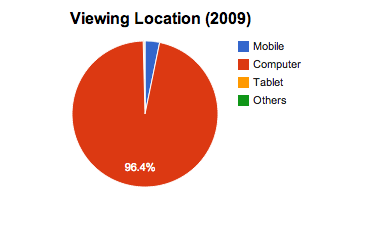
The trends towards mobile comes with good reason and concrete data. Here’s what our stats show: Nearly 97% of users accessed their church’s website via desktop in 2009:

Viewing2009

Keep in mind, this is only four years ago. Barack Obama was still a new President and poor ol’ Tiger Woods announced an “indefinite leave from professional golf” to work on his marriage. Seems like it was just yesterday but, of course, it wasn’t.

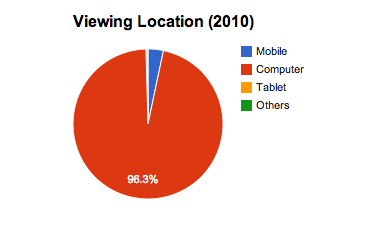
Our online viewing habits have changed significantly since then. Here’s how users accessed church websites in 2010:

JustinWisewebsite210

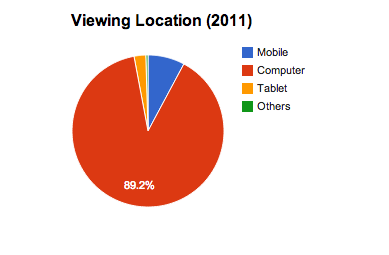
It isn’t a big change, but the divergence from desktop was just beginning to pick up steam. Keep in mind the first iPad was released in April 2010—a stake-in-the-ground moment for mobile/tablet usage. Here’s what the same chart in 2011 looked like:

JustinWiseviewinglocation2011

Desktop usage by church website users decreased 7.5% from 2009 to 2011. Desktop usage decreased another 1.7% in 2012, thus solidifying the downward trend for desktop internet use. Desktop is out. Mobile and tablet use is in. (Maybe that’s what led Google to declare “desktops will be irrelevant“…by 2013.)

Look at mobile-savvy cultures like India to see where the U.S. is headed in terms of website usage. According to Mary Meeker’s research, India become a mobile-first country in May 2012. for the first time in history, more people accessed the web in this country via mobile than did desktop.

JustinWisemobiletraffice 2012

This is not insignificant.

As the slide states, many more countries will follow. So will many churches. Organizations must begin considering a mobile-first environment. This can be especially daunting for churches who still wrestle with the purpose of their desktop-based website.

Conclusion

The data I’ve presented here is a small snippet of what we’ll be covering in our yearly “State of the Church Online” report, due out the end of this month. You can get early access to the report by joining our mailing list here.

Read more from Justin here.

Download PDF

Tags: , , , ,

| What is MyVisionRoom? > | Back to Communication >

ABOUT THE AUTHOR

Justin Wise

See more articles by >

COMMENTS

What say you? Leave a comment!

Chris O — 04/08/13 8:39 am

Hey, it looks like png 1, 2, and 3 isn't coming through. Would love to see the data! :)

Recent Comments
comment_post_ID); ?> Thank you for this information. I'm going to use this article to improve my work with the Lord.
 
— Abel Singbeh
 
comment_post_ID); ?> Thank you Ed for sharing your insights into the Church Growth Movement. I have my reservations with Church Growth models because it has done more damage than good in the Body of Christ. Over the years, western churches are more focused on results, formulas and processes with little or no emphasis on membership and church discipline. Pastors and vocational leaders are burnt out because they're overworked. I do believe that the Church Growth model is a catalyst to two destructive groups: The New Apostolic Reformation and the Emerging Church. Both groups overlap and have a very loose definition. They're both focus on contemporary worship, expansion of church brand (franchising), and mobilizing volunteering members as 'leaders' to grow their ministry. Little focus on biblical study, apologetics and genuine missional work with no agenda besides preaching of the gospel.
 
— Dave
 
comment_post_ID); ?> Thank you for sharing such a good article. It is a great lesson I learned from this article. I am one of the leaders in Emmanuel united church of Ethiopia (A denomination with more-than 780 local churches through out the country). I am preparing a presentation on succession planning for local church leaders. It will help me for preparation If you send me more resources and recommend me books to read on the topic. I hope we may collaborate in advancing leadership capacity of our church. God Bless You and Your Ministry.
 
— Argaw Alemu
 

Clarity Process

Three effective ways to start moving toward clarity right now.

Tracking an Emerging Role in Church Leadership: Pastor of Innovation

What may be emerging is a new role in the church: pastor of innovation. (Granted this may not become mainstream where every church would have one, since most churches have more pressing operational day-to-day needs.) I’ll do my part to keep this list updated. (Please do add to this list.)

How much of their job is pure innovation and experimentation? Would you like to know? Me too!

There are over 30+ definitions of innovation and over 6000+ definitions of leadership. Organizations, especially organized churches in the 21st century, need more innovation and more leadership, not less. What’s worked in the past is not working as well as it used to, so we as the Church capital-C must make room to develop new ways of doing things.

Peter Drucker has said, “Any time an organization fails to change at the rate of the world around it, that organization is doomed to failure.” and ”innovation is change that creates a new level of performance” and ”All organizations require one core competency: Innovation.

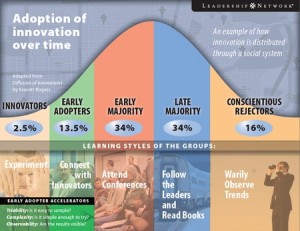
The chart below (from Leadership Network) illustrates how church innovations get adopted over time. As an experimenter, I’ve had very limited resources to experiment in developing innovations; I’m praying for more resources to do more. [disclosure: I do contract work with Leadership Network]

Innovation curve - LN

Rob Rynders makes a case for innovation in his denomination – Why The UMC Needs an Era of Innovation –

We need an intentional, grassroots, movement of innovators willing to put new ideas into action, fully realizing that many of those ideas will fail, but some will be successful. Even the failures will allow for immense learning, evaluation, further experimentation and adaption, ultimately leading to success. As successes and failures build, over time, we must apply those learnings from those models to other contexts and allow easy ways for others to learn, model, and adapt.

As mentioned in yesterday’s post, there are 4 levels of innovation, so not all innovation has to be risky and be revolutionary game-changers. Pastor Karl Vaters provides a helpful list for key questions to consider when preparing a church for change (and innovation) @ 10 Questions Every Innovative Small Church Pastor Needs to Ask.

Read more from DJ here.

Download PDF

Tags: , , ,

| What is MyVisionRoom? > | Back to Leadership >

ABOUT THE AUTHOR

D.J. Chuang

D.J. Chuang

D.J. is a Strategy Consultant for non-profits & churches with a focus on web strategy, social media, and online education.

See more articles by >

COMMENTS

What say you? Leave a comment!

RON M WEEKS — 05/13/13 7:21 pm

Faith in Various Expressions is now over the first year of being a forum on the internet. I am glad for all of those who shared and read the blogs and ideas offered and what next? I am confident that the next year will bring much more on how to bring forth information on faith growth.

Recent Comments
comment_post_ID); ?> Thank you for this information. I'm going to use this article to improve my work with the Lord.
 
— Abel Singbeh
 
comment_post_ID); ?> Thank you Ed for sharing your insights into the Church Growth Movement. I have my reservations with Church Growth models because it has done more damage than good in the Body of Christ. Over the years, western churches are more focused on results, formulas and processes with little or no emphasis on membership and church discipline. Pastors and vocational leaders are burnt out because they're overworked. I do believe that the Church Growth model is a catalyst to two destructive groups: The New Apostolic Reformation and the Emerging Church. Both groups overlap and have a very loose definition. They're both focus on contemporary worship, expansion of church brand (franchising), and mobilizing volunteering members as 'leaders' to grow their ministry. Little focus on biblical study, apologetics and genuine missional work with no agenda besides preaching of the gospel.
 
— Dave
 
comment_post_ID); ?> Thank you for sharing such a good article. It is a great lesson I learned from this article. I am one of the leaders in Emmanuel united church of Ethiopia (A denomination with more-than 780 local churches through out the country). I am preparing a presentation on succession planning for local church leaders. It will help me for preparation If you send me more resources and recommend me books to read on the topic. I hope we may collaborate in advancing leadership capacity of our church. God Bless You and Your Ministry.
 
— Argaw Alemu
 

Clarity Process

Three effective ways to start moving toward clarity right now.

Four Focusing Questions to Save Time with Social Media

The way to keep social media simple is to be selective.

Social Media can be overwhelming. Don’t get me wrong: I love social media. 

Social Media exists for three reasons:

  1. to connect with people
  2. to share with others
  3. to learn from others

If you feel like you are spending too much time with social media,

Ask yourself these questions:

  1. Why do I want to go to this social media site?
  2. Is this site more conducive to broadcasting or engaging in a network of people?
  3. What’s the benefit of this social media site to me?
  4. Am I looking to pass the time using a social media?

Here are the Apps I use:

  • Instagram. I love taking pictures. I love learning form others. Some great connections have been made over the last years.
  • I use the free Buffer App to schedule the sharing of things I think are important. This saves me lot’s of time and I don’t have to be online all day.
  • I used the JustUnfollow service to unfollow some people on Twitter whom I had no idea why I was following. A cleaner twitter stream means I’m less likely to miss out on what my friends have to say when I log in to join the conversation.
  • Hootsuite. I enjoy being involved in chats, and answering and asking questions online.  I respond to nearly everything…just not necessarily the very second you contact me.
  • My goal is to check in on Twitter and Facebook at least twice a day to keep the conversation going.

I’ve turned off notifications on my phone for my Social Media apps. By having these social media apps off on my iPhone means I’m fully present locally but able to connect without distraction online when I do log in each day.

Tell me…How do you keep social media simple?

This post is inspired by Dana Byers

Read more from N.D. here.

Download PDF

Tags: , ,

| What is MyVisionRoom? > | Back to Communication >

ABOUT THE AUTHOR

ND Strupler

ND Strupler

I was born in Zurich, Switzerland 1973 and lived in Switzerland and the USA. I am married since 1994 with Sophal Strupler. Proud father of 2 beautiful kids. (Noa Noëmi 2000, Kimo 2002). I love to inspire & maximize leaders. I like photography, social media + communication. I am creative, innovative and enjoy life with God. I have a clear vision to change culture. The most effective way to change culture is through healthy communities that reflect the love of God in everyday life. And that’s why I love to help leaders plant new life-giving churches. (ICF Movement)

See more articles by >

COMMENTS

What say you? Leave a comment!

Recent Comments
comment_post_ID); ?> Thank you for this information. I'm going to use this article to improve my work with the Lord.
 
— Abel Singbeh
 
comment_post_ID); ?> Thank you Ed for sharing your insights into the Church Growth Movement. I have my reservations with Church Growth models because it has done more damage than good in the Body of Christ. Over the years, western churches are more focused on results, formulas and processes with little or no emphasis on membership and church discipline. Pastors and vocational leaders are burnt out because they're overworked. I do believe that the Church Growth model is a catalyst to two destructive groups: The New Apostolic Reformation and the Emerging Church. Both groups overlap and have a very loose definition. They're both focus on contemporary worship, expansion of church brand (franchising), and mobilizing volunteering members as 'leaders' to grow their ministry. Little focus on biblical study, apologetics and genuine missional work with no agenda besides preaching of the gospel.
 
— Dave
 
comment_post_ID); ?> Thank you for sharing such a good article. It is a great lesson I learned from this article. I am one of the leaders in Emmanuel united church of Ethiopia (A denomination with more-than 780 local churches through out the country). I am preparing a presentation on succession planning for local church leaders. It will help me for preparation If you send me more resources and recommend me books to read on the topic. I hope we may collaborate in advancing leadership capacity of our church. God Bless You and Your Ministry.
 
— Argaw Alemu
 

Clarity Process

Three effective ways to start moving toward clarity right now.

6 Shifts Necessary in Leading and Mentoring the iGeneration

Have you been keeping up with demographics? Almost half the world’s population is 25 and under. That’s about three billion young people. If we’re really serious about reaching the world, we must get serious about understanding and connecting with these kids. Just three years ago in America, Generation Y reached a milestone. (They are the youth born between 1984 and 2002). They’re now the largest generation in American history, passing up the Baby boomers in size, at 80 million people.

I call the youngest members, born since 1990: “Generation iY.” I use this term because they’ve grown up on-line, impacted by the “i” world—iTunes, iPhones, iPods, iMacs, iPads…and for many of them, life is pretty much about “I.” We’ve raised a more self-absorbed batch of kids than their earlier counterparts.

Much more than their predecessors in Generation X, young people from Generation iY seem to be acting as a generational group. In some ways, the university students I talk to in the U.S. feel they belong to each other. They’re truly connected, both via technology as well as a community across the globe. The recruiting chief at L’Oreal, Francois De Wazieres, agrees that these kids are surprisingly similar. “One thing I find to be very universal is that they have international experiences, are eager to take on the world and value their relationships…whether they are from Malaysia, India, France, Argentina, or the U.S, they wear similar clothing, have the same iPods, and mix and connect easily. Two hours after meeting, they’re probably best friends on Facebook.” This, of course, doesn’t sound bad. What’s wrong with a tight-knit demographic like this?

Some may view this generation’s size and connection as a warm, fluffy phenomenon that has no downside. I hope they are right. Unfortunately, with my ear to the ground, I am picking up some signals that could be trouble if we fail to respond well. Let me tell this story beginning with Generation iY in America.

A Rising Generation and a Retiring Generation

Our situation has even greater ramifications than the ones above. Because we have two large generations sandwiching a smaller one in between, we have a new challenge on our hands here at home. The following two lines summarize the challenge in front of us:

1. Young people (Generation Y) will be entering the marketplace in greater numbers and more quickly than we can prepare them.

2. Older people, (the Baby Boomer generation) will be retiring in greater numbers and more quickly than we can replace them.

This is one of the most crucial tests we’ll face in our lifetime. It will impact everyone and yet few seem aware of the dilemma it presents for our generation. Unless we raise the standard for kids today and help them to think and act like authentic leaders, they will not be ready for the responsibility thrust on them as they enter adulthood. Generation Y is already the fastest growing segment of the workforce, and with immigration, some social scientists say it could reach 100 million strong. While the generation of younger children is much smaller (in America, some call them “Homelanders,” as they’re born after the launch of the Department of Homeland Security), there is a swelling of teens and twenty-somethings. Here’s why our problem is amplified in America. The Baby Boomers (78 million) are aging. The first wave has already begun retiring. In fact, during the next decade, about 45% of the workforce will vanish. And they’ll continue retiring for the next eighteen years. There is a much smaller population behind them—Generation X (46 million). Just do the math and you can see there are not enough leaders within Generation X to fill the spots vacated by the Baby Boomers. Someone must fill those roles. Ready or not, our kids today will be our leaders.

So, how should we lead these young people? May I talk straight? We must master the art of mentoring them and leading them. Let me suggest six shifts we must make:

1. Don’t think CONTROL, think CONNECT.

Often our ambition as a parent or leader is to seize control. Studies show that parents who over-program their child’s schedule often breed kids who rebel as teens. Instead, wise leaders work to connect with them. Why? Because once we connect, we build a bridge of relationship that can bear the weight of truth. We earn our right to influence them.

2. Don’t think INFORM, think INTERPRET.

This is the first generation of kids that don’t need adults to get information. It’s coming at them 24/7. What they need from us is interpretation. Their knowledge has no context. We must help them make sense of all they know as they build a wise and healthy worldview.

3. Don’t think ENTERTAIN, think EQUIP.

I’ve seen parents who are consumed with entertaining their child. I know teachers who approach their classrooms the same way. A better perspective may be: how can I equip my young person for the future? If I give them relevant tools to succeed, they’ll stay engaged. Happiness is a by-product. True satisfaction comes from growth.

4. Don’t think “DO IT FOR THEM” think “HELP THEM DO IT.”

Adults have been committed to giving kids a strong self-esteem for thirty years now. According to the American Psychological Association, healthy and robust self-esteem actually comes from achievement not merely affirmation. We lead for the long-term not the short term. Sure it’s quicker to do it yourself—but it’s better to transfer a skill.

5. Don’t think IMPOSE, think EXPOSE.

When adults become scared a kid is falling behind, we tend to impose a rule or a behavior on them. While mandatory conduct is part of life, if kids feel forced to do it; they usually don’t take ownership of it; it’s your idea not theirs. Why not think “expose” instead of impose. Show them something. Give them an opportunity they can’t pass up.

6. Don’t think PROTECT, think PREPARE.

Adults paranoid about the safety of our kids. Sadly, in our obsession over safety, we’ve failed to prepare them for adulthood. Instead of fearing for them, it’s better to recall your entrance into adulthood and discuss what you learned that helped you succeed. The greatest gift a parent can give their child is the ability to get along without them.

7. Don’t think LECTURE, think LAB.

When young people do wrong, we’re predisposed to lecture them. While it’s a quick way to transmit an idea, it’s not the best way to transform a life. We must create experiences from which we can process truths—like science class—a lab with a lecture. They’re not looking for a sage on the stage with a lecture but a guide on the side with an experience.

Read the full story here.

Read more from Tim here.

Download PDF

Tags: , , ,

| What is MyVisionRoom? > | Back to Leadership >

ABOUT THE AUTHOR

Tim Elmore

Tim Elmore

Tim Elmore is the founder and president of Growing Leaders. His latest book Habitudes for the Journey is designed to master the art of navigating life’s critical transitions.

See more articles by >

COMMENTS

What say you? Leave a comment!

Recent Comments
comment_post_ID); ?> Thank you for this information. I'm going to use this article to improve my work with the Lord.
 
— Abel Singbeh
 
comment_post_ID); ?> Thank you Ed for sharing your insights into the Church Growth Movement. I have my reservations with Church Growth models because it has done more damage than good in the Body of Christ. Over the years, western churches are more focused on results, formulas and processes with little or no emphasis on membership and church discipline. Pastors and vocational leaders are burnt out because they're overworked. I do believe that the Church Growth model is a catalyst to two destructive groups: The New Apostolic Reformation and the Emerging Church. Both groups overlap and have a very loose definition. They're both focus on contemporary worship, expansion of church brand (franchising), and mobilizing volunteering members as 'leaders' to grow their ministry. Little focus on biblical study, apologetics and genuine missional work with no agenda besides preaching of the gospel.
 
— Dave
 
comment_post_ID); ?> Thank you for sharing such a good article. It is a great lesson I learned from this article. I am one of the leaders in Emmanuel united church of Ethiopia (A denomination with more-than 780 local churches through out the country). I am preparing a presentation on succession planning for local church leaders. It will help me for preparation If you send me more resources and recommend me books to read on the topic. I hope we may collaborate in advancing leadership capacity of our church. God Bless You and Your Ministry.
 
— Argaw Alemu
 

Clarity Process

Three effective ways to start moving toward clarity right now.

Five Reminders for Making Ministry Videos Viral

An interesting insight into what makes social content effective has emerged, or at least made itself more visible, in the past year or so. Content is king, but editing may be the queen who’s actually running the castle.

Our traditionally analog means of consuming media—television, newspaper, radio, outdoor—are quickly being replaced by digital means. We supplement TV watching with our iPads, get our news in near real time from Twitter, and share life’s moments in an instant on Facebook.

This consumption of digital content has led to the concept of “virality.” Just a few years ago this concept didn’t exist. Videos, images and articles didn’t “go viral.” Exposure on all levels, particularly for advertising, was limited to the very rich or very lucky.

Now individuals, media outlets and brands alike are owning their channels, creating and publishing content in hopes of that content’s being consumed, appreciated and shared. So now the question is not whether or not to own a channel and create content but what type of content is most likely to be shared. This leads to other questions. What resonates with audiences? Where do they consume it? Why do they share it?

THAT’S WHERE EDITING COMES IN

If you’re reading this, it is likely that within the past day or so you’ve encountered an article by the likes of BuzzFeed, This Advertising Life, ICanHazCheezburger? and any of a number of other sites (there are millions) dedicated to curating and sharing quick bites of content.

But what’s important is not so much why the editors at BuzzFeed create this content; it’s more the lessons learned from how they do it. BuzzFeed has concocted a lethal formula for social-publishing success, combining dozens of unique pieces of content each day with pop culture, timeliness, topics proven to be shareable and brevity. Most articles contain images with captions, and only a few articles contain more than a couple of hundred words.

WHAT DOES ALL THIS MEAN FOR BRANDS?

The idea of editing and succinctness isn’t just a concept for media outlets pushing Grumpy Cat memes and Gangnam Style videos. There is a correlation between the success of viral-media sites and the success of brands on Facebook, Twitter, Pinterest, Vine and other channels. Shorter content works (hence the existence of Twitter, Vine and Instagram). Here are a few tips to keep in mind when creating content in hopes of achieving viral success:

1. Understand your platform
What works for Facebook doesn’t necessarily work for Twitter. Write with the platform (and its audience) in mind.

2. Push the boundaries
Many platforms have technical limitations, but that doesn’t mean the boundaries aren’t there to be pushed. Brands are already using Vine for creative stop-motion videos.

3. Stay on topic
Nothing can derail a shareable piece of content like too much irrelevant content. Stay focused and stick to what your headline promises (easier said than done, especially for me).

4. Don’t under-deliver
If you’re spending more time on your headline than on your content, you’re doing it wrong. Don’t promise “10 Tricks You’ve Never Heard Of” only to repurpose tricks everyone has heard of.

5. You can sacrifice time or quality, but not both
If your content is quick, audiences will forgive a lack of quality. But if you’re publishing long-form content, the production quality must be able to override the audience’s brief attention span (think Harlem Shake versus Kony 2012).

Of course, a brand’s content-marketing strategy must correspond to its goals, since bite-size content won’t work for every brand. But in 2013, there’s no question of the power of effective editing and the shareability of entertaining short-form content. Thinking like an editor when creating your brand’s content may just turn ordinary into viral. 

Read the full story here.

Read more from Jon here.
Download PDF

Tags: , , ,

| What is MyVisionRoom? > | Back to Vision >

ABOUT THE AUTHOR

Jon Thomas

See more articles by >

COMMENTS

What say you? Leave a comment!

Recent Comments
comment_post_ID); ?> Thank you for this information. I'm going to use this article to improve my work with the Lord.
 
— Abel Singbeh
 
comment_post_ID); ?> Thank you Ed for sharing your insights into the Church Growth Movement. I have my reservations with Church Growth models because it has done more damage than good in the Body of Christ. Over the years, western churches are more focused on results, formulas and processes with little or no emphasis on membership and church discipline. Pastors and vocational leaders are burnt out because they're overworked. I do believe that the Church Growth model is a catalyst to two destructive groups: The New Apostolic Reformation and the Emerging Church. Both groups overlap and have a very loose definition. They're both focus on contemporary worship, expansion of church brand (franchising), and mobilizing volunteering members as 'leaders' to grow their ministry. Little focus on biblical study, apologetics and genuine missional work with no agenda besides preaching of the gospel.
 
— Dave
 
comment_post_ID); ?> Thank you for sharing such a good article. It is a great lesson I learned from this article. I am one of the leaders in Emmanuel united church of Ethiopia (A denomination with more-than 780 local churches through out the country). I am preparing a presentation on succession planning for local church leaders. It will help me for preparation If you send me more resources and recommend me books to read on the topic. I hope we may collaborate in advancing leadership capacity of our church. God Bless You and Your Ministry.
 
— Argaw Alemu
 

Clarity Process

Three effective ways to start moving toward clarity right now.

12 Questions to Help New Leaders Thrive in a New Ministry Position

Congratulations! You made it! You’re the new leader. Now what?

I know you’re supposed to always look like you know what you’re doing but — truth be told — new leaders often don’t even know where to start. They drift around for a month or so, smiling a lot, ordering new stationery while they act as if they’ve got it covered.

I came across this all-too-familiar scenario recently while coaching a young executive at a non-profit. He had been moved unexpectedly to a new division after achieving some success in another department. The move caught him by surprise, but he threw himself into it with all the energy he could find.

When we first met, I asked the young executive what questions he had. He sheepishly shrugged his shoulders and admitted, “I’m not even sure what questions I should be asking.”

I suspect he’s not alone. As I thought back over times when I’ve tackled a new leadership position, I remembered the same uncertainty. I also recalled 12 questions I asked or — knowing what I know now — wish I had asked.

It’s an impartial list, of course, but these 12 questions should help any new leader prepare to thrive in a new position.

1. Who are the key influencers on your new team? It shouldn’t take long to figure out who everyone already respects and follows. They can make or break you. By applying the 80/20 principle, plan to invest a disproportionate amount of time with these key influencers to gain their buy-in before getting too far into your new digs. If you don’t, you might not stay long.

2. What exactly is expected of you? The last few times I’ve started a new position, I took the time to unpack the job description in great detail. I ended up with an outline of my duties that filled 8-10 pages, typed, single-spaced. I only reviewed my outline annually after that, but the process of breaking it all down can help you be sure you’re not missing anything that might surprise you later.

3. What exactly are you expected to do? This question from John Maxwell is one you need to ask of your supervisor. I’m amazed at how often it isn’t asked, only assumed — until later when performance evaluations are due. Too late. Better to ask specifically up front to help you know what you are personally expected to do and what you can delegate to others.

4. How will your success be measured? I am again surprised by how few leaders, especially in ministry and non-profits, ever ask this question. Most of us thrive when we know the standards being used to evaluate us and become paranoid or even resentful when we find out after the fact that we didn’t measure up. Get clarity by asking clearly.

5. How are you perceived by your new team? Our own self-image seldom matches reality. Just because you think you’re awesome, doesn’t mean anyone else on your new team does — or cares about your previous success. In some cases, you might even detect resistance to your arrival because of your success elsewhere.

6. Are you talking enough? Silence speaks. When we choose to say nothing, we’re still saying something. We’ve simply surrendered control of the message. Your team will fill in the silence by reaching into their own insecurities. And that can’t be good. The absence of intentional communication is communication.

7. Have you enlisted a coach or mentor to guide you? Let’s face it. You’re in uncharted waters. Your new position requires insight and wisdom you just don’t have yet. If it doesn’t, you’re probably not in the right position. Recruit a coach — or several — who have been there, done that. They can save you a lot of pain.

8. Are you ready to pay the price to grow? Every learning curve requires a high initial investment of time and energy — but the payoff can be huge. That’s just part of the deal. But the curve is also the place to grow like nowhere else. The greatest potential for the most explosive personal growth is found only in the curve. Prepare to lean into it. Just for a little while.

9. Are you protecting what empowers you? As you tackle the curve, the leadership process will drain you quickly if you don’t protect what energizes you. It might be family time, physical exercise, spiritual growth — whatever it is for you, fiercely defend it or you’ll burn out before your team is done with the donuts you bought them.

10. Are you leaving a margin for what you don’t know? As Catalyst CEO Brad Lomenick put it in his recent post Make Time for Margins, “Margin in our lives overall creates options. Options to pursue dreams, think, pray, relax, meditate, process, grow and ultimately live life more fully.” Expect the unexpected. Plan for it. And be happier because of it.

11. Where are you going? Simple question — or at least we’d like to think it should be. But do you know your mission and can you share it easily? Is it simple enough for your team to spread and repeat it. As Andy Stanley asked at Catalyst Atlanta last fall, does everyone on your team know what a win is?

12. How will my team know that I care? The tried adage is also true — people don’t care how much you know until they know how much you care. Be intentional about showing them your heart. It’s especially easy for new leaders to focus instead on efficiency as a measure of success. Better to take a page from the order of Disney’s guest service priorities: safety, courtesy, show, and then efficiency. Let people be your bottom line.

What questions would you suggest new leaders ask when starting a new position?

Read more from Bill here.

 
Download PDF

Tags: , , ,

| What is MyVisionRoom? > | Back to Leadership >

ABOUT THE AUTHOR

Bill Blankschaen

Bill Blankschaen

Bill Blankschaen is a proven non-profit leader, writer, speaker, and ministry consultant who equips Christians to think, live, and lead with abundant faith. He blogs at FaithWalkers at Patheos.

See more articles by >

COMMENTS

What say you? Leave a comment!

Recent Comments
comment_post_ID); ?> Thank you for this information. I'm going to use this article to improve my work with the Lord.
 
— Abel Singbeh
 
comment_post_ID); ?> Thank you Ed for sharing your insights into the Church Growth Movement. I have my reservations with Church Growth models because it has done more damage than good in the Body of Christ. Over the years, western churches are more focused on results, formulas and processes with little or no emphasis on membership and church discipline. Pastors and vocational leaders are burnt out because they're overworked. I do believe that the Church Growth model is a catalyst to two destructive groups: The New Apostolic Reformation and the Emerging Church. Both groups overlap and have a very loose definition. They're both focus on contemporary worship, expansion of church brand (franchising), and mobilizing volunteering members as 'leaders' to grow their ministry. Little focus on biblical study, apologetics and genuine missional work with no agenda besides preaching of the gospel.
 
— Dave
 
comment_post_ID); ?> Thank you for sharing such a good article. It is a great lesson I learned from this article. I am one of the leaders in Emmanuel united church of Ethiopia (A denomination with more-than 780 local churches through out the country). I am preparing a presentation on succession planning for local church leaders. It will help me for preparation If you send me more resources and recommend me books to read on the topic. I hope we may collaborate in advancing leadership capacity of our church. God Bless You and Your Ministry.
 
— Argaw Alemu
 

Clarity Process

Three effective ways to start moving toward clarity right now.

Three Implications of Understanding New Testament Worship

What is worship?

More specifically, what does it mean to worship? Is there a right way or a wrong way to do it?

Is it singing, clapping and/or raising your hands at your local church on Sunday… or is there something more to it than that?

The question of what worship is is extremely important. Far too many arguments have been had over what is and is not a legitimate form of worship. Preferences can too easily become elevated to precepts if we’re not carefully grounding our understanding of worship in what we see in the Bible.

Worship is singing… but not only singing.

Many Christians today understand worship as singing. When we talk about Sunday morning, we refer to congregational singing as “worship.” When we say, “I really enjoyed the worship,” we almost always mean “I really enjoyed the music.”

This isn’t entirely wrong… it’s just incomplete. There are clear examples of singing as worship found in Scripture (see Ex. 15:1, 21; Num. 21:17; Judges 5:3; 2 Sam. 22:50; Psa. 5:11; 7:17; 9:2, 11; 18:49; 33:3; 1 Cor. 14:15, 26; Eph. 5:19; Col. 3:16). We’re admonished to sing to the Lord and to encourage one another with hymns and spiritual songs.

So singing, biblically, is a part of worship.

However, we must be careful not to equate worship with singing and music.

The word “worship” at its most basic level means to ascribe worth. This is helpful to keep in mind, especially when you consider the words translated as “worship.” The two most commonly used words in Hebrew and Greek that we often translate as “worship” (ḥā·wā[h] and proskyneō) refer to bowing or kneeling down, both to God and to men.

They describe an act of reverential deference.

This is the important thing to understand, then, about worship. It’s not merely about singing, it’s about reverence—it’s about having a biblical fear of the Lord.

At its most basic level, then, you could define worship as the humbling of yourself before the One who is your better.

This, naturally, has serious implications.

Worship is not primarily about how you feel.

First, if worship is about humbling yourself before God, we have to consider the place of our feelings. Many today seem to equate fired up feelings with genuine affection for the Lord. The louder the music, the higher the hands are raised, the more our hearts must be inclined toward God… right?

But this understanding places too much emphasis on feelings. We must always remember that while emotional expressiveness can be a sign of genuine affection, “Nothing can be certainly known of the nature of religious affections by this, that they much dispose persons with their mouths to praise and glorify God,” as Jonathan Edwards puts it so well in Religious Affections.

His point is simple: people can fervently praise God with their mouths and still be far off from Him. This is much the same warning Paul gives when he tells the Corinthians that you can have a great outward show, but without love, it’s worthless (cf. 1 Cor. 13:1-3).

Is it any wonder that Jeremiah reminds us not to put too much stock in our feelings (Jer. 17:9)?

Worship is what you do every moment of every day.

Second, in the Old Testament, particularly once the nation of Israel is established, there’s a definite connection between place and worship. God’s people were to worship in a specific place (first the Tabernacle, then the Temple). This was the meeting place between God and His people. At the Temple, God’s people would offer sacrifices for the forgiveness of sin, peace offerings to God, and numerous other offerings and acts of service.

It can be tempting to take the imagery of the Temple worship and place it upon the local church. However, the New Testament doesn’t allow for this. Instead, starting with Jesus, the New Testament presents a definite shift away from “place and time” worship to “every moment, everywhere” worship.

In his discussion with the woman at the well, Jesus tells her:

Woman, believe me, the hour is coming when neither on this mountain nor in Jerusalem will you worship the Father. You worship what you do not know; we worship what we know, for salvation is from the Jews. But the hour is coming, and is now here, when the true worshipers will worship the Father in spirit and truth, for the Father is seeking such people to worship him. God is spirit, and those who worship him must worship in spirit and truth. (John 4:21-24, emphasis added)

I appeal to you therefore, brothers, by the mercies of God, to present your bodies as a living sacrifice, holy and acceptable to God, which is your spiritual worship. (Romans 12:1)

Through him then let us continually offer up a sacrifice of praise to God, that is, the fruit of lips that acknowledge his name. Do not neglect to do good and to share what you have, for such sacrifices are pleasing to God. (Hebrews 13:15-16)

While I’ve only included a few brief examples, the general thrust of the New Testament, while never neglecting the importance of believers gathering together in corporate worship (1 Cor. 14:25), drastically broadens our understanding of what worshipping God truly is. It’s not a matter of getting together on Sunday, singing songs, giving money, listening to a sermon and heading home for the rest of the week to do whatever we want.

Every moment of every day is to be an act of worship to God.

This brings us to the most serious implication of the New Testament understanding of worship: our need for the gospel.

The gospel perfects our worship.

On our best days, our efforts are half-hearted, our motives conflicted. The flesh is constantly at war with the spirit… it’s no wonder Martin Luther said that Christians are all simultaneously sinners and saints (see Rom 7). If our worship were up to us alone, we’d be utterly lost. None of it would be pleasing and acceptable to God.

But this is where the good news of the gospel aids us in our worship—Jesus is the perfect worshipper. In His incarnation, He obeyed every command of God without flaw or failure. His devotion is unwaivering.

He gives us His perfect worship to cover our imperfect offerings of songs, service and sacrifice.

The gospel gives us reason to stand before the throne of grace, imperfect as we are, because we have an Advocate there who has completed the work for us, one who appeals to us to rely on Him increasingly to purify our motives, and perfect our worship (cf. Heb. 4:16).

That’s what biblical worship looks like. Don’t settle for a substitute.

 Read more from Aaron here.
Download PDF

Tags: , ,

| What is MyVisionRoom? > | Back to Environments >

ABOUT THE AUTHOR

Aaron Armstrong

Aaron Armstrong

Aaron is the author of Awaiting a Savior: The Gospel, the New Creation, and the End of Poverty (Cruciform Press, 2011). He is a writer, serves as an itinerant preacher throughout southern Ontario, Canada, and blogs daily at Blogging Theologically.

See more articles by >
COMMENTS

What say you? Leave a comment!

Recent Comments
comment_post_ID); ?> Thank you for this information. I'm going to use this article to improve my work with the Lord.
 
— Abel Singbeh
 
comment_post_ID); ?> Thank you Ed for sharing your insights into the Church Growth Movement. I have my reservations with Church Growth models because it has done more damage than good in the Body of Christ. Over the years, western churches are more focused on results, formulas and processes with little or no emphasis on membership and church discipline. Pastors and vocational leaders are burnt out because they're overworked. I do believe that the Church Growth model is a catalyst to two destructive groups: The New Apostolic Reformation and the Emerging Church. Both groups overlap and have a very loose definition. They're both focus on contemporary worship, expansion of church brand (franchising), and mobilizing volunteering members as 'leaders' to grow their ministry. Little focus on biblical study, apologetics and genuine missional work with no agenda besides preaching of the gospel.
 
— Dave
 
comment_post_ID); ?> Thank you for sharing such a good article. It is a great lesson I learned from this article. I am one of the leaders in Emmanuel united church of Ethiopia (A denomination with more-than 780 local churches through out the country). I am preparing a presentation on succession planning for local church leaders. It will help me for preparation If you send me more resources and recommend me books to read on the topic. I hope we may collaborate in advancing leadership capacity of our church. God Bless You and Your Ministry.
 
— Argaw Alemu
 

Clarity Process

Three effective ways to start moving toward clarity right now.