Recharge: 7 Ways to Improve Innovative Thinking

In this volatile world the old model of process innovation needs a new framework. It isn’t in sync with the way our minds work, which brain research tells us is more serendipitous than linear.

Innovation just doesn’t lend itself to being predictable and risk free. Innovation demands looking at the world differently, and finding connections between seemingly disconnected things.

Corporate protocol, management hierarchies, and rigid assumptions about people’s needs often create anxiety and stifle freedom of thought and exploration.

It’s surprising that we repeat things in business even when we don’t get the results we want, but we’re creatures of habit and old habits are hard to break. Changing a routine takes time and thought out of our busy work lives and there is a risk in trying something new. Even something that is simple and accessible and that has an obvious benefit doesn’t always go over right away.

It’s time for a change.

Endorse unexpected questions. Challenge existing assumptions. It’s better in the long run to have a hunch that something might work and try it out than it is to declare “I know this will work” and invest in proving it. Make sure people are out in the field with customers seeing how they use things, seeing what fails, getting their hands dirty. The process is non-linear and, yes, chaotic.

Here is your opportunity to completely recharge innovative thinking within your organization, while at the same time halting the vicious cycle of failure. There are 7 surprisingly simple things you can do right now to ignite your thinking, invigorate existing ideas, and boost productivity.

If organizations want to innovate the way successful bold newcomers have, they have to unplug from the constraints of “That’s the way we’ve always done it” and recharge, starting with the mantra, “Let’s just not do that anymore.  – Debra Kaye


>> Download 7 Ways to Improve Innovative Thinking here.

Downloadicon1

Download PDF

Tags: , , ,

| What is MyVisionRoom? > | Back to Leadership >

ABOUT THE AUTHOR

Debra Kaye

Debra Kaye is an international innovation consultant specializing in brand and culture strategy for consumer businesses. Her clients have included Apple, Mars, Colgate, McDonald’s, American Express, Kimberly-Clark and many more. A frequent commentator on American Public Radio’s “Marketplace” and contributor to Fast Company, Kaye is a partner at the innovation consultancy Lucule and former CEO of TBWA\Italy.

See more articles by >

COMMENTS

What say you? Leave a comment!

Recent Comments
comment_post_ID); ?> Thank you for this information. I'm going to use this article to improve my work with the Lord.
 
— Abel Singbeh
 
comment_post_ID); ?> Thank you Ed for sharing your insights into the Church Growth Movement. I have my reservations with Church Growth models because it has done more damage than good in the Body of Christ. Over the years, western churches are more focused on results, formulas and processes with little or no emphasis on membership and church discipline. Pastors and vocational leaders are burnt out because they're overworked. I do believe that the Church Growth model is a catalyst to two destructive groups: The New Apostolic Reformation and the Emerging Church. Both groups overlap and have a very loose definition. They're both focus on contemporary worship, expansion of church brand (franchising), and mobilizing volunteering members as 'leaders' to grow their ministry. Little focus on biblical study, apologetics and genuine missional work with no agenda besides preaching of the gospel.
 
— Dave
 
comment_post_ID); ?> Thank you for sharing such a good article. It is a great lesson I learned from this article. I am one of the leaders in Emmanuel united church of Ethiopia (A denomination with more-than 780 local churches through out the country). I am preparing a presentation on succession planning for local church leaders. It will help me for preparation If you send me more resources and recommend me books to read on the topic. I hope we may collaborate in advancing leadership capacity of our church. God Bless You and Your Ministry.
 
— Argaw Alemu
 

Clarity Process

Three effective ways to start moving toward clarity right now.

Good Doctrine Demands We Teach About Money

As a Pastor, I’m well aware of how many people have the assumption that “all Pastors want to talk about is money.” The funny thing is, after twenty years in ministry and communicating regularly with thousands of pastors, I can firmly assert that talking about money is one of our least favorite things to do, especially in our culture where personal finances are very… personal.

But the Apostle Paul wrote to a younger Pastor in Ephesus named Timothy once and told him to “Teach and urge these things… there is great gain in godliness with contentment… but those who desire to be rich fall into temptation… for the love of money is the root of all evil… As for the rich in this present age, charge them not to be haughty, nor to set their hopes on the uncertainty of riches.” (1 Timothy 5:2-17 ESV)

In other words, good doctrine (which literally means “teaching”) demands that we address the issue of money. Here are several reasons why the church NEEDS to talk about finances…

  • Money is a gift from God to be managed for a season, not an earned commodity to be consumed for pleasure alone.
  • How we use money is a matter of worship – it demonstrates our values and what is important to us.
  • It’s pretty obvious people NEED help in this area – we’re strapped and stressed because of terrible management.
  • Generosity is a key value of the Christian life, for the church and for the individual Christian.
  • Money needs to serve the needs of man and the causes of justice, rather than man serving under the tyranny of money.
  • Money makes missions happen, which is God’s chief business and area of concern – the spread of the gospel deserves to be resourced.

If you don’t want the church to teach about money because it’s “none of their business,” you should change the way you see it. Nobody in the church (at least not my church) wants to see your budget or bank statements. We simply want to help people get healthy financially and become generous with our resources so that everyone experiences God’s blessings. In other words, my church doesn’t want something from you, we want something for you.

I’m really just scratching the surface here. There is much more to be said about the role of giving and stewardship in discipleship. What did I miss?

> Read more from Brandon.

Download PDF

Tags: , , , , ,

| What is MyVisionRoom? > | Back to Resourcing >

ABOUT THE AUTHOR

Brandon Cox

Brandon Cox has been a Pastor for fifteen years and is currently planting a church in northwest Arkansas, a Saddleback-sponsored church. He also serves as Editor of Pastors.com and Rick Warren's Pastors' Toolbox, and authors a top 100 blog for church leaders (brandonacox.com). He's also the author of Rewired: Using Technology to Share God's Love.

See more articles by >

COMMENTS

What say you? Leave a comment!

Recent Comments
comment_post_ID); ?> Thank you for this information. I'm going to use this article to improve my work with the Lord.
 
— Abel Singbeh
 
comment_post_ID); ?> Thank you Ed for sharing your insights into the Church Growth Movement. I have my reservations with Church Growth models because it has done more damage than good in the Body of Christ. Over the years, western churches are more focused on results, formulas and processes with little or no emphasis on membership and church discipline. Pastors and vocational leaders are burnt out because they're overworked. I do believe that the Church Growth model is a catalyst to two destructive groups: The New Apostolic Reformation and the Emerging Church. Both groups overlap and have a very loose definition. They're both focus on contemporary worship, expansion of church brand (franchising), and mobilizing volunteering members as 'leaders' to grow their ministry. Little focus on biblical study, apologetics and genuine missional work with no agenda besides preaching of the gospel.
 
— Dave
 
comment_post_ID); ?> Thank you for sharing such a good article. It is a great lesson I learned from this article. I am one of the leaders in Emmanuel united church of Ethiopia (A denomination with more-than 780 local churches through out the country). I am preparing a presentation on succession planning for local church leaders. It will help me for preparation If you send me more resources and recommend me books to read on the topic. I hope we may collaborate in advancing leadership capacity of our church. God Bless You and Your Ministry.
 
— Argaw Alemu
 

Clarity Process

Three effective ways to start moving toward clarity right now.

7 Types of People You Need to Lose the Most

In leadership, you always face your share of critics.

Everyone has an opinion, and if you’re like me, you can get focused on keeping people happy, which is always a critical leadership mistake. Your church or your organization isn’t for everyone (here’s why).

Usually, the discussion at the leadership table will end up with someone saying:

Look, we can’t afford to lose people. 

Sometimes that’s true.

Often, it’s simply not.

In fact, often the opposite is true.

The people you are most afraid of losing are the people you most need to lose.

Truthfully, you can’t afford to keep them.

Who You Can’t Afford to Keep

So who can you not afford to keep if you want your mission to move forward?

1. You can’t afford to keep perpetual critics.

2. You can’t afford to keep people who are opposed to everything.

3. You can’t afford to keep people who drain the energy and health out of a church or organization.

4. You can’t afford to keep people who contribute nothing and criticize everything.

5. You can’t afford to keep people who have no vision of what the future should be, only a vision for what the future shouldn’t be.

6. You can’t afford to keep people who put their own preferences ahead of your organization’s principles.

7. You can’t afford to keep people who always resist change.

Your mission is just too important.

So next time you face critics who are threatening to walk out the door, don’t ask yourself if you can afford to lose them.

Ask if you can afford to keep them.

It might completely change your approach…and your decisions.

> Read more from Carey.

Download PDF

Tags: ,

| What is MyVisionRoom? > | Back to Leadership >

ABOUT THE AUTHOR

Carey Nieuwhof

Carey Nieuwhof

Carey Nieuwhof is lead pastor of Connexus Community Church and author of the best selling books, Leading Change Without Losing It and Parenting Beyond Your Capacity. Carey speaks to North American and global church leaders about change, leadership, and parenting.

See more articles by >

COMMENTS

What say you? Leave a comment!

Josh — 05/02/17 4:24 am

Thanks Carey :)

Recent Comments
comment_post_ID); ?> Thank you for this information. I'm going to use this article to improve my work with the Lord.
 
— Abel Singbeh
 
comment_post_ID); ?> Thank you Ed for sharing your insights into the Church Growth Movement. I have my reservations with Church Growth models because it has done more damage than good in the Body of Christ. Over the years, western churches are more focused on results, formulas and processes with little or no emphasis on membership and church discipline. Pastors and vocational leaders are burnt out because they're overworked. I do believe that the Church Growth model is a catalyst to two destructive groups: The New Apostolic Reformation and the Emerging Church. Both groups overlap and have a very loose definition. They're both focus on contemporary worship, expansion of church brand (franchising), and mobilizing volunteering members as 'leaders' to grow their ministry. Little focus on biblical study, apologetics and genuine missional work with no agenda besides preaching of the gospel.
 
— Dave
 
comment_post_ID); ?> Thank you for sharing such a good article. It is a great lesson I learned from this article. I am one of the leaders in Emmanuel united church of Ethiopia (A denomination with more-than 780 local churches through out the country). I am preparing a presentation on succession planning for local church leaders. It will help me for preparation If you send me more resources and recommend me books to read on the topic. I hope we may collaborate in advancing leadership capacity of our church. God Bless You and Your Ministry.
 
— Argaw Alemu
 

Clarity Process

Three effective ways to start moving toward clarity right now.

8 Actions of a Confident Leader in the Face of Conflict

Balancing conflict is inevitable.

Most of the time, I find that I am either coming out of conflict, in the midst of it, or heading back into the storm of a new one. Conflict has the power to derail focus, upset strategy, and erode confidence. Every day a leader has the opportunity to move past the obstacles of life with confidence.

When I think about people in the Bible who had confidence in the midst of conflict- Joseph always comes to mind. From Genesis 37-41 we watch Joseph ride a conflict roller-coaster. He was sold into slavery by his brothers, wrongfully accused of raping his boss’s wife, thrown into prison, and forgotten by someone who could have helped him. When the time comes for him to be brought before Pharaoh, instead of seeing it as an opportunity to prove himself or a moment to escape his circumstances, he stands in confidence. When asked by Pharaoh if he could interpret dreams, Joseph’s response is: “I can’t, but God can.” Joseph found confidence in God’s abilities, not his own. He realized that God was orchestrating all his circumstances, which included conflict.

In the face of conflict a confident leader:

  • responds in faith
  • accuses no one
  • accepts his/her circumstances
  • is patient with others
  • doesn’t complain
  • is not afraid of the outcome
  • has focus
  • embraces unknown seasons because he/she knows who makes the seasons in the first place

It’s not what I know, but who I know that helps me move from conflict to confidence.

In the midst of circumstances full of conflict, there is a prime opportunity to take our eyes off the immediate trouble surrounding us and place them on the one in whom we can have full confidence. In John 16:33, Jesus says,

“In this world you will have trouble. But take heart, because I have overcome the world!”

Conflict should always accompany confidence, because we have the help of the one who knows the end of the story.

Take a next step, or as I like to call a test drive, and discover what confidence looks like in the eyes of those closest to you.

Email two close friends and ask them two questions. 

It’s important that these people are close because you are going to ask them for feedback into your life. If they don’t really know you then this exercise won’t create the impact that you’re looking for. This email is meant to sharpen you in your own personal leadership journey. Once you determine who those people will be, I want you to ask them two questions.

Download this email template with instructions and content. Simply copy, paste, and send as a test drive.

> Read more from Chris.

Download PDF

Tags: , ,

| What is MyVisionRoom? > | Back to Leadership >

ABOUT THE AUTHOR

Chris Rivers

Chris Rivers

Over the last eight years, Chris has worked with ministry leaders to provide solutions to the challenge of vision transfer in the areas of finance, process, and leadership development. In 2008, he partnered with a startup called SecureGive. SecureGive was the nation's first giving kiosk designed to help churches empower their people who wanted to give but did not carry cash or a checkbook. Chris then joined a new division of Shelby Systems called ArenaChMS, where he collaborated with church staff of various ministry departments to create customized solutions for their ministry needs. In 2010, Chris joined the staff at NewSpring Church in Anderson, S.C., to help them rethink church technology. During his time at NewSpring Church, Chris created a staff development program that would transition new staff into ministry with clarity. Within 18 months of launching staff development, NewSpring hired 147 additional staff members, which nearly doubled the staff’s size. Increasingly pastors were asking him for ideas about better strategizing their visions, which led Chris to create CultureBus, an online training resource that gives ministry leaders practical ways to transfer vision to their teams. Chris lives in Anderson, S.C, with his wife, Rachel, and their three children, Riley, Finn, and Blythe. You can follow Chris on his blog at culturebus.cc.

See more articles by >

COMMENTS

What say you? Leave a comment!

Recent Comments
comment_post_ID); ?> Thank you for this information. I'm going to use this article to improve my work with the Lord.
 
— Abel Singbeh
 
comment_post_ID); ?> Thank you Ed for sharing your insights into the Church Growth Movement. I have my reservations with Church Growth models because it has done more damage than good in the Body of Christ. Over the years, western churches are more focused on results, formulas and processes with little or no emphasis on membership and church discipline. Pastors and vocational leaders are burnt out because they're overworked. I do believe that the Church Growth model is a catalyst to two destructive groups: The New Apostolic Reformation and the Emerging Church. Both groups overlap and have a very loose definition. They're both focus on contemporary worship, expansion of church brand (franchising), and mobilizing volunteering members as 'leaders' to grow their ministry. Little focus on biblical study, apologetics and genuine missional work with no agenda besides preaching of the gospel.
 
— Dave
 
comment_post_ID); ?> Thank you for sharing such a good article. It is a great lesson I learned from this article. I am one of the leaders in Emmanuel united church of Ethiopia (A denomination with more-than 780 local churches through out the country). I am preparing a presentation on succession planning for local church leaders. It will help me for preparation If you send me more resources and recommend me books to read on the topic. I hope we may collaborate in advancing leadership capacity of our church. God Bless You and Your Ministry.
 
— Argaw Alemu
 

Clarity Process

Three effective ways to start moving toward clarity right now.

Four Rules of Thumb to Get You Started Toward Ministry Innovation

Solving a difficult ministry challenge requires imagination, focus, endurance, and a tolerance for failure, to name but a few key ingredients. However, the real secret behind delivering world-class ministry innovation actually depends on what we lack rather than what we have.

Here are four memorable little rules of thumb aimed to help guide your decision making as you address ministry and organizational challenges alike.

>> If the schedule gets longer, you’re doing it wrong-er.

It turns out delaying a project’s delivery date in response to difficulty is a demonstrably ineffective problem-solving technique, to say nothing of being inefficient.

>> The more you delay, the more you will pay.

Long timelines expose projects to more changes than short timelines. Technologies change, markets change and economic situations change. Responding to these changes can be expensive, not only in terms of dollars but also in the amount of intellectual investment required.

>> The smaller the crew, the more you can do.

One of the best ways to unleash talent is to not have too much of it. That is, a small team of talented people will generally outperform a larger group of similarly skilled people, because the members of the smaller group have a greater personal investment in the outcome and thus apply their talents more effectively.

>> A simpler design will work just fine.

Generally speaking, complexity is not a sign of sophistication. Simplicity is. Increases to complexity therefore should be approached with caution.

The good news is that you have an alternative. It genuinely is possible to be fast, inexpensive, restrained, and elegant. When you put those pieces together, you just might discover you are capable of producing something amazing.

Author Dan Ward calls this approach the F.I.R.E. method, and it’s the subject of his recent book F.I.R.E.: How Fast, Inexpensive, Restrained and Elegant Methods Ignite Innovation.

F.I.R.E. presents and analyzes a wide range of rapid, thrifty innovation stories, including both successes and failures, and shows how focusing on speed, thrift, simplicity and restraint helps foster creativity.

The foundational lesson is that people who produce breakthrough results often pursue and embrace limited resources and have a low tolerance for complexity.

>> Download a brief manifesto about all of the F.I.R.E. concepts here.

Downloadicon1

Download PDF

Tags: , , ,

| What is MyVisionRoom? > | Back to Leadership >

ABOUT THE AUTHOR

VRcurator

VRcurator

Bob Adams is Auxano's Vision Room Curator. His background includes over 23 years as an associate/executive pastor as well as 8 years as the Lead Consultant for a church design build company. He joined Auxano in 2012.

See more articles by >

COMMENTS

What say you? Leave a comment!

Recent Comments
comment_post_ID); ?> Thank you for this information. I'm going to use this article to improve my work with the Lord.
 
— Abel Singbeh
 
comment_post_ID); ?> Thank you Ed for sharing your insights into the Church Growth Movement. I have my reservations with Church Growth models because it has done more damage than good in the Body of Christ. Over the years, western churches are more focused on results, formulas and processes with little or no emphasis on membership and church discipline. Pastors and vocational leaders are burnt out because they're overworked. I do believe that the Church Growth model is a catalyst to two destructive groups: The New Apostolic Reformation and the Emerging Church. Both groups overlap and have a very loose definition. They're both focus on contemporary worship, expansion of church brand (franchising), and mobilizing volunteering members as 'leaders' to grow their ministry. Little focus on biblical study, apologetics and genuine missional work with no agenda besides preaching of the gospel.
 
— Dave
 
comment_post_ID); ?> Thank you for sharing such a good article. It is a great lesson I learned from this article. I am one of the leaders in Emmanuel united church of Ethiopia (A denomination with more-than 780 local churches through out the country). I am preparing a presentation on succession planning for local church leaders. It will help me for preparation If you send me more resources and recommend me books to read on the topic. I hope we may collaborate in advancing leadership capacity of our church. God Bless You and Your Ministry.
 
— Argaw Alemu
 

Clarity Process

Three effective ways to start moving toward clarity right now.

Leading A Cause Bigger Than Ourselves

Church movements are tricky things, but the phrase has never been more popular.

People keep referring to themselves as “a movement for global change” or “a church planting movement.” If we’re honest, however, that’s usually not the case.

Why do so many people classify themselves as a movement? People want to be a part of one. I recognize that desire because I share it. I am a seeker of movements. I want one. We need one.

Yet, only God can create a movement—it takes His divine and sovereign work. But, based on my observations in history and around the world today, there do seem to be some patterns related to such movements.

The obvious question is, “What will it take for a church movement to start now?” Here are just a few ideas of many:

We need unreasonable men and women.

The comfortable do not create movements. Instead, they originate with those who are desperate, demanding something different. Movements come from those who become more committed than they are now.

George Bernard Shaw, Irish dramatist and socialist, once said, “The reasonable man adapts himself to the world; the unreasonable one persists in trying to adapt the world to himself. Therefore all progress depends on the unreasonable man.” He’s right, in a way.

I’d say that when women and men allow their faith to be tamed by the world, they end up with a “nice religion” uninterested in the big issues like global evangelization, world poverty, and injustice. That’s why I love passionate people. We need more, not less of them.

Christianity needs unreasonable people who are uncomfortable with the status quo and unwilling to be content with the current mode of life and church. We all need a cause bigger than ourselves, which can drive us to action with a holy dissatisfaction.

We need churches that are willing to sacrifice.

Seeing the Kingdom as more important than an individual church will take sacrifice, but that’s what a movement is about. For so many churches that are simply trying to get by, however, that is an odd thing. Instead of a vision for the Kingdom, they have a vision for survival.

A movement takes churches that so believe in their mission and cause that they are willing to sacrifice for it—financially, congregationally and corporately. They are willing to give andgo. Movement churches will sacrifice people to send out missionaries around the world and church planters across the nation.

Everyone loves a movement, as long as it looks great, but costs them little. A true movement will have a steep price, but those who are a part of it will recognize the immeasurable value.

We need multiplying disciples.

That’s so basic it is easy to miss, but it cannot be more essential. The fact is, no disciples are willing to be unreasonable and no churches are willing to sacrifice unless deeply committed disciples are involved.

Discipleship is the DNA of “movemental Christianity.” It is the basic building block of anything Jesus calls us to do, which is why it is central to the mission of God. Disciples are unreasonable because they want the world to know of Jesus and to live as those who are changed by the gospel’s power. Disciples demand their churches sacrifice for greater gospel good.

Paul explained that when we become new creations in Christ, we are drafted into service. We go out on God’s behalf and offer reconciliation to the people in our lives. We don’t replace Christ, but we do join him in the grand plan of redemption. We join churches and sacrifice for the good of the Kingdom.

On multiple occasions Jesus challenged the faith development of his disciples. As time went on, he expected them to step out in faith and believe with more consistency. He expected them to step out of boats with greater confidence. He expected them to be unsatisfied.

No Christian movement can be birthed without discipleship. It is impossible.

So, what needs to happen and what needs to change?

This book, Kingdom First: Starting Churches that Shape Movements, by Jeff Christopherson with Mac Lake, is a helpful tool to answer that very question. Throughout this text, Jeff walks the reader through the various necessities required for a real movement of the church, focused on the kingdom, powered by discipleship.

All sorts of factors play into church movements: leadership, purpose, communication, teamwork, and so much more. I am thankful for the ways in which Jeff has addressed all of these topics because each one of them plays an important role in real, effective Kingdom-centric movements of the global Church.

I hope that as you read and engage with Jeff’s book, you would be inspired to take the steps necessary to focus your discipleship-fueled multiplication on the good of the universal Kingdom of God.

> Read more from Ed.

Download PDF

Tags: , , , ,

| What is MyVisionRoom? > | Back to Leadership >

ABOUT THE AUTHOR

Ed Stetzer

Ed Stetzer

Ed Stetzer, Ph.D., holds the Billy Graham Chair of Church, Mission, and Evangelism at Wheaton College and serves as Executive Director of the Billy Graham Center for Evangelism. He has planted, revitalized, and pastored churches, trained pastors and church planters on six continents, holds two masters degrees and two doctorates, and has written dozens of articles and books. Previously, he served as Executive Director of LifeWay Research. Stetzer is a contributing editor for Christianity Today, a columnist for Outreach Magazine, and is frequently cited or interviewed in news outlets such as USAToday and CNN. He serves as interim pastor of Moody Church in Chicago.

See more articles by >

COMMENTS

What say you? Leave a comment!

Recent Comments
comment_post_ID); ?> Thank you for this information. I'm going to use this article to improve my work with the Lord.
 
— Abel Singbeh
 
comment_post_ID); ?> Thank you Ed for sharing your insights into the Church Growth Movement. I have my reservations with Church Growth models because it has done more damage than good in the Body of Christ. Over the years, western churches are more focused on results, formulas and processes with little or no emphasis on membership and church discipline. Pastors and vocational leaders are burnt out because they're overworked. I do believe that the Church Growth model is a catalyst to two destructive groups: The New Apostolic Reformation and the Emerging Church. Both groups overlap and have a very loose definition. They're both focus on contemporary worship, expansion of church brand (franchising), and mobilizing volunteering members as 'leaders' to grow their ministry. Little focus on biblical study, apologetics and genuine missional work with no agenda besides preaching of the gospel.
 
— Dave
 
comment_post_ID); ?> Thank you for sharing such a good article. It is a great lesson I learned from this article. I am one of the leaders in Emmanuel united church of Ethiopia (A denomination with more-than 780 local churches through out the country). I am preparing a presentation on succession planning for local church leaders. It will help me for preparation If you send me more resources and recommend me books to read on the topic. I hope we may collaborate in advancing leadership capacity of our church. God Bless You and Your Ministry.
 
— Argaw Alemu
 

Clarity Process

Three effective ways to start moving toward clarity right now.

Lifestyle Generosity: Christians & Tipping

The following is a true story. Granted, it happened several years ago. But I wonder how often such scenarios unfold.

Two pastors were at lunch together. The older pastor paid for their previous meal, so the younger pastor picked up the tab for this meal. The younger pastor paid cash for the meal, so his older friend asked if he had included a tip. He said he forgot the tip, so he put some cash on the table.

As they were departing, the younger pastor said he forgot something, and returned to the restaurant. The other pastor saw him through the window. The younger man went back to the table, picked up the cash, and put it in his pocket.

Hopefully, such stories are rare. But we do have reasons to be concerned when church members and Christian leaders treat restaurant servers and other service employees so poorly. Allow me to outline seven key concerns.

  1. Tipping is an opportunity we may not otherwise have. We have social contact with people with whom we may not interact on a regular basis. This is our opportunity to represent the name of Christ well. God has put these people in our paths for a reason.
  2. Our generosity is one way we point people toward Christ. We demonstrate our priorities with the ways we spend money. We have seen in numerous studies that churches with a passion and heart for their communities are the churches making a difference. We can’t have a positive witness with a greedy attitude.
  3. We can help counter some of the negative impact of other church members. A server in a restaurant told me she hated working the Sunday lunch shift. She said church members were the rudest and stingiest customers she encountered. Our positive witness with a generous tip can counter some of the negativity caused by others.
  4. Generous tipping reflects a compassionate and grateful heart. Many servers work long hours and endure verbal abuse on a regular basis. Often their pay is very low. They may depend on tips to make ends meet. When we tip generously, we are demonstrating compassion for these servers, and we are expressing our gratitude for their service.
  5. Most of us are blessed with abundance. We should be generous with that which God has given us. Healthy tipping is thus a matter of evangelistic witness and wise stewardship.
  6. Generous tipping can reinforce positive conversations with servers. If we are kind to servers, and if we speak with graciousness and gratitude toward them, our witness is reinforced when we tip generously.
  7. Poor tipping can be a negative witness that takes time to overcome. A few years ago, several people in my organization went to lunch together. They tipped very poorly. The server wrote on Facebook about these employees with clear reference to our organization. Our witness was thus compromised with the server and with the public in general.

I have little patience with those who are stingy to servers. If we can afford to eat out, we can afford to tip generously. Church leaders would do well to remind their members about this often-neglected topic of witness in the community.

By the way, the older pastor in the story I began above went back to the restaurant and apologized to the server. He also left her a 100 percent tip.

It is both amazing and tragic how the simple act of tipping can affect our witness in the communities in which we live. What do you think about this topic? 

> Read more from Thom.

Download PDF

Tags: , ,

| What is MyVisionRoom? > | Back to Resourcing >

ABOUT THE AUTHOR

Thom Rainer

Thom Rainer

Thom S. Rainer is the founder and CEO of Church Answers, an online community and resource for church leaders. Prior to founding Church Answers, Rainer served as president and CEO of LifeWay Christian Resources. Before coming to LifeWay, he served at The Southern Baptist Theological Seminary for twelve years where he was the founding dean of the Billy Graham School of Missions and Evangelism. He is a 1977 graduate of the University of Alabama and earned his Master of Divinity and Ph.D. degrees from The Southern Baptist Theological Seminary.

See more articles by >

COMMENTS

What say you? Leave a comment!

Recent Comments
comment_post_ID); ?> Thank you for this information. I'm going to use this article to improve my work with the Lord.
 
— Abel Singbeh
 
comment_post_ID); ?> Thank you Ed for sharing your insights into the Church Growth Movement. I have my reservations with Church Growth models because it has done more damage than good in the Body of Christ. Over the years, western churches are more focused on results, formulas and processes with little or no emphasis on membership and church discipline. Pastors and vocational leaders are burnt out because they're overworked. I do believe that the Church Growth model is a catalyst to two destructive groups: The New Apostolic Reformation and the Emerging Church. Both groups overlap and have a very loose definition. They're both focus on contemporary worship, expansion of church brand (franchising), and mobilizing volunteering members as 'leaders' to grow their ministry. Little focus on biblical study, apologetics and genuine missional work with no agenda besides preaching of the gospel.
 
— Dave
 
comment_post_ID); ?> Thank you for sharing such a good article. It is a great lesson I learned from this article. I am one of the leaders in Emmanuel united church of Ethiopia (A denomination with more-than 780 local churches through out the country). I am preparing a presentation on succession planning for local church leaders. It will help me for preparation If you send me more resources and recommend me books to read on the topic. I hope we may collaborate in advancing leadership capacity of our church. God Bless You and Your Ministry.
 
— Argaw Alemu
 

Clarity Process

Three effective ways to start moving toward clarity right now.

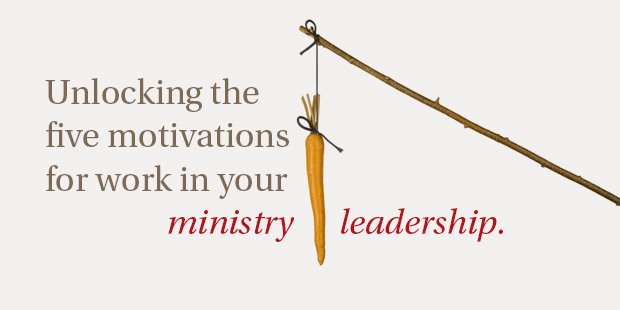
Unlocking the Five Motivations for Work in Your Ministry Leadership

We all have motivations that get us out of bed in the morning. And, we all have a wide array of forces that impact our sense of identity as it relates to work.

I have found it helpful to identify these and to explore their interrelationship. In doing so there are multiple benefits to fortifying your life as a ministry leader. In fact, great leaders deeply understand these benefits  in their own life. In addition, these motivations and the benefits of understanding them, become very helpful in stewarding the gifts and talents of others. What are the benefits of exploring the five motivations? They include:

  • Building self-awareness
  • Bringing a higher perspective to everyday work 
  • Enhancing a God-focused life
  • Aiding in value-based, directional career decision-making 
  • Finding health and balance in your job. 

Explore these  five motivations for your work. While some of these categories may be defined from a negative point of view, (Careerism is selfish), I consider them from positive perspective.

#1 Work as Job: “I get paid in order to live.”

All of us, with few exceptions, start here. You get a job to put bread on the table and to pay the rent. It’s a baseline and noble motivation- survival.

#2 Work as Career: “I advance my life.” 

In addition to getting paid, its nice to know you will get paid more in the future. Progress is a life impulse biologically and emotionally. When you ad a little testosterone to the equation, watch out.  The impetus to win and to have more influence and to “better your position” becomes a significant, if not dominating motive for most people. While Jesus never rebukes the motivation for progress, he does rebuke the selfish and worldly interpretation of what progress looks like (lording over people verses serving them).

#3 Work as Fulfillment: “I enjoy using my life’s talents and abilities.” 

When people cultivate an awareness and practice of their gifts, new things begin to emerge in the motivational dynamic. “Work as job” and “work as career” motivations begin to shift. For example, I might be willing to trade financial benefit or title of influence for the euphoria of a tightly aligned role match with my passion or talents.

#4 Work as Calling: “God created my life for a unique purpose.” 

The definition of calling may have some nuances depending on your faith background. Here, I mean the term to reflect a personal relationship with God that brings the revelation of a life agenda or purpose or destiny.  It’s the movement from occupation to vocation. This is more specific than a generic, “I follow Jesus” or “God has a wonderful plan for your life.”  And this specificity is very real and concrete to those who discern it or find it or receive it. Luke wrote of Paul in Acts 13:36, “For David, after he had served the purpose of God in his own generation, fell asleep…”

#5 Work as Convergence: “I enjoy life for God’s glory.” 

I have struggled with the idea of calling being the ultimate “right” motivation. In some ways, that is the obviously answer. In other ways,  I believe in the nobility of every level and the opportunity to engage in as many levels as possible. “Work as convergence” is the answer. Even though one may be clear on calling, isn’t it still natural to desire a sense of fulfillment and advancement? I think so. As the Westminster Confession reminds us, glorifying God isn’t separable from enjoying him. On another practical level, convergence brings the overlap of “work as job” and “work as calling.” Many feel like they have to work a “job” in order to serve God (calling) in some other area of life. In this case there is an opportunity to explore convergence.

What’s your motivation for work?

Read more from Will here.

Download PDF

Tags: , ,

| What is MyVisionRoom? > | Back to Leadership >

ABOUT THE AUTHOR

Will Mancini

Will Mancini

Will Mancini wants you and your ministry to experience the benefits of stunning, God-given clarity. As a pastor turned vision coach, Will has worked with an unprecedented variety of churches from growing megachurches and missional communities, to mainline revitalization and church plants. He is the founder of Auxano, creator of VisionRoom.com and the author of God Dreams and Church Unique.

See more articles by >

COMMENTS

What say you? Leave a comment!

Recent Comments
comment_post_ID); ?> Thank you for this information. I'm going to use this article to improve my work with the Lord.
 
— Abel Singbeh
 
comment_post_ID); ?> Thank you Ed for sharing your insights into the Church Growth Movement. I have my reservations with Church Growth models because it has done more damage than good in the Body of Christ. Over the years, western churches are more focused on results, formulas and processes with little or no emphasis on membership and church discipline. Pastors and vocational leaders are burnt out because they're overworked. I do believe that the Church Growth model is a catalyst to two destructive groups: The New Apostolic Reformation and the Emerging Church. Both groups overlap and have a very loose definition. They're both focus on contemporary worship, expansion of church brand (franchising), and mobilizing volunteering members as 'leaders' to grow their ministry. Little focus on biblical study, apologetics and genuine missional work with no agenda besides preaching of the gospel.
 
— Dave
 
comment_post_ID); ?> Thank you for sharing such a good article. It is a great lesson I learned from this article. I am one of the leaders in Emmanuel united church of Ethiopia (A denomination with more-than 780 local churches through out the country). I am preparing a presentation on succession planning for local church leaders. It will help me for preparation If you send me more resources and recommend me books to read on the topic. I hope we may collaborate in advancing leadership capacity of our church. God Bless You and Your Ministry.
 
— Argaw Alemu
 

Clarity Process

Three effective ways to start moving toward clarity right now.

To Bless Many, Focus on a Few

As a leader, where should the majority of your focus be? Should you be focused on the crowd or on a smaller group of people?

As you read through the gospels, you find Jesus being incredibly intentional with His disciples and intensely focused on their development. Jesus was focused on a few, for the blessing of the many. Because His disciples were transformed and trained, the world was radically impacted. Robert Coleman wrote, “His concern was not with programs to reach the multitudes, but with men, who the multitudes would follow… The disciples were to be His method of winning the world to God.”

Luke 12 provides us a snapshot of Jesus’ intense focus on His disciples. A massive crowd gathered around Jesus, so much so that people were trampling on one another. And Jesus “began to say to His disciples first” (Luke 12:1). Jesus’ first concern was not the crowd, but His disciples.

Try to get a sense of the scene… Imagine showing up at a major Christian event to hear an incredible communicator, the one everyone longs to hear from. The stadium is sold-out. Christians are honking at one another in the massive parking lot and cutting in front of one another in line, vying for the best seats. You finally sit down with your Diet Coke and chicken sandwich, ready to hear from an incredible teacher. To your surprise, the teacher invites a small group on the stage and speaks to them while you are sitting in the crowd. You think, “Is this some type of illustration?” But the teacher continues. Finally someone asks a question. The famous speaker briefly answers but then turns back to the small group and continues addressing them directly. It could seem a bit odd, a bit dismissive of the crowd. This is how Luke 12 reads…

Jesus was teaching His disciples in the midst of a huge crowd, a crowd who has been waiting for this moment. After someone asked questions about dividing an inheritance, Jesus answered him with a parable and then again spoke directly to His disciples about not worrying, trusting God, seeking Him first, and being prepared (Luke 12:13-40). As you read the narrative, you get the sense that perhaps Peter feels badly for the crowd. He even asks Jesus, “Lord are you telling this parable to us or to everyone?” In other words, “Jesus there are a whole bunch of people here. Watching and listening to you right now. Are you thinking this is for them too?” Jesus didn’t answer Peter. He kept speaking to His disciples about faithfulness and suffering (Luke 12:41-53).

One would expect the well-sought out Teacher to speak to the masses and allow the smaller group to overhear. But Jesus spoke to the disciples and allowed the crowd to overhear, not the other way around. Jesus’ focus was precisely opposite of what we might expect.

Why did Jesus focus so passionately on His disciples? He knew His time with them was short, and they were the focus of His urgency. In John 17, in His prayer in the Garden of Gethsemane for His disciples, Jesus prayed:

I have revealed Your name to the men You gave Me from the world. They were Yours, You gave them to Me, and they have kept Your word. Now they know that all things You have given to Me are from You, because the words that You gave Me, I have given them. They have received them … (John 17:6-8)

Jesus left His role as disciple-maker knowing “the words that you gave me, I have given them.” A time is approaching when you will vacate your role. Wise leaders envision their last day and work backwards. To make the biggest impact, the few need your focus. To bless many, focus on a few.

> Read more from Eric.

Download PDF

Tags: , ,

| What is MyVisionRoom? > | Back to Leadership >

ABOUT THE AUTHOR

Eric Geiger

Eric Geiger

Eric Geiger is the Senior Pastor of Mariners Church in Irvine, California. Before moving to Southern California, Eric served as senior vice-president for LifeWay Christian. Eric received his doctorate in leadership and church ministry from Southern Seminary. Eric has authored or co-authored several books including the best selling church leadership book, Simple Church. Eric is married to Kaye, and they have two daughters: Eden and Evie. During his free time, Eric enjoys dating his wife, taking his daughters to the beach, and playing basketball.

See more articles by >

COMMENTS

What say you? Leave a comment!

Recent Comments
comment_post_ID); ?> Thank you for this information. I'm going to use this article to improve my work with the Lord.
 
— Abel Singbeh
 
comment_post_ID); ?> Thank you Ed for sharing your insights into the Church Growth Movement. I have my reservations with Church Growth models because it has done more damage than good in the Body of Christ. Over the years, western churches are more focused on results, formulas and processes with little or no emphasis on membership and church discipline. Pastors and vocational leaders are burnt out because they're overworked. I do believe that the Church Growth model is a catalyst to two destructive groups: The New Apostolic Reformation and the Emerging Church. Both groups overlap and have a very loose definition. They're both focus on contemporary worship, expansion of church brand (franchising), and mobilizing volunteering members as 'leaders' to grow their ministry. Little focus on biblical study, apologetics and genuine missional work with no agenda besides preaching of the gospel.
 
— Dave
 
comment_post_ID); ?> Thank you for sharing such a good article. It is a great lesson I learned from this article. I am one of the leaders in Emmanuel united church of Ethiopia (A denomination with more-than 780 local churches through out the country). I am preparing a presentation on succession planning for local church leaders. It will help me for preparation If you send me more resources and recommend me books to read on the topic. I hope we may collaborate in advancing leadership capacity of our church. God Bless You and Your Ministry.
 
— Argaw Alemu
 

Clarity Process

Three effective ways to start moving toward clarity right now.

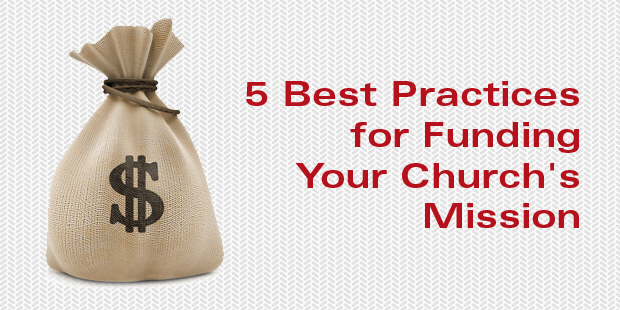
5 Best Practices for Funding Your Mission

Every Lead Pastor is responsible for financing the mission.  As a Lead Pastor you have to own it.  We can delegate a lot of the responsibilities to the financial team, business administrator, or executive pastor, but at the end of the day the buck stops with you.  The degree in which your church is funded lands squarely on your shoulders.

At the same time, many Lead Pastors shy away from this role.  It’s almost as if they feel less spiritual if they think and talk about issues related to funding the mission. Because of this, it’s not unusual for churches to go under-funded or for significant ministry opportunities to simply never happen.

We could all use more funding.  Vision simply has a way of always out pacing our resources.  I’m convinced that we can be better funded with a little intentional effort.  Here are five best practices for funding the mission that I’ve observed and practiced over the years.

They talk about money.  Sometime during the 80’s we got the idea that we shouldn’t talk about money.  We went to great lengths to avoid the conversation.  We even invited people not to give when we passed the offering plates or baskets. At the same time, leaders who finance the mission don’t back away when it comes  to talking about money. They recognize that it’s their responsibility and they are intentional about talking to their teams, staff, and entire congregation.  Not talking about money doesn’t overcome the challenge of financing the mission, it only intensifies it.

They are conservative operators.  They expect God to do great things, but at the same time they realize they must live within their means.  This often plays out in three common ways:

  1.  They set their budgets on what they know, not on what they assume.
  2. They keep their staff percentages well below the norm.
  3.  They have a system for monitoring their budget regularly.

They help others win financially.  They understand that if the people they shepherd win, the church wins.  They are intentional about systems being put into place that teach people how to budget, save, and get out of debt.  I am convinced that the number one way of financing the mission is a long-term financial ministry.  This should be the first thing we staff and fund as a church, and not the last.

They understand the importance of focused campaigns.  They understand that a capital campaign is really not a capital campaign, but a spiritual initiative.  God uses these times of focused intensity to disciple His people, create movement, and fund his mission.

They are accountable and they communicate. They openly thank people for their sacrifice.  They connect their giving with real life change and ministry.  They are financially accountable to the body.  They create trust.  They are over- the-top in communicating through some kind of end-of-the-year report.

Here are five practical applications, based on these best practices, you can apply this year.

  1. Preach at least one series on giving.
  2. Budget on 90% of your income and keep staffing to 35% of total budget
  3. Launch a financial ministry that includes regular classes on getting out of debt, saving, and giving.  Include financial counselors.
  4. Schedule a capital or generosity campaign.
  5. Present an over-the-top end-of-the-year report.

We would love to help you win in these areas.  For your generosity and campaign needs don’t hesitate to reach out to us, the Auxano Team (www.auxano.com), or email me at davidp@auxano.com.

> Read more from David here.

Download PDF

Tags: , , ,

| What is MyVisionRoom? > | Back to Resourcing >

ABOUT THE AUTHOR

David Putman

David Putman

David is a Lead Navigator serving on the Auxano Team, the category leader in vision clarity and vision focus campaigns. He is also founder leader of Planting the Gospel a non-profit ministry committed to helping churches move discipleship from a program to a culture. He has been involved in church planting for over twenty years as a planter, strategist, and coach. He is author of I Woke Up In Heaven, The Gospel Disciple, Detox for the Overly Religious, Breaking the Discipleship Code, and co-author of Breaking the Missional Code with Ed Stetzer. He latest book The Gospel Disciple Journey will be released in February 2014. David’s life mission is to help others discover the simplicity, centrality, and beauty of Jesus and his ways. David is married to Tami and they have two awesome kids, and two even more awesome grandkids.

See more articles by >

COMMENTS

What say you? Leave a comment!

Recent Comments
comment_post_ID); ?> Thank you for this information. I'm going to use this article to improve my work with the Lord.
 
— Abel Singbeh
 
comment_post_ID); ?> Thank you Ed for sharing your insights into the Church Growth Movement. I have my reservations with Church Growth models because it has done more damage than good in the Body of Christ. Over the years, western churches are more focused on results, formulas and processes with little or no emphasis on membership and church discipline. Pastors and vocational leaders are burnt out because they're overworked. I do believe that the Church Growth model is a catalyst to two destructive groups: The New Apostolic Reformation and the Emerging Church. Both groups overlap and have a very loose definition. They're both focus on contemporary worship, expansion of church brand (franchising), and mobilizing volunteering members as 'leaders' to grow their ministry. Little focus on biblical study, apologetics and genuine missional work with no agenda besides preaching of the gospel.
 
— Dave
 
comment_post_ID); ?> Thank you for sharing such a good article. It is a great lesson I learned from this article. I am one of the leaders in Emmanuel united church of Ethiopia (A denomination with more-than 780 local churches through out the country). I am preparing a presentation on succession planning for local church leaders. It will help me for preparation If you send me more resources and recommend me books to read on the topic. I hope we may collaborate in advancing leadership capacity of our church. God Bless You and Your Ministry.
 
— Argaw Alemu
 

Clarity Process

Three effective ways to start moving toward clarity right now.