Don’t Ask What, Ask Why

Instead of accepting a given constraint, ask whether this is the right problem to be solving.

Every parent knows how infuriating 5-year-olds can be with their constantly questioning “Why?” But for design thinkers, asking “Why?” is an opportunity to reframe a problem, redefine the constraints, and open the field to a more innovative answer.

For example Will Work For, the design provocation I wrote about earlier, questions the core motivations for why we work.

There is nothing more frustrating than coming up with the right answer to the wrong question. This is true whether you’re designing a new company strategy or designing the next week of your life.

A willingness to ask “Why?” will annoy your colleagues in the short run, but in the long run it will improve your chances of spending energy on the right problems.

What will you ask “Why?” about this week?

Read more from Tim here.

Download PDF

Tags: , ,

| What is MyVisionRoom? > | Back to Leadership >

ABOUT THE AUTHOR

Tim Brown

See more articles by >

COMMENTS

What say you? Leave a comment!

Recent Comments
comment_post_ID); ?> Thank you for this information. I'm going to use this article to improve my work with the Lord.
 
— Abel Singbeh
 
comment_post_ID); ?> Thank you Ed for sharing your insights into the Church Growth Movement. I have my reservations with Church Growth models because it has done more damage than good in the Body of Christ. Over the years, western churches are more focused on results, formulas and processes with little or no emphasis on membership and church discipline. Pastors and vocational leaders are burnt out because they're overworked. I do believe that the Church Growth model is a catalyst to two destructive groups: The New Apostolic Reformation and the Emerging Church. Both groups overlap and have a very loose definition. They're both focus on contemporary worship, expansion of church brand (franchising), and mobilizing volunteering members as 'leaders' to grow their ministry. Little focus on biblical study, apologetics and genuine missional work with no agenda besides preaching of the gospel.
 
— Dave
 
comment_post_ID); ?> Thank you for sharing such a good article. It is a great lesson I learned from this article. I am one of the leaders in Emmanuel united church of Ethiopia (A denomination with more-than 780 local churches through out the country). I am preparing a presentation on succession planning for local church leaders. It will help me for preparation If you send me more resources and recommend me books to read on the topic. I hope we may collaborate in advancing leadership capacity of our church. God Bless You and Your Ministry.
 
— Argaw Alemu
 

Clarity Process

Three effective ways to start moving toward clarity right now.

Is Your Church Microsoft or Apple?

For many years I was a Microsoft devotee. I laughed at all the Apple fanboys to the point that when I met one of Steve Jobs right hand guys I proudly announced, “I’m a PC”. (I’m special that way) But in my old age I have seen the light. I now have a Mac and two iPads, my only non-Cupertino inspired device is my Samsung Galaxy S III. I kind of like the Google map app that actually gets me to my destination. Which sort of gets me to my point.

Microsoft and Apple have two very different philosophies about when to ship. Microsoft ships as soon as its good enough and then offers patches and fixes as bugs are discovered in the software. Microsoft software always kind of sort of works. Apple, on the other hand, ships when its perfect. They have a near zero tolerance policy for bugs and defects. Steve Jobs was always willing to stop everything until they got it exactly right. It is this dedication to perfection that led to my defection to the cult of Apple.

The challenge with the Apple approach is that it absolutely, positively has to be perfect right out of the box. Us fanboys won’t tolerate iterations, updates or patches. We want excellence served in an exquisite black or white box. That’s why Apple Maps was such a crushing disaster. If it were Microsoft we would expect the Denver airport to be missing the first time, we’d know they’d find it eventually. For Apple that kind of imperfection is intolerable.

Over the past 20 years we have seen the Apple-ification of the church. We have convinced ourselves and the attenders that God deserves, nay, demands excellence. The lights, the sound the video should be the best of any venue in town. Every weekend should be more amazing than the weekend before. (“I’m so excited about this weekend I’m about to wet myself!!”) The sermon should be spell-binding and funny and heart wrenching every week. As pastors we can be transparent and authentic as long as everyone knows that under that veneer of “real” is a substrate of “really good”.

I’ve come to realize that as much as I want to be Apple I’m really Microsoft. I put out the best that I can, but my best will always have flaws and be full of bugs and it will need frequent updates, patches and fixes. My best never comes in a shiny white box with invisible flaps and secret compartments, my best comes on a paper plate with pizza stains on the edges. Its kind of a relief to be honest. Trying to be Apple all the time is exhausting.

Right before my pastor went on stage this past weekend I asked him if the message was going to be any good? He responded immediately, “Not really, mediocre at best.” He was wrong, it was an amazing message, but I love attending a church with a Microsoft attitude. They do their best, but we all know its never perfect. And that’s ok, that’s how we all are.

Just don’t take away my iPad.

Read more from Geoff here.

Download PDF

Tags: , , ,

| What is MyVisionRoom? > | Back to Leadership >

ABOUT THE AUTHOR

Geoff Surratt

Geoff Surratt

Geoff lives in Denver, Colorado with his wife Sherry (CEO of MOPS International). Geoff and Sherry have two awesome kids (Mike and Brittainy), a wonderful daughter-in-law (Hilary) and the most beautiful granddaughter on earth (Maggie Claire) Geoff has served on staff at Seacoast Church and Saddleback Church. He is now the Director of Exponential and a freelance Church Catalyst and Encourager.

See more articles by >

COMMENTS

What say you? Leave a comment!

Recent Comments
comment_post_ID); ?> Thank you for this information. I'm going to use this article to improve my work with the Lord.
 
— Abel Singbeh
 
comment_post_ID); ?> Thank you Ed for sharing your insights into the Church Growth Movement. I have my reservations with Church Growth models because it has done more damage than good in the Body of Christ. Over the years, western churches are more focused on results, formulas and processes with little or no emphasis on membership and church discipline. Pastors and vocational leaders are burnt out because they're overworked. I do believe that the Church Growth model is a catalyst to two destructive groups: The New Apostolic Reformation and the Emerging Church. Both groups overlap and have a very loose definition. They're both focus on contemporary worship, expansion of church brand (franchising), and mobilizing volunteering members as 'leaders' to grow their ministry. Little focus on biblical study, apologetics and genuine missional work with no agenda besides preaching of the gospel.
 
— Dave
 
comment_post_ID); ?> Thank you for sharing such a good article. It is a great lesson I learned from this article. I am one of the leaders in Emmanuel united church of Ethiopia (A denomination with more-than 780 local churches through out the country). I am preparing a presentation on succession planning for local church leaders. It will help me for preparation If you send me more resources and recommend me books to read on the topic. I hope we may collaborate in advancing leadership capacity of our church. God Bless You and Your Ministry.
 
— Argaw Alemu
 

Clarity Process

Three effective ways to start moving toward clarity right now.

Does Your Church Have a Content Strategy for Its Website?

Creating awareness for local churches becomes increasingly difficult as more time demands are made on faith community members.

When a user goes to a church website to find information on programs, services, or to find directions, you have 7-30 seconds to keep their attention. If people can’t find what they need, they will go elsewhere. A cluttered website is not only irritating, it could be sending potential church members away in frustration.

Increase the effectiveness of your church website with a content strategy.

We interviewed dozens of ministry leaders and church communications professionals for our latest report, “Effective Church Content Strategies.” We wanted to show you what can happen in the life of a local church when their website is organized. A clear process emerges that savvy church leaders use to accomplish organizational and ministry goals. Conversely, this white paper will show you what happens when churches do not have a content governance in place for their online presence. (Hint: words like “painful,” “messy,” and “frustrating” sum it up!)

Learn how to assess the content that is already on your church website.

Melissa Therrien of Eagle Brook Church shares the story of when the staff went through a content auditing process. Each page on the website was sifted through with a fine-tooth comb, asking questions like:

  1. Does this content accomplish our goal to reach people for Christ?
  2. Does this help people who are wanting to find out about our church find what they need?
  3. Do we know what our call to action is?

Does the content on your church website have this level of clarity and purpose? If not, you’ll learn how to start the content strategy process for your church.

Additionally, you’ll learn how to make your online content readable, understandable, findable, and actionable. Put simply, your church website will work for the user, not against it.

There’s a quote from the report that sums things up nicely: If your church can not be Googled, it does not exist. The church website is the new front door to the organization. Make sure when users come knocking, they find you standing with the door open, saying, “we’ve been waiting for you…Come on in.”

 Go here to download the report.
Read more from Justin here.
Download PDF

Tags: , ,

| What is MyVisionRoom? > | Back to Communication >

ABOUT THE AUTHOR

Justin Wise

See more articles by >

COMMENTS

What say you? Leave a comment!

Recent Comments
comment_post_ID); ?> Thank you for this information. I'm going to use this article to improve my work with the Lord.
 
— Abel Singbeh
 
comment_post_ID); ?> Thank you Ed for sharing your insights into the Church Growth Movement. I have my reservations with Church Growth models because it has done more damage than good in the Body of Christ. Over the years, western churches are more focused on results, formulas and processes with little or no emphasis on membership and church discipline. Pastors and vocational leaders are burnt out because they're overworked. I do believe that the Church Growth model is a catalyst to two destructive groups: The New Apostolic Reformation and the Emerging Church. Both groups overlap and have a very loose definition. They're both focus on contemporary worship, expansion of church brand (franchising), and mobilizing volunteering members as 'leaders' to grow their ministry. Little focus on biblical study, apologetics and genuine missional work with no agenda besides preaching of the gospel.
 
— Dave
 
comment_post_ID); ?> Thank you for sharing such a good article. It is a great lesson I learned from this article. I am one of the leaders in Emmanuel united church of Ethiopia (A denomination with more-than 780 local churches through out the country). I am preparing a presentation on succession planning for local church leaders. It will help me for preparation If you send me more resources and recommend me books to read on the topic. I hope we may collaborate in advancing leadership capacity of our church. God Bless You and Your Ministry.
 
— Argaw Alemu
 

Clarity Process

Three effective ways to start moving toward clarity right now.

A Vision Resource for German-speaking Church Leaders

ND Strupler, Leadership Development Director with the ICF Movement in Zurich, Switzerland, just delivered an early Christmas present to Auxano.

The Church Unique Visual Summary – translated into German.

Will Mancini, founder of Auxano and author of Church Unique, made these comments when learning of the translation:

I love the ICF Movement and the work ND does to equip church planters. I have been grateful for our relationship over the years and time I spent with ICF planters in Zurich last year.  I hope this translation will spark some intentional clarity work for many more German-speaking pastors. 

Strupler has a clear vision to change culture, and he finds that the most effective way to change culture is through healthy communities that reflect the love of God in everyday life.

I want to get things moving. That’s why I am willing to roll up my sleeves and get to work. I am not satisfied with mediocrity, that’s why I think strategically about how I can help people maximize their leadership skills.
I inspire action with a positive attitude and the passion for communication.

Strupler was born in Zurich, Switzerland and lives there now with his wife and two children. After finishing high school he successfully graduated from a 4-year apprenticeship as a professional printer. In 1997 he started to work for ICF Zurich, a church at the heartbeat of time. As a pioneer he started many ministries and projects and lead the youth ministry for 10 years.

Since 2007 Strupler has worked for the ICF Movement, a church planting movement for Europe. Main areas of service are Leader-Development, Consulting, Networking and Creative- Innovation.

Strupler was born in Zurich, Switzerland and lives there now with his wife and two children.

You can download the Church Unique Visual Summary in German here.


Download PDF

Tags: , , ,

| What is MyVisionRoom? > | Back to Vision >

ABOUT THE AUTHOR

ND Strupler

ND Strupler

I was born in Zurich, Switzerland 1973 and lived in Switzerland and the USA. I am married since 1994 with Sophal Strupler. Proud father of 2 beautiful kids. (Noa Noëmi 2000, Kimo 2002). I love to inspire & maximize leaders. I like photography, social media + communication. I am creative, innovative and enjoy life with God. I have a clear vision to change culture. The most effective way to change culture is through healthy communities that reflect the love of God in everyday life. And that’s why I love to help leaders plant new life-giving churches. (ICF Movement)

See more articles by >

COMMENTS

What say you? Leave a comment!

Recent Comments
comment_post_ID); ?> Thank you for this information. I'm going to use this article to improve my work with the Lord.
 
— Abel Singbeh
 
comment_post_ID); ?> Thank you Ed for sharing your insights into the Church Growth Movement. I have my reservations with Church Growth models because it has done more damage than good in the Body of Christ. Over the years, western churches are more focused on results, formulas and processes with little or no emphasis on membership and church discipline. Pastors and vocational leaders are burnt out because they're overworked. I do believe that the Church Growth model is a catalyst to two destructive groups: The New Apostolic Reformation and the Emerging Church. Both groups overlap and have a very loose definition. They're both focus on contemporary worship, expansion of church brand (franchising), and mobilizing volunteering members as 'leaders' to grow their ministry. Little focus on biblical study, apologetics and genuine missional work with no agenda besides preaching of the gospel.
 
— Dave
 
comment_post_ID); ?> Thank you for sharing such a good article. It is a great lesson I learned from this article. I am one of the leaders in Emmanuel united church of Ethiopia (A denomination with more-than 780 local churches through out the country). I am preparing a presentation on succession planning for local church leaders. It will help me for preparation If you send me more resources and recommend me books to read on the topic. I hope we may collaborate in advancing leadership capacity of our church. God Bless You and Your Ministry.
 
— Argaw Alemu
 

Clarity Process

Three effective ways to start moving toward clarity right now.

Developing Creative Confidence as a Leader

Most people are born creative. As children, we revel in imaginary play, ask outlandish questions, draw blobs and call them dinosaurs. But over time, because of socialization and formal education, a lot of us start to stifle those impulses. We learn to be warier of judgment, more cautious, more analytical. The world seems to divide into “creatives” and “noncreatives,” and too many people consciously or unconsciously resign themselves to the latter category.

And yet we know that creativity is essential to success in any discipline or industry. According to a recent IBM survey of chief executives around the world, it’s the most sought-after trait in leaders today. No one can deny that creative thinking has enabled the rise and continued success of countless companies, from start-ups like Facebook and Google to stalwarts like Procter & Gamble and General Electric.

Students often come to Stanford University’s “d.school” (which was founded by one of us—David Kelley—and is formally known as the Hasso Plattner Institute of Design) to develop their creativity. Clients work with IDEO, our design and innovation consultancy, for the same reason. But along the way, we’ve learned that our job isn’t to teach them creativity. It’s to help them rediscover their creative confidence—the natural ability to come up with new ideas and the courage to try them out. We do this by giving them strategies to get past four fears that hold most of us back: fear of the messy unknown, fear of being judged, fear of the first step, and fear of losing control.

We’ve used the same approach over the past 30 years to help people transcend the fears that block their creativity. You break challenges down into small steps and then build confidence by succeeding on one after another. Creativity is something you practice, not just a talent you’re born with. The process may feel a little uncomfortable at first, but the discomfort quickly fades away and is replaced with new confidence and capabilities.

Fear of the Messy Unknown

Creative thinking in business begins with having empathy for your customers (whether they’re internal or external), and you can’t get that sitting behind a desk. Yes, we know it’s cozy in your office. Everything is reassuringly familiar; information comes from predictable sources; contradictory data are weeded out and ignored. Out in the world, it’s more chaotic. You have to deal with unexpected findings, with uncertainty, and with irrational people who say things you don’t want to hear. But that is where you find insights—and creative breakthroughs. Venturing forth in pursuit of learning, even without a hypothesis, can open you up to new information and help you discover nonobvious needs. Otherwise, you risk simply reconfirming ideas you’ve already had or waiting for others—your customers, your boss, or even your competitors—to tell you what to do.

Fear of Being Judged

If the scribbling, singing, dancing kindergartner symbolizes unfettered creative expression, the awkward teenager represents the opposite: someone who cares—deeply—about what other people think. It takes only a few years to develop that fear of judgment, but it stays with us throughout our adult lives, often constraining our careers. Most of us accept that when we are learning, say, to ski, others will see us fall down until practice pays off. But we can’t risk our business-world ego in the same way. As a result, we self-edit, killing potentially creative ideas because we’re afraid our bosses or peers will see us fail. We stick to “safe” solutions or suggestions. We hang back, allowing others to take risks. But you can’t be creative if you are constantly censoring yourself.

Half the battle is to resist judging yourself. If you can listen to your own intuition and embrace more of your ideas (good and bad), you’re already partway to overcoming this fear. So take baby steps. Instead of letting thoughts run through your head and down the drain, capture them systematically in some form of idea notebook. Keep a whiteboard and marker in the shower. Schedule daily “white space” in your calendar, where your only task is to think or take a walk and daydream. When you try to generate ideas, shoot for 100 instead of 10. Defer your own judgment and you’ll be surprised at how many ideas you have—and like—by the end of the week.

Fear of the First Step

Even when we want to embrace our creative ideas, acting on them presents its own challenges. Creative efforts are hardest at the beginning. The writer faces the blank page; the teacher, the start of school; businesspeople, the first day of a new project. In a broader sense, we’re also talking about fear of charting a new path or breaking out of your predictable workflow. To overcome this inertia, good ideas are not enough. You need to stop planning and just get started—and the best way to do that is to stop focusing on the huge overall task and find a small piece you can tackle right away.

Fear of Losing Control

Confidence doesn’t simply mean believing your ideas are good. It means having the humility to let go of ideas that aren’t working and to accept good ideas from other people. When you abandon the status quo and work collaboratively, you sacrifice control over your product, your team, and your business. But the creative gains can more than compensate. Again, you can start small. If you’re facing a tough challenge, try calling a meeting with people fresh to the topic. Or break the routine of a weekly meeting by letting the most junior person in the room set the agenda and lead it. Look for opportunities to cede control and leverage different perspectives.

For people with diverse backgrounds as diverse , fear—of the messy unknown, of judgment, of taking the first step, or of letting go—could have blocked the path to innovation. But instead, you can work to overcome your fears, rediscover your creative confidence, and make a difference. As Hungarian essayist György Konrád once said, “Courage is only the accumulation of small steps.” So don’t wait at the starting line. Let go of your fears and begin practicing creative confidence today.

Read the complete article by David Kelley here.

For a related video by David, go here.

Download PDF

Tags: , ,

| What is MyVisionRoom? > | Back to Leadership >

ABOUT THE AUTHOR

Tom and David Kelley

See more articles by >

COMMENTS

What say you? Leave a comment!

Recent Comments
comment_post_ID); ?> Thank you for this information. I'm going to use this article to improve my work with the Lord.
 
— Abel Singbeh
 
comment_post_ID); ?> Thank you Ed for sharing your insights into the Church Growth Movement. I have my reservations with Church Growth models because it has done more damage than good in the Body of Christ. Over the years, western churches are more focused on results, formulas and processes with little or no emphasis on membership and church discipline. Pastors and vocational leaders are burnt out because they're overworked. I do believe that the Church Growth model is a catalyst to two destructive groups: The New Apostolic Reformation and the Emerging Church. Both groups overlap and have a very loose definition. They're both focus on contemporary worship, expansion of church brand (franchising), and mobilizing volunteering members as 'leaders' to grow their ministry. Little focus on biblical study, apologetics and genuine missional work with no agenda besides preaching of the gospel.
 
— Dave
 
comment_post_ID); ?> Thank you for sharing such a good article. It is a great lesson I learned from this article. I am one of the leaders in Emmanuel united church of Ethiopia (A denomination with more-than 780 local churches through out the country). I am preparing a presentation on succession planning for local church leaders. It will help me for preparation If you send me more resources and recommend me books to read on the topic. I hope we may collaborate in advancing leadership capacity of our church. God Bless You and Your Ministry.
 
— Argaw Alemu
 

Clarity Process

Three effective ways to start moving toward clarity right now.

Developing Creative Confidence as a Leader

A video by IDEO Mananging Director David Kelley on “Developing Creative Confidence As a Leader.

To read an accompanying article, go here.

16p9YRF0l-g

Download PDF

Tags: , ,

| What is MyVisionRoom? > | Back to Leadership >

ABOUT THE AUTHOR

Tom and David Kelley

See more articles by >

COMMENTS

What say you? Leave a comment!

Recent Comments
comment_post_ID); ?> Thank you for this information. I'm going to use this article to improve my work with the Lord.
 
— Abel Singbeh
 
comment_post_ID); ?> Thank you Ed for sharing your insights into the Church Growth Movement. I have my reservations with Church Growth models because it has done more damage than good in the Body of Christ. Over the years, western churches are more focused on results, formulas and processes with little or no emphasis on membership and church discipline. Pastors and vocational leaders are burnt out because they're overworked. I do believe that the Church Growth model is a catalyst to two destructive groups: The New Apostolic Reformation and the Emerging Church. Both groups overlap and have a very loose definition. They're both focus on contemporary worship, expansion of church brand (franchising), and mobilizing volunteering members as 'leaders' to grow their ministry. Little focus on biblical study, apologetics and genuine missional work with no agenda besides preaching of the gospel.
 
— Dave
 
comment_post_ID); ?> Thank you for sharing such a good article. It is a great lesson I learned from this article. I am one of the leaders in Emmanuel united church of Ethiopia (A denomination with more-than 780 local churches through out the country). I am preparing a presentation on succession planning for local church leaders. It will help me for preparation If you send me more resources and recommend me books to read on the topic. I hope we may collaborate in advancing leadership capacity of our church. God Bless You and Your Ministry.
 
— Argaw Alemu
 

Clarity Process

Three effective ways to start moving toward clarity right now.

The Science of Storytelling

In 1748, the British politician and aristocrat John Montagu, the 4th Earl of Sandwich used a lot of his free time for playing cards. One of the problems he had was that he greatly enjoyed eating a snack, whilst still keeping one hand free for the cards.

So he came up with the idea to eat beef between slices of toast, which would allow him to finally eat and play cards at the same time. Eating his newly invented “sandwich”, the name for 2 slices of bread with meat in between, became one of the most popular meal inventions in the western world.

What’s interesting about this, is that you are very likely to never forget the story of who invented the sandwich ever again. Or at least, much less likely to do so, if it would have been presented to us in bullet points or other purely information based form.

For over 27,000 years, since the first cave paintings were discovered, telling stories has been one of our most fundamental communication methods. Since recently a good friend of mine, gave me an introduction to the power of storytelling, I wanted to learn more.

Here is the science around storytelling and how we can use it to make better decisions every day:

Our brain on stories: How our brains become more active when we tell stories

We all enjoy a good story, whether it’s a novel, a movie or simply something one of our friends is explaining to us that they’ve experienced. But why do we feel so much more engaged when we hear a narrative about events?

It’s in fact quite simple. If we listen to a powerpoint presentation with boring bullet points, a certain part in the brain gets activated. Scientists call this Broca’s area and Wernicke’s area. Overall, it hits our language processing parts in the brain, where we decode words into meaning. And that’s it, nothing else happens.

When we are being told a story though, things change dramatically found researchers in Spain. Not only are the language processing parts in our brain activated, but any other area in our brain, that we would use when experiencing the events of the story are too.

If someone tells us about how delicious certain foods were, our sensory cortex lights up, if it’s about motion, our motor cortex gets active:

“Metaphors like “The singer had a velvet voice” and “He had leathery hands” roused the sensory cortex. […] Then, the brains of participants were scanned as they read sentences like “John grasped the object” and “Pablo kicked the ball.” The scans revealed activity in the motor cortex, which coordinates the body’s movements.”

A story can put your whole brain to work. And yet, it gets better:

When we tell stories to others that have really helped us shape our thinking and way of life, we can have the same effect on them too. The brains of the person telling a story and listening to it, can synchronize, says Uri Hasson from Princeton:

“When the woman spoke English, the volunteers understood her story, and their brains synchronized.  When she had activity in her insula, an emotional brain region, the listeners did too.  When her frontal cortex lit up, so did theirs. By simply telling a story, the woman could plant ideas, thoughts and emotions into the listeners’ brains.”

Anything you’ve experienced, you can get others to experience the same. Or at least, get their brain areas that you’ve activated that way, active too:

Evolution has wired our brains for storytelling – how to make use of it

Now all this is interesting. We know that we can activate our brains better if we listen to stories. The still unanswered question is: Why is that? Why does the format of a story, where events unfold one after the other have such a profound impact on our learning?

The simple answer is this: We are wired that way. A story, if broken down into the simplest form is a connection of cause and effect. And that is exactly how we think.

We think in narratives all day long, no matter if it is about buying groceries, whether we think about work or our spouse at home. We make up (short) stories in our heads for every action and conversation. In fact, Jeremy Hsu found:

“Personal stories and gossip make up 65% of our conversations.”

Now, whenever we hear a story, we want to relate it to one of our existing experiences. That’s why metaphors work so well with us. Whilst we are busy searching for a similar experience in our brains, we activate a part called insula, which helps us relate to that same experience of pain, joy, disgust or else.

The following graphic probably describes it best:

In a great experiment, John Bargh at Yale found the following:

“Volunteers would meet one of the experimenters, believing that they would be starting the experiment shortly. In reality, the experiment began when the experimenter, seemingly struggling with an armful of folders, asks the volunteer to briefly hold their coffee. As the key experimental manipulation, the coffee was either hot or iced. Subjects then read a description of some individual, and those who had held the warmer cup tended to rate the individual as having a warmer personality, with no change in ratings of other attributes.”

We link up metaphors and literal happenings automatically. Everything in our brain is looking for the cause and effect relationship of something we’ve previously experienced.

3 Awesome ways to use storytelling in every day life

  • Make others come up with your idea: Exchange telling suggestions for telling stories: 

Do you know the feeling, when a good friend tells you a story and then two weeks later, you mention the same story to him, as if it was your idea? This is totally normal and at the same time, one of the most powerful ways to get people on board with your ideas and thoughts. According to Uri Hasson from Princeton, a story is the only way to activate parts in the brain so that a listener turns the story into their own idea and experience.

The next time you struggle with getting people on board with your projects and ideas, simply tell them a story, where the outcome is that doing what you had in mind, is the best thing to do. According to Princeton researcher Hasson, storytelling is the only way to plant ideas into other people’s minds.

  • Write more persuasively – bring in stories from yourself or an expert: 

This is something that took me a long time to understand. If you start out writing, it’s only natural to think “I don’t have a lot of experience with this, how can I make my post believable if I use personal stories?”. The best way to get around this is by simply exchanging stories to those of experts. When this blog used to be a social media blog, I would ask for quotes from the top folks in the industry or simply find great passages they had written online. It’s a great way to add credibility and at the same time, tell a story.

  • The simple story is more successful than the complicated one: 

When we think of stories, it is often easy to convince ourselves that they have to be complex and detailed to be interesting. The truth is however, that the simpler a story, the more likely it will stick. Using simple language as well as a low complexity is the best way to activate the brain regions that make us truly relate to the situation and happenings in the story. This is a similar reason to why multitasking is so hard for us. Try for example to reduce the number adjectives or complicated nouns in a presentation or article and exchange them with more simple, yet heartfelt language.


Quick last fact: Our brain learns to ignore certain overused words and phrases that used to make stories awesome

Oh and one last thing. Scientists, in the midst of researching the topic of storytelling have also discovered, that certain words and phrases have lost all storytelling power:

“Some scientists have contended that figures of speech like “a rough day” are so familiar that they are treated simply as words and no more.”

This means, that the frontal cortex – the area of your brain responsible to experience emotions, can’t be activated with these phrases. It’s something that might be worth remembering when crafting your next story.

Storytelling is one of the most powerful techniques we have as humans to communicate and motivate. What are your best tips for telling stories? Have you had similar experiences with telling stories?

Read more from Leo here.

Download PDF

Tags: , ,

| What is MyVisionRoom? > | Back to Culture >

ABOUT THE AUTHOR

Leo Widrich

See more articles by >

COMMENTS

What say you? Leave a comment!

Peter Romero — 12/23/12 4:14 pm

I have enjoyed telling stories to my high school students. Stories that have a point or moral carry more weight. Stories, where the location is visually described with as many of the senses as possible is another key. Finally, when telling a story it is important that it identifies as close to the audience's age or experience. There are more keys to storytelling, thank you for allowing me these few.

Recent Comments
comment_post_ID); ?> Thank you for this information. I'm going to use this article to improve my work with the Lord.
 
— Abel Singbeh
 
comment_post_ID); ?> Thank you Ed for sharing your insights into the Church Growth Movement. I have my reservations with Church Growth models because it has done more damage than good in the Body of Christ. Over the years, western churches are more focused on results, formulas and processes with little or no emphasis on membership and church discipline. Pastors and vocational leaders are burnt out because they're overworked. I do believe that the Church Growth model is a catalyst to two destructive groups: The New Apostolic Reformation and the Emerging Church. Both groups overlap and have a very loose definition. They're both focus on contemporary worship, expansion of church brand (franchising), and mobilizing volunteering members as 'leaders' to grow their ministry. Little focus on biblical study, apologetics and genuine missional work with no agenda besides preaching of the gospel.
 
— Dave
 
comment_post_ID); ?> Thank you for sharing such a good article. It is a great lesson I learned from this article. I am one of the leaders in Emmanuel united church of Ethiopia (A denomination with more-than 780 local churches through out the country). I am preparing a presentation on succession planning for local church leaders. It will help me for preparation If you send me more resources and recommend me books to read on the topic. I hope we may collaborate in advancing leadership capacity of our church. God Bless You and Your Ministry.
 
— Argaw Alemu
 

Clarity Process

Three effective ways to start moving toward clarity right now.

Designing Style Guidelines for Brands and Websites

A website is never done. Everyone has worked on a project that changed so much after it launched that they no longer wanted it in their portfolio. One way to help those who take over your projects is to produce a style guide.

Edward Tufte once said: “Great design is not democratic; it comes from great designers. If the standard is lousy, then develop another standard.” Although there’s no stopping some clients from making their website awful, by creating a style guide, you’re effectively establishing rules for those who take over from you.

WHY CREATE A STYLE GUIDE?

  • You’ll have an easy guide to refer to when handing over the project.
  • Makes you look professional. They’ll know you did everything for a reason
  • You maintain control of the design. When someone does something awful, you can refer them to the document.
  • You avoid cheapening the design, message and branding.
  • Forces you to define and hone your style, making for a more cohesive design.

(Smashing’s note: If you are looking for a good book on mobile, this is the one. Our brand new book on best design and coding practices for mobile, Responsive Web design and UX design for mobile. Get your copy now!)

lg.php.gif

Branding Guidelines: What To Include?

STRATEGIC BRAND OVERVIEW

This should be short and sweet. In as few words as possible, make clear the vision for this design and any keywords people should keep in mind while designing. Most people will probably flip straight to the picture pages, but they may read a few sentences here.
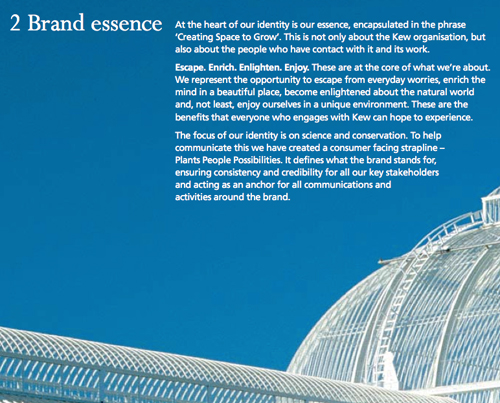

See Kew’s branding guidelines.

Kew uses strong photography in its “brand essence” message, with a few paragraphs that both inspire and define the brand. Even if you read only the first sentence, you get a sense of what it’s trying to do. While Kew has quite a few of these message pages, they are intertwined with beautiful photography that themselves define the photographic style and primary message.

LOGOS

For print and Web, most brands revolve around the logo. Make sure you provide logo variations and clarify minimum sizes.
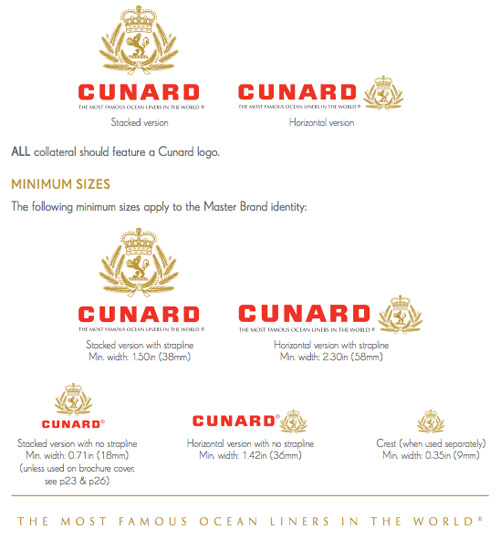

See Cunard’s branding guidelines.

Cunard provides many variations on its minimum sizes. Because its crest can be displayed either on its own, with the name or with the tagline, specifying minimum sizes is important for legibility (for example, if the logo with the tagline is too small, it will be illegible).
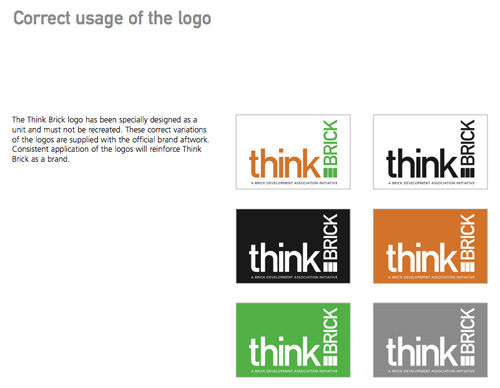

See Think Brick’s branding guidelines.

Provide logos with different colors, and specify which colours are allowed. Think Brick gives designers a lot of options with its design. The point is to allow flexibility while maintaining consistency.

SHOW EXAMPLES OF WHAT AND WHAT NOT TO DO

You’re a professional, and you know better than to mess around with logos. But many others will try and think they’ve done a good job. They are so wrong. You must make clear what they can and cannot do with a design.


See I Love New York’s branding guidelines.

I Love New York has done a great job defining all the things you shouldn’t do with its logo. It has also produced a beautiful (though bit wordy) document.

SPACING

Many non-designers underestimate the need for white space. Include a spacing reference, especially for the logo. Rather than specifying inches or centimeters, use a portion of the logo (a letter or a shape) to set the clearance. This way, whether the logo is big or small, the space around it will be sufficient.


See BlackBerry’s branding guidelines (PDF, 2.2 MB).

BlackBerry not only explains its spacing policy, but also uses the capital B in the logo to define the clearance.

COLORS

Always include color palettes and what the colors should be used for. And include formats for both print and Web: CMYK, Pantones (if they exist) and RGB (or HEX). Always include a CMYK alternative for Pantones because sometimes matching is hard (especially when Pantone printing is not possible). Specify primary and secondary colours and when and where to use them.


See Channel 4s style guide.

Channel 4 shows all of its Web and print colors, and it displays the swatches below an image that helps to define its color palette.


See the New School’s branding guidelines.

The New School is clear about its primary colors and defines them for both print (Pantone and CMYK) and Web (RGB). Its brand guideline document is beautiful, too.


See Christopher Doyle’s Personal Identity Guidelines.

Okay, so this one isn’t a traditional branding guideline, but rather a personal identity guideline. Here Christopher Doyle shows off some alternative color palettes. He does a fantastic job of mocking branding guidelines; well worth a look (and chuckle).

FONTS

You’ll need to define the typefaces to use: sizes, line height, spacing before and after, colors, headline versus body font, etc. Make sure to include Web alternatives for non-Web fonts.
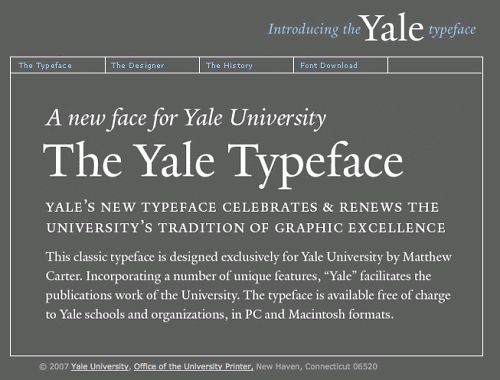

See Yale’s typeface.

Yale has its own typeface, which it provides to its designers.


See Yale’s Visual Identity page.

On the typeface section of its website, Yale also details when fonts should be used. It has a specific Web font section, detailing which fonts to use there.

LAYOUTS AND GRIDS

By setting up templates and guidelines for grids, you encourage best practices and promote consistency. In Web, preparing some generic templates can curb excessive creativity with the layout.


See the Barbican’s branding, print and Web guidelines.

For its website, the Barbican has set up building blocks that are both flexible and ordered—meaning they’re likely to remain in a grid.

TONE OF VOICE

A huge component of a brand’s personality is the copy, and defining the tone is a great way to keep a brand consistent. When multiple people are writing the copy, the brand can start to sound like it has multiple personalities.
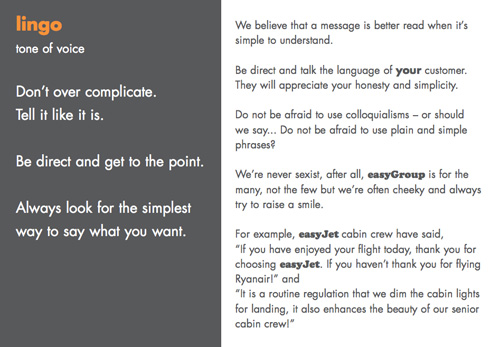

See easyJet’s branding guidelines (PDF, 2 MB).

easyJet has a well-defined personality, both verbal and written, and it gives examples for both.

COPY-WRITING GUIDE

For those who require clients to write their own copy but want to maintain consistency, a copy-writing style guide can be helpful. Copy-writing is one of those things that most people register subconsciously. When reading, your brain automatically looks for consistency and patterns, and poor copy-writing can ruin the reading flow.
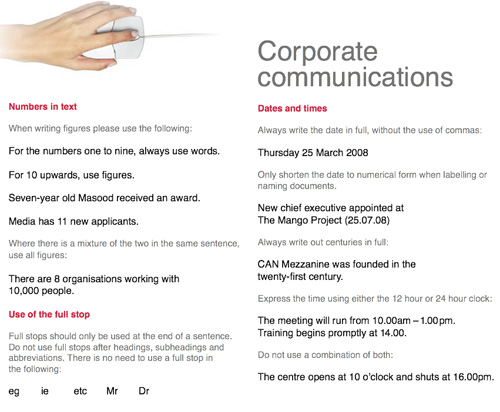

See CAN’s branding guidelines (PDF, 845 KB).

CAN wants its number formats to look the same. On another page, it defines which spelling variants to use, reminds people of common mistakes and more.

IMAGERY

Many designers have established a particular tone in their photographs and images. Show your clients examples, and explain why they are good choices. Show them in the context of your design, and explain why they were chosen for that context.
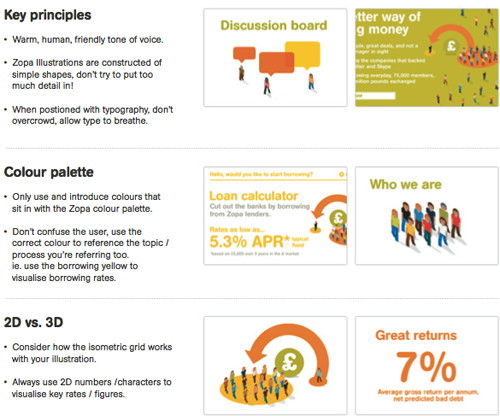

See Zopa’s style sheet (PDF, 3.7 MB).

Zopa has done a fantastic job of making its illustrated style clear. Its online style guide is very good, and it offers further tips on how to construct pages around its illustrations in the online style sheet.

BRING IT ALL TOGETHER

Show a few examples of what the logo, photography and text look like together and the preferred formats.
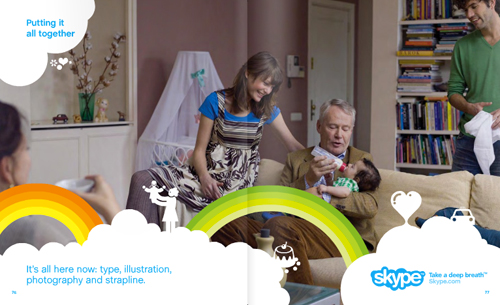

See Skype’s branding guidelines.

Skype has done a fantastic job of showing how it want designers to use its illustrations and photography. It has examples of the subtle differences between good and bad usage. The whole guide is beautiful and well worth a look.

Web Guidelines: What To Include?

Many people create branding guidelines but forget to include important style guides for the Web. Just like branding guidelines, Web guidelines keep everything consistent, from button styles to navigation structure.

BUTTON HIERARCHY

You’ve carefully decided what all the buttons are for and meticulously defined their states. Unfortunately, the in-house designer hasn’t applied your hover states or has created their own, and they look terrible.

Create a page that shows what all links do (including the buttons), the appropriate behavior of each and when to use them (with examples of appropriate usage). If one button is dominant, make clear the maximum number of times it should be used per page (usually once at most). Define the hover, disabled and visited states for all buttons.
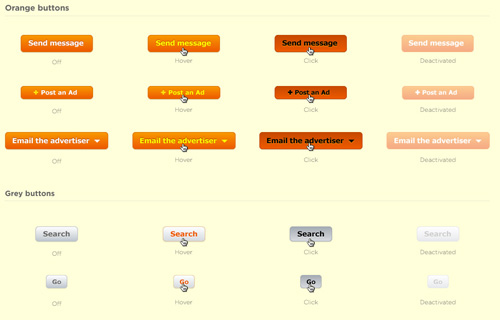

Gumtree.

Gumtree has worked hard to define all button states, especially custom buttons (for example, Post an Ad has a + sign in front of it). These were defined for the Gumtree redesign, which is now live.

ICONS

Defining size and spacing and where to use icons is another great way to promote consistency. If icons should be used only sparingly, make this clear.


See ZURB’s icon sizes.

Here, the ZURB agency defines icon sizes and when to use them, and it provides clients with an online source from which to download them. ZURB also defines badges and explains their purpose. It believes that its guidelines are best shared online.

NAVIGATION (LOGGED IN/OUT STATES)

On the Web, good consistent navigation can make or break a website. New pages are often added to a website after the designer is done with it. Have you left some space for this? Doing things like letting people know what to do with new navigation items and showing logged-in states make for a cleaner website.
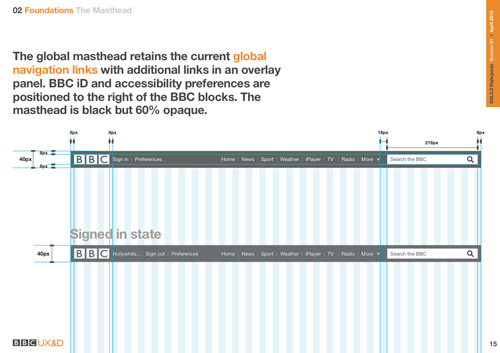

See the BBC’s Global Experience Language.

This is one of the most beautiful guidelines I’ve seen. BBC shows what to do with long user names, how much space everything should have and more.

BASIC CODING GUIDELINES

There’s no way to make someone else code like you, but you can offer others basic guidelines that will minimize the damage, such as:

  • CSS class naming conventions
    Should they use .camelCase or .words-with-dashes?
  • JavaScript integration
    Are you using jQuery? MooTools? How should new JavaScript be integrated?
  • Form styling
    Include the code, error states and more so that they understand what style conventions you expect.
  • Doc type and validation requirements
    Do you allow certain invalid items? Do you expect the CSS and HTML to validate?
  • Directory structure
    Make clear how you have organized it.
  • Accessibility standards
    Should people include alt tags? Is image replacement used for non-standard fonts?
  • Testing methods
    Which standard should they test with? Do you have staging and production websites?
  • Version control
    What system are you using? How should they check in new code?

How To Format

Some branding guidelines have been turned into beautiful books:
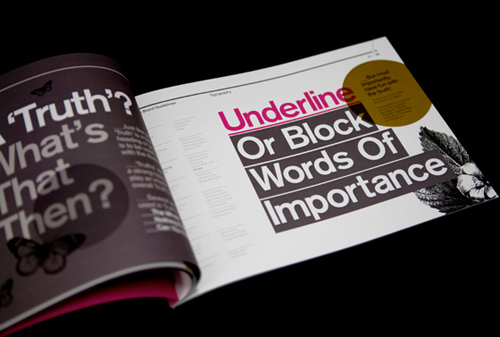

See the Truth brand guidelines.

This beautiful example, which was designed to go with a brand redesign, shows just how beautiful branding guidelines can be.

But this requires a substantial budget and a reprint every so often. For most companies with tight budgets, this is not practical. On the Web especially, content is constantly being refined and styles for elements are not set in stone.

Here are a few good practices for formatting your guidelines:

  • Include a cover
    This should include an example of best practices for the logo.
  • Make it beautiful
    Even if it won’t be printed as a book, you can still make sure the branding guidelines appeal to the viewer. After all, you’re trying to inspire them to use your designs to the highest standards!
  • Include contact details
    For when they have questions, so that you can prevent bad decisions from being made.
  • Make it easy to access and open
    Usually this means putting it online or in PDF format. Don’t make it too big; use images sparingly.
  • Make it printable
    For international companies especially, keep margins big so that the document can be printed in both A4 and US letter sizes. If it’s online, make sure your print style sheets render the document as expected. Don’t do white text on a black background, either: you don’t want the client to have to buy a new ink cartridge every time they print a copy.
  • Make it easy to change
    Updating, adding new pages and making changes should be easy, because it will happen!
  • Create a mini version
    Make a short handy guide that has just the basics, in addition to the full version. Both will get used in different instances.
  • Provide print templates whenever possible
    Things like letterheads, business cards and envelops should have their own templates. While guidelines will help people put things in the right spot, they usually won’t help them get the right resolution or color format.


Here’s a useful template for a one-page branding guideline.

LENGTH

Remember, people should be able to follow branding guidelines. A 100-page book will engage none but the most diligent designer. Many believe that a concise three-page overview is best for daily use, with a more in-depth 20-page document for more complex tasks. Less is more, usually!
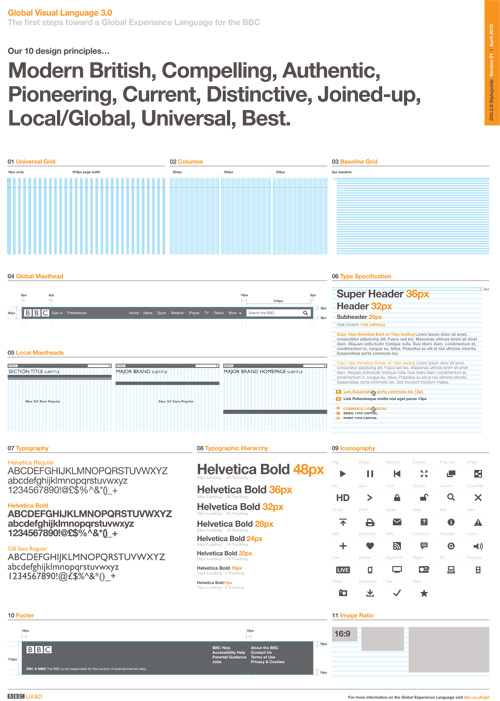

See the BBC’s branding guidelines and poster.

The BBC has created a detailed 38-page guideline. But it has also produced a beautiful poster for quick reference. It’s a brilliant idea, and it keeps the guidelines at the front of mind.

Resources

Download PDF

Tags: , , , ,

| What is MyVisionRoom? > | Back to Communication >

ABOUT THE AUTHOR

Kat Neville

See more articles by >

COMMENTS

What say you? Leave a comment!

Recent Comments
comment_post_ID); ?> Thank you for this information. I'm going to use this article to improve my work with the Lord.
 
— Abel Singbeh
 
comment_post_ID); ?> Thank you Ed for sharing your insights into the Church Growth Movement. I have my reservations with Church Growth models because it has done more damage than good in the Body of Christ. Over the years, western churches are more focused on results, formulas and processes with little or no emphasis on membership and church discipline. Pastors and vocational leaders are burnt out because they're overworked. I do believe that the Church Growth model is a catalyst to two destructive groups: The New Apostolic Reformation and the Emerging Church. Both groups overlap and have a very loose definition. They're both focus on contemporary worship, expansion of church brand (franchising), and mobilizing volunteering members as 'leaders' to grow their ministry. Little focus on biblical study, apologetics and genuine missional work with no agenda besides preaching of the gospel.
 
— Dave
 
comment_post_ID); ?> Thank you for sharing such a good article. It is a great lesson I learned from this article. I am one of the leaders in Emmanuel united church of Ethiopia (A denomination with more-than 780 local churches through out the country). I am preparing a presentation on succession planning for local church leaders. It will help me for preparation If you send me more resources and recommend me books to read on the topic. I hope we may collaborate in advancing leadership capacity of our church. God Bless You and Your Ministry.
 
— Argaw Alemu
 

Clarity Process

Three effective ways to start moving toward clarity right now.

What is Transformational Church?

People sometimes ask me about Transformational Church (TC), particularly after I mention it on Twitter as I did last week. I was talking about our TC Brasil project, as we are doing the TC research there.

So, here is a quick overview.

What:

Transformational Church and the TCAT (Transformational Church Assessment Tool) were designed to give churches tools to keep their focus on the biblical principles and guidelines for being the church while at the same time providing guidance on how to help them engage their culture and grow their church.

Transformational Church is a hopeful message:

  1. Because it relates to churches regardless of size or location
  2. It keeps the focus on the biblical expectations of the church without ignoring practical and contextual expressions
  3. We are seeing local churches learning that they can as a body of believers discern God’s direction and follow His leading in their local context.


When:

Our God is a transforming God. Anytime He is Lord of someone’s heart and life, transformation occurs. The same is true for the local church. We have found that there are certain seasons of a church’s life when they may be more open to seeking out God and allowing this transformation to begin and take hold.

Here are a few we have seen:

  • Vision Casting– pastors and leaders helping keep the focus of of the people reaching up and out rather than inward.
  • Transition– pastor and staff turnover; community demographics changing. Frankly, anytime the people sense that they are losing “control” is a great opportunity to give it back to God.
  • Crisis– when the pain of the status quo is too much.


Why:

If churches aren’t seeing the transformation they want (or want to see it at a greater level), this tools helps them define reality and then press forward with a plan together. TC helps churches understand 1) what biblical churches focus on, and 2) where they can start.

How:

Real transformation isn’t something that we can schedule, but it is something we can recognize. Church leaders can begin by leading their key leaders (staff and volunteer) through the Transformational Church book and leadership DVD. Taking the time to teach your people the biblical basis and matrix for thinking about being a transformational church.

Take the assessment. Find out where you are so you know where to begin. Every church has things she can celebrate and things she needs to work on. The TCAT isn’t a pass/fail assessment but rather a tool to help clarify where a current church is, what can be celebrated, and where they can make improvements.

Use the book. The Transformational Church book is provided for churches and leaders to work through together– evaluating where they are and where they need to go.

As I have written before, it is built on some incredibly simple and biblical ideas.

Incredibly Biblical Idea #1: Transformation. This is what happens when God gets hold of the life of an everyday person. He transforms them with the gospel. Every thought and action begins to change. Values and attitudes change. And people notice. They change from living for self to dying to self. Soon, life focuses solely on the mission of Christ.
Incredibly Biblical Idea #2: The Local Church. I believe in the church because of her Lord. It is the gathering of transformed people to hear the gospel, worship, and then scatter to participate in God’s mission. The church is God’s chosen instrument to spread the gospel. It is His people engaged in His mission to carry His message into their culture and every culture. The local church is not an antiquated idea but a necessity in our day.

And when these two words are combined using God’s perspective on and involvement in them both, then you have something even more compelling. And that is what happened when we discovered the principles included in Transformational Church.


It is simple. What we’re trying to do is help churches engage God’s mission more faithfully to see the transformation of individual lives through the proclamation of the Gospel, the transformation of churches as they join God on mission and the transformation of communities so that the name and fame of Jesus might be more widely known.

For more information, go to www.transformationalchurch.com.

Download PDF

Tags: , ,

| What is MyVisionRoom? > | Back to Process >

ABOUT THE AUTHOR

Ed Stetzer

Ed Stetzer

Ed Stetzer, Ph.D., holds the Billy Graham Chair of Church, Mission, and Evangelism at Wheaton College and serves as Executive Director of the Billy Graham Center for Evangelism. He has planted, revitalized, and pastored churches, trained pastors and church planters on six continents, holds two masters degrees and two doctorates, and has written dozens of articles and books. Previously, he served as Executive Director of LifeWay Research. Stetzer is a contributing editor for Christianity Today, a columnist for Outreach Magazine, and is frequently cited or interviewed in news outlets such as USAToday and CNN. He serves as interim pastor of Moody Church in Chicago.

See more articles by >

COMMENTS

What say you? Leave a comment!

Recent Comments
comment_post_ID); ?> Thank you for this information. I'm going to use this article to improve my work with the Lord.
 
— Abel Singbeh
 
comment_post_ID); ?> Thank you Ed for sharing your insights into the Church Growth Movement. I have my reservations with Church Growth models because it has done more damage than good in the Body of Christ. Over the years, western churches are more focused on results, formulas and processes with little or no emphasis on membership and church discipline. Pastors and vocational leaders are burnt out because they're overworked. I do believe that the Church Growth model is a catalyst to two destructive groups: The New Apostolic Reformation and the Emerging Church. Both groups overlap and have a very loose definition. They're both focus on contemporary worship, expansion of church brand (franchising), and mobilizing volunteering members as 'leaders' to grow their ministry. Little focus on biblical study, apologetics and genuine missional work with no agenda besides preaching of the gospel.
 
— Dave
 
comment_post_ID); ?> Thank you for sharing such a good article. It is a great lesson I learned from this article. I am one of the leaders in Emmanuel united church of Ethiopia (A denomination with more-than 780 local churches through out the country). I am preparing a presentation on succession planning for local church leaders. It will help me for preparation If you send me more resources and recommend me books to read on the topic. I hope we may collaborate in advancing leadership capacity of our church. God Bless You and Your Ministry.
 
— Argaw Alemu
 

Clarity Process

Three effective ways to start moving toward clarity right now.

What I Wish Someone Had Told Me: Leading Pastors Share Thoughts on Vision and Alignment

Every year, Outreach Magazine provides a profile of the 100 Fastest-growing churches in the country. This year, they had a few interview spots entitled, “What I wish someone told me.”

What really struck me are the common threads on vision and alignment. Look for how these pastors discuss clarity and unique calling. The big themes are as follows:

  • Radical emphasis on mission and vision (including values and strategy)
  • Willingness to “let people go” who don’t align with the vision
  • Commitment to stop programs and cut ministry not aligned with the vision

Now, listen to their own words form the 2012 special issue.

Luke Barnett (@LWBarnett),  Phoenix First Assembly of God (12th Fastest-growing)

At first you think the mobilizing leadership happens naturally, like leaders and volunteers and magically appear because you have a great idea, but that’s not so. Over time you learn that you have to be intentional in mobilizing and recruiting leaders and you have to develop the leaders that have bought into the vision and feel appreciated.

John  Beukema (@John Beukema), King Street Church (39th Fastest-growing)

Some people will never leave no matter what happens and some people will leave no matter what happens. Since that has been true, I wish I had been told how pitiful and unproductive it is to worry over who you retain and who you don’t. Just do the right things, be clear on your mission, and don’t get emotionally invested in who stays or goes.

David Brown (@DavidBrown_Ave), The Avenue Church (44th Fast-growing)

People do not have trouble committing to something. Look around at the ball fields and cheerleading meets. The church has been slow at giving them something worth committing to be in. When leaders are passionate about the vision God has given the local church and begin to share that vision people will follow.

Jim Burgen, Flatirons Community Church (2nd Fastest-growing)

At least once a year we carve out six weeks to work through our primary six values that drive everything we do, why we do it, how we do it, and why we don’t do that other thing.  Regularly working through our values in creative parables allows people that have never been to church to know what kind of place they have landed in.

Jeff Clark, First Hattiesburg (20th Fastest-growing)

We killed Sunday School, and it saved our church We killed men’s and women’s ministry and it saved our church. We found that you can’t have competing ministries and build intimacy. Simple, clear and focused opportunities for connection build intimacy. Small groups are driving a stake in the heart of feeling disconnected and left out.

Mark Connelly (@missionmark), Mission Community Church (8th Fastest-growing)

The bigger you get the better your Sunday morning experience is. That draws spectators. We constantly fight against that by boldly calling people to sacrificially live their faith, and don’t worry about the fallout. In a recent sermon, I called spectators parasites on the body of Christ. I am sure we lost some people as a result. And they’re probably parasites on some other church now.

Jack Graham (@Jackngraham), Prestonwood Baptist Church (75th Fastest growing)

The most important lesson I have learned is to ensure we planning and preparing or growth. It’s more than a cliché: Vision produces provision.

Too often we ride dead horses into the sunset. We always ask, “Is this program fulfilling the church’s mission?” Is it vibrant and life-changing?” “Is it good stewardship?”  We must be willing at times to make tough decisions and cut programs that are no longer productive.

Stuart Hodges (@stuhodges), Waters Edge Church (36th Fastest-growing)

From the verbiage we use in an e-mail communication to things we do on Facebook, we’re connecting people to mission. We utilize weekly team huddles to keep our volunteers connected to the mission, We emphasize the mission regularly in our community group curriculum. And throughout the year, I constantly tie the mission of our church into sermons.

We limit our programs. By saying “now” to additional church programs we can say “yes” to resourcing outreach. If we said yes to every great idea for “the church” there would be no time, energy or dollars for outreach.

Jonathon Howes (@Johnny Howes), Graystone Church (40th Fastest-growing)

One of things we have done to retain more people is to lower our requirement of membership. We still want every member to live out our values, but we realized that it’s a process, and we need to let them grow spiritually as the Holy Spirit moves in their lives and they learn from the Word of God.

Some people will always be spectators, but our goal is challenging people to move from the crowd to the core. We have built into the Graystone culture: Everyone comes, everyone serves and everyone gives.

Benji Kelly (@BenjiKelley) Newhope Church (5th Fastest-growing)

I truly believe that the same vision that attacts some also repels others. In the larger scheme of things, I think we pastors would do well to become OK with people leaving our church. For the sake of those that God still wants to reach with love and forgiveness, we have unfortunately have to sometimes let believers exit out the back door!

John McKinzie, Hope Fellowship (48th Fastest-growing)

One thing I don’t know if I realized in my early years is that retention in the body of Christ is more important that retention in my church. If people are unhappy, I would rather help them find a church that “fits” them than have them stay unhappy and possibly quit going to church altogether.

Scott Ridout (@scottridout) Sun Valley Community Church (4th Fastest-growing)

I wish I would have know that the natural drift of every church is inward. The more time Christians spend in church, it seems the farther they move away from God’s original intention­­– to reach the lost.  Momentum is easily lost when it comes ot evangelistic fervor, and we have to constantly champion an outward-focused lifestyle among our people.

Kerry Shook (@kerryshook), The Woodlands Church (9th Largest)

I had no idea how intentional I would have to be to stay true to my purpose and the vision God had put in my heart for what the church should be and do. It is so easy to please everyone and compromise your calling of the vision God has given you and how he desires to you and your ministry uniquely in His Kingdom to reach people for Christ…No one every told me that if you lead well people will still leave the church.

Once a year we have an alignment campaign where all of our small groups are expected to take the same small group challenge. This provides a sense of shared mission and we all do the same study together, and it gets everyone on the same page with the vision God has given us.

Download PDF

Tags: , , ,

| What is MyVisionRoom? > | Back to Vision >
ABOUT THE AUTHOR

Will Mancini

Will Mancini

Will Mancini wants you and your ministry to experience the benefits of stunning, God-given clarity. As a pastor turned vision coach, Will has worked with an unprecedented variety of churches from growing megachurches and missional communities, to mainline revitalization and church plants. He is the founder of Auxano, creator of VisionRoom.com and the author of God Dreams and Church Unique.

See more articles by >
COMMENTS

What say you? Leave a comment!

Recent Comments
comment_post_ID); ?> Thank you for this information. I'm going to use this article to improve my work with the Lord.
 
— Abel Singbeh
 
comment_post_ID); ?> Thank you Ed for sharing your insights into the Church Growth Movement. I have my reservations with Church Growth models because it has done more damage than good in the Body of Christ. Over the years, western churches are more focused on results, formulas and processes with little or no emphasis on membership and church discipline. Pastors and vocational leaders are burnt out because they're overworked. I do believe that the Church Growth model is a catalyst to two destructive groups: The New Apostolic Reformation and the Emerging Church. Both groups overlap and have a very loose definition. They're both focus on contemporary worship, expansion of church brand (franchising), and mobilizing volunteering members as 'leaders' to grow their ministry. Little focus on biblical study, apologetics and genuine missional work with no agenda besides preaching of the gospel.
 
— Dave
 
comment_post_ID); ?> Thank you for sharing such a good article. It is a great lesson I learned from this article. I am one of the leaders in Emmanuel united church of Ethiopia (A denomination with more-than 780 local churches through out the country). I am preparing a presentation on succession planning for local church leaders. It will help me for preparation If you send me more resources and recommend me books to read on the topic. I hope we may collaborate in advancing leadership capacity of our church. God Bless You and Your Ministry.
 
— Argaw Alemu
 

Clarity Process

Three effective ways to start moving toward clarity right now.