Are You Helping or Hurting Your Mission?

One of the keys to a church’s missional success is how its members are deployed. There are two approaches—one facilitates the church’s mission; the other often frustrates it.  Few in the church ever clarify this choice, but every church makes it, and every church lives with the consequences of its choice.

The institutional approach to lay ministry begins with the needs of the institution.  Every church needs Sunday school teachers, committee members, musicians, ushers.  In the institutional approach, when a job opens up, the response is to search for a person who seems most suitable to fill it and/or is most likely to say yes.  Success, in such churches, is when a member says, “Okay, I’ll do it.”  Hopefully the person is qualified, gifted, and motivated for that ministry; but there are no guarantees.  If it turns out there is a mismatch between member and task, the result is a job poorly done and a member mostly frustrated.  “Plugging warm bodies into ministry slots in a congregation,” says Pam Heaton, “tends to increase volunteer burnout, dissatisfaction, and departure.”[i]  With the institutional approach to lay ministry, church members exist to serve the needs of the institution.

The individual approach is far less widely practiced, but significantly more effective for missional success.  Here the goal is not to fill a vacancy but to find or create a place where members can joyfully and productively participate in the mission.  Rather than beginning with the needs of the institution, the individual approach begins with the strengths of the person.  Church members are encouraged to try a position related to their interest and see how it fits.  If it does, the member may choose to spend more time in that ministry and/or receive additional training.  If the task is not comfortable, or the person does not feel a sense of calling, he or she is guided to explore other ministries that might be a better fit.  If a match cannot be found, creating a new ministry is explored.  In the individual approach to lay ministry the institution exists for the benefit of the people rather than the people for the benefit of the institution.

Consider the difference in results of these two approaches to lay ministry…screenshot_611

Take a Lay Ministry Check-Up…

The chart below can help you discern whether your present approach to lay ministry is increasing or decreasing the liklihood of missional success. First, write in line 1 the number that represents your total church constituency—all church members, plus regular attenders who are not officially members (above age thirteen).  Next, determine in which column your church falls on rows 2-18.  All the numbers in the chart are percentages.  Calculate your percentages based on your total church constituency (line 1), unless otherwise noted.

If you find your scores are primarily in the left columns, it is likely that your members are seen as “workers” and the focus of your ministry is on the church institution.  The farther your scores are to the right, the more likely your members are seen as “ministers,” and the focus of your ministry is on people.

screenshot_645

Ask a team of 3-4 people in your church to do this research and report back what they have found.  Then use the following questions to focus discussion among your leaders about how to best accomplish the work Christ has given your church:

  1. On which side of the chart do most of our scores fall?
  2. Are the results of this assessment consistent with our previous perceptions?
  3. Which items seem to be most important to address?
  4. What activities do we engage in that have brought us to this point?  Can they, or should they, be changed?
  5. What steps would be involved in moving toward an individual approach to lay ministry, and away from an institutional approach?

(See What Every Pastor Should Know: 101 Rules for Effective Church Leadership [Gary McIntosh & Charles Arn] for more practical tools on this and other topics related to church health/growth.  Available April, 2013 from Baker Books.)

Download PDF

Tags: , ,

| What is MyVisionRoom? > | Back to Vision >

ABOUT THE AUTHOR

Charles Arn

Charles Arn

Dr. Charles Arn has been a leading contributor to the conversation on church growth/health for the past 30 years. His newest book, What Every Pastor Should Know, will be published by Baker Books in 2013.

See more articles by >

COMMENTS

What say you? Leave a comment!

Recent Comments
comment_post_ID); ?> Thank you for this information. I'm going to use this article to improve my work with the Lord.
 
— Abel Singbeh
 
comment_post_ID); ?> Thank you Ed for sharing your insights into the Church Growth Movement. I have my reservations with Church Growth models because it has done more damage than good in the Body of Christ. Over the years, western churches are more focused on results, formulas and processes with little or no emphasis on membership and church discipline. Pastors and vocational leaders are burnt out because they're overworked. I do believe that the Church Growth model is a catalyst to two destructive groups: The New Apostolic Reformation and the Emerging Church. Both groups overlap and have a very loose definition. They're both focus on contemporary worship, expansion of church brand (franchising), and mobilizing volunteering members as 'leaders' to grow their ministry. Little focus on biblical study, apologetics and genuine missional work with no agenda besides preaching of the gospel.
 
— Dave
 
comment_post_ID); ?> Thank you for sharing such a good article. It is a great lesson I learned from this article. I am one of the leaders in Emmanuel united church of Ethiopia (A denomination with more-than 780 local churches through out the country). I am preparing a presentation on succession planning for local church leaders. It will help me for preparation If you send me more resources and recommend me books to read on the topic. I hope we may collaborate in advancing leadership capacity of our church. God Bless You and Your Ministry.
 
— Argaw Alemu
 

Clarity Process

Three effective ways to start moving toward clarity right now.

What Does Your Ministry Brand Say About You?

Every tweet, every status update, every avatar, every social network background image—they all say something about your digital brand. Have you taken inventory to see what they’re saying?

For most organizations, the answer is, “no.” It’s not an intentional “no.” It’s a “no” stemming from not enough time in the day. People usually stumble into digital ghost towns by accident, not on purpose.

A Few Good Brands

MailChimp does a fantastic job at translating who they are as a company to their online presence. Their Twitter feed is filled with irreverent kookiness. The welcome greeting on the dashboard borders on nonsensical.

Wherever you interact with MailChimp online, they are the same company. There’s no confusion about who they are, what their company is like, and what they want their customer to experience. It’s all intentionally, purposefully crafted.

Kristina Halvorson and the folks at Brain Traffic are another shining example. Here’s the website for her book Content Strategy for the Web:

Content Strategy website

Beauteous. Her message of “better content, better business” is actually built into the website itself. I can guarantee you every word on this home page has been poured over and intentionally chosen. For good measure, here’s the website for Brain Traffic, the company Kristina helps run:

Brain Traffic website

And here’s the site for one of their events, Confab Twin Cities:

Con Fab Twin Cities

It’s all in-sync. It all works together. The brand’s values seep out of every corner of the web, ready to be enjoyed by whomever comes across it.

What Does Your Brand Say About You?

Take a quick look at your online presence. Twitter, websites, fan pages, Instagram feeds—the works. Go ahead, I’ll wait =)

What do you see? Do you see a continuous presence, flowing from one channel to the next? Are your values prevalent in each digital outpost? For instance, if you say you value “quality,” does your website actually reflect it? Do you have an online home you can be proud of? Did you invest the time, effort, and, yes, resources to build something of actual quality?

Here’s the thing (and I’m going to shoot straight with you): you don’t have the luxury of sandbagging your digital presence any longer. The game has changed. It is no longer in the act of changing.

You can no longer simply have a blog, you must have a strategy for it. You can no longer simply tweet, you must have a strategy for those tweets. Catch my drift?

As a business, brand, individual or organization, you need to be considering:

  • Content strategy
  • Content marketing
  • Social media strategy
  • Social media management
  • Social media audits
  • Email marketing
  • Editorial calendars
  • Over digital communication strategy
  • And, yes, more…

If you’re not actively developing plans for most of these, I’m afraid the widening gap may prove too wide in the future.

Read more from Justin here.

Download PDF

Tags: , , ,

| What is MyVisionRoom? > | Back to Communication >

ABOUT THE AUTHOR

Justin Wise

See more articles by >

COMMENTS

What say you? Leave a comment!

Recent Comments
comment_post_ID); ?> Thank you for this information. I'm going to use this article to improve my work with the Lord.
 
— Abel Singbeh
 
comment_post_ID); ?> Thank you Ed for sharing your insights into the Church Growth Movement. I have my reservations with Church Growth models because it has done more damage than good in the Body of Christ. Over the years, western churches are more focused on results, formulas and processes with little or no emphasis on membership and church discipline. Pastors and vocational leaders are burnt out because they're overworked. I do believe that the Church Growth model is a catalyst to two destructive groups: The New Apostolic Reformation and the Emerging Church. Both groups overlap and have a very loose definition. They're both focus on contemporary worship, expansion of church brand (franchising), and mobilizing volunteering members as 'leaders' to grow their ministry. Little focus on biblical study, apologetics and genuine missional work with no agenda besides preaching of the gospel.
 
— Dave
 
comment_post_ID); ?> Thank you for sharing such a good article. It is a great lesson I learned from this article. I am one of the leaders in Emmanuel united church of Ethiopia (A denomination with more-than 780 local churches through out the country). I am preparing a presentation on succession planning for local church leaders. It will help me for preparation If you send me more resources and recommend me books to read on the topic. I hope we may collaborate in advancing leadership capacity of our church. God Bless You and Your Ministry.
 
— Argaw Alemu
 

Clarity Process

Three effective ways to start moving toward clarity right now.

10 Rules of Thumb for Healthy Churches in America

Using rules of thumb to gauge church health is problematic because they are, well, rules of thumb. There will always be exceptions, extenuating circumstances, and even disagreements on the right metrics.

I thus realize I am taking a risk when I publish these broad guidelines. There is the greater risk that someone will take these numbers as infallible and perfectly suited for his or her congregation. Please let wisdom prevail. So many factors, such as demographics, multiple sites, and history will always provide better insights than mere numbers.

Nevertheless, I provide you these ten rules of thumb as a starting point. You can then wisely discern how well and specifically they apply to your situation.

  1. Number of acres needed for church site: one acre for every 125 in attendance. This ratio is based on useable acres. That number is affected by zoning requirements, water retention requirements, and property shape, to name a few.
  2. Parking Spaces: one space for every 2 people in attendance.
  3. Parking Area: 100 spaces for every acre used for parking.
  4. Evangelistic effectiveness: 12 conversions per year for every 100 in average attendance. Different congregations used different terminology: conversions, baptisms, professions of faith, salvations, etc. In this metric, the number refers to those in the past year who became Christians and became active in that specific congregation.
  5. Seating space per attendee: 27 inches. That number was 20 inches at one time. It has changed due to larger posteriors and greater cultural space desires.
  6. Maximum capacity of a facility: 80% full. This old tried and true ratio is still good. When a facility is 80% full architecturally, it feels 100% full.
  7. Retention effectiveness: For every 10 new members added per year, average worship attendance should increase by 7.
  8. Effective giving; For every person in average attendance, including children and preschool, $26.00 in budget receipts. For example, a church with an average worship attendance of 100 should average at least $2,600 in weekly budget giving. This ratio is obviously greatly impacted by demographics.
  9. Maximum debt payment budgeted: 33 percent of annual income for most churches. Up to 40 percent for fast-growing churches.
  10. Maximum debt owed: 2.5 times the annual income of the church for the previous year.

So how do you evaluate these rules of thumb? How is your church doing? What would you recommend I change or add?

Read more from Thom here.

 
Download PDF

Tags: , ,

| What is MyVisionRoom? > | Back to Vision >

ABOUT THE AUTHOR

Thom Rainer

Thom Rainer

Thom S. Rainer is the founder and CEO of Church Answers, an online community and resource for church leaders. Prior to founding Church Answers, Rainer served as president and CEO of LifeWay Christian Resources. Before coming to LifeWay, he served at The Southern Baptist Theological Seminary for twelve years where he was the founding dean of the Billy Graham School of Missions and Evangelism. He is a 1977 graduate of the University of Alabama and earned his Master of Divinity and Ph.D. degrees from The Southern Baptist Theological Seminary.

See more articles by >

COMMENTS

What say you? Leave a comment!

Recent Comments
comment_post_ID); ?> Thank you for this information. I'm going to use this article to improve my work with the Lord.
 
— Abel Singbeh
 
comment_post_ID); ?> Thank you Ed for sharing your insights into the Church Growth Movement. I have my reservations with Church Growth models because it has done more damage than good in the Body of Christ. Over the years, western churches are more focused on results, formulas and processes with little or no emphasis on membership and church discipline. Pastors and vocational leaders are burnt out because they're overworked. I do believe that the Church Growth model is a catalyst to two destructive groups: The New Apostolic Reformation and the Emerging Church. Both groups overlap and have a very loose definition. They're both focus on contemporary worship, expansion of church brand (franchising), and mobilizing volunteering members as 'leaders' to grow their ministry. Little focus on biblical study, apologetics and genuine missional work with no agenda besides preaching of the gospel.
 
— Dave
 
comment_post_ID); ?> Thank you for sharing such a good article. It is a great lesson I learned from this article. I am one of the leaders in Emmanuel united church of Ethiopia (A denomination with more-than 780 local churches through out the country). I am preparing a presentation on succession planning for local church leaders. It will help me for preparation If you send me more resources and recommend me books to read on the topic. I hope we may collaborate in advancing leadership capacity of our church. God Bless You and Your Ministry.
 
— Argaw Alemu
 

Clarity Process

Three effective ways to start moving toward clarity right now.

When Does Knowledge Equal Spiritual Growth?

Evangelicals have a love-hate relationship with knowledge, it seems. Many churches seem to be so embarrassingly anti-intellectual that it seems if you enjoy books, you may finding yourself looking for a new church.

There seems to be a great fear of having a swelled, puffed up head (cf. 1 Cor. 8:1), and with good reason—too many of us have made the error of putting too much stock in head knowledge that doesn’t move to the heart. Too often we take someone’s knowledge of Scripture and Christian theology as evidence of their spiritual maturity.

But where we go too far is when we assume that seeking knowledge is a bad thing.

In fact, knowledge should be a great concern of all Christians. We’re to be transformed by the renewal of our minds (Rom 12:3). Our love is to be informed by “knowledge and all discernment” (Phil 1:9). Paul connects salvation with knowledge—a coming “to a knowledge of the truth” (2 TIm. 2:25).

He even prays that the Colossians will be filled with knowledge in Col. 1:9-10:

And so, from the day we heard, we have not ceased to pray for you, asking that you may be filled with the knowledge of his will in all spiritual wisdom and understanding, so as to walk in a manner worthy of the Lord, fully pleasing to him, bearing fruit in every good work and increasing in the knowledge of God.

So does growth in knowledge mean spiritual growth? Anthony Hoekema puts it well:

The answer depends on what one means by knowledge. If it is mere abstract, intellectual knowledge, mere rote-memory knowledge, mere “Bible Trivia” knowledge, not necessarily. Paul  in fact, talks about a type of knowledge that “puffs up,” but does not build up (1 Cor. 8:1). But if growth in knowledge means growth in understanding what Christ has done for us, what the Spirit is doing in us, and what God wants us to do for him and to be for him, then growth in knowledge is bound to bring spiritual growth. This is the type of knowledge Peter has in mind when he enjoins his readers, in 2 Peter 3:18, “But grow in the grace and knowledge of our Lord and Savior Jesus Christ.”

Anthony A. Hoekema, Saved by Grace, 142 (Westminster | Amazon)

We are right to take little stock in knowledge that fills the head but doesn’t transform the heart. But we should always rejoice as believers grow in the grace and knowledge of our Lord and Savior.

Read more from Aaron here.

Download PDF

Tags: , ,

| What is MyVisionRoom? > | Back to Process >

ABOUT THE AUTHOR

Aaron Armstrong

Aaron Armstrong

Aaron is the author of Awaiting a Savior: The Gospel, the New Creation, and the End of Poverty (Cruciform Press, 2011). He is a writer, serves as an itinerant preacher throughout southern Ontario, Canada, and blogs daily at Blogging Theologically.

See more articles by >

COMMENTS

What say you? Leave a comment!

Recent Comments
comment_post_ID); ?> Thank you for this information. I'm going to use this article to improve my work with the Lord.
 
— Abel Singbeh
 
comment_post_ID); ?> Thank you Ed for sharing your insights into the Church Growth Movement. I have my reservations with Church Growth models because it has done more damage than good in the Body of Christ. Over the years, western churches are more focused on results, formulas and processes with little or no emphasis on membership and church discipline. Pastors and vocational leaders are burnt out because they're overworked. I do believe that the Church Growth model is a catalyst to two destructive groups: The New Apostolic Reformation and the Emerging Church. Both groups overlap and have a very loose definition. They're both focus on contemporary worship, expansion of church brand (franchising), and mobilizing volunteering members as 'leaders' to grow their ministry. Little focus on biblical study, apologetics and genuine missional work with no agenda besides preaching of the gospel.
 
— Dave
 
comment_post_ID); ?> Thank you for sharing such a good article. It is a great lesson I learned from this article. I am one of the leaders in Emmanuel united church of Ethiopia (A denomination with more-than 780 local churches through out the country). I am preparing a presentation on succession planning for local church leaders. It will help me for preparation If you send me more resources and recommend me books to read on the topic. I hope we may collaborate in advancing leadership capacity of our church. God Bless You and Your Ministry.
 
— Argaw Alemu
 

Clarity Process

Three effective ways to start moving toward clarity right now.

Understanding Megachurches Part 3: Myths

So this week inadvertently turned into Megachurch Week on the blog. In the event you missed it, everything started  with some data on the continued growth of megachurches. Then, I shared a new infographic from Leadership Network on the financial health of megachurches.

Throughout the week, I’ve received blog comments, Facebook messages, tweets, and emails challenging the positive influence of several megachurches– some by name, some not. I get it. Some megachurches are not healthy environments. As I said Tuesday, I think some are quite terrible and fulfill every stereotype out there. Yet, there are also some great ones, and for that I am thankful. I want to understand them more and, when possible, to encourage them on their journey.

And while I encourage them, I’d also encourage those of you not pastoring or attending megachurches to do the same. Yes, there are some terrible megachurches. Just like there are some terrible churches that run 125 every week. But my job, and yours, is not to indiscriminately cast stones at every church that happens to be, or not to be, a certain size.

Wednesday evening I got an email from my friend Scott Thumma, one of the authors of the research I had quoted and one of the top megachurch researchers in the country, and I got an idea. Scott actually authored the book that debunks megachurch myths, appropriately titled Beyond Megachurch Myths. If you routinely deal with, work at, or attend a megachurch, I would encourage you to buy the book. It’s full of research, anecdotes, and stats and is written in a very accessible way.

Without further ado, here are the nine megachurch myths from Scott Thumma and Dave Travis and a little of my commentary about each of them. Keep in mind that these are their myths and I am commenting on them.

1 – All Megachurches Are Alike

Scott and Dave identified (and listed examples of: p. 31-38) at least four different streams of megachurches: Old Line/Program-Based (large FBC’s and other historic churches); Seeker (Saddleback, Willow Creek, etc.); Charismatic/Pastor-Focused (Church without Walls, Lakewood, Potter’s House); and New Wave/Re-Envisioned (NewSpring, Mars Hill Seattle, The Village).

If you are at all familiar with the church names or pastors of those churches, you know they are nothing alike. The same could be said of the church I pastor and any other church plant that meets in a movie theater like we do. Our size and surroundings may be similar, but our churches would likely be very different.

2 – Megachurches Are Just Too Big

“Of the 320,000 Christian churches, 60% of them have fewer than 100 participating adults and children (p. 45). And when surveyed, 64% of megachurch attendees knew as many or more people in the megachurch than they did at smaller churches (p. 46). 80% of attendees felt satisfied with the level of pastoral care they received (p. 47).”

Any church can “be too big.” But as our culture becomes increasingly urbanized and less rural, large churches become less intimidating– just as large cities became less intimidating for farmers in generations past. Simply put, obviously many people do not think they are too big.

3 – Megachurches Are Cults of Personality

Thumma writes “Pastors are often the center of attention whether the church is large or small…It is not surprising that megachurches are often identified by the names of their senior pastors. Any successful enterprise can come to be characterized by its leader. But it is unfortunate that this reality has led critics to suggest that megachurches are more about a pastor’s ego than about God’s kingdom (p. 55-56).”

We are often quick to criticize churches that grow under a certain pastor’s leadership, but good leaders will attract teams to work with them. Those teams will grow and, at times, the churches will become larger and larger– perhaps even a megachurch. That does not make it a cult of personality.

4 – Megachurches Are Only Concerned About Themselves and the Needs of Their Attendees

“72% of megachurches have partnered with other congregations to do international missions (p. 80). Because membership is spread across an expansive region and over multiple communities, megachurch social ministry may also be dispersed over a large area (p. 82).”

I ran an entire series last year on how megachurches can be– and often times are– missional in their practice and theology. From counseling ministries to food banks to substance abuse programs to thrift stores, megachurches can make dramatic impact in both their social and spiritual communities.

5 – Megachurches Water Down the Faith

“It is abundantly clear that some churches preach a prosperity gospel of kingdom theology or the acceptance of lifestyles and political positions with which many critics from different theological positions would find fault. However, the vast majority of megachurches have belief statements on paper and in practice that are clearly in line with orthodox Christian doctrines. Even more important, these churches’ organized programs and the values instilled into committed attendees show that this theology is promoted and lived out. (p. 98-99)”

I know big churches and small churches that water down the faith. However, stats show that large churches tend to have more orthodox beliefs and practices than any other size. When Scott and Dave researched what was emphasized in the religious practices of megachurches they found higher percentages of personal prayer, meditations, or devotions (51-42); personal Scripture study (54-47); and tithing or sacrificial giving (47-39).

6 – These Churches are Bad for Other Local Churches

“Individuals will always have disagreements with the actions and theology of certain megachurches and their pastors, but do smaller churches have reason to fear a megachurch the way a mom-and-pop general store might when rumors of Wal-Mart arise? Some of their concern might be justified, but we suggest that the benefits these congregations bring to other churches can outweigh the challenging situations they create.” (p. 119)

This is THE complaint/criticism that I receive more than any other when I write about megachurches. Several of you wrote in that the only reason they were growing was because they were “swapping sheep” from other local churches. Some even claimed stats that local church transfers accounted for anywhere from 60-95% of new members at megachurches. So I went digging for an accurate stat, and Scott has the only one I can find. In their 2009 report Not Who You Think They Are: A Profile of the People Who Attend America’s Megachurches, Scott, David Travis, and Warren Bird provide this breakdown:
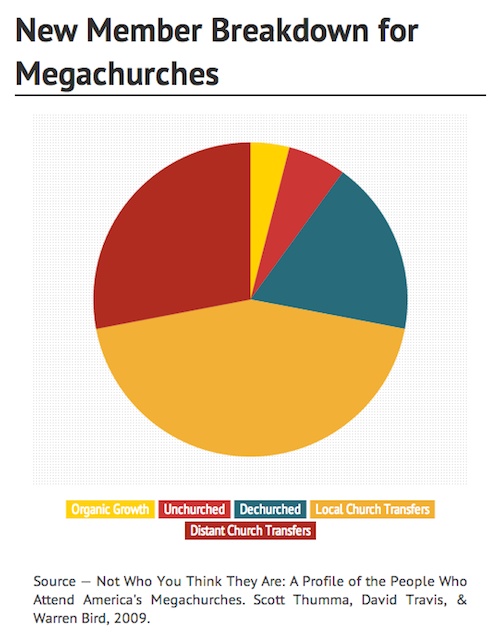
how-people-join-megachurches

Breakdown: 4% Organic; 6% Unchurched; 18% Dechurched; 28% Distant Transfer; 44% Local Transfer

So there it is– about 44% of new members at megachurches are from other local churches– not 60%, not 70%, and definitely not 95%. I hear people saying 90% and I agree that’s a myth. (But it is still way too high… just like so many other churches.)

I wish it were 0%, and every person that joined a megachurch was formerly without Christ, but the fact is that people do transfer between churches. Yet, I don’t know of any research or real evidence (beyond “but I KNOW it is true, Ed”) that megachurches transfer more out of local churches, destroying them while benefiting their own growth.

Actually, my friend (and church expert) George Hunter says that based on his lifelong observation, 80% of church growth (in churches of all sizes) is transfer from other churches. (If you add local and distant transfer, you don’t quite get to 80%, but it is close.) In other words, megachurches transfer like everyone else– but since they are bigger, perhaps we notice it more.

In 2009, our LifeWay Research study of Protestant church pastors revealed “49 percent of new attendees during the last five years have transferred from other congregations, while 32 percent were unchurched and 19 percent were children born to adults attending the church.”

Now these are self-reported numbers from pastors, who I would assume report a higher percentage of unchurched and a lower percentage of church transfers than would be true if we surveyed the actual attendees (as was done in the megachurch study cited above). But the picture here shows us what is true in all churches.

Way too many people transfer from between churches. But it also shows what is not provable– that megachurches are draining and destroying local churches on a widespread basis. Most churches grow by transfer, regardless of size.

There are some differences in how we classified the information and how Scott, David, and Warren did, but it is safe to say that on average, less than half of new church members– regardless of church size– come from other local churches. My guess is that megachurches attract more distant (new in town) transfers from other churches, but that is just a guess. Regardless, at this point, we just don’t have evidence that megachurches transfer people out of local churches at a higher rate than other churches.

Now, I understand that some have a very emotionally-vested perception that megachurches steal all the sheep from local churches. And maybe it was true at your church. But by and large, there is no statistical evidence that shows that megachurches are having a disproportionate impact on other local churches through transfer.

I want more unchurched being reached, but by and large with the information we have now, there is not evidence that megachurches transfer in more than other local churches– and in certain instances may do a little less.

For what it is worth, I’d love to see more research here to definitively answer the question, but at this point, someone’s hunch or angst does not make a trend or reality.

7 – Megachurches Are Full of People of the Same Race, Class, and Political Preference

“Many megachurches have intentionally adopted an inclusive vision that the church is for all people no matter what race or socioeconomic group. The leadership of these churches has a strong desire to cultivate an atmosphere of inclusion and embrace a wide diversity of people. This message is translated to the people in the pews.” (p. 138)

I honestly can’t imagine anyone believing this myth is true. When I look back at all of the megachurches I’ve been in over the years, many of them are most diverse than smaller churches– socially, economically, and ethnically. Maybe the splits aren’t even, but even still, they are much more diverse than most smaller churches. Most smaller churches are catching up, and I’m glad for it.

8 – Megachurches Grow Because of the Show

Thumma shows that while the worship service elements are important to the growth of megachurches, the greatest influence was the pastor and members’ active involvement in– and passion for– evangelism and integrating newcomers (p. 160).

In the circles in which I run, we call this closing the back door. A church can’t grow if someone walks out the back door every time you have someone walk in the front door. Assimilation is one of the major components of growing churches regardless of its size. An effective assimilation plan will help any church. When you have members– not just staff– who are committed to bringing people in the front door while closing the back door, churches grow quickly.

9 – The Megachurch Movement is Dying

Nope.

See this post.

So, long story short, there is a reason there is a book called Beyond Megachurch Myths. I hope you won’t spread them.

Read more from Ed here.

Download PDF

Tags: , ,

| What is MyVisionRoom? > | Back to Vision >

ABOUT THE AUTHOR

Ed Stetzer

Ed Stetzer

Ed Stetzer, Ph.D., holds the Billy Graham Chair of Church, Mission, and Evangelism at Wheaton College and serves as Executive Director of the Billy Graham Center for Evangelism. He has planted, revitalized, and pastored churches, trained pastors and church planters on six continents, holds two masters degrees and two doctorates, and has written dozens of articles and books. Previously, he served as Executive Director of LifeWay Research. Stetzer is a contributing editor for Christianity Today, a columnist for Outreach Magazine, and is frequently cited or interviewed in news outlets such as USAToday and CNN. He serves as interim pastor of Moody Church in Chicago.

See more articles by >

COMMENTS

What say you? Leave a comment!

Recent Comments
comment_post_ID); ?> Thank you for this information. I'm going to use this article to improve my work with the Lord.
 
— Abel Singbeh
 
comment_post_ID); ?> Thank you Ed for sharing your insights into the Church Growth Movement. I have my reservations with Church Growth models because it has done more damage than good in the Body of Christ. Over the years, western churches are more focused on results, formulas and processes with little or no emphasis on membership and church discipline. Pastors and vocational leaders are burnt out because they're overworked. I do believe that the Church Growth model is a catalyst to two destructive groups: The New Apostolic Reformation and the Emerging Church. Both groups overlap and have a very loose definition. They're both focus on contemporary worship, expansion of church brand (franchising), and mobilizing volunteering members as 'leaders' to grow their ministry. Little focus on biblical study, apologetics and genuine missional work with no agenda besides preaching of the gospel.
 
— Dave
 
comment_post_ID); ?> Thank you for sharing such a good article. It is a great lesson I learned from this article. I am one of the leaders in Emmanuel united church of Ethiopia (A denomination with more-than 780 local churches through out the country). I am preparing a presentation on succession planning for local church leaders. It will help me for preparation If you send me more resources and recommend me books to read on the topic. I hope we may collaborate in advancing leadership capacity of our church. God Bless You and Your Ministry.
 
— Argaw Alemu
 

Clarity Process

Three effective ways to start moving toward clarity right now.

Improving the Ineffective Leader: Moving from Bad to Good

Leadership literature is chock-full of ways in which an average leader can become great. We all believe we’re good. Greatness is just a book, a conference, or a degree away. Indeed, I believe run-of-the-mill leaders can become better with training. A desire to learn, self-awareness, and a solid work ethic go a long way.

Some leaders, however, are just bad. They don’t lead well. Poor decisions are normative.

I believe most pastors want to lead their congregations in a way honoring to God. I believe most pastors care about their flocks. And God uses different types of leaders in different contexts. A rural setting, for example, requires a different type of leader than an urban setting. One is not superior over the other simply because of contextual expertise. But not all leaders—or shepherds for that matter—are great. And some pastors are poor examples of leadership, even if they really do care.

Years of practice entrench bad habits.

At some point, enough imbedded weaknesses transform an otherwise mediocre leader into a bad leader. Sometimes bad leadership is caused by context or position. The church leader is a poor match for the church, ministry focus, or setting. What makes a good senior pastor does not make a good middle school pastor. What makes a good worship pastor does not make a good children’s pastor. While environment and position influence bad leadership, not every case of poor leadership can be blamed on a mismatch. Some leaders are just outliers on the wrong side of the bell curve.

There are two types of bad leaders: the inept and the unethical.

Prominent malicious leaders tend to make the news. Unfortunately, scandals and scoundrels abound. But another category of bad leaders involves those who do not intentionally lead people astray. They are not malicious, just incapable. I’ve written previously on what makes a pastor a bad boss. These leaders desire to make ethical decisions, but they are oblivious as to how their decisions affect others. They shoot from the hip and trigger collateral damage.

The focus of this post is improving the ineffective rather than redeeming the unethical. What are some ways in which bad leaders can become better? A recent study sheds light on behaviors helping a leader transition from bad to good.

  • They shared their knowledge. One of the main drivers of poor leadership is poor interpersonal skills. Many people get promoted because of their expertise in a specific area, but leadership is more than technical knowledge. Bad leaders are stingy with knowledge. Bad pastors can guard theological and methodological black boxes. Good leaders use their knowledge to develop others.
  • They raised the bar of expectations. Expecting little of your church or staff is usually a reflection of low personal expectations. Raise the bar of personal expectations and improvements are bound to occur in the people around you.
  • They shifted from a discouraging posture to an encouraging posture. Bad church leaders become better when they stop focusing on why something can’t be done and rather focus on how something can be done.
  • They worked at becoming proactive change agents instead of reactive change agents. If all you do is put out fires, then you’re not seeing the forest for the trees. Little flare-ups always exist. Bad leaders reactively move from one to the next. Good leaders proactively discern the dangerous fires with the potential to affect everyone.
  • They began to encourage cooperation rather than competition. Bad leaders divide people, creating opposing camps. Bad pastors use theological nuances as a wedge. Bad church leaders pit style preferences of one group against another. Good church leaders are bridge builders, demonstrating how different people can cooperate rather than compete.

Bad church leaders fail in many areas, but average leaders have weaknesses in specific areas.

Good, bad, or ugly—we can all improve our leadership. And the best pastors recognize continual improvement is the only option for leadership. While only a work of God can redeem unethical pastors, I believe every incompetent pastor can become a good leader. Bad leaders are not locked into poor decisions. Greatness is a noble goal, but good is an achievable step.

Read more from Sam here.

Download PDF

Tags: , , ,

| What is MyVisionRoom? > | Back to Leadership >

ABOUT THE AUTHOR

Sam Rainer III

Sam serves as lead pastor of West Bradenton Baptist Church. He is also the president of Rainer Research, and he is the co-founder/co-owner of Rainer Publishing. His desire is to provide answers for better church health. Sam is author of the book, Obstacles in the Established Church, and the co-author of the book, Essential Church. He is an editorial advisor/contributor at Church Executive magazine. He has also served as a consulting editor at Outreach magazine. He has written over 150 articles on church health for numerous publications, and he is a frequent conference speaker. Before submitting to the call of ministry, Sam worked in a procurement consulting role for Fortune 1000 companies. Sam holds a B.S. in Finance and Marketing from the University of South Carolina, an M.A. in Missiology from Southern Seminary, and a Ph.D. in Leadership Studies at Dallas Baptist University.

See more articles by >

COMMENTS

What say you? Leave a comment!

Recent Comments
comment_post_ID); ?> Thank you for this information. I'm going to use this article to improve my work with the Lord.
 
— Abel Singbeh
 
comment_post_ID); ?> Thank you Ed for sharing your insights into the Church Growth Movement. I have my reservations with Church Growth models because it has done more damage than good in the Body of Christ. Over the years, western churches are more focused on results, formulas and processes with little or no emphasis on membership and church discipline. Pastors and vocational leaders are burnt out because they're overworked. I do believe that the Church Growth model is a catalyst to two destructive groups: The New Apostolic Reformation and the Emerging Church. Both groups overlap and have a very loose definition. They're both focus on contemporary worship, expansion of church brand (franchising), and mobilizing volunteering members as 'leaders' to grow their ministry. Little focus on biblical study, apologetics and genuine missional work with no agenda besides preaching of the gospel.
 
— Dave
 
comment_post_ID); ?> Thank you for sharing such a good article. It is a great lesson I learned from this article. I am one of the leaders in Emmanuel united church of Ethiopia (A denomination with more-than 780 local churches through out the country). I am preparing a presentation on succession planning for local church leaders. It will help me for preparation If you send me more resources and recommend me books to read on the topic. I hope we may collaborate in advancing leadership capacity of our church. God Bless You and Your Ministry.
 
— Argaw Alemu
 

Clarity Process

Three effective ways to start moving toward clarity right now.

Spiritual Malnourishment: When the Sheep Won’t Feed Themselves

One of the greatest critiques of the American Church today is that it’s malnourished. Some would even say it’s our most pressing problem.

When most people voice this complaint, the focus is on the worship experience. From people who leave these churches, you hear, “I wasn’t getting fed.” Or, “I just want some deeper teaching.” From people outside these churches you hear, “too much milk, not enough meat.”

In some cases, I’m sure this is true. But I really don’t think that’s the real problem. Yes, American Christians are malnourished. But I don’t believe it has anything to do with milk or meat.

Most American Christians aren’t malnourished because of what they’re getting fed on Sunday. They’re malnourished because they don’t feed themselves Monday through Saturday.

So you had filet mignon on Sunday and learned about the mystical union of Christ and the church as it relates to the rapture and the design of the tabernacle in relation to Levitical dietary laws as understood by the Council of Trent. Good for you. Have fun starving yourself the rest of the week and letting your pastor read the Bible so you don’t have to.

So you had some milk on Sunday and learned 37 ways to ________. Have fun having 37 new ways to not obey God during the coming week.

The crisis facing the church today isn’t what people are getting fed on Sundays. It’s what they’re not feeding themselves the rest of the days. Who really cares whether you consume meat or milk on Sunday if it’s the only meal you have all week?

I’m not saying this to get pastors and churches off the hook. It is the shepherd’s job to feed the sheep (John 21). And feed them well based on their needs and faith development. But it’s also the sheep’s job to eat:
13Anyone who lives on milk, being still an infant, is not acquainted with the teaching about righteousness. 14But solid food is for the mature, who by constant use have trained themselves to distinguish good from evil.
Hebrews 5:13-14

Here’s the point. Churches: we have a responsibility. We should serve up the Word, hot and fresh every single Sunday. As church leaders, it is our job to create and sustain processes and systems that responsibly enable people to grow in their faith after receiving Christ.

People in our churches: you also have a responsibility. If you refuse to study the Word, apply it, pray some during the week, join a small group and dig deeper with others, there’s not much we can do to help you. Your malnourishment won’t be cured by anything we give you on Sunday.

So are you an infant and need milk? Drink it for now, but the only way you’re getting more mature and will be ready for meat is by training yourself. Constantly. Do you want meat? From these verses, it seems like meat is doing the milk. On your own. Constantly.

Not getting it served to you once a week.

Read more from Steven here.
Download PDF

Tags: , , ,

| What is MyVisionRoom? > | Back to Process >

ABOUT THE AUTHOR

Steven Furtick

Steven Furtick

Pastor Steven Furtick is the lead pastor of Elevation Church. He and his wife, Holly, founded Elevation in 2006 with seven other families. Pastor Steven holds a Master of Divinity degree from The Southern Baptist Theological Seminary. He is also the New York Times Best Selling author of Crash the Chatterbox, Greater, and Sun Stand Still. Pastor Steven and Holly live in the Charlotte area with their two sons, Elijah and Graham, and daughter, Abbey.

See more articles by >

COMMENTS

What say you? Leave a comment!

Recent Comments
comment_post_ID); ?> Thank you for this information. I'm going to use this article to improve my work with the Lord.
 
— Abel Singbeh
 
comment_post_ID); ?> Thank you Ed for sharing your insights into the Church Growth Movement. I have my reservations with Church Growth models because it has done more damage than good in the Body of Christ. Over the years, western churches are more focused on results, formulas and processes with little or no emphasis on membership and church discipline. Pastors and vocational leaders are burnt out because they're overworked. I do believe that the Church Growth model is a catalyst to two destructive groups: The New Apostolic Reformation and the Emerging Church. Both groups overlap and have a very loose definition. They're both focus on contemporary worship, expansion of church brand (franchising), and mobilizing volunteering members as 'leaders' to grow their ministry. Little focus on biblical study, apologetics and genuine missional work with no agenda besides preaching of the gospel.
 
— Dave
 
comment_post_ID); ?> Thank you for sharing such a good article. It is a great lesson I learned from this article. I am one of the leaders in Emmanuel united church of Ethiopia (A denomination with more-than 780 local churches through out the country). I am preparing a presentation on succession planning for local church leaders. It will help me for preparation If you send me more resources and recommend me books to read on the topic. I hope we may collaborate in advancing leadership capacity of our church. God Bless You and Your Ministry.
 
— Argaw Alemu
 

Clarity Process

Three effective ways to start moving toward clarity right now.

Understanding Megachurches Part 2: Finances

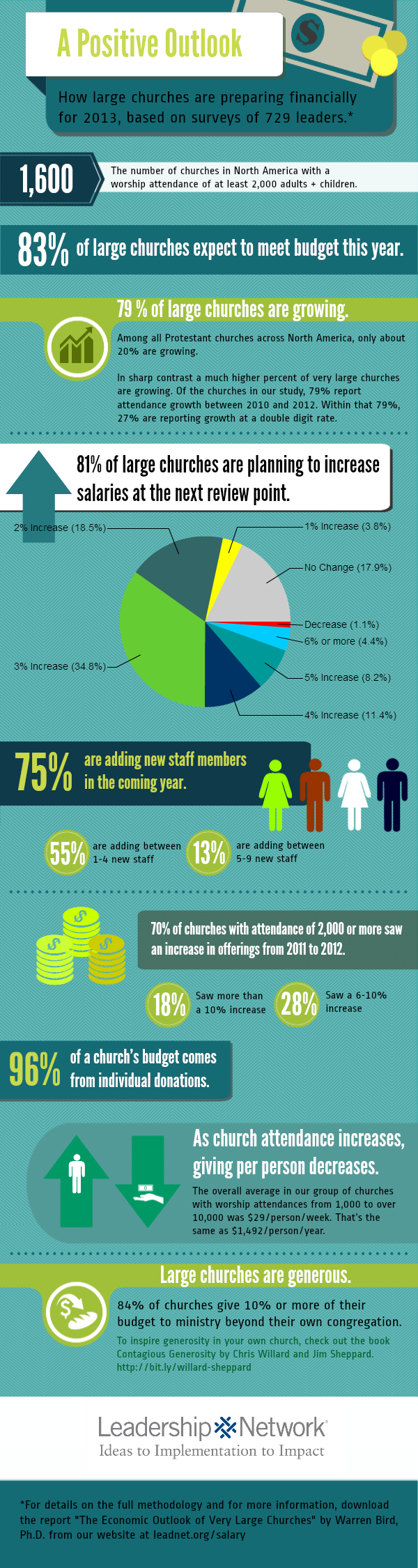
Recently, Leadership Network released a new study entitled The Economic Outlook of Very Large Churches: Trends Driving the Budgets and Staffing Activities of North America’s Biggest Congregations. The infographic below was part of that release. Considering the discussion yesterday here on the blog about the growth of the number of megachurches, I thought this was worth sharing today.

Again, the number of megachurches is not declining. And based on these statistics, they are financially healthier than non-megas.

According to our most recent LifeWay Research economic impact survey, 22% of all churches reported giving below budget. Only 17% of megachurches expect giving to be below budget this year. Also, 70% of megachurches showed an increase in giving as compared to just 40% of all churches.

Despite 50% of large churches being slowed by the Great Recession that has marked North America since 2008, a majority of large congregations met or exceeded their budgets in 2012, and most have seen offerings increase over that same time period.

You can find those and other findings in Leadership Network’s most recent report, The Economic Outlook of Very Large Churches: Trends Driving the Budgets and Staffing Activities of North America’s Biggest Congregations (free download).

Church staffing trends, giving patterns of worship attenders and the role of e-giving are also part of this year’s findings, which draw from two Leadership Network surveys of more than 700 large churches.

EconomicOutlook


Read more from Ed here.
Get a free download from Leadership Network here.
Download PDF

Tags: , , ,

| What is MyVisionRoom? > | Back to Vision >

ABOUT THE AUTHOR

Ed Stetzer

Ed Stetzer

Ed Stetzer, Ph.D., holds the Billy Graham Chair of Church, Mission, and Evangelism at Wheaton College and serves as Executive Director of the Billy Graham Center for Evangelism. He has planted, revitalized, and pastored churches, trained pastors and church planters on six continents, holds two masters degrees and two doctorates, and has written dozens of articles and books. Previously, he served as Executive Director of LifeWay Research. Stetzer is a contributing editor for Christianity Today, a columnist for Outreach Magazine, and is frequently cited or interviewed in news outlets such as USAToday and CNN. He serves as interim pastor of Moody Church in Chicago.

See more articles by >

COMMENTS

What say you? Leave a comment!

Recent Comments
comment_post_ID); ?> Thank you for this information. I'm going to use this article to improve my work with the Lord.
 
— Abel Singbeh
 
comment_post_ID); ?> Thank you Ed for sharing your insights into the Church Growth Movement. I have my reservations with Church Growth models because it has done more damage than good in the Body of Christ. Over the years, western churches are more focused on results, formulas and processes with little or no emphasis on membership and church discipline. Pastors and vocational leaders are burnt out because they're overworked. I do believe that the Church Growth model is a catalyst to two destructive groups: The New Apostolic Reformation and the Emerging Church. Both groups overlap and have a very loose definition. They're both focus on contemporary worship, expansion of church brand (franchising), and mobilizing volunteering members as 'leaders' to grow their ministry. Little focus on biblical study, apologetics and genuine missional work with no agenda besides preaching of the gospel.
 
— Dave
 
comment_post_ID); ?> Thank you for sharing such a good article. It is a great lesson I learned from this article. I am one of the leaders in Emmanuel united church of Ethiopia (A denomination with more-than 780 local churches through out the country). I am preparing a presentation on succession planning for local church leaders. It will help me for preparation If you send me more resources and recommend me books to read on the topic. I hope we may collaborate in advancing leadership capacity of our church. God Bless You and Your Ministry.
 
— Argaw Alemu
 

Clarity Process

Three effective ways to start moving toward clarity right now.

Seven Steps to Move Members into Ministry

Sam attends his church faithfully every Sunday, but he is not involved in doing ministry through his church. Others view Sam as a committed member simply because he is there every Sunday morning, and no one would dare question his faithfulness.

Yet, Sam is really doing nothing in his church.  How do you move members like him into ministry?  Here are some basic principles we learned in a study published in my book, Membership Matters.

1.  Pray for Laborers

Jesus gave us clear guidelines for securing workers: pray for God to provide them (Luke 10:2).  The fields, He said, are ready, but the workers are few.

My experience is that churches look for laborers, and they begin praying earnestly only after they’ve not been able to secure workers through their established processes. Is it possible we would have less difficulty enlisting workers if we started praying before recruiting?

I encourage churches to build praying for laborers into their DNA. The staff and church should pray not only for current workers, but also for potential workers. Prayer meetings should include a time of focused prayer for more workers, even when all the current positions are filled. God will provide the laborers if your church will follow His command to pray.

2.  State Expectations Up Front

Here’s the primary reason church members don’t get involved: churches expect very little.  One of the best ways to correct this problem is to state expectations in a membership class.  Our study shows that churches with effective membership classes stress five expectations of members:

  • Identifying with the church (e.g., through public baptism)
  • Attending worship services and small groups
  • Serving in the ministry of the church
  • Giving financially toward the church’s work
  • Promoting unity in the church

Stating these expectations is no guarantee there will be no members like Sam in your church, but not clarifying expectations almost assures you will.

3.  Have a Ministry Placement Process in Place

In the churches we studied, leaders had an intentional placement strategy.  Those strategies included the SHAPE concept (Rick Warren), the DESIGN program (Wayne Cordeiro), BodyLife (John Powers), and Network (Willow Creek). These processes are built upon the assumption that God works through our life experiences, desires, spiritual gifts, personalities, and abilities to prepare us to serve in His church.

4.  Recruit Face-to-Face 

We asked laypersons in our study why they chose to get involved in their church’s ministry.  Listen to the personal recruiting that their answers reflected:

“A minister spoke to me and challenged me to get active.”
“The Minister of Education sat me down and talked to me.”
“Two guys approached me and asked me [to serve].”

Leaders in the churches we studied did not recruit workers through bulletin board sign-ups, worship folder tear-offs, or pulpit announcements.  Rather, they sought workers by challenging members face-to-face—the way Jesus recruited disciples. In most cases, a personal challenge and invitation made the difference.

5.  Offer Entry-level Ministry Positions

Not every member is ready now to be a teacher, a deacon, or an elder.  All members might, however, be ready to take on the challenge of “entry level” positions that allow them to get involved in the church.

Entry-level positions include parking lot greeters, refreshment committees, class custodians, choir members, and any position that does not demand significant training.  The goal is to help everyone get involved at some level as quickly as possible so new members feel needed and wanted.  Moreover, entry-level positions help to evaluate potential leaders, as a person unwilling to serve in an entry position probably won’t make a good servant leader later.

6.  Recognize and Affirm Workers

Too often, we take for granted dependable church members who serve week after week. To be fair, most of these workers would not want any recognition, but their reticence to be recognized does not let us off the hook.  We honor God by affirming His work in the lives of those who give their best for His church.

One simple way to recognize workers is to sponsor an annual Workers Banquet.  Cater it, publicize it, and make it special.  Not only will the current workers be grateful, but potential workers will also see that their church will appreciate their service.

7.  Don’t Give Up Easily

In 1 Corinthians 12, Paul taught that God puts His church together as He wishes (12:1-11). Our task is to help members find their role, challenge them to serve, equip them, and hold them accountable.  This work is not easy, though, and sometimes it’s tempting just to give up and overwork the current workers.  Rather than taking that wrong step, the answer is to return to principle #1 and start the process again.

What specific action does your church take to move members into ministry?

Download PDF

Tags: , ,

| What is MyVisionRoom? > | Back to Environments >

ABOUT THE AUTHOR

Chuck Lawless

Chuck Lawless currently serves as Professor of Evangelism and Missions and Dean of Graduate Studies at Southeastern Seminary.

See more articles by >

COMMENTS

What say you? Leave a comment!

Recent Comments
comment_post_ID); ?> Thank you for this information. I'm going to use this article to improve my work with the Lord.
 
— Abel Singbeh
 
comment_post_ID); ?> Thank you Ed for sharing your insights into the Church Growth Movement. I have my reservations with Church Growth models because it has done more damage than good in the Body of Christ. Over the years, western churches are more focused on results, formulas and processes with little or no emphasis on membership and church discipline. Pastors and vocational leaders are burnt out because they're overworked. I do believe that the Church Growth model is a catalyst to two destructive groups: The New Apostolic Reformation and the Emerging Church. Both groups overlap and have a very loose definition. They're both focus on contemporary worship, expansion of church brand (franchising), and mobilizing volunteering members as 'leaders' to grow their ministry. Little focus on biblical study, apologetics and genuine missional work with no agenda besides preaching of the gospel.
 
— Dave
 
comment_post_ID); ?> Thank you for sharing such a good article. It is a great lesson I learned from this article. I am one of the leaders in Emmanuel united church of Ethiopia (A denomination with more-than 780 local churches through out the country). I am preparing a presentation on succession planning for local church leaders. It will help me for preparation If you send me more resources and recommend me books to read on the topic. I hope we may collaborate in advancing leadership capacity of our church. God Bless You and Your Ministry.
 
— Argaw Alemu
 

Clarity Process

Three effective ways to start moving toward clarity right now.

Understanding Megachurches, Part 1: Growth

One of the more popular series last year on the blog dealt with the question “Can Megachurches be Missional?” It was part of a continuing– and important– dialogue within the Christian world.

Several people have written and researched at length the trends found in megachurches. Whether it is our LifeWay Research/Outreach Magazine list of the 100 Largest Churches in America or John Vaughan’s helpful research, Elmer Towns’ articles for Christian Life, or what Warren Bird and Scott Thumma are researching, megachurches are of interest to many.

The fact is that many practices found in smaller churches trickle down from larger ones, but also because we are a numbers-oriented culture– we want our church to grow, so we try to copy what the growing churches are doing.

While imitation is often the greatest form of flattery and many copy their methods, their terminology, and their programs, megachurches tend to face scrutiny– some fair and some unfair. In the process, several unhelpful things are said about them either out of jealousy or ignorance. One piece of misinformation spread about megachurches is that they are a dying breed.

I have heard this over and over again– that the megachurch is dying out. That people are wising up and getting into organic churches. That the mindless robots who blindly follow a the charlatan megachurch pastor have seen the light. The day of the megachurch is done.

One problem: the claims are just not true (and some of it is quite insulting to many passionate believers who attend megachurches who actually have higher levels of involvement and service according to the best research).

Facts are our friends– and we need some here. And the fact that Christians are choosing megachurches– and megachurches are thriving– is not a matter of debate, it is simply a matter of math. (This is not to say that there are issues to consider, but it is helpful to get this fact straight.)

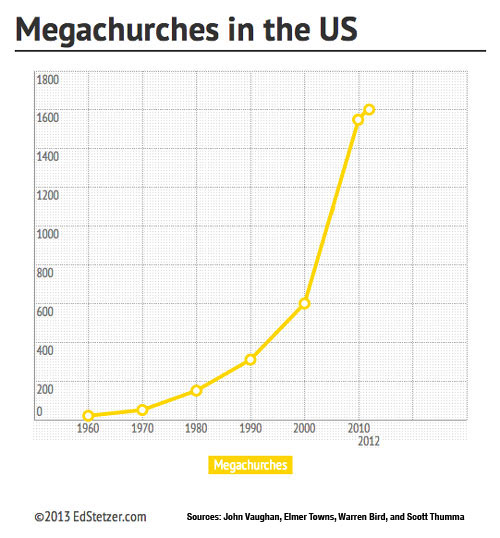
So, the number of megachurches is not declining. Recent analysis from Scott Thumma and Warren Bird show the opposite, actually. There are more megachurches every year, not less. And, they have exploded in number in the last few decades.

megachurches-in-the-us

You are entitled to your opinion about megachurches, but not to your own facts. The fact is, they are not going away. Instead, they keep coming.

The graphic might show a slowdown in the last two years from the explosive growth (from explosive to electric?) we saw over the past decade, but Warren and I don’t think so (yet). Two years does not make a trend, and the trend is quite remarkable when it comes of the number of megachurches.

For example:

  • The number of megachurches in America has nearly doubled during every decade over the last half century.
  • In 1960, there was 1 megachurch for every 7.5 million Americans. In 2010, there was one for every 200,000 Americans.
  • There are as many megachurches today in the greater Nashville area as there were in the entire country in 1960.

Now, I don’t think that every megachurch is good– I assure you, I think some are quite terrible and fulfill every stereotype out there. Yet, there are also some great ones, and for that I am thankful. I want to understand them more and, when possible, to encourage them on their journey.

We are actually considering some learning communities (with D.Min. credit available) for megachurch pastors who want a peer group to considering that question. More soon on that, but for now… you have the facts.

For more information on megachurches and many of the stats cited in this article, visit Leadership Network’s megachurch resource page.

Read more from Ed here.

Download PDF

Tags: , , ,

| What is MyVisionRoom? > | Back to Vision >

ABOUT THE AUTHOR

Ed Stetzer

Ed Stetzer

Ed Stetzer, Ph.D., holds the Billy Graham Chair of Church, Mission, and Evangelism at Wheaton College and serves as Executive Director of the Billy Graham Center for Evangelism. He has planted, revitalized, and pastored churches, trained pastors and church planters on six continents, holds two masters degrees and two doctorates, and has written dozens of articles and books. Previously, he served as Executive Director of LifeWay Research. Stetzer is a contributing editor for Christianity Today, a columnist for Outreach Magazine, and is frequently cited or interviewed in news outlets such as USAToday and CNN. He serves as interim pastor of Moody Church in Chicago.

See more articles by >

COMMENTS

What say you? Leave a comment!

Recent Comments
comment_post_ID); ?> Thank you for this information. I'm going to use this article to improve my work with the Lord.

 
— Abel Singbeh
 
comment_post_ID); ?> Thank you Ed for sharing your insights into the Church Growth Movement. I have my reservations with Church Growth models because it has done more damage than good in the Body of Christ. Over the years, western churches are more focused on results, formulas and processes with little or no emphasis on membership and church discipline. Pastors and vocational leaders are burnt out because they're overworked. I do believe that the Church Growth model is a catalyst to two destructive groups: The New Apostolic Reformation and the Emerging Church. Both groups overlap and have a very loose definition. They're both focus on contemporary worship, expansion of church brand (franchising), and mobilizing volunteering members as 'leaders' to grow their ministry. Little focus on biblical study, apologetics and genuine missional work with no agenda besides preaching of the gospel.
 
— Dave
 
comment_post_ID); ?> Thank you for sharing such a good article. It is a great lesson I learned from this article. I am one of the leaders in Emmanuel united church of Ethiopia (A denomination with more-than 780 local churches through out the country). I am preparing a presentation on succession planning for local church leaders. It will help me for preparation If you send me more resources and recommend me books to read on the topic. I hope we may collaborate in advancing leadership capacity of our church. God Bless You and Your Ministry.
 
— Argaw Alemu
 

Clarity Process

Three effective ways to start moving toward clarity right now.