The Power of the Generosity Prayer

I know you’ve heard of “The Serenity Prayer which was said to be authored by Reinhold Niebuhr in the 1930′s or 1940′s.

God, grant me the serenity to accept the things I cannot change, the courage to change the things I can, and the wisdom to know the difference.”

Alcoholics Anonymous and other 12-step programs have adopted these powerful 27 words. Over the years it has been prayed by millions of people searching for wisdom, courage, and peace in their time of need.

I would like to introduce you to The Generosity Prayer, which is inspired by 2 Corinthians 9:8-11.

“Thank you, Lord, for blessing me in all ways, at all times, with more than I need. Lead me to live generously, share joyfully, and look expectantly toward my future.”

GenerosityPrayer

This prayer is a positive confession, a powerful request, and a hopeful promise. It acknowledges the truth that generosity begins with God, and is then followed by a request to grow in a lifestyle of faithful and generous living. Finally, it concludes by reminding us that generosity isn’t something that robs our future, but insures it of provision. I have found it to be easy to remember and really helpful in providing me with a proper life perspective by recalibrating my thoughts, eyes, heart, and hands. I encourage you to pray this prayer repeatedly for 30 days. As we look toward Christmas, now would be a great time to begin!

> Read more from Todd.


 Would you like to learn more about the generosity for your church? Connect with an Auxano Navigator and start a conversation with our team.

Download PDF

Tags: , ,

| What is MyVisionRoom? > | Back to Resourcing >

ABOUT THE AUTHOR

Todd McMichen

Todd McMichen

Todd serves at the Director of Generosity by LifeWay. His generosity roots arise from leading multiple capital campaigns for local churches that together raised over $35,000,000 for their visionary projects. Since 2000, Todd has been a well-established stewardship coach, generosity leader, author, and conference speaker.

See more articles by >

COMMENTS

What say you? Leave a comment!

Recent Comments
comment_post_ID); ?> Thank you for this information. I'm going to use this article to improve my work with the Lord.
 
— Abel Singbeh
 
comment_post_ID); ?> Thank you Ed for sharing your insights into the Church Growth Movement. I have my reservations with Church Growth models because it has done more damage than good in the Body of Christ. Over the years, western churches are more focused on results, formulas and processes with little or no emphasis on membership and church discipline. Pastors and vocational leaders are burnt out because they're overworked. I do believe that the Church Growth model is a catalyst to two destructive groups: The New Apostolic Reformation and the Emerging Church. Both groups overlap and have a very loose definition. They're both focus on contemporary worship, expansion of church brand (franchising), and mobilizing volunteering members as 'leaders' to grow their ministry. Little focus on biblical study, apologetics and genuine missional work with no agenda besides preaching of the gospel.
 
— Dave
 
comment_post_ID); ?> Thank you for sharing such a good article. It is a great lesson I learned from this article. I am one of the leaders in Emmanuel united church of Ethiopia (A denomination with more-than 780 local churches through out the country). I am preparing a presentation on succession planning for local church leaders. It will help me for preparation If you send me more resources and recommend me books to read on the topic. I hope we may collaborate in advancing leadership capacity of our church. God Bless You and Your Ministry.
 
— Argaw Alemu
 

Clarity Process

Three effective ways to start moving toward clarity right now.

How a Mere 18 Inches Can Start a Counter-Culture Revolution

Look at this picture. What do you notice?

Counter-Culture

These guys that change oil and rotate tires made a small adjustment to their store that could also make a big difference in a first-time guest’s perception of your church:

They came out from behind the counter. 

By turning the computer screens around and standing next to the customer, a type of counter-culture revolution started. According to the mechanic, without the physical barrier in front he feels more connected to each customer and a higher level of trust exists, as they can see what he sees on the computer screen.

And who does not need more trust from their mechanic?

Most churches need a revolution from the “counter-culture” as well. Moving about 18 inches out from behind the typical welcome center desk…

… communicates readiness. Removing the barrier helps host team members feel more accessible to someone new, almost as if guests were actually expected. Take a walk around your church hallways or lobby. Which counters are ripe for removal and which should reside against the wall?

… forces simplicity. Church communications clutter diminishes when it can no longer hide in cabinets or shelves under the counter. Take a look at everything on and behind your welcome desk. Thinking next steps, ask yourself: What are the one or two most important pieces of information a guest needs right now?

… builds intention. Volunteers who are not standing behind a counter move from a passive posture and naturally become more engaged with their surroundings. Take an evening and schedule some training. What skills and practices will help lead your host team members from reactive welcoming into proactive hospitality?

Counters are great when dispensing a product in coffee shops and fast-food restaurants. However, even tire stores can see the relational benefit of moving out from behind desks to serve and engage people where they are.

Isn’t it time to start a counter-culture revolution in your church?


Would you like to know about how your environment can be more engaging? Connect with an Auxano Navigator and start a conversation with our team.

Download PDF

Tags: , , , ,

| What is MyVisionRoom? > | Back to Communication >

ABOUT THE AUTHOR

Bryan Rose

Bryan Rose

As Lead Navigator for Auxano, Bryan Rose has a strong bias toward merging strategy and creativity within the vision of the local church and has had a diversity of experience in just about every ministry discipline over the last 12 years. With his experience as a multi-site strategist and campus pastor at a 3500 member multi-campus church in the Houston Metro area, Bryan has a passion to see “launch clarity” define the unique Great Commission call of developing church plants and campus, while at the same time serving established churches as they seek to clarify their individual ministry calling. Bryan has demonstrated achievement as a strategic thinker with a unique ability to infuse creativity into the visioning process while bringing a group of people to a deep sense of personal ownership and passion.

See more articles by >

COMMENTS

What say you? Leave a comment!

Recent Comments
comment_post_ID); ?> Thank you for this information. I'm going to use this article to improve my work with the Lord.
 
— Abel Singbeh
 
comment_post_ID); ?> Thank you Ed for sharing your insights into the Church Growth Movement. I have my reservations with Church Growth models because it has done more damage than good in the Body of Christ. Over the years, western churches are more focused on results, formulas and processes with little or no emphasis on membership and church discipline. Pastors and vocational leaders are burnt out because they're overworked. I do believe that the Church Growth model is a catalyst to two destructive groups: The New Apostolic Reformation and the Emerging Church. Both groups overlap and have a very loose definition. They're both focus on contemporary worship, expansion of church brand (franchising), and mobilizing volunteering members as 'leaders' to grow their ministry. Little focus on biblical study, apologetics and genuine missional work with no agenda besides preaching of the gospel.
 
— Dave
 
comment_post_ID); ?> Thank you for sharing such a good article. It is a great lesson I learned from this article. I am one of the leaders in Emmanuel united church of Ethiopia (A denomination with more-than 780 local churches through out the country). I am preparing a presentation on succession planning for local church leaders. It will help me for preparation If you send me more resources and recommend me books to read on the topic. I hope we may collaborate in advancing leadership capacity of our church. God Bless You and Your Ministry.
 
— Argaw Alemu
 

Clarity Process

Three effective ways to start moving toward clarity right now.

Five Insights to Help You Communicate Better as a Leader

Former President Ronald Reagan was known as the Great Communicator. That title wasn’t an award, it was just true. President Reagan was optimistic when he spoke, had a quick wit and sense of humor, gave hope, and had a deep belief in what he spoke about. He possessed a natural connection with people that allowed him to speak truth with a folksy wisdom that captured young and old alike. How about you, what distinguishes you as a communicator?

First, I’d like to encourage you with three thoughts about your communication potential as a church leader.

  • The size of your stage doesn’t determine the size of your gift. God may have chosen you for a smaller platform but that does not limit your ability to develop your skill. Don’t seek a larger stage, strive to develop your ability.
  • The size of your gift doesn’t determine the scope of your reach. The power of prayer will always trump eloquence and skill. Your eternal impact can be greater than your skill when you bathe your communication in prayer.
  • The scope of your reach doesn’t determine the value of your ministry. If you never speak to large crowds, you can still rock the gates of heaven with staggering stories life change.

Second, here are 5 questions that give you insight to great communication:

1) Are you are comfortable in your own shoes?

The best communicators are at ease with who they are as a person. They don’t try to look, sound or speak like other people. They are self-aware, genuine, and have found their own voice. Because of this they can communicate with poise, confidence and personal authority rather than insecurity.

2) Do you connect at heart level?

All great communicators connect with people. Their authenticity gains them an innate trust from the listeners. There is no pretense, which will always break a heart level connection. Though the topic may be serious, there is a light-heartedness and sense of humor in their style. This allows them to engage the emotions of the people.

3) Do you read the room quickly?

Knowing your audience is important but there’s more to it. Great communicators have the ability to sense if the people are engaged and responsive. And if this is not the case, they can change their approach in the moment. It might be as simple as slowing down and cutting content, or something more complex like adding a personal story on the fly to recapture the room.

4) Do you make people think?

Jesus made people think. From the Pharisees and Roman leaders to his own beloved disciples, he challenged them with questions, and made them think by telling stories in parable form. His approach was simple but profound. For you and I, there is simply no substitute for substantial preparation.

5) Do you know how to land the plane?

This is the leadership moment, the moment that captures why you are teaching.  Be strong, clear, concise and bold. Don’t circle the runway when it’s time to land the plane! Know the point of your message and stick to it. There are two questions that will help your message land in a way that makes a difference.

  • What do you want each person to know?
  • What do you want each person to do?

> Read more from Dan


Would you like to know more insights on how to be a better communicator? Connect with an Auxano Navigator and start a conversation with our team.

Download PDF

Tags: , , ,

| What is MyVisionRoom? > | Back to Communication >

ABOUT THE AUTHOR

Dan Reiland

Dan Reiland

Dr. Dan Reiland serves as Executive Pastor at 12Stone Church in Lawrenceville, Georgia. He previously partnered with John Maxwell for 20 years, first as Executive Pastor at Skyline Wesleyan Church in San Diego, then as Vice President of Leadership and Church Development at INJOY. He and Dr. Maxwell still enjoy partnering on a number of church related projects together. Dan is best known as a leader with a pastor's heart, but is often described as one of the nations most innovative church thinkers. His passion is developing leaders for the local church so that the Great Commission is advanced.

See more articles by >

COMMENTS

What say you? Leave a comment!

Recent Comments
comment_post_ID); ?> Thank you for this information. I'm going to use this article to improve my work with the Lord.
 
— Abel Singbeh
 
comment_post_ID); ?> Thank you Ed for sharing your insights into the Church Growth Movement. I have my reservations with Church Growth models because it has done more damage than good in the Body of Christ. Over the years, western churches are more focused on results, formulas and processes with little or no emphasis on membership and church discipline. Pastors and vocational leaders are burnt out because they're overworked. I do believe that the Church Growth model is a catalyst to two destructive groups: The New Apostolic Reformation and the Emerging Church. Both groups overlap and have a very loose definition. They're both focus on contemporary worship, expansion of church brand (franchising), and mobilizing volunteering members as 'leaders' to grow their ministry. Little focus on biblical study, apologetics and genuine missional work with no agenda besides preaching of the gospel.
 
— Dave
 
comment_post_ID); ?> Thank you for sharing such a good article. It is a great lesson I learned from this article. I am one of the leaders in Emmanuel united church of Ethiopia (A denomination with more-than 780 local churches through out the country). I am preparing a presentation on succession planning for local church leaders. It will help me for preparation If you send me more resources and recommend me books to read on the topic. I hope we may collaborate in advancing leadership capacity of our church. God Bless You and Your Ministry.
 
— Argaw Alemu
 

Clarity Process

Three effective ways to start moving toward clarity right now.

Six Principles for Raising Up New Leaders in Your Church

1. Exemplary in overall character. They lead and shepherd by example. And no area of leadership is insignificant in this respect. If he oversees the greeters, he does so with grace, patience, and diligence. If he shepherds a small group of 2 other men, he doesn’t berate them for not doing their reading that week. He sets the tone by his example. He gets people motivated by his observable diligence and enthusiasm. Overall his life is photocopy-able (1 Pet 5:3), erring on the side of taking more time than less to observe this. Others should already be able to identify them as someone who can be modeled.

2. Competency as a shepherd and/or leadership characteristics. They are showing clear signs of a biblical shepherd. If they are going to be involved in something like shepherding a home group, its best to ensure they are a deacon or already known as a capable shepherd by existing leadership, including a potential ability to teach (1 Tim 3: 1-71 Pet 5:2-3). They must already have visible and competent influence in the church, especially for more formal disciple-making roles. We should ask, “Who is already being impacted by them?” and, “Who is already receiving some biblical care by this person?” People in the flock should point to this person as someone who they are already following at some level. This is an area where many leadership teams err; namely, by presumptuously appointing leaders. Simultaneously, many presumptuously assume they should be leading others (i.e. a Bible study, small group, etc.) with no wake of sanctified souls to show, by God’s grace. No one should presume they are ready for shepherding/leadership in such a capacity if they do not have at least a handful of souls who have been observably transformed more into the image of Christ because of their competent care.

3. Exemplary in mistakes. One of my mentors (who patiently took risks with me) used to tell us, “The higher you climb up the flagpole, the more everyone can see your tail.” Whether overseeing the meal ministry or chair set-up or preaching, leaders’ mistakes are magnified. They just have to embrace the fact. So, the way they respond to their own sin and failures in leadership needs to be exemplary as well. They humbly acknowledge mistakes and demonstrate a genuine quickness and sincerity in confessing sins and asking forgiveness (1 Pet 5:3). This is important even in the small things. Beware of the one who seems to shift the blame, even in little things.

4. Unity with current leadership. This point cannot be overemphasized. Before planting the church, some wise elders told our team, “It doesn’t matter much who you minister to; but who you minister with is everything.” Unity is the necessary fertile ground to bloom a healthy ministry. And unity should include doctrinal and philosophical unity. Rising leaders in the local church, then, need to competently articulate the doctrine and philosophy of ministry of the local church while being united with it. They should have demonstrated a pattern of humble and eager unity in the church through membership.. They can’t be the one you hear about who maintains a distance or quietly chatters about the leadership to others in the church. That is in no way to say that leadership are unapproachable. On the contrary. But he approaches them privately, to preserve the relationship, protect the leadership’s reputation, and recognize those whom God has put over him. A humble loyalty ought to characterize a future leader’s demeanor towards the leadership in order to preserve Christ’s reputation (John 17:20-23Eph 4:3Phil 2:1-5).

5. Submission to current leadership. Even if they do not see eye-to-eye on every doctrinal issue, they show that critical trait of humility by coming under the imperfect, existing leadership team. Their life is a model for the flock of biblical submission to leadership (Heb 13:17). If they cannot submit to leaders prior to serving in leadership, they will not be able to once in such a position. And if that’s the case, they are hazardous to the flock, potentially factious, and should not be leading. They need additional shepherding and care. Leaders at every level need to demonstrate an unforced, genuine submission to the current leadership team. It’s the way Jesus has designed the local church to work.

6. Confrontable. After seeing churches, lives, and relationships wrecked due to an unconfrontable spirit, I am increasingly convinced that this is one of the necessary barometers of biblical character necessary for leadership. Leaders at any and every stage must demonstrate teachability, especially in the form of of responding with humility to confrontation (Prov 15:31-33Heb 3:12-14). Leaders humbly desire that the flock will respond well to confrontation. Consequently, they must be the examples of this. This demonstrates further unity with leadership along with respect for the imperfect, flawed instruments which Christ has put in place.

Like our Lord patiently does with us, existing leaders need to intentionally discover and develop potential leaders at every point in their leadership capacities. We need to equip, train, nurture, and recognize them along the way, giving grace for imperfection, while entrusting them with responsibilities for the care of the Lord’s church.

Read page 1 here.

Read more from Eric here.

Download PDF

Tags: , ,

| What is MyVisionRoom? > | Back to Leadership >

ABOUT THE AUTHOR

Eric Davis

Eric Davis

Eric is the pastor of Cornerstone Church in Jackson Hole, WY. He and his team planted the church in 2008.

See more articles by >

COMMENTS

What say you? Leave a comment!

Recent Comments
comment_post_ID); ?> Thank you for this information. I'm going to use this article to improve my work with the Lord.
 
— Abel Singbeh
 
comment_post_ID); ?> Thank you Ed for sharing your insights into the Church Growth Movement. I have my reservations with Church Growth models because it has done more damage than good in the Body of Christ. Over the years, western churches are more focused on results, formulas and processes with little or no emphasis on membership and church discipline. Pastors and vocational leaders are burnt out because they're overworked. I do believe that the Church Growth model is a catalyst to two destructive groups: The New Apostolic Reformation and the Emerging Church. Both groups overlap and have a very loose definition. They're both focus on contemporary worship, expansion of church brand (franchising), and mobilizing volunteering members as 'leaders' to grow their ministry. Little focus on biblical study, apologetics and genuine missional work with no agenda besides preaching of the gospel.
 
— Dave
 
comment_post_ID); ?> Thank you for sharing such a good article. It is a great lesson I learned from this article. I am one of the leaders in Emmanuel united church of Ethiopia (A denomination with more-than 780 local churches through out the country). I am preparing a presentation on succession planning for local church leaders. It will help me for preparation If you send me more resources and recommend me books to read on the topic. I hope we may collaborate in advancing leadership capacity of our church. God Bless You and Your Ministry.
 
— Argaw Alemu
 

Clarity Process

Three effective ways to start moving toward clarity right now.

Going Old Testament with Your Tithe

When we think about tithing today, we often picture ourselves giving ten percent of our paycheck to a local church. Sometimes that involves making a donation through a mobile app, sometimes it’s dropping a check in the plate as it’s getting passed by.

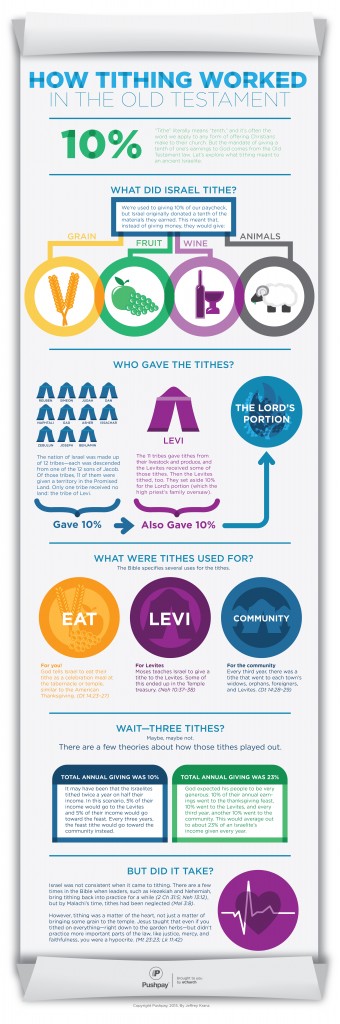
Either way, we tend to think of tithing as a practice of giving money. But how did tithing work in the Old Testament, when it began? You might be surprised to know that:

  • People more often donated grain, wine, and animals than money. (They could give cash, but that was a little more expensive.)
  • Those donations didn’t just go to the clergy of the times—some went to the community, and some was eaten as a feast.
  • The people of Israel may have given anywhere from ten percent to twenty-three percent of their income!

There’s a lot we can learn about how tithing worked in Bible times, so we put together an infographic to illustrate. Check it out—and if you know anyone who would get a kick out of this information, please share!

HowTithingWorkedinOT

> Read more from Derek.


 Would you like to learn more about the tithe and generosity in your church? Connect with an Auxano Navigator and start a conversation with our team.

Download PDF

Tags: , , ,

| What is MyVisionRoom? > | Back to Resourcing >

ABOUT THE AUTHOR

Derek Gillette

My name is Derek Gillette and I am the Communications Manager for eChurchGiving and Pushpay. I like to use analogies and metaphors as a way to tell better stories. If you are a church, ministry, or non-profit leader, contact me to learn how eChurchGiving & Pushpay helps engage with young and first time givers to build lasting relationships.

See more articles by >

COMMENTS

What say you? Leave a comment!

Recent Comments
comment_post_ID); ?> Thank you for this information. I'm going to use this article to improve my work with the Lord.
 
— Abel Singbeh
 
comment_post_ID); ?> Thank you Ed for sharing your insights into the Church Growth Movement. I have my reservations with Church Growth models because it has done more damage than good in the Body of Christ. Over the years, western churches are more focused on results, formulas and processes with little or no emphasis on membership and church discipline. Pastors and vocational leaders are burnt out because they're overworked. I do believe that the Church Growth model is a catalyst to two destructive groups: The New Apostolic Reformation and the Emerging Church. Both groups overlap and have a very loose definition. They're both focus on contemporary worship, expansion of church brand (franchising), and mobilizing volunteering members as 'leaders' to grow their ministry. Little focus on biblical study, apologetics and genuine missional work with no agenda besides preaching of the gospel.
 
— Dave
 
comment_post_ID); ?> Thank you for sharing such a good article. It is a great lesson I learned from this article. I am one of the leaders in Emmanuel united church of Ethiopia (A denomination with more-than 780 local churches through out the country). I am preparing a presentation on succession planning for local church leaders. It will help me for preparation If you send me more resources and recommend me books to read on the topic. I hope we may collaborate in advancing leadership capacity of our church. God Bless You and Your Ministry.
 
— Argaw Alemu
 

Clarity Process

Three effective ways to start moving toward clarity right now.

Are You Telling a Story with Your Church Logo?

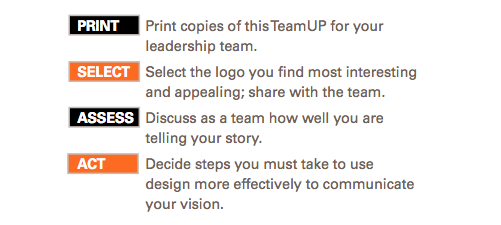
Have you seen Auxano’s TeamUP download that focuses on one of our six services: Communication?

12ChurchLogos1

As a “vision shop,” we believe that all vision should be communicated visually. This gorgeous, free PDF will share a little bit more about our philosophy of communication and how your design can elevate and demonstrate the unique work of God in your church through your church logo.

Here is a glimpses of the logos we will explore inside.

12ChurchLogos2

Also included is a guide (we do this with all TeamUP downloads) that you can walk through with your church team. Be sure to forward this to your team for planning. Wouldn’t you like to take your communication to a whole new level in 2016?

12ChurchLogos3

Download this free resource: TeamUP – 12 Church Logos That Tell a Story

> Read more from Will.


 Would you like to know more about the use of logos in your ministry? Connect with an Auxano Navigator and start a conversation with our team.

Download PDF

Tags: , , ,

| What is MyVisionRoom? > | Back to Communication >

ABOUT THE AUTHOR

Will Mancini

Will Mancini

Will Mancini wants you and your ministry to experience the benefits of stunning, God-given clarity. As a pastor turned vision coach, Will has worked with an unprecedented variety of churches from growing megachurches and missional communities, to mainline revitalization and church plants. He is the founder of Auxano, creator of VisionRoom.com and the author of God Dreams and Church Unique.

See more articles by >

COMMENTS

What say you? Leave a comment!

Recent Comments
comment_post_ID); ?> Thank you for this information. I'm going to use this article to improve my work with the Lord.
 
— Abel Singbeh
 
comment_post_ID); ?> Thank you Ed for sharing your insights into the Church Growth Movement. I have my reservations with Church Growth models because it has done more damage than good in the Body of Christ. Over the years, western churches are more focused on results, formulas and processes with little or no emphasis on membership and church discipline. Pastors and vocational leaders are burnt out because they're overworked. I do believe that the Church Growth model is a catalyst to two destructive groups: The New Apostolic Reformation and the Emerging Church. Both groups overlap and have a very loose definition. They're both focus on contemporary worship, expansion of church brand (franchising), and mobilizing volunteering members as 'leaders' to grow their ministry. Little focus on biblical study, apologetics and genuine missional work with no agenda besides preaching of the gospel.
 
— Dave
 
comment_post_ID); ?> Thank you for sharing such a good article. It is a great lesson I learned from this article. I am one of the leaders in Emmanuel united church of Ethiopia (A denomination with more-than 780 local churches through out the country). I am preparing a presentation on succession planning for local church leaders. It will help me for preparation If you send me more resources and recommend me books to read on the topic. I hope we may collaborate in advancing leadership capacity of our church. God Bless You and Your Ministry.
 
— Argaw Alemu
 

Clarity Process

Three effective ways to start moving toward clarity right now.

To Develop Generous Disciples, Understand Why People Give

If you want your church to grow, you must learn how to motivate believers to invest their resources into the kingdom for ministry and for facilities. It is a key responsibility of leadership. Whoever writes the agenda must be able to underwrite the agenda. If you’re going to form the vision you also have to be able to fund the vision.

A lot of pastors, a lot of elders, lot of church leaders have a real hangup about asking people to give. They allow personal insecurities and personal fears to limit the ministry. You don’t need to be embarrassed about asking people to give. There is nothing greater than the kingdom of God. There is no more significant cause than the church.

I am very much against fundraising, but I am in favor of teaching people to give.  Fundraising is what I call collecting money from other people in return for a product, service, reward or recognition. But in giving, we simply challenge ourselves to give out of our own resources for spiritual reasons. The result of fundraising is that funds are collected.  The results of teaching people to be givers is that funds are collected and disciples are developed.

And to develop generous disciples, you need to understand why people give.

1.  People give when they trust the leadership.

John 10:1-11 says, “The sheep listen to the shepherd’s voice. He calls his own sheep by name and leads them out. He goes on ahead of them and his sheep follow him because they know his voice but they will never follow a stranger. In fact, they will run from him. The good shepherd lays down his life for the sheep. The hired hand is not the shepherd.” Study after study has proven that in the hierarchy of giving, people give first of all to people they believe in. Then they give to purposes. Finally they give to programs. That means that the most essential elements in teaching people to give are relational, not functional.

Even if you use a consultant to help you raise money, you as the pastor still need to be out front. Because the person who asks for the giving needs to be the person with the most credibility. And if you are a Pastor and you are not the most trusted person, you have a leadership problem and you’re not ready to teach people to give yet. You need to be the most visible because the person who is the best qualified to ask for money should be the person whose the most trusted.

2.  People give when they catch a vision, not when they see a need.

The Bible says, “Where there is no vision the people perish.” Did you know that Ivy League schools usually receive the largest endowments? And they are the schools that need the money the least. Why? People give to success. They give to vision. They don’t give to needs.  That’s why in fifteen years we have never had a bulletin with our financial reports in it along with how much we need. Why? Because bills do not motivate people to give. People give when they catch a vision and they get the big picture.

You must be very clear about what your vision is. At Saddleback, we’ve never had a vision for a building, but rather for what the building can help us do. We’ve never had a vision for raising money, but rather for what the money can do. Emphasize the lives that will be changed as people give – the marriages that will be saved, the broken people that are going to be put back together, the people who will break addictions, the changed lives that will happen. That’s the vision!

3.  People give to experience the joy of generosity.

It feels good to give generously – it really does. A person who doesn’t understand that has never given generously. The happiest people in the world are the most giving people. Guilt never motivates people to give. Giving that is motivated by guilt only lasts as long as the guilt does. So you never use guilt to motivate people to give. You use joy to motivate people to give.

I absolutely do not accept the health and wealth theology, which teaches that God wants everybody to be rich. But the fact is, there are more promises in the Bible related to giving than any other subject. You cannot out-give God. If you’re going to be Christlike you’ve got to learn to give.

4.  People give when they are inspired by models.

We learn best by watching models. That’s why a testimony about giving is a thousand times more effective than a sermon on giving. Models motivate us. Giving is contagious. So I encourage people to write down and send me their testimonies, how they decided to give, and what they were giving.

5.  People give when they are involved.

Paul told the Philippians, “I thank God because of your partnership in the gospel.”  The fact is those who are most involved in the campaign will be those who sacrifice the most. One of our gauges of involvement at Saddleback is how many people have completed our CLASSes (and you can get our CLASS material here). And the more CLASSes people have completed, the more involved they are, and the more they tend to give. The average gift in our church from an attender during one of our giving campaigns was about $7000. For the people who had gone through class 101, the average gift was $8500. The average of gift for people who had been through class 201 and 101 was over $11,000.  And the average gift of people who had been through 101, 201 and 301, which usually indicates they are actually involved in the ministry of the church was over $15,000.

6.  People give when you ask them to give.

James says, “You have not because you ask not.” The Bible says ask and seek and knock. God asks people to give. The fact is we’re doing people a favor when we ask them to give because they grow in faith, they grow in love, they grow in sacrifice, they grow in commitment, they grow in character as they learn to give. They will be blessed in return. Never say no for anybody. Your church will be hurt more by those who would have said yes and were not asked than by those who were asked and said no.

7.  People give when you make it possible for them to give.

2 Corinthians 8 says, “For if the willingness is there the gift is acceptable according to what one has not according to what one does not have.” That means you need to make it possible for people to give in as many ways as you can. Teach people how to want to give and they’ll figure out how.

Teach people that they can either give by reason or by revelation. Giving by reason means this – I look at what I have, I figure out what’s reasonable and I commit that amount. It doesn’t take any faith to give by reason. I just figure out what can I afford to give. Giving by revelation means I determine my gift by praying “Lord, what do You want to give through me?” This requires faith. When you give by revelation, you’re committing an act of worship and saying, “How much am I willing to trust God?”

8.  People give when their gifts are appreciated.

The whole book of Philippians is just a thank you letter from Paul for their offering, for their financial support. Figure out seven ways to thank people for their gift – a card, a call, a banquet, etc. A little appreciation goes a long way in encouraging people to be generous for the long haul.

> Read more from Rick.


 Would you like to learn more about developing generous disciples in your church? Connect with an Auxano Navigator and start a conversation with our team.

Download PDF

Tags: , , ,

| What is MyVisionRoom? > | Back to Resourcing >

ABOUT THE AUTHOR

Rick Warren

Rick Warren

Rick Warren is the founding pastor of Saddleback Church in Lake Forest, Calif., one of America's largest and most influential churches. Rick is author of the New York Times bestseller The Purpose Driven Life. His book, The Purpose Driven Church, was named one of the 100 Christian books that changed the 20th century. He is also founder of Pastors.com, a global Internet community for pastors.

See more articles by >

COMMENTS

What say you? Leave a comment!

Recent Comments
comment_post_ID); ?> Thank you for this information. I'm going to use this article to improve my work with the Lord.
 
— Abel Singbeh
 
comment_post_ID); ?> Thank you Ed for sharing your insights into the Church Growth Movement. I have my reservations with Church Growth models because it has done more damage than good in the Body of Christ. Over the years, western churches are more focused on results, formulas and processes with little or no emphasis on membership and church discipline. Pastors and vocational leaders are burnt out because they're overworked. I do believe that the Church Growth model is a catalyst to two destructive groups: The New Apostolic Reformation and the Emerging Church. Both groups overlap and have a very loose definition. They're both focus on contemporary worship, expansion of church brand (franchising), and mobilizing volunteering members as 'leaders' to grow their ministry. Little focus on biblical study, apologetics and genuine missional work with no agenda besides preaching of the gospel.
 
— Dave
 
comment_post_ID); ?> Thank you for sharing such a good article. It is a great lesson I learned from this article. I am one of the leaders in Emmanuel united church of Ethiopia (A denomination with more-than 780 local churches through out the country). I am preparing a presentation on succession planning for local church leaders. It will help me for preparation If you send me more resources and recommend me books to read on the topic. I hope we may collaborate in advancing leadership capacity of our church. God Bless You and Your Ministry.
 
— Argaw Alemu
 

Clarity Process

Three effective ways to start moving toward clarity right now.

6 Bad Habits Affecting Your Church Announcements

Announcements are a great tool for moving people to action. [I wrote all about this in my ebook called Effective Announcements.] However, it can be difficult to keep them fresh and creative every weekend. Even worse, the people who do them can get lazy and some bad habits sneak in that undermine their effectiveness. Here are some of the bad habits for church announcements I’ve seen over the years:

  • Constant weather updates // Commenting on the weather all the time is verbal diarrhea for church leaders. It’s a crutch when you don’t know what else to say … don’t do it! Add a high-value transition, like commenting on what just happened in the service rather than what a great day is it outside.
    • BONUS: The same is true about over-commenting on sports. Use it sparingly!
  • Last-minute additions // It’s Sunday morning and someone from your kids ministry pleads with you to sell a special event happening on Tuesday evening. Don’t do it! Last-minute additions never pay the response dividends that people are looking for and they short circuit a well-planned communications strategy. Remember … it’s always bad to add!
  • “Blessings” and other insider language // I don’t know what it is about doing announcements that makes people add all kinds of “churchy” language. Rather than talking about how great the youth event was … they talk about what a blessing it was for the youth to fellowship in that way. WHAT? Use language that makes sense to people who don’t normally attend church. (And stop taking up those “clap offerings”!)
  • Shielding your eyes from the light // You go on stage and there are bright lights so people can see you. But you want to be able to see them, so you make a “hand over your eyes” shield. Stop that! It takes people out of the moment, reinforces the fact that those lights are there, and makes people feel disconnected from you because they can’t see you.
  • Not introducing people // Who are all those people on stage with you? If you’ve ever visited a church and not known who is on stage, you’ll know how disorienting it is. Take 10 seconds and introduce everyone … it puts first-time guests at ease.
  • Weird prayers // One of the reasons we pray in public is because it models what a “normal” prayer life is like. However, some church leaders fall into the trap of trying to impress people with big words or overly complex prayers. Don’t do it … model a prayer life that uses normal language to connect with God. It’s a simple way to help people take their next steps in this vitally important part of their spiritual lives.

> Read more from Rich.


Would you like to know more how to use announcements in a powerful, positive way that reinforces your vision? Connect with an Auxano Navigator and start a conversation with our team.

Download PDF

Tags: , , ,

| What is MyVisionRoom? > | Back to Communication >

ABOUT THE AUTHOR

Rich Birch

Rich Birch

Thanks so much for dropping by unseminary … I hope that your able to find some resources that help you lead your church better in the coming days! I’ve been involved in church leadership for over 15 years. Early on I had the privilege of leading in one of the very first multisite churches in North Amerca. I led the charge in helping The Meeting House in Toronto to become the leading multi-site church in Canada with over 4,000 people in 6 locations. (Today they are 13 locations with somewhere over 5,000 people attending.) In addition, I served on the leadership team of Connexus Community Church in Ontario, a North Point Community Church Strategic Partner. I currently serves as Operations Pastor at Liquid Church in the Manhattan facing suburbs of New Jersey. I have a dual vocational background that uniquely positions me for serving churches to multiply impact. While in the marketplace, I founded a dot-com with two partners in the late 90’s that worked to increase value for media firms and internet service providers. I’m married to Christine and we live in Scotch Plains, NJ with their two children and one dog.

See more articles by >

COMMENTS

What say you? Leave a comment!

Recent Comments
comment_post_ID); ?> Thank you for this information. I'm going to use this article to improve my work with the Lord.
 
— Abel Singbeh
 
comment_post_ID); ?> Thank you Ed for sharing your insights into the Church Growth Movement. I have my reservations with Church Growth models because it has done more damage than good in the Body of Christ. Over the years, western churches are more focused on results, formulas and processes with little or no emphasis on membership and church discipline. Pastors and vocational leaders are burnt out because they're overworked. I do believe that the Church Growth model is a catalyst to two destructive groups: The New Apostolic Reformation and the Emerging Church. Both groups overlap and have a very loose definition. They're both focus on contemporary worship, expansion of church brand (franchising), and mobilizing volunteering members as 'leaders' to grow their ministry. Little focus on biblical study, apologetics and genuine missional work with no agenda besides preaching of the gospel.
 
— Dave
 
comment_post_ID); ?> Thank you for sharing such a good article. It is a great lesson I learned from this article. I am one of the leaders in Emmanuel united church of Ethiopia (A denomination with more-than 780 local churches through out the country). I am preparing a presentation on succession planning for local church leaders. It will help me for preparation If you send me more resources and recommend me books to read on the topic. I hope we may collaborate in advancing leadership capacity of our church. God Bless You and Your Ministry.
 
— Argaw Alemu
 

Clarity Process

Three effective ways to start moving toward clarity right now.