Make Your Sunday Bulletin Simple AND Effective

How many announcements should you include in your church bulletin?

Pretty much… none.

My philosophy about church bulletins (i.e. worship folders, programs, brochures, handouts, etc.) has changed a lot over the years. A decade and a half ago, I wanted it to be as large and stuffed with information as possible. It was my way of thinking bigger than our church was at the time.

Now, I want our weekly bulletin to be as small as possible, with as few announcements as possible. In fact, here’s a photo of our current bulletin.
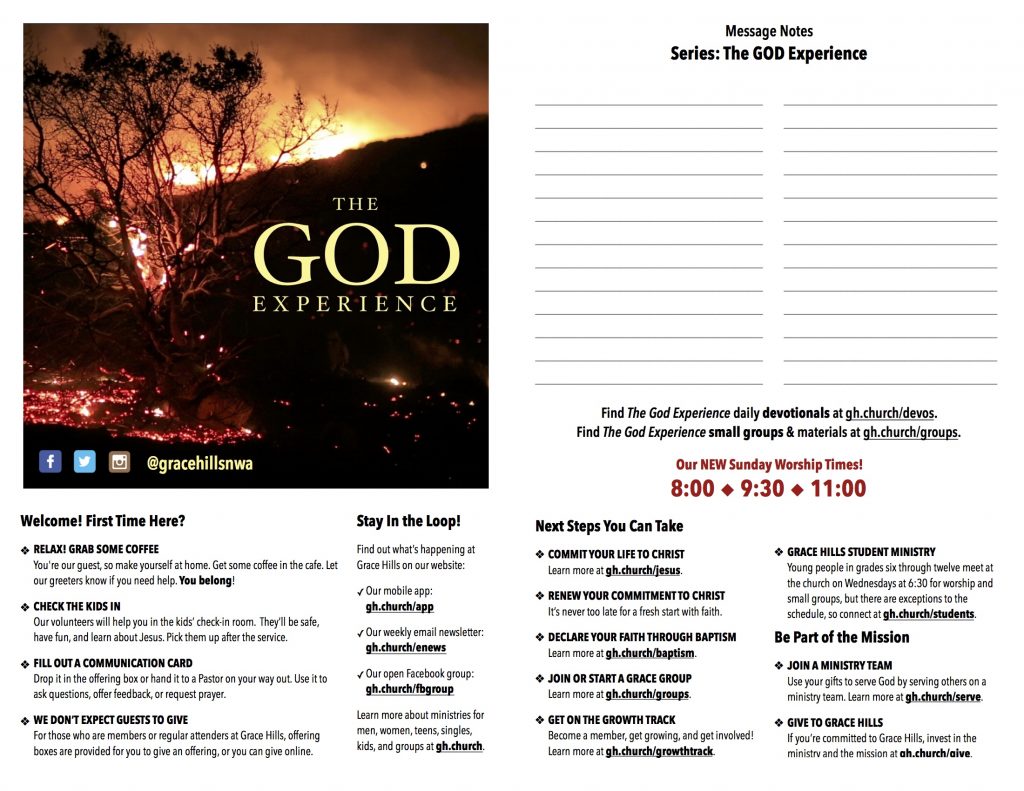
Bulletin161009


That’s it. NO actual “announcements” are included. At least, not the kind you’d normally think of. We print this on an 8.5″ x 11″ sheet of card stock, both sides, cut them in half, and hand them out. It’s a single half-sheet, sturdy enough to take notes on. And, we print one bulletin per sermon series and only change it during the series if something drastically changes and needs to be communicated.

Why is it so slim on information?

It’s all about who it’s for!

We print a Sunday bulletin with one person in mind – the guest. We want our guests to know that they belong, that we have next steps for them, that we don’t want their money and that we want them to know what to expect.

The weekend bulletin is really just an excuse to greet people with something printed. It offers the basic next steps, how to find out more, and how to stay in the loop.

We’re also very aware that every announcement is a “signal” that gets sent to the minds of those who are reading or listening. Our minds only have room for so many signals. So if you want people to remember two or three things, in particular, don’t tell them to remember five or eight or thirty things.

In fact, if you’ll notice, every piece of information in the bulletin actually has a short hyperlink that leads to an information page online that is mobile-friendly. Sometimes, that short link forwards to a Facebook Event so people can RSVP and share. Sometimes, it leads to a page of our website dedicated to a certain ministry. But our goal is to get people to engage with us online, beyond Sunday, so that we can communicate throughout the week with everyone.

So where do we announce stuff?

Here’s how we see it.

There are announcements that everyone needs to hear, and those are included in the bulletin, which everyone gets. Then, there are announcements only pertinent to regular attenders, which we communicate through various other means, including:

  • Our email list.
  • Our open Facebook group (not our main Facebook page).
  • Our mobile app (including one push notification per week).
  • Our website, especially the events page and the blog.
  • Some slides that cycle as people are coming in.
  • Our various Facebook “sub”-pages (men, women, students, kids, etc.).
  • Word-of-mouth, especially through small groups.

Does it work?

Not perfectly. Sometimes, someone is unaware of something happening. But we rarely hear about it. We’ve spent a long time creating a culture where people don’t expect to be spoon-fed and taken by the hand and personally led through every event.

We’re always learning and tweaking. I may have to scrap this blog post a few months from now when we flip our strategy on its head. But for now, we’re confident that growth is happening because we’re able to communicate the big signals to the many and the smaller signals to the few.


Learn more about effective communication with your Sunday bulletin by connecting with an Auxano Navigator.


> Read more from Brandon.

Download PDF

Tags: , , ,

| What is MyVisionRoom? > | Back to Communication >

ABOUT THE AUTHOR

Brandon Cox

Brandon Cox has been a Pastor for fifteen years and is currently planting a church in northwest Arkansas, a Saddleback-sponsored church. He also serves as Editor of Pastors.com and Rick Warren's Pastors' Toolbox, and authors a top 100 blog for church leaders (brandonacox.com). He's also the author of Rewired: Using Technology to Share God's Love.

See more articles by >

COMMENTS

What say you? Leave a comment!

VRcurator — 12/13/17 6:23 am

Sorry, the author of this content has removed the links at the original source!

Steve Elliott — 12/11/17 10:44 pm

The hypertext link is broken for the pdf download - can it be fixed? Thanks!

Recent Comments
comment_post_ID); ?> Thank you for this information. I'm going to use this article to improve my work with the Lord.
 
— Abel Singbeh
 
comment_post_ID); ?> Thank you Ed for sharing your insights into the Church Growth Movement. I have my reservations with Church Growth models because it has done more damage than good in the Body of Christ. Over the years, western churches are more focused on results, formulas and processes with little or no emphasis on membership and church discipline. Pastors and vocational leaders are burnt out because they're overworked. I do believe that the Church Growth model is a catalyst to two destructive groups: The New Apostolic Reformation and the Emerging Church. Both groups overlap and have a very loose definition. They're both focus on contemporary worship, expansion of church brand (franchising), and mobilizing volunteering members as 'leaders' to grow their ministry. Little focus on biblical study, apologetics and genuine missional work with no agenda besides preaching of the gospel.
 
— Dave
 
comment_post_ID); ?> Thank you for sharing such a good article. It is a great lesson I learned from this article. I am one of the leaders in Emmanuel united church of Ethiopia (A denomination with more-than 780 local churches through out the country). I am preparing a presentation on succession planning for local church leaders. It will help me for preparation If you send me more resources and recommend me books to read on the topic. I hope we may collaborate in advancing leadership capacity of our church. God Bless You and Your Ministry.
 
— Argaw Alemu
 

Clarity Process

Three effective ways to start moving toward clarity right now.

The Real Measure of Making Disciples

Looking back, 2016 was truly a landmark year. From Olympics to Elections to Chewbacca Mom, the year contained moments worth sharing and remembering. The year contained new beginnings, new opportunities and the potential for new ministry impact.

Maybe 2016 was also supposed to be the year that you finally implemented a discipleship strategy, but there never seemed to be enough time, the right team or an applicable model.
In this, the last issue of SUMS Remix for 2016, the Auxano team wants to help you jumpstart the implementation of an intentional discipleship strategy for 2017. We are proud to feature disciple-making strategy solutions from three foundational books of the Auxano Vision Framing process.

There is no time like right now to develop a discipleship strategy that engages hearts and inspires growing faith every day. Do not let 2017 slip away. Start building the disciples of tomorrow, today.

Develop the Measures of a growing disciple

THE QUICK SUMMARY – Church Unique, by Will Mancini

Church Unique, written by Will Mancini, outlines a new kind of visioning process to help churches develop a stunningly unique model of ministry that leads to redemptive movement. The process guides churches away from an internal focus to emphasize participation in their community and surrounding culture.

In Church Unique, Mancini explains that each church has a culture that reflects its particular values, thought, attitudes, and actions. It also shows how church leaders can unlock their church’s individual DNA and unleash their congregation’s one-of-a-kind potential.

A SIMPLE SOLUTION

Imagine that you are sitting in front of five or six people at your church. They may be elders, council members, volunteer leaders, or members of your small group. For the sake of our illustration, imagine that these people are paid staff at the church.

Then you ask them the simple question, “What ministry bull’s-eye are you all aiming at together?”

Would you see blank stares in response to this question? Or if the staff does attempt an answer, the bull’s-eye descriptions are never the same. In other words, it is almost impossible to walk into a church where the top leaders have a shared articulation of what results they are looking for.

The question becomes, “How do you know when all of these components are working as they should? In other words, when do you hit the bull’s-eye?” The answer is found in defining Measures as Missional Life Marks.

Auxano defines Measures as a set of attributes in an individual’s life that define or reflect the accomplishment of the church’s mission. The Measures are the church’s portrait of a disciple and definition of spiritual maturity. Measures supply the standard by which the mission can be measured with respect to an individual’s development through the ministry of the church.

The old maxim goes, “Your mission is what you measure.” Every church feels the gravitation pull to measure only the ABC’s (attendance, buildings, and cash). The problem is that you can be very successful with the ABC’s but be a circus. So what measures are appropriate for kingdom-minded leaders in the missional church? By defining your measures, you can focus your church on the Spirit’s work of soul formation, and Jesus’ agenda for multiplication. 

Although Measures can be a straightforward and simple definition for pastors, it’s strangely missing in our churches. On a typical leadership team, most people could scratch out a basic definition of a disciple within five minutes. Yet years and years go by without ministry staff ever having a shared definition to work from.

Will Mancini, Church Unique

A NEXT STEP

Use the following exercises to determine the top-level outline of your Measures.

Teams should create four to six categories as the outline of their Measures. More than six will be difficult for people to remember. To stimulate creative juices, here is a sample of ideas and exercises to get you started:

Mission man: Have small groups of leaders draw a stick figure on a large white pad. Using parts of the body as a creative spark, develop a list of the attributes of a disciple that corresponds to the body part.

Red-letter maturity: Have groups scan the red letters of the gospel— the words that Jesus spoke directly. Organize them into no more than six categories that describe a mature follower of Christ.

Missional interviews: Bring in three to five people who represent the most missionally minded people in your church. Talk to them about their story and life practices of following Christ. Ask them to list the six most important characteristics of their walk with Jesus. See how their individual lists compare and from them develop your own.

Obviously, these exercises are meant to stimulate the expression of biblical foundations already present on the leadership team. For a more thorough treatment, find books and Bible studies to work through together. Of course you can always study the Measures of other churches like those found in Church Unique. But don’t get too preoccupied with the expressions of others. Do the hard work of your own process! At this stage of the process your focus should be on content—what are the most important four to six ideas you want to use to describe the missional life.

Excerpt taken from SUMS Remix 56-1, issued December 2016


This is part of a weekly series posting content from one of the most innovative content sources in the church world: SUMS Remix Book Summaries for church leaders. SUMS Remix takes a practical problem in the church and looks at it with three solutions; and each solution is taken from a different book. As a church leader you get to scan relevant books based on practical tools and solutions to real ministry problems, not just by the cover of the book. Each post will have the edition number which shows the year and what number it is in the overall sequence. (SUMS provides 26 issues per year, delivered every other week to your inbox). 

Subscribe to SUMS Remix <<

Download PDF

Tags: , , , ,

| What is MyVisionRoom? > | Back to Discipleship >

ABOUT THE AUTHOR

VRcurator

VRcurator

Bob Adams is Auxano's Vision Room Curator. His background includes over 23 years as an associate/executive pastor as well as 8 years as the Lead Consultant for a church design build company. He joined Auxano in 2012.

See more articles by >

COMMENTS

What say you? Leave a comment!

Recent Comments
comment_post_ID); ?> Thank you for this information. I'm going to use this article to improve my work with the Lord.
 
— Abel Singbeh
 
comment_post_ID); ?> Thank you Ed for sharing your insights into the Church Growth Movement. I have my reservations with Church Growth models because it has done more damage than good in the Body of Christ. Over the years, western churches are more focused on results, formulas and processes with little or no emphasis on membership and church discipline. Pastors and vocational leaders are burnt out because they're overworked. I do believe that the Church Growth model is a catalyst to two destructive groups: The New Apostolic Reformation and the Emerging Church. Both groups overlap and have a very loose definition. They're both focus on contemporary worship, expansion of church brand (franchising), and mobilizing volunteering members as 'leaders' to grow their ministry. Little focus on biblical study, apologetics and genuine missional work with no agenda besides preaching of the gospel.
 
— Dave
 
comment_post_ID); ?> Thank you for sharing such a good article. It is a great lesson I learned from this article. I am one of the leaders in Emmanuel united church of Ethiopia (A denomination with more-than 780 local churches through out the country). I am preparing a presentation on succession planning for local church leaders. It will help me for preparation If you send me more resources and recommend me books to read on the topic. I hope we may collaborate in advancing leadership capacity of our church. God Bless You and Your Ministry.
 
— Argaw Alemu
 

Clarity Process

Three effective ways to start moving toward clarity right now.

The Secret to Meaningful Blogging

I never intended to become active on social media. My boss intended it for me and I am glad he did. It has helped me formulate thoughts more clearly, has pushed me to keep learning, and has broadened the types of people I can connect with.

At first, I did not have a social media or a blog strategy. As I started hearing feedback from people about things I wrote, I thought, “I really need to take this more seriously.” So Chris Martin helped me form a blog strategy. We sit down once a month and he brings me a list of potential topics, shows me data on what seems to be helping and resonating, and makes suggestions on tweaks I should make.

Culture might eat strategy for breakfast, but that doesn’t meant we abandon strategy. If you are a leader who uses social media, here are three reasons you should have a strategy:

1. Strategy saves time.

I don’t feel like I have any extra time, so when Chris nudged me to get on the Five Leadership Questions Podcast and to start Facebook Live videos, I was like “Dude, are you crazy.” He showed me we could simply plan to tweak and adjust existing content to move into different mediums. So Facebook Live videos are simply me explaining and articulating something I have already written. The podcast takes zero prep time, but then becomes prep time for future blogs.

2. Strategy simplifies processes.

Without a strategy incredible amounts of time are wasted having the same conversations over and over. Because we know the plan for what content will go where and when, we are not daily rehashing the same conversations. I write, send for editing, it gets posted, which later becomes a video, etc.

3. Strategy serves your audience.

Having a strategy allows you to think more intentionally. Having a strategy and being strategic are not the same things. But having a strategy can help you be strategic. Having a blog or content strategy provides a framework for you to think about how to best serve those in your audience.

Read more from Eric.


Download PDF

Tags: , ,

| What is MyVisionRoom? > | Back to Communication >

ABOUT THE AUTHOR

Eric Geiger

Eric Geiger

Eric Geiger is the Senior Pastor of Mariners Church in Irvine, California. Before moving to Southern California, Eric served as senior vice-president for LifeWay Christian. Eric received his doctorate in leadership and church ministry from Southern Seminary. Eric has authored or co-authored several books including the best selling church leadership book, Simple Church. Eric is married to Kaye, and they have two daughters: Eden and Evie. During his free time, Eric enjoys dating his wife, taking his daughters to the beach, and playing basketball.

See more articles by >

COMMENTS

What say you? Leave a comment!

Recent Comments
comment_post_ID); ?> Thank you for this information. I'm going to use this article to improve my work with the Lord.
 
— Abel Singbeh
 
comment_post_ID); ?> Thank you Ed for sharing your insights into the Church Growth Movement. I have my reservations with Church Growth models because it has done more damage than good in the Body of Christ. Over the years, western churches are more focused on results, formulas and processes with little or no emphasis on membership and church discipline. Pastors and vocational leaders are burnt out because they're overworked. I do believe that the Church Growth model is a catalyst to two destructive groups: The New Apostolic Reformation and the Emerging Church. Both groups overlap and have a very loose definition. They're both focus on contemporary worship, expansion of church brand (franchising), and mobilizing volunteering members as 'leaders' to grow their ministry. Little focus on biblical study, apologetics and genuine missional work with no agenda besides preaching of the gospel.
 
— Dave
 
comment_post_ID); ?> Thank you for sharing such a good article. It is a great lesson I learned from this article. I am one of the leaders in Emmanuel united church of Ethiopia (A denomination with more-than 780 local churches through out the country). I am preparing a presentation on succession planning for local church leaders. It will help me for preparation If you send me more resources and recommend me books to read on the topic. I hope we may collaborate in advancing leadership capacity of our church. God Bless You and Your Ministry.
 
— Argaw Alemu
 

Clarity Process

Three effective ways to start moving toward clarity right now.

10 Financial Mistakes Too Many Churches Make

The intersection of faith and finance is never easy to navigate as a local church leader.

The topic of money is inescapable for anyone who leads a church, so while many of us would rather lead people toward Jesus, we must also embrace the truth that the functions of a local church do not operate for free.

In this post, I’ve listed ten big mistakes to avoid on the subject of finance. There are many more detailed issues involving numbers and percentages, but that’s for another post. Let me give you one example.

When you step into the realm of numbers, there are so many variables. For example, the majority of churches would hold 50% of their budget as a maximum investment for total compensation for all (staff) personnel. A church plant, however, would be a little higher. And in very large churches, approximately 10,000 and larger, that number drops to approximately 35-40%. There are also considerations of variables from the cost of living in the city you’re in, to your current ministry emphasis. That’s just one item of dozens.

For this article, let’s look at principle driven issues that we must all lead well.

Ten Finance Mistakes:

1) Abdication of responsibility by the lead pastor

When a well-intentioned pastor relinquishes a huge amount of their direct involvement in the finances of the church to various committees and boards, they are usually asking for trouble.

The justification is often that they are trained as a pastor and Bible teacher, not a businessman. It’s good to have capable board members you trust, but if you end up out of the picture, you may soon no longer be leading your church.

2) Failure to connect the vision to the revenue

Projecting revenue and setting the annual budget carries a much larger scope than how to meet expenses. Vision and faith have always been the primary driving factors in cultivating generosity within a local church.

Start with your vision, then identify the major financial needs to achieve the vision. Compare those findings to the anticipated revenue, make any needed cuts, then finalize the budget.

3) Ignoring the tension between faith and prudence

Where do you draw the line between faith and fiscal responsibility? That has always been a great tension for any church leader. Spiritual leaders know that God will meet the needs, yet it’s not uncommon to have a financial shortfall. Prayer is vital and so is leadership.

Declaring“if we just believe” won’t increase the offerings. It’s of critical importance to lean into great faith, but it’s also vital to exercise strong financial wisdom in stewardship. The combination of those two together will serve you well.

4) Taking on too much debt

Many churches believe debt in any amount is to be avoided at all costs. I think we would all agree that in general, the less debt, the better. But there are some circumstances where debt is required to advance the Kingdom mission.

Your church’s ability to balance cash on hand and revenue will guide you in a proper amount of debt. Some experts will say that a debt level of two to three times your current income is acceptable, but that should be the maximum. Others suggest that one to two times your current income is the max. Consider factors like how well your church is growing to help you know what is an acceptable debt level if any at all.

5) Ignoring the budget

I find this one most surprising. Church leaders will do a good job working through a well-prepared budget. Then they ignore it. They go over in any category they choose and literally run out of money before the end of the fiscal year.

In effect, they are making it up as they go which is obviously a bad idea. Budgets are not straight-jackets, but they are strong boundaries put in place for good reasons. The practice of discipline in your budget carries over into the rest of your ministry.

6) Allowing donors to dictate the vision

It is unwise to allow donors to direct their monies to specific purposes of their choosing. We all know stories of a person with resources who says “If you do this, I’ll give this.” Resist that temptation with all you’ve got!

The pressure is great to cave in and receive the money, but we must trust God to meet the needs of the church without allowing anyone to hijack the vision.

Instead, use those moments for courageous discipleship and have an honest conversation about the way God teaches us to give without strings attached.

7) Lack of training in biblical stewardship and personal finance

There are more than 2,000 scriptures on money or financially related subjects. Teaching on biblical stewardship is a vital and necessary part of the discipleship / spiritual formation process.

There are two primary platforms that all local church ministries should include. First, regular biblical teaching on Sunday mornings. Perhaps one finance series a year. Second, small group curriculum and or seminars for practical money management with a scriptural foundation.

8) Trusting those who handle the money without safeguards.

Churches often place great trust in others without appropriate safeguards to protect those we trust from temptation. Developing appropriate internal controls against fraud and embezzlement can be established by any church.

For example, the same person should not deposit offerings, write checks to vendors, and execute the payroll for the church. Many churches may only have one person in the accounting department.  However, every church could include a volunteer to review bank statements on a monthly basis or form a finance committee to review monthly financial statements.

If you’re not sure where to start, Church Finance Today is a great resource for less than $5 per month.

9) Special treatment for the wealthy

James 2:1 makes it clear that we must not show favoritism. It’s a natural temptation, and the pressure is real.

 “If you show special attention to the man wearing fine clothes and say, “Here’s a good seat for you,” but say to the poor man, “You stand there” or “Sit on the floor by my feet,” 4 have you not discriminated among yourselves and become judges with evil thoughts?” James 2:3-4

No church has too much money, but if it is gained by privilege rather than spiritual maturity, God’s blessing may be withheld.

10) Not carrying sufficient or appropriate insurance coverages

Regardless of the size of your church, your investment merits protection. Every church is unique and carries specific risks. These risks and levels of risk change over time.

A good review of insurance needs by a professional other than the church’s insurance broker should be done at least once a year.  In a smaller church, ask a member who owns his or her business to help in this regard.

> Read more from Dan


Connect with an Auxano Navigator to learn more about Generosity in your church.

Download PDF

Tags: , ,

| What is MyVisionRoom? > | Back to Resourcing >

ABOUT THE AUTHOR

Dan Reiland

Dan Reiland

Dr. Dan Reiland serves as Executive Pastor at 12Stone Church in Lawrenceville, Georgia. He previously partnered with John Maxwell for 20 years, first as Executive Pastor at Skyline Wesleyan Church in San Diego, then as Vice President of Leadership and Church Development at INJOY. He and Dr. Maxwell still enjoy partnering on a number of church related projects together. Dan is best known as a leader with a pastor's heart, but is often described as one of the nations most innovative church thinkers. His passion is developing leaders for the local church so that the Great Commission is advanced.

See more articles by >

COMMENTS

What say you? Leave a comment!

Recent Comments
comment_post_ID); ?> Thank you for this information. I'm going to use this article to improve my work with the Lord.
 
— Abel Singbeh
 
comment_post_ID); ?> Thank you Ed for sharing your insights into the Church Growth Movement. I have my reservations with Church Growth models because it has done more damage than good in the Body of Christ. Over the years, western churches are more focused on results, formulas and processes with little or no emphasis on membership and church discipline. Pastors and vocational leaders are burnt out because they're overworked. I do believe that the Church Growth model is a catalyst to two destructive groups: The New Apostolic Reformation and the Emerging Church. Both groups overlap and have a very loose definition. They're both focus on contemporary worship, expansion of church brand (franchising), and mobilizing volunteering members as 'leaders' to grow their ministry. Little focus on biblical study, apologetics and genuine missional work with no agenda besides preaching of the gospel.
 
— Dave
 
comment_post_ID); ?> Thank you for sharing such a good article. It is a great lesson I learned from this article. I am one of the leaders in Emmanuel united church of Ethiopia (A denomination with more-than 780 local churches through out the country). I am preparing a presentation on succession planning for local church leaders. It will help me for preparation If you send me more resources and recommend me books to read on the topic. I hope we may collaborate in advancing leadership capacity of our church. God Bless You and Your Ministry.
 
— Argaw Alemu
 

Clarity Process

Three effective ways to start moving toward clarity right now.

Great Communication, Part 1: Get Personal

There is really no situation much worse than finding yourself caught in a presentation or conference where the person speaking has something important to share, but remains clearly unable to share it. Those moments are a great reminder that, in order to reach someone with the message of the gospel, we first must be able to capture his or her attention.

As a church leader, you may be confident and used to speaking in front of audiences of all sizes. However, truly connecting with people requires more than confidence and experience. Great communicators have a plan for developing their message to present it in a compelling and engaging way.

THE QUICK SUMMARY – TED Talks, by Chris Anderson

For anyone who has ever been inspired by a TED talk…

…this is an insider’s guide to creating talks that are unforgettable.

Since taking over TED in the early 2000s, Chris Anderson has shown how carefully crafted short talks can be the key to unlocking empathy, stirring excitement, spreading knowledge, and promoting a shared dream. Done right, a talk can electrify a room and transform an audience’s worldview. Done right, a talk is more powerful than anything in written form.

This book explains how the miracle of powerful public speaking is achieved, and equips you to give it your best shot. There is no set formula; no two talks should be the same. The goal is for you to give the talk that only you can give. But don’t be intimidated. You may find it more natural than you think.
Chris Anderson has worked behind the scenes with all the TED speakers who have inspired us the most, and here he shares insights from such favorites as Sir Ken Robinson, Amy Cuddy, Bill Gates, Elizabeth Gilbert, Salman Khan, Dan Gilbert, Mary Roach, Matt Ridley, and dozens more — everything from how to craft your talk’s content to how you can be most effective on stage. This is the 21st-century’s new manual for truly effective communication and it is a must-read for anyone who is ready to create impact with their ideas.

A SIMPLE SOLUTION

It’s one thing to give a good presentation that your audience seems to enjoy. It’s quite another thing to create a unique, exciting, and memorable experience that has your listeners on the edge of their seats, and more importantly, ready to act.

Would you like to make a lasting impression on your listeners? What if you could design an experience that leaves them in deep thought, changes their worldview, or best of all, changes their lives?

In order to do something like that, you have to connect with your audience.

Knowledge cant be pushed into a brain. It has to be pulled in.

Before you can build an idea in someone else’s mind, you need their permission. People are naturally cautious about opening up their minds – the most precious thing they own – to complete strangers. You need to find a way to overcome that caution. And the way you do that is to make visible the human being cowering inside you.

Hearing a talk is a completely different thing from reading an essay. It’s not just the words. Not at all. It’s the person delivering the words. To make an impact, there has to be a human connection. You can give the most brilliant talk, with crystal-clear explanations and laser-sharp logic, but if you don’t first connect with the audience, it just won’t land. Even if the content is, as some level, understood, it won’t be activated but simply filed away in some soon-to-be-forgotten mental archive.

Five suggestions to make that vial early connection:

Make eye contact, right from the start. Scientists have shown that just the act of two people staring at each other will trigger mirror neuron activity that literally adopts the emotional state of the other person.

Show vulnerability. Willing to be vulnerable is one of the most powerful tools a speaker can wield.

Make em laugh – but not squirm. Audiences who laugh with you quickly come to like you.

Park your ego. The purpose of your talk is to gift an idea, not to self-promote.

Tell a story. We’re born to love stories. They are instant generators of interest, empathy, emotion, and intrigue.

Chris Anderson, TED Talks

A NEXT STEP

To help you develop the concept of connecting with your audience, practice the following exercise the next time you are speaking.

A few moments before you prepare to step up to the podium or center stage to speak, pick one person in the room to focus on – for example, a young man in the middle of the room about halfway back.

Think about that man. What does he know and need to know in order to respond favorably to your message?

As you begin to speak, make eye contact with the man, and as you do, reach out toward him with an appropriate hand gesture. As you hand extends, your body will naturally follow. As you lean forward, your head will dip into a head nod, which will cause the man to nod back to you involuntarily. In order to maintain your eye connection with him, you will have to look up through your eyebrows, causing them to rise, making your features expressive.

When you practice the actions above while speaking, you are setting the tone for the rest of your presentation by making a connection to your audience.

Excerpt taken from SUMS Remix 52-1, issued October 2016


This is part of a weekly series posting content from one of the most innovative content sources in the church world: SUMS Remix Book Summaries for church leaders. SUMS Remix takes a practical problem in the church and looks at it with three solutions; and each solution is taken from a different book. As a church leader you get to scan relevant books based on practical tools and solutions to real ministry problems, not just by the cover of the book. Each post will have the edition number which shows the year and what number it is in the overall sequence. (SUMS provides 26 issues per year, delivered every other week to your inbox). 

Subscribe to SUMS Remix <<

Download PDF

Tags: , , , ,

| What is MyVisionRoom? > | Back to Communication >

ABOUT THE AUTHOR

VRcurator

VRcurator

Bob Adams is Auxano's Vision Room Curator. His background includes over 23 years as an associate/executive pastor as well as 8 years as the Lead Consultant for a church design build company. He joined Auxano in 2012.

See more articles by >

COMMENTS

What say you? Leave a comment!

Recent Comments
comment_post_ID); ?> Thank you for this information. I'm going to use this article to improve my work with the Lord.
 
— Abel Singbeh
 
comment_post_ID); ?> Thank you Ed for sharing your insights into the Church Growth Movement. I have my reservations with Church Growth models because it has done more damage than good in the Body of Christ. Over the years, western churches are more focused on results, formulas and processes with little or no emphasis on membership and church discipline. Pastors and vocational leaders are burnt out because they're overworked. I do believe that the Church Growth model is a catalyst to two destructive groups: The New Apostolic Reformation and the Emerging Church. Both groups overlap and have a very loose definition. They're both focus on contemporary worship, expansion of church brand (franchising), and mobilizing volunteering members as 'leaders' to grow their ministry. Little focus on biblical study, apologetics and genuine missional work with no agenda besides preaching of the gospel.
 
— Dave
 
comment_post_ID); ?> Thank you for sharing such a good article. It is a great lesson I learned from this article. I am one of the leaders in Emmanuel united church of Ethiopia (A denomination with more-than 780 local churches through out the country). I am preparing a presentation on succession planning for local church leaders. It will help me for preparation If you send me more resources and recommend me books to read on the topic. I hope we may collaborate in advancing leadership capacity of our church. God Bless You and Your Ministry.
 
— Argaw Alemu
 

Clarity Process

Three effective ways to start moving toward clarity right now.