Are You Ready for the Future?

What can you do to prepare yourself for the VUCA world of the future? VUCA stands for Volatile, Uncertain, Complex, and Ambiguous.

Bob Johansen, a long-time futurist, former president of the Institute for the Future (IFTF) and author, insists that forecasts and predictions are not immutable outcomes. He insists that leaders — if they have the right skills — can make the future.

In the extensively updated edition of Leaders Make the Future: Ten New Leadership Skills for an Uncertain World, Johansen describes the forces that IFTF says will shape the world in the next 10 years. He argues that leaders will need new skills to manage those forces. The final chapter is devoted to the individual leader who asks, what can I do to develop my future leadership skills? Here’s a short version of Johansen’s recommendations:

  1. Rate your readiness. How ready are you to lead in a future that is volatile, uncertain, complex and ambiguous? What future trends can you relate to now? What seems entirely foreign? How could you start to learn the 10 future leadership skills? What do you need to better understand, learn and practice? Johansen includes questions for reflection as well as a simple self-assessment (co-created with CCL’s Sylvester Taylor) in the book. An online version of the assessment is available from the publisher, complete with results graphs, interpretation and follow-up questions to consider based on your scores.
  2. Immerse yourself in the future. Preparing for the future requires immersive learning experiences. This gives you the chance to operate in situations that don’t fully make sense and in which old models, behaviors or skills aren’t enough to succeed. You’ll want to seek out experiences that place you in unfamiliar, often uncomfortable, situations — and that push you to learn something that you have identified as necessary to face the future. Use a learner’s mindset to get the most out of these experiences.
  3. Reflect back on your own leadership journey. Even as you look forward, Johansen advocates looking back at your life. What experiences and choices have influenced your leadership ability and style? What from your background could you revisit or bring forward to address the future? Perhaps you tried something that failed, but might work now. Or a long-forgotten past experience or connection may offer insight into future directions for you or your organization.
  4. Return to the present. You will gain great insight and develop new skills by immersing yourself in the future. Wisdom comes from where you have been in the past. But you must return to the present. Take what you have learned, says Johansen, and apply it today to make a better future.


Leaders will make the future, but they won’t make it all at once and they can’t make it alone. This will be a make-it-ourselves future.

Download PDF

Tags: , , ,

| What is MyVisionRoom? > | Back to Vision >

ABOUT THE AUTHOR

Bob Johansen

See more articles by >

COMMENTS

What say you? Leave a comment!

Recent Comments
comment_post_ID); ?> Thank you for this information. I'm going to use this article to improve my work with the Lord.
 
— Abel Singbeh
 
comment_post_ID); ?> Thank you Ed for sharing your insights into the Church Growth Movement. I have my reservations with Church Growth models because it has done more damage than good in the Body of Christ. Over the years, western churches are more focused on results, formulas and processes with little or no emphasis on membership and church discipline. Pastors and vocational leaders are burnt out because they're overworked. I do believe that the Church Growth model is a catalyst to two destructive groups: The New Apostolic Reformation and the Emerging Church. Both groups overlap and have a very loose definition. They're both focus on contemporary worship, expansion of church brand (franchising), and mobilizing volunteering members as 'leaders' to grow their ministry. Little focus on biblical study, apologetics and genuine missional work with no agenda besides preaching of the gospel.
 
— Dave
 
comment_post_ID); ?> Thank you for sharing such a good article. It is a great lesson I learned from this article. I am one of the leaders in Emmanuel united church of Ethiopia (A denomination with more-than 780 local churches through out the country). I am preparing a presentation on succession planning for local church leaders. It will help me for preparation If you send me more resources and recommend me books to read on the topic. I hope we may collaborate in advancing leadership capacity of our church. God Bless You and Your Ministry.
 
— Argaw Alemu
 

Clarity Process

Three effective ways to start moving toward clarity right now.

Taking Your Vision Public, Step 3: Crafting Your Church’s Key Messages

In our journey toward Vision-Soaked Communication, we’ve filled the pool by articulating vision and boiled it down to a great tagline. Step 3 is like describing the water: crafting your church’s key messages. In this step, we’ll talk about how to develop key messages that describe your unique vision and personality as an organization. Remember, this is all about Taking Vision Public with communication that is soaked with vision, so we’re thinking first about the external audience that doesn’t know much about you.

If your vision is like a pool, your key messages describe the water. What makes your pool unique? What will it be like when people jump in? Good key messages begin to answer these questions. Below are 5 stages of vision-soaked key message development. Let’s dive in. (I couldn’t resist.)

1. List key words and concepts.
Start the key message development process by gathering a long list of words and concepts that are a part of a church or organization’s brand. This list may have 70-100 words and include descriptors like energetic, warm, and diverse and concepts like transformation, discipleship, and service. You can pull these words from your Vision Frame and other language you’ve developed for your church. It’s amazing how different churches end up with lists of words and concepts that are very different (with some overlap, of course), which reflect their unique personalities.

2. Force-prioritize the list.

You can’t have 70-100 key messages. You can realistically only have 4 or 5 (6 at the most). So, prioritize the list of words and concepts you’ve developed, weeding out words that don’t convey your unique mission and personality. Also, look for different words or concepts that convey the same idea like “transformation” and “life-change.” Delete one of them from the list, keeping the one that is more consistent with your Vision Frame language and internal vocabulary. Repeat this process until you have only 7-10 words left in the list.

3. Define the categories.
Usually, by this point, the final 7-10 words from your list will fall into 4 or 5 categories. Those categories are the foundation of your key messages. List the categories on a separate page—don’t worry about specific wording yet, just capture the concepts. As you look at this list, ask yourself, “Are these true of us?” The last thing you want to do is develop key messages that sound good but describe something your church can’t deliver.

4. Create the language.
This is where you need to tap into your creativity. Each key message should stand on it’s own, but the best key messages also have a connection with the others. Symmetry in structure is good (adjective/noun like “Inspiring Community”) and memorable is even better. Memorable messaging usually involves some sort of interesting twist on language that makes the audience pause and say, “Hmm. That’s interesting.” Even the phrase above, “inspiring community” has a small twist in that the word “inspiring” can have multiple meanings. If you’re not a writer, find one in your church who can help with this. Remember – the key messages are primarily for your external audience, so try to stay away from Christianese and phrases that people outside of your congregation won’t understand. Make sure to remember to articulate the problem you exist to solve. This is so important that we’ve devoted the whole next step to it – Tap into the Thirst. We’ll look at that in more detail next time.

5. Revise, revise, revise.
The first draft is only rarely the best draft. When you invite others to review and give comments, hold your ideas with an open hand. If there are things about them that aren’t resonating with the team, that’s fine. Always remember—there’s another idea. The ones you’ve come up with to this point aren’t the only ideas that exist…you can find new ideas. So, with humility and openness, listen to feedback and make adjustments. The end result will be much better, and the team will have a different level of buy-in.

At the end of that process, you should have key messages that reflect your unique personality and are consistent with your Vision Frame. If you’ve been following along with this series, you might be interested in seeing Vanguard University’s key messages that were developed by using the process described above. You can download the one-page PDF here.

You’re almost ready to break out the hose and start drenching people with your vision-soaked communication. But next, let’s look at how to tap into the thirst that exists in people’s hearts.

Download PDF

Tags: , ,

| What is MyVisionRoom? > | Back to Communication >

ABOUT THE AUTHOR

Will Mancini

Will Mancini

Will Mancini wants you and your ministry to experience the benefits of stunning, God-given clarity. As a pastor turned vision coach, Will has worked with an unprecedented variety of churches from growing megachurches and missional communities, to mainline revitalization and church plants. He is the founder of Auxano, creator of VisionRoom.com and the author of God Dreams and Church Unique.

See more articles by >

COMMENTS

What say you? Leave a comment!

Recent Comments
comment_post_ID); ?> Thank you for this information. I'm going to use this article to improve my work with the Lord.
 
— Abel Singbeh
 
comment_post_ID); ?> Thank you Ed for sharing your insights into the Church Growth Movement. I have my reservations with Church Growth models because it has done more damage than good in the Body of Christ. Over the years, western churches are more focused on results, formulas and processes with little or no emphasis on membership and church discipline. Pastors and vocational leaders are burnt out because they're overworked. I do believe that the Church Growth model is a catalyst to two destructive groups: The New Apostolic Reformation and the Emerging Church. Both groups overlap and have a very loose definition. They're both focus on contemporary worship, expansion of church brand (franchising), and mobilizing volunteering members as 'leaders' to grow their ministry. Little focus on biblical study, apologetics and genuine missional work with no agenda besides preaching of the gospel.
 
— Dave
 
comment_post_ID); ?> Thank you for sharing such a good article. It is a great lesson I learned from this article. I am one of the leaders in Emmanuel united church of Ethiopia (A denomination with more-than 780 local churches through out the country). I am preparing a presentation on succession planning for local church leaders. It will help me for preparation If you send me more resources and recommend me books to read on the topic. I hope we may collaborate in advancing leadership capacity of our church. God Bless You and Your Ministry.
 
— Argaw Alemu
 

Clarity Process

Three effective ways to start moving toward clarity right now.

Taking Your Vision Public, Step 5: Leveraging Every Medium

I’ve been in a series called Taking Vision Public: Six Steps to Vision-Soaked CommunicationWe’ve been looking at the steps involved in sharing your unique vision in compelling ways, inviting people to join in and be a part of what God has called you to do and be as a church. Here’s what we’ve covered already:


Now, it’s time to break out the hose, leveraging every communication medium as an outlet for your vision. This is a crucial step as we move from strategy to implementation, from planning to practice. This is also the step where far too many ministries drastically limit their effectiveness because of their unwillingness to make changes to their daily, weekly, and monthly rhythms.

Communication in any organization is built on certain rhythms and rituals, and churches are no different. A church’s normal weekly rhythm (a weekly worship service) drives many of its communication rituals. Each of these rituals need to be examined, evaluated, and reshaped in light of the work you’ve done in prior steps. This is where the hard work is really done, where the rubber meets the road, where difficult decisions need to be made.

DON’T MAKE THE BIG MISTAKE
The biggest mistake I see churches make at this point in the process is that they don’t leverage every medium to its fullest for the sake of communicating the vision. Here’s what I mean. You can redesign your weekly bulletin and overhaul your announcements to be built on vision, but if those things are disconnected from all the other things you do every Sunday, the effect will be minimal. Remember, your entire worship service is a communication event. Every word that is said, every song that is sung, every message that is preached is telling people what you think is important. If the only “vision language” that people hear is during the announcements or in the weekly bulletin, it will fall flat. That’s why I like the image of “vision-soaked communication.”

Your vision—articulated in the language you developed in steps 1-4—needs to permeate your weekly worship services. Why do we sing? Why do we pray? Why do we spend so much time reading the Bible and trying to understand what it means for us today? Why is community important? The answers to these questions must be articulated all the time and in every medium, using the vision-soaked language you’ve developed. Use the language until you’re tired of it. That’s when people will start to understand it.

There are three stages to vision becoming engrained in the hearts of people: awareness, understanding, and appreciation. First, people will slowly become aware of the vision you’re presenting and the consistent language you’re using to present it. Next, people will begin to understand what you mean and why it’s important. The final stage is appreciation, when people value the vision and can tell others why it’s important. These stages only come as you break out the hose in every area, not even just your entire weekend services.

LEVERAGE EVERY MEDIUM
Here’s a list we’ve developed over the years of many of the possible mediums you can use to communicate your vision. It’s not comprehensive, but it should certainly give you a good start. Each of these mediums should have vision running through it all the time.

  • weekly bulletin
  • verbal announcements
  • message or message series
  • videos (used during services, on website, etc.)
  • information center (physical place people go with questions)
  • pre-service announcement slides
  • photos
  • website
  • Facebook (and other social media)
  • e-newsletter (monthly or quarterly)
  • print newsletter (monthly or quarterly)
  • pastor’s blog (or other staff members’ blog)
  • mailings (letters, postcards, etc.)
  • billboards
  • newspaper ads
  • sign(s) outside church building and/or offices
  • posters (inside the church and in the community)
  • invitation cards (tools for people to invite friends)
  • welcome brochure
  • other print pieces highlighting programs and events
  • environmental design (photos, banners, etc. within your meeting space)


SPECIAL NOTE
Churches are historically bad at leveraging visual media like photos and videos. With the tools available today, decent videos are within the reach of every church in America. By definition, photos and videos connect with people on an emotional level long before words alone will. (Check out the book Flickering Pixels for a more detailed exploration of this topic.) Who are the people in your congregation that love to take pictures? Ask them to take high-quality photos at least once a quarter in all of your different environments (not just the main worship services!). Use as many of these photos as possible across every medium, showing people what the vision looks like. (Make sure to get permission from people to use their photos. Check with your lawyer on specific guidelines for this.)

When you take your vision public, you need to break out the hose, leveraging every medium to share your vision-soaked communication. There’s one more step to taking vision public, and it may be the most underestimated step of all. We’ll cover it next time.

Download PDF

Tags: , ,

| What is MyVisionRoom? > | Back to Communication >

ABOUT THE AUTHOR

Will Mancini

Will Mancini

Will Mancini wants you and your ministry to experience the benefits of stunning, God-given clarity. As a pastor turned vision coach, Will has worked with an unprecedented variety of churches from growing megachurches and missional communities, to mainline revitalization and church plants. He is the founder of Auxano, creator of VisionRoom.com and the author of God Dreams and Church Unique.

See more articles by >

COMMENTS

What say you? Leave a comment!

Recent Comments
comment_post_ID); ?> Thank you for this information. I'm going to use this article to improve my work with the Lord.
 
— Abel Singbeh
 
comment_post_ID); ?> Thank you Ed for sharing your insights into the Church Growth Movement. I have my reservations with Church Growth models because it has done more damage than good in the Body of Christ. Over the years, western churches are more focused on results, formulas and processes with little or no emphasis on membership and church discipline. Pastors and vocational leaders are burnt out because they're overworked. I do believe that the Church Growth model is a catalyst to two destructive groups: The New Apostolic Reformation and the Emerging Church. Both groups overlap and have a very loose definition. They're both focus on contemporary worship, expansion of church brand (franchising), and mobilizing volunteering members as 'leaders' to grow their ministry. Little focus on biblical study, apologetics and genuine missional work with no agenda besides preaching of the gospel.
 
— Dave
 
comment_post_ID); ?> Thank you for sharing such a good article. It is a great lesson I learned from this article. I am one of the leaders in Emmanuel united church of Ethiopia (A denomination with more-than 780 local churches through out the country). I am preparing a presentation on succession planning for local church leaders. It will help me for preparation If you send me more resources and recommend me books to read on the topic. I hope we may collaborate in advancing leadership capacity of our church. God Bless You and Your Ministry.
 
— Argaw Alemu
 

Clarity Process

Three effective ways to start moving toward clarity right now.

Taking Your Vision Public, Step 1: Articulating Your Church’s Vision

You can’t take your vision public until you’ve articulated your vision. Seems like that should go without saying, right? Kind of like the assumption that you’ve got to fill the pool before you’re going to dive in. But you’d be surprised how many churches and organizations have never taken the time to understand and articulate their unique calling from God. Or maybe you wouldn’t be surprised…because you’ve been a part of them before. Maybe you’re leading one right now.

I’ve been writing and speaking about assessing and articulating vision for years now, so I’m not going to try to summarize Church Unique here. Instead, I’d like to share a couple of pieces of my recent experience in leading Vanguard University through the Vision Frame process. Over a period of about nine months, I facilitated an assessment and articulation process for a group of Vanguard’s key leaders. Each month, we would spend a day or two together, wrestling with different aspects of their Vision Frame to more clearly articulate the unique mission God has given Vanguard. I was honored to work alongside these committed, passionate leaders who have dedicated their lives to Christian secondary education.

By using Vanguard as an example, I’d like to answer the question I am most frequently asked about the Vision Frame process.

Why does it take so long to articulate vision clearly?
Many people assume that clarity means simplicity. That’s not usually the case. The best kind of clarity—clarity that provides fuel for the organization—is only find by slogging through the complexity. Only after wading into the complexity of organizational history, internal dynamics, multiple priorities, personal callings, and, most importantly, listening for God’s voice together, can a leadership team emerge with unified clarity. If you just want a nice mission statement, you can do that in a couple of hours. If you want a fully-formed vision that fills your leaders with an unquenchable fire to do whatever it takes for the cause…it will take a big longer. You can’t microwave clear, compelling vision. Period.

With Vanguard, there were many complex issues that needed to be discussed openly and honestly in the process. We included key people from these different constituent groups (faculty, staff, administration, etc.) in the core team, but at significant points in the process, we needed to hear from the wider group as well. In order for us to be able to move forward confidently, it was absolutely critical to hear the voice of the larger group. And (this is important), we had to be willing to go back and make adjustments to the way we had articulated things based on their input. There are times when a leadership team must listen and adjust and other times when a team needs to set the direction clearly, inviting everyone to join in. A wise leader knows which is which and leads accordingly.

Do you see why it takes longer than you think to fill the pool with a clearly articulated vision? You’re going to need people to help you maintain the pool and invite others to jump into the pool in the future, so you can’t do it all yourself. Articulating vision clearly is a collaborative effort, not an individual task.

Vanguard’s Vision Frame
After months of work with Vanguard, here’s the result…their Vision Frame. Over the next few posts in this series about Taking Vision Public, it’ll be important for you to have their Vision Frame in mind so that you can see how all the different pieces work together and are built on this foundation.

Mission 
Equipping students for a Spirit-empowered life of Christ-centered leadership and service.

Values
Truth – We pursue truth by knowing Christ who is Truth.
Virtue – We honor God by committing ourselves to the person and model of Jesus Christ.
Service – We develop our talents to their potential and discern God’s purpose for our lives.

Strategy
Cultivating the Spirit-empowered life in Christian experience and service
Promoting academic excellence that integrates faith and life
Providing professor-mentors in a dynamic community environment

Measures
Spiritual vitality
Academic excellence
Institutional health

As a part of articulating the Measures, we developed what we called the Vital 9, a grid of more specific mission marks in the life of each student. The Vital 9 were developed by placing the values on one side of the grid and the measures on the other side of the grid and describing the resulting attitudes and attributes that Vanguard wanted to see in each student.

This Vision Frame articulated the unique vision and approach of Vanguard, filling the pool with clear, refreshing water. That meant it was time to move on to the next step of vision-soaked communication…the tagline. We’ll cover that next time.

Download PDF

Tags: , ,

| What is MyVisionRoom? > | Back to Communication >

ABOUT THE AUTHOR

Will Mancini

Will Mancini

Will Mancini wants you and your ministry to experience the benefits of stunning, God-given clarity. As a pastor turned vision coach, Will has worked with an unprecedented variety of churches from growing megachurches and missional communities, to mainline revitalization and church plants. He is the founder of Auxano, creator of VisionRoom.com and the author of God Dreams and Church Unique.

See more articles by >

COMMENTS

What say you? Leave a comment!

Recent Comments
comment_post_ID); ?> Thank you for this information. I'm going to use this article to improve my work with the Lord.
 
— Abel Singbeh
 
comment_post_ID); ?> Thank you Ed for sharing your insights into the Church Growth Movement. I have my reservations with Church Growth models because it has done more damage than good in the Body of Christ. Over the years, western churches are more focused on results, formulas and processes with little or no emphasis on membership and church discipline. Pastors and vocational leaders are burnt out because they're overworked. I do believe that the Church Growth model is a catalyst to two destructive groups: The New Apostolic Reformation and the Emerging Church. Both groups overlap and have a very loose definition. They're both focus on contemporary worship, expansion of church brand (franchising), and mobilizing volunteering members as 'leaders' to grow their ministry. Little focus on biblical study, apologetics and genuine missional work with no agenda besides preaching of the gospel.
 
— Dave
 
comment_post_ID); ?> Thank you for sharing such a good article. It is a great lesson I learned from this article. I am one of the leaders in Emmanuel united church of Ethiopia (A denomination with more-than 780 local churches through out the country). I am preparing a presentation on succession planning for local church leaders. It will help me for preparation If you send me more resources and recommend me books to read on the topic. I hope we may collaborate in advancing leadership capacity of our church. God Bless You and Your Ministry.
 
— Argaw Alemu
 

Clarity Process

Three effective ways to start moving toward clarity right now.

Taking Your Vision Public, Step 6: Talking Your Church’s Vision Daily

Drip, drip, drip. It’s constant and you can’t not think about it. I know, I know, it’s a double negative. But haven’t you experienced that when you hear a drip somewhere in your house? You become obsessed with finding the source of the drip. Usually I don’t like using illustrations that have a negative connotation, but the final step to taking vision public is to drip it daily, and this constant dripping is a great way to think about it.

Near the end of Church Unique, I describe your leaders as the engine of your vision.Without leaders that are aligned with (actions) and attuned to (emotions) the vision, you’re destined for failure. How do you keep your key leaders aligned and attuned over time? You’ve got to drip vision daily in your conversations and interactions.

Here are a few simple questions to see how well you drip the vision.

  • Have you drawn your strategy on the back of a napkin in a restaurant to explain it to someone in the last month?
  • Can all of your key staff and volunteer leaders recite your mission and talk about why it matters?
  • Have you spent time in the last month during a staff or leadership meeting to revisit your Vision Frame?


If you answered “no” to any of those questions, you need to do a better job of dripping vision daily. This is where  your Vision Frame language, tagline, and key messages can help. Start using this language all the time—in every meeting, during every conversation. This language should infiltrate and permeate your conversations, becoming a part of your normal vocabulary. By talking vision daily like this, your vision will start to become ingrained as a part of your culture rather than just some language you developed once to be framed and put on the wall.

Here are three practical suggestions for ways you can drip vision daily.

  1. In the next conversation you have with a key staff member or volunteer leader, work in at least 3 phrases from your Vision frame, tagline, or key messages.
  2. Add “Vision Frame Review” to your leadership meeting agenda for sometime in the next month and take 30 minutes to reflect together on one or two parts of the Vision Frame (I’d suggest reviewing your mission and your strategy).
  3. Consider using the Vision Deck as a tool in your regular meetings. It’s a tool we developed with 52 suggestions for ways you can better integrate your vision into your culture during normal meeting rhythms.


The main thing you need to do is start dripping vision daily right now…if you’re not already doing it. You’ve got to be intentional about doing this at the beginning, until you develop it as a habit. Soon, talking vision should become a natural part of your daily, weekly, and monthly rhythms.

If you keep these six steps in mind: fill the pool (by articulating your vision), boil it down (by developing your tagline), describe the water (by crafting key messages), tap into the thirst (by communicating the Big Why), break out the hose (by leveraging every medium), and drip, drip, drip (by talking vision daily), you’ll have vision-soaked communication that will move your church or organization toward being more effective for your mission. And that’s the goal, isn’t it?

Download PDF

Tags: , ,

| What is MyVisionRoom? > | Back to Communication >

ABOUT THE AUTHOR

Will Mancini

Will Mancini

Will Mancini wants you and your ministry to experience the benefits of stunning, God-given clarity. As a pastor turned vision coach, Will has worked with an unprecedented variety of churches from growing megachurches and missional communities, to mainline revitalization and church plants. He is the founder of Auxano, creator of VisionRoom.com and the author of God Dreams and Church Unique.

See more articles by >

COMMENTS

What say you? Leave a comment!

Recent Comments
comment_post_ID); ?> Thank you for this information. I'm going to use this article to improve my work with the Lord.
 
— Abel Singbeh
 
comment_post_ID); ?> Thank you Ed for sharing your insights into the Church Growth Movement. I have my reservations with Church Growth models because it has done more damage than good in the Body of Christ. Over the years, western churches are more focused on results, formulas and processes with little or no emphasis on membership and church discipline. Pastors and vocational leaders are burnt out because they're overworked. I do believe that the Church Growth model is a catalyst to two destructive groups: The New Apostolic Reformation and the Emerging Church. Both groups overlap and have a very loose definition. They're both focus on contemporary worship, expansion of church brand (franchising), and mobilizing volunteering members as 'leaders' to grow their ministry. Little focus on biblical study, apologetics and genuine missional work with no agenda besides preaching of the gospel.
 
— Dave
 
comment_post_ID); ?> Thank you for sharing such a good article. It is a great lesson I learned from this article. I am one of the leaders in Emmanuel united church of Ethiopia (A denomination with more-than 780 local churches through out the country). I am preparing a presentation on succession planning for local church leaders. It will help me for preparation If you send me more resources and recommend me books to read on the topic. I hope we may collaborate in advancing leadership capacity of our church. God Bless You and Your Ministry.
 
— Argaw Alemu
 

Clarity Process

Three effective ways to start moving toward clarity right now.

Taking Vision Public, Step 2: Developing Your Church’s Tagline

How do you take your vision public? How do you communicate it clearly and in a way that compels your audience to join in and be a part of it? The answer is what I’m calling “vision-soaked communication.” Last time, we looked at filling the pool by articulating your unique vision in the Vision Frame. This time, we’ll boil it down by looking at how to develop a strong tagline. I’ve already written a series of posts on the tagline process, so in this post, we’ll  look at the specific example of Vanguard University and how their tagline serves to communicate their vision.

In our last post, I shared the Vanguard Vision Frame. With that as background, let’s look at Vanguard’s new tagline.

This tagline was born in a unique way – it came when one of our team members was listening to a Vanguard alum present a work of art she had recently created. It was a video that chronicled the stories of a few Vanguard students and alumni—how God was using their lives to make a difference in the world. She made a statement in her introduction that immediately jumped out at us as the core statement and invitation that Vanguard is making with their vision. She said, “Your story matters at Vanguard.” The team member scribbled it down as soon as she said it: “Your story matters.” Although we eventually landed on “your story matters” as the tagline, it was one of dozens of ideas we brainstormed and considered as a team.

If you remember, the mission statement of Vanguard hangs on two words: “equipping students.” The word “equip” comes from a sailing term that was used to describe the process of preparing a ship for a journey. But why is equipping students important? Why is it worth being a part of? Because the story of every student matters.

As we worked through “your story matters” as the potential tagline for Vanguard, we developed a paragraph that articulates the compelling nature of the tagline, illustrating the direct connection to the mission.

Your Story Matters
At Vanguard, your story matters. Where have you been? What are the experiences God has used to shape and prepare you? We care about your story, about who God is making you to be. And we want to equip you—to give you the skills, knowledge, and experience you need—for the journey God specifically has for you. More importantly, your story matters after you leave Vanguard. Our alumni are making a difference in education, the arts, ministry, business, and more. They’ve been prepared for a Spirit-empowered life of Christ-centered leadership and service here at VU, and God is using them in powerful ways to shape this world. Your story matters. Where will it take you next?

Do you see how the tagline functions as both a statement of fact and an invitation to discover more? And, by pairing it with the simple question, “Where will it take you next?” we set the foundation for the specific key messages we want to share with Vanguard’s audiences. (We’ll look at the key messages next time.)

When you take your vision public, your tagline needs to boil your vision down to its essence. Why should people care that you exist? How will you invite them to be a part of what you are doing? The tagline can’t answer every question in great detail, but it should serve as an emotive and compelling invitation for your audience to learn more about who you are and why you exist. It can become a kind of rallying cry that reminds people of your mission and vision that you can return to again and again.

Now that we’ve filled the pool and boiled it down, next time, we’ll talk about how to describe the water by crafting your key messages. Each of these pieces is critical to vision-soaked communication.

Download PDF

Tags: , ,

| What is MyVisionRoom? > | Back to Communication >

ABOUT THE AUTHOR

Will Mancini

Will Mancini

Will Mancini wants you and your ministry to experience the benefits of stunning, God-given clarity. As a pastor turned vision coach, Will has worked with an unprecedented variety of churches from growing megachurches and missional communities, to mainline revitalization and church plants. He is the founder of Auxano, creator of VisionRoom.com and the author of God Dreams and Church Unique.

See more articles by >

COMMENTS

What say you? Leave a comment!

Recent Comments
comment_post_ID); ?> Thank you for this information. I'm going to use this article to improve my work with the Lord.
 
— Abel Singbeh
 
comment_post_ID); ?> Thank you Ed for sharing your insights into the Church Growth Movement. I have my reservations with Church Growth models because it has done more damage than good in the Body of Christ. Over the years, western churches are more focused on results, formulas and processes with little or no emphasis on membership and church discipline. Pastors and vocational leaders are burnt out because they're overworked. I do believe that the Church Growth model is a catalyst to two destructive groups: The New Apostolic Reformation and the Emerging Church. Both groups overlap and have a very loose definition. They're both focus on contemporary worship, expansion of church brand (franchising), and mobilizing volunteering members as 'leaders' to grow their ministry. Little focus on biblical study, apologetics and genuine missional work with no agenda besides preaching of the gospel.
 
— Dave
 
comment_post_ID); ?> Thank you for sharing such a good article. It is a great lesson I learned from this article. I am one of the leaders in Emmanuel united church of Ethiopia (A denomination with more-than 780 local churches through out the country). I am preparing a presentation on succession planning for local church leaders. It will help me for preparation If you send me more resources and recommend me books to read on the topic. I hope we may collaborate in advancing leadership capacity of our church. God Bless You and Your Ministry.
 
— Argaw Alemu
 

Clarity Process

Three effective ways to start moving toward clarity right now.

Taking Vision Public: 6 Steps to Vision-Soaked Communication

You must be an active subscriber to view this premium content. Subscribe or Login.

Download PDF

Tags: , ,

| What is MyVisionRoom? > | Back to Communication >

ABOUT THE AUTHOR

Will Mancini

Will Mancini

Will Mancini wants you and your ministry to experience the benefits of stunning, God-given clarity. As a pastor turned vision coach, Will has worked with an unprecedented variety of churches from growing megachurches and missional communities, to mainline revitalization and church plants. He is the founder of Auxano, creator of VisionRoom.com and the author of God Dreams and Church Unique.

See more articles by >

COMMENTS

What say you? Leave a comment!

Recent Comments
comment_post_ID); ?> Thank you for this information. I'm going to use this article to improve my work with the Lord.
 
— Abel Singbeh
 
comment_post_ID); ?> Thank you Ed for sharing your insights into the Church Growth Movement. I have my reservations with Church Growth models because it has done more damage than good in the Body of Christ. Over the years, western churches are more focused on results, formulas and processes with little or no emphasis on membership and church discipline. Pastors and vocational leaders are burnt out because they're overworked. I do believe that the Church Growth model is a catalyst to two destructive groups: The New Apostolic Reformation and the Emerging Church. Both groups overlap and have a very loose definition. They're both focus on contemporary worship, expansion of church brand (franchising), and mobilizing volunteering members as 'leaders' to grow their ministry. Little focus on biblical study, apologetics and genuine missional work with no agenda besides preaching of the gospel.
 
— Dave
 
comment_post_ID); ?> Thank you for sharing such a good article. It is a great lesson I learned from this article. I am one of the leaders in Emmanuel united church of Ethiopia (A denomination with more-than 780 local churches through out the country). I am preparing a presentation on succession planning for local church leaders. It will help me for preparation If you send me more resources and recommend me books to read on the topic. I hope we may collaborate in advancing leadership capacity of our church. God Bless You and Your Ministry.
 
— Argaw Alemu
 

Clarity Process

Three effective ways to start moving toward clarity right now.

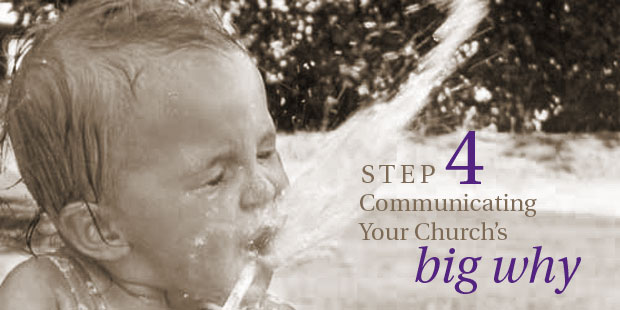
Taking Your Vision Public, Step 4: Communicating Your Church’s Big Why

What is it that causes some communication to grab people and stick with them? What is different about communication that causes people to move from being observers of a mission to participants in the mission? The answer, plain and simple is emotion.

I once heard it said, “There is no motion without emotion.” I believe that’s true. People get involved with things that they care about – things that connect with them on an emotional level. I’ve mentioned Simon Sinek before and his book, Start with Why, which goes into how this concept of inspiring action by connecting with people emotionally is actually wired into our physiology. If you’re the type of person that’s looking for the Cliff’s Notes, check out his TED talk.

So when you take your vision public, you need to remember to c0nnect with people emotionally by communicating the Big Why. I’ve been using a metaphor of vision-soaked communication – fill the pool (by articulating your vision clearly), boil it down (by developing an effective tagline), and describing the water (by crafting your key messages). Within that framework, I think of the Big Why as tapping into the thirst that exists within the hearts of people.

You would think that this is something that church leaders would do more consistently than those that work in the business world. But that’s not always the case. Think about your announcements from last Sunday or the blurbs in the weekly bulletin or the ad you run in the newspaper or the billboard promoting your services. The vast majority of churches spend 90% of their time communicating about “the What” instead of communicating “the Why.”

Here’s a perfect example. I know of a pastor and his preaching team that are planning to preach through the Bible as their first sermon series of 2012, choosing the 20 most significant stories and passages. When asked why they chose that topic, the first response was, “Biblical literacy has gone down significantly in the past 20 years.” Not very compelling, right? Why should the person in the pew (or padded seats) care about that…or, even more importantly, why would they invite their neighbor to come and hear that sermon series? They haven’t connected on an emotional level!

What if, on the other hand, the preaching team of that same church presented the same 20 stories and passages of scripture within a different framework? “God is telling a story and it is only within the context of that larger story that the every day issues we face like pain, suffering, hope, the longing for peace, and the desire for love and acceptance make any sense at all. In this series, we’ll get a handle on the larger story that brings all of our lives into perspective.” Makes a difference, doesn’t it? And, by the way, this framework is directly connected to their vision as a church…a vision they had already articulated (inviting people to experience and share the whole, new life available in Christ).

The Big Why makes all the difference. But so many churches brush right past the why to the what. Take a look at the key messages we developed for Vanguard again. In this case, we have built some of the Big Why ideas into the paragraphs that support the specific messages. Can you find the “Big Why” language?

This idea of tapping into the thirst that exists in the hearts of people is so crucial to vision-soaked communication that it must be at the core of everything you communicate. It doesn’t matter what you’re communicating, you should always answer the question, “Why should I care?” The people who are listening are always implicitly asking that question. If you give them an answer that connects with them emotionally, they will dive in, step up, or whatever other metaphor for participation you’d like to use. Tap into the thirst by always communicating the Big Why.

And then, you need to break out the hose. We’ll cover that next time.

Download PDF

Tags: , ,

| What is MyVisionRoom? > | Back to Communication >

ABOUT THE AUTHOR

Will Mancini

Will Mancini

Will Mancini wants you and your ministry to experience the benefits of stunning, God-given clarity. As a pastor turned vision coach, Will has worked with an unprecedented variety of churches from growing megachurches and missional communities, to mainline revitalization and church plants. He is the founder of Auxano, creator of VisionRoom.com and the author of God Dreams and Church Unique.

See more articles by >

COMMENTS

What say you? Leave a comment!

Recent Comments
comment_post_ID); ?> Thank you for this information. I'm going to use this article to improve my work with the Lord.
 
— Abel Singbeh
 
comment_post_ID); ?> Thank you Ed for sharing your insights into the Church Growth Movement. I have my reservations with Church Growth models because it has done more damage than good in the Body of Christ. Over the years, western churches are more focused on results, formulas and processes with little or no emphasis on membership and church discipline. Pastors and vocational leaders are burnt out because they're overworked. I do believe that the Church Growth model is a catalyst to two destructive groups: The New Apostolic Reformation and the Emerging Church. Both groups overlap and have a very loose definition. They're both focus on contemporary worship, expansion of church brand (franchising), and mobilizing volunteering members as 'leaders' to grow their ministry. Little focus on biblical study, apologetics and genuine missional work with no agenda besides preaching of the gospel.
 
— Dave
 
comment_post_ID); ?> Thank you for sharing such a good article. It is a great lesson I learned from this article. I am one of the leaders in Emmanuel united church of Ethiopia (A denomination with more-than 780 local churches through out the country). I am preparing a presentation on succession planning for local church leaders. It will help me for preparation If you send me more resources and recommend me books to read on the topic. I hope we may collaborate in advancing leadership capacity of our church. God Bless You and Your Ministry.
 
— Argaw Alemu
 

Clarity Process

Three effective ways to start moving toward clarity right now.

A Missional Incarnational Leadership Guide

This week I had a chance to share some coaching pointers with some great leaders at the New Thing Network. As the church is changing, so leaders must change and the coaching questions we used to use may not fit the life, tensions, or reality that many leaders now face. I coach to incarnation not just proclamation. I coach to community and cultural engagement not just tasks of running a church of weekend Sunday experience. Every leader gets lost and blind in their own world and sometimes the most powerful way to influence leaders is by asking the right questions. Jesus did this and it changed history so consider browsing through this list and make some suggestions. Someday this might be a great list that we can all share. I am giving you four key aspects of a leaders life that must be coached for a true missionally incarnational leader must be: Deep in Character, Clear in Calling, Culturally Savvy, and Able to Lead Inclusive Community.


DEEP IN CHARACTER

  • What are you anxious about this month, this last week?
  • How much are your concerns stressing you out? How is that showing up? Anger, withdrawal, harsh words, criticalness or any moments of depression that you can’t dig out of?
  • Is anyone being hurt by the stress level in your life? How can you apologize this week to those you’ve hurt?
  • What are you hearing from God about these concerns?
  • Have you been regularly finding a place of silence to hear from God?
    What do you think He is saying to you about your marriage, your heart, the balance of leading people vs. leading your family?
  • How are you dealing with battles of your mind? Purity? Pornography? Do you need some help with this?
  • Have you felt any undue pressure to lie, or try to prove your worth to anyone this last month?
  • Have you been speaking well and praying for other pastors in your city?
  • What have you been reading for your own encouragement?
  • Do you feel like God loves you this month? Do you feel like He wants to give favor to you or do you feel like he wants to discipline you? Why?
  • Where do you feel dark spiritual forces hassling or attacking you? Have you specifically exposed these issues and asked people to pray?
  • Do you feel you have real friends right now? Who? Why or Why not?
  • What things have made you the saddest this last month?
  • What things have made you laugh and find joy this last month?
  • What are you afraid of right now as we talk?


CLEAR IN CALLING
Here you are coaching through the intersection of real life and divine calling and roles.

  • Are you taking care of the one body God has given you? What are you doing to stay healthy?  If not, what are your plans to get going?
  • Is your spouse feeling “close” to you in your calling right now? How can you include them more in what you are doing? Do they want to be included more or protected more from your ministry calling?
  • Are you helping them find and pursue their passions while you pursue your own?
  • How often are you having time together without any ministry talk? What fun things have you done together this last month?
  • What types of conversations and experiences have you had this month with your children? What have you planned for this coming month?
  • Are you making choices with your finances that keep you moving toward freedom or bondage?  Any choices you want to run by me at this point?
  • Are you being mentored in any specific area of your life right now? What would you love to get help in?
  • Are you feeling motivated and excited to wake up every day? Why or why not?
  • Do you feel confident or alone in leading the people God’s given you?
  • Are there any aspects of your life that you feel must change in order for God to keep growing your influence or leadership?
  • If you were God, what would you absolutely tell me as your coach, that I should ask you about
  • What are you most excited about? What is giving you life and joy right now?
  • Do you feel that God’s word is alive to you or are you a bit dry this month?
  • Who are you hanging out with that inspires you toward better living?
  • Describe what your “Sabbath” is right now? Is that working? If not, do you see any way to make the happen?
  • Have you been consistently pre-planning your week or have you been more “responding” to the apparent pressures that come to you?  How will be making time to get intentional with your weekly schedule?
  • Where have you been wasting time?


CULTURALLY SAVVY
Here you are coaching for their ability to engage the lost culture with the Gospel.

  • Do you know the names of all your neighbors? If not, what can you do this month to get to know them without being a dork?
  • Are you doing any recreation, hobbies, or school functions with the intent to make friends?
  • Tell me about some good conversations you’ve had with lost friends this month? Have you made any plans to invite them deeper into your lives or go deeper into their lives?
  • How could you bless the children of the people you’re meeting?
  • Have any of your lost friends invited you to anything this last month? Did you go? How did it go? Any plans to thank them by inviting them to something cool?
  • Have you done anything this last month that you may need to apologize for to a lost friend? Maybe not being more helpful to them? Saying no to an invite they gave you?  Maybe being gone when something bad happened to them?
  • What are you finding is always good news to your lost friends? Have you made any plans to be good news? What is that?
  • Have you taken much time this month to exegete the needs of your community? Have you talked to any school employees, city workers or government officials? How can you make that happen or begin to help where they expose need?
  • How many parties have you thrown or gone to this last month?
  • What types of non-profits are working in your area that you could help out with and support?
  • Have you been able to share much of your story to a lost friend this month? How did that go? Any follow up?
  • Are you showing patience with the people around you or have you overstepped any lines the culture is giving you lately?
  • Have you helped serve anyone this month?
  • How are you praying for the people around you? What does that look like? Has God led you to do anything unique for a friend?
  • Have you invited any new friends to anything this last month? What was it? How did that go? Any next steps?
  • Are you and your spouse in the same stride in how much time you’re giving to lost folks? How many times a week or evenings have you been opening your home?
  • How many of your 21 weekly meals have you been sharing with people?
  • How have you been engaging the culture with those in your Christian community?
  • Do you feel that your Christian community is trustworthy to bring any new friend to? If not, Why and how can you mentor your community toward inclusiveness and trust?
  • Have you been advocating for any people this last month?
  • What common space, coffee shops, pubs, etc. have you been hanging out in consistently? Have any interesting relationships started to form?


ABLE TO LEAD COMMUNITY
Here you are coaching for their ability to lead people toward God and his church.

  • What are you doing to help nurture the lives of the Christians who are with you now?
  • Are there any people in your community right now that seem to be struggling or fighting against what you feel God has led your community to do or be? What do you think God is asking you to do to address the problems?
  • Are any non-believers moving toward your community or in their faith with God? How do you envision integrating them into your “Christian space and rhythms?”
  • How are you feeding the sheep right now?
  • How are you teaching the sheep to feed themselves and each other?
  • Are the experiences that your Christian community participates in causing them to be less or more consumeristic? Less or more selfish and self oriented? Less or more individualistic?
  • Has anything come up this month that is a concern for you regarding the growth or missionality of your Christian friends? What are your plans to help them grow through this?
  • Is the DNA of your community clear? How do you know?
  • Describe how the spiritual activities your people have done this last month have displayed the DNA?
  • Where do you think you may be doing things that go against the DNA of the gospel?
  • How much time are you spending with Christians vs. Non-Christians? How would you assess the rest of your community on this question?
  • How are you leading your people beyond just head knowledge or doctrine but into action?
  • Have you had any weird or awkward conversations between your saint’s and unchurched sojourners? How have you helped navigate that?
  • This last month, do you feel more like a “doer” of the ministry or an “equipper”?  How can you get closer to the equipper? What could you give up or give to someone else to do? What is keeping you from doing that?
  • How are you managing the tension of working in your vocational job and your calling to lead people?
  • Has your community locked into any specific areas of need or found some relational causes to be a part of? Describe how that is being lived out.
  • What do you feel you should protect your community from? What do you feel you should expose your community to this month?
  • What conflicts have come up this month in your community? How are you leading them through this? How are you dealing with judgements and frustrations some might have with you this month?
  • Out of all the false or immature critiques of your leadership, what elements of truth might God still want you to acknowledge and grow in?


Read more from Hugh here.

Download PDF

Tags: , , , , ,

| What is MyVisionRoom? > | Back to Leadership >

ABOUT THE AUTHOR

Hugh Halter

See more articles by >

COMMENTS

What say you? Leave a comment!

Recent Comments
comment_post_ID); ?> Thank you for this information. I'm going to use this article to improve my work with the Lord.
 
— Abel Singbeh
 
comment_post_ID); ?> Thank you Ed for sharing your insights into the Church Growth Movement. I have my reservations with Church Growth models because it has done more damage than good in the Body of Christ. Over the years, western churches are more focused on results, formulas and processes with little or no emphasis on membership and church discipline. Pastors and vocational leaders are burnt out because they're overworked. I do believe that the Church Growth model is a catalyst to two destructive groups: The New Apostolic Reformation and the Emerging Church. Both groups overlap and have a very loose definition. They're both focus on contemporary worship, expansion of church brand (franchising), and mobilizing volunteering members as 'leaders' to grow their ministry. Little focus on biblical study, apologetics and genuine missional work with no agenda besides preaching of the gospel.
 
— Dave
 
comment_post_ID); ?> Thank you for sharing such a good article. It is a great lesson I learned from this article. I am one of the leaders in Emmanuel united church of Ethiopia (A denomination with more-than 780 local churches through out the country). I am preparing a presentation on succession planning for local church leaders. It will help me for preparation If you send me more resources and recommend me books to read on the topic. I hope we may collaborate in advancing leadership capacity of our church. God Bless You and Your Ministry.
 
— Argaw Alemu
 

Clarity Process

Three effective ways to start moving toward clarity right now.

8 Measures of Personal Discipleship

In 2008, LifeWay Research commissioned a survey of more than 7,000 churches to discover the principles involved with healthy congregations. That research made up the framework for Transformational Church, a book I coauthored with Thom Rainer.

In 2011, we conducted another study to focus not on the church, but on the individual believer. In this study, we asked more than 4,000 people about their spiritual lives and level of maturity. This was not a convenience sample drawn from participating churches, but a randomly selected sample to ensure an even higher level of research accuracy.

The results allowed us to identify eight Biblical factors that consistently show up in the life of a maturing believer. Those “attributes of discipleship” are:

  1. Bible engagement
  2. Obeying God and denying self
  3. Serving God and others
  4. Sharing Christ
  5. Exercising faith
  6. Seeking God
  7. Building relationships
  8. Unashamed transparency


Spiritual growth does not happen by accident, and since Jesus has called us to make disciples of all nations, we wanted to discover the common traits for those maturing in their faith. It goes without saying that such attributes do not make you a Chrisitan but, rather, are an outgrowth of being a Christian. Furthermore, these are measurements of growth, but only God causes the growth.

Yet, God shapes congregations through the shaping of the individual members’ lives. This shaping doesn’t just happen; God grows us as we place ourselves in a position of obedience to receive that growth. This requires intentional awareness and leadership on the part of both leaders and church members.

Preparing your church to receive the growth God provides almost always involves knowing where your people are in their spiritual walk. To help pastors, churches and individuals measure their spiritual development, we used the survey data to develop the Transformational Discipleship Assessment (TDA). The assessment results in a report on spiritual maturity using the eight attributes of biblical discipleship. The TDA also provides helpful and practical suggestions for individuals to take the next steps in their spiritual development.

TDA

I’ll be releasing more information about the specific factors later in the fall. Due to the sheer volume of material, however, it will take several months to complete our analysis and release all of the materials.

Here is some more information from the news release:

Scott McConnell, director of LifeWay Research, said the new assessment tool zooms in to the personal level.”The Transformational Discipleship Assessment helps people see how they are doing with those eight attributes. It answers, ‘Are you growing? Are you consistently following Christ?'” McConnell explained. “It also helps leaders know where to focus sermons, Bible studies, events and other disciple-building activities.”

McConnell said the research was conducted in three phases. First recognized discipleship experts were interviewed. Their input was used to revise a set of questions that have been effective in measuring dozens of specific biblical principles that may be reflected in a believers actions, attitudes or beliefs. Then 1,000 Protestant pastors in the United States were polled. In the final phase, more than 4,000 Protestants from both the U.S. and Canada were surveyed in three languages, English, Spanish and French.

What have been some of the key ways in which your church has been effective in the discipleship of believers?

Read more from Ed here.

Download PDF

Tags: , , , , ,

| What is MyVisionRoom? > | Back to Process >

ABOUT THE AUTHOR

Ed Stetzer

Ed Stetzer

Ed Stetzer, Ph.D., holds the Billy Graham Chair of Church, Mission, and Evangelism at Wheaton College and serves as Executive Director of the Billy Graham Center for Evangelism. He has planted, revitalized, and pastored churches, trained pastors and church planters on six continents, holds two masters degrees and two doctorates, and has written dozens of articles and books. Previously, he served as Executive Director of LifeWay Research. Stetzer is a contributing editor for Christianity Today, a columnist for Outreach Magazine, and is frequently cited or interviewed in news outlets such as USAToday and CNN. He serves as interim pastor of Moody Church in Chicago.

See more articles by >

COMMENTS

What say you? Leave a comment!

Recent Comments
comment_post_ID); ?> Thank you for this information. I'm going to use this article to improve my work with the Lord.
 
— Abel Singbeh
 
comment_post_ID); ?> Thank you Ed for sharing your insights into the Church Growth Movement. I have my reservations with Church Growth models because it has done more damage than good in the Body of Christ. Over the years, western churches are more focused on results, formulas and processes with little or no emphasis on membership and church discipline. Pastors and vocational leaders are burnt out because they're overworked. I do believe that the Church Growth model is a catalyst to two destructive groups: The New Apostolic Reformation and the Emerging Church. Both groups overlap and have a very loose definition. They're both focus on contemporary worship, expansion of church brand (franchising), and mobilizing volunteering members as 'leaders' to grow their ministry. Little focus on biblical study, apologetics and genuine missional work with no agenda besides preaching of the gospel.
 
— Dave
 
comment_post_ID); ?> Thank you for sharing such a good article. It is a great lesson I learned from this article. I am one of the leaders in Emmanuel united church of Ethiopia (A denomination with more-than 780 local churches through out the country). I am preparing a presentation on succession planning for local church leaders. It will help me for preparation If you send me more resources and recommend me books to read on the topic. I hope we may collaborate in advancing leadership capacity of our church. God Bless You and Your Ministry.
 
— Argaw Alemu
 

Clarity Process

Three effective ways to start moving toward clarity right now.