The Success Factor – Leverage Today’s Wins to Solve Tomorrow’s Problems

Below is a new weekly series posting content from one of the most innovative content sources in the church world: SUMS Remix Book Summaries for church leaders. SUMS Remix takes a practical problem in the church and looks at it with three solutions; and each solution is taken from a different book. As a church leader you get to scan relevant books based on practical tools and solutions to real ministry problems, not just by the cover of the book. Each post will have the edition number which shows the year and what number it is in the overall sequence. (SUMS provides 26 editions per year, delivered every other week to your inbox). 

You can purchase a subscription to SUMS Remix here >>>

Our church dreams more about where we have been than where God is leading us.

Have you ever looked around to realize that your church might be living today by focusing on yesterday?

Many churches long for the past, dreaming about the “good old days.” When faced with questions that are not easily answered, or walking through times of trial and doubt, churches, like people, often want things to be the way they used to be.

The problem is, the past has gone. While we may look back and respect it, and maybe even at times revere it, we cannot live in the past, especially when circumstances demand answers for the future.

If you are interested in learning how to lead your church away from the past in order to focus on what God has ahead, consider this solution:

Solution #2: Cultivate solutions by celebrating current successes.

THE QUICK SUMMARY

In Missional Renaissance, Reggie McNeal shows three significant shifts in thinking and behavior that churches need to make in order to allow leaders to chart a missional course forward. These shifts are:

  • from an internal to an external focus, ending the church as exclusive social club model;
  • from running programs and ministries to developing people as its core activity; and
  • from professional leadership to leadership that is shared by everyone in the community.

With in-depth discussions of the “what” and the “how” of transitioning to being a missional church, readers will be equipped to move into what McNeal sees as the most viable future for Christianity. 

A SIMPLE SOLUTION

As a leader, do you find more passion in learning about the past – events, activities, and people? Or, do you find passion in looking forward into the future, and wondering what events and activities of tomorrow and beyond are going to be brought about by what kind of people?

As in many leadership questions, there is no right or wrong answer, and elements of both passions described above are helpful to any leader. However, in terms of the life of the church, there is a subtle danger in a focus on past heroes and the times when they lived, the actions they led, and the events they are fondly remembered for.

While keeping a firm grip on the importance and foundations of the past, leaders must reach forward and lead their churches to what the people of God must do.

Typical church leadership spends a lot of time keeping the past alive. Missional movement leaders appreciate the past, but mine the past for lessons on how to forge ahead.

When we come together for our gatherings, if all our heroes are the ones who have gone before us and all our God stories are about yesteryear, we’re in trouble.

The traditional church celebrates the history of the saints, but missional movements yearn for journalists who can tell us what God is up to today.

The model for this kind of leadership is found in the role of apostles and prophets in the New Testament. They witnessed and passed along God news that was good news. The journalists tied their stories to the work of God before, but they allowed the new developments to shape their understanding of God’s work in the world.

Journalists take us to places they’ve already visited. They uncover stories beneath the stories and inform us of what’s going on. They shape our perceptions by what they have seen, experienced, and uncovered. They move us from where we are into a new reality.

Our discovery of what He is up to becomes the faith story that is prologue to our future.

– Reggie McNeal, Missional Renaissance

A NEXT STEP

At your next leadership team meeting, spend 10 minutes of discussion, asking your team members to call to mind current individuals and events that your church holds in high regard. Write the names and events on a chart tablet. Beside each, write a phrase or sentence describing the importance of the individual or event.

Now, spend 45 minutes asking your team in broad and generic terms to list the qualities revealed through the character of these individuals or results of these events that will propel your church into the greatest ministry period of its existence. Along with each item, list one to two immediate actions that it will take to make the list become a reality.

As a team, choose the most pressing individual description or event listed, designate a team leader, and prayerfully commission that leader to create the future.

In another leadership team meeting, review the following questions to help equip your team members as “journalists” who will uncover the real talk of conversations going on in the hallways and parking lots of your church.

  1. What do you enjoy doing? Helps people see how God might use them in their everyday lives.
  2. Where do you see God at work right now? Helps people see God in their family, their community, the office – wherever.
  3. What would you like to see God doing in your life over the next six to 12 months? How can we help? Helps communicate the importance of the individual now, not in the past.
  4. How would you like to serve other people? How can we help? Helps focus on serving others, emphasizing outside the church.
  5. How can we pray for you? Helps demonstrate personal care and concern.

Ask your team members to use the five questions above in conversations with at least seven key volunteer leaders they work with in the next month. After a month of conversations, dedicate one hour of a team meeting to share the highlights of the conversations.

Consider asking key volunteer leaders to duplicate the conversations with at least five team members they work with. After they have had a chance to have these conversations, debrief the leaders and note key phrases that are repeated. Bring these to the next team meeting to add to the conversations already started.

Designate an individual to maintain this five question process in a digital document that can be continually updated and accessed by team leaders. From time to time, reference this document in team discussions to ensure that the voices of the present are being heard – and acted on.


Taken from SUMS Remix 22-2, published September 2015.

>>> You can purchase a subscription to SUMS Remix here >>>

Download PDF

Tags: , , ,

| What is MyVisionRoom? > | Back to Vision >

ABOUT THE AUTHOR

VRcurator

VRcurator

Bob Adams is Auxano's Vision Room Curator. His background includes over 23 years as an associate/executive pastor as well as 8 years as the Lead Consultant for a church design build company. He joined Auxano in 2012.

See more articles by >

COMMENTS

What say you? Leave a comment!

Recent Comments
comment_post_ID); ?> Thank you for this information. I'm going to use this article to improve my work with the Lord.
 
— Abel Singbeh
 
comment_post_ID); ?> Thank you Ed for sharing your insights into the Church Growth Movement. I have my reservations with Church Growth models because it has done more damage than good in the Body of Christ. Over the years, western churches are more focused on results, formulas and processes with little or no emphasis on membership and church discipline. Pastors and vocational leaders are burnt out because they're overworked. I do believe that the Church Growth model is a catalyst to two destructive groups: The New Apostolic Reformation and the Emerging Church. Both groups overlap and have a very loose definition. They're both focus on contemporary worship, expansion of church brand (franchising), and mobilizing volunteering members as 'leaders' to grow their ministry. Little focus on biblical study, apologetics and genuine missional work with no agenda besides preaching of the gospel.
 
— Dave
 
comment_post_ID); ?> Thank you for sharing such a good article. It is a great lesson I learned from this article. I am one of the leaders in Emmanuel united church of Ethiopia (A denomination with more-than 780 local churches through out the country). I am preparing a presentation on succession planning for local church leaders. It will help me for preparation If you send me more resources and recommend me books to read on the topic. I hope we may collaborate in advancing leadership capacity of our church. God Bless You and Your Ministry.
 
— Argaw Alemu
 

Clarity Process

Three effective ways to start moving toward clarity right now.

A Game-Changing Perspective: Knowing the Difference Between a Decentralized and Fragmented Ministry

Good church leaders know the importance of releasing and sending people to do ministry. Jesus himself moved quickly from modeling ministry for twelve leaders, to sending out those same twelve to do ministry on their own (Luke 9:1).

Yet in observing hundreds of churches from coast to coast, not all “releasing” is the same. In fact, there is a good kind and a bad kind.  And if you don’t the difference, your ministry will be limited for the rest of your life.

Let’s say a pastor is consistently recruiting volunteers to initiate and lead in multiple environments like groups, classes, and teams. And let’s say he has just recruited ten new small group leaders. In the next week, let’s imagine these ten leaders will be facilitating some kind of learning and relationship building in homes for the sake of Jesus— a common snapshot of small group life in the American church.

What will actually happen in those homes?

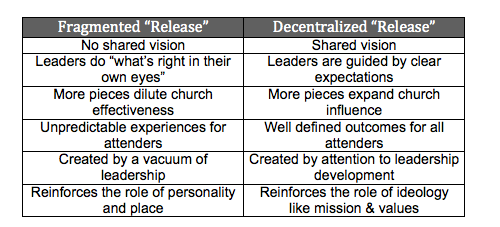
In this scenario the most common kind of “releasing” is fragmentation. That is, we are not just splitting up and breaking into “smaller chunks of people” with regard to ministry time and place, we are also dividing and breaking apart the shared intent within each time and place.

The biblical and effective way to “release” is not fragmentation but decentralization. That is, taking some centrally defined intent and executing them without a central person or place defining the experience.

Most ministry activity is fragmented not decentralized because there simply no clarity of shared intent, no cultivation of shared values, and no development of shared abilities within the church. In short, their is no shared vision, just many little mini-visions everywhere a ‘piece’ of the ministry gathers.

The few ministries that operate a decentralized ministry have gone to great lengths to build a well defined vision first. Something other than a central pastor or central church building define the what, why and how of reality where ever groups, classes or events meet. That something always brings shared meaning in the form of  ideals, goals, dreams, tools, approaches, stories, etc.

To illustrate, Alcoholics Anonymous is a decentralized organization.  This successful program happens with no central person or place to guide it. But there is a central methodology—12-steps—with a defined set of values and practices that guide the experience of de-centralized communities.

What central methodology guides the experiences of your classes or groups or teams? Is your ministry fragmented or decentralized?

It is tempting to try to explain these concepts with metaphors like “the starfish and the spider” or apples and oranges. There are several quick and dirty metaphors out there. But based on your unique church context those metaphors may or may not work. That’s why I am working on a better metaphor or illustration for another post.  I would love to hear your ideas if any come to mind.

Read more from Will here.

Download PDF

Tags: , ,

| What is MyVisionRoom? > | Back to Vision >

ABOUT THE AUTHOR

Will Mancini

Will Mancini

Will Mancini wants you and your ministry to experience the benefits of stunning, God-given clarity. As a pastor turned vision coach, Will has worked with an unprecedented variety of churches from growing megachurches and missional communities, to mainline revitalization and church plants. He is the founder of Auxano, creator of VisionRoom.com and the author of God Dreams and Church Unique.

See more articles by >

COMMENTS

What say you? Leave a comment!

Recent Comments
comment_post_ID); ?> Thank you for this information. I'm going to use this article to improve my work with the Lord.
 
— Abel Singbeh
 
comment_post_ID); ?> Thank you Ed for sharing your insights into the Church Growth Movement. I have my reservations with Church Growth models because it has done more damage than good in the Body of Christ. Over the years, western churches are more focused on results, formulas and processes with little or no emphasis on membership and church discipline. Pastors and vocational leaders are burnt out because they're overworked. I do believe that the Church Growth model is a catalyst to two destructive groups: The New Apostolic Reformation and the Emerging Church. Both groups overlap and have a very loose definition. They're both focus on contemporary worship, expansion of church brand (franchising), and mobilizing volunteering members as 'leaders' to grow their ministry. Little focus on biblical study, apologetics and genuine missional work with no agenda besides preaching of the gospel.
 
— Dave
 
comment_post_ID); ?> Thank you for sharing such a good article. It is a great lesson I learned from this article. I am one of the leaders in Emmanuel united church of Ethiopia (A denomination with more-than 780 local churches through out the country). I am preparing a presentation on succession planning for local church leaders. It will help me for preparation If you send me more resources and recommend me books to read on the topic. I hope we may collaborate in advancing leadership capacity of our church. God Bless You and Your Ministry.
 
— Argaw Alemu
 

Clarity Process

Three effective ways to start moving toward clarity right now.

6 World-Changing Convictions of the Church

You tend to base your decisions on one of four motivations in life: circumstances, conveniences, criticisms, or convictions. Yet only decisions that are based on your convictions will last and leave a lasting legacy.

The people who have made the greatest impact on this world, for good or bad, are those who had the deepest convictions. They weren’t necessarily the smartest people, the brightest people, the most educated, the wealthiest, or even the most famous.

If you’re going to build convictions, you need to build them on something that’s going to last. Everything changes. Fads change, fashions change. Psychology changes. Even science textbooks change. We keep learning more and more. There’s only one thing that never changes. That is the truth of God. If it was true a thousand years ago, it will be true today and it will be true a thousand years from tomorrow because truth does not change.

The Bible says this in Isaiah 40:8: “The grass withers, and the flowers fade, but the word of our God stands forever” (NLT).

Saddleback has been built on six biblical convictions that are all based on God’s eternal Word. I’m willing to go to the mat for all six convictions. Here they are.

1. It’s all about God.

It’s not about me. It’s not about you. It’s not about profit, politics, or anything else. It’s all about God. Until you understand that, life and ministry are never going to make sense. In Romans 11, the Bible says, “For everything comes from him and exists by his power and is intended for his glory” (Romans 11:36 NLT).

What’s the implication of that?

If it’s all about God, and it’s not all about making money or being popular or anything else the world thinks is important, then the implication is that it is more important to love God than anything else. It’s my very first priority. Jesus said in Matthew 22:37-38, “Love the Lord your God with all your heart and with all your soul and with all your mind. This is the first and greatest commandment” (NIV).

2. Only the Church will last forever.

Nothing on earth will last forever – no business, government, or nation. But the Church will.

Jesus said in Matthew 16:18: “I will build my church and all the powers of hell will not conquer it” (NLT).

A thousand years from today, there probably will be no United States of America. No nation lasts forever – no empire lasts forever. Where’s the Roman Empire today? Where’s the Greek Empire? A thousand years from today, there probably won’t be a Microsoft. A thousand years from today, even many of our good Christian organizations will be gone. Nothing man-made lasts. Nothing but the Church.

I’ll give my entire life to serve the Church – Saddleback and the global Body of Christ.

That matters more to me than anything else in the world. All of our staff tithe their time. That means 10 percent of our time goes to help other churches. We’re not in this just for our church. Over the years we’ve trained more than 400,000 pastors from 163 countries.

What does this conviction mean for you and me? If we’re all going to live together forever, we better get along. It’s not enough just to love God. You must love the Church – despite all of our differences. The Bible says Christ died for the Church, the whole Church, anyone who has made Jesus Lord of his or her life.

Love is more important than personal differences in the family of God. Love is more important than political differences. We need to love our brothers and sisters in Christ.

3. God expects me to love everybody else too.

I don’t know if you see the pattern here, but it’s all about love. Life is not about the acquisition of things. It’s not about achievement. It’s not about popularity. It’s about learning how to love. If you miss that, you miss the lesson of life. God is love. And he says the most important thing is to love him. The second most important thing is in Mark 12: “The second most important commandment is love your neighbor as yourself” (Mark 12:31 NLT).

So who is our neighbor? That’s not a new question. It was asked right after Jesus said this. That’s when Jesus told the story of the Good Samaritan. The short answer is everybody is your neighbor. There is nobody you’re allowed to not love on this earth.

That means you’re to love the unlovely, those who are different, difficult – and even dangerous. You’re supposed to love everyone.

It’s easy to love people who agree with you. It’s easy to love people who are cool. And it’s easy to love people who are safe. But God says that he wants you to take it even further. He says we’re to love even our enemies (Luke 6:35).

It’s tough to love people who are treating you poorly – or love someone who believes something totally antithetical to what the Bible teaches. But God says we’re to love even our enemies.

4. The whole world needs Jesus.

The whole Bible testifies to this, particularly the Great Commission. In it, Jesus tells us to “go and make disciples of all nations” (Matthew 28:19 NIV). Does it say, go and make disciples of some nations? No. All nations. Does that include Syria? Yes. Does that include North Korea? Yes. Does that include Iran? Yes. No nation is off limits. As Christians, we report to a higher authority – Jesus Christ. I’m not a politician; I’m a pastor. If Iran opens the door, I’m going. There is no place I won’t go. I’d go into hell if I could bring people out with me. There is no place I would not go.

If the whole world needs Jesus, then we have to share the Good News. To keep it a secret would be criminal. If you knew the cure for a dreaded disease – like cancer or AIDS – and you didn’t share it, that would be criminal. We have something better than that. We know the cure for the human heart. We know the cure for the deepest needs of mankind. We need our past forgiven, a purpose for living, and a home in heaven – we need Jesus.

You may be a pastor, yet you’ve never made this truth your own. It’ll change your life. How? First, it’ll change your priorities. You no longer live for yourself; you’re living for Jesus.

Then your perspective changes. You no longer regard people the way you used to. They’re not objects; they’re priceless souls that Jesus shed his precious blood for. They’re worthwhile and they’re valuable. I don’t care if the person is a coke smoking crack junkie in the alley, he or she is valuable to God. We must look at people not as objects but with a broken heart.

5. Everything is possible with God.

The Bible says, “Jesus looked at them and said, ‘With man this is impossible, but with God all things are possible’” (Matthew 19:26 NIV). Why did we launch the P.E.A.C.E. Plan? What makes us think that Saddleback Church could lead hundreds of thousands of other churches to go after the five biggest problems on the planet? The answer is we have a big God.

Jesus also said: “According to your faith it will be done unto you” (Matthew 9:29 NIV). You know what the implication is? God’s waiting on you. God is waiting for you to trust him. God wants to use you. He wants to bless you. He wants to do amazing things in your life. He wants you to be a world changer. You just need to stop saying, “I can’t.” That’s a lie. All things are possible to him who believes God. God gets the most glory when we trust him for the impossible.

6. History’s conclusion is inevitable.

I believe this with all my heart. It’s a fait accompli. It’s done. It’s finished. There’s no doubt. I’ve read the final chapter. The Bible tells us how it’s going to end. One day, God’s going to wrap it all up here on earth and he’s going to take his children who’ve trusted him to heaven for ever and ever. In Matthew 24 the Bible says, “The Good News about God’s Kingdom will be preached in all the world to every nation, to every people group, and then the end will come” (Matthew 24:14 ICB). It’s a certainty.

Fellow pastors, we are not trying to bring in the Kingdom here on earth. It’s not going to happen here on earth. What we are trying to do is populate the Kingdom of Heaven. We want to take all our friends and everybody else with us. We want to get people into the Kingdom of Heaven, where they’re going to be for eternity.

These six convictions of mine are behind everything we do at Saddleback and everything I say. It’s all about God’s glory. God gets glory when I love him with all my heart. He gets glory when I love you and other people in the family of God. God gets glory when I love my neighbor and the people I’m least likely to love. He gets glory when I love my enemy and when I treat them with dignity and respect even though they disrespect me. God gets glory when I share the Good News with everybody. God gets glory when I trust him with problems in my life that cannot be solved except through a miracle. And God gets glory when I know and trust that the end is inevitable and, in the end, he wins.

> Read more from Rick.


Download PDF

Tags: , ,

| What is MyVisionRoom? > | Back to Vision >

ABOUT THE AUTHOR

Rick Warren

Rick Warren

Rick Warren is the founding pastor of Saddleback Church in Lake Forest, Calif., one of America's largest and most influential churches. Rick is author of the New York Times bestseller The Purpose Driven Life. His book, The Purpose Driven Church, was named one of the 100 Christian books that changed the 20th century. He is also founder of Pastors.com, a global Internet community for pastors.

See more articles by >

COMMENTS

What say you? Leave a comment!

Ruth Kamau — 09/16/16 9:20 am

Thanks for that its very encouraging yeah i agree with you all we have to do should be to the glory of God

Recent Comments
comment_post_ID); ?> Thank you for this information. I'm going to use this article to improve my work with the Lord.
 
— Abel Singbeh
 
comment_post_ID); ?> Thank you Ed for sharing your insights into the Church Growth Movement. I have my reservations with Church Growth models because it has done more damage than good in the Body of Christ. Over the years, western churches are more focused on results, formulas and processes with little or no emphasis on membership and church discipline. Pastors and vocational leaders are burnt out because they're overworked. I do believe that the Church Growth model is a catalyst to two destructive groups: The New Apostolic Reformation and the Emerging Church. Both groups overlap and have a very loose definition. They're both focus on contemporary worship, expansion of church brand (franchising), and mobilizing volunteering members as 'leaders' to grow their ministry. Little focus on biblical study, apologetics and genuine missional work with no agenda besides preaching of the gospel.
 
— Dave
 
comment_post_ID); ?> Thank you for sharing such a good article. It is a great lesson I learned from this article. I am one of the leaders in Emmanuel united church of Ethiopia (A denomination with more-than 780 local churches through out the country). I am preparing a presentation on succession planning for local church leaders. It will help me for preparation If you send me more resources and recommend me books to read on the topic. I hope we may collaborate in advancing leadership capacity of our church. God Bless You and Your Ministry.
 
— Argaw Alemu
 

Clarity Process

Three effective ways to start moving toward clarity right now.

Would You Recognize Inward Drift in Your Church?

All organizations tend to lose their focus and forget their original purposes over time. I call this almost imperceptible movement “inward drift.” The attitude becomes one of protecting the way we’ve always done it rather than looking back to the original purposes and reasons for existence. Numbers of stagecoach businesses failed, for example, because they thought their primary purpose was to make stagecoaches rather than to provide reasonable and rapid transportation.

The primary dangers with inward drift are twofold. First and foremost, the organization can forget the very reason it was created. Second, the drift is often imperceptible. Many organizations don’t realize there is a problem until it’s too late.

When Inward Drift Comes to Church

Local congregations are not immune from inward drift. To the contrary, the vast majority of churches in North America are likely in crisis because of the negative impact of inward drift.

Some of the labeling of congregations is unfortunate. Particularly, when we speak of “traditional churches” or “contemporary churches,” we rarely come to consensus on a clear definition. My son, Sam Rainer, popularized the term “established churches,” a term I prefer to use today. An established church is simply a church that has been in existence for a few years and is thus susceptible to inward drift. Indeed most any church three years or older will likely begin to experience some of the symptoms of inward drift.

When an organization such as a for-profit business begins to experience inward drift, it will change or die within relative short order. The marketplace will not buy its goods or services if the company doesn’t address the needs and the hearts of the consumers.

An established church, however, can exist for years and even decades with inward drift. The church may not be making disciples. It may not be reaching the community and the nations with the gospel. But it continues to exist more as a religious social club than a true New Testament church. Its members and constituents are willing to fund the congregation since it meets their perceived needs and desires.

Signs of Inward Drift in Established Churches

The signs of inward drift in an established church are clear even though the members don’t often recognize them:

  1. Most of the ministries and programs are focused on meeting the desires and needs of the members.
  2. The budget of the congregation is directed primarily at funding the projects and even comforts of the members.
  3. Conflict in the congregation is not uncommon since members are more concerned about getting their perceived needs and desires met.
  4. There is little to no focus on evangelism, reaching out to the community, and getting the gospel to the nations.
  5. Leadership is weak and reticent to address the problems, because that leadership emphasis could disrupt the status quo.

Addressing the Issue of Inward Drift in the Church

I recently drove through my hometown. I lived in the same house and the same town for my first eighteen years of life. But it had been more than a decade since I visited the town. I was shocked. Businesses on the main street were closed. Some were boarded. Many of the homes I knew and loved had deteriorated greatly. The major industries had exited and left large vacant buildings. It was almost a ghost town.

Someone who had never left the town, though, told me that things were really going well there. They were serious when they said it had not changed much since I left. For me, the change was stark and shocking. For him, it was slow and imperceptible. When we fail to see the deterioration that is taking place, we will not see the need to make changes to reverse the course.

Such is the crisis in many of our established churches today. And it is that imperceptible inward drift that often makes it so difficult to lead a congregation toward healthy change. In a future post, I will address some of the possible steps to lead an established church toward change without destroying it in the process. I hope you will join me then.

Read more from Thom here.

Download PDF

Tags: , , ,

| What is MyVisionRoom? > | Back to Vision >

ABOUT THE AUTHOR

Thom Rainer

Thom Rainer

Thom S. Rainer is the founder and CEO of Church Answers, an online community and resource for church leaders. Prior to founding Church Answers, Rainer served as president and CEO of LifeWay Christian Resources. Before coming to LifeWay, he served at The Southern Baptist Theological Seminary for twelve years where he was the founding dean of the Billy Graham School of Missions and Evangelism. He is a 1977 graduate of the University of Alabama and earned his Master of Divinity and Ph.D. degrees from The Southern Baptist Theological Seminary.

See more articles by >

COMMENTS

What say you? Leave a comment!

Recent Comments
comment_post_ID); ?> Thank you for this information. I'm going to use this article to improve my work with the Lord.
 
— Abel Singbeh
 
comment_post_ID); ?> Thank you Ed for sharing your insights into the Church Growth Movement. I have my reservations with Church Growth models because it has done more damage than good in the Body of Christ. Over the years, western churches are more focused on results, formulas and processes with little or no emphasis on membership and church discipline. Pastors and vocational leaders are burnt out because they're overworked. I do believe that the Church Growth model is a catalyst to two destructive groups: The New Apostolic Reformation and the Emerging Church. Both groups overlap and have a very loose definition. They're both focus on contemporary worship, expansion of church brand (franchising), and mobilizing volunteering members as 'leaders' to grow their ministry. Little focus on biblical study, apologetics and genuine missional work with no agenda besides preaching of the gospel.
 
— Dave
 
comment_post_ID); ?> Thank you for sharing such a good article. It is a great lesson I learned from this article. I am one of the leaders in Emmanuel united church of Ethiopia (A denomination with more-than 780 local churches through out the country). I am preparing a presentation on succession planning for local church leaders. It will help me for preparation If you send me more resources and recommend me books to read on the topic. I hope we may collaborate in advancing leadership capacity of our church. God Bless You and Your Ministry.
 
— Argaw Alemu
 

Clarity Process

Three effective ways to start moving toward clarity right now.

Commanding Clarity

I was honored to attend my friend’s change of command ceremony near Seattle. I marveled at the connection between the highly disciplined environment of the military and the practice of clarity. Think about it for a moment-in the military clarity is everywhere:

  • The mission is always crystal clear
  • There is a ton of communication before and after any initiative (after action review)
  • Lines of authority are unmistakable
  • A person’s accomplishments, time and experience are worn on their sleeve, literally
  • Lots of attention goes into training and technology for communication
  • Maintaining clarity requires a whole new world of vocabulary
  • Expectations and role descriptions for each individual are always reviewed
  • There is never a moment without total accountability to what is made clear

At one point I almost began weeping. As I immersed myself in a day of military culture, I couldn’t believe the sheer discipline of clarity that we exercise on behalf of our great country, in contrast to how little we achieve as leaders within God’s eternal kingdom.

Here is the mission of the squadron I was with: To provide combatant commanders with a fully combat ready strike group, capable of prompt and sustained operations across the full spectrum of naval operations anywhere in the world.

During the ceremony the three core values of the Navy were not only passionately conveyed by the four leading officers, they were demonstrated throughout the ceremony. For example, one aspect of the core value of “honor” is articulated as “We also honor the sacrifices our families and loved ones make to support us in our call of duty.” During the ceremony, Hunter’s wife, mother and two daughters were lavishly honored with generous bouquets from the Navy. The moment reflected the value wonderfully. The other two values are courage and commitment.

Read more from Will here.


Would you like to learn more about the vision clarity process? Connect with an Auxano Navigator and start a conversation with our team.

Download PDF

Tags: , ,

| What is MyVisionRoom? > | Back to Vision >

ABOUT THE AUTHOR

Will Mancini

Will Mancini

Will Mancini wants you and your ministry to experience the benefits of stunning, God-given clarity. As a pastor turned vision coach, Will has worked with an unprecedented variety of churches from growing megachurches and missional communities, to mainline revitalization and church plants. He is the founder of Auxano, creator of VisionRoom.com and the author of God Dreams and Church Unique.

See more articles by >

COMMENTS

What say you? Leave a comment!

Recent Comments
comment_post_ID); ?> Thank you for this information. I'm going to use this article to improve my work with the Lord.
 
— Abel Singbeh
 
comment_post_ID); ?> Thank you Ed for sharing your insights into the Church Growth Movement. I have my reservations with Church Growth models because it has done more damage than good in the Body of Christ. Over the years, western churches are more focused on results, formulas and processes with little or no emphasis on membership and church discipline. Pastors and vocational leaders are burnt out because they're overworked. I do believe that the Church Growth model is a catalyst to two destructive groups: The New Apostolic Reformation and the Emerging Church. Both groups overlap and have a very loose definition. They're both focus on contemporary worship, expansion of church brand (franchising), and mobilizing volunteering members as 'leaders' to grow their ministry. Little focus on biblical study, apologetics and genuine missional work with no agenda besides preaching of the gospel.
 
— Dave
 
comment_post_ID); ?> Thank you for sharing such a good article. It is a great lesson I learned from this article. I am one of the leaders in Emmanuel united church of Ethiopia (A denomination with more-than 780 local churches through out the country). I am preparing a presentation on succession planning for local church leaders. It will help me for preparation If you send me more resources and recommend me books to read on the topic. I hope we may collaborate in advancing leadership capacity of our church. God Bless You and Your Ministry.
 
— Argaw Alemu
 

Clarity Process

Three effective ways to start moving toward clarity right now.

6 Ways to Responsibly Steward the Power of Vision

Recently a friend called looking for some advice. She and her husband were at a crossroads. A few years ago they had sold their home and most of their possessions, left family and long-time friends to take a job across the country. They knew it was risky adventure, but they were compelled by the vision of this organization. The organization had some audacious goals but not outside of the realm of possibility. They were excited about the possibilities. They asked lots of questions and took time to process with friends and mentors. They sought God for guidance and eventually made the leap.

Now they were struggling. They had made tremendous sacrifices only to discover that the organization really wasn’t ready to pursue the vision they had cast. This family was in upheaval because a leader didn’t fully understand the power of vision.

Sound crazy or extreme? Sadly, change the names and organizations and I hear a version of this story nearly every day.

Vision is essential for individuals, teams and organizations.

Proverbs reminds us “without vision people perish.” Those of us who are visionary by nature use this scripture to help us find significance in the visionary gift that we have.

But visions are dangerously powerful and a leader who doesn’t understand that power has the potential to cause irreparable damage to the people they lead.

One of my greatest concerns for leaders is that we don’t fully grasp the weight of our influence on others. Influence by definition means, “the power to change or affect someone.” Let this sink in… the POWER to change someone. Our position of influence gives us power that quite literally changes or at a minimum affects another person’s life.

You understand this… Think about the influence your parents have on your life. Think about your first boss. Think about your soccer coach or piano teacher. Your life has been shaped by their influence, positively and negatively.

Visionary leaders create hope and possibility. They appeal to people’s dreams and goals. They define a preferred future. The better a leader is at casting a compelling vision, the more influence they wield.

At their best, a visionary not only casts an inspiring vision, but they have the wherewithal to see that vision come to fruition. And while people may perish without a vision, we also know that “hope deferred makes the heart sick.” When a leader does not have the ability to see a vision become a reality, they create pain and hopelessness for those they lead.

  1. Refine your vision with the wisdom of others. Visionary leaders nearly always underestimate what their ideas will entail. Because they are often removed from frontline activity, they have lost touch with what it takes to bring an idea to life. Don’t cast your vision to the masses until you’ve worked it out with a team of people who can help you understand what it will really take. And by the way, make sure you really listen in this conversation. Your gregariousness and charm can woo others easily.
  2. Slow down and be cautious. Once you’ve received critical feedback, count the cost for accomplishing this vision. What will it take? What will you risk? Who will take risks? What will it cost?
  3. Get in touch with reality. As you’ve processed the impact and the cost, think through the critical points in this vision. What key conversations will you need to have? Who may try to derail it? How likely are they to succeed? What difficult decisions will you have to navigate in order to keep the vision on track? What happens and who is impacted if the vision isn’t realized?
  4. Count the cost. What will this require of you? Will it pull you from other priorities and if so, what is the potential impact? What will it take financially? Do you have the margin to pursue it? What will it require of your staff? What will they give up? If you’re recruiting people based on the vision, what are they risking and if you were in their shoes would you take the risk?
  5. Proceed humbly. If you have taken the time to process well and feel compelled to move forward with the vision, hold it humbly. Acknowledge what it is requiring of everyone, every step of the way.
  6. Evaluate your “why”. What motivates you to this vision? Is it a vision you would pursue even if it cost you everything?

Too often I see leaders cast a vision and pursue it without a full understanding of the cost and impact. We get starry-eyed with the thrill of accomplishing the goal, that we underestimate what it will cost, especially in human capital, to achieve it.

We’ve seen this play out with the business professional who scales the corporate ladder at the expense of his family. He cast a vision for why working hard would acquire their grand “American Dream” but they underestimated the sacrifice of their relationships.

We’ve witnessed the fast-growing church with their audacious growth goal that gets blindsided by a moral failure. They were racing so fast towards the vision that they blew past the warning signs.

We’ve read the stories of start-up companies that hire for rapid growth only to make drastic cuts when investment funds run out.

Visions have enormous power. And visions in the hands of strong leaders wield extraordinary power.

Power in and of itself is not bad, but power wielded carelessly leaves carnage.

Leaders, you have the sacred responsibility of stewardship. And two of the most precious things you’ll steward are vision and people. They are inextricably linked – “without vision people perish” but without people, visions are just pipe dreams.

We need you to be visionaries. We need you to dream great, God-sized dreams. Please don’t shrink away from that. However, we need you to equally recognize the power of those visions and if they are not birthed of God and nurtured with humility, you risk wielding your power dangerously.

Leadership is sacred work. Visionary leadership is powerful work. May you sacredly steward your power for the glory of God and the good of others.

Read more from Jenni Catron here.


Do you need a plan for the future and are interested in learning more about Auxano’s Vision services? Click here.


Download PDF

Tags: , ,

| What is MyVisionRoom? > | Back to Vision >

ABOUT THE AUTHOR

Jenni Catron

Jenni Catron

Jenni Catron is a writer, speaker, and leadership expert committed to helping others lead from their extraordinary best. Jenni’s passion is to lead well and to inspire, equip and encourage others to do the same. She speaks at conferences and churches nationwide, seeking to help others develop their leadership gifts and lead confidently in the different spheres of influence God has granted them. Additionally, she consults with individuals and teams on leadership and organizational health. Jenni is the author of several books including Clout: Discover and Unleash Your God-Given Influence and The 4 Dimensions of Extraordinary Leadership. Jenni blogs here and contributes to a number of other online publications as well. Outreach Magazine has recognized Jenni as one of the 30 emerging influencers reshaping church leadership.

See more articles by >

COMMENTS

What say you? Leave a comment!

Recent Comments
comment_post_ID); ?> Thank you for this information. I'm going to use this article to improve my work with the Lord.
 
— Abel Singbeh
 
comment_post_ID); ?> Thank you Ed for sharing your insights into the Church Growth Movement. I have my reservations with Church Growth models because it has done more damage than good in the Body of Christ. Over the years, western churches are more focused on results, formulas and processes with little or no emphasis on membership and church discipline. Pastors and vocational leaders are burnt out because they're overworked. I do believe that the Church Growth model is a catalyst to two destructive groups: The New Apostolic Reformation and the Emerging Church. Both groups overlap and have a very loose definition. They're both focus on contemporary worship, expansion of church brand (franchising), and mobilizing volunteering members as 'leaders' to grow their ministry. Little focus on biblical study, apologetics and genuine missional work with no agenda besides preaching of the gospel.
 
— Dave
 
comment_post_ID); ?> Thank you for sharing such a good article. It is a great lesson I learned from this article. I am one of the leaders in Emmanuel united church of Ethiopia (A denomination with more-than 780 local churches through out the country). I am preparing a presentation on succession planning for local church leaders. It will help me for preparation If you send me more resources and recommend me books to read on the topic. I hope we may collaborate in advancing leadership capacity of our church. God Bless You and Your Ministry.
 
— Argaw Alemu
 

Clarity Process

Three effective ways to start moving toward clarity right now.

Bigger and Better: Scaling the Organization Without Losing the Excellence

The team I lead recently read Scaling Up Excellence together. Every year I assign books to individual team members and also to the team collectively. Sometimes we discuss a book in one meeting, and other times we walk through a book chapter by chapter. Scaling Up Excellence was one we walked through chapter by chapter.

Accomplishing both “scale” and “excellence” at the same time is extremely challenging. The authors call this the “problem of more.” When an organization grows, the risk always increases that there will be value dilution among a team that is expanding. New players join who lack the same conviction of the original team. Necessary systems are implemented that can rob the entrepreneurial passion with bureaucratic clutter. As focus is taken away from the initial mission, excellence can easily wane as scale increases.

The division I lead at LifeWay Christian Resources [the Resources Division] serves hundreds of thousands of churches and individuals every year with resources such as Bible studies, books, events, consulting, and other services. We have more than 600 employees in our division, so I feel deeply both the blessings and the challenges of scale.

So how does a leader lead people to scale without losing excellence? Without simply rehashing the chapters, here are six takeaways I wrote down in the back of my book:

1. Continually connect organizational belief and behavior.

Debates occur over whether leaders should focus on instilling the right beliefs or instilling the right behaviors. Those who advocate beginning with belief insist that when people believe the right things, the right actions will follow. Those who advocate a focus on behavior emphasize that our beliefs are formed around our behaviors. The reality is that both belief and behavior exist and wise leaders connect them together. When unhealthy behavior exists, the beliefs beneath the surface must be evaluated. When healthy actions are evident, leaders must root healthy actions in belief so that they may spread.

2. Celebrate to cultivate.

My favorite quote from the book is “To spread excellence you need to have some excellence to spread.” So leaders are wise, even in a large organization, to dive deeply into some areas to ensure there is excellence to invite other areas to emulate. When those pockets of excellence are found, leaders should celebrate them so they will be cultivated elsewhere.

3. Talent and accountability are essential.

Some have imagined that accountability is only necessary when there is low density of talent and that as talent increases, accountability can decrease. The authors wisely articulated that talent multiplied by accountability equals scaling capacity. Accountability does not equate to micromanagement. An environment with high and clear expectations attracts driven self-managers. When people join organizations that are clear on mission and values, they are signing up for accountability.

4. Stay as lean as possible.

When an organization grows, there is a temptation to hire more people and implement more systems. More people and systems are important, but it is much better to want what you don’t have than to have what you do not want. When people are added to the team, they quickly work to justify the existence of their roles. In some cases non-essential work gets done, which creates more work for everyone else. Staying lean prevents unnecessary complexity and ensures the most important work gets the attention.

 5. Continually simplify.

Construction crews place scaffolding on the side of a building to add to the building, to increase its size and scale. But when the building is complete, the scaffolding is removed. Organizations, as they are growing, often utilize systems and processes to aid (or handle) the growth. But just as scaffolding is removed so should some systems and processes that were utilized to scale. Leaders must continually fight to rid the organization of bureaucracy so that more resources are continually devoted to the work.

6.  Evaluate action steps with “premortems.”

A helpful tool mentioned in the book, one that I now use with my team, is the exercise of a “premortem.” Leaders have routinely led postmortems where they evaluate after something has been launched or implemented. Conducting a “premortem” is inviting the right players to imagine success or failure several months or even years out and then work backwards to identify all the action steps that produced the result.

Read more from Eric here.


Learn more about Auxano’s Execution service.

Download PDF

Tags: ,

| What is MyVisionRoom? > | Back to Execution >

ABOUT THE AUTHOR

Eric Geiger

Eric Geiger

Eric Geiger is the Senior Pastor of Mariners Church in Irvine, California. Before moving to Southern California, Eric served as senior vice-president for LifeWay Christian. Eric received his doctorate in leadership and church ministry from Southern Seminary. Eric has authored or co-authored several books including the best selling church leadership book, Simple Church. Eric is married to Kaye, and they have two daughters: Eden and Evie. During his free time, Eric enjoys dating his wife, taking his daughters to the beach, and playing basketball.

See more articles by >

COMMENTS

What say you? Leave a comment!

Recent Comments
comment_post_ID); ?> Thank you for this information. I'm going to use this article to improve my work with the Lord.
 
— Abel Singbeh
 
comment_post_ID); ?> Thank you Ed for sharing your insights into the Church Growth Movement. I have my reservations with Church Growth models because it has done more damage than good in the Body of Christ. Over the years, western churches are more focused on results, formulas and processes with little or no emphasis on membership and church discipline. Pastors and vocational leaders are burnt out because they're overworked. I do believe that the Church Growth model is a catalyst to two destructive groups: The New Apostolic Reformation and the Emerging Church. Both groups overlap and have a very loose definition. They're both focus on contemporary worship, expansion of church brand (franchising), and mobilizing volunteering members as 'leaders' to grow their ministry. Little focus on biblical study, apologetics and genuine missional work with no agenda besides preaching of the gospel.
 
— Dave
 
comment_post_ID); ?> Thank you for sharing such a good article. It is a great lesson I learned from this article. I am one of the leaders in Emmanuel united church of Ethiopia (A denomination with more-than 780 local churches through out the country). I am preparing a presentation on succession planning for local church leaders. It will help me for preparation If you send me more resources and recommend me books to read on the topic. I hope we may collaborate in advancing leadership capacity of our church. God Bless You and Your Ministry.
 
— Argaw Alemu
 

Clarity Process

Three effective ways to start moving toward clarity right now.

Vision + Values = Organizational Strength

Vision without a clearly established set of values will hinder an organization from achieving it’s maximum impact.  One of the key competencies we teach church planters at LAUNCH is “Evaluate your core values and integrate them into the DNA of your church”.  Church planters are some of the most optimistic, enthusiastic, visionary leaders on our planet.  I see it all the time, God captures a young energetic leader and burns a vision into his heart and he becomes virtually unstoppable.  But sometimes those very same leaders become discouraged or disillusioned when their God given vision doesn’t seem to be getting traction.

Leaders love to think, dream and inspire people to pursue a better future.  While this type of visioning is essential for organizational direction, if the leader doesn’t provide a clear set of values it may be difficult to achieve the desired outcomes. Having a clear vision doesn’t ensure the necessary behaviors to achieve that vision. That’s why the church planter must invest as enthusiastically in values as he does in the vision of his church.  Values are not cute “statements” that you post in the hallway of your office.  Values are the core behaviors that define the very fabric of who you are.  Values describe how you will behave on a day-to-day basis.  In fact, personally I’ve stopped using the word values and have substituted it with “core behaviors”.

You may have a great vision but if the people in your organization don’t operate according to a unified set of core behaviors you will find yourselves unable to move forward in an aligned and productive way.

What are the essential core behaviors (values) for your church?  How well are those demonstrated in the attitudes and actions of the leaders in your organization?  What adjustments need to be made to ensure that all leaders are living out those core behaviors?

Read more from Mac here.

Download PDF

Tags: , , ,

| What is MyVisionRoom? > | Back to Vision >

ABOUT THE AUTHOR

Mac Lake

Mac Lake

Mac is a pioneering influence in the church planting movement. In 1997, he planted Carolina Forest Community Church (Myrtle Beach, South Carolina). In 2004, he began serving as Leadership Development Pastor at Seacoast Church (Charleston, South Carolina) where he served for over six years. In July 2010, Mac Lake joined with West Ridge Church to become the Visionary Architect for the LAUNCH Network. In 2015 Mac begin working with Will Mancini and Auxano to develop the Leadership Pipeline process. He joined Auxano full time in 2018. Mac and his wife, Cindy, live in Charleston, South Carolina and have three children, Brandon, Jordan and Brianna.

See more articles by >

COMMENTS

What say you? Leave a comment!

Recent Comments
comment_post_ID); ?> Thank you for this information. I'm going to use this article to improve my work with the Lord.
 
— Abel Singbeh
 
comment_post_ID); ?> Thank you Ed for sharing your insights into the Church Growth Movement. I have my reservations with Church Growth models because it has done more damage than good in the Body of Christ. Over the years, western churches are more focused on results, formulas and processes with little or no emphasis on membership and church discipline. Pastors and vocational leaders are burnt out because they're overworked. I do believe that the Church Growth model is a catalyst to two destructive groups: The New Apostolic Reformation and the Emerging Church. Both groups overlap and have a very loose definition. They're both focus on contemporary worship, expansion of church brand (franchising), and mobilizing volunteering members as 'leaders' to grow their ministry. Little focus on biblical study, apologetics and genuine missional work with no agenda besides preaching of the gospel.
 
— Dave
 
comment_post_ID); ?> Thank you for sharing such a good article. It is a great lesson I learned from this article. I am one of the leaders in Emmanuel united church of Ethiopia (A denomination with more-than 780 local churches through out the country). I am preparing a presentation on succession planning for local church leaders. It will help me for preparation If you send me more resources and recommend me books to read on the topic. I hope we may collaborate in advancing leadership capacity of our church. God Bless You and Your Ministry.
 
— Argaw Alemu
 

Clarity Process

Three effective ways to start moving toward clarity right now.

Who is My Neighbor? Analysis is Better Assumption.

Below is a new weekly series posting content from one of the most innovative content sources in the church world: SUMS Remix Book Summaries for church leaders. SUMS Remix takes a practical problem in the church and looks at it with three solutions; and each solution is taken from a different book. As a church leader you get to scan relevant books based on practical tools and solutions to real ministry problems, not just by the cover of the book. Each post will have the edition number which shows the year and what number it is in the overall sequence. (SUMS provides 26 editions per year, delivered every other week to your inbox). 

You can purchase a subscription to SUMS Remix here >>>

The community around our church has changed, and we are not sure how to respond.

Some say that we live in the age of the “selfie” and are raising a generation aware of how they look, and at the same time they are growing more and more unaware of the world around them. What about your church? If you took a “congregational selfie” and then compared it to a “neighborhood selfie” of the community around your church, what would you find?

For many churches, especially established congregations with years of ministry impact, there will be a significant difference.

In the beginning, the church was a reflection of the community where it was located. There was probably significant and steady growth – as the community grew, the church naturally grew. Many churches might even have been seen as their “community center.”

However, over time, every community begins to change. It may be as simple as the community aging – or as complex as an ethnic, racial, or other socioeconomic change. Whatever the case, the community around the church probably changed…

…but the church didn’t change.

Over time, most churches resist, and even fear change.

The growing disparity between a church and its community was probably subtle – maybe even occurring over several generations. It starts with a few people beginning to move into other parts of the town and no longer making the drive back to their old community. Other events beyond the church’s control take place, like key industry moving out of town and the workforce following. Whatever the cause, the end result is that the church begins to no longer look like the community around it and many leaders are not sure how to respond.

Solution #1: Conduct a community analysis.

THE QUICK SUMMARY

In addition to understanding the Word of God, it is necessary to understand the people we serve. Once we make sense of our neighborhoods and communities, we can begin to “diagnose” needs and apply the proper “dose” of the gospel to meet those opportunities.

Neighborhood Mapping awakens the neighborhood explorer to consider effective methodology of understanding their neighborhood. Dr. Fuder calls believers to shift the focus from inside the church building to those who live in the community.

Best practices and sample surveys will be available in this resource as explorers will look through the lens of Scripture to give practical steps to exegete the community and consider best practices of:

  • What is a neighborhood map/Community Analysis?
  • When should this map/analysis be created?
  • Why should we map our neighborhood?
  • Who is on the map and who is a part of this analysis?
  • Where are the borders of this map/analysis?
  • How does one conduct a community analysis?

A SIMPLE SOLUTION

It’s no secret that our world is changing rapidly around us. We often are more accepting of societal change around the world than across the street. Yet God has placed your church in a specific location so that you might impact your community with cosmic significant and locally specific actions.

If your church is going to be an active presence in your community, you can’t sit behind closed doors, waiting for the neighborhood to come to you. You must step out, engaging those around you and seeking to understand their hopes, dreams, and needs.

In order to minister to your community, you need to not only know how to interpret the Bible, but also how to engage with and adapt to those for whom the gospel message is addressed.

When we exegete a community, we draw meaning from it. We discover the underlying history, context, and culture of that place and its people.

Analyzing our communities enables us to explore and rediscover our surroundings. Once we make sense of our context, we can begin to “diagnose” needs and apply the proper “dose” of the gospel to meet those opportunities. Community analysis is the methodology and vehicle to rediscover our missional mandate in the church: to proclaim and demonstrate the gospel. The focus shifts from those inside the building to those outside – it is about the people we seek to reach. We must help our people see that “neighbor love” is an important part of following Jesus, and that moves us to find ways to know our neighbors in order to minister to and serve them well.

Community analysis is a four-step process; it’s what I call the 4Ss: supplication, stakeholders, surveys, and stories.

Supplication – before we do anything else in our communities, we seek, individually and corporately, God’s direction and leading.

Stakeholders – focus on people within the community with whom we can partner or network, such as neighborhood leaders, social services, schools, or businesses.

Surveys – through questionnaires and gathering focus groups, we get a stronger idea of our neighbor’s felt needs, worldviews, and attitudes toward church and faith in general.

Stories – gather the stories we hear through those questionnaires and interviews and put them into case studies to get a fuller picture of our neighbors so that we can better minister and reach out to them.

– John Fuder, Neighborhood Mapping

A NEXT STEP

Prior to your next leadership team meeting, distribute this SUMS Remix to members of your team and ask them to read through it and be prepared to work on Solution #1 using the 4S guide as outlined above. Spend 15 minutes in each of the following sections, using the listed questions as a springboard for great discussion. Before moving on to the next section, identify one team action or next step, and one individual next step. Also be sure someone is documenting the conversation and key ideas that emerge.

Supplication – seeking God’s direction and leading

  • In your personal prayer life, are you specifically naming individuals and needs of your community?
  • In your leadership team’s prayer life, are you specifically naming individuals and needs of your community?
  • In your corporate prayer life, are you specifically naming individuals and needs of your community?
  • Commit to one specific action both individually and corporately that you will undertake in the area of Supplication in the next week.

Stakeholders – seeking community and neighborhood partners

  • Do you have individual or a network of community leaders with whom you maintain a regular connection?
  • If not, do you know where or how to obtain names of such individuals?
  • Do you have a local governmental connection that you maintain regular contact with?
  • Assuming you have connections described above, how often do you connect with them? Do you seek information from them or primarily use the connection as an information flow from you to them?
  • In connections with the individuals listed above, do you have a mechanism in place to regularly listen to and develop a deeper understanding of their concerns?
  • Assuming you have such a mechanism, how do you take action on their concerns?
  • Commit to one specific action both individually and corporately that you will undertake in the area of Stakeholders in the next week.

Surveys – seeking information that helps reveal our communities understanding of our church specifically and faith generally

  • Has your church ever conducted a community survey of any type? If so, when was it done? How was the information used?
  • Do you have knowledge of the resources needed to conduct a community survey? If not, do you know where to get the resources?
  • If you were to look at the community around you, can you identify specific segments that might need different types of surveys? If so, what are they?
  • Commit to one specific action both individually and corporately that you will undertake in the area of Surveys in the next week.

Stories – collecting the stories arising out of the actions listed above

  • Do you know where to go and who to listen to in order to hear the stories of your community?
  • Have you really listened to the stories of the community around you from people actually involved in them? How did that make you feel?
  • Compare those stories to any stories that make up part of your church’s history and heritage. Do they coincide, or are they vastly different?
  • Consider specific ways you will gather stories from your community through active listening, surveys, or guided conversations.
  • Commit to one specific action both individually and corporately that you will undertake in the area of Stories in the next week.

Your community is not frozen in time; it is constantly changing. Your work of community analysis must also be done over and over again. It is never a “one and done” thing. To learn more about congregational and community survey resources, start a conversation with the Auxano team today.


Taken from SUMS Remix 21-1, published August 2015.

>>> You can purchase a subscription to SUMS Remix here >>>

Download PDF

Tags: , ,

| What is MyVisionRoom? > | Back to Vision >

ABOUT THE AUTHOR

VRcurator

VRcurator

Bob Adams is Auxano's Vision Room Curator. His background includes over 23 years as an associate/executive pastor as well as 8 years as the Lead Consultant for a church design build company. He joined Auxano in 2012.

See more articles by >

COMMENTS

What say you? Leave a comment!

Recent Comments
comment_post_ID); ?> Thank you for this information. I'm going to use this article to improve my work with the Lord.
 
— Abel Singbeh
 
comment_post_ID); ?> Thank you Ed for sharing your insights into the Church Growth Movement. I have my reservations with Church Growth models because it has done more damage than good in the Body of Christ. Over the years, western churches are more focused on results, formulas and processes with little or no emphasis on membership and church discipline. Pastors and vocational leaders are burnt out because they're overworked. I do believe that the Church Growth model is a catalyst to two destructive groups: The New Apostolic Reformation and the Emerging Church. Both groups overlap and have a very loose definition. They're both focus on contemporary worship, expansion of church brand (franchising), and mobilizing volunteering members as 'leaders' to grow their ministry. Little focus on biblical study, apologetics and genuine missional work with no agenda besides preaching of the gospel.
 
— Dave
 
comment_post_ID); ?> Thank you for sharing such a good article. It is a great lesson I learned from this article. I am one of the leaders in Emmanuel united church of Ethiopia (A denomination with more-than 780 local churches through out the country). I am preparing a presentation on succession planning for local church leaders. It will help me for preparation If you send me more resources and recommend me books to read on the topic. I hope we may collaborate in advancing leadership capacity of our church. God Bless You and Your Ministry.
 
— Argaw Alemu
 

Clarity Process

Three effective ways to start moving toward clarity right now.

8 Mistakes New Pastors Make

I met one of the most stupid rookie pastors I’ve ever known.

The year was 1984. I saw him when I looked in the mirror.

It is excruciating for me to recall some of the dumb things I did. I am so grateful for church members who demonstrated love and grace. I am thankful I did not do something so stupid that it had a lasting impact on my ministry.

I love pastors. I love rookie pastors. As I have worked with hundreds of rookie pastors over the years, I see a pattern of mistakes many of them make. I pray my highlighting of these eight common mistakes will be helpful to some of you.

  1. They handle personnel issues with difficulty. Most of these rookies have never had direct supervisory responsibility or led an organization. They often have difficulty confronting direct reports. They can make rash decisions without considering the unintended consequences.
  2. They amplify criticisms. Most of us don’t enjoy criticism. Rookie pastors often have never been criticized as a leader. The criticism stings, and the pastors can make more of the criticism than they should.
  3. They are not disciplined with their schedules. Not only are most rookie pastors in a leadership role for the first time, they are put in the unstructured role of a pastor. Many of them have no idea how to utilize their time effectively. They either become workaholics, lazy bums, absentee pastors, or inefficient users of time.
  4. They don’t often ask for help. Many of them desperately need help in business, finance, counseling, time management, conflict resolution, preaching, leadership, and many other areas.
  5. They demonstrate favoritism. When you spend most of your time with a select group of people in the secular world, it’s called “relationships.” When you spend most of your time with a select group of people in the church, it’s called “favoritism.”
  6. They don’t seek feedback or coaching. They either don’t want to hear it, or they don’t know how to get it.
  7. They don’t continue their education. Education should not end with seminary or Bible college. It should be ongoing, either formal or informal.
  8. They are influenced by the latest fad or group. One rookie pastor got most of his leadership insights from a group who had no idea about the context in which he ministered. He listened to them and made some grave mistakes.

One of the reasons I do what I do is to help pastors as much as possible, both rookies and veterans. I pray these words will prove beneficial to you who are just beginning a lifetime of ministry as a local church pastor.

Read more from Thom Rainer here.


Learn more about Auxano’s Execution service.

Download PDF

Tags: ,

| What is MyVisionRoom? > | Back to Execution >

ABOUT THE AUTHOR

Thom Rainer

Thom Rainer

Thom S. Rainer is the founder and CEO of Church Answers, an online community and resource for church leaders. Prior to founding Church Answers, Rainer served as president and CEO of LifeWay Christian Resources. Before coming to LifeWay, he served at The Southern Baptist Theological Seminary for twelve years where he was the founding dean of the Billy Graham School of Missions and Evangelism. He is a 1977 graduate of the University of Alabama and earned his Master of Divinity and Ph.D. degrees from The Southern Baptist Theological Seminary.

See more articles by >

COMMENTS

What say you? Leave a comment!

Recent Comments
comment_post_ID); ?> Thank you for this information. I'm going to use this article to improve my work with the Lord.
 
— Abel Singbeh
 
comment_post_ID); ?> Thank you Ed for sharing your insights into the Church Growth Movement. I have my reservations with Church Growth models because it has done more damage than good in the Body of Christ. Over the years, western churches are more focused on results, formulas and processes with little or no emphasis on membership and church discipline. Pastors and vocational leaders are burnt out because they're overworked. I do believe that the Church Growth model is a catalyst to two destructive groups: The New Apostolic Reformation and the Emerging Church. Both groups overlap and have a very loose definition. They're both focus on contemporary worship, expansion of church brand (franchising), and mobilizing volunteering members as 'leaders' to grow their ministry. Little focus on biblical study, apologetics and genuine missional work with no agenda besides preaching of the gospel.
 
— Dave
 
comment_post_ID); ?> Thank you for sharing such a good article. It is a great lesson I learned from this article. I am one of the leaders in Emmanuel united church of Ethiopia (A denomination with more-than 780 local churches through out the country). I am preparing a presentation on succession planning for local church leaders. It will help me for preparation If you send me more resources and recommend me books to read on the topic. I hope we may collaborate in advancing leadership capacity of our church. God Bless You and Your Ministry.
 
— Argaw Alemu
 

Clarity Process

Three effective ways to start moving toward clarity right now.