A Simple Strategy for Church Communications: Inform

I’m currently in the middle of a series on church communications strategy. That may not sound like the most exciting topic, but it’s one that is grossly neglected in thousands of churches across the U.S. and Canada.

I previously wrote on the six keys to engaging your audience. So once you have them engaged, you need to keep them informed. These seven keys will help.

  1. Information isn’t just facts. Presenting information alone doesn’t get the job done. When people are inundated with data without context or a purpose, they ignore it. The information you decide to share needs a reason and a purpose.
  2. Consistency is key. Knowing when to expect information and how it will be presented helps in awareness and retention. Many churches have a template for their worship guides or bulletins. That’s because people want to look in the same spot each week to find similar information. If the information changes locations on the page every week, it makes it harder to find and fewer people will retain the information. Templates are a communicator’s best friends.
  3. Timing matters. When you decide to communicate information to your church or potential guests, having enough lead time is important. If you have an upcoming event and you would like to encourage members to invite friends, they need time to identify potential invitees. A week isn’t really enough time. A month might not be either. Inform your audience well enough in advance to act when you are encouraging them to do so.
  4. Calendars are helpful. Not only do calendars allow you to give enough lead time, they also help you to plan how often to communicate with your audience and in which ways to communicate. A variety of channels and messages help people retain and remember information. Use a calendar to eliminate message clutter and information overlap.
  5. Don’t major on the minors. It’s best to have a system to determine the importance of your messaging and decide what gets the most attention. A Christmas Eve service should be communicated much more than a room change for the decorating committee meeting. Knowing what is of most importance will keep you from cluttering your communications.
  6. Tailor your wording to the audience. I mentioned this in the engaging post as well. You need to use the right words for the audience. Acronyms often make little to no sense to church guests. Your message should always be geared to its desired audience.
  7. Use all the tools at your disposal. Don’t limit the methods in which you communicate. Your options are nearly limitless. Newsletters, bulletins, social media, texting, phone trees, mailings, and the church website only scratch the surface of the communications options churches have today. Use as many methods as possible to communicate as much information as possible.

When it comes to informing church members and guests, keep these seven keys in mind. What would you add to this list? What is your church’s greatest struggle in keeping members informed?


Connect with an Auxano Navigator to learn how your church can learn more about keeping members informed.


> Read more from Jonathan.

Download PDF

Tags: , , ,

| What is MyVisionRoom? > | Back to Communication >

ABOUT THE AUTHOR

Jonathan Howe

Jonathan Howe serves as vice president of communications for the Southern Baptist Convention's Executive Committee. He oversee all SBC Executive Committee communications including SBC.net, SBC LIFE, Baptist Press, social media initiatives and other media and messaging strategies. Howe was formerly the Director of Strategic Initiatives at LifeWay Christian Resources. Connect with Jonathan on Twitter at @Jonathan_Howe.

See more articles by >

COMMENTS

What say you? Leave a comment!

Recent Comments
comment_post_ID); ?> Thank you for this information. I'm going to use this article to improve my work with the Lord.
 
— Abel Singbeh
 
comment_post_ID); ?> Thank you Ed for sharing your insights into the Church Growth Movement. I have my reservations with Church Growth models because it has done more damage than good in the Body of Christ. Over the years, western churches are more focused on results, formulas and processes with little or no emphasis on membership and church discipline. Pastors and vocational leaders are burnt out because they're overworked. I do believe that the Church Growth model is a catalyst to two destructive groups: The New Apostolic Reformation and the Emerging Church. Both groups overlap and have a very loose definition. They're both focus on contemporary worship, expansion of church brand (franchising), and mobilizing volunteering members as 'leaders' to grow their ministry. Little focus on biblical study, apologetics and genuine missional work with no agenda besides preaching of the gospel.
 
— Dave
 
comment_post_ID); ?> Thank you for sharing such a good article. It is a great lesson I learned from this article. I am one of the leaders in Emmanuel united church of Ethiopia (A denomination with more-than 780 local churches through out the country). I am preparing a presentation on succession planning for local church leaders. It will help me for preparation If you send me more resources and recommend me books to read on the topic. I hope we may collaborate in advancing leadership capacity of our church. God Bless You and Your Ministry.
 
— Argaw Alemu
 

Clarity Process

Three effective ways to start moving toward clarity right now.

5 Practices of Better Communication

So you want to be a better communicator. You’re just not sure how to do that.

Sometimes the art and science of becoming better seems so complex, you’re not sure where to start.

After all, most people who hear you talk can’t give you meaningful feedback. They can tell you whether they liked it or not, but rarely can they tell you why they liked it. Even if you did a great job, you will have a hard time repeating it if you don’t understand what made it great.

That’s why it’s so critical to get feedback and coaching from other communicators. They can often explain why your talk worked or why it didn’t, just like a hitting coach in major league baseball can help a .300 hitter become a .310 hitter by offering far more helpful tips than a simple “Hey, just strike out less.”

So in this post, I share some of my favorite communication tips (including a few I’ve never written about before) that can make a surprisingly big difference.


Here are 5 simple tips that can definitely make you a better communicator before you give your next talk. They’ve definitely helped me.

1. Don’t Memorize Your Talk, Understand It

This may be my favorite speaking tip of all time. It just solves so many problems and reduces tension before you speak and while you speak.

I get asked all the time how I can speak for 45 minutes or even longer without looking at notes. I learned the secret when I was in seminary and asked Tom Long, a Princeton professor, how he did it.

He told me: Don’t memorize your talk; understand it.

He was right. Memorizing a talk is extremely difficult. Especially a longer talk. I personally find that trying to recall a memorized talk stilts your delivery because you can’t focus on the moment.

So instead of memorizing your talk, understand your talk.

Think about it. You do this intuitively when you talk to someone. For example, you don’t memorize inviting someone to dinner. (Okay, maybe you memorized a dinner invite once, when you were asking that girl you had a crush on out on a first date…And remember how awkward that was? Point made…)

No, if you’re inviting a friend to dinner, you just intuitively know that you need to see if they’re free, set up the details and maybe figure out where and when and who’s bringing what. Your conversation follows that flow.

Your talk is no different. It’s an introduction, a body, a conclusion and some transition points along the way. If you can grasp those main points, it’s amazingly easy to see how you will naturally fill the space in between with what you prepared.

You need to be familiar with your talk and you need to understand it, but you’ll never need to memorize it.

I wrote more on how to deliver a talk without using notes here.

2. Begin Writing  Your Talk Weeks In Advance

It’s good to get ahead on your talk for so many reasons. But here’s one you may not have known.

Your brain actually has both long term and short term memory capacity.

If you write a talk shortly before you give it, the brain stores your talk in your short term memory. This is why, sometimes, if you’re a preacher who wrote Sunday’s message on a Thursday (or worse, on Saturday night!), it can feel so unfamiliar to you on Sunday.

Contrast that with a talk you’ve worked on weeks ago and maybe delivered recently. For some reason, you probably feel like you know that talk much better than the others you write just before delivery. The reason is simple: your brain stored that information in your long term memory because it’s been around longer.

Ideas stored in long term memory are just easier to recall.

I know it’s hard to get ahead, but try it. I’m working on a series I’m delivering two months from now. I’ve even got most of the bottom lines developed for the series and I’ll flesh out most of the messages in detail two to three weeks before I preach them. My guess is that by the time I deliver the first message, the series will already feel like an old friend.

Because I’m comfortable with it, the talk will immediately connect better with the audience. Your comfort with the subject may even appear to give you more authority on the subject, too, because your audience will assume you understand it well. They’ll realize you own it, because you do.

Speakers, this is also why conference talks you’ve repeated once or twice are so easy to recall: they’re stored in your long term memory.

By beginning every talk well in advance, you give every talk the opportunity to flourish into something better.

3. Include At Least One Self-Deprecating Story

If you want to build rapport with your audience, show them your weaknesses, not just your strengths.

I almost always try to find one mildly self-deprecating story in any talk I’m giving. (Fortunately, I seem to have an endless supply of self-deprecating moments from which to draw.)

This does two things. First, it put you on the same level as the audience, which is exactly where you want to be in a post-modern, post-Christian culture. Theologically, that’s a good thing, because you actually are on the same level as your audience. But in our post-modern, anti-authoritarian culture, the audience wants to know you’re one of them.

In a post-modern, post-Christian culture, your authority actually goes up, not down, when you display your vulnerability.

Second, the audience empathizes with you. They see themselves in you, and your honesty makes them quietly cheer for you.

Can you overshare? Yes. Can you under-share? Absolutely.

How do you know where the line is? If you’re not sure, I wrote this post on how to be an appropriately transparent leader without oversharing.

The bottom line, though, is this: people may admire your strengths, but they resonate with your weaknesses.

4. Pay Attention To The Logical Flow Of Your Talk

Every talk should take people on a logical journey. Even our stories are sequenced logically, with a beginning, middle and end. If you don’t believe it, try watching a movie with the scenes in random order. It will drive you crazy and the story, of course, will make no sense.

Our brains are hardwired to search for meaning, and logic brings order out of the chaos around us.

Your talk should have a beginning, middle and end, and each section should be logically and sequentially related.

For example, if you start your talk by describing a problem, then your talk should also offer the solution or at least a response to that problem. If it doesn’t, you’ll just annoy people.

Similarly, move the different sections of your talk through a logical grid. It should look something like this: If A, then B, then C and then, finally, D.

Here’s the logical flow of a recent message I gave.

  • Some of you don’t like Christians because you think most Christians are hypocrites.
  • In fact, aren’t some non-Christians actually better moral people than the Christians you know?
  • Well, you’re right. Most of us are hypocrites.  You have a moral standard. The question is: have you kept it?
  • But what if our personal morality isn’t the basis of Christian salvation? Christianity doesn’t make moral people better. It makes dead people live.
  • God is actually more critical of hypocrites than you are.
  • Fortunately he forgives, and challenges those ready to throw stones at others to drop them.
  • In light of God’s incredible mercy, it’s time to drop the stone.

Most messages typically have 3 to 7 key logical moves in them. This one had seven. Whatever it is, understanding the logical flow of your argument will help you understand your talk, which as we saw in Point 1 above, eliminates the need for memorization.

If you can’t figure out the logical flow of your talk as a communicator, your audience never will.

5. Speak With Double Your Normal Energy During Delivery

One final quick tip: whenever you’re communicating, speak with double your normal energy.

It’s going to feel weird at first, but it’s vital.

Speaking in normal conversational tones when you have a microphone in your hand actually makes you sound boring. So double your energy.

Start by doubling your normal volume. I’m not talking about yelling. I’m talking about speaking more loudly and passionately.

Many speakers get freaked out by the microphone. Don’t. The sound person will turn you down when you project your voice.

A quick hack? Pretend you have no mic on and you’re speaking to the person at the back of the room. That will automatically make you a more compelling speaker.

Energetic speakers are always more compelling.


Want to learn more about becoming a better communicator? Connect with an Auxano Navigator.


> Read more from Carey.

Download PDF

Tags: , ,

| What is MyVisionRoom? > | Back to Communication >

ABOUT THE AUTHOR

Carey Nieuwhof

Carey Nieuwhof

Carey Nieuwhof is lead pastor of Connexus Community Church and author of the best selling books, Leading Change Without Losing It and Parenting Beyond Your Capacity. Carey speaks to North American and global church leaders about change, leadership, and parenting.

See more articles by >

COMMENTS

What say you? Leave a comment!

Recent Comments
comment_post_ID); ?> Thank you for this information. I'm going to use this article to improve my work with the Lord.
 
— Abel Singbeh
 
comment_post_ID); ?> Thank you Ed for sharing your insights into the Church Growth Movement. I have my reservations with Church Growth models because it has done more damage than good in the Body of Christ. Over the years, western churches are more focused on results, formulas and processes with little or no emphasis on membership and church discipline. Pastors and vocational leaders are burnt out because they're overworked. I do believe that the Church Growth model is a catalyst to two destructive groups: The New Apostolic Reformation and the Emerging Church. Both groups overlap and have a very loose definition. They're both focus on contemporary worship, expansion of church brand (franchising), and mobilizing volunteering members as 'leaders' to grow their ministry. Little focus on biblical study, apologetics and genuine missional work with no agenda besides preaching of the gospel.
 
— Dave
 
comment_post_ID); ?> Thank you for sharing such a good article. It is a great lesson I learned from this article. I am one of the leaders in Emmanuel united church of Ethiopia (A denomination with more-than 780 local churches through out the country). I am preparing a presentation on succession planning for local church leaders. It will help me for preparation If you send me more resources and recommend me books to read on the topic. I hope we may collaborate in advancing leadership capacity of our church. God Bless You and Your Ministry.
 
— Argaw Alemu
 

Clarity Process

Three effective ways to start moving toward clarity right now.

Seven Actions to Lead Your Church to Financial Fitness

Is your church financially fit? When asked this question most church leaders usually have a quick gut level response between two extremes. They either respond with a confident “yes” because the church has more money than it spends every year. Or an absolute “no” due to the impression of too few resources to fulfill the dream. Before we venture into an honest discussion of what it means to be financially fit, let’s make sure we understand the land mines of measuring the wrong things.

False Financial Measures

  1. No Debt – Debt can be the number one binder on financial freedom. However, being a church with no debt can also result in a lack of numeric growth, dated and unmaintained facilities, or a hoarding of resources. Don’t make debt free the ultimate measuring stick of financial health.
  2. Increased Budget Growth – Receiving more resources every year is not the end all measurement on financial health. It might be the result of a small percentage of willing donors or can lead to unjustified spending which is sinful. A generous church is not the same as a wealthy congregation.
  3. Lack of Financial Conversations – A church that never talks about money may also be a church that is stuck or even moving backwards. It may be a church without a clear mission that demands a great sacrifice. It may be a church with very little financial discipleship occurring.
  4. High Missions Giving Percentage – I’ve learned that being a “missions-minded church” can mean a lot of different things. Sometimes it means we live for the mission, then other times it means we do nothing but study missionaries and give resources away. I have also seen foreign missions giving be trumpeted as better than internal or local investments in ministry.

Financial Values Leading To Fitness

  1. Model The Way – Every church I encounter that is enjoying the fruit of financial freedom is being led by a generous pastor who is not distant from every financial conversation. A pastor who understands both personal stewardship and the generous life will naturally lead the organization by the same principles.
  2. Tell Great Stories – Church leaders would be shocked to know how many times a church attender gives to non-profits, because he or she does not clearly see the impact of the mission of the local church. Most committed church givers do so out of duty, habit, or obligation. Very few see, hear, and experience the stories of impact. NPO’s have clear visions that are big and engaging. The church has a budget and bills.
  3. Invest For A Return – 100% of church resources need to be wisely invested as resources considered holy by God and wholly committed to the mission. Every budget year most churches answer two lingering questions, “What did we do last year?” and ” How much money do we have to spend this year?” The conversation needs to begin with a clear understanding of where God is uniquely at work in your church. Then, church leaders should have a clear and tactical vision moving forward. We should never justify an expense solely because of the person leading the ministry or fear of making a change.
  4. Tame the Monsters – The two biggest expenses in most church budgets are staff and facilities. As a matter of fact, these two spending categories routinely create 75% of yearly expenses. We find that churches who pay their staff well, while creating a stronger volunteer pipeline, can steadily see their staff expense trend below 50% or less. When the figure is closer to 35% we see real future potential. Churches that maintain a debt load of less than 1 time their annual expenses also show few signs of financial bondage. There are certainly seasons in church life cycles where staff expense can trend above 50% and debt can be 2-3 times your annual income, but these are two places you want to avoid as a pattern.
  5. Focused Impact – Decades ago people could revolve their lives around church activities. That is simply not the case today. Church programming is far better off when you do a few things well as opposed to many things. Focusing your resources of people, funds, and space can produce far better results than stretching yourself thin.
  6. Personal Path – Money affects every person. We value and experience money at every stage of life and it is constantly different. Just watch a kid on a toy aisle or a senior adult fretting over a major health expense. Every person and family regardless of age or income level deserves the opportunity to enjoy financial freedom offered by the generous life. For many churches 50-60% of their people give far below the tithe principle taught in Scripture. A financially fit church has a discipleship plan for each giver beyond just a money management class and tithing sermon.
  7. Surplus Plan – This principle always sounds so foreign to church leaders. Unfortunately most churches begin each fiscal year having created a spending plan that consumes all expected margin. This leads to false limitations of ministries, an unnecessary weight for church leaders, and self-induced pressure. When we encounter a church that has the pattern of only spending 90% or less of last year’s undesignated receipts, we encounter freedom and joy. The conversation among church leaders is no longer what they can’t do, but instead, “God, we are ready. Lead the way.”

As you look to measure your church’s financial fitness it is really important to sort out what you should and shouldn’t measure. Scripture is clear that God gives resources to people and He then leads them to be generous. The church is not responsible for those two actions. Here is what church leaders are responsible for and should measure:

  1. Possessing a clear vision of the unique mission
  2. Providing the discipleship opportunity for personal growth in life stewardship
  3. Proving each expense is being invested for the highest kingdom good
  4. Placing faith in God as the wise provider

How much money a church receives or saves is not the end all. Never experiencing a financial pressure is not the ultimate test. A financially fit church rests on the fact that God controls the amount, and we control how we use it.

For more resources you can download the Generosity Dream Tool here or purchase my book Leading A Generous Church.


To learn how how to help your church be financially fit, connect with an Auxano Navigator today.


> Read more from Todd.

Download PDF

Tags: , , , ,

| What is MyVisionRoom? > | Back to Resourcing >

ABOUT THE AUTHOR

Todd McMichen

Todd McMichen

Todd serves at the Director of Generosity by LifeWay. His generosity roots arise from leading multiple capital campaigns for local churches that together raised over $35,000,000 for their visionary projects. Since 2000, Todd has been a well-established stewardship coach, generosity leader, author, and conference speaker.

See more articles by >

COMMENTS

What say you? Leave a comment!

Recent Comments
comment_post_ID); ?> Thank you for this information. I'm going to use this article to improve my work with the Lord.
 
— Abel Singbeh
 
comment_post_ID); ?> Thank you Ed for sharing your insights into the Church Growth Movement. I have my reservations with Church Growth models because it has done more damage than good in the Body of Christ. Over the years, western churches are more focused on results, formulas and processes with little or no emphasis on membership and church discipline. Pastors and vocational leaders are burnt out because they're overworked. I do believe that the Church Growth model is a catalyst to two destructive groups: The New Apostolic Reformation and the Emerging Church. Both groups overlap and have a very loose definition. They're both focus on contemporary worship, expansion of church brand (franchising), and mobilizing volunteering members as 'leaders' to grow their ministry. Little focus on biblical study, apologetics and genuine missional work with no agenda besides preaching of the gospel.
 
— Dave
 
comment_post_ID); ?> Thank you for sharing such a good article. It is a great lesson I learned from this article. I am one of the leaders in Emmanuel united church of Ethiopia (A denomination with more-than 780 local churches through out the country). I am preparing a presentation on succession planning for local church leaders. It will help me for preparation If you send me more resources and recommend me books to read on the topic. I hope we may collaborate in advancing leadership capacity of our church. God Bless You and Your Ministry.
 
— Argaw Alemu
 

Clarity Process

Three effective ways to start moving toward clarity right now.

Inspiring Communication Series: Convey One Truth

To help others see change, the leader must understand how to unlock the imagination.

The very act of imagination is connected to faith. The author of Hebrews writes, “Now faith is the assurance of things hoped for and the conviction of things not seen” (Hebrews 11:1). When a leader articulates, or provokes, a follower’s imagination, he or she is serving both God and the individual by exercising the muscle of faith.

Unlock the imagination of your audience by conveying one simple truth.

THE QUICK SUMMARY – Communicating for Change, by Andy Stanley and Lane Jones
Great stories capture and hold an audience’s attention from start to finish. Why should it be any different when you stand up to speak?

In Communicating for a Change, Andy Stanley and Lane Jones offer a unique strategy for communicators seeking to deliver captivating and practical messages. In this highly creative presentation, the authors unpack seven concepts that will empower you to engage and impact your audience in a way that leaves them wanting more.

Whether you speak from the pulpit, podium, or the front of a classroom, you don’t need much more than blank stares and faraway looks to tell you you’re not connecting. Take heart before your audience takes leave! You can convey your message in the powerful, life-changing way it deserves to be told. An insightful, entertaining parable that’s an excellent guide for any speaker, Communicating for a Change takes a simple approach to delivering effectively.

A SIMPLE SOLUTION

It’s a good idea to keep your vision stories simple. The primary reason for this is that the human capacity to absorb multiple elements isn’t unlimited. When you are communicating a story, keep in mind the limitation of your listeners’ working memory. For the story to be useful, it must be neither too detailed nor too general. The simpler your story is, the more likely that people will comprehend and remember it.

Every time I stand to communicate I want to take one simple truth and lodge it in the heart of the listener. I want them to know that one thing and know what to do with it.

Determine Your Goal – What are you after when you speak or teach? What is the win? Smarter people? Changed people? People with more confidence in God? Your approach to communicating needs to match your goal.

Pick a Point – Point refers to one of three things: an application, an insight, or a principle. With this approach, the point serves as the glue to hold the other parts together.

Create a Map – Follow a five-word outline, each representing a section of the message.

  • ME (Orientation) – a dilemma the communicator has faced or is currently facing.
  • WE (Identification) – common ground with your audience.
  • GOD (Illumination) – transition to the text to discover what God says.
  • YOU (Application) – challenge your audience to act on what they have just heard.
  • WE (Inspiration) – close with several statements about what could happen if everybody embraced that particular truth.

Internalize the Message – you should be able to sit down at a table and communicate your message to an audience of two in a way that is both conversational and authentic.

Engage Your Audience – presentation trumps information when it comes to engaging the audience.

Find Your Voice – to develop an effective style you need to constantly ask yourself two questions:

  • What works?
  • What works for me?

Start All Over – when you get stuck, use these five questions to discover the one thing that the people God has entrusted to our care need to know.

What do they need to know? INFORMATION

Why do they need to know it? MOTIVATION

What do they need to do? APPLICATION

Why do they need to do it? INSPIRATION

How can I help them remember? REITERATION

Andy Stanley, Communicating for a Change

A NEXT STEP

 Think of a recent situation where you were stuck in the preparation of a presentation, sermon, or teaching element. Take this situation to your next leadership team meeting for a collaborative session.

On a chart tablet, list Andy Stanley’s five questions from the “Start All Over” section above. For each of the five questions, solicit answers from your team in a true brainstorming session (no judgments allowed).

After completing each of the five questions, go back through the lists and circle the three most valuable phrases and comments for each question.

As a group, decide on which single word or phrase is your team’s best choice, and underline it.

To complete the exercise and make it useful for both individuals and groups in the future, spend 30 minutes talking through the process of the individual and team choices. Note any applications for future use when you are stuck in your preparation, and apply those applications to help you move forward.

Taken from SUMS Remix 29-2, published December 2015.


This is part of a weekly series posting content from one of the most innovative content sources in the church world: SUMS Remix Book Summaries for church leaders. SUMS Remix takes a practical problem in the church and looks at it with three solutions; and each solution is taken from a different book. As a church leader you get to scan relevant books based on practical tools and solutions to real ministry problems, not just by the cover of the book. Each post will have the edition number which shows the year and what number it is in the overall sequence. (SUMS provides 26 issues per year, delivered every other week to your inbox). 

> Subscribe to SUMS Remix <<

Download PDF

Tags: , , ,

| What is MyVisionRoom? > | Back to Communication >

ABOUT THE AUTHOR

VRcurator

VRcurator

Bob Adams is Auxano's Vision Room Curator. His background includes over 23 years as an associate/executive pastor as well as 8 years as the Lead Consultant for a church design build company. He joined Auxano in 2012.

See more articles by >

COMMENTS

What say you? Leave a comment!

Recent Comments
comment_post_ID); ?> Thank you for this information. I'm going to use this article to improve my work with the Lord.
 
— Abel Singbeh
 
comment_post_ID); ?> Thank you Ed for sharing your insights into the Church Growth Movement. I have my reservations with Church Growth models because it has done more damage than good in the Body of Christ. Over the years, western churches are more focused on results, formulas and processes with little or no emphasis on membership and church discipline. Pastors and vocational leaders are burnt out because they're overworked. I do believe that the Church Growth model is a catalyst to two destructive groups: The New Apostolic Reformation and the Emerging Church. Both groups overlap and have a very loose definition. They're both focus on contemporary worship, expansion of church brand (franchising), and mobilizing volunteering members as 'leaders' to grow their ministry. Little focus on biblical study, apologetics and genuine missional work with no agenda besides preaching of the gospel.
 
— Dave
 
comment_post_ID); ?> Thank you for sharing such a good article. It is a great lesson I learned from this article. I am one of the leaders in Emmanuel united church of Ethiopia (A denomination with more-than 780 local churches through out the country). I am preparing a presentation on succession planning for local church leaders. It will help me for preparation If you send me more resources and recommend me books to read on the topic. I hope we may collaborate in advancing leadership capacity of our church. God Bless You and Your Ministry.
 
— Argaw Alemu
 

Clarity Process

Three effective ways to start moving toward clarity right now.

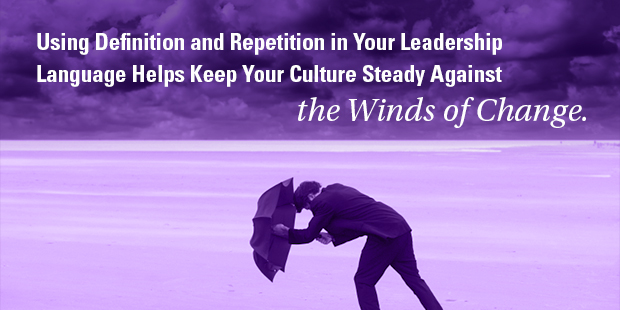
Using Definition and Repetition in Your Leadership Language Helps Keep Your Culture Steady Against the Winds of Change

When the winds of change blow against your church culture, what keeps it steady? The visionary leader cares too much about the message to let it just blow in the wind, unattended.

Wise leaders understand the importance of words.

They grasp the importance of language in describing the culture of the organization and the direction she is headed. But the role of a leader in relationship to language does not end when the doctrinal statement is finalized. It does not end when the mission and values are clarified, placed on a wall, and boldly declared. Leaders must continually remind people of the meaning behind the words, behind the language that is essential to the organization. The important words need definition and repetition.

  • Words need definition

Words must constantly be defined, or the words will lose their original intent and begin to mean different things to different people. Language drift often occurs as people in an organization learn the desired or accepted organizational vocabulary and use those words as taglines in an attempt to give credence to just about anything.

For example, if “community” is the current focus for a local congregation, a leader can add “community” language to any initiative or event to give it credence. Similarly, if “customer-centric” or “narrowing the focus” are the latest buzzwords in an organization, folks can start to haphazardly use these words without understanding the intent and heartbeat behind them. Pretty soon, the words carry an array of definitions and lose their singularity and potency.

Unless there is constant definition of what the important culture-shaping words mean, there will not be alignment. In fact, if the important words are allowed to mean a plethora of things, if leaders don’t constantly define the words that are used, the language will only create confusion and a plethora of directions.

If you are a leader, it is important to define the important terms/words in the organization you are leading. If you hear words that are important in your culture being used in a way that does not match the original intent, some definition is necessary.

  • Words need repetition

Some leaders run from repetition for the desire to always say something new and fresh. But wise leaders understand, as Max De Pree said, “Leadership is like third grade: it means repeating the significant things.” For example—because the gospel is the principle and essential doctrine of the Christian faith, Martin Luther stated “most necessary is it that we know this article [the gospel] well, teach it to others, and beat it into their heads continually.” Luther was clearly passionate about repeating the most important message continually.

When it comes to articulating a direction, I have learned that when the leaders are sick and tired of presenting and discussing, people are just then starting to grasp it.

Both definition and repetition are necessary.

Read more from Eric here.

Download PDF

Tags: , , ,

| What is MyVisionRoom? > | Back to Communication >

ABOUT THE AUTHOR

Eric Geiger

Eric Geiger

Eric Geiger is the Senior Pastor of Mariners Church in Irvine, California. Before moving to Southern California, Eric served as senior vice-president for LifeWay Christian. Eric received his doctorate in leadership and church ministry from Southern Seminary. Eric has authored or co-authored several books including the best selling church leadership book, Simple Church. Eric is married to Kaye, and they have two daughters: Eden and Evie. During his free time, Eric enjoys dating his wife, taking his daughters to the beach, and playing basketball.

See more articles by >

COMMENTS

What say you? Leave a comment!

Recent Comments
comment_post_ID); ?> Thank you for this information. I'm going to use this article to improve my work with the Lord.
 
— Abel Singbeh
 
comment_post_ID); ?> Thank you Ed for sharing your insights into the Church Growth Movement. I have my reservations with Church Growth models because it has done more damage than good in the Body of Christ. Over the years, western churches are more focused on results, formulas and processes with little or no emphasis on membership and church discipline. Pastors and vocational leaders are burnt out because they're overworked. I do believe that the Church Growth model is a catalyst to two destructive groups: The New Apostolic Reformation and the Emerging Church. Both groups overlap and have a very loose definition. They're both focus on contemporary worship, expansion of church brand (franchising), and mobilizing volunteering members as 'leaders' to grow their ministry. Little focus on biblical study, apologetics and genuine missional work with no agenda besides preaching of the gospel.
 
— Dave
 
comment_post_ID); ?> Thank you for sharing such a good article. It is a great lesson I learned from this article. I am one of the leaders in Emmanuel united church of Ethiopia (A denomination with more-than 780 local churches through out the country). I am preparing a presentation on succession planning for local church leaders. It will help me for preparation If you send me more resources and recommend me books to read on the topic. I hope we may collaborate in advancing leadership capacity of our church. God Bless You and Your Ministry.
 
— Argaw Alemu
 

Clarity Process

Three effective ways to start moving toward clarity right now.

A Simple Strategy for Church Communication: Engage

In a previous post, I outlined three essentials of a church communications plan and promised to develop the three points further. Today, we begin with the keys to engaging your audience. Remember, your audience includes both church members and potential guests alike. So it’s imperative that you craft messages for both and to each segment.

Engagement is most successful when you start with the goals of your communication in mind and work backwards: consider the desired result, decide the best platform to reach your goal, and word your message accordingly. This can be seen more fully in these six strategic steps:

  1. Keep the audience in mind. One main reason for communications failure is not considering the audience for the message. When you don’t think from the audience’s perspective, you tend to miss details or context clues that are needed in communications. A good example of this is using acronyms. Members may know what you mean, but church acronyms are often lost on guests. Simplify your messaging to reach the widest audience possible as clearly as possible.
  2. Decide on the best channel for communications. Not thinking about the audience often leads to using the wrong channel of communication. Not every message has the same audience, and not every message requires the same channel. Some announcements are better made in print, others are better online, and still others need to be communicated verbally.
  3. Find the best timing. A major church event needs weeks of lead-time when you’re communicating to your members and guests. A Wednesday night supper menu doesn’t. But for weekly events, don’t wait until the last minute or the day before to promote them. Promote them early and often. Finally, when using social media, consider posting at times when you know people will be online and able to respond or share your posts.
  4. Think about the wording. Every word matters. How you label something or the words you use to communicate will have an effect on how people respond or digest the information. A pastor I know once referred to “tithes and offerings” as “church revenue” in a blog post. He received several angry emails and letters as a result. It was an honest mistake, but it goes to show how using the wrong wording can cause the message to be missed.
  5. Use appropriate imagery. Images should compliment the message, not distract from it. There are several free or low cost image sites online for churches to use. If you use imagery wisely, you’ll better communicate with your audience. Please, no clip art. Please.
  6. Proof relentlessly. Some mistakes will slip through. It happens. But you should do everything possible to proof everything that is sent out from your church. Find someone other than the creator to look over something before it’s sent. Familiarity with a document or message will cause you to miss errors. A fresh set of eyes is always best to catch spelling, grammatical, or typographical errors.

Once you’ve moved through this progression, you should have a more fully developed and engaging message to communicate.

How do you engage your audience with your church’s communications? Is there something that is particularly effective for you in your context?


Connect with an Auxano Navigator to learn more about engaging your church through communication.


> Read more from Jonathan.

Download PDF

Tags: , , ,

| What is MyVisionRoom? > | Back to Communication >

ABOUT THE AUTHOR

Jonathan Howe

Jonathan Howe serves as vice president of communications for the Southern Baptist Convention's Executive Committee. He oversee all SBC Executive Committee communications including SBC.net, SBC LIFE, Baptist Press, social media initiatives and other media and messaging strategies. Howe was formerly the Director of Strategic Initiatives at LifeWay Christian Resources. Connect with Jonathan on Twitter at @Jonathan_Howe.

See more articles by >

COMMENTS

What say you? Leave a comment!

Recent Comments
comment_post_ID); ?> Thank you for this information. I'm going to use this article to improve my work with the Lord.
 
— Abel Singbeh
 
comment_post_ID); ?> Thank you Ed for sharing your insights into the Church Growth Movement. I have my reservations with Church Growth models because it has done more damage than good in the Body of Christ. Over the years, western churches are more focused on results, formulas and processes with little or no emphasis on membership and church discipline. Pastors and vocational leaders are burnt out because they're overworked. I do believe that the Church Growth model is a catalyst to two destructive groups: The New Apostolic Reformation and the Emerging Church. Both groups overlap and have a very loose definition. They're both focus on contemporary worship, expansion of church brand (franchising), and mobilizing volunteering members as 'leaders' to grow their ministry. Little focus on biblical study, apologetics and genuine missional work with no agenda besides preaching of the gospel.
 
— Dave
 
comment_post_ID); ?> Thank you for sharing such a good article. It is a great lesson I learned from this article. I am one of the leaders in Emmanuel united church of Ethiopia (A denomination with more-than 780 local churches through out the country). I am preparing a presentation on succession planning for local church leaders. It will help me for preparation If you send me more resources and recommend me books to read on the topic. I hope we may collaborate in advancing leadership capacity of our church. God Bless You and Your Ministry.
 
— Argaw Alemu
 

Clarity Process

Three effective ways to start moving toward clarity right now.

Sharing a Social Network Gospel

In ministry, some things must never change, but others must change constantly.

Clearly, God’s five purposes for his Church are non-negotiable. If a church fails to balance the five purposes of worship, fellowship, discipleship, ministry, and evangelism, then it’s no longer a healthy church, and it’s in danger of becoming simply a social club.

On the other hand, the way or style in which we fulfill these eternal purposes must continually be adjusted and modified because human culture is always changing.

For instance, when I first started Saddleback Church, fresh out of Southwestern Seminary, computers were in their infancy, slow and cumbersome and capable of very limited functions. The Internet was just a crude academic network and nobody had even heard of email. Now I often sit in my pajamas and have conversations with people across the globe.

In addition, you can get on a plane and within a few hours fly to almost anywhere in the world, and that means there’s even less of an excuse for not being involved in foreign missions, even if just for the short-term. The times, they are a-changing, and they’ll keep right on a-changing whether we want them to or not.

And that’s why at Saddleback, any time a new tool becomes available, we embrace it. Before the world wide web, there was Gopher, and Saddleback used it. And we’ve used the web, Facebook, Twitter, and every other major social media tool since.

Our message must never change, but the way we deliver that message must be constantly updated to reach each new generation.

In other words, our message of transformation must never change while the transformation of our presentation should be continual, adapting to the new languages of our culture.

Consider this: the word contemporary literally means with temporariness. By nature, nothing contemporary is meant to last forever! It is only effective for a while and only relevant in that particular moment – which what makes it contemporary.

What is considered contemporary and relevant in the next 10 years will inevitably appear dated and tired in 20 years. As a pastor, I’ve watched churches adopt many contemporary styles in worship, programming, architecture, music, and evangelism. That’s okay, as long as the biblical message is unchanged.

But whatever is in style now will inevitably be out of style soon, and the cycles of change are getting shorter and shorter, aided by technology and the media. New styles and preferences, like fashions, are always emerging.

Let me give you a word of advice. Never attach your church to a single style – you’ll soon be passé, and outdated. One of the secret strengths of Saddleback Church is that we’re constantly adapting; we’ve changed styles of worship, programming, and outreach many, many times in the last 36 years, and we’ll continue to do so because the world keeps changing.

The only way to stay relevant is to anchor your ministry to unchanging truths and eternal purposes but be willing to continually adapt how you communicate those truths and purposes.

In 36 years at Saddleback, we’ve never had a planned, organized visitation program. Yet, we’ve baptized over 47,000 people! Our church has grown simply by inviting one person at a time, friends from work, from school, and from the neighborhood, and from social networks.

Our members are constantly on mission to bring their friends and neighbors to our weekend services, where we reach out to non-believers – particularly those who have no real church background – by singing songs they can embrace, by voicing prayers that help them relate, and by preaching messages they understand. We make Christianity available on an introductory level to any visitor to Saddleback.

You might wonder if we attract these visitors by watering down the Gospel, but we don’t; we simply communicate it in ways that non-believers understand! Jesus drew enormous crowds (called multitudes) without compromising the message. He was clear, practical, loving, and he presented his timeless message in a contemporary fashion.

Lost people have a need for meaning, a need for purpose, a need for forgiveness, a need for love. They want to know how to make right decisions, how to protect their family, how to handle suffering, and how to have hope in our world. These are all issues we have answers for, yet millions are ignoring the message of Christ because we insist on communicating in ways that make little sense anymore.

In a sense, we’ve made the Gospel too difficult for a changing culture to understand. Let me give you this analogy: Imagine a missionary going overseas and saying, “I’m here to share the Good News, but first you have to learn to speak my language, learn my customs, and sing my style of music.” You can immediately see why this strategy would fail!

Yet, we do that all the time in a culture that is in radical flux. If we want to reach people in the current century, we must start thinking differently. I believe the most overlooked requirement in the church is to have spiritually mature members – members who unselfishly limit their own preferences of what they think a church should look like in order to reach lost people for Christ. As Jesus said in Luke 5:38, “New wine must be poured into new wineskins!”

Here’s a simple tradition to break in the 21st century: stop thinking of the church as an institution. Emerging generations are desperately looking for community. You and I may know that the church is a community, but emerging generations have never seen it that way. They’ve seen a list of rules, not a loving community. This is a prime example of an opportunity to restate the eternal truths of the Bible in a fresh, contemporary way.

Emerging generations are also focused on the experiential, and that means we have to adjust the way we teach and preach because most traditional churches focus almost exclusively on the intellect. In the 21st century church, we not only want people to know about God, we also want them to actually encounter God.

Of course, this means rather than preaching simply for information, we should also preach for action. Our message is not meant to just inform, but to transform the lives of those in our congregation. In almost every single sermon I preach every point has a verb in it – something to do. What are you going to do now that you know this godly truth?

Why do I do it this way? Because God says, “Be doers of the word, not hearers only,” and our entirePurpose Driven process at Saddleback is designed to move people, not only into intimacy with God, but also into service for him, where they’ll experience a deep and broader faith in the midst of community and ministry.

Since planting Saddleback, spiritual seekers have changed a lot. In the first place, there are a whole lot more of them! There are seekers everywhere! I’ve never seen more people so hungry to discover and develop the spiritual dimension of their lives. That’s why there’s such a big interest in Eastern thought, New Age practices, mysticism, and the transcendent.

Today seekers are hungry for symbols and metaphors and experiences and stories that reveal the greatness of God. Because seekers are constantly changing, we must be sensitive to them like Jesus was, be willing to meet them on their own turf, and speak to them in ways they understand.

Remember: the world changes but the Word doesn’t. To be effective in ministry we must learn to live with the tension between those two.

My prayer is that God will use you the way he used David, as described in Acts 13:36, to serve God’s purpose in your generation. We need churches that are both Purpose Driven and post-modern; timeless and timely at the same time! May God use you greatly and may you fulfill his purpose for your life.


Learn more about your church’s unique purpose through Auxano’s Vision Framing process. Connect with one of our navigators today to find out more.


> More from Rick.

Download PDF

Tags: , , ,

| What is MyVisionRoom? > | Back to Communication >
ABOUT THE AUTHOR

Rick Warren

Rick Warren

Rick Warren is the founding pastor of Saddleback Church in Lake Forest, Calif., one of America's largest and most influential churches. Rick is author of the New York Times bestseller The Purpose Driven Life. His book, The Purpose Driven Church, was named one of the 100 Christian books that changed the 20th century. He is also founder of Pastors.com, a global Internet community for pastors.

See more articles by >

COMMENTS

What say you? Leave a comment!

Recent Comments
comment_post_ID); ?> Thank you for this information. I'm going to use this article to improve my work with the Lord.
 
— Abel Singbeh
 
comment_post_ID); ?> Thank you Ed for sharing your insights into the Church Growth Movement. I have my reservations with Church Growth models because it has done more damage than good in the Body of Christ. Over the years, western churches are more focused on results, formulas and processes with little or no emphasis on membership and church discipline. Pastors and vocational leaders are burnt out because they're overworked. I do believe that the Church Growth model is a catalyst to two destructive groups: The New Apostolic Reformation and the Emerging Church. Both groups overlap and have a very loose definition. They're both focus on contemporary worship, expansion of church brand (franchising), and mobilizing volunteering members as 'leaders' to grow their ministry. Little focus on biblical study, apologetics and genuine missional work with no agenda besides preaching of the gospel.
 
— Dave
 
comment_post_ID); ?> Thank you for sharing such a good article. It is a great lesson I learned from this article. I am one of the leaders in Emmanuel united church of Ethiopia (A denomination with more-than 780 local churches through out the country). I am preparing a presentation on succession planning for local church leaders. It will help me for preparation If you send me more resources and recommend me books to read on the topic. I hope we may collaborate in advancing leadership capacity of our church. God Bless You and Your Ministry.
 
— Argaw Alemu
 

Clarity Process

Three effective ways to start moving toward clarity right now.

Inspiring Communicators Start With WHY

To help others see change, the leader must understand how to unlock the imagination.

The very act of imagination is connected to faith. The author of Hebrews writes, “Now faith is the assurance of things hoped for and the conviction of things not seen” (Hebrews 11:1). When a leader articulates, or provokes, a follower’s imagination, he or she is serving both God and the individual by exercising the muscle of faith.

Unlock the imagination of your audience by starting with WHY.

THE QUICK SUMMARY – Start with WHY by Simon Sinek

Why are some people and organizations more innovative, more influential, and more profitable than others? Why do some command greater loyalty?

In studying the leaders who’ve had the greatest influence in the world, Simon Sinek discovered that they all think, act, and communicate in the exact same way-and it’s the complete opposite of what everyone else does. People like Martin Luther King Jr., Steve Jobs, and the Wright Brothers might have little in common, but they all started with why.

Drawing on a wide range of real-life stories, Sinek weaves together a clear vision of what it truly takes to lead and inspire.

A SIMPLE SOLUTION

Walt Disney’s dream that we now know as Disneyland faced an immense problem: how do you get financial investors to back something that’s never been done before, and exists only in a few sketches?

Faced with this dilemma, Disney did what he was best at: he painted pictures with words:

The idea of Disneyland is a simple one. It will be a place for people to find happiness and knowledge. It will be a place for parents and children to spend pleasant times in one another’s company.

Disneyland will be based upon and dedicated to the ideals, the dreams, and hard facts that have created America. And it will be uniquely equipped to dramatize these dreams and facts and send them forth as a source of courage and inspiration to all the world.

Disneyland will be filled with the accomplishments, the joys and hopes of the world we live in. And it will remind us and show us how to make those wonders part of our lives.

(Walt Disney, An American Original, 246-247)

Disney’s simple but evocative language convinced the investors of a future they could not see – and the rest is history.

Great leaders and great organizations are good at seeing what most of us can’t see. They are good at giving us things we would never think of asking for.

Great leaders are those who trust their gut. They are those who understand the art before the science. They win hearts before minds. They are the ones who start with WHY.

Products and services with a clear sense of WHY give people a way to tell the outside world who they are and what they believe. Remember, people don’t buy WHAT you do, they buy WHY you do it. If an organization does not have a clear sense of WHY then it is impossible for the outside world to perceive anything more than WHAT the organization does. And when that happens, manipulations that rely on pushing price, features, service or quality become the primary currency of differentiation.

WHAT: Every single organization on the planet knows WHAT they do. Everyone is easily able to describe the products or services a company sells or the job function they have within that system. WHATS are easy to identify.

HOW: Some companies and people know HOW they do WHAT they do. HOWs are often given to explain how something is different or better. Not as obvious as WHATs, many think these are the differentiating or motivating factors in a decision. It would be false to assume that’s all that is required. There is one missing detail:

WHY: Very few people or companies can clearly articulate WHY they do WHAT they do. By WHY I mean what is your purpose, cause or belief? WHY does your organization exist? WHY do you get out of bed every morning? And WHY should anyone care?

It all starts from the inside out. It all starts with WHY.

Simon Sinek, Start with Why

A NEXT STEP

There is a fine line between inspiration and manipulation. A leader can use powerful language, vivid images, and emotional pleas to his audience – and be a manipulative, power-hungry despot.

A leader can also use powerful language, vivid images, and emotional pleas to his audience – and be a visionary leader.

The difference is in the WHY. If people don’t believe in the WHY behind your vision, they won’t be motivated to help you deliver it.

To understand the WHY behind all sides of a situation, idea, or problem you are facing, take the WHY Train by answering the following questions:

  1. Who is the main actor in the situation or problem?
  2. What is the main concept, object, or action the main actor uses or performs?
  3. Where is the main actor located when performing or using the main concept, object, or action?
  4. When does the situation or problem occur?
  5. Describe each answer in more depth.
  6. Conclude by asking WHY to the answers you have given.

The result of this exercise will be a thorough and sequential description about a situation and the insightful reasoning behind each element.

Taken from SUMS Remix 29-1, published December 2015.


This is part of a weekly series posting content from one of the most innovative content sources in the church world: SUMS Remix Book Summaries for church leaders. SUMS Remix takes a practical problem in the church and looks at it with three solutions; and each solution is taken from a different book. As a church leader you get to scan relevant books based on practical tools and solutions to real ministry problems, not just by the cover of the book. Each post will have the edition number which shows the year and what number it is in the overall sequence. (SUMS provides 26 issues per year, delivered every other week to your inbox). 

> Subscribe to SUMS Remix <<

Download PDF

Tags: , , , ,

| What is MyVisionRoom? > | Back to Communication >

ABOUT THE AUTHOR

VRcurator

VRcurator

Bob Adams is Auxano's Vision Room Curator. His background includes over 23 years as an associate/executive pastor as well as 8 years as the Lead Consultant for a church design build company. He joined Auxano in 2012.

See more articles by >

COMMENTS

What say you? Leave a comment!

Recent Comments
comment_post_ID); ?> Thank you for this information. I'm going to use this article to improve my work with the Lord.
 
— Abel Singbeh
 
comment_post_ID); ?> Thank you Ed for sharing your insights into the Church Growth Movement. I have my reservations with Church Growth models because it has done more damage than good in the Body of Christ. Over the years, western churches are more focused on results, formulas and processes with little or no emphasis on membership and church discipline. Pastors and vocational leaders are burnt out because they're overworked. I do believe that the Church Growth model is a catalyst to two destructive groups: The New Apostolic Reformation and the Emerging Church. Both groups overlap and have a very loose definition. They're both focus on contemporary worship, expansion of church brand (franchising), and mobilizing volunteering members as 'leaders' to grow their ministry. Little focus on biblical study, apologetics and genuine missional work with no agenda besides preaching of the gospel.
 
— Dave
 
comment_post_ID); ?> Thank you for sharing such a good article. It is a great lesson I learned from this article. I am one of the leaders in Emmanuel united church of Ethiopia (A denomination with more-than 780 local churches through out the country). I am preparing a presentation on succession planning for local church leaders. It will help me for preparation If you send me more resources and recommend me books to read on the topic. I hope we may collaborate in advancing leadership capacity of our church. God Bless You and Your Ministry.
 
— Argaw Alemu
 

Clarity Process

Three effective ways to start moving toward clarity right now.

A Simple Strategy for Church Communication

Most churches don’t think strategically about their communications efforts. Many times, communications practices are passed on from staffer to staffer without any regard to what is effective. And often, the responsible staff member or volunteer has other duties that take precedent in ministry.

Regardless of your staffing structure or size, church communications can be done effectively and strategically if you consider the perspective of your audience. Church communication isn’t for the benefit of the church; it’s for the benefit of members and guests. So when considering what to say, when to say it, and which channel to use, keep in mind these three essential elements:

  1. Engage the audience. Your church communications should be engaging. Putting out a tweet or Facebook post just so you can check that item off your to-do list is rarely going to engage your church members and potential guests. Content should be sharable, memorable, and relevant. The difference between engaging content and content that is not typically involves thinking through the messaging. Start with the goals of your communication in mind and work backwards: consider the desired result, decide the best platform to reach your goal, and word your message accordingly.
  2. Inform the audience. Once you’ve engaged your audience, keep them informed. Consistency with your communications is important. Try to plan out your church’s communications week by week and stick to the plan as best as possible. Once you have your weekly schedule set, then you can move to monthly, quarterly, and annual planning. By planning out what you want to communicate to members and guests on a consistent basis, you can more effectively integrate major church events into your communications plan.
  3. Inspire the audience. Informing and engaging your audience isn’t enough. They should be inspired to share. Graphics aid in this area more than words. People are more likely to share inspiring graphics than inspiring paragraphs. Both have value, but one appeals visually. The graphics you choose can be the difference in someone sharing your content and not sharing it.

Over the next few week’s, I’ll be digging deeper into these three elements. So if you have any questions about the specifics, share them in the comments section below, and I’ll be sure to touch on those items in future posts.

Does your church plan its communications strategically? Do you engage, inform, and inspire your church members and guests with your content?


Want to learn how to be strategic with your church communication? Contact an Auxano Navigator to start a conversation.


> Read more from Jonathan.

Download PDF

Tags: , ,

| What is MyVisionRoom? > | Back to Communication >

ABOUT THE AUTHOR

Jonathan Howe

Jonathan Howe serves as vice president of communications for the Southern Baptist Convention's Executive Committee. He oversee all SBC Executive Committee communications including SBC.net, SBC LIFE, Baptist Press, social media initiatives and other media and messaging strategies. Howe was formerly the Director of Strategic Initiatives at LifeWay Christian Resources. Connect with Jonathan on Twitter at @Jonathan_Howe.

See more articles by >

COMMENTS

What say you? Leave a comment!

Recent Comments
comment_post_ID); ?> Thank you for this information. I'm going to use this article to improve my work with the Lord.
 
— Abel Singbeh
 
comment_post_ID); ?> Thank you Ed for sharing your insights into the Church Growth Movement. I have my reservations with Church Growth models because it has done more damage than good in the Body of Christ. Over the years, western churches are more focused on results, formulas and processes with little or no emphasis on membership and church discipline. Pastors and vocational leaders are burnt out because they're overworked. I do believe that the Church Growth model is a catalyst to two destructive groups: The New Apostolic Reformation and the Emerging Church. Both groups overlap and have a very loose definition. They're both focus on contemporary worship, expansion of church brand (franchising), and mobilizing volunteering members as 'leaders' to grow their ministry. Little focus on biblical study, apologetics and genuine missional work with no agenda besides preaching of the gospel.
 
— Dave
 
comment_post_ID); ?> Thank you for sharing such a good article. It is a great lesson I learned from this article. I am one of the leaders in Emmanuel united church of Ethiopia (A denomination with more-than 780 local churches through out the country). I am preparing a presentation on succession planning for local church leaders. It will help me for preparation If you send me more resources and recommend me books to read on the topic. I hope we may collaborate in advancing leadership capacity of our church. God Bless You and Your Ministry.
 
— Argaw Alemu
 

Clarity Process

Three effective ways to start moving toward clarity right now.