How to Communicate With a Distracted Audience, Part One: Leverage “Pre-suasion” to Gain Attention

Do you think people care about what you have to say? The truth is that the average person doesn’t know you. It’s not that you’re not likable or smart; it’s just a matter of survival for people in today’s world. There is simply too much out there and not enough time to take it all in.

These words by communications expert Kem Meyer succinctly point out the dilemma for communicators today: for many people, the last thing they are looking for is unsolicited information, or someone to tell them to change their ways.

And yet many, if not most, of the sermons preached by pastors attempt to do just that.

However, many people will take the time to read or listen to something that reinforces an opinion they already have or speaks to a real need in their lives. If they are not looking for it, they won’t hear it. But, if you take the time to learn what they’re looking for, you can get in on a conversation already in progress in their minds.

How then, can a leader understand their audience in such a way to make their message more receptive? How can you connect, communicate, and influence your audience toward life-long transformation?

THE QUICK SUMMARY – Pre-Suasion: A Revolutionary Way to Influence and Persuade by Robert Cialdini

The acclaimed New York Times and Wall Street Journal bestseller from Robert Cialdini – “the foremost expert on effective persuasion” (Harvard Business Review) – explains how it’s not necessarily the message itself that changes minds, but the key moment before you deliver that message.

What separates effective communicators from truly successful persuaders? With the same rigorous scientific research and accessibility that made his Influence an iconic bestseller, Robert Cialdini explains how to prepare people to be receptive to a message before they experience it. Optimal persuasion is achieved only through optimal pre-suasion. In other words, to change “minds” a pre-suader must also change “states of mind.”

Named a “Best Business Books of 2016” by the Financial Times, and “compelling” by The Wall Street Journal, Cialdini’s Pre-Suasion draws on his extensive experience as the most cited social psychologist of our time and explains the techniques a person should implement to become a master persuader. Altering a listener’s attitudes, beliefs, or experiences isn’t necessary, says Cialdini—all that’s required is for a communicator to redirect the audience’s focus of attention before a relevant action.

From studies on advertising imagery to treating opiate addiction, from the annual letters of Berkshire Hathaway to the annals of history, Cialdini outlines the specific techniques you can use on online marketing campaigns and even effective wartime propaganda. He illustrates how the artful diversion of attention leads to successful pre-suasion and gets your targeted audience primed and ready to say, “Yes.” His book is “an essential tool for anyone serious about science based business strategies…and is destined to be an instant classic.

A SIMPLE SOLUTION

Even the most well-planned communication opportunity often achieves lackluster results without the audience listening (and hopefully acting on your suggestions).

But what if the audience can be warmed up to your message before they even see it?

The best persuaders become the best through pre-suasion – the process of arranging for recipients to be receptive to a message before they encounter it.

Pre-suasion, a word coined by Robert Cialdini, is the process of gaining agreement with a message before it’s been sent. Although that may seem like some form of magic, it’s not. It’s established science.

That key moment is the one that allows a communicator to create a state of mind in recipients that is consistent with the forthcoming message. It’s the moment in which we can arrange for others to be attuned to our message before they encounter it. That step is crucial for maximizing desired change.

The answer involves an essential but poorly appreciated tenant of all communication: what we present first changes the way people experience what we present to them next.

The truly influential things we say and do first act to pre-suade our audiences, which then alters audience members’ associations with what we say or do next.

All told, there are any of a number of first steps besides establishing trust persuaders can take that will make audiences more redemptive to the case they intend to present.

The steps can take multiple forms, and, accordingly, they’ve been given multiple labels by behavioral scientists. They can be called frames or anchors or primes or mindsets or first impressions. I’m going to refer to them as openers – because they open up things for influence in two ways.

First, they simply initiate the process: they provide the starting points, the beginnings of persuasive appeals. But it is in their second function that they clear the way to persuasion, by removing existing barriers.

It’s because of the only-temporary receptiveness that pre-suasive actions often produce in others that I’ve introduced the concept of privileged moments.

The meaning of the word privileged is straightforward referring to special, elevated status. The word moment, though, is more complex, as it evokes a pair of meanings. One connotes a time-limited period: in this case, the window of opportunity following a pre-suasive opener, when a proposal’s power is greatest. The other connotation comes from physics and refers to a unique leveraging force that can bring about unprecedented movement. These yoke dimensions, temporal on the one hand and physical on the other, have the capacity to instigate extraordinary change in a yet third, psychological, dimension.

Robert Cialdini, Pre-Suasion: A Revolutionary Way to Influence and Persuade

A NEXT STEP

Author Robert Cialdini believes that altering a listener’s attitudes, beliefs, or experiences isn’t necessary. All that’s required is to alter the audience’s focus of attention just before requesting a relevant action.

The factor most likely to determine a person’s choice in a situation is often not the one that offers the most accurate or useful counsel; instead, it is the one that has been elevated in attention (and thereby in privilege) at the moment of decision.

“Privileged moments” are identifiable points in time when an individual is particularly receptive to a communicator’s message.

The artful channeling of attention leads to potent pre-suasion and positive outcomes.

In his earlier work, Influence, Cialdini argued that there are six concepts that empower the major principles of human social influence. Understanding and practicing these concepts will help you “pre-suade” your audience.

Reciprocation – People say yes to those they owe. Those “freebies” given away in stores? Studies show they can increase the likelihood of purchase by over 40%. Requesters who hope to commission the pre-suasive force of the rule for reciprocation have to do something that appears daring: they have to take a chance and give first. The “gift” should be meaningful, unexpected, and customized.

Liking – It may seem so common sense, but it is true: people say yes to those who they like. Two specific ways to create positive attention get the most attention: highlight similarities and provide compliments.

Social Proof – People think it is appropriate for them to believe, feel, or do something to the extent that others, especially comparable others, are believing, feeling, or doing it. Two components of that perceived appropriateness – validity and feasibility – can drive change.

Authority – When a legitimate expert on a topic speaks, people are usually persuaded. Sometimes, information becomes persuasive only because an authority is its source. This is especially true when the recipient is uncertain of what to do.

Scarcity – We want more of what we can have less of. Our aversion to losing something of value is a key factor. Scarcity also raises the judged value of that item.

Consistency – Communicators who can get listeners to take a pre-suasive step, even a small one, in the direction of a particular idea or entity will increase our willingness to take a much larger, congruent step when asked.

Review each of the above concepts, along with their brief description, and commit to applying one or more of these concepts over the next two months. Examples could include: social media posts, sermons, vision casting moments, or staff meetings. At the end of two months, review the use of each to determine how effective it was in helping your audiences take a next step in their walk with Christ.

Excerpt taken from SUMS Remix 104-1, released October 2018.


This is part of a weekly series posting excerpts from one of the most innovative content sources in the church world: SUMS Remix book excerpts for church leaders.

SUMS Remix takes a practical problem in the church and looks at it with three solutions; each solution is taken from a different book. Additionally, a practical action step is included with each solution.

As a church leader you get to scan relevant books based on practical tools and solutions to real ministry problems, not just by the cover of the book. Each post will have the edition number which shows the year and what number it is in the overall sequence. (SUMS Remix provides 26 issues per year, delivered every other week to your inbox). 

> > Subscribe to SUMS Remix <<

Download PDF

Tags: , , ,

| What is MyVisionRoom? > | Back to Communication >

ABOUT THE AUTHOR

VRcurator

VRcurator

Bob Adams is Auxano's Vision Room Curator. His background includes over 23 years as an associate/executive pastor as well as 8 years as the Lead Consultant for a church design build company. He joined Auxano in 2012.

See more articles by >

COMMENTS

What say you? Leave a comment!

Recent Comments
comment_post_ID); ?> Thank you for this information. I'm going to use this article to improve my work with the Lord.
 
— Abel Singbeh
 
comment_post_ID); ?> Thank you Ed for sharing your insights into the Church Growth Movement. I have my reservations with Church Growth models because it has done more damage than good in the Body of Christ. Over the years, western churches are more focused on results, formulas and processes with little or no emphasis on membership and church discipline. Pastors and vocational leaders are burnt out because they're overworked. I do believe that the Church Growth model is a catalyst to two destructive groups: The New Apostolic Reformation and the Emerging Church. Both groups overlap and have a very loose definition. They're both focus on contemporary worship, expansion of church brand (franchising), and mobilizing volunteering members as 'leaders' to grow their ministry. Little focus on biblical study, apologetics and genuine missional work with no agenda besides preaching of the gospel.
 
— Dave
 
comment_post_ID); ?> Thank you for sharing such a good article. It is a great lesson I learned from this article. I am one of the leaders in Emmanuel united church of Ethiopia (A denomination with more-than 780 local churches through out the country). I am preparing a presentation on succession planning for local church leaders. It will help me for preparation If you send me more resources and recommend me books to read on the topic. I hope we may collaborate in advancing leadership capacity of our church. God Bless You and Your Ministry.
 
— Argaw Alemu
 

Clarity Process

Three effective ways to start moving toward clarity right now.

3 Myths of Church Communication that Get Everyone

Church communication is a popular topic in the church world. But the expectations of how to fix communication, is often overinflated. It’s not a cure all. In fact, effective communication takes time as the correct messages are produced consistently. Producing the right messages takes talent and skill especially when consistency is required.

Here are 3 church communication myths that need to be understood:

  1. A bad event doesn’t benefit from effective communication. Your congregation knows hype and has reasonable expectations for your church events. Saying “this is a must-attend ministry opportunity” over and over does not increase attendance — unless there’s validity to the assertion.  Every event in your church can’t be “the best thing ever”. Truth: Communication needs to state the benefit of attending or participating along with pertinent details (that requires someone to decide what the value is for attendance). Communication cannot “fix” a bad event or poor attendance. Be sure to work on the quality of your ministries before communicating them. Will that fix everything instantly? Not if your congregation or community has endured years of lackluster events. It’ll take time for positive word-of-mouth to support the communication claims.
  2. The more you say, the more important it’ll feel. Many leaders feel that “if we talk multiple times about something” it will feel like everyone should feel the importance of it. Or, if we tell lots of details and extend the promotion to include “everything” about the event, more people will get a sense of urgency. The opposite is often the case. Truth: People don’t have time to listen to redundancy or read long paragraphs. What we’re learned from research? People are quick to half-listen when they feel you get too detailed or sense redundancy. In print? They tend to scan for details. Ultimately, people want to know “what’s in it for me”. So, ensure the benefit is compelling and simple, and you’ll capture the attention and attendance you seek. And remember that most people don’t want ALL the details during the promotion — instead, send them to your website for additional details (if they want them).
  3. All stories communicate effectively. We hear regularly that churches must tell stories. This isn’t always the case — some stories shouldn’t be told. And the way they’re told is just as important. In fact, many stories hurt the communication rather than help it. Truth: Ensure your story is edited to the shortest length possible to keep the point of it. Make sure there’s a clear ending and reasonable point that can be gleaned be everyone listening. Make sure the hero of the story is not you or the church leadership! It’s always “them” — and make sure the point of the story can be quickly applied to the congregation that’s listening or reading. Other bonuses? Think about good storytelling formula: have a clear villain (that wants the hero to fail), a clear hero with goals to achieve, a guide that helps take them on a journey. And the end? A twist or unexpected outcomes alway work effectively and capture the attention of the listener/reader. Just remember the attention span of Americans today is short. Very short. So edit (for all of your communication)!

> Read more from Mark.


Download PDF

Tags: , ,

| What is MyVisionRoom? > | Back to Communication >

ABOUT THE AUTHOR

Mark MacDonald

Mark MacDonald

Mark MacDonald is a Bible Teacher, speaker, best-selling author of Be Known For Something, and communication strategist for BeKnownForSomething.com and the Florida Baptist Convention. He empowers churches to become known for something relevant (a communication thread) throughout their ministries, websites, and social media. His book is available at BeKnownBook.com and amazon.com.

See more articles by >

COMMENTS

What say you? Leave a comment!

Recent Comments
comment_post_ID); ?> Thank you for this information. I'm going to use this article to improve my work with the Lord.
 
— Abel Singbeh
 
comment_post_ID); ?> Thank you Ed for sharing your insights into the Church Growth Movement. I have my reservations with Church Growth models because it has done more damage than good in the Body of Christ. Over the years, western churches are more focused on results, formulas and processes with little or no emphasis on membership and church discipline. Pastors and vocational leaders are burnt out because they're overworked. I do believe that the Church Growth model is a catalyst to two destructive groups: The New Apostolic Reformation and the Emerging Church. Both groups overlap and have a very loose definition. They're both focus on contemporary worship, expansion of church brand (franchising), and mobilizing volunteering members as 'leaders' to grow their ministry. Little focus on biblical study, apologetics and genuine missional work with no agenda besides preaching of the gospel.
 
— Dave
 
comment_post_ID); ?> Thank you for sharing such a good article. It is a great lesson I learned from this article. I am one of the leaders in Emmanuel united church of Ethiopia (A denomination with more-than 780 local churches through out the country). I am preparing a presentation on succession planning for local church leaders. It will help me for preparation If you send me more resources and recommend me books to read on the topic. I hope we may collaborate in advancing leadership capacity of our church. God Bless You and Your Ministry.
 
— Argaw Alemu
 

Clarity Process

Three effective ways to start moving toward clarity right now.

5 Ways to Engage the Sermon, not just Evaluate It

After the service what do you hear about the sermon? What do you read on social media?

  • “It wasn’t deep enough.”
  • “I loved the message, God spoke to me!”
  • “Pastor Bob’s sermon from 1st Church was better, he connects better.”
  • “That teaching was challenging and convicted me, thank you!”
  • “It was boring and I didn’t get anything out of it.”
  • “Pastor brought the heat, can’t wait for next Sunday!”
  • “I really couldn’t listen, I’m not happy with the Pastor right now.”

If you have been part of a church for some time you’ve heard all these and more. It’s not a slam on the local church, it’s part of our humanity, but that doesn’t mean it’s all good.

There’s nothing wrong with some constructive criticism, in fact helpful critique is good. But there is a big difference between helpful critique and hurtful criticism about the Sunday sermon.

A pastor and close friend showed me the manuscripts of his sermons that one person in his church typed out every week, and marked all the grammatical errors, how many times he said the word “I,” and corrected his theology – all in red.

Yes, that’s extreme, but the art of evaluating the pastor’s sermon is at an all-time high. That’s why I’m eager to write these thoughts on moving away from evaluating the Sunday message to engaging it.

Most of my teaching is in the arena of spiritual and strategic leadership for church leaders, so I don’t personally get many of these sermon-oriented comments. But I coach the pastors that do, so I’m current and know how real the impact is.

I’m hoping this post helps us all stay focused on the purpose and value of a Sunday sermon.

Candidly, the Sunday message is designed for people’s spiritual growth, not their evaluation. There should be a small team in place to evaluate the sermon and help the pastor become a better communicator. Let them do that part.

Before we jump into a list of practical thoughts, let me offer three simple, “Please don’t do this, it’s hazardous to your spiritual health,” statements.

  1. Don’t allow your spirit to become critical, thereby lowering or possibly blocking your receptivity to God’s Word.
  2. Don’t compare your pastor to the dozens of other communicators you can hear online.
  3. Don’t think about all the other people who need to hear the sermon until it has changed you first.

Let me be very candid, there are some sermons that could have been better, I know, I’ve delivered a few of them. Thank God for people’s grace and my improvement over time.

However, I honestly believe that if you and I want to get something out of it, we can – every Sunday.

5 practices that will benefit your spiritual growth from the Sunday message:

1) Focus on the message not the messenger.

What is the main point of the sermon? What is God saying to you?

It’s easy in our current culture to assess and evaluate the speaker, and not necessarily in a mean or attacking way.

We are all evaluated, so we naturally evaluate. However, in the Sunday morning setting, evaluating the speaker is rarely helpful or productive.

If the pastor stumbles on a word or two, looks at the notes too often, has a unique speaking idiosyncrasy, etc., let it go. Let the designated team work on that.

Your sole focus is to engage the message in order to hear God’s voice with anticipation of an insight just for you. That takes us to the second practice.

2) Listen for insight more than entertainment.

I’ll quickly admit I love humor and communicators with a sense of humor. But I sometimes catch myself talking more about my favorite funny story than the spiritual insight that God meant for me.

Purposeful humor is a strong and desirable asset in a sermon, but entertainment isn’t the main thing the hearer should look for.

Enjoy the humor but seek the insight the Holy Spirit has for you, look for it. Look for what is new for you in that moment.

A biblical or spiritual insight can be new or a refresher, but either way it hits you as an “aha moment,” something relevant and meaningful to your life right then. Anticipate the aha moment.

3) Make it an act of worship more than education.

God teaches us through His Word, and that is always important, but information over transformation is not the point of the Sunday message.

16 All Scripture is God-breathed and is useful for teaching, rebuking, correcting and training in righteousness, 17 so that the servant of God may be thoroughly equipped for every good work.

2 Timothy 3:16-17

I thoroughly believe in biblical education, but there is something else, arguably larger, in play. It is the worship of God from the self-revelation of His Word.

Worship is the high calling for all Christians. As you listen to the message what does God reveal to you about his character, heart and will? What is He making known to you about who He is?

The more you know the one and true God the greater the depth and passion of your worship.

4) Engage the moment spiritually rather than remaining detached.

No one walks into church completely carefree. We are all distracted by the burdens we carry, the problems we face and the curve balls that life throws our way.

Yet, that 60 minutes or so of worship and teaching may be exactly what you need most. In fact, my hunch is that the more engaged you are the more you receive God’s guidance for you.

Worry, stress, and problems keep us distracted and detached when we desperately need to be engaged to what God is saying.

A great way to resist being detached and fully engage the moment is to not only seek what God is saying to you, but to be aware of what is happening in the room and pray for others.

For example, the pastor may be making a point that you sense a need to pray for others in that moment. Pay attention to what is happening in the spiritual realm and engage God in his work.

The Holy Spirit may put someone on your mind, pray for them right then! In this way you are actually entering into and aligning with what God is doing.

5) Pursue personal change over perfect content.

Spiritual growth is the purpose of your Sunday morning experience and your hearing of the message in particular.

There may be days where you just need comfort, wisdom or to sense the nearness and love of God. That’s good. But ultimately, the purpose is the development of your faith, spiritual maturity and to be transformed by the power of God.

Candidly, the content does not need to be perfect and polished for that change to take place. The power to change is up to God, the choice to change is up to you.

Yes, your pastor needs to work hard to be prepared, but in the end, God delivers what we need, then we choose if we will respond or not.

I’m often amazed at what people have said to me after I preach. (Besides “When is the senior pastor coming back?”) 😅

They tell me about the thought that really helped them, challenged them, or was exactly what they needed in the moment. And that thought was nowhere in my notes, nor did I say it even once!

It is simply God at work speaking to the person who is fully engaged and seeks to change.

> Read more from Dan.


Download PDF

Tags: , ,

| What is MyVisionRoom? > | Back to Communication >

ABOUT THE AUTHOR

Dan Reiland

Dan Reiland

Dr. Dan Reiland serves as Executive Pastor at 12Stone Church in Lawrenceville, Georgia. He previously partnered with John Maxwell for 20 years, first as Executive Pastor at Skyline Wesleyan Church in San Diego, then as Vice President of Leadership and Church Development at INJOY. He and Dr. Maxwell still enjoy partnering on a number of church related projects together. Dan is best known as a leader with a pastor's heart, but is often described as one of the nations most innovative church thinkers. His passion is developing leaders for the local church so that the Great Commission is advanced.

See more articles by >

COMMENTS

What say you? Leave a comment!

Recent Comments
comment_post_ID); ?> Thank you for this information. I'm going to use this article to improve my work with the Lord.
 
— Abel Singbeh
 
comment_post_ID); ?> Thank you Ed for sharing your insights into the Church Growth Movement. I have my reservations with Church Growth models because it has done more damage than good in the Body of Christ. Over the years, western churches are more focused on results, formulas and processes with little or no emphasis on membership and church discipline. Pastors and vocational leaders are burnt out because they're overworked. I do believe that the Church Growth model is a catalyst to two destructive groups: The New Apostolic Reformation and the Emerging Church. Both groups overlap and have a very loose definition. They're both focus on contemporary worship, expansion of church brand (franchising), and mobilizing volunteering members as 'leaders' to grow their ministry. Little focus on biblical study, apologetics and genuine missional work with no agenda besides preaching of the gospel.
 
— Dave
 
comment_post_ID); ?> Thank you for sharing such a good article. It is a great lesson I learned from this article. I am one of the leaders in Emmanuel united church of Ethiopia (A denomination with more-than 780 local churches through out the country). I am preparing a presentation on succession planning for local church leaders. It will help me for preparation If you send me more resources and recommend me books to read on the topic. I hope we may collaborate in advancing leadership capacity of our church. God Bless You and Your Ministry.
 
— Argaw Alemu
 

Clarity Process

Three effective ways to start moving toward clarity right now.

Speaking to Your Church on Race and Racism

If you are a teaching pastor of a church, or in leadership of a church, this blog is for you.

Everyone else can eavesdrop.

You need to do a series on race and racism. And you need to do it soon—as soon as you can.

Racial division is our culture’s most pressing concern, and it is a deeply biblical and spiritual issue. To not address it would be overlooking the largest elephant in the cultural room. And, I might add, the Christian room.

The church is the hope of the world and, in this particular matter, the only hope for modeling racial unity. We have been called into the new community, with Christ as its center. If we can achieve racial unity in our churches, it truly would be offering the world something it does not already have and could never achieve on its own.

It would also be the most arresting picture imaginable of God’s salvific work, and would draw people in as few other things would. In fact, in John 17, didn’t Jesus Himself pray that we would be unified, and that unity would capture the attention of the world as nothing else would?

We just haven’t thought of that prayer in racial terms.

At Mecklenburg Community Church, we just finished a three-week series titled “Woke.” You can get mp3s and/or pdfs here.

We began with a theology of race: What is race? Where did the races come from in terms of creation and Adam and Eve? What is God’s vision when it comes to ethnicity?

The second week tackled racism itself as a distortion of God’s vision and a great stench in His nostrils.

The third week was on the need for civility in our very uncivil world.

Multiple videos were used strategically throughout the series. We ended the entire series with a 6+ minute song (yes, you read that right) that was nothing less than anointed and sealed the series to our hearts in a way that we are still talking about. (The video links and the links to the songs can be found in the .pdfs)

Still have fears? You should also know that along the way we broke every attendance record on the books. Three straight weeks, three straight records. All to say, our world and our people are hungering for us to speak to this.

And in personal terms, I received nothing but gratitude for the series.

Many church leaders are afraid to broach this subject. Don’t be. But do your work. I would take advantage of using our series as a resource, along with the books listed below. I also met with a group of our church members – black, African, Hispanic – for nearly two hours over a lunch to ask them questions like, “What do you hope I’ll say in this series?” and “What do you fear I will say?” I asked about the language I should use, the questions white people secretly ask, the balance I should strike, and so much more. The series benefited greatly from the education and insight they graciously bestowed.

I would gently urge that you should do the same.

I write all this because I am deeply burdened by this issue—and by the silence of most churches. Nine out of 10 churches are predominantly one color, whether it be black or white.

That isn’t right.

It isn’t good.

And it isn’t God’s vision.

We are the only ones who have the voice and vision to address this imbalance.

Actually, that’s not strong enough. The truth is that Christ compels us to address it. If we don’t, we will be held accountable as His under-shepherds. I believe we will be judged as to whether we spoke to this issue as His leaders.

So please, take advantage of our resources as well as so many others at your disposal, and speak to this issue. God will show up, your people will be served,

… and the world just may start to change.

> Read more from James Emery White.


Download PDF

Tags: , ,

| What is MyVisionRoom? > | Back to Communication >

ABOUT THE AUTHOR

James Emery White

James Emery White

James Emery White is the founding and senior pastor of Mecklenburg Community Church in Charlotte, NC, and the ranked adjunctive professor of theology and culture at Gordon-Conwell Theological Seminary, which he also served as their fourth president. He is the founder of Serious Times and this blog was originally posted at his website www.churchandculture.org.

See more articles by >

COMMENTS

What say you? Leave a comment!

Recent Comments
comment_post_ID); ?> Thank you for this information. I'm going to use this article to improve my work with the Lord.
 
— Abel Singbeh
 
comment_post_ID); ?> Thank you Ed for sharing your insights into the Church Growth Movement. I have my reservations with Church Growth models because it has done more damage than good in the Body of Christ. Over the years, western churches are more focused on results, formulas and processes with little or no emphasis on membership and church discipline. Pastors and vocational leaders are burnt out because they're overworked. I do believe that the Church Growth model is a catalyst to two destructive groups: The New Apostolic Reformation and the Emerging Church. Both groups overlap and have a very loose definition. They're both focus on contemporary worship, expansion of church brand (franchising), and mobilizing volunteering members as 'leaders' to grow their ministry. Little focus on biblical study, apologetics and genuine missional work with no agenda besides preaching of the gospel.
 
— Dave
 
comment_post_ID); ?> Thank you for sharing such a good article. It is a great lesson I learned from this article. I am one of the leaders in Emmanuel united church of Ethiopia (A denomination with more-than 780 local churches through out the country). I am preparing a presentation on succession planning for local church leaders. It will help me for preparation If you send me more resources and recommend me books to read on the topic. I hope we may collaborate in advancing leadership capacity of our church. God Bless You and Your Ministry.
 
— Argaw Alemu
 

Clarity Process

Three effective ways to start moving toward clarity right now.

How Long is Too Long? 5 New Sermon Length Trends

One thing is for certain regarding the proclamation of God’s Word: preaching is still primary for both pastors and church members.

Because of the centrality of preaching in most churches, it is always fascinating to learn what developments are taking place in the preaching ministry. I recently conducted another social media survey on sermon length. This time, however, I asked an additional question. The two questions were as follows: What is your typical sermon length? Has it changed over your ministry?

We received nearly 1,000 responses. With that volume of great feedback, we were able to see five clear trends:

  1. Pastors are, for the most part, changing sermon length over the course of their ministry (Trending Up ⬆). Over eight of ten pastors indicated they had made significant changes to their sermon length in their ministries. There were a number of reasons for the changes, but the most common was adapting to listening patterns of the congregation.
  2. Sermon length is down slightly over the past four years (Trending Down ⬇). The median length of the sermon of those surveyed was 27 minutes, down from 29 minutes four years ago.
  3. Though a number of respondents indicated changes to sermon length were longer than previous years, by a 3:2 margin more pastors were moving to shorter sermons (Trending Down ⬇). Since this point is similar to number two above, you would expect more pastors moving to shorter sermons than to longer sermons.
  4. Many of the pastors who were resistant to shortening the length of their sermons were compelled to do so when they went to multiple services, multiple sites, and/or multiple venues (Trending Down ⬇). This pastor said it well: “I preached around 50 minutes until we added a second service. I had to trim the length by 10 minutes just for logistical reasons. It about killed me!”
  5. The number of pastors whose sermon length is an outlier (fewer than 15 minutes or greater than 50 minutes) is small but stable (Trending Stable ⬅➡). Fewer than five percent of the pastors who responded preach sermons whose length is an outlier because of its brevity or longer length. The number of outliers has not changed significantly, but the advocates of either extreme tend to be clear and eager to verbalize the benefits of their sermon lengths.


Thank you, first, to the Church Answers’ community for starting this discussion. And thank you to the hundreds of you who responded.

What is your typical sermon length? Has it changed over the course of your ministry?

> Read more from Thom.


Download PDF

Tags: , ,

| What is MyVisionRoom? > | Back to Communication >

ABOUT THE AUTHOR

Thom Rainer

Thom Rainer

Thom S. Rainer is the founder and CEO of Church Answers, an online community and resource for church leaders. Prior to founding Church Answers, Rainer served as president and CEO of LifeWay Christian Resources. Before coming to LifeWay, he served at The Southern Baptist Theological Seminary for twelve years where he was the founding dean of the Billy Graham School of Missions and Evangelism. He is a 1977 graduate of the University of Alabama and earned his Master of Divinity and Ph.D. degrees from The Southern Baptist Theological Seminary.

See more articles by >

COMMENTS

What say you? Leave a comment!

Recent Comments
comment_post_ID); ?> Thank you for this information. I'm going to use this article to improve my work with the Lord.
 
— Abel Singbeh
 
comment_post_ID); ?> Thank you Ed for sharing your insights into the Church Growth Movement. I have my reservations with Church Growth models because it has done more damage than good in the Body of Christ. Over the years, western churches are more focused on results, formulas and processes with little or no emphasis on membership and church discipline. Pastors and vocational leaders are burnt out because they're overworked. I do believe that the Church Growth model is a catalyst to two destructive groups: The New Apostolic Reformation and the Emerging Church. Both groups overlap and have a very loose definition. They're both focus on contemporary worship, expansion of church brand (franchising), and mobilizing volunteering members as 'leaders' to grow their ministry. Little focus on biblical study, apologetics and genuine missional work with no agenda besides preaching of the gospel.
 
— Dave
 
comment_post_ID); ?> Thank you for sharing such a good article. It is a great lesson I learned from this article. I am one of the leaders in Emmanuel united church of Ethiopia (A denomination with more-than 780 local churches through out the country). I am preparing a presentation on succession planning for local church leaders. It will help me for preparation If you send me more resources and recommend me books to read on the topic. I hope we may collaborate in advancing leadership capacity of our church. God Bless You and Your Ministry.
 
— Argaw Alemu
 

Clarity Process

Three effective ways to start moving toward clarity right now.

Neighborly, Part 1: The Power of Hospitality

The heart of God’s purpose for humankind is relationships – first, with God Himself; then, with one another. Arguably, there is no better place to build relationships than at the table with good food and great conversation.

Len Sweet, in his book From Tablet to Table states it eloquently:

Remember God’s first command in the Bible? Eat.

Remember God’s last command in the Bible? Drink.

And everything in between is a table – a life-course meal on which is served the very bread of life and cup of salvation.

It’s time to bring back the table to our homes, to our churches, and to our neighborhoods and the world.

The table is a recurring biblical theme, one that our fast-paced, drive-through, Instant Pot culture finds unfamiliar.

What would happen if we brought back the table as a sacred object of furniture in every home, church, and community?

Are we truly hungry to accept Jesus’ invitation – “Come and follow” – and to go wherever He leads, even if it means next door?

Especially if it means following Him next door!

What would it take for the table to return to the center of our family lives – and by extension, to those God has placed in our circle and situations?

SOLUTION #1: Hospitality points others to Jesus

THE QUICK SUMMARY – Just Open the Door by Jen Schmidt

For many of us, inviting people into our lives and homes feels more like inviting judgment on our entertaining skills and stress on our already maxed-out schedules. But what if you knew that opening your front door had the power to radically change the world? To make an impact and leave a legacy with everyday invitations?

Jen Schmidt has set out to reframe how we think about hospitality and to equip us to walk a road of welcome in our daily lives. Jen knows that every time we choose open-door living—whether in our homes or by taking hospitality on the road just like Jesus—those we invite in get to experience the lived-out Gospel, our kids grow up in a life-lab of generosity, and we trade insecurity for connection.

Just Open the Door is a personal yes-you-can guide to offering the life-changing gift of invitation. Whether you’re a seasoned host looking for renewed inspiration or a nervous newbie not sure where to begin, these personal stories, practical ideas, and poignant insights will give you the confidence you need to see your home as the most likely location for changing the world around you, one open door at a time.

A SIMPLE SOLUTION

Just what is hospitality, anyway? For many, it’s all about a clean house, amazing food, and perfectly planned and executed evening with friends.

Unfortunately, that image has been engrained into our minds through television shows, glossy magazine articles, and untold Pinterest pins.

In reality, when we overstress, overplan, and overthink inviting others into our lives and homes, hospitality becomes overwhelming to our souls. We become slaves to the expectations of others.

Taken to its extreme, we freeze at the thought of asking others to come to our homes. Afraid that we cannot live up to the expectations of HGTV, the Food Network, Southern Living, Martha Stewart’s Living, or any of dozens more – we find ourselves slaves to the expectations of others.

Where do we find the balance?

It really comes down to knowing the difference between entertaining and hospitality.

That’s the heart of hospitality: to point others to Him, to love on one another while affirming His goodness. 

Biblical hospitality is different from modern entertaining. Biblical hospitality offers our best to Him first, understanding that our best to others will then fall into place. It transforms our selfish motives and elevates our guest.

When the hospitable hostess swings wide the door, all her attention focuses outward: “You’re here! I’ve been waiting for you. No one is more important today than you, and I’m thrilled you’ve come.”

The posture we assume in hospitality is one that bends low, generously offering our heart to one another despite whatever interruption to our own plans or comfort. Extending hospitality is about freely giving of ourselves while granting others the freedom to be themselves. Shifting our focus from us to them removes all unnecessary expectations. No need to worry about what to say or how to act. Just come as you are.

Hospitality, unlike entertaining, treats everyone as a guest of honor rather than grasping at honor for yourself. Opening your door has nothing to do with the actual setting, the guest list, or the food. The atmosphere can be exactly the same yet have very different results based on the heart attitude of the one who welcomes.

  • Status seeking versus servanthood
  • “Here I am” versus “here you are”
  • Self-serving to serving others

The deep-seated worrying, the excuses, and the overthinking of a simple invitation should be warning signs, telling us we’re confusing social entertaining with hospitality. When we use our lives exactly as they are, desiring only to create a sacred space for our guests, we turn entertaining upside down, and it becomes radical hospitality.

Jen Schmidt, Just Open the Door

A NEXT STEP

On a chart tablet, write the three bullet point phrases listed above. Leave plenty of space below each. Set aside a quiet hour of time to reflect on each. List words or phrases from your personal life under each, using a red marker for the first part of the phrase and a green marker for the second part of the phrase.

After filling out each of the three sections, review the comments in red. What actions must you take to eliminate those?

Review the comments in green. What actions can you take to expand these?

Ask yourself these questions by author Jen Schmidt:

  • Can you think of one friend or family member you could invite for lunch this weekend? It doesn’t have to be at your home, but extend the invitation. Just start.
  • Are you ready to elevate your neighborhood relationships? Pick one activity to begin connecting with those who live closest to you, and you may just begin to change the entire culture of how people neighbor.

Excerpt taken from SUMS Remix 103-1, released October 2018.


This is part of a weekly series posting excerpts from one of the most innovative content sources in the church world: SUMS Remix book excerpts for church leaders.

SUMS Remix takes a practical problem in the church and looks at it with three solutions; each solution is taken from a different book. Additionally, a practical action step is included with each solution.

As a church leader you get to scan relevant books based on practical tools and solutions to real ministry problems, not just by the cover of the book. Each post will have the edition number which shows the year and what number it is in the overall sequence. (SUMS Remix provides 26 issues per year, delivered every other week to your inbox). 

> > Subscribe to SUMS Remix <<

Download PDF

Tags: , , ,

| What is MyVisionRoom? > | Back to Discipleship >

ABOUT THE AUTHOR

VRcurator

VRcurator

Bob Adams is Auxano's Vision Room Curator. His background includes over 23 years as an associate/executive pastor as well as 8 years as the Lead Consultant for a church design build company. He joined Auxano in 2012.

See more articles by >

COMMENTS

What say you? Leave a comment!

Recent Comments
comment_post_ID); ?> Thank you for this information. I'm going to use this article to improve my work with the Lord.
 
— Abel Singbeh
 
comment_post_ID); ?> Thank you Ed for sharing your insights into the Church Growth Movement. I have my reservations with Church Growth models because it has done more damage than good in the Body of Christ. Over the years, western churches are more focused on results, formulas and processes with little or no emphasis on membership and church discipline. Pastors and vocational leaders are burnt out because they're overworked. I do believe that the Church Growth model is a catalyst to two destructive groups: The New Apostolic Reformation and the Emerging Church. Both groups overlap and have a very loose definition. They're both focus on contemporary worship, expansion of church brand (franchising), and mobilizing volunteering members as 'leaders' to grow their ministry. Little focus on biblical study, apologetics and genuine missional work with no agenda besides preaching of the gospel.
 
— Dave
 
comment_post_ID); ?> Thank you for sharing such a good article. It is a great lesson I learned from this article. I am one of the leaders in Emmanuel united church of Ethiopia (A denomination with more-than 780 local churches through out the country). I am preparing a presentation on succession planning for local church leaders. It will help me for preparation If you send me more resources and recommend me books to read on the topic. I hope we may collaborate in advancing leadership capacity of our church. God Bless You and Your Ministry.
 
— Argaw Alemu
 

Clarity Process

Three effective ways to start moving toward clarity right now.

Four Benefits of a Disciple-Making Pipeline

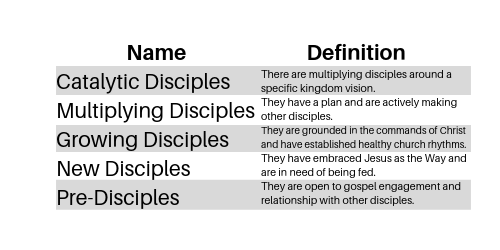
Let’s face it; you don’t have to have a disciple-making pipeline to make disciples.  I would say that very few churches have an intentional pipeline.  At the same time, there may be some benefits that you might want to consider when it comes to a disciple-making pipeline.

Let’s start by looking at what is a disciple-making pipeline? A disciple-making pipeline is a structure for identifying and moving disciples from one level of development to the next. Our goal in developing and implementing a disciple-making pipeline is more and better disciples.  We encourage churches to develop their unique disciple-making pipeline. The table below represents a generic disciple-making pipeline for beginning our conversation and for the development of your own disciple-making pipeline.

The benefits of an intentional disciple-making pipeline are numerous.  Here are a few:

1. It depicts a clear pathway for growth.  I can remember being a brand follower of Christ, thinking I want to be a good citizen.  I had no clue what it meant to be a disciple or that as a disciple, I needed to grow.  Imagine having a clear pathway with clearly delineated measures or competencies at each level of discipleship.  Regardless of how you program around a pipeline, just having one would benefit any church serious about making disciples.

2. It allows you as a church to evaluate your disciple-making effectiveness.  Once you develop your own disciple-making pipeline based on your disciple-making dream,  you have a built-in tool for assessing your effectiveness.  For example, if you don’t have any pre-disciples, it is a good indication that something is off about your overall disciple-making culture.  The same could be true of any level of your pipeline where you may have a deficiency.  A healthy disciple-making culture will have disciples at every level of the pipeline.

3. It integrates both evangelism and disciple-making.  A common mistake that churches make is separating evangelism and disciple-making, but for Jesus evangelism was always a critical part of His disciple-making.   His disciple-making always began with pre-disciples.  Creating a disciple-making pipeline should always begin with pre-disciples.

4. It encourages the disciple-maker to focus on his/her area of greatest strength.  We all have different passions and giftedness.  I may have a passion for working with pre-disciples, while you may be gifted at working with multiplying disciples. Having a disciple-making pipeline gives us multiple areas and places to plug into the disciple-making process as a disciple-maker.


To learn more about a disciplemaking pipeline, connect with an Auxano Navigator.

Download PDF

Tags: , , ,

| What is MyVisionRoom? > | Back to Discipleship >

ABOUT THE AUTHOR

David Putman

David Putman

David is a Lead Navigator serving on the Auxano Team, the category leader in vision clarity and vision focus campaigns. He is also founder leader of Planting the Gospel a non-profit ministry committed to helping churches move discipleship from a program to a culture. He has been involved in church planting for over twenty years as a planter, strategist, and coach. He is author of I Woke Up In Heaven, The Gospel Disciple, Detox for the Overly Religious, Breaking the Discipleship Code, and co-author of Breaking the Missional Code with Ed Stetzer. He latest book The Gospel Disciple Journey will be released in February 2014. David’s life mission is to help others discover the simplicity, centrality, and beauty of Jesus and his ways. David is married to Tami and they have two awesome kids, and two even more awesome grandkids.

See more articles by >

COMMENTS

What say you? Leave a comment!

Recent Comments
comment_post_ID); ?> Thank you for this information. I'm going to use this article to improve my work with the Lord.
 
— Abel Singbeh
 
comment_post_ID); ?> Thank you Ed for sharing your insights into the Church Growth Movement. I have my reservations with Church Growth models because it has done more damage than good in the Body of Christ. Over the years, western churches are more focused on results, formulas and processes with little or no emphasis on membership and church discipline. Pastors and vocational leaders are burnt out because they're overworked. I do believe that the Church Growth model is a catalyst to two destructive groups: The New Apostolic Reformation and the Emerging Church. Both groups overlap and have a very loose definition. They're both focus on contemporary worship, expansion of church brand (franchising), and mobilizing volunteering members as 'leaders' to grow their ministry. Little focus on biblical study, apologetics and genuine missional work with no agenda besides preaching of the gospel.
 
— Dave
 
comment_post_ID); ?> Thank you for sharing such a good article. It is a great lesson I learned from this article. I am one of the leaders in Emmanuel united church of Ethiopia (A denomination with more-than 780 local churches through out the country). I am preparing a presentation on succession planning for local church leaders. It will help me for preparation If you send me more resources and recommend me books to read on the topic. I hope we may collaborate in advancing leadership capacity of our church. God Bless You and Your Ministry.
 
— Argaw Alemu
 

Clarity Process

Three effective ways to start moving toward clarity right now.

This Could Change Everything in Your Church Hospitality

What is the first thing that comes to mind when you hear the word hospitality? For most people, images emerge of entertaining around meals or inviting friends into our homes for a night of fun and games. Now let’s be clear. There is nothing wrong with sharing a meal with friends and family. Genuine, biblical hospitality, however, is much more than entertaining.

One simple distinction between biblical hospitality and entertaining is that the latter puts the focus on the host. In doing so, it can actually become an issue of pride. As the host, we are concerned what others will think about our home. We wonder, how will our home reflect on us? There is a desire to impress our guests. We want them to like us and the place we live. We worry about making everything just right. If our home isn’t perfectly clean and decorated, how can we possibly entertain guests? This sort of hospitality can easily become more about appearances than persons.

With biblical hospitality, the focus is not on us as hosts. Instead, it is on our guest. Our concern is not on the appearance of our home, but on the needs and concerns of those invited into our homes. What do we have to learn from our guests? What do they have to share? What needs do our guests bring with them that we can address? What promise are they carrying with them that we need to receive? What about our guest can we celebrate during our time together? Soon, we discover the distinction between host and guest proves to be artificial. Our differences evaporate into a mutual sense of being included.

Scripture gives further clarity on the concept of hospitality, as well as its crucial importance. The Bible holds hospitality—especially toward strangers—in high regard. The laws prescribing holiness in the book of Leviticus include reference to hospitality:

When a foreigner resides among you in your land, do not mistreat them. The foreigner residing among you must be treated as your native-born. Love them as yourself, for you were foreigners in Egypt. I am the Lord your God (Leviticus 19:33-34).

We are not only to do no wrong to those outside of our community; we are to actively love the “foreigner” as we love ourselves. In this passage, the better translation of “as yourself” (kamocha) is “for he is like you.” We, too, were aliens once—outside the community—yet God treated us as native-born. The point is reiterated in Deuteronomy 10:19: “… you are to love those who are foreigners, for you yourselves were foreigners in Egypt.”

In the New Testament, the Greek word for “hospitality” is the word philoxenia, which is a combination of two words: love (phileo) and the word for stranger (xenos). It literally means “love of stranger.”

Another aspect of hospitality is important to note. It is not just for the benefit of the other. There is also something extraordinary that is gained when we receive the stranger.

When you give a dinner or a banquet, do not invite your friends or your brothers or your relatives or rich neighbors, lest they also invite you in return and you be repaid. But when you give a feast, invite the poor, the crippled, the lame, the blind, and you will be blessed,because they cannot repay you (Luke 14:12-14, ESV).

The practice of biblical hospitality is unique because it reaches out to those who cannot reciprocate. In most cases, when we invite friends into our homes for dinner, there is an expectation that they will return the “favor” and have us into their home. But the point of this passage is that customary “pay back” hospitality is of no great merit to God. The very best hospitality is that which is bestowed, not exchanged.

Reflection Questions

1. Where do you have space in your home and in your life, that could be opened up to others? Do you have room in your heart to love and serve someone who is unwanted, unloved, and uncared for? Do you have room in your home to welcome someone, even temporarily?

2. Who in your neighborhood, your place of work or in the places you hang out is living a relationally impoverished life? How can you turn a stranger into a friend this week?

3. Besides welcoming people into our homes, in what other settings might we be more hospitable?

> Read more from Brad.


Download PDF

Tags: , ,

| What is MyVisionRoom? > | Back to Discipleship >

ABOUT THE AUTHOR

Brad Brisco

Brad Brisco

I have an undergraduate degree in health care admin from Wichita State, a Masters of Divinity from Southwestern Baptist Theological Seminary in Fort Worth, and a Doctorate of Ministry degree in the area of missional ecclesiology. My doctoral thesis was on assisting existing congregations in transitioning in a missional direction. I have been involved in church planting for over seventeen years and am currently the Director of Bivocational church planting for the North American Mission Board. I am co-founder of Forge Kansas City, a missional training center located in Kansas City and the Sentralized conference. I am co-author of Missional Essentials a 12 week group curriculum published by The House Studio, The Missional Quest a book with InterVarsity Press, and Next Door As It Is In Heaven, published by NavPress. Additionally, I enjoy working with existing congregations that desire to more deeply engage God’s mission in a local context. I have taught college level courses for more than ten years, including History of Christianity, Religion in America, Life of Paul, Discipleship and Evangelism and a course on Worship. My wife and I are parents to three children and have been foster parents to more than fifty other kids. You can contact me at brad.brisco@gmail.com

See more articles by >

COMMENTS

What say you? Leave a comment!

Recent Comments
comment_post_ID); ?> Thank you for this information. I'm going to use this article to improve my work with the Lord.
 
— Abel Singbeh
 
comment_post_ID); ?> Thank you Ed for sharing your insights into the Church Growth Movement. I have my reservations with Church Growth models because it has done more damage than good in the Body of Christ. Over the years, western churches are more focused on results, formulas and processes with little or no emphasis on membership and church discipline. Pastors and vocational leaders are burnt out because they're overworked. I do believe that the Church Growth model is a catalyst to two destructive groups: The New Apostolic Reformation and the Emerging Church. Both groups overlap and have a very loose definition. They're both focus on contemporary worship, expansion of church brand (franchising), and mobilizing volunteering members as 'leaders' to grow their ministry. Little focus on biblical study, apologetics and genuine missional work with no agenda besides preaching of the gospel.
 
— Dave
 
comment_post_ID); ?> Thank you for sharing such a good article. It is a great lesson I learned from this article. I am one of the leaders in Emmanuel united church of Ethiopia (A denomination with more-than 780 local churches through out the country). I am preparing a presentation on succession planning for local church leaders. It will help me for preparation If you send me more resources and recommend me books to read on the topic. I hope we may collaborate in advancing leadership capacity of our church. God Bless You and Your Ministry.
 
— Argaw Alemu
 

Clarity Process

Three effective ways to start moving toward clarity right now.

Three Places to Uncover Values in Your Culture

While serving alongside the Auxano team, I learned the important distinction between vision, mission, strategy, and values. Well-intentioned leaders can confuse those and mix and match them in a way that actually harms clarity.

  • Mission is the what. Your mission is what your organization or ministry is on the planet to do.
  • Strategy is the how. Your strategy is how you accomplish the mission.
  • Vision is what you are pursuing now – the major goals in front of your team that are in alignment with your mission.
  • And your values impact everything you do because your values form the culture of your ministry organization.

Because it is the shared values and beliefs that form the culture, it is critically important for leaders to understand the values beneath the surface. Wise leaders don’t declare values; they uncover the values that are already there. In your organization, you can learn the values that are beneath the surface by looking in a few places. Doing so will help you understand the culture, and understanding the culture is more important than understanding the strategy because strategy is much more flexible than culture. So where do you look? To uncover the values in your culture, look in these three places:

1. The Heroes and Stories

The leaders in the culture that are spoken of as the epitome of the ministry or organization are good examples of the values on display. Listen to the stories that describe the heroes in the culture and you can learn what is valued. As I interviewed and onboarded into my new role at Mariners Church, I heard numerous stories of God’s people at Mariners serving the poor and marginalized in our community and around the world. The stories are beautiful and amazing. By listening, you can learn a lot about what is valued.

2. The Celebrations

Plato famously declared, “What is celebrated in a country is cultivated.” The same is true in any ministry or organization. Whatever has been celebrated has formed the culture. If a ministry celebrates tangible impact in a local community, you know local engagement is in the culture. If a ministry celebrates volunteers who are equipped for ministry, you know that leadership development is in the culture. If you pay attention to what is celebrated you will you learn what is valued. If you want to add a value to a culture, you will need to find ways to celebrate and cultivate that value. You won’t be able to merely speak a value into existence. You may be the leader, but you are not God.

3. The Language

As the new senior pastor of Mariners, I knew one of my first tasks was to understand the culture beneath the surface at Mariners. Thankfully there was language and history for me to study.

I have been fortunate and blessed to follow an exceptional leader in Kenton Beshore. He has, infused the church with values that have created the culture. When he became the senior pastor 35 years ago, he brought the church a list of five values to the church:

  • We teach God’s Word.
  • Be God’s loving family.
  • Every believer is a minister with a ministry.
  • Be innovative in our ministry and relevant in our community.
  • Be contagious in sharing Jesus Christ

Those values have been crystalized over time. I am leading our team through those values again. We are spending one staff meeting a month, with our whole team, walking through the importance and the implications of each value. It is helping me learn the culture, and I hope and pray it is helping us all renew our commitment to and unify around values that have formed the church we are honored to serve.

I love strategy. I have a tendency to go there first. Strategy is important, but culture is more so. Peter Drucker wisely quipped that “Culture eats strategy for breakfast.” My friend Will Mancini has provided helpful tools, such as this one, to help leaders articulate values through demonstration of those values.

If you are a ministry leader who would like some strategic outside eyes to help you and your team uncover your unique identity, not only your values but also your mission and your strategy, I highly recommend Auxano. I have learned a great deal from the team and believe wholeheartedly they would serve you and your team well. To reach out to the team, click here.

> Read more from Eric.


Download PDF

Tags: , , , ,

| What is MyVisionRoom? > | Back to Vision >

ABOUT THE AUTHOR

Eric Geiger

Eric Geiger

Eric Geiger is the Senior Pastor of Mariners Church in Irvine, California. Before moving to Southern California, Eric served as senior vice-president for LifeWay Christian. Eric received his doctorate in leadership and church ministry from Southern Seminary. Eric has authored or co-authored several books including the best selling church leadership book, Simple Church. Eric is married to Kaye, and they have two daughters: Eden and Evie. During his free time, Eric enjoys dating his wife, taking his daughters to the beach, and playing basketball.

See more articles by >

COMMENTS

What say you? Leave a comment!

Recent Comments
comment_post_ID); ?> Thank you for this information. I'm going to use this article to improve my work with the Lord.
 
— Abel Singbeh
 
comment_post_ID); ?> Thank you Ed for sharing your insights into the Church Growth Movement. I have my reservations with Church Growth models because it has done more damage than good in the Body of Christ. Over the years, western churches are more focused on results, formulas and processes with little or no emphasis on membership and church discipline. Pastors and vocational leaders are burnt out because they're overworked. I do believe that the Church Growth model is a catalyst to two destructive groups: The New Apostolic Reformation and the Emerging Church. Both groups overlap and have a very loose definition. They're both focus on contemporary worship, expansion of church brand (franchising), and mobilizing volunteering members as 'leaders' to grow their ministry. Little focus on biblical study, apologetics and genuine missional work with no agenda besides preaching of the gospel.
 
— Dave
 
comment_post_ID); ?> Thank you for sharing such a good article. It is a great lesson I learned from this article. I am one of the leaders in Emmanuel united church of Ethiopia (A denomination with more-than 780 local churches through out the country). I am preparing a presentation on succession planning for local church leaders. It will help me for preparation If you send me more resources and recommend me books to read on the topic. I hope we may collaborate in advancing leadership capacity of our church. God Bless You and Your Ministry.
 
— Argaw Alemu
 

Clarity Process

Three effective ways to start moving toward clarity right now.

Five Keys for Effective Church Communication

Your church is the only one struggling to communicate effectively. Your website is quite possibly the worst church website ever created. You are the only leader who loses a half-day to social media distraction while trying to post a simple announcement.

Of course none of those things are true.

In this era of over-messaging and under-communicating, every church struggles to ensure people live excited and on-mission. While this may be comforting to some, the uncomfortable reality is that there is also no single silver-bullet solution. Effective church communication is an art, not a science. Yet all is not lost. It remains possible to successfully reach your congregation and encourage them toward next steps in Christ.

One approach to developing a focused and holistic pattern of regular communication sits literally at your fingertips. The expertly crafted and balanced tool of the human hand presents a strategic picture of how complementary channels of connection might work in unison to accomplish the singular task of effective communication.

HERE IS THE FIVE-FINGER CHURCH COMMUNICATION STRATEGY

THE THUMB: WEEKLY EMAILS

The opposing thumb is an anatomical separator of humans from the majority of the animal kingdom. Thumbs allow people to use tools through grasping and gripping. Your thumb is a key part of daily life. The thumb is the unsung hero of eating Chinese food, changing channels and crafting witty text messages. But the thumb is somewhat useless by itself. Imagine your hand with just a thumb. It would be hard to do anything very well. Most churches rely on a weekly email blast as their only venue of informing and connecting people. In today’s world, digital communication is a must. But weekly emails are somewhat useless and easily ignored by themselves. Worse yet, when every department sends a separate email email blast to the same people, it is as if everyone has two hands full of thumbs. Your weekly email should anchor a communication strategy in the same way the thumb anchors your hand: one vital part of a greater whole.

THE POINTER FINGER: STAGE ANNOUNCEMENTS

Each Sunday, someone on your platform or pulpit stands and verbally points the church toward key events or next steps of growth in Christ. Stage announcements relate as a pointer finger points, by focusing attention on what lies ahead. And each Sunday the congregation either hears three minutes of announcements, or receives 180 seconds of visionary communication. One form results in continued inattention, the other toward immediate engagement in God’s better future. Stage announcements, or videos, each Sunday morning serve to align and point people toward what matters the most.

THE MIDDLE FINGER: SOCIAL MEDIA

What can you really say about the middle finger that was not completely obvious by Middle School? A raised middle finger is all about making a statement. It is sharing an emotional response and often designed to directly impact a specific audience: like the jerk behind you in traffic. A middle finger message is more sender-centric than viewer-concerned, and therefore comes with consequences when the wrong person or group receive the message. In this way, social media functions as a middle finger (so long as we can take the horribly offensive nature of the symbol out of this illustration). Facebook and Instagram posts are egotistically self-serving. They are typically designed to evoke emotion or communicate a quick point. Response is infrequent, and when a response happens, it is rarely helpful or healthy. Understand your social media strategy as a powerful and emotional communication tool. But brace yourself if the wrong people get the message.

THE RING FINGER: FAMILY MINISTRY

One of the most powerful symbols in our culture today, as well as every young pastor’s go-to baptism illustration, is the wedding ring. It goes without saying that the ring finger stands for family. And family is where our culture lives. In communicating to the church, meet every parent right where they are spending the majority of their time, their waking hours driving, and every bit of their income: with their kids. Essential to any full-formed communication strategy is integration into the weekly rhythms of preschool, children and student ministry. Invest the extra time to craft take-home moments each week, in every ministry, that speak to what matters most at your church. Leverage parent meetings and milestone moments to communicate directly with families. In these seasons, parents are most attentive. And if you really want your parents to engage in the larger story of church vision, get their kids excited about it first.

THE PINKIE FINGER: CHURCH WEBSITE

What exactly does the pinkie finger do but, when extended, signify a special moment? It is found in a sip of exquisite liquid or in a particular affinity to the University of Texas. The pinkie is all about small dose savoring and a specialized approach to the finer things in life. Your church website should be approached in this same way. More than 80% of the everyday users of church websites are guests looking for information. The other 2-20% are church members trying to figure out what time something starts. Unfortunately, the amount of design time and effort most communication teams invest in their church website in no way reflects this imbalance. Churches often bury essential information on service time and campus location three-to-four clicks deep. They use language that only insiders understand. They post 8 minute-long videos that are rarely viewed all the way through. Instead of thinking about small engagements, and a special audience (first time guests) church websites are burdened by by-laws, expired announcements and labyrinthine navigation menus. Approach the design and content of your church website with an eye for small doses. Ask yourself and the team: what is most important? How can it be accessed quickly? Who is actually looking at it?

Great church communication is as balanced and useful as the human hand. It can be as powerful as a solid punch, with every finger involved in making impact possible. After-all, what challenges are you facing in your weekly church leadership that a good punch wouldn’t solve?

> Read more from Bryan


Connect with an Auxano Navigator to learn more about great communication at your church.

Download PDF

Tags: , ,

| What is MyVisionRoom? > | Back to Communication >

ABOUT THE AUTHOR

Bryan Rose

Bryan Rose

As Lead Navigator for Auxano, Bryan Rose has a strong bias toward merging strategy and creativity within the vision of the local church and has had a diversity of experience in just about every ministry discipline over the last 12 years. With his experience as a multi-site strategist and campus pastor at a 3500 member multi-campus church in the Houston Metro area, Bryan has a passion to see “launch clarity” define the unique Great Commission call of developing church plants and campus, while at the same time serving established churches as they seek to clarify their individual ministry calling. Bryan has demonstrated achievement as a strategic thinker with a unique ability to infuse creativity into the visioning process while bringing a group of people to a deep sense of personal ownership and passion.

See more articles by >

COMMENTS

What say you? Leave a comment!

Recent Comments
comment_post_ID); ?> Thank you for this information. I'm going to use this article to improve my work with the Lord.
 
— Abel Singbeh
 
comment_post_ID); ?> Thank you Ed for sharing your insights into the Church Growth Movement. I have my reservations with Church Growth models because it has done more damage than good in the Body of Christ. Over the years, western churches are more focused on results, formulas and processes with little or no emphasis on membership and church discipline. Pastors and vocational leaders are burnt out because they're overworked. I do believe that the Church Growth model is a catalyst to two destructive groups: The New Apostolic Reformation and the Emerging Church. Both groups overlap and have a very loose definition. They're both focus on contemporary worship, expansion of church brand (franchising), and mobilizing volunteering members as 'leaders' to grow their ministry. Little focus on biblical study, apologetics and genuine missional work with no agenda besides preaching of the gospel.
 
— Dave
 
comment_post_ID); ?> Thank you for sharing such a good article. It is a great lesson I learned from this article. I am one of the leaders in Emmanuel united church of Ethiopia (A denomination with more-than 780 local churches through out the country). I am preparing a presentation on succession planning for local church leaders. It will help me for preparation If you send me more resources and recommend me books to read on the topic. I hope we may collaborate in advancing leadership capacity of our church. God Bless You and Your Ministry.
 
— Argaw Alemu
 

Clarity Process

Three effective ways to start moving toward clarity right now.