The Complex Work of the Simple Church

During a recent podcast conversation with Doug Paul, one of the Pastors at East End Fellowship in Richmond, VA, the idea of keeping programming simplified came up. In thisMy Ministry Breakthrough episode, Doug talks about the strategy of developing and discipling people at his church. One stark realization came up: strategy takes more than three words on your website.
Every week I meet another church or pastor for whom their idea of simplicity, often inspired by the book Simple Church, resulted in simply organizing their website menus around three keywords. “Simple Church” ministry demands more than picking three words to put on your marketing pieces. True simplicity requires a conviction in a calling, courage to assess, confidence in a team and competency to lead forward. In most cases, the mountain of simplicity feels too steep to climb, so we turn around.
Here is why: it is a simple thing to maintain complexity, but it is a complex thing to maintain simplicity.
You really have to do nothing to keep a complex ministry calendar and confusing process of assimilation and growth. But to really become simple, you have some complex work that must be done. Hard conversations with people who love Jesus must be had. Stringent assessments of what effectiveness in disciple-making really looks like must be completed. Challenging seasons of sunsetting ministries that were once vital to the life of your church must be navigated.
For many of us, it is easier to fight the fires of week-to-week ministry and hope that those three strategic words we crafted will eventually work their magic. As a result, you keep doing what you’ve always done and then expect different results.
Here are 23 things you are probably still doing even though you read Simple Church:
  1. Still doing too much yourself without developing anyone else
  2. Still missing a clear path for spiritual development that is easy enough to draw on a napkin
  3. Still running on the assimilation class hamster wheel never really getting anywhere
  4. Still propping the back door open and wondering why unconnected people are walking out
  5. Still elevating participation above transformation because you’re just counting heads
  6. Still sustaining ministries that no longer contribute to your mission
  7. Still tiptoeing around sensitive leaders who confuse passion for purpose
  8. Still running events out of nostalgia, not conviction
  9. Still pleading for volunteers instead of developing leaders
  10. Still closing classrooms and blaming youth sports
  11. Still circling the wagons of theology instead of living the gospel in your neighborhood
  12. Still thinking that lots of activity must mean you’re doing a good job
  13. Still asking for more money to do the same things and get the same results
  14. Still building ministry calendars as if there are families out there just hoping for more to do
  15. Still programming as if the church were the center of life and community
  16. Still consuming members’ schedules with on-campus activity instead of giving them time to know their neighbors
  17. Still chasing past programming success instead of charting future gospel influence
  18. Still starting new, exciting initiatives without stopping existing, obligatory activity
  19. Still putting words on a wall one day and thinking that people know or care what they mean the next
  20. Still approaching discipleship in terms of products, instead of process
  21. Still trying to get somewhere with your mission without giving anyone a map of where they’re going
  22. Still running ministry that feels random instead of growing people in rhythm
  23. Still announcing every possibility of church connection instead of one next step into community
Developing a clear, and simple, ministry strategy may be vital, but strategy represents only 20% of vision clarity. If you have not also developed a shared understanding of the marks of a disciple in your context, the next steps will never be enough.
Find out more about what a fully-formed framework of real church growth looks like through Auxano’s Vision Framing process.
> Read more from Bryan here.

Download PDF

Tags: , , , ,

| What is MyVisionRoom? > | Back to Vision >

ABOUT THE AUTHOR

Bryan Rose

Bryan Rose

As Lead Navigator for Auxano, Bryan Rose has a strong bias toward merging strategy and creativity within the vision of the local church and has had a diversity of experience in just about every ministry discipline over the last 12 years. With his experience as a multi-site strategist and campus pastor at a 3500 member multi-campus church in the Houston Metro area, Bryan has a passion to see “launch clarity” define the unique Great Commission call of developing church plants and campus, while at the same time serving established churches as they seek to clarify their individual ministry calling. Bryan has demonstrated achievement as a strategic thinker with a unique ability to infuse creativity into the visioning process while bringing a group of people to a deep sense of personal ownership and passion.

See more articles by >

COMMENTS

What say you? Leave a comment!

Recent Comments
comment_post_ID); ?> Thank you for this information. I'm going to use this article to improve my work with the Lord.
 
— Abel Singbeh
 
comment_post_ID); ?> Thank you Ed for sharing your insights into the Church Growth Movement. I have my reservations with Church Growth models because it has done more damage than good in the Body of Christ. Over the years, western churches are more focused on results, formulas and processes with little or no emphasis on membership and church discipline. Pastors and vocational leaders are burnt out because they're overworked. I do believe that the Church Growth model is a catalyst to two destructive groups: The New Apostolic Reformation and the Emerging Church. Both groups overlap and have a very loose definition. They're both focus on contemporary worship, expansion of church brand (franchising), and mobilizing volunteering members as 'leaders' to grow their ministry. Little focus on biblical study, apologetics and genuine missional work with no agenda besides preaching of the gospel.
 
— Dave
 
comment_post_ID); ?> Thank you for sharing such a good article. It is a great lesson I learned from this article. I am one of the leaders in Emmanuel united church of Ethiopia (A denomination with more-than 780 local churches through out the country). I am preparing a presentation on succession planning for local church leaders. It will help me for preparation If you send me more resources and recommend me books to read on the topic. I hope we may collaborate in advancing leadership capacity of our church. God Bless You and Your Ministry.
 
— Argaw Alemu
 

Clarity Process

Three effective ways to start moving toward clarity right now.

Whose Vision Is it Anyway?

You hear ministry leaders talk all the time about what a church needs to grow. Some say it’s preaching. Some say you need a great location. Others suggest you need a vibrant ministry to children or youth.

All of those aspects are important for a healthy, growing church. But I don’t think they are what’s most important.

You start with leadership. Everything rises and falls on leadership. I see churches in great locations that struggle because of bad leadership. I see churches with great preaching struggle because of poor leadership. Leadership matters.

And leadership rests on vision.

Charisma doesn’t make a great leader. Vision does. In fact, communicating vision is your number one job as a leader. As a pastor, you need to continually clarify the vision of your church. It gets harder and harder (but more and more important) as you grow.

But where do you get vision that will propel your church forward?

You have to get vision from the Holy Spirit. God’s vision never wears out. His vision will never fail. His vision is better and grander than anything we can think up. And his vision is exactly what our churches need.

How does God communicate his vision to us? I’ve discovered through the years that God tends to share his vision with me in three stages.

1. God tells me what he’s going to do.

God starts by telling me what he wants to do through our ministry. The “what” always comes before the “how” and the “when.”

To figure out what God wants you to do, start with what God says in the Bible about what the church is supposed to do. Your church isn’t your church. It’s Jesus’ church. He founded the church, died for the church, sent his Spirit to guide the church, and someday will return for his church. He has already declared what the church is supposed to do. The purposes of the church are non-negotiable.

So start with the purposes of the church that God defines in the Bible. And then ask God to tell you how he wants to apply those purposes to your church.

2. God tells me how he’s going to do it.

Too often leaders skip this step. When God gives them a vision, they move on quickly to how they’re going to do it. They come up with their own strategy and their own plans. Then they fall on their face and come crawling back to him.

3. God tells me when he’ll complete it.

The longer I’m a Christian, the more I’m convinced that God’s timing is absolutely perfect. The week before Easter of 1980, during our final preview service at Saddleback before launching the next week, I shared what God had showed me about the church’s future.

In that message, I shared a dream of “at least 50 acres of land, on which will be built a regional church for Southern Orange County—with beautiful, yet simple, facilities . . . including a worship center seating thousands, a counseling and prayer center, classrooms for Bible studies and training lay ministers, and a recreation area. All of this will be designed to minister to the total person—spiritually, emotionally, physically, and socially—and set in a peaceful, inspiring garden landscape.”

But when I shared that vision, I had no idea how or when it would happen. I certainly had no idea it would take nearly 13 years before Saddleback had land of its own. In fact, we were the first church in America to grow to more than 10,000 in weekly attendance without a building of its own. That wasn’t my timing, but it was God’s.

Nearly all of the pastors I’ve known who lead healthy churches have gone through seasons of burnout when they’ve had to learn that their vision for the church was from the Holy Spirit, not their own ego. I came to that point at the end of my first year at Saddleback. My vision for the second year of this church was simple: Hang on. I was out of big dreams. I just wanted to keep going.

I had two particularly haunting doubts during that time. Saddleback was growing fast, and I didn’t believe I deserved it—and I didn’t think I could handle it.

The truth is, God had a few important lessons for me to learn. Out of that period, God told me, “You’re right. You don’t deserve it. But I use you by grace.” Grace is the fact that God knows everything I’m going to do in the ministry, every mistake I’m going to make, but he still uses me anyway. That’s good news.

Out of that experience came confidence rooted in the realization that everything God does at Saddleback is an act of grace. It’s not my responsibility to build the church. It’s my responsibility to be faithful. While I was out there in the desert, God said, “You build the people, and I’ll build the church.”

So whatever vision God gives you for your ministry, hold it loosely. For nearly 40 years, I’ve prayed over and over again, “God, if I’m getting in the way of this church, I’m willing to move.” The vision for Saddleback has never been mine. In the same way, the vision for your church belongs to God.

> Read more from Rick.


Connect with an Auxano Navigator to learn more about creating a Vision Pathway for your church.

Download PDF

Tags: , ,

| What is MyVisionRoom? > | Back to Vision >

ABOUT THE AUTHOR

Rick Warren

Rick Warren

Rick Warren is the founding pastor of Saddleback Church in Lake Forest, Calif., one of America's largest and most influential churches. Rick is author of the New York Times bestseller The Purpose Driven Life. His book, The Purpose Driven Church, was named one of the 100 Christian books that changed the 20th century. He is also founder of Pastors.com, a global Internet community for pastors.

See more articles by >

COMMENTS

What say you? Leave a comment!

Recent Comments
comment_post_ID); ?> Thank you for this information. I'm going to use this article to improve my work with the Lord.
 
— Abel Singbeh
 
comment_post_ID); ?> Thank you Ed for sharing your insights into the Church Growth Movement. I have my reservations with Church Growth models because it has done more damage than good in the Body of Christ. Over the years, western churches are more focused on results, formulas and processes with little or no emphasis on membership and church discipline. Pastors and vocational leaders are burnt out because they're overworked. I do believe that the Church Growth model is a catalyst to two destructive groups: The New Apostolic Reformation and the Emerging Church. Both groups overlap and have a very loose definition. They're both focus on contemporary worship, expansion of church brand (franchising), and mobilizing volunteering members as 'leaders' to grow their ministry. Little focus on biblical study, apologetics and genuine missional work with no agenda besides preaching of the gospel.
 
— Dave
 
comment_post_ID); ?> Thank you for sharing such a good article. It is a great lesson I learned from this article. I am one of the leaders in Emmanuel united church of Ethiopia (A denomination with more-than 780 local churches through out the country). I am preparing a presentation on succession planning for local church leaders. It will help me for preparation If you send me more resources and recommend me books to read on the topic. I hope we may collaborate in advancing leadership capacity of our church. God Bless You and Your Ministry.
 
— Argaw Alemu
 

Clarity Process

Three effective ways to start moving toward clarity right now.

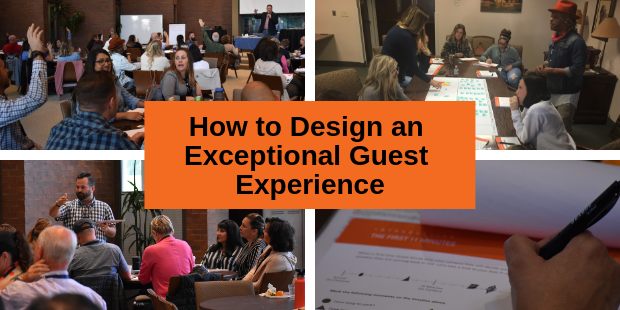
How to Design an Exceptional Guest Experience

Did you know that a first time guest will typically decide to come back in the first 11 minutes of visiting your church? And yet, we spend very little time thinking about how to shape those first few minutes in a powerful way, much less the rest of their time with us.

The fact of the matter is that defining moments shape our lives, but we don’t have to wait for them to happen.

We can be the author of them.

In today’s increasingly fast-paced and unpredictable environment, church leaders need to be involved in design thinking more than ever. Design is all about action, and churches too often get stuck at the talking stage.

Face it – despite all our planning and analyzing and controlling, the typical church’s track record at translating its rhetoric into results is not impressive.

Moments matter. And what an opportunity we miss when we leave them to chance!

  • All it takes is a bit of insight and forethought.
  • All it takes is for you to think like a designer.

Auxano’s Guest Experience Boot Camp will help you and your team do just that.


Here’s what some past participants have said:

  • I loved all the content.  It was made even more meaningful as we spent a chunk of time working on a personal plan for our church. Thank you for building that time in.
  • The content was killer. Can’t wait to process it all when I go back home. I loved how you gave us time to design it in the moment with our team.

  • My team used the information we learned to actually plan out the improvements of our church’s guest experience.

  • We loved the process of learning some new principles and paradigms and the opportunity to apply them to our context in teams.

The Guest Experience Boot Camp will introduce your team to developing powerful moments through design thinking…

…because Designing Guest Experiences is more important than delivering guest services.


Check out Auxano’s Guest Experience Boot Camp in Cincinnati, OH on August 7-8.


> Register for the Guest Experience Boot Camp here.


Download PDF

Tags: , , ,

| What is MyVisionRoom? > | Back to Execution >

ABOUT THE AUTHOR

Bob Adams

Bob Adams

Bob is an absolute fanatic about Guest Experiences, growing up watching his father serve customers at the gas station he built and operated for 44 years. Bob is continually connecting with corporate leaders in the customer experience world, learning and then translating practices for ChurchWorld. He writes, speaks, and consults on the topic frequently. Vocationally, Bob has a dual role at Auxano, a clarity first consulting firm serving the church. As Vision Room Curator and Digital Engagement Leader he researches, edits, writes and publishes online content. As Guest Experience Navigator, he leverages his passion, providing Guest Perspective Evaluations and Guest Experience Blueprints. Bob and his wife Anita have been married for 40 years. They have 4 children, 3 daughters-in-law, 1 son-in-law, and 5 grandchildren.

See more articles by >

COMMENTS

What say you? Leave a comment!

Recent Comments
comment_post_ID); ?> Thank you for this information. I'm going to use this article to improve my work with the Lord.
 
— Abel Singbeh
 
comment_post_ID); ?> Thank you Ed for sharing your insights into the Church Growth Movement. I have my reservations with Church Growth models because it has done more damage than good in the Body of Christ. Over the years, western churches are more focused on results, formulas and processes with little or no emphasis on membership and church discipline. Pastors and vocational leaders are burnt out because they're overworked. I do believe that the Church Growth model is a catalyst to two destructive groups: The New Apostolic Reformation and the Emerging Church. Both groups overlap and have a very loose definition. They're both focus on contemporary worship, expansion of church brand (franchising), and mobilizing volunteering members as 'leaders' to grow their ministry. Little focus on biblical study, apologetics and genuine missional work with no agenda besides preaching of the gospel.
 
— Dave
 
comment_post_ID); ?> Thank you for sharing such a good article. It is a great lesson I learned from this article. I am one of the leaders in Emmanuel united church of Ethiopia (A denomination with more-than 780 local churches through out the country). I am preparing a presentation on succession planning for local church leaders. It will help me for preparation If you send me more resources and recommend me books to read on the topic. I hope we may collaborate in advancing leadership capacity of our church. God Bless You and Your Ministry.
 
— Argaw Alemu
 

Clarity Process

Three effective ways to start moving toward clarity right now.

Overcome an Overloaded Life: Establish Rhythm

We’re all busy in the same sorts of ways. Our lives are consumed with the crushing weight of family, work, and church activities. Our lives are bombarded with requests, demands, and desires. Individual situations may be quantitatively less busy than others, and some more so, but as a society we are living a shared experience of an overwhelmed life.

Where does it all stop? When will things slow down? How can we recapture time lost?

Technology has delivered time-saving devices that actually consume more time. Progress moves our lives faster and faster, yet we seem incapable of enjoying little if any benefit. We desire and often achieve more. We have bought into a full-life timeshare to only find ourselves bankrupt in emptiness.

Are you asking this question?

I don’t have enough time to do the things I need to do, let alone the things I want to do.

THE QUICK SUMMARY – Your Life in Rhythm by Bruce B. Miller

Your Life in Rhythm offers a realistic solution to our crazy, overly busy, stressed lives. Miller exposes the myth of living a “balanced” life, and offers “rhythmic living” as a new paradigm for relieving guilt and stress, while accomplishing more of what matters most in life.

Rhythmic living details six practical strategies for living a more fulfilling life. Instead of managing time, Miller suggests that we flow with life, living in tune with the natural rhythms of nature. By applying the rhythm strategies, we can reduce stress, frustration, and guilt while increasing fulfillment and inner peace. The point is not to balance all of our responsibilities at one time, but to focus attention on what matters most at different times.

Although this sounds easy enough, the six strategies he outlines are crucial to helping the reader to achieve this goal. Miller helps us to understand the stages and seasons of life we all experience over a lifetime. This new understanding, when applied, will solve time-management problems and help readers to let go of misplaced priorities and relieve their overbooked lifestyle. The rhythm solution, in short, brings freedom.

A SIMPLE SOLUTION

Do you ever feel overwhelmed? Do you find yourself working longer and longer hours at the office or running a taxi service to deliver your kids to all their activities? Are you juggling multiple responsibilities at home, work, and church? Does it always seem as if you have at least one too many things pulling you in different directions?

If any (or all!) of the above is true, no doubt you’ve been told or read somewhere that you need to get your life in balance.

The problem is the concept of “balance” is part of the problem!

It’s time to shift your paradigm of a well-lived life from balance to rhythm. Life is not static, linear, or uniform. It moves, oscillates, vibrates, and pulsates. A rhythm model honors time and movement; it celebrates variety and diversity; it highlights uniqueness and recognizes common patterns. Rhythm honors excellence and the sacrifice required for achievements while also providing time for renewal.

The very concept of balance that is designed to free us from the frenzy of modern life has actually subjected us to idealistic notions of a perfectly proportioned life. Balance is what one does to chemical equations and columns of numbers, not to life.

I am using the concepts of chronos and kairos to label the two basic kinds of rhythm: cycles and seasons. We live rhythmically by following the sky’s patterns, which form our chronos rhythms (cycles), and by riding the sea waves of our kairos rhythms (seasons).

We all live in the same world, structured by five fundamental chronos cycles: solar, seasonal, lunar, sabbatical, and rotational; in other words, the year, quarter, month, week, and day. We also live in kairos seasons: unique times such as the birth of a child, the college years, rehabilitation after an injury, retirement, or moving to a new city. We ride the waves of life as they come. Chronos cycles describe the temporal context of our environment on planet Earth, whereas kairos seasons describe the patterns in the flow of our human lives.

Kairos seasons are not tied to clock time. They are flows rather than cycles, the movement of a story rather than the meter of a tune. Kairos is an opportune time, the right time to say or do something.

The chronos cycles describe cyclical, recurring rhythms built into the fabric of the created order, environmental rhythms established by astronomical phenomena and embedded in our biology. In contrast, kairos seasons are linear, noncyclical, human rhythms.

Kairos Rhythm Strategies

  1. Release expectations – Be at peace with the stage God has you in right now. Release your expectations of other times, and stop envying others who are older or younger.
  2. Seize opportunities – We do not get to relive most stages of our lives. We get one shot. When we live our lives in rhythm, we make the most of every season and stage of life.
  3. Anticipate what’s next – If you really don’t like the stage of life you’re in right now, use the power of anticipation to give yourself hope.

Chronos Rhythm Strategies

  1. Pace yourself – We will find more peaceful, enjoyable, and fulfilled lives if we can identify appropriate frequencies for our regular activities.

  2. Build rituals – By building rituals in an annual cycle, you are achieving your mission in harmony with the way our world actually works.

  3. Oscillate work and rest – Think in advance how you will stay healthy through the year by oscillating between intensity and renewal.

Bruce B. Miller, Your Life in Rhythm

A NEXT STEP

Author Bruce Miller has a series of exercises sprinkled throughout his book. Here is a sampling of each, following the list of strategies listed above.

Set aside time each day this week and practice the exercise. Where called for, create a chart tablet and leave it up all week long.

Release expectations – Create a chart tablet headed with the following phrase: “I will release the following expectations…” Take 10 minutes and complete the phrase with as many actions as you can.

Seize opportunities – Create a chart tablet headed with the following phrase: “I will seize these unique opportunities in this kairos season…” Take 10 minutes and complete the phrase with as many actions as you can.

Anticipate what’s next – Create a chart tablet headed with the following phrase: “I can anticipate the following personal seasons and life stages coming…” Take 10 minutes and complete the phrase with as many actions as you can.

Pace yourself – Try the following steps to help you get started on pacing yourself:

  1. Change the frequency of one activity in your life to a more appropriate pace.
  2. Take one aspect of your life and consider paces that follow the flow of natural chronos cycles.
  3. Talk about your pace with those you live with.

Build rituals – Identify a life-enhancing ritual that you can build for at least one chronos cycle.

Oscillate work and rest – Identify an oscillation between work and rest that you can introduce in at least one chronos cycle. Put it into practice, and note positive changes in your physical, emotional, and spiritual well-being.

Excerpt taken from SUMS Remix 87-2, released February 2018.


This is part of a weekly series posting excerpts from one of the most innovative content sources in the church world: SUMS Remix book excerpts for church leaders.

SUMS Remix takes a practical problem in the church and looks at it with three solutions; each solution is taken from a different book. Additionally, a practical action step is included with each solution.

As a church leader you get to scan relevant books based on practical tools and solutions to real ministry problems, not just by the cover of the book. Each post will have the edition number which shows the year and what number it is in the overall sequence. (SUMS Remix provides 26 issues per year, delivered every other week to your inbox). 

> > Subscribe to SUMS Remix <<

Download PDF

Tags: , , ,

| What is MyVisionRoom? > | Back to Leadership >

ABOUT THE AUTHOR

VRcurator

VRcurator

Bob Adams is Auxano's Vision Room Curator. His background includes over 23 years as an associate/executive pastor as well as 8 years as the Lead Consultant for a church design build company. He joined Auxano in 2012.

See more articles by >

COMMENTS

What say you? Leave a comment!

Recent Comments
comment_post_ID); ?> Thank you for this information. I'm going to use this article to improve my work with the Lord.
 
— Abel Singbeh
 
comment_post_ID); ?> Thank you Ed for sharing your insights into the Church Growth Movement. I have my reservations with Church Growth models because it has done more damage than good in the Body of Christ. Over the years, western churches are more focused on results, formulas and processes with little or no emphasis on membership and church discipline. Pastors and vocational leaders are burnt out because they're overworked. I do believe that the Church Growth model is a catalyst to two destructive groups: The New Apostolic Reformation and the Emerging Church. Both groups overlap and have a very loose definition. They're both focus on contemporary worship, expansion of church brand (franchising), and mobilizing volunteering members as 'leaders' to grow their ministry. Little focus on biblical study, apologetics and genuine missional work with no agenda besides preaching of the gospel.
 
— Dave
 
comment_post_ID); ?> Thank you for sharing such a good article. It is a great lesson I learned from this article. I am one of the leaders in Emmanuel united church of Ethiopia (A denomination with more-than 780 local churches through out the country). I am preparing a presentation on succession planning for local church leaders. It will help me for preparation If you send me more resources and recommend me books to read on the topic. I hope we may collaborate in advancing leadership capacity of our church. God Bless You and Your Ministry.
 
— Argaw Alemu
 

Clarity Process

Three effective ways to start moving toward clarity right now.

Leaders Should Know – and Tell – Their Organization’s Creation Story

Will Mancini, founder of Auxano and Younique, writes about the importance of leadership stories here. He believes that storytelling and understanding the nuances of story will help leaders in the daily ebb and flow of communication. The first, appropriately, is your organization’s creation story.

As a leader, you should know more about the creation story of your organization than anyone on the planet. What are the circumstances—passions, problems, and people—surrounding how the organization got started to begin with? 

Mastering the richness of the creation story will help in two major ways. First, it will hold insight into the unique culture of the organization and therefore future decision-making and vision. Second, your mastery of the story itself will bring tremendous credibility with people when initiating change.

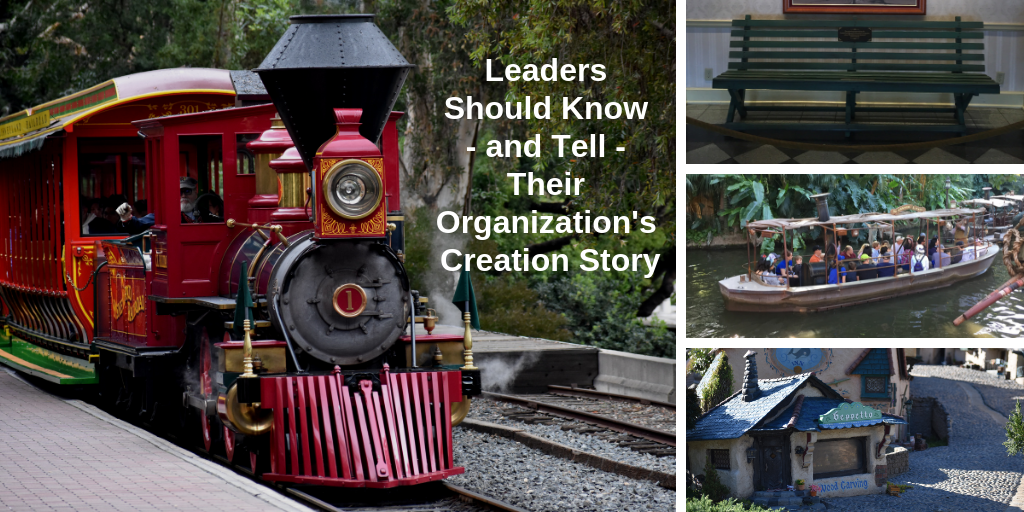
With a passion of Disney history, I’m always grateful to visit Disney properties and immerse myself in the stories and culture of Walt Disney and the “kingdom” he began. During a recent multi-day visit to California, I had the opportunity to visit Disneyland several days, experiencing both the familiar and new perspectives.

Take this image, for example:

In talking with current Cast Members, Tour Guides, and former Imagineers, various stories were given as to the origin of Disneyland:

  1. It was Walt Disney’s fascination with trains, beginning as a boy, that led him to first create a scale model railroad in his backyard. Not satisfied, he begin to develop an ever-growing park that would include a railroad. When Disneyland opened in 1955, the first object you saw approaching the park was a train station, and a 5/8 scale railroad encircled the park.
  2. Saturday’s were “Daddy’s Day,” and Walt often took his daughters to play in nearby parks. While sitting on a bench in Griffith Park, Walt imagined what a park would look like that would allow both parents and children to be immersed in a story-rich, safe, clean park.
  3. Fascinated by miniatures, Walt began a hobby of crafting extremely detailed miniature items, building entire rooms filled with objects that were not only beautiful to look at, but fully functional. He envisioned a place to display these miniatures so that people from all over the country could enjoy them.
  4. By the late 1940’s-early 1950’s, Walt had grown tired of making animated pictures, and even his recent venture into live-action motion pictures left him dissatisfied. He imagined a place were people could actually be a part of a story, immersed in all the rich details that a “theme park” could provide.

What is the true origin of Disneyland?

I believe that all of the above contributed to the creation of Disneyland. And the common denominator of all of them?

Passion.

> What about your organization?

ACTION STEP: Write a one-page, 2-minute creation story talk. If you have any gaps in your knowledge, interview people in your organization until you know more than anyone else.

> Read more by Bob.

Download PDF

Tags: , , , , ,

| What is MyVisionRoom? > | Back to Vision >

ABOUT THE AUTHOR

Bob Adams

Bob Adams

Bob is an absolute fanatic about Guest Experiences, growing up watching his father serve customers at the gas station he built and operated for 44 years. Bob is continually connecting with corporate leaders in the customer experience world, learning and then translating practices for ChurchWorld. He writes, speaks, and consults on the topic frequently. Vocationally, Bob has a dual role at Auxano, a clarity first consulting firm serving the church. As Vision Room Curator and Digital Engagement Leader he researches, edits, writes and publishes online content. As Guest Experience Navigator, he leverages his passion, providing Guest Perspective Evaluations and Guest Experience Blueprints. Bob and his wife Anita have been married for 40 years. They have 4 children, 3 daughters-in-law, 1 son-in-law, and 5 grandchildren.

See more articles by >

COMMENTS

What say you? Leave a comment!

Recent Comments
comment_post_ID); ?> Thank you for this information. I'm going to use this article to improve my work with the Lord.
 
— Abel Singbeh
 
comment_post_ID); ?> Thank you Ed for sharing your insights into the Church Growth Movement. I have my reservations with Church Growth models because it has done more damage than good in the Body of Christ. Over the years, western churches are more focused on results, formulas and processes with little or no emphasis on membership and church discipline. Pastors and vocational leaders are burnt out because they're overworked. I do believe that the Church Growth model is a catalyst to two destructive groups: The New Apostolic Reformation and the Emerging Church. Both groups overlap and have a very loose definition. They're both focus on contemporary worship, expansion of church brand (franchising), and mobilizing volunteering members as 'leaders' to grow their ministry. Little focus on biblical study, apologetics and genuine missional work with no agenda besides preaching of the gospel.
 
— Dave
 
comment_post_ID); ?> Thank you for sharing such a good article. It is a great lesson I learned from this article. I am one of the leaders in Emmanuel united church of Ethiopia (A denomination with more-than 780 local churches through out the country). I am preparing a presentation on succession planning for local church leaders. It will help me for preparation If you send me more resources and recommend me books to read on the topic. I hope we may collaborate in advancing leadership capacity of our church. God Bless You and Your Ministry.
 
— Argaw Alemu
 

Clarity Process

Three effective ways to start moving toward clarity right now.

Discerning the Difference Between Urgent and Important

On a recent episode of My Ministry Breakthrough, Eastern Hills Community Church Pastor Phil EuBank spoke of the maturing of his leadership as learning to discern the important from the urgent. (You can listen to the whole podcast episode here.)

Understanding this difference, between what is urgent and what is important, is a crucial facet of successful pastoral leadership. Here is the simple principle:

Not everything urgent is important. Not everything important is urgent.

In the day-to-day work of pastoral leadership, most of the urgent requests, tasks or conversations are not organizationally important. And similarly, most of the important requests, tasks or conversations are not immediately urgent. Those things that are both urgent and important do exist, but they are rare and easily recognizable. They are moments of shepherding through sudden tragedy or celebrating in a surprising victory.

When everything is both important and urgent, ministry is hard. In fact, it is nearly impossible to sustain. This is true for you, and for your team.

It remains then that knowing the difference between what is urgent and what is important creates margin and produces perspective for every leader in the organization.

Failing to steward the urgent and the important can also disguise, or even mute, the work of God in a particular moment or situation. There is something to be said about not being immediately responsive to every urgent request presented to the pastor.

The best example of this comes from Jesus in John 11. Upon hearing that Lazarus was sick, Jesus’ immediate response was nothing. He stuck around for two more days. Luke even tells us that: “Jesus loved Martha, her sister, and Lazarus. So… he stayed two more days in the place where he was.”

Brian Dembowczyk of The Gospel Project captures Jesus’ discernment between the urgent and the important in this way:

“Had we written the script, we would have settled for so much less, wouldn’t we have? Our version would have had Jesus rushing to Lazarus’ side to heal him followed by a festive party of some sort. And we would have missed so much more that Jesus actually gave to His beloved friends. Jesus gave His friends a great gift when He allowed Lazarus to die. He gave them the gift of advancing their faith and drawing them that much closer to eternal life in Him, the Son of God.”

Even if it didn’t make sense in human terms, Jesus knew the powerful difference in responding to what is urgent and what is important.

In most cases:

…urgent requests reflect personal preference.

…important needs protect organizational clarity.

…urgent challenges request responsive appeasement.

…important issues require collaborative agreement.

…urgent tasks captivate within ministry silos.

…important initiatives motivate across ministry goals.

…urgent needs come with a moving story.

…important moments bring Christ-honoring glory.

The mature pastor sees the urgent request that is not organizationally important as an opportunity to develop other leaders through empowering delegation.

The mature pastor sees the important need that is not immediately urgent as an opportunity to take the time to seek God and wise counsel through collaborative determination.

As you face another week of to-do lists, programmatic activity, and pastoral needs, what is seemingly urgent that you should hand-off, and what is truly important that you should fix your mind-on?

> Read more from Bryan.


Download PDF

Tags: , , ,

| What is MyVisionRoom? > | Back to Leadership >

ABOUT THE AUTHOR

Bryan Rose

Bryan Rose

As Lead Navigator for Auxano, Bryan Rose has a strong bias toward merging strategy and creativity within the vision of the local church and has had a diversity of experience in just about every ministry discipline over the last 12 years. With his experience as a multi-site strategist and campus pastor at a 3500 member multi-campus church in the Houston Metro area, Bryan has a passion to see “launch clarity” define the unique Great Commission call of developing church plants and campus, while at the same time serving established churches as they seek to clarify their individual ministry calling. Bryan has demonstrated achievement as a strategic thinker with a unique ability to infuse creativity into the visioning process while bringing a group of people to a deep sense of personal ownership and passion.

See more articles by >

COMMENTS

What say you? Leave a comment!

Recent Comments
comment_post_ID); ?> Thank you for this information. I'm going to use this article to improve my work with the Lord.
 
— Abel Singbeh
 
comment_post_ID); ?> Thank you Ed for sharing your insights into the Church Growth Movement. I have my reservations with Church Growth models because it has done more damage than good in the Body of Christ. Over the years, western churches are more focused on results, formulas and processes with little or no emphasis on membership and church discipline. Pastors and vocational leaders are burnt out because they're overworked. I do believe that the Church Growth model is a catalyst to two destructive groups: The New Apostolic Reformation and the Emerging Church. Both groups overlap and have a very loose definition. They're both focus on contemporary worship, expansion of church brand (franchising), and mobilizing volunteering members as 'leaders' to grow their ministry. Little focus on biblical study, apologetics and genuine missional work with no agenda besides preaching of the gospel.
 
— Dave
 
comment_post_ID); ?> Thank you for sharing such a good article. It is a great lesson I learned from this article. I am one of the leaders in Emmanuel united church of Ethiopia (A denomination with more-than 780 local churches through out the country). I am preparing a presentation on succession planning for local church leaders. It will help me for preparation If you send me more resources and recommend me books to read on the topic. I hope we may collaborate in advancing leadership capacity of our church. God Bless You and Your Ministry.
 
— Argaw Alemu
 

Clarity Process

Three effective ways to start moving toward clarity right now.