Readying Yourself to Be Used by God

As a pastor or church leader, I know you want to be used by God. As a leader of leaders, I know you want to help others to be usable by God.

“For the eyes of the LORD range throughout the earth to strengthen those whose hearts are fully committed to him” (2 Chronicles 16:9 NIV).

The Bible teaches five requirements for being used by God.

1. Keep your life clean.

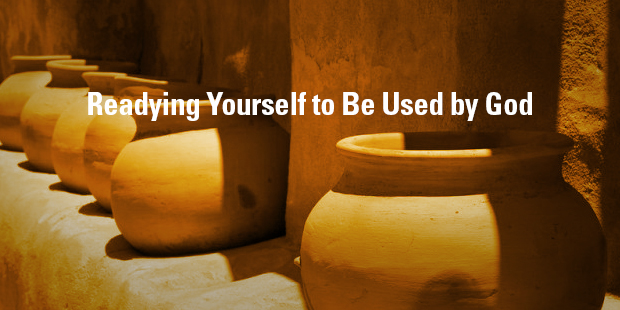
The first step to being used by God is always personal examination. When you find someone whom God is using in a great way, they’ve dealt with the personal sin in their lives by confessing it to God. God uses small vessels, plain vessels, and even broken vessels. But he will not use a dirty vessel. Matthew 23:26 says, “Blind Pharisee! First clean the inside of the cup and dish, and then the outside also will be clean” (NIV).

2. Keep your eyes open.

One of the most misunderstood words in leadership circles is the word vision. We think of vision as predicting the future, but none of us can know the future the way God does. Vision is seeing God at work in your present situation and moving with him. It’s about getting in on what God is doing in the world and being a part of it where he has placed you. If your vision isn’t in alignment with what God is doing, you are off-course. As David said, “Keep your eyes open for God, watch for his works; be alert for signs of his presence” (Psalm 105:4 The Message).

3. Keep your heart grateful.

God uses grateful people. Thankfulness is also one of the keys to longevity in ministry. Thankful people endure longer because they focus on God’s provision more than their problems. Doctors refer to gratitude as the healthiest of all emotions because of its physical and psychological benefits. If you don’t stay grateful, you’ll become cynical. Paul said, “Never be lacking in zeal, but keep your spiritual fervor, serving the Lord” (Romans 12:11 NIV). We need to constantly remind ourselves what a privilege it is to serve Jesus. Never take for granted the things that God does in, through, and around us entirely because of his grace.

4. Keep your purpose firm.

You were planned for God’s pleasure, formed for God’s family, created to become like Christ, shaped for service, and made for a mission. These are the purposes for which God made you! One of my life verses is Acts 13:36: “David served God’s purpose in his own generation” (CEB). I want to serve God’s purpose for my life, and I know you do too.

5. Keep your mind on Jesus.

Meditate on this verse, “Keep your eyes on Jesus, who both began and finished this race we’re in. Study how he did it. Because he never lost sight of where he was headed – he could put up with anything along the way: cross, shame, whatever. And now he’s there, in the place of honor, right alongside God” (Hebrews 12:2 The Message). God’s purpose for your life is far greater than your problems. Don’t give up when it gets tough. Go to Jesus. Keep your mind on Him!


TAKING ACTION

(1) Reflect on these five requirements. Give yourself a grade in each area. Thank God for your strengths and identify how you might strengthen your weaknesses.

(2) Share this article with your key leaders, and follow up with a discussion.


> Read more from Rick.


Let’s talk! Connect with an Auxano Navigator.

Download PDF

Tags: , ,

| What is MyVisionRoom? > | Back to Leadership >

ABOUT THE AUTHOR

Rick Warren

Rick Warren

Rick Warren is the founding pastor of Saddleback Church in Lake Forest, Calif., one of America's largest and most influential churches. Rick is author of the New York Times bestseller The Purpose Driven Life. His book, The Purpose Driven Church, was named one of the 100 Christian books that changed the 20th century. He is also founder of Pastors.com, a global Internet community for pastors.

See more articles by >

COMMENTS

What say you? Leave a comment!

Recent Comments
comment_post_ID); ?> Thank you for this information. I'm going to use this article to improve my work with the Lord.
 
— Abel Singbeh
 
comment_post_ID); ?> Thank you Ed for sharing your insights into the Church Growth Movement. I have my reservations with Church Growth models because it has done more damage than good in the Body of Christ. Over the years, western churches are more focused on results, formulas and processes with little or no emphasis on membership and church discipline. Pastors and vocational leaders are burnt out because they're overworked. I do believe that the Church Growth model is a catalyst to two destructive groups: The New Apostolic Reformation and the Emerging Church. Both groups overlap and have a very loose definition. They're both focus on contemporary worship, expansion of church brand (franchising), and mobilizing volunteering members as 'leaders' to grow their ministry. Little focus on biblical study, apologetics and genuine missional work with no agenda besides preaching of the gospel.
 
— Dave
 
comment_post_ID); ?> Thank you for sharing such a good article. It is a great lesson I learned from this article. I am one of the leaders in Emmanuel united church of Ethiopia (A denomination with more-than 780 local churches through out the country). I am preparing a presentation on succession planning for local church leaders. It will help me for preparation If you send me more resources and recommend me books to read on the topic. I hope we may collaborate in advancing leadership capacity of our church. God Bless You and Your Ministry.
 
— Argaw Alemu
 

Clarity Process

Three effective ways to start moving toward clarity right now.

The Great Commission Is Not Great Numbers

It is predictable.

Any time I write about anything dealing with church sizes, some of the discussion degenerates into a debate about the best size church. It happened last week when I wrote some positive words about smaller churches. It has happened in the past when I wrote some positive words about megachurches.

We need all churches. All sizes of churches. We need more churches. It’s not either/or. It’s both/and. Allow me to point out seven reasons why a debate on church size bears no good fruit.

  1. Church health and church size are not synonymous. There are many healthy small churches. There are many healthy large and megachurches. And there are plenty of unhealthy churches of all sizes.
  2. Conflict is not unique to a particular church size. Indeed some level of conflict is in every church. There are times where conflict is more visible in the smaller church because everyone knows everyone. But that does not mean conflict is not present, and sometimes intense, in larger churches.
  3. Categorical statements are harmful to the body of Christ. “All pastors of large churches care about are the numbers.” “If a small church was doing was it was supposed to do, it wouldn’t be a small church.” Such categorical statements do no good. Indeed, they do harm. Why should we even participate in such conversations?
  4. The body of Christ is diverse; that is good. In 1 Corinthians 12, the Apostle Paul lauds the diversity of the individual members of the body of Christ. Similarly, there is diversity in the congregations working for His glory. Some of those churches are small. Some are mid-size. Some are large. Some are mega.
  5. The death of churches is not a function of church size. Obviously, a church gets smaller on its way to death. But that does not mean the church size is the cause of the death. It simply means the church is getting smaller as it approaches zero.
  6. Faithfulness and obedience are mandated of all church members. Leave the numerical results to God. He may lead a church to become very large; or He may lead a church to be a standard size church in the community. Neither size is inherently good or inherently bad.
  7. It would be wonderful if churches worked together as much as some churches often criticize othersOur communities may be waiting to see if we churches can work together before the members of the community decide they even want us around.

God gives us small churches. God gives us mid-size churches. God gives us large and very large churches. They are all part of His plan. Let’s stop criticizing each other and start working together.

We may be surprised how God will then use us.

> Read more from Thom.


Let’s talk! Connect with an Auxano Navigator.


Download PDF

Tags: , ,

| What is MyVisionRoom? > | Back to Leadership >

ABOUT THE AUTHOR

Thom Rainer

Thom Rainer

Thom S. Rainer is the founder and CEO of Church Answers, an online community and resource for church leaders. Prior to founding Church Answers, Rainer served as president and CEO of LifeWay Christian Resources. Before coming to LifeWay, he served at The Southern Baptist Theological Seminary for twelve years where he was the founding dean of the Billy Graham School of Missions and Evangelism. He is a 1977 graduate of the University of Alabama and earned his Master of Divinity and Ph.D. degrees from The Southern Baptist Theological Seminary.

See more articles by >

COMMENTS

What say you? Leave a comment!

Recent Comments
comment_post_ID); ?> Thank you for this information. I'm going to use this article to improve my work with the Lord.
 
— Abel Singbeh
 
comment_post_ID); ?> Thank you Ed for sharing your insights into the Church Growth Movement. I have my reservations with Church Growth models because it has done more damage than good in the Body of Christ. Over the years, western churches are more focused on results, formulas and processes with little or no emphasis on membership and church discipline. Pastors and vocational leaders are burnt out because they're overworked. I do believe that the Church Growth model is a catalyst to two destructive groups: The New Apostolic Reformation and the Emerging Church. Both groups overlap and have a very loose definition. They're both focus on contemporary worship, expansion of church brand (franchising), and mobilizing volunteering members as 'leaders' to grow their ministry. Little focus on biblical study, apologetics and genuine missional work with no agenda besides preaching of the gospel.
 
— Dave
 
comment_post_ID); ?> Thank you for sharing such a good article. It is a great lesson I learned from this article. I am one of the leaders in Emmanuel united church of Ethiopia (A denomination with more-than 780 local churches through out the country). I am preparing a presentation on succession planning for local church leaders. It will help me for preparation If you send me more resources and recommend me books to read on the topic. I hope we may collaborate in advancing leadership capacity of our church. God Bless You and Your Ministry.
 
— Argaw Alemu
 

Clarity Process

Three effective ways to start moving toward clarity right now.

Life Design Essential #2: Name Your Personal Life Calling

We live in a world where every artificial thing is designed. Whether it is the car we ride in, the streets we drive on, the lights that illuminate the road, or the building that is our destination, some person or group of people had to decide on the layout, operation, and mechanisms of the journey described above.

Your life has a design, too.

Design doesn’t just work for cars and roads and streetlights and buildings, and all the hundreds of thousands of components that make those things up. You can use design thinking to discover the life God has uniquely created for you. It is a life that is meaningful, joyful, and fulfilling.

Several years ago, Auxano founder Will Mancini launched Life Younique, a training company that certifies church leaders to offer gospel-centered life design through their church. Will, along with co-founder Dave Rhodes, is passionate about helping people get life mission right – what exactly is the best way to know and name what God has created you to do?

THE QUICK SUMMARY – More by Todd Wilson

More meets Christians where they’re at, acknowledging the roots of their discontent and demonstrating how to move from inspiration and desire into action. Church strategist and ministry activator Todd Wilson shows how all believers can live more abundant lives around the uniqueness of how they were made and what they are called to do.

Introducing a memorable vocabulary and an easy-to-use practical framework, More equips readers to embark on a journey of discovering their unique personal calling. It enables readers to answer three of the most important and profound questions we all naturally ask.

(1) “Who am I created to be?”

(2) “What am I created to do?”

(3) “Where am I to be best positioned to do it?”

The integrated answers to these key questions—the BE-DO-GO of a person’s life—represent the core dimensions of personal calling. Inspiring and challenging, More gives readers permission and encouragement to engage in the journey God has solely for them.

A SIMPLE SOLUTION

“Many people aren’t living the life they were meant to live because they don’t know who they are or what gifts God has given them.” The author of those words, Tom Paterson, goes on to say, “God has a plan for your life. In creating who you are, God simultaneously built into your life what you are to do.”

Redefine every day with the deep sense of knowing your special assignment from God.

We are called not just to follow Jesus (common call to all people) but we are called to accomplish something specific as a one-of-a-kind saint (your special assignment from God).

Your mission in life is something created, designed, and given by God.

Our primary or general calling gives us the fullness of Jesus and a context for what we are to accomplish when we go. This overflows to our secondary or unique calling, equipping us to play our unique part. This comes, not by force of will, but rather as a movement of love, one act of kindness at a time.

Our unique identity of BE is the first element in our secondary or unique personal calling. We must discover it, embrace it, and allow it to guide how we steward the time, talent, treasure, and influence God gives us in doing good works and deeds. It is from the overflow of our unique design that God brings our unique good works to life.

While we can never completely define the fullness of our uniqueness, we can seek to express it in a short phrase. Our unique identity is a word or phrase that seeks to capture the fullness of our unique design in very simple terms. You might be a creative storyteller, or an encouraging coach, or a restorer of broken relationships, or a collaborative networker. The possibilities and descriptor are endless and reflect the breadth of God’s creativity brought to life in our uniqueness.

How do we discover our unique identity? We look for clues. In coaching people to discover their unique design, several practical tips have proven helpful. These include:

Our lives are like a book. The clues of our unique identity are spread throughout the story being written in our lives, from birth to now.

The clues transcend all domains of life including personal, family, work, church, and community. The characteristics are illuminated 24/7. We can’t turn them off.

There are assessment tools we can use to help uncover and then magnify the clues.

Todd Wilson, More

A NEXT STEP

Write each phrase above in bold on three chart tablets. Use the comments below, adapted from More author Todd Wilson, to help you explore each phrase. Write you thoughts on the chart tablet as you process them.

Our lives are like a book. If we desire clarity on who we are and where our story is headed, we should first look to the past for clues revealed in what’s already been lived. The clues scattered throughout our past shed light on God’s unique workmanship and his divine plans for our future.

Recall moments in your past that stand out vividly in your imagination. List them on the chart tablet, and consider what deeper insights they can reveal to you in who you are uniquely made to be.

The clues transcend all domains of life. Write the following “domains” of life on the chart tablet: personal, family, work, church, and community. The story of your life (#1) will have core characteristics that jump into action across many, if not all, of our domains of life. Write these down under each domain.

Assessment tools. There are numerous self-assessment tools that can enhance your discovery and understanding of your personal wiring. You’ve probably completed several over the years.

Refer to assessments you have done and can access, and write the top three to five characteristics from each that you agree with.

Group similar or like words into a single word or short phrase that best describes each.

Does the resulting word or short phrase resonate with you and help you clarify your personal life calling?

Excerpt taken from SUMS Remix 101-2, released September 2018.


This is part of a weekly series posting excerpts from one of the most innovative content sources in the church world: SUMS Remix book excerpts for church leaders.

Each issue SUMS Remix takes a practical problem in the church and looks at it with three solutions; each solution is taken from a different book. Additionally, a practical action step is included with each solution.

As a church leader you get to scan relevant books based on practical tools and solutions to real ministry problems, not just by the cover of the book. Each post will have the edition number which shows the year and what number it is in the overall sequence. (SUMS Remix provides 26 issues per year, delivered every other week to your inbox). 

>> Subscribe to SUMS Remix <<

Download PDF

Tags: , , , ,

| What is MyVisionRoom? > | Back to Vision >

ABOUT THE AUTHOR

VRcurator

VRcurator

Bob Adams is Auxano's Vision Room Curator. His background includes over 23 years as an associate/executive pastor as well as 8 years as the Lead Consultant for a church design build company. He joined Auxano in 2012.

See more articles by >

COMMENTS

What say you? Leave a comment!

Recent Comments
comment_post_ID); ?> Thank you for this information. I'm going to use this article to improve my work with the Lord.
 
— Abel Singbeh
 
comment_post_ID); ?> Thank you Ed for sharing your insights into the Church Growth Movement. I have my reservations with Church Growth models because it has done more damage than good in the Body of Christ. Over the years, western churches are more focused on results, formulas and processes with little or no emphasis on membership and church discipline. Pastors and vocational leaders are burnt out because they're overworked. I do believe that the Church Growth model is a catalyst to two destructive groups: The New Apostolic Reformation and the Emerging Church. Both groups overlap and have a very loose definition. They're both focus on contemporary worship, expansion of church brand (franchising), and mobilizing volunteering members as 'leaders' to grow their ministry. Little focus on biblical study, apologetics and genuine missional work with no agenda besides preaching of the gospel.
 
— Dave
 
comment_post_ID); ?> Thank you for sharing such a good article. It is a great lesson I learned from this article. I am one of the leaders in Emmanuel united church of Ethiopia (A denomination with more-than 780 local churches through out the country). I am preparing a presentation on succession planning for local church leaders. It will help me for preparation If you send me more resources and recommend me books to read on the topic. I hope we may collaborate in advancing leadership capacity of our church. God Bless You and Your Ministry.
 
— Argaw Alemu
 

Clarity Process

Three effective ways to start moving toward clarity right now.

5 Ways to Start Your Day in the Right Way

Have you ever come to the end of your workday, or even a workweek, and asked yourself, “What did I accomplish?”

You know you showed up, went to meetings, worked hard, but somehow, sometimes, wonder if you really accomplished much.

You are not alone.

The good news is that there is something you can do about it.

It’s always important to start with the big picture in mind. Or as Stephen Covey has said, “Start with the end in mind.” If you don’t know where you’re headed or where you want to go, you will likely arrive somewhere else. Somewhere you don’t want to be.

At some point, however, you live out those big-picture goals based on very practical plans, one day at a time.

Admittedly, the five questions are relatively simple on the surface, but underneath they are complex, and the discipline to execute daily is not so easy. That’s one of the reasons that question number five is so important. We’ll get to that.

Before the questions, let me briefly cover three things that block daily productivity.

Distraction

The source of distraction is internal. That means it’s from within you. It can be anything from social media to doing the things that you like to do rather than the things that are required of you. The remedy is learning to focus and focus in particular on what is important.

Disruption

The source of disruption is external. Disruption comes from others around you. Being disrupted from your focused work is part of life and leadership. It’s going to happen. Your ability to handle it with poise and firm resolve enables you to greatly increase your productivity. The remedy is learning to gracefully say no, postpone the request or handle something important quickly.

Direction

The source of direction must be unified. You may be the visionary source of the direction, or you may be enthusiastically supportive, but either way, the people you lead must also buy into the direction you are all attempting to go, or you’ll end up going in circles or stuck.

In terms of productivity blockers, I mean more accurately, directionless, or multi-directions. Without an agreed-upon crystal clear direction, productivity is nearly impossible.

5 simple questions for a highly productive day.

1) What are you required to do?

Always start with the most critical projects and appointments with people that align with what you are required to do, and that produce the greatest return for your investment of time and energy.

Leaders who get things done, but not the right things slowly become ineffective.

Productivity is not assessed merely by how much you do, but if you do the right things that produce the greatest return. Even if you don’t finish your to-do list, this will increase your productivity dramatically.

As you deliver increasingly higher levels of quality and excellence in what you accomplish, your leadership begins to create space and freedom to do a little more, over time, of what you want to do.

2) Who did you help?

Long term legacy leadership in the church never takes place without helping people. Don’t fall prey to becoming an event planner with a theological degree.

Ultimately our spiritual responsibility is to lead people to Jesus and see an eternal transformation. Facets of this happen from the boardroom working on a strategy to out in the community with those who are far from God.

Bottom line – always think people.

At the end of each day, ask yourself:

  • Who did I encourage?
  • Who did I strengthen with wisdom?
  • Who did I train with helpful skills?
  • Who did I take a developmental moment with to coach their leadership?
  • Who did I bless with compassion, whether a staff member or a homeless person?

You get the idea; how did you add value to people?

It’s not likely that you can do all these things in one day, but don’t go a day where your leadership touches no one.

3) What did you complete?

This can be a discouraging or invigorating moment. A moment, literally sixty seconds, where you jot down what you accomplished.

Sometimes you finish something, and many days you advance something just a little further. All progress counts, as long as you remain focused on what is required, what is important, and what produces the greatest return.

This is where your ability to handle distractions, disruptions, and remain headed in the right direction is essential.

If your day was unproductive and maybe discouraging, shake it off, and start fresh and focused the next day.

It is smart to make a list the night before of what you want to accomplish. Remember the old adage, if you don’t plan your time, someone else will.

4) What did you learn?

Don’t skip this step, and don’t make it complicated.

This can take two or three minutes, maybe five. When you reflect on your day from what you learned in prayer and Scripture, to perhaps a difficult conversation with someone, crystalize what you learned.

The goal isn’t to make a long list. The purpose is to focus on the most significant thing you learned – that you will apply. Even just one a day is a lot over a year. I have found that I “re-learn” many things over the course of a year. The Holy Spirit makes things fresh and new as I lead at greater levels.

It might be something you read in a book or a blog. It might have been something you wouldn’t do again in a talk. It might be a deep truth that came from confession; it might be a pearl of wisdom from a friend.

If you are looking for what you learn, there is much there for you, even in a single day.

5) Why did you do it?

Motivation is a powerful subject in the life of a leader.

“Why do you do what you do?” That is an important question. Yes, in part, we do much because it is required. That’s why it’s so important to be in the exact place God wants you, with leaders you trust.

But let’s be honest about the “why.” There’s nothing wrong with a bigger church, greater opportunity, and reward for your hard work, as long as that’s not your primary motivation.

When motives turn inward for personal gain and a serving heart turns to the presumption of entitlement, any leader is in the danger zone. Guard your heart!

This may not be likely, but it can happen to any of us!

Instead, remind yourself often of why God called you to serve others. Reflect on why He gave you an opportunity to lead.

“Why” is always an important question.

And from me to you, I hope and pray that what you do also rewards you with great joy.

Scriptures to reflect on for a productive day:

  • Ecclesiastes 11:6
  • Proverbs 14:23
  • Matthew 25:14-30
  • 2 Corinthians 9:6
  • Ephesians 5:15-16

> Read more from Dan.


Let’s talk! Connect with an Auxano Navigator.

Download PDF

Tags: , ,

| What is MyVisionRoom? > | Back to Execution >

ABOUT THE AUTHOR

Dan Reiland

Dan Reiland

Dr. Dan Reiland serves as Executive Pastor at 12Stone Church in Lawrenceville, Georgia. He previously partnered with John Maxwell for 20 years, first as Executive Pastor at Skyline Wesleyan Church in San Diego, then as Vice President of Leadership and Church Development at INJOY. He and Dr. Maxwell still enjoy partnering on a number of church related projects together. Dan is best known as a leader with a pastor's heart, but is often described as one of the nations most innovative church thinkers. His passion is developing leaders for the local church so that the Great Commission is advanced.

See more articles by >

COMMENTS

What say you? Leave a comment!

Recent Comments
comment_post_ID); ?> Thank you for this information. I'm going to use this article to improve my work with the Lord.
 
— Abel Singbeh
 
comment_post_ID); ?> Thank you Ed for sharing your insights into the Church Growth Movement. I have my reservations with Church Growth models because it has done more damage than good in the Body of Christ. Over the years, western churches are more focused on results, formulas and processes with little or no emphasis on membership and church discipline. Pastors and vocational leaders are burnt out because they're overworked. I do believe that the Church Growth model is a catalyst to two destructive groups: The New Apostolic Reformation and the Emerging Church. Both groups overlap and have a very loose definition. They're both focus on contemporary worship, expansion of church brand (franchising), and mobilizing volunteering members as 'leaders' to grow their ministry. Little focus on biblical study, apologetics and genuine missional work with no agenda besides preaching of the gospel.
 
— Dave
 
comment_post_ID); ?> Thank you for sharing such a good article. It is a great lesson I learned from this article. I am one of the leaders in Emmanuel united church of Ethiopia (A denomination with more-than 780 local churches through out the country). I am preparing a presentation on succession planning for local church leaders. It will help me for preparation If you send me more resources and recommend me books to read on the topic. I hope we may collaborate in advancing leadership capacity of our church. God Bless You and Your Ministry.
 
— Argaw Alemu
 

Clarity Process

Three effective ways to start moving toward clarity right now.

If Your Culture is Stuck, HOW is It Stuck?

You’ve taken a big step to read this article if you’re reading it the week it was published. It’s September, and that means you’re slammed. You are either launching or have recently launched initiatives for the fall. If you have kids to get into the school routine, that only compounds the busyness.

Will this September get your organization and your people moving forward? Will this fall’s initiatives make a difference? Or will it be a fast-moving treadmill, drawing a lot of energy but not getting anywhere?

Last September was as busy for leaders everywhere as this one is. But did it get them as far as they hoped it would? Or are they merely back to doing more of the same as last year—maybe a little more, maybe a little less, maybe some changes around the edges, but essentially making the same swift strokes to keep the organization’s head above water?

If you feel that your organization’s disciplemaking culture is stuck, you are not alone. Many leaders feel that way.

When we’re stuck, our instincts push us to try a little harder or maybe to flip some switches and turn some dials that are easy to reach.

But culture shift isn’t primarily about technique. It’s primarily about relationship—the relationship between your organization and the individuals that make it up. Until the relationship changes, the culture won’t.

There is not just one kind of stuck relationship, however. To understand how to move your culture forward, you first need to understand what the relationship between organization and people is like today. You diagnose it by asking two questions:

  • Is my organization clear about its unique calling from God?
  • Are individuals in my organization clear about their unique calling from God?

These two questions yield four answers that indicate where your organization is now and where it needs to go next.
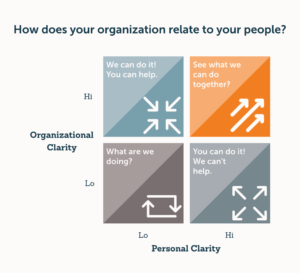
Relationship #1: “What are we doing?”

When organizational clarity is low, the organization may help people, but without a clear vision, its leaders’ hope for the future defaults to merely engaging more people. Likewise, when personal clarity is also low, an individual may be loyal to the organization while it delivers what he or she likes. But without a clear vision, the individual defaults to seeking personal gratification, even if it is defined in spiritual terms.

No matter what good things might be happening in the organization, when organizational clarity and personal clarity are both low, the organization has gotten stuck in “preservation mode.” No organization starts out this way. There was always a fire, a zeal, a cause that people took a risk to make real. But it’s common for organizations to become victims of their own success. With so much to keep track of and with so many people who joined for different reasons than those at the beginning, it becomes hard to remain clear on what the organization does and why and how it does it. Under these conditions, the unconscious, default vision for both the organization and its people is “keep what we like and get more of it.” Together they spin in circles.

Relationship #2: “We can do it! You can help.”

When organizational clarity is high, the organization has a compelling discipleship vision and a robust capacity to form believers accordingly. Yet it needs volunteers to make the machine run, so leaders recruit people to fill slots to keep producing. However, when personal clarity is low, individuals in the organization essentially become part cogs in the machine, part products that the organization manufactures. They are passive in the process even if they are busily involved with it.

Some individuals may resist the organization’s vision because it threatens to upset the place, people, and programs they hold dear. Some like the vision in principle but keep their distance in practice. Many, however, wholeheartedly embrace the organization’s vision as their own, which is exactly what leaders hope will happen.

Unfortunately, when people confuse the organization’s calling with their personal calling, over time they frequently lose interest, lose faith, or lose heart. They joined the organization’s cause by filling a slot where volunteers are needed, because they have been persuaded that it is what Christ wants them to do. But in time they get restless because they come to feel like a square peg in a round hole or burned out because they don’t get fueled and impassioned by what they are doing.

Others are more content with their service. They get acknowledged and rewarded for serving in the same volunteer role for 20 or 30 years. But sometimes you may wonder, “Have we let this person down? Is it really God’s will for this person to stay in the same function all that time? Or have we kept the person in the place that was convenient for us?”

When organizational clarity is high but personal clarity is low, the organization often unintentionally, unknowingly manipulates people into positions they have no business committing to because they do not accord with their divine design. Or they keep them in positions forever that they can never leave. Volunteers become victims of the organization’s success, and sometimes they flake away feeling used. In the end, the organization is stuck in “direction mode”—that is, because it is so sure of its direction, it is equally sure about how to direct others. Ironically, organizations fail to reach the disciple-making goals they sincerely believe in because they subtly come to count their people more as human resources than as individuals on unique journeys with God.

Relationship #3: “You can do it! We can’t help.”

When organizational clarity is low but personal clarity is high, the organization is blessed with individuals who attempt to bring their passion and personal clarity to the organization. The problem is that the organization’s leaders don’t know how the individual’s dream fits with the organization because it doesn’t know how anything fits. The consistent justification for the activities it does is that it is in the habit of doing them. So leaders are often thrilled at first by the energy and vision of the new person, but the good times don’t last.

For example, the organization may want the leader to channel her talent into a neat, prefabricated box of volunteering. But if the person persists in pursuing the unique vision God gave her and cannot find a home for it in the organization, she will eventually redirect her service, money, and time away from the organization that she used to give there.

Sometimes this happens in the name of being “missional.” An organization sees itself as succeeding when it urges its people to follow their respective callings out into the world, but it provides them no support or equipment to succeed in mission there. It may desire to be a great “sending” church, but its impact isn’t sustained as individuals get exhausted without the help of the body of Christ.

Alternatively, the organization may embrace multiple driven, dynamic leaders, but their visions are incompatible. Like vandals spraying graffiti, they make great art, but they paint where they don’t belong. As each one tries to steer the organization according to their own passion, conflict erupts or else the organization breaks down into disunited, self-contained silos. In all these scenarios, the organization is stuck in “permission mode,” allowing people to function but seeing scant impact because of wasted, contradictory, and unsustained energy.

Relationship #4: “See what we can do together?”

When both organizational and personal clarity are high, the organization functions as an Olympic team. It recruits, trains, and equips people to be world-class leaders, devoted to the same goal of success in obeying the Great Commission. Each individual is a champion, both performing solo and contributing in community in a variety of ways according to their unique talents.

When both personal and organizational clarity share first place, individuals pursuing God’s dream for them and the organization pursuing God’s dream for it are not an either-or choice but a both-and reality. Both individual uniqueness and organizational unity are at a maximum. The organization sees the irreplaceable value of each individual, and the individuals recognize that without the organization, they will not fully live out God’s calling on their lives. Each side is fueled and renewed by the other’s success, an ongoing, upward spiral.

When an organization is in “mobilization mode,” even when God does lead an individual on from the organization, the person isn’t considered to be lost but to be sent. When an organization equally prioritizes clarity for itself and clarity for its people, both realize their calling and the blessing of making an impact that resonates far into the future.

Productive collision

I encountered a great illustration of this principle when one of my daughters studied chemistry. In chemistry, a productive collision occurs when the correct side of one molecule smashes into the correct side of another with enough energy to burst their molecular bonds and re-form into something new. When an oxygen molecule is part of the collision, it releases a great deal of energy. This is called combustion, commonly experienced as fire.

When breakthrough clarity both for an organization and for individuals collide productively, they combine into something much stronger than either of them alone, and they unleash extraordinary energy, power, and movement. In short, when an organization and its people both know their special callings from God, the collision lights a fire for him that cannot be quenched.

> Read more from Kelly.


Download PDF

Tags: , , ,

| What is MyVisionRoom? > | Back to Vision >

ABOUT THE AUTHOR

Kelly Kannwischer

Kelly Kannwischer

Kelly has spent her vocational life as a not-for-profit executive, consultant and development professional. Former to becoming the CEO of Younique, Kelly founded OptUp Consulting, served THINK Together as the Chief Engagement Officer, and led Vanguard University as a Vice President and President of the Vanguard University Foundation. Kelly graduated from the University of Virginia and earned her Masters degree from Princeton Theological Seminary. She is married to Rev. Dr. Richard Kannwischer and is the proud mother of Danica (age 15) and Ashby (age 13).

See more articles by >

COMMENTS

What say you? Leave a comment!

Recent Comments
comment_post_ID); ?> Thank you for this information. I'm going to use this article to improve my work with the Lord.
 
— Abel Singbeh
 
comment_post_ID); ?> Thank you Ed for sharing your insights into the Church Growth Movement. I have my reservations with Church Growth models because it has done more damage than good in the Body of Christ. Over the years, western churches are more focused on results, formulas and processes with little or no emphasis on membership and church discipline. Pastors and vocational leaders are burnt out because they're overworked. I do believe that the Church Growth model is a catalyst to two destructive groups: The New Apostolic Reformation and the Emerging Church. Both groups overlap and have a very loose definition. They're both focus on contemporary worship, expansion of church brand (franchising), and mobilizing volunteering members as 'leaders' to grow their ministry. Little focus on biblical study, apologetics and genuine missional work with no agenda besides preaching of the gospel.
 
— Dave
 
comment_post_ID); ?> Thank you for sharing such a good article. It is a great lesson I learned from this article. I am one of the leaders in Emmanuel united church of Ethiopia (A denomination with more-than 780 local churches through out the country). I am preparing a presentation on succession planning for local church leaders. It will help me for preparation If you send me more resources and recommend me books to read on the topic. I hope we may collaborate in advancing leadership capacity of our church. God Bless You and Your Ministry.
 
— Argaw Alemu
 

Clarity Process

Three effective ways to start moving toward clarity right now.

Stop Spreading Your Time Too Thin

Calendars fill up quickly. If leaders don’t manage their calendars then their calendars will manage them. In my view, one of the most important decisions leaders makes is how to plan their work. Do they just react to what comes their way or do they proactively plan how they will lead and create? Meetings, emergencies, and time with people are a given. But what about preparing messages, planning ahead, and crafting direction? Some leaders set large blocks of time for that work while others attempt to “squeeze that work in” to their busy schedules.

I have learned that it is significantly more fruitful to intentionally place large chunks of time on the weekly calendar for preparation. In other words, the “blocks of time” have to be planned and protected. I have learned that:

  • One five-hour block of message prep is significantly more productive that five one-hour blocks.
  • One four-hour block of advanced planning is significantly more fruitful than eight 30-minute sessions in-between emails and meetings.

Here are 4 reasons leaders need large blocks of time (such as 3-5 hours of uninterrupted focus):

1. To maximize deep work.

In his book Deep Work, Cal Newport describes deep work as “a state of distraction-free concentration that pushes your cognitive capabilities to their limit. These efforts create new value, improve your skill, and are hard to replicate.” In other words, there is a place where you can go mentally that is hard to reproduce. I have heard leaders, writers, and preachers call it “the zone” or “being locked in,” but all speak about the sacredness of those moments, the amount of work that is accomplished, and the desire to not to get up from the desk because you don’t want the moment to end. Those moments of “deep work” cannot be microwaved; they take time.

2. To train yourself to not live and lead reactively.

There is always something to react to as a leader, always a problem to solve, always a question to answer, and always a correspondence to respond to. If you don’t block off time, you can easily spend your day just responding and not proactively leading.

3. To help others lead proactively.

Just as it is healthy for leaders to train themselves to not continually live in chaotic, reactive mode, it is healthy for their teams to also know they don’t have to, and shouldn’t, lead that way either. A leader who leads proactively teaches the team to do so and thus reduces chaos for the entire organization.

4. To encourage your team to solve problems without you.

A leader who loves to be, or needs to be, in every decision trains the team to not solve problems or make decisions without the leader. But a leader who is inaccessible for “large blocks of time” encourages the team to solve problems on their own. “Deep work” is good for the leader and the team.

> Read more from Eric.


Let’s talk! Connect with an Auxano Navigator for more information.

Download PDF

Tags: , , , ,

| What is MyVisionRoom? > | Back to Execution >

ABOUT THE AUTHOR

Eric Geiger

Eric Geiger

Eric Geiger is the Senior Pastor of Mariners Church in Irvine, California. Before moving to Southern California, Eric served as senior vice-president for LifeWay Christian. Eric received his doctorate in leadership and church ministry from Southern Seminary. Eric has authored or co-authored several books including the best selling church leadership book, Simple Church. Eric is married to Kaye, and they have two daughters: Eden and Evie. During his free time, Eric enjoys dating his wife, taking his daughters to the beach, and playing basketball.

See more articles by >

COMMENTS

What say you? Leave a comment!

Recent Comments
comment_post_ID); ?> Thank you for this information. I'm going to use this article to improve my work with the Lord.
 
— Abel Singbeh
 
comment_post_ID); ?> Thank you Ed for sharing your insights into the Church Growth Movement. I have my reservations with Church Growth models because it has done more damage than good in the Body of Christ. Over the years, western churches are more focused on results, formulas and processes with little or no emphasis on membership and church discipline. Pastors and vocational leaders are burnt out because they're overworked. I do believe that the Church Growth model is a catalyst to two destructive groups: The New Apostolic Reformation and the Emerging Church. Both groups overlap and have a very loose definition. They're both focus on contemporary worship, expansion of church brand (franchising), and mobilizing volunteering members as 'leaders' to grow their ministry. Little focus on biblical study, apologetics and genuine missional work with no agenda besides preaching of the gospel.
 
— Dave
 
comment_post_ID); ?> Thank you for sharing such a good article. It is a great lesson I learned from this article. I am one of the leaders in Emmanuel united church of Ethiopia (A denomination with more-than 780 local churches through out the country). I am preparing a presentation on succession planning for local church leaders. It will help me for preparation If you send me more resources and recommend me books to read on the topic. I hope we may collaborate in advancing leadership capacity of our church. God Bless You and Your Ministry.
 
— Argaw Alemu
 

Clarity Process

Three effective ways to start moving toward clarity right now.

Why is Breakthrough So Elusive?

In this inaugural episode, Will Mancini, founder of Auxano sits down with My Ministry Breakthrough host, and Auxano Lead Navigator, Bryan Rose, to unpack the concept behind “breakthrough clarity” in the mission statement of Auxano.

> Listen to the podcast here.

When it comes to crafting church vision and casting church vision, the tunnel of chaos is unavoidable. But by moving through the church conflicts, volunteer leadership issues, and congregational governance challenges, pastors can achieve church vision that is clear, concise, compelling and catalytic to everyone in their congregation. Will and Bryan also discuss the origin story of Auxano and the importance of slowing down in order to speed up ministry effectiveness.

You can read more from Will Mancini in his two groundbreaking books on church vision clarity: God Dreams and Church Unique.

Learn more about Auxano and schedule a vision clarity conversation here.

Download PDF

Tags: , , ,

| What is MyVisionRoom? > | Back to Vision >

ABOUT THE AUTHOR

Bryan Rose

Bryan Rose

As Lead Navigator for Auxano, Bryan Rose has a strong bias toward merging strategy and creativity within the vision of the local church and has had a diversity of experience in just about every ministry discipline over the last 12 years. With his experience as a multi-site strategist and campus pastor at a 3500 member multi-campus church in the Houston Metro area, Bryan has a passion to see “launch clarity” define the unique Great Commission call of developing church plants and campus, while at the same time serving established churches as they seek to clarify their individual ministry calling. Bryan has demonstrated achievement as a strategic thinker with a unique ability to infuse creativity into the visioning process while bringing a group of people to a deep sense of personal ownership and passion.

See more articles by >

COMMENTS

What say you? Leave a comment!

Recent Comments
comment_post_ID); ?> Thank you for this information. I'm going to use this article to improve my work with the Lord.
 
— Abel Singbeh
 
comment_post_ID); ?> Thank you Ed for sharing your insights into the Church Growth Movement. I have my reservations with Church Growth models because it has done more damage than good in the Body of Christ. Over the years, western churches are more focused on results, formulas and processes with little or no emphasis on membership and church discipline. Pastors and vocational leaders are burnt out because they're overworked. I do believe that the Church Growth model is a catalyst to two destructive groups: The New Apostolic Reformation and the Emerging Church. Both groups overlap and have a very loose definition. They're both focus on contemporary worship, expansion of church brand (franchising), and mobilizing volunteering members as 'leaders' to grow their ministry. Little focus on biblical study, apologetics and genuine missional work with no agenda besides preaching of the gospel.
 
— Dave
 
comment_post_ID); ?> Thank you for sharing such a good article. It is a great lesson I learned from this article. I am one of the leaders in Emmanuel united church of Ethiopia (A denomination with more-than 780 local churches through out the country). I am preparing a presentation on succession planning for local church leaders. It will help me for preparation If you send me more resources and recommend me books to read on the topic. I hope we may collaborate in advancing leadership capacity of our church. God Bless You and Your Ministry.
 
— Argaw Alemu
 

Clarity Process

Three effective ways to start moving toward clarity right now.

Life Design Essential #1: Uncover the Only You

We live in a world where every artificial thing is designed. Whether it is the car we ride in, the streets we drive on, the lights that illuminate the road, or the building that is our destination, some person or group of people had to decide on the layout, operation, and mechanisms of the journey described above.

Your life has a design, too.

Design doesn’t just work for cars and roads and streetlights and buildings, and all the hundreds of thousands of components that make those things up. You can use design thinking to discover the life God has uniquely created for you. It is a life that is meaningful, joyful, and fulfilling.

Several years ago, Auxano founder Will Mancini launched Life Younique, a training company that certifies church leaders to offer gospel-centered life design through their church. Will, along with co-founder Dave Rhodes, is passionate about helping people get life mission right – what exactly is the best way to know and name what God has created you to do?

THE QUICK SUMMARY – The Rhythm of Life by Matthew Kelly

In The Rhythm of Life Matthew Kelly exposes the lifestyle challenges and problems that face us in this age obsessed with noise, speed, and perpetual activity. Kelly’s message rings out with a truth that is challenging and unmistakably attractive Who you become is infinitely more important than what you do, or what you have. Are you ready to meet the best version of yourself?

The Rhythm of Life is a brilliant and clear-eyed rejection of the chaotic lifestyle that has captured the world, written with common sense, humor, and extraordinary insight. This book is destined to change lives.

A SIMPLE SOLUTION

What is the brief and bold big idea that best captures today what God made you to do?

Think of it as a golden compass pointing the way or a silver golden thread that weaves through every activity of your life. It’s the enduring rally cry of team-you; it’s the victory banner waving over everything you do.

Ideally, every priority, project, and penny is filtered through, guided by and championed through this concept. Imagine every person in your sphere of influence being blessed better, served stronger, and loved longer because you form a unique life mission every day.

Translate a wide variety of life-awareness and self-awareness into a meaningful, practical, and simple understanding of what God has made only you to do.

Who you become is infinitely more important than what you do or what you have. The meaning and purpose of life is for you to become the best version of yourself.

In the diagram below, Point A represents you right now – here and today – with all your strengths and weaknesses, faults, failings, flaws, defects, talents, abilities, and potential.

Point B represents you as the person you were created to be – perfectly. If you close your eyes for a few moments and imagine the better person you know you can be in any areas of your life, and then multiply that vision to include the better person you know you can be in every area of your life, that is the person you have become when you reach point B – the best version of yourself.

At every point along the path closer to point B, we more fully recognize, appreciate, and use our talents and abilities and are more dedicated to our development – physically, emotionally, intellectually, and spiritually.

At each point along the path toward point B, there is a more harmonious relationship among our needs, desires, and talents. Through this process of transformation, we begin to reach our once hidden potential. At point B, through the dual process of self-discovery and discovery of God, we have overcome our fears and transformed our faults and failings into virtues.

Matthew Kelly, The Rhythm of Life

A NEXT STEP

Duplicate the drawing above on a chart tablet. Add the four words “Physically, Emotionally, Intellectually, and Spiritually” above the line between Point A and Point B.

Below the line, and under each of the words, write in actions that will help you move towards Point B. These are the best things you can do for your spouse, your children, your friends, your colleagues, your employees, your employer, your church, your nation, the human family, and yourself.

The best thing you can do is to become the-best-version-of-yourself, because it is doing with a purpose.

Excerpt taken from SUMS Remix 101-1, released September 2018.


This is part of a weekly series posting excerpts from one of the most innovative content sources in the church world: SUMS Remix book excerpts for church leaders.

Each issue SUMS Remix takes a practical problem in the church and looks at it with three solutions; each solution is taken from a different book. Additionally, a practical action step is included with each solution.

As a church leader you get to scan relevant books based on practical tools and solutions to real ministry problems, not just by the cover of the book. Each post will have the edition number which shows the year and what number it is in the overall sequence. (SUMS Remix provides 26 issues per year, delivered every other week to your inbox). 

>> Subscribe to SUMS Remix <<


Download PDF

Tags: , , , , ,

| What is MyVisionRoom? > | Back to Vision >

ABOUT THE AUTHOR

VRcurator

VRcurator

Bob Adams is Auxano's Vision Room Curator. His background includes over 23 years as an associate/executive pastor as well as 8 years as the Lead Consultant for a church design build company. He joined Auxano in 2012.

See more articles by >

COMMENTS

What say you? Leave a comment!

Recent Comments
comment_post_ID); ?> Thank you for this information. I'm going to use this article to improve my work with the Lord.
 
— Abel Singbeh
 
comment_post_ID); ?> Thank you Ed for sharing your insights into the Church Growth Movement. I have my reservations with Church Growth models because it has done more damage than good in the Body of Christ. Over the years, western churches are more focused on results, formulas and processes with little or no emphasis on membership and church discipline. Pastors and vocational leaders are burnt out because they're overworked. I do believe that the Church Growth model is a catalyst to two destructive groups: The New Apostolic Reformation and the Emerging Church. Both groups overlap and have a very loose definition. They're both focus on contemporary worship, expansion of church brand (franchising), and mobilizing volunteering members as 'leaders' to grow their ministry. Little focus on biblical study, apologetics and genuine missional work with no agenda besides preaching of the gospel.
 
— Dave
 
comment_post_ID); ?> Thank you for sharing such a good article. It is a great lesson I learned from this article. I am one of the leaders in Emmanuel united church of Ethiopia (A denomination with more-than 780 local churches through out the country). I am preparing a presentation on succession planning for local church leaders. It will help me for preparation If you send me more resources and recommend me books to read on the topic. I hope we may collaborate in advancing leadership capacity of our church. God Bless You and Your Ministry.
 
— Argaw Alemu
 

Clarity Process

Three effective ways to start moving toward clarity right now.

Great Teams Need Great FollowUp Emails

Conducting a successful vision planning retreat takes courage, investment, and trust. First, courage is required to make a conviction-driven ask of your leaders to collaborate and fully engage in a conversation about God’s better future for your church. Second, an investment is required, because the commitment of time and financial resources to a visionary plan brings a necessary and natural accountability to the congregation. Last, trust is needed because inviting others into the vision conversation might involve receiving outside perspectives and handling honest input.

However, just conducting a successful retreat is not enough. The real power of a visionary plan like the Horizon Storyline lies within the successful execution of your initial set of 90-day initiatives. This first-foreground horizon usually provides the momentum toward overall plan accomplishment. Therefore it is of vital importance to communicate progress to your entire leadership team, especially those on the front lines of action and activity.

The following outline provides the general framework of a quick visionary plan progress report. You can see how it also works to affirm the team and even enlist more significant commitment if needed. The flow of a great 90-day initiative follow-up email goes something like this:

  1. Tell the team how thankful you are for them.
  2. Affirm the lasting impact of their efforts.
  3. Share a story in 2-3 sentences that demonstrates impact.
  4. Give an honest and high-level overview of the current status.
  5. Summarize progress on each in only one sentence.
  6. Affirm the staff and/or lay leader for each initiative.
  7. (A) – Close with another brief, meaningful word of thanks.

-or-

    7. (B) –  Circle back around to ONE initiative that needs help.
  1. Expand on the need with 2-3 sentences of detail.
  2. Make a clear ask from your leaders.
  3. If there is not something to do, then you should’ve ended the email at 7(A) above.
  4. Encourage engagement by affirming the 5-10 year vision.
  5. Close with another brief, but challenging word of thanks.

Here is a great example I recently received that uses many of the elements and the flow. This email was sent from an Auxano client-pastor (names and core content has been changed for privacy reasons) and illustrates a great 90-day initiative progress report email:

Greetings visioning team!

I’m pleased to report that the Elders have unanimously adopted our work without redaction. Thank you to Vince who worked with me to present the whole as a unified piece. All of your hard work was met with resounding excitement, thanks again for your time and thoughtful engagement. 

One of the Elders in attendance was able to clearly articulate their excitement about what is next, and apply it to her life and the potential impact on her neighbors. She affirmed this direction and will commit to engaging alongside each of us. 

Our meeting focus was on the short-range vision proper: the one year horizon and the 90-day initiatives. We broke up into teams to work on those five components, which gave everyone an opportunity to get their hands into activating this vision rather than just talking about it. There was positive energy and we have some momentum. On Tuesday, August 13, the Elders will meet for an extended deep dive into the background “big Ideas” and develop the 90 day pieces. Until then they will be chewing on our work and they may ask you some questions.

We still have some next step assignments to do from our Auxano Vision Framing sessions. Please make sure to get to work on these and feel free to invite current elders and others on the visioning team into your conversations. Our first round of 90-day initiative work is due by the end of September. Please see the below list for particulars on the assignments before us, as well as who is doing what. 

Cindy is the point leader for “Create a Stop Doing list”  – This needs immediate attention and must be handled carefully as some ministries with great impact years ago need to be phased out. 

Gordon is the point leader for “First Neighborhood Connection Event” – This will happen by the end of the month in my neighborhood.

Joseph is the point leader for “Fall Vision Frame Roll-Out Plan” – We have carved out 5 Sundays from late September into early October to communicate in worship and small groups. 

Mary is the point leader for “Celebrate Children & Youth” – We are coming off a strong summer and have been collecting stories at Bible School, Youth Camp and Children’s Camp, look for more here soon.

I’ll be working most closely with Joseph, but please keep me in the loop on the others and I’ll check in with you. We need a couple more of you to weigh in on the “Stop Doing List” – who can jump on a call with Cindy next Monday during lunch?

To keep our work in one place, and so we can check in with each other easily (hopefully), I’ve sent each of you an invitation to the communication tool we use at the church office: SLACK. This allows us to chat, and load and work on documents collaboratively. If this does not work, please let me know!

Thanks to each of you for the work you’ve put in thus far. Once we’ve completed this next phase, likely we’ll be in a good place to appoint a new visioning team and to give the congregation an opportunity to celebrate what each of you have put into this. I’m so grateful for each of you, and have appreciated getting to know you more through this process.

Grace and Peace,
Pastor 
PS – This progress report email flow is not restricted to just the Horizon Storyline follow-up. Anytime as a pastor, you have asked leaders to work toward a common goal – and they have responded – excellent communication is critical. Where can you apply this flow in the next 2 weeks to communicate success and appreciate your leaders?
> Read more from Bryan.

Want to know more? Connect with an Auxano Navigator to learn about visionary planning!
Download PDF

Tags: , , , ,

| What is MyVisionRoom? > | Back to Vision >

ABOUT THE AUTHOR

Bryan Rose

Bryan Rose

As Lead Navigator for Auxano, Bryan Rose has a strong bias toward merging strategy and creativity within the vision of the local church and has had a diversity of experience in just about every ministry discipline over the last 12 years. With his experience as a multi-site strategist and campus pastor at a 3500 member multi-campus church in the Houston Metro area, Bryan has a passion to see “launch clarity” define the unique Great Commission call of developing church plants and campus, while at the same time serving established churches as they seek to clarify their individual ministry calling. Bryan has demonstrated achievement as a strategic thinker with a unique ability to infuse creativity into the visioning process while bringing a group of people to a deep sense of personal ownership and passion.

See more articles by >

COMMENTS

What say you? Leave a comment!

Recent Comments
comment_post_ID); ?> Thank you for this information. I'm going to use this article to improve my work with the Lord.
 
— Abel Singbeh
 
comment_post_ID); ?> Thank you Ed for sharing your insights into the Church Growth Movement. I have my reservations with Church Growth models because it has done more damage than good in the Body of Christ. Over the years, western churches are more focused on results, formulas and processes with little or no emphasis on membership and church discipline. Pastors and vocational leaders are burnt out because they're overworked. I do believe that the Church Growth model is a catalyst to two destructive groups: The New Apostolic Reformation and the Emerging Church. Both groups overlap and have a very loose definition. They're both focus on contemporary worship, expansion of church brand (franchising), and mobilizing volunteering members as 'leaders' to grow their ministry. Little focus on biblical study, apologetics and genuine missional work with no agenda besides preaching of the gospel.
 
— Dave
 
comment_post_ID); ?> Thank you for sharing such a good article. It is a great lesson I learned from this article. I am one of the leaders in Emmanuel united church of Ethiopia (A denomination with more-than 780 local churches through out the country). I am preparing a presentation on succession planning for local church leaders. It will help me for preparation If you send me more resources and recommend me books to read on the topic. I hope we may collaborate in advancing leadership capacity of our church. God Bless You and Your Ministry.
 
— Argaw Alemu
 

Clarity Process

Three effective ways to start moving toward clarity right now.

3 Unpardonable Sins of the Guest Experience

Some of your visitors are looking for reasons not to return.

These guests are difficult to please. If they look for the flaws in your church, they will find them. There are no perfect churches, and pleasing everyone is impossible.  Do your best to love everyone, but the prospect of chasing people who are intent to run is usually a futile process.

Some of your visitors are looking for reasons to stay.

These guests are looking for a few things that are important to them, such as friendship, spiritual growth, help in a crisis, or a healthy environment for their kids. If they find a few things they care most about, they will overlook a few less than ideal aspects of your church.

In fact, it’s amazing how forgiving people can be if you treat them well as a person.

The musicians on your worship team may not be world class, or perhaps you don’t have enough parking, or maybe your student ministry isn’t what you want it to be. But if you treat people well they are usually pretty forgiving.

This is not an excuse to ignore the things that need attention, but it’s enough grace to know that you can still do great ministry while you work on what needs to be improved.

First time guests and people new to your church will give lots of grace for the flaws and shortcomings if you treat them with:

  • Kindness
  • Respect
  • Love

But there are some things people who are new to your church will not forgive. These are mistakes you cannot afford to make.

3 Experiences Guests Won’t Forgive:

1) If you treat their kids as a program to be managed rather than kids to be loved.

Structure can beat out spirit, and the programs and processes can become more important than the person.

This can happen in any ministry in your church, but there is little to no grace when it comes to people’s kids.

I’m willing to bet that the heart of your church is about life change, meaning, and real spiritual transformation through Christ. You want to see the children love Jesus and enjoy church!

But here’s where it breaks down. If you begin to make your children’s ministry easier on the staff and volunteer leaders by making it more difficult for the parents and kids, you are making a big mistake. You’d never do that on purpose, but it happens.

The leaders must always absorb the pressure, not the guests.

If the kids become a number in the check-in process or are scolded more than encouraged because they didn’t behave just right, or there are so many rules that it’s impossible to keep up with, it’s highly unlikely that the new families will return.

2) If you treat the adults in any way “less than.”

Most reasonable adults are pretty resilient. As I’ve said, they understand there is no perfect church. But if you treat them poorly as a person, you don’t get a second chance.

One thing that’s easy to forget is that even though someone may be spiritually unresolved or disconnected, they are still usually spiritually sensitive.

If the pastor says something that makes a person feel spiritually foolish, or an usher or greeter treats someone with disrespect, they won’t give you a second chance.

We can’t live on pins and needles worrying about offending everyone, but we can do our best to serve with intentional love and grace.

I remember several years ago trying to help a young mom tend to her crying baby in church. I did my best to be kind and respectful, but I inadvertently offended her by asking her to take her child to the nursery. Maybe I could have done a better job, or perhaps it was a no-win situation, but the result was she was upset and said she’d never come back.

Most of these situations are nuanced and unintentional, but it’s so important to do our best to treat our guests with love, respect, and kindness.

3) If you treat any guest with an eye to get more than you give.

It might seem nearly impossible for a church team to treat any guest in such a way where that person felt like you wanted more from them than for them. But once again, this is easier than it sounds.

Church leaders are often under pressure. They are under pressure for things like more volunteers, larger offerings, and support in general for the vision and direction of the church.

For example, if a church is hurting for more volunteers, they can put pressure on people, including guests, to sign up.

When pressure (or even guilt) is employed rather than inspiration and encouragement, you have fallen into the mistake of wanting more from the people than for them. Your guests have no appetite for that.

Another example might be if a church is behind in the budget. That can sometimes “leak” out in a sermon, or during the time to receive the offering. This kind of pressure makes it feel like the church wants more from the person than for them. If this is what your guests experience, they are not likely to return.

Kindness, respect, and love will always help you treat people well.

> Read more from Dan.


Want to know more about Guest Experiences at your church? Let’s talk! Connect with an Auxano Navigator here.

Download PDF

Tags: , , , , ,

| What is MyVisionRoom? > | Back to Execution >

ABOUT THE AUTHOR

Dan Reiland

Dan Reiland

Dr. Dan Reiland serves as Executive Pastor at 12Stone Church in Lawrenceville, Georgia. He previously partnered with John Maxwell for 20 years, first as Executive Pastor at Skyline Wesleyan Church in San Diego, then as Vice President of Leadership and Church Development at INJOY. He and Dr. Maxwell still enjoy partnering on a number of church related projects together. Dan is best known as a leader with a pastor's heart, but is often described as one of the nations most innovative church thinkers. His passion is developing leaders for the local church so that the Great Commission is advanced.

See more articles by >

COMMENTS

What say you? Leave a comment!

Recent Comments
comment_post_ID); ?> Thank you for this information. I'm going to use this article to improve my work with the Lord.
 
— Abel Singbeh
 
comment_post_ID); ?> Thank you Ed for sharing your insights into the Church Growth Movement. I have my reservations with Church Growth models because it has done more damage than good in the Body of Christ. Over the years, western churches are more focused on results, formulas and processes with little or no emphasis on membership and church discipline. Pastors and vocational leaders are burnt out because they're overworked. I do believe that the Church Growth model is a catalyst to two destructive groups: The New Apostolic Reformation and the Emerging Church. Both groups overlap and have a very loose definition. They're both focus on contemporary worship, expansion of church brand (franchising), and mobilizing volunteering members as 'leaders' to grow their ministry. Little focus on biblical study, apologetics and genuine missional work with no agenda besides preaching of the gospel.
 
— Dave
 
comment_post_ID); ?> Thank you for sharing such a good article. It is a great lesson I learned from this article. I am one of the leaders in Emmanuel united church of Ethiopia (A denomination with more-than 780 local churches through out the country). I am preparing a presentation on succession planning for local church leaders. It will help me for preparation If you send me more resources and recommend me books to read on the topic. I hope we may collaborate in advancing leadership capacity of our church. God Bless You and Your Ministry.
 
— Argaw Alemu
 

Clarity Process

Three effective ways to start moving toward clarity right now.