The 10 Best Teams Ever Assembled (and What We Can Learn From Them)

No man is an island. From time to time, we all find we’ve gone as far as we can go on our own. Therein lays the beauty of teamwork: a helping hand to pick you up and see you through to the end. To celebrate the joy of working together, we’ve compiled the definitive list of the best teams ever assembled, along with what each of them has to teach us. We made our picks from all walks of life, from sports to space and from fictional to factual. Enjoy.

As another summer Olympics came and went, there were rumblings about this year’s U.S. men’s basketball team being the best ever. To all such Lakers shooting guards we say, we’re gonna let you finish but the Dream Team was the greatest basketball team ever assembled. The 1992 team’s roster reads like a list of the greatest NBA players ever: Michael Jordan, Larry Bird, Magic Johnson, Patrick Ewing, Karl Malone, Charles Barkley. The Dreams won every game by an average of 40 points on their way to gold. So sorry, Kobe; there will only ever be one true Dream Team.

What we can learn from them: A practice game loss to a group of college players reminded the Olympians (and us) that motivation and hustle can overcome talent any time.

Sherlock Holmes and Dr. Watson:

It’s been 85 years since the last work was published and this crime-solving duo remains one of the most popular literary teams ever. Sure, Holmes was the best crime-solver ever, but it was the way he solved them that made him great. Never seeking recognition for his genius, quietly thwarting horrible crimes or saving entire governments, almost none of London’s other inhabitants knew the man at 221B Baker Street was one of the greatest minds the world has ever seen. Without Watson tagging along and documenting his cases, we never would have known it either.

What we can learn from them: There is no such thing as a self-made man.

Rogers and Hammerstein:

Name your favorite musical; odds are these guys wrote it. The coming-together of these two musical virtuosos resulted in a 16-year partnership that produced instant classics like Oklahoma!State Fair,South PacificThe King and I, and The Sound of Music. For their work, they received a staggering 34 Tonys, 15 Academy Awards, two Grammys, and a Pulitzer Prize. They were recently named to a list of top-earning deceased celebrities, proving America’s love of their work has not faded in the half a century since their last collaboration.

What we can learn from them: Rogers and Hammerstein perfected their team dynamic: each had an extraordinary talent to which the other deferred. As Hammerstein once said, “I hand him a lyric and get out of his way.”

SEAL Team Six:

This is the only team on our list whose ranks are regularly changing, as old members leave and new ones join. It’s also the only team that doesn’t officially exist. The black operatives in this super-secret group (which is formally called the United States Naval Special Warfare Development Group) can swim hundreds of feet with their hands and feet bound and are trained to withstand arctic temperatures and tear gas. As one author put it, the SEALs are the Navy’s elite, and Team Six are the SEALs’ elite. On May 2, 2011, the team cemented their spot as some of the greatest soldiers in history by killing America’s Public Enemy Number One, Osama bin Laden.

What we can learn from them: They’re living testaments to what the human body can do.

The Beatles:

It’s so cliche to call The Beatles the best band ever. It’s also quite true. The influence of the music made by John Lennon, Paul McCartney, George Harrison, and Ringo Starr on music and culture cannot be overstated. They were more than the sum of their individual parts, as some of their future projectswould come to prove. Apart, Lennon and McCartney were good; together, with McCartney providing the poppy, light optimism and Lennon the searching, contemplative depth, they made music that will never be forgotten.

What we can learn from them: All good things, even the best things, must come to an end.

1985 Chicago Bears:

On their way to beating the Patriots so badly in Super Bowl XX that Patriots player Ron Wooten compared his team to the Washington Generals, the ’85-’86 Bears stomped everyone in the league except the Dolphins and Dan Marino, the Bears’ only loss of the year. There were William “The Refrigerator” Perry playing both sides of the ball, the legendary Walter Payton at running back, the solid Jim McMahon at QB, and the speedy Willie Gault at receiver. With a suffocating defense that gave up only 198 points all season (compared to the 456 points the offense put up), the Bears shuffled their way past the undefeated 1972 Dolphins to the spot of best NFL team ever.

What we can learn from them: It’s not bragging if you can really do it.

The Justice League:

If we had room for two superhero teams on this list, The Avengers would fill that second slot. But as it stands, the Justice League of America (JLA) gets our nod as the greatest group of supers ever put to paper (and later to film, many, many times). DC Comics’ team brings to the world-saving table Superman’s struggle for “truth, justice, and the American way;” Batman’s take-one-for-the-team nobility; Green Lantern’s handy jewelry; and Aquaman’s, um, super-amazing breaststroke skills. Besides, JLA could beat the Avengers in a fight.

What we can learn from them: In their first fight as a team against the Appelaxian warriors, the JLA members learned they had to work together to win. Ergo, killing aliens is easiest in teams.

The Apollo 11 team:

Men walking on the Moon was one of the greatest moments in human history; a giant leap, if you will. And while Armstrong and Aldrin will always be the headliners of the accomplishment, they make up only about 0.0005% of the full Apollo 11 team. It took an estimated 400,000 scientists, engineers, and technicians to send them to our celestial neighbor, from the seamstresses who sewed 21 layers of fabric into each spacesuit to the contractors scattered across the country who had never made parts for space travel before. When the 400,000 watched the historic walk on TV on July 21, 1969, they each knew they’d been part of something special.

What we can learn from them: Even what seems like the most insignificant work on a team can be incredibly rewarding in the end.

The Not Ready for Primetime Players:

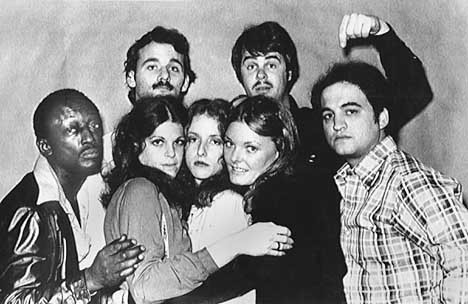
This young crop of comics and comediennes first appeared on live TV on Oct. 18, 1975. Although they started in the first season of Saturday Night Live as unknowns, by the end of the season, John Belushi, Chevy Chase, Dan Akroyd, Gilda Radner, Laraine Newman, Jane Curtis, and Garrett Morris were household names. And while other seasons’ casts have legitimate arguments as being a funnier ensemble, The Not Ready for Primetime Players paved the way. TV had never been edgier or more exciting week in and week out, and even today’s cast falls far short of bringing the public something it had never seen before.

What we can learn from them: Drugs are bad.

The Manhattan Project:

Although we now know the Nazis would not succeed in their efforts to build an atomic bomb, scientists and government officials in 1939 had no such knowledge. Driven by the shared realization that the very existence of the human race could be at stake, scientists from Europe and the U.S. answered the call to beat Hitler to the development of a nuclear weapon. This team of brilliant men like Ernico Fermi, J. Robert Oppenheimer, Leo Szilard, and Ernest O. Lawrence, and women like Leona Woods Marshall Libbyand Maria Goeppert Mayer ultimately won the war for the Allies and changed the course of history in the process.

What we can learn from them: Though top scientists are often hindered from collaboration by inflated egos, these men put aside nationalities and even genders, no small feat for a time when sexual discrimination was the norm, and united under a common cause.

 Read more here.
Download PDF

Tags: , ,

| What is MyVisionRoom? > | Back to Leadership >

ABOUT THE AUTHOR

Best Degrees

See more articles by >

COMMENTS

What say you? Leave a comment!

Recent Comments
comment_post_ID); ?> Thank you for this information. I'm going to use this article to improve my work with the Lord.
 
— Abel Singbeh
 
comment_post_ID); ?> Thank you Ed for sharing your insights into the Church Growth Movement. I have my reservations with Church Growth models because it has done more damage than good in the Body of Christ. Over the years, western churches are more focused on results, formulas and processes with little or no emphasis on membership and church discipline. Pastors and vocational leaders are burnt out because they're overworked. I do believe that the Church Growth model is a catalyst to two destructive groups: The New Apostolic Reformation and the Emerging Church. Both groups overlap and have a very loose definition. They're both focus on contemporary worship, expansion of church brand (franchising), and mobilizing volunteering members as 'leaders' to grow their ministry. Little focus on biblical study, apologetics and genuine missional work with no agenda besides preaching of the gospel.
 
— Dave
 
comment_post_ID); ?> Thank you for sharing such a good article. It is a great lesson I learned from this article. I am one of the leaders in Emmanuel united church of Ethiopia (A denomination with more-than 780 local churches through out the country). I am preparing a presentation on succession planning for local church leaders. It will help me for preparation If you send me more resources and recommend me books to read on the topic. I hope we may collaborate in advancing leadership capacity of our church. God Bless You and Your Ministry.
 
— Argaw Alemu
 

Clarity Process

Three effective ways to start moving toward clarity right now.

What to Do When You’re Burned Out

It happens to everyone sooner or later. You’re producing great work, everything seems to be running smoothly, and in short – you’re on fire. Then soon you feel the first pangs of that fire turning on you, and within a short while you’re running on empty.


When this happens, ideas don’t flow as easily, and everything you try seems to take much more effort than you have available. Yet you still have to produce. You have to deliver the results you’re being paid to produce, and there is little reprieve from the pressure of the create-on-demand world.

So what do you do when you’re burned out? How can you begin to reclaim your creative energy and get “back in the game”?

Step One: Admit that you’re overextended.

This is critical, because many people are too afraid to admit such a thing because it breaks the illusion of invulnerability. Sometimes we’d rather perpetuate that illusion than engage in the kind of honesty that helps us be more effective. It’s important to accept that you have limits.

Sometimes it’s also helpful to share how you feel with your manager, though if it’s a season in which everyone is overextended, you’re likely to get the “yeah, me too” glare. Still, teams that are able to have these kinds of conversations openly and honestly are less likely to have massive explosions of distrust and anger down the road. (If you’re a team leader, encourage people to have these kinds of conversations with you, as it helps you gauge team members’ expectations and true limits.)

Create an inventory of your current commitments, upcoming obligations, and anything else that demands your focus, time, and energy. Get a good sense for where you are, how you got there, and the true scope of your current situation.

Read the rest of the article from Todd here.

Download PDF

Tags: , , ,

| What is MyVisionRoom? > | Back to Leadership >

ABOUT THE AUTHOR

Todd Henry

See more articles by >

COMMENTS

What say you? Leave a comment!

Recent Comments
comment_post_ID); ?> Thank you for this information. I'm going to use this article to improve my work with the Lord.
 
— Abel Singbeh
 
comment_post_ID); ?> Thank you Ed for sharing your insights into the Church Growth Movement. I have my reservations with Church Growth models because it has done more damage than good in the Body of Christ. Over the years, western churches are more focused on results, formulas and processes with little or no emphasis on membership and church discipline. Pastors and vocational leaders are burnt out because they're overworked. I do believe that the Church Growth model is a catalyst to two destructive groups: The New Apostolic Reformation and the Emerging Church. Both groups overlap and have a very loose definition. They're both focus on contemporary worship, expansion of church brand (franchising), and mobilizing volunteering members as 'leaders' to grow their ministry. Little focus on biblical study, apologetics and genuine missional work with no agenda besides preaching of the gospel.
 
— Dave
 
comment_post_ID); ?> Thank you for sharing such a good article. It is a great lesson I learned from this article. I am one of the leaders in Emmanuel united church of Ethiopia (A denomination with more-than 780 local churches through out the country). I am preparing a presentation on succession planning for local church leaders. It will help me for preparation If you send me more resources and recommend me books to read on the topic. I hope we may collaborate in advancing leadership capacity of our church. God Bless You and Your Ministry.
 
— Argaw Alemu
 

Clarity Process

Three effective ways to start moving toward clarity right now.

3 Ways to Create a Successful Blog for Your Church

When it comes to reaching people on the Web, few online tools are more advantageous than a blog. A church communications blog can help you better disseminate your message, create stronger connections with church members, and drive more people to your church website. Yet many churches continue to shy away from setting up blogs either for general fear of the unknown or because they just don’t know where to begin.

Here’s the good news: Setting up a blog for your church doesn’t have to be intimidating or complex. In fact, setting up a blog for your church is quite easy. The hard part is getting – and keeping – your content rolling so you can enjoy all the benefits a blog has to offer. Here are a few practical tips for launching and maintaining a successful church communications blog.

Three Steps to Make Your Church Blog a Success

#1 Get Senior Leadership Buy-In

In order for your blog to be successful, church leaders must be on board. How do you get them on board? Use the facts. Explain the benefits of having a blog in a clear manner. Tell them a blog is no different than standing on stage on Sunday and speaking your message – it just happens to be online. Let them know a blog is another forum for making your church’s voice heard and getting your message across to more people.

Once they understand the benefits, they’ll want to know how the blog will function – and what role they will play. The key here is to let them know they will be involved without placing significant burden on their already-heavy workload. Set aside a chunk of time for the staff to brainstorm blog content ideas and create a blog-posting calendar. Let senior leaders know they will not be required to write blog posts (unless they want to), but they can still contribute ideas and direct the content of the blog.

#2 Encourage Contribution

While you don’t want to place the blogging burden on senior leaders, you will need help. You don’t want to go it alone. The more people who contribute to your church blog, the more successful it will be. More contributors increases the likelihood your church blog will keep chugging along and not fall by the wayside in the months to come. The key to getting people to contribute is making it as easy as possible.

Install a simple way for staff members to submit blog content ideas or even posts they’ve written. Create an easy-to-remember email address (for example: blogideas@abcchurch.com) where staff members can submit their suggestions or drafted blog content. You can even share that email address with your congregation members and let them know they can submit content (personal stories, upcoming events, etc.) to be considered for posting on the church blog. The more people you have involved, the more content youwill have to post. The more content you have to post, the more effective your blog will be at enriching your church marketing and helping you reach more people.

#3 Select a Content Curator 

To keep your content rolling, you need a Content Curator. Having a Content Curator is essential to ensure your church blog is posting regularly and your messaging is consistent. This is a very important role. The individual who takes on this role must have strong writing, editing and organizational skills. They will receive and review all the content submitted from contributors, edit and revise it as needed, and post it on the blog.

The Content Curator will also be the person who spearheads the church blog. Your Content Curator will work to recruit volunteers and contributors, and generate ideas for future blog posts. They will monitor the blog, respond to comments and keep track of traffic. They will also be responsible for communicating to church leaders and church members the existence of the blog. They need to let people know the blog is a platform for highlights, devotionals, stories and more. They will work to help spread the word.

Setting up a church blog is advantageous for any church that wants to continue to grow and expand. It’s a great way to reach more people with your message, and draw in new church members. But you have to do more than just create a blog – you have to nurture your blog. By getting senior leadership buy-in, encouraging contribution from staff members and making sure you have a reliable content curator, your blog will give your church a powerful and resounding voice in the online space.

How does your church staff generate and maintain blog content?

Read more from Tim here.

Download PDF

Tags: , , ,

| What is MyVisionRoom? > | Back to Communication >

ABOUT THE AUTHOR

Tim Peters

See more articles by >

COMMENTS

What say you? Leave a comment!

Recent Comments
comment_post_ID); ?> Thank you for this information. I'm going to use this article to improve my work with the Lord.
 
— Abel Singbeh
 
comment_post_ID); ?> Thank you Ed for sharing your insights into the Church Growth Movement. I have my reservations with Church Growth models because it has done more damage than good in the Body of Christ. Over the years, western churches are more focused on results, formulas and processes with little or no emphasis on membership and church discipline. Pastors and vocational leaders are burnt out because they're overworked. I do believe that the Church Growth model is a catalyst to two destructive groups: The New Apostolic Reformation and the Emerging Church. Both groups overlap and have a very loose definition. They're both focus on contemporary worship, expansion of church brand (franchising), and mobilizing volunteering members as 'leaders' to grow their ministry. Little focus on biblical study, apologetics and genuine missional work with no agenda besides preaching of the gospel.
 
— Dave
 
comment_post_ID); ?> Thank you for sharing such a good article. It is a great lesson I learned from this article. I am one of the leaders in Emmanuel united church of Ethiopia (A denomination with more-than 780 local churches through out the country). I am preparing a presentation on succession planning for local church leaders. It will help me for preparation If you send me more resources and recommend me books to read on the topic. I hope we may collaborate in advancing leadership capacity of our church. God Bless You and Your Ministry.
 
— Argaw Alemu
 

Clarity Process

Three effective ways to start moving toward clarity right now.

How to Run Your Meetings Like Apple and Google

Careers have been built on poking fun at meetings. From commercials to comic strips it’s no secret that most of us would rather be, you know, working.But there’s good news: Rapid experimentation with meetings in the past decade by startups and Fortune 500 companies alike has produced a new set of rules to consider. Here are three that seem to be universal:
  1. All meetings must have a stated purpose or agenda. Without an agenda, meetings can easily turn into aimless social gatherings rather than productive working sessions.
  2. Attendees should walk away with concrete next steps or Action ItemsWe love Action Items here, but we’re not the only ones. From Apple to the Toastmasters, the world’s most successful organizations demand that attendees leave meetings with actionable tasks.
  3. The meeting should have an end timeConstraints breed creativity. By not placing an endtime, we encourage rambling, off-topic and useless conversation.


Of course, there’s no need to stop there. Truly productive companies always continue tweaking to suit their specific culture. Here are a few highlights:

Apple

During the Steve Jobs era, Apple constantly worked to stay true to its startup roots while becoming the largest company in the world.
  • Every project component or task has a “DRI.” According to Fortune’s Adam Lashinsky, Apple breeds accountability at meetings by having a Directly Responsible Individual whose name appears next to all of the agenda items they are responsible for. With every task tagged, there’s rarely any confusion about who should be getting what done.
  • Be prepared to challenge and be challenged. There are dozens of tales about Jobs’ ability to aggresively question his employees, sometimes moving them to tears. While you probably don’t need the waterworks at your office, everyone should be willing to defend their ideas and work from honest criticism. If a person has no ideas to defend, they shouldn’t be at the meeting.


Catalyst

Catalyst, a group of young Christian leaders in the South, places an emphasis on keeping meetings positive and loose. Some examples:

  • The answer is always “yes, and…” and never “no, but…” Keep things positive and ideas flowing by not shouting down initial proposals.
  • Take a break every 30 minutes. If your meeting must last longer than a half hour, make sure attendees can get up, walk out of the room and put their brain on pause.
  • Think and dream with out limitations. Those come later.


Google

In a recent issue of “Think With Google,” Google VP of Business Operations Kristen Gil described how the company spent 2011 getting back to its original values as a startup, which included reconsidering how the company approached meetings. Some takeaways:

  • All meetings should have a clear decision maker. Gil credits this approach to helping the Google+ team ship over 100 new features in the 90 days after launch.
  • No more than ten people at a meeting. “Attending meetings isn’t a badge of honor,” she writes.
  • Decisions should never wait for a meeting. Otherwise, the velocity of the company is slowed to its meeting schedule. If a meeting needs to happen for something to get done, hold the meeting as soon as possible.
  • Kill ideas, and meetings. After Larry Page replaced Eric Schmidt as Google CEO, the company quickly killed its Buzz, Code Search, and Desktop products so it could focus more resources on less efforts. Focus has to permeate every aspect of a company, including meetings.


37Signals

If it were up to 37 Signals, there would be no meetings at all and discussion would be limited to IM and email. In the company’s best-selling book Rework, they urge creatives to remember that “every minute you avoid spending in a meeting is a minute you can get real work done instead.” In fact, the firm even created National Boycott a Meeting Day in 2011. But if you absolutely must meet, they have three rules:

  • Keep it short. No, shorter than that. And use a timer to enforce the time limit.
  • Have an agenda.
  • Invite as few people as possible.

Reily
This New Orleans-based food and beverage company was profiled in the book Good Boss, Bad Boss by Robert Sutton. The company utilizes “stand up” meetings made popular for the Agile method of software development.
  • Schedule the meetings for the same time. Keeping employees in a rhythm allows them to not have their work unexpectedly disrupted.
  • The stand up is to communicate, not solve. If your team has a regularly planned stand up meeting, “lack of communication” is no longer an excuse for problems. Just be sure to protect the stand up meeting time by deferring larger discussions to private meetings.

(BTW: If you’re interested in the nitty-gritty of the stand up meeting, Jason Yip wrote an entire manual.)


Technically Media

Not exactly Apple or Google, but at my previous company, Technically Media, we worked hard to make meetings as useful as possible. We met only once a week to update one another on progress, propose new ideas and hammer out any problems. We kept to an extremely strict time table and meeting structure as detailed by my fellow co-founder Christopher Wink on his personal blog. Some key observations:
  • There is no judging in brainstorming. Focus on capturing ideas before filtering and critiquing them.
  • Bring solutions, not problems. Solutioning in the middle of a meeting wastes precious communication time. If you can’t bring proposed solutions to the table, save it for next time or bring it up in private conversations.
  • Review “homework” from the last meeting. Not only does it remind participants what happened last week, it holds attendees accountable.
What’s Your Approach?How does your organization run its meetings?
Read more from Sean here.
Download PDF

Tags: , ,

| What is MyVisionRoom? > | Back to Leadership >

ABOUT THE AUTHOR

Sean Blanda

See more articles by >

COMMENTS

What say you? Leave a comment!

Recent Comments
comment_post_ID); ?> Thank you for this information. I'm going to use this article to improve my work with the Lord.
 
— Abel Singbeh
 
comment_post_ID); ?> Thank you Ed for sharing your insights into the Church Growth Movement. I have my reservations with Church Growth models because it has done more damage than good in the Body of Christ. Over the years, western churches are more focused on results, formulas and processes with little or no emphasis on membership and church discipline. Pastors and vocational leaders are burnt out because they're overworked. I do believe that the Church Growth model is a catalyst to two destructive groups: The New Apostolic Reformation and the Emerging Church. Both groups overlap and have a very loose definition. They're both focus on contemporary worship, expansion of church brand (franchising), and mobilizing volunteering members as 'leaders' to grow their ministry. Little focus on biblical study, apologetics and genuine missional work with no agenda besides preaching of the gospel.
 
— Dave
 
comment_post_ID); ?> Thank you for sharing such a good article. It is a great lesson I learned from this article. I am one of the leaders in Emmanuel united church of Ethiopia (A denomination with more-than 780 local churches through out the country). I am preparing a presentation on succession planning for local church leaders. It will help me for preparation If you send me more resources and recommend me books to read on the topic. I hope we may collaborate in advancing leadership capacity of our church. God Bless You and Your Ministry.
 
— Argaw Alemu
 

Clarity Process

Three effective ways to start moving toward clarity right now.

7 Sabbatical Insights for Pastors

The church I served as executive pastor for eight years (Christ Fellowship) graciously gives their pastors a sabbatical. Mine was scheduled for six weeks in the summer of 2010, but I was not quite sure I was going to make it until then.

In January of 2010, some signs of exhaustion were clear. I was struggling to sleep at night, always thinking about some issue or opportunity as I tossed in bed. I felt impatient and numb. I would completely crash on the couch on Sunday afternoons, barely move until Monday morning, and wake up still very tired. I was transparent with Kaye, my wife, and told her I thought I could make it until June–the start of the sabbatical. But in April, I hit a wall. I was in a simple meeting with our business administrator looking at a budget report, not something that usually stumped me. But I could not make sense of it. I was gone, toast. There was nothing left.

I called Kaye, and she quickly called a family in the church who let me stay at their house in the Florida Keys for a few days. Kaye came down at nights to have dinner. I slept, read, ate, and slept again each day for two days. God used those few days to get me through to the sabbatical and to show me how much I needed the time that the church was going to graciously give me in just a few weeks.

The sabbatical was incredible. Kaye and I planned it with great intentionality. And the Lord used it deeply in my life. I read entire books of the Bible in one sitting and felt overwhelmed with the grace of God. I played for hours with our girls, took Kaye on tons of dates, never once answered my phone, and exercised almost every day. When I came back to my ministry role, I was refreshed spiritually, physically, and mentally.

Here are seven lessons learned from my sabbatical:

1) Leave your cell phone behind. I bought a cheap disposable cell phone with pre-paid minutes on it. Only two people had the number, my assistant and my pastor. They both knew only to call in extreme emergencies. We defined what those would be beforehand, and only a few rare things made the list. The phone did not ring one time. It took me almost two weeks to stop occasionally reaching into my pocket to pull out my iPhone, which was not there.

2) Leave town. If I had not left town, I would have inexorably been drawn into needs I sensed in the area.

3) Open the trip with activities. We spent two weeks on a remote beach, but these were not the first two weeks of the trip. If I had opened up the sabbatical with stillness, my mind would have been preoccupied with the ministry back home. Instead, Kaye and I toured New York City non-stop before going to Kansas City to teach a class at a seminary. And while some would say the teaching was not rest, it was different from my normal routine, and my kids were able to stay on campus with me. We played each afternoon and evening and had a blast.

4) Know the cost is worth it. Some churches cover the cost of a sabbatical; others cover the cost of a sabbatical if the purpose is study or ministry preparation; and others leave the cost to the pastor without any expectation for study or preparation. If the cost is on you, realize that you get this opportunity rarely in your life. Realize what you spend is an investment in your ministry, your faith, and your family.

5) Ask others to help. My parents were invaluable during the sabbatical. They watched the kids for us for multiple weeks so that we could do several things alone.

6) Mentally resign. The only way I could completely disconnect was to resign, in a sense, from my role at the church. I never told anyone I was resigning. I did not submit a letter of resignation or make plans for another role. But I completely released the ministry to the Lord, something I should do continually, I know. I thanked Him for the season He had given me at the church and in my mind walked away. And it was so healthy. He reminded me through the process that He is the One who builds His church. I am not the one who is ultimately responsible. He is. He has invited me to serve His bride because He wants me, not because He needs me for anything. The mental resignation made the trip so liberating and refreshing.

7) Ease out and ease back in. Instead of having a hard stop to my responsibilities, I put my vacation email responder on about four days before my sabbatical would begin. During that time, I still checked my email and responded to ones that were critical. It was a way to give staff and others one final opportunity to have a conversation before I was going to be away for many weeks. In the same way, I re-engaged about 3 days before my sabbatical was going to be over. I wrote down key lessons from the time away and some goals for the next season of ministry. I replied to all of my emails and then saved them as a draft so as not to alert people to send me new emails. On the eve of my first day back, I sent all the emails. I was ready to hit the ground running the next day.

Two years later, Kaye and the kids still remember and talk about the sabbatical. And I remember some of the sweet times of fellowship I enjoyed with them and with the Lord. Reading Romans on the beach as the sun went down was very centering for me. Pastors, if the Lord gives you an opportunity for a sabbatical, take full advantage of the opportunity. It will be a blessing to you, your family, and the church.

Read more from Eric here.

Download PDF

Tags: , ,

| What is MyVisionRoom? > | Back to Leadership >

ABOUT THE AUTHOR

Eric Geiger

Eric Geiger

Eric Geiger is the Senior Pastor of Mariners Church in Irvine, California. Before moving to Southern California, Eric served as senior vice-president for LifeWay Christian. Eric received his doctorate in leadership and church ministry from Southern Seminary. Eric has authored or co-authored several books including the best selling church leadership book, Simple Church. Eric is married to Kaye, and they have two daughters: Eden and Evie. During his free time, Eric enjoys dating his wife, taking his daughters to the beach, and playing basketball.

See more articles by >

COMMENTS

What say you? Leave a comment!

Recent Comments
comment_post_ID); ?> Thank you for this information. I'm going to use this article to improve my work with the Lord.
 
— Abel Singbeh
 
comment_post_ID); ?> Thank you Ed for sharing your insights into the Church Growth Movement. I have my reservations with Church Growth models because it has done more damage than good in the Body of Christ. Over the years, western churches are more focused on results, formulas and processes with little or no emphasis on membership and church discipline. Pastors and vocational leaders are burnt out because they're overworked. I do believe that the Church Growth model is a catalyst to two destructive groups: The New Apostolic Reformation and the Emerging Church. Both groups overlap and have a very loose definition. They're both focus on contemporary worship, expansion of church brand (franchising), and mobilizing volunteering members as 'leaders' to grow their ministry. Little focus on biblical study, apologetics and genuine missional work with no agenda besides preaching of the gospel.
 
— Dave
 
comment_post_ID); ?> Thank you for sharing such a good article. It is a great lesson I learned from this article. I am one of the leaders in Emmanuel united church of Ethiopia (A denomination with more-than 780 local churches through out the country). I am preparing a presentation on succession planning for local church leaders. It will help me for preparation If you send me more resources and recommend me books to read on the topic. I hope we may collaborate in advancing leadership capacity of our church. God Bless You and Your Ministry.
 
— Argaw Alemu
 

Clarity Process

Three effective ways to start moving toward clarity right now.

New Research: Less Than 20% of Churchgoers Read the Bible Daily

Statistically, you can see a recurring pattern: Bible engagement is directly related to spiritual growth.

While it may be possible to become a “better person” by attending church, it is not true spiritual growth. New life in Christ, the sanctifying work of the Holy Spirit, are regular Bible engagement is evident in the lives of growing believers.

God’s Word is truth, so it should come as no surprise that reading and studying the Bible are still the activities that have the most statistical influence on growth in this attribute of spiritual maturity. As basic as that is, there are still numerous churchgoers who are not reading the Bible regularly. You simply won’t grow if you don’t know God and spend time in God’s Word. Bible reading won’t make you a Christian and you can’t grow without the power of the Spirit, but engaging the word deeply matters.

However, if tangible life changes are statistically related to Bible engagement in the life of a disciple of Christ, why aren’t more reading and studying the Bible?

We’ve released new research as part of the Transformational Discipleship study that shows only 19% of churchgoers personally (not as part of a church worship service) read the Bible every day. That is roughly the same as those who responded “Rarely/Never” (18 percent). A quarter of respondents indicate they read the Bible a few times a week, and 14% say they read the Bible “Once a Week” while another 22 percent say “Once a Month” or “A Few Times a Month.” (Note that “churchgoers” does not mean “born again” or other things– just what is says. We will look at more on that in future research releases.)

From the release (read the full story here):

While the majority of churchgoers desire to honor Christ with their lives and even profess to think on biblical truths, a recent study found few actually engage in personal reading and study of the Scriptures.
“Bible engagement” is one of the eight attributes of discipleship identified in the Transformational Discipleship study conducted by LifeWay Research. The study produced the Transformational Discipleship Assessment, which measures an individual’s spiritual growth in each of these areas of development.

The survey found 90 percent of churchgoers agree “I desire to please and honor Jesus in all I do,” and 59 percent agree with the statement: “Throughout the day I find myself thinking about biblical truths.” While the majority agree with both statements, there is a significant difference in the strength of agreement. Nearly two-thirds of churchgoers (64 percent) strongly agree with the first statement, but only 20 percent strongly agree with the second.

While these stats might seem disheartening, we did identify six things that led to increased Bible engagement:

  1. Confessing wrongdoings to God and asking forgiveness.
  2. Believing in Jesus Christ as the only way to heaven and the number of years one has believed this.
  3. Making a decision to obey or follow God with an awareness that choosing to do so might be costly. Sixty-three percent of churchgoers say they have at least once in the last six months.
  4. Praying for the spiritual status of people they know are not professing Christians.
  5. Reading a book about increasing their spiritual growth. Sixty-one percent of churchgoers say they have in the last year.
  6. Having been discipled or mentored one-on-one by a more spiritually mature Christian.

Bible Engagment Art.jpg


These findings on Bible engagement are part of the largest discipleship study of its kind. Results from each of the eight attributes of spiritual maturity will continue to be released over the coming months.

To help pastors, churches and individuals measure spiritual development, LifeWay Research used the study’s data to develop a questionnaire for believers, called theTransformational Discipleship Assessment (TDA). This online evaluation delivers both individual and group reports on spiritual maturity using the eight factors of biblical discipleship. The TDA also provides helpful and practical suggestions on appropriate next steps for spiritual development.

Read more from Ed here.

Download PDF

Tags: , ,

| What is MyVisionRoom? > | Back to Process >

ABOUT THE AUTHOR

Ed Stetzer

Ed Stetzer

Ed Stetzer, Ph.D., holds the Billy Graham Chair of Church, Mission, and Evangelism at Wheaton College and serves as Executive Director of the Billy Graham Center for Evangelism. He has planted, revitalized, and pastored churches, trained pastors and church planters on six continents, holds two masters degrees and two doctorates, and has written dozens of articles and books. Previously, he served as Executive Director of LifeWay Research. Stetzer is a contributing editor for Christianity Today, a columnist for Outreach Magazine, and is frequently cited or interviewed in news outlets such as USAToday and CNN. He serves as interim pastor of Moody Church in Chicago.

See more articles by >

COMMENTS

What say you? Leave a comment!

Recent Comments
comment_post_ID); ?> Thank you for this information. I'm going to use this article to improve my work with the Lord.
 
— Abel Singbeh
 
comment_post_ID); ?> Thank you Ed for sharing your insights into the Church Growth Movement. I have my reservations with Church Growth models because it has done more damage than good in the Body of Christ. Over the years, western churches are more focused on results, formulas and processes with little or no emphasis on membership and church discipline. Pastors and vocational leaders are burnt out because they're overworked. I do believe that the Church Growth model is a catalyst to two destructive groups: The New Apostolic Reformation and the Emerging Church. Both groups overlap and have a very loose definition. They're both focus on contemporary worship, expansion of church brand (franchising), and mobilizing volunteering members as 'leaders' to grow their ministry. Little focus on biblical study, apologetics and genuine missional work with no agenda besides preaching of the gospel.
 
— Dave
 
comment_post_ID); ?> Thank you for sharing such a good article. It is a great lesson I learned from this article. I am one of the leaders in Emmanuel united church of Ethiopia (A denomination with more-than 780 local churches through out the country). I am preparing a presentation on succession planning for local church leaders. It will help me for preparation If you send me more resources and recommend me books to read on the topic. I hope we may collaborate in advancing leadership capacity of our church. God Bless You and Your Ministry.
 
— Argaw Alemu
 

Clarity Process

Three effective ways to start moving toward clarity right now.

5 Things I Wish I Had Known as a Young Pastor

I left my breakfast meeting with a young pastor and realized, with a measure of sadness, that I was no longer a “young pastor.” He was facing a number of ministry challenges that seemed very familiar to me.

As I shared with him some of the lessons I had learned, he remarked, “I wish I had known this three years ago.” It occurred to me that the lessons I shared with him were ones that I wish I had been told when a small country church that allowed a rough, unrefined college student to get his feet wet in ministry. As I look back, there are (at least) five things I wish I had been aware of when I was just starting out:

1. You are pastoring a parade. The first time I had a family leave the church I was leading, I was personally hurt. I thought that I had really messed up as a pastor, or in my more frustrated moments, I thought that they “just didn’t get it.” What I failed to realize is that, sometimes, God removes people from your ministry for your benefit. And, I am sure, sometimes he moves them for their benefit! It was John Maxwell I first heard say, “every pastor pastors a parade … people are always coming and going.” As I have watched people “come and go” over the years, I have learned to trust solely in the Lord to bring people that would add benefit to the church. It is, after all, his church to build. Indeed, God often removes someone in order to drive us to Him, and then blesses us with someone else who adds tremendous value to the church. So, as a young pastor, be prepared for the fact that people will come and go, and trust that God is doing so for your benefit and for the good of the body.

2. The people who demand the most serve the least. As a young pastor, my assumption was that the people who gave and served most faithfully would demand most of my attention. The truth was the exact opposite. The people who demand the most are typically those who give the least and serve the least. And, upon reflection, that makes sense. When people are faithful and obedient to give of themselves and their resources to advance God’s Kingdom, they are far less inclined to believe they should have a pastor’s undivided attention. So, don’t be surprised when those most disappointed in you and who criticize you the harshest are those who have the least invested in the ministry of the local church.

3. You will see ugly behavior. I have to be honest; this lesson comes from my wife. I asked her what she wished she would have known when we first started out. Her comment was, “you will see the ugliest behavior you can imagine in the church.” Now, please don’t think of my wife as a bitter crank. She is not. Rather, as the wife of a young pastor, she was not prepared for the ugly behavior that she saw. As a young pastor it is important to remember that you are not the only one who hears the criticism of others. You need to be sure to help your family understand that such behavior is sin and we ought not return sinful behavior with sinful behavior. Instead, let the Lord defend you as you exhibit Christlikeness in the face of criticism.

4. You are irreplaceable (but not at church). A lot of pastors act as if they are irreplaceable at the church they are serving. That is why they cancel or postpone family outings and activities to attend to the latest need of a church member. But, being irreplaceable at the church is not what is intended here. Rather, you are irreplaceable at home. Think about it: You likely were not the first pastor of the church you are serving and hopefully you won’t be the last. But your role as husband and father are the only truly unique roles you will have in life. I first heard this idea from Andy Stanley at a critical time in my life. I spent nearly half of my pastoral ministry taking my family for granted as I tried to be the pastor everyone else wanted me to be. Thankfully, I have learned that it does not profit us to grow a “successful” church and lose our family. A careful examination of 1 Timothy 3:1-7 and Titus 2:6 illustrates the importance the Lord places on you faithfully discharging your duties as husband and father as a prerequisite to serving as a pastor.

5. Preach the Word. Every year the market is filled with the latest books on how to grow a church. Some of that advice is really good, being based on solid research into churches that are growing. Others are not so good. The temptation for young pastors is to find a concept or idea that they resonate with and decide to run with it. Or, worse, they simply attempt to copy what is working somewhere else. However, while there is much to gain from missiologists and church growth practitioners, there is one thing that must not be forgotten. The only thing we have to say that is of any value to our people is found in the Word of God. No church growth gimmicks, slick presentations, or changes in style can replace the power of the man of God, hidden behind the cross, preaching Christ from all of Scripture.

When I was a younger pastor, I wish I had been warned about these things. As a more experienced pastor, I have to remind myself of them constantly. Regardless of which describes you, may we all be mindful to “not become weary in doing good, for at the proper time we will reap a harvest if we do not give up” (Galatians 6:9).

Download PDF

Tags: , , ,

| What is MyVisionRoom? > | Back to Leadership >

ABOUT THE AUTHOR

Rob Pochek

See more articles by >

COMMENTS

What say you? Leave a comment!

Recent Comments
comment_post_ID); ?> Thank you for this information. I'm going to use this article to improve my work with the Lord.
 
— Abel Singbeh
 
comment_post_ID); ?> Thank you Ed for sharing your insights into the Church Growth Movement. I have my reservations with Church Growth models because it has done more damage than good in the Body of Christ. Over the years, western churches are more focused on results, formulas and processes with little or no emphasis on membership and church discipline. Pastors and vocational leaders are burnt out because they're overworked. I do believe that the Church Growth model is a catalyst to two destructive groups: The New Apostolic Reformation and the Emerging Church. Both groups overlap and have a very loose definition. They're both focus on contemporary worship, expansion of church brand (franchising), and mobilizing volunteering members as 'leaders' to grow their ministry. Little focus on biblical study, apologetics and genuine missional work with no agenda besides preaching of the gospel.
 
— Dave
 
comment_post_ID); ?> Thank you for sharing such a good article. It is a great lesson I learned from this article. I am one of the leaders in Emmanuel united church of Ethiopia (A denomination with more-than 780 local churches through out the country). I am preparing a presentation on succession planning for local church leaders. It will help me for preparation If you send me more resources and recommend me books to read on the topic. I hope we may collaborate in advancing leadership capacity of our church. God Bless You and Your Ministry.
 
— Argaw Alemu
 

Clarity Process

Three effective ways to start moving toward clarity right now.

Organizations Lose $1.3 Trillion by Not Engaging in Social Media

I was shocked. Two presidents of organizations began using Twitter in the past two months. These are presidents I know well, leaders who for years saw no value in Twitter or other social media. As one told me, he had moved over to the dark side.

These leaders are not alone. Only 20 of the CEOs of Fortune 500 companies engage in Twitter. But my guess is that many of them will be moving to “the dark side” as well. The evidence is building rapidly. Your organization is at a distinct disadvantage if it does not embrace social media with enthusiasm.

A new study by the highly regarded McKinsey and Company should move even some of the deepest skeptics. Their research found that, while 72 percent of organizations use some form of social media, very few embrace it strategically. As a consequence, the productivity lost in these companies could be as high as $1.3 trillion. That’s a lot of zeros. In fact, if those dollars were the gross domestic product (GDP) of a country, its economy would be the 14thlargest in the world.

The McKinsey study notes that organizations lose both interaction within the company and connection outside the company if they do not engage social media with enthusiasm. Collaboration opportunities are lost and intimate customer connections are forfeited.

While I’m sure the organization I lead could improve greatly, we strategically embraced social media several years ago. Allow me to share four principles I have learned to this point.

1. Embracing social media begins at the top. While social media is a great equalizer, an organization will not embrace it corporately unless the leader of the organization gives his or her tacit permission. My enthusiastic involvement in social media sent a clear message that it was important for the entire organization.

2. An open attitude for the organization is worth the risk. When a large number of employees are active in social media speaking on behalf of the organization, the risks are obvious. We still encourage blogs, tweets, Facebook posts, and other social media interaction. The rewards are greater than the risks.

3. Guidelines are good, but they must not be too restrictive. We do have social medial guidelines, but we understand that too many rules go counter to the openness of social media. We feel that our balance is pretty good. We have many employees engaged in social media; and we have spoken to unwise engagement only four or five times in the past five years.

4. We often make heroes of those who engage in social media well. On many occasions, an employee has engaged in social media in such a way that we think it’s worth telling the story about what he or she did. Those stories eventually become part of the organization’s culture and, consequently, encourage others to do so as well.

Leaders and organizations will ignore social media to their own peril. Ryan Holmes, author of the article about McKinsey’s research, notes: “It seems noteworthy that the report’s conclusions have been echoed of late from the most authoritative of places: Wall Street. In the last year, the world’s largest enterprise software companies–Google, Microsoft, Salesforce, Adobe, and even Ellison’s own Oracle–have spent upward of $2.5 billion snatching up social media tools to add to their enterprise suites. Even Twitter-phobic CEOs may have a hard time ignoring that business case.”

Large corporations, small businesses, nonprofits, churches, and a plethora of other organizations are increasingly realizing the critical need for social media. Ultimately, it gets those in the organization closer to each other, as well as connecting to those whom the organization wants to reach.

The case for organizations embracing social media has been anecdotally powerful for years. But now McKinsey presents overwhelming objective data that cannot be ignored. I can only presume that many will still ignore this clear and powerful evidence. And their organizations will likely suffer as a result.

Read more from Thom here.

Download PDF

Tags: , , , ,

| What is MyVisionRoom? > | Back to Communication >

ABOUT THE AUTHOR

Thom Rainer

Thom Rainer

Thom S. Rainer is the founder and CEO of Church Answers, an online community and resource for church leaders. Prior to founding Church Answers, Rainer served as president and CEO of LifeWay Christian Resources. Before coming to LifeWay, he served at The Southern Baptist Theological Seminary for twelve years where he was the founding dean of the Billy Graham School of Missions and Evangelism. He is a 1977 graduate of the University of Alabama and earned his Master of Divinity and Ph.D. degrees from The Southern Baptist Theological Seminary.

See more articles by >

COMMENTS

What say you? Leave a comment!

Recent Comments
comment_post_ID); ?> Thank you for this information. I'm going to use this article to improve my work with the Lord.
 
— Abel Singbeh
 
comment_post_ID); ?> Thank you Ed for sharing your insights into the Church Growth Movement. I have my reservations with Church Growth models because it has done more damage than good in the Body of Christ. Over the years, western churches are more focused on results, formulas and processes with little or no emphasis on membership and church discipline. Pastors and vocational leaders are burnt out because they're overworked. I do believe that the Church Growth model is a catalyst to two destructive groups: The New Apostolic Reformation and the Emerging Church. Both groups overlap and have a very loose definition. They're both focus on contemporary worship, expansion of church brand (franchising), and mobilizing volunteering members as 'leaders' to grow their ministry. Little focus on biblical study, apologetics and genuine missional work with no agenda besides preaching of the gospel.
 
— Dave
 
comment_post_ID); ?> Thank you for sharing such a good article. It is a great lesson I learned from this article. I am one of the leaders in Emmanuel united church of Ethiopia (A denomination with more-than 780 local churches through out the country). I am preparing a presentation on succession planning for local church leaders. It will help me for preparation If you send me more resources and recommend me books to read on the topic. I hope we may collaborate in advancing leadership capacity of our church. God Bless You and Your Ministry.
 
— Argaw Alemu
 

Clarity Process

Three effective ways to start moving toward clarity right now.

Leadership Matters, but So Does Preaching

God uses pastors in many diferent ways. He uses them to cast vision. He works through pastors to set the tone in churches and to be examples for others to follow. Unfortunately some churches won’t follow good leaders no matter what. They would rather die than change. And they usually get the former for forsaking the latter.

Still, leadership matters. Leadership is critical. And the most visible aspect of leadership for the pastor takes place in the pulpit. For better or worse, the people in the church are watching and listening. Most of them do not expect the pastor to have the oratory skills of a well-known pastor. They do not expect him to have the exegetical insights of some of the most brilliant preachers in the land.

But they do have expectations.

They expect pastors to be prepared in the pulpit. They know, for the most part, who’s winging it and who has prepared. They expect the pastor to teach them about God’s Word. In many ways the preaching event is sacred. The people want to hear from God and His Word. They expect the pastor to open the Bible and teach them what God says.

And they expect him to make the Bible relevant to their lives. While they may be fascinated by some esoteric doctrine, they ultimately want to know how God would have them apply His truths to their lives.

One of the most common complaints I hear about the beleaguered pastors from church members is, “I’m just not getting fed.” Now I realize that some of those complaints are self-centered. I also realize that some people will complain about everything and anything. And some people would find fault if the apostle Paul himself were preaching.

But the comment is telling.

“I’m just not getting fed.” That means they are hungry. They are hungry for God’s Word for their lives today.

That’s what I’ve seen in my research of the dechurched. They were hungry, and they were not being fed. Sure, they could have and should have found a church where they could be fed, but the reality is that they are dropouts. And it is clear how important the role of the pastor is in stemming the tide of church dropouts.

In the research for Essential Church, we found one out of every seven dropouts said the sermons did not capture their attention, and about the same number say that the church was not helping them to develop spiritually. Of the dropouts 8 percent stated bluntly that the pastor was not a good preacher and 7 percent said that the sermons were not relevant to their lives.

Taken individually, none of the responses was overwhelming; but taken in the aggregate, they are saying something powerfully. Preaching matters. The content of the sermons matters. And the life application of the sermons matters.

Any church or pastor who does not take seriously the role of preaching in his church is missing it. Just look at the dropouts as at least part of the evidence.


Adapted from Essential Church (B&H Publishing Group, 2008).

Read more from Thom here.

Download PDF

Tags: , ,

| What is MyVisionRoom? > | Back to Communication >

ABOUT THE AUTHOR

Thom Rainer

Thom Rainer

Thom S. Rainer is the founder and CEO of Church Answers, an online community and resource for church leaders. Prior to founding Church Answers, Rainer served as president and CEO of LifeWay Christian Resources. Before coming to LifeWay, he served at The Southern Baptist Theological Seminary for twelve years where he was the founding dean of the Billy Graham School of Missions and Evangelism. He is a 1977 graduate of the University of Alabama and earned his Master of Divinity and Ph.D. degrees from The Southern Baptist Theological Seminary.

See more articles by >

COMMENTS

What say you? Leave a comment!

Recent Comments
comment_post_ID); ?> Thank you for this information. I'm going to use this article to improve my work with the Lord.
 
— Abel Singbeh
 
comment_post_ID); ?> Thank you Ed for sharing your insights into the Church Growth Movement. I have my reservations with Church Growth models because it has done more damage than good in the Body of Christ. Over the years, western churches are more focused on results, formulas and processes with little or no emphasis on membership and church discipline. Pastors and vocational leaders are burnt out because they're overworked. I do believe that the Church Growth model is a catalyst to two destructive groups: The New Apostolic Reformation and the Emerging Church. Both groups overlap and have a very loose definition. They're both focus on contemporary worship, expansion of church brand (franchising), and mobilizing volunteering members as 'leaders' to grow their ministry. Little focus on biblical study, apologetics and genuine missional work with no agenda besides preaching of the gospel.
 
— Dave
 
comment_post_ID); ?> Thank you for sharing such a good article. It is a great lesson I learned from this article. I am one of the leaders in Emmanuel united church of Ethiopia (A denomination with more-than 780 local churches through out the country). I am preparing a presentation on succession planning for local church leaders. It will help me for preparation If you send me more resources and recommend me books to read on the topic. I hope we may collaborate in advancing leadership capacity of our church. God Bless You and Your Ministry.
 
— Argaw Alemu
 

Clarity Process

Three effective ways to start moving toward clarity right now.

A Talent Development Quick Win

What can you do right away to improve your talent development process?

“Help your leaders so they don’t screw up performance reviews,” advises CCL’s Roland Smith. “Teach them how to hold talent conversations with employees.”

Individual leaders are in the best position to influence and develop talent — or shut it down. By having talent conversations, managers can give employees good reasons to be engaged, work effectively and build their skills.

Importantly, a talent conversation is not done to someone but with someone. It is about building a relationship that allows managers to influence employees toward improved performance, development and positive outcomes.

Talent conversations can happen at any time, but one of the most critical moments for getting them right is during your organization’s regular performance review process.

The first step is for the manager to clarify what type of talent conversation he or she will have with each employee:

  1. The Top Talent Conversation. The message: future investment. Individuals who clearly meet or exceed expectations and deliver superior results are top talent. These are the individuals who are seen as the future leaders in the organization.
  2. The Solid Performer Conversation. The message: maintaining or building value. Solid performers are typically individual contributors who are valued by the organization, but could take on more responsibility.
  3. The Potential Performer Conversation. The message: short-term success. Potential performers are individuals who may not have had enough time in their role to show significant results, but are expected to bring a lot to the role they are in.
  4. The Underperformer Conversation. The message: improve performance. Underperformers are people who are not meeting expectations. The talent conversation should remain focused on the here and now, rather than future options, new tasks or additional responsibilities.

The conversation itself should have a structure, too. It helps for the manager to follow six steps:

  1. Clarify the goal. What is the purpose of the conversation? What exactly does each of us want to accomplish?
  2. Explore the issues. Assess strengths, vulnerabilities, development needs and performance enhancement. Identify motivation and career aspirations.
  3. Identify the options. Generate ideas and opportunities for learning and improvement.
  4. Set expectations. What do we want to do first? Next? What are the obstacles?
  5. Motivate. Are the goals meaningful? What support is needed? How can I help and what other sources are needed?
  6. Identify the plan. How will we know you are on target? How will we track outcomes?

Finally, be sure managers know that whatever other formal talent management or leadership development systems are in place, the talent conversation is where development becomes real. It is the time to build commitment to the organization and engagement in the work. It’s where you have the opportunity to accelerate development and results.

When talent conversations are done right, they are one of the simplest, most effective ways to develop others.

For details of how to prepare managers to hold talent conversations, read “Talent Conversations: What They Are, Why They’re Crucial and How to Do Them Right” by CCL’s Roland Smith and Michael Campbell. Or register for a CCL On-Demand Webinar with the authors.


Download PDF

Tags: , ,

| What is MyVisionRoom? > | Back to Leadership >

ABOUT THE AUTHOR

Center for Creative Leadership

The Center for Creative Leadership (CCL®) offers what no one else can: an exclusive focus on leadership education and research and unparalleled expertise in solving the leadership challenges of individuals and organizations everywhere. We equip clients around the world with the skills and insight to achieve more than they thought possible through creative leadership.

See more articles by >

COMMENTS

What say you? Leave a comment!

Recent Comments
comment_post_ID); ?> Thank you for this information. I'm going to use this article to improve my work with the Lord.
 
— Abel Singbeh
 
comment_post_ID); ?> Thank you Ed for sharing your insights into the Church Growth Movement. I have my reservations with Church Growth models because it has done more damage than good in the Body of Christ. Over the years, western churches are more focused on results, formulas and processes with little or no emphasis on membership and church discipline. Pastors and vocational leaders are burnt out because they're overworked. I do believe that the Church Growth model is a catalyst to two destructive groups: The New Apostolic Reformation and the Emerging Church. Both groups overlap and have a very loose definition. They're both focus on contemporary worship, expansion of church brand (franchising), and mobilizing volunteering members as 'leaders' to grow their ministry. Little focus on biblical study, apologetics and genuine missional work with no agenda besides preaching of the gospel.
 
— Dave
 
comment_post_ID); ?> Thank you for sharing such a good article. It is a great lesson I learned from this article. I am one of the leaders in Emmanuel united church of Ethiopia (A denomination with more-than 780 local churches through out the country). I am preparing a presentation on succession planning for local church leaders. It will help me for preparation If you send me more resources and recommend me books to read on the topic. I hope we may collaborate in advancing leadership capacity of our church. God Bless You and Your Ministry.
 
— Argaw Alemu
 

Clarity Process

Three effective ways to start moving toward clarity right now.