5 Reasons Pastors Should Read Over Their Heads

Whenever I talk about reading I try to throw in a lot of disclaimers. Reading is my “thing.” It’s what comes easily to me (more easily than, say, personal evangelism). So I always want to be careful that I don’t impose my passions on everyone else.

But even with that caveat, I encourage pastors to regularly read over their heads. This will mean different things to different men, but what I have in mind is the reading of academic writing. Well-meaning people sometimes call me a leading theologian or a scholar, but I’m not anything close to either. I write books, and hopefully my theology is pretty careful and pretty sound, but none of this means I do what real scholars do.

Very, very, very (did I say “very”) few pastors are called to engage in the highest levels of scholarship at the same time as pastoring a congregation. It’s just not possible, at least not for very long. But most pastors should still make it a point to jump into the deep end of the pool and get in over their heads once in awhile.

Let me give you a few reasons why.

  1. Reading scholarly stuff keeps you learning and learning keeps you fresh. Most Christian books are fairly derivative. This isn’t necessarily bad. It just means that if you read nothing but the new releases on your Christian bookstore, you may not be challenged with new insights and new ideas on old topics and old truths.
  2. Reading scholarly stuff keeps you humble. Granted, there is garbage in the academic world as much as there is garbage anywhere. But if you read an excellent scholarly work, like Richard Muller on Post-Reformation Reformed Theology or Scott Manetsch’s new book on Calvin’s Company of Pastors, you’ll realize that you don’t know nearly as much as you thought. This can make you jealous or make you despair. Or it can make you humble and thankful. Even those of us who think we are well read, could be outpaced by an earnest grad student in most areas within a couple weeks.
  3. Reading scholarly stuff keeps you hungry. When I read bad academic work I want to laugh, then cry, then ask for my money back. But when I read excellent work, I get excited to fill in the gaps of my knowledge and make connections I’ve never made before. Good pastors are voraciously curious—about people, about history, about the Bible, and about knowledge. Stay thirsty, my friends.
  4. Reading scholarly stuff keeps you balanced. Again, I’m thinking of the fine academic work, not esoteric gibberish. When you read excellent scholarship you realize two important things: One, some of the sound bites and catch phrases that pass for good thinking and exegetical insights do not deserve to be taken seriously. And two, some of the confident assertions we make deserve to be more nuanced.
  5. Reading scholarly stuff keeps you edified. We live in a place and in a time with an incredible wealth of Christian resources. We have many fine scholars teaching in our schools and seminaries. Most of them genuinely want to serve the church and further the cause of Christ. They have done us a tremendous favor by learning foreign languages, digging around in the desert, or hunkering down in archives, or committing years of their lives to a single person, place, or idea. Let’s take advantage of the best of their labors.

What does this mean for you as a pastor? I can’t say for sure. But consider subscribing to a good journal like Journal of the Evangelical Theological Society) or Westminster Theological Journal. Don’t dismiss every book that costs more than you think it’s worth. Plow through a book on your shelf that only makes sense half of the time. Find an area or a person you are really interested in and take a few months to read as much as you can. Try to peruse at least one scholarly monograph each year. And best of all, don’t be afraid to read the old, big books that these men and women are writing about.

Read more from Kevin here.

Download PDF

Tags: , ,

| What is MyVisionRoom? > | Back to Leadership >

ABOUT THE AUTHOR

Kevin DeYoung

I am the Senior Pastor at University Reformed Church(RCA) in East Lansing, Michigan, near Michigan State University. I’ve been the pastor there since 2004. I was born in Chicagoland, but grew up mostly in the Grand Rapids, Michigan area. I root for da Bears, da Bulls, da Blackhawks, the White Sox, and the Spartans. I have been married to Trisha since January 2002. We live in East Lansing and have five young children.

See more articles by >

COMMENTS

What say you? Leave a comment!

Recent Comments
comment_post_ID); ?> Thank you for this information. I'm going to use this article to improve my work with the Lord.
 
— Abel Singbeh
 
comment_post_ID); ?> Thank you Ed for sharing your insights into the Church Growth Movement. I have my reservations with Church Growth models because it has done more damage than good in the Body of Christ. Over the years, western churches are more focused on results, formulas and processes with little or no emphasis on membership and church discipline. Pastors and vocational leaders are burnt out because they're overworked. I do believe that the Church Growth model is a catalyst to two destructive groups: The New Apostolic Reformation and the Emerging Church. Both groups overlap and have a very loose definition. They're both focus on contemporary worship, expansion of church brand (franchising), and mobilizing volunteering members as 'leaders' to grow their ministry. Little focus on biblical study, apologetics and genuine missional work with no agenda besides preaching of the gospel.
 
— Dave
 
comment_post_ID); ?> Thank you for sharing such a good article. It is a great lesson I learned from this article. I am one of the leaders in Emmanuel united church of Ethiopia (A denomination with more-than 780 local churches through out the country). I am preparing a presentation on succession planning for local church leaders. It will help me for preparation If you send me more resources and recommend me books to read on the topic. I hope we may collaborate in advancing leadership capacity of our church. God Bless You and Your Ministry.
 
— Argaw Alemu
 

Clarity Process

Three effective ways to start moving toward clarity right now.

More Collaboration is Better for Your Ministry – Until It’s Not

Collaboration is an important part of innovation.  The days of the lone genius are gone (if they ever really existed at all) – now, it takes a network to innovate.

But how much collaboration do we need?

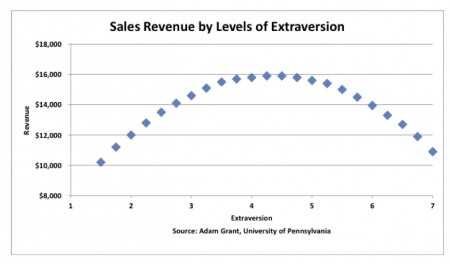
In his new book To Sell is Human, Dan Pink talks about some interesting findings in the research of Adam Grant.  Grant looks at sales results relative to a person’s level of extraversion.  Everyone knows that extraverts make the best salespeople, right?  Well, wrong, actually.  Check this out:

Sales Revenue - Extraversion

Pink says:

As you can see from the chart, the folks who fared the best — by a wide margin — were the in the modulated middle. They’re called “ambiverts,” a term that has been in the literature since the 1920s. They’re not overly extraverted. They’re not overly introverted. They’re a little of both.

He adds more detail in this post, and also has a test where you can test whether or not you’re an ambivert too.

The key question is why does it turn back down?  This upside-down U shape is actually a very common research finding.   You frequently see it in systems that require attention.  Usually, it means that if you have too many team members involved, you can’t pay enough attention to each, and your results start to get worse.

This is interesting for a three reasons.

  • We often search for black and white answers – but life rarely offers them.
  • Is collaboration good?  Yes, but only up to a point.
  • Is extraversion good if you’re a salesperson (and all leaders are “selling” something)?  Yes, but only up to a point.

Figuring out where that point lies is part of the art of managing.  And being comfortable with the ambiguity in this is an even bigger part being a leader.

So just remember: more is better, but only until it’s not.

Read more from Tim here.

Download PDF

Tags: , , , , ,

| What is MyVisionRoom? > | Back to Leadership >

ABOUT THE AUTHOR

Tim Kastelle

Tim Kastelle

Tim Kastelle is a Lecturer in Innovation Management in the University of Queensland Business School. He blogs about innovation at the Innovation Leadership Network.

See more articles by >

COMMENTS

What say you? Leave a comment!

Recent Comments
comment_post_ID); ?> Thank you for this information. I'm going to use this article to improve my work with the Lord.
 
— Abel Singbeh
 
comment_post_ID); ?> Thank you Ed for sharing your insights into the Church Growth Movement. I have my reservations with Church Growth models because it has done more damage than good in the Body of Christ. Over the years, western churches are more focused on results, formulas and processes with little or no emphasis on membership and church discipline. Pastors and vocational leaders are burnt out because they're overworked. I do believe that the Church Growth model is a catalyst to two destructive groups: The New Apostolic Reformation and the Emerging Church. Both groups overlap and have a very loose definition. They're both focus on contemporary worship, expansion of church brand (franchising), and mobilizing volunteering members as 'leaders' to grow their ministry. Little focus on biblical study, apologetics and genuine missional work with no agenda besides preaching of the gospel.
 
— Dave
 
comment_post_ID); ?> Thank you for sharing such a good article. It is a great lesson I learned from this article. I am one of the leaders in Emmanuel united church of Ethiopia (A denomination with more-than 780 local churches through out the country). I am preparing a presentation on succession planning for local church leaders. It will help me for preparation If you send me more resources and recommend me books to read on the topic. I hope we may collaborate in advancing leadership capacity of our church. God Bless You and Your Ministry.
 
— Argaw Alemu
 

Clarity Process

Three effective ways to start moving toward clarity right now.

4 Easter Promotion Hacks to Drive Attendance

We are just a few weeks away from Easter! This is one of those days in the calendar when people are willing to invite their family and friends to attend your church with them.

This year we are adding some new components to our communication plan with our people. We’re still doing direct mail, in service announcements, invite cards, PR push, social media, and text messaging but these are newer items that I think we’re going to get some more traction out of. I’m looking forward to seeing these new tools in our approach help us reach more people this year!

  • Daylight Saving Reminder Card // On March 3rd we’re going to have 4×6 cards inserted into every program that will remind people to “turn their clocks forward” the following weekend … on the back of each of those cards is a “save the date” reminder that Easter Sunday is on March 31st.  This card will ask them to be thinking about who they will be inviting this year.
  • More Radio! // Yesterday we launched a weekly 30 minute radio program. (I know … welcome to 1960s ministry!)  Our data tells us that radio has been incredibly effective in attracting first time guests to our church.  So we are deciding to do more of it this year. [Listen to the first episode.] The cost per minute of radio time is incredibly low. For the month of March we will not only be running our normal teaching production but accompanying that with lots of encouragement to attend our services with some family and friends. How can you use “old media” to connect people to your church? 
  • Digital Tools Galore // For these “big days” we generate a wide variety of digital invite tools for people. If our people change their facebook profile image to something we provide it generates conversation with their friends. For this Easter we’re going to max out the varieties of these pieces. We want to make content that is easily sharable on whatever social platform our people prefer!
  • Impact Testimonies // The four weeks leading up to Easter we’re going to feature “impact testimonies” on our facebook page.  These will be short articles talking about how being involved in Liquid has made a positive impact on them.  These stories will also be accompanied by photos of the people. Although there isn’t a direct correlation between this content and “please invite your friends to Easter” … it does remind people that good things happen when people connect with our church.

What are you doing this year to help get the word out about your Easter services?  I’d love to hear about it! We’re always looking for great ideas to help us communicate with our people.

Read more from Rich here.

Download PDF

Tags: , , , ,

| What is MyVisionRoom? > | Back to Communication >

ABOUT THE AUTHOR

Rich Birch

Rich Birch

Thanks so much for dropping by unseminary … I hope that your able to find some resources that help you lead your church better in the coming days! I’ve been involved in church leadership for over 15 years. Early on I had the privilege of leading in one of the very first multisite churches in North Amerca. I led the charge in helping The Meeting House in Toronto to become the leading multi-site church in Canada with over 4,000 people in 6 locations. (Today they are 13 locations with somewhere over 5,000 people attending.) In addition, I served on the leadership team of Connexus Community Church in Ontario, a North Point Community Church Strategic Partner. I currently serves as Operations Pastor at Liquid Church in the Manhattan facing suburbs of New Jersey. I have a dual vocational background that uniquely positions me for serving churches to multiply impact. While in the marketplace, I founded a dot-com with two partners in the late 90’s that worked to increase value for media firms and internet service providers. I’m married to Christine and we live in Scotch Plains, NJ with their two children and one dog.

See more articles by >

COMMENTS

What say you? Leave a comment!

Recent Comments
comment_post_ID); ?> Thank you for this information. I'm going to use this article to improve my work with the Lord.
 
— Abel Singbeh
 
comment_post_ID); ?> Thank you Ed for sharing your insights into the Church Growth Movement. I have my reservations with Church Growth models because it has done more damage than good in the Body of Christ. Over the years, western churches are more focused on results, formulas and processes with little or no emphasis on membership and church discipline. Pastors and vocational leaders are burnt out because they're overworked. I do believe that the Church Growth model is a catalyst to two destructive groups: The New Apostolic Reformation and the Emerging Church. Both groups overlap and have a very loose definition. They're both focus on contemporary worship, expansion of church brand (franchising), and mobilizing volunteering members as 'leaders' to grow their ministry. Little focus on biblical study, apologetics and genuine missional work with no agenda besides preaching of the gospel.
 
— Dave
 
comment_post_ID); ?> Thank you for sharing such a good article. It is a great lesson I learned from this article. I am one of the leaders in Emmanuel united church of Ethiopia (A denomination with more-than 780 local churches through out the country). I am preparing a presentation on succession planning for local church leaders. It will help me for preparation If you send me more resources and recommend me books to read on the topic. I hope we may collaborate in advancing leadership capacity of our church. God Bless You and Your Ministry.
 
— Argaw Alemu
 

Clarity Process

Three effective ways to start moving toward clarity right now.

5 Stages for Launching Creative Projects at Your Church

We get asked all the time about how we come up with new and fresh ideas for Catalyst. It’s a pretty simple process that has proven to be effective. This can be useful in any organization or scenario, whether you are launching ideas, or just looking to make sound decisions. Here you go:

1. Create– we spend a ton of time just brainstorming, which is obviously a very important part of the process. The more ideas on the board, the more opportunities for one of those to make it through the process. All ideas matter at this stage. For example, we have probably 300-350 programming ideas every year for our October conference. And creative meetings are “yes and” meetings, not “no but.” Incredibly important!

2. Criticize – every idea, in order to stay in the process, has to be critiqued and criticized significantly. This is key in order to make sure you don’t spend tons of time chasing too many rabbits and driving everyone crazy with lots of good ideas but nothing ever happening. And make sure everyone doesn’t take things personal- criticizing an idea is much different than criticizing the person who came up with the idea. It’s not personal. This stage is a filter, and weeds out lots of possible ideas that just don’t have the legs to keep moving up the grid.

3. Optimize– anything that makes it pass the criticize phase has to be built on. In some ways, this is a second and third wave of innovation. Most of the time the original idea will turn into something that looks totally different. And that is okay, and actually important and needed. This is really the essence of putting icing on the cake. A bit of time will usually bring clarity and renewed energy to an idea, so we have to usually let good ideas cook a bit in order to make them great.

4. Validate– every idea has to be validated- financially, operationally, personnel wise, and direction/vision related. Lots of big ideas appropriately get held up in this phase, either to be released later or put on the shelf for good. Conversely, in many organizations, lots of bad ideas make it through this phase because of bad systems and/or leaders who aren’t willing to say no, or a team that can’t say no to the leader. Leaders- if you are using your position and power to push the wrong ideas through the validation phase, this is a major red flag!

5. Execute– it all comes down to getting things done. Hard work is time consuming and tiring. We take tremendous pride in execution on ideas. If it has gone through the entire process and made it to this point, the idea deserves the attention and focus to make sure it happens. And if every level of the Idea process grid was correctly put in motion, the idea is probably going to be good when turned into reality!

Read more from Brad here.

Download PDF

Tags: , , ,

| What is MyVisionRoom? > | Back to Leadership >

ABOUT THE AUTHOR

Brad Lomenick

Brad Lomenick

In a nutshell, I’m an Oklahoma boy now residing in the South. I am a passionate follower of Christ, and have the privilege of leading and directing a movement of young leaders called Catalyst. We see our role as equipping, inspiring, and releasing the next generation of young Christian leaders, and do this through events, resources, consulting, content and connecting a community of like-minded Catalysts all over the world. I appreciate the chance to continually connect with and collaborate alongside leaders.

See more articles by >

COMMENTS

What say you? Leave a comment!

Recent Comments
comment_post_ID); ?> Thank you for this information. I'm going to use this article to improve my work with the Lord.
 
— Abel Singbeh
 
comment_post_ID); ?> Thank you Ed for sharing your insights into the Church Growth Movement. I have my reservations with Church Growth models because it has done more damage than good in the Body of Christ. Over the years, western churches are more focused on results, formulas and processes with little or no emphasis on membership and church discipline. Pastors and vocational leaders are burnt out because they're overworked. I do believe that the Church Growth model is a catalyst to two destructive groups: The New Apostolic Reformation and the Emerging Church. Both groups overlap and have a very loose definition. They're both focus on contemporary worship, expansion of church brand (franchising), and mobilizing volunteering members as 'leaders' to grow their ministry. Little focus on biblical study, apologetics and genuine missional work with no agenda besides preaching of the gospel.
 
— Dave
 
comment_post_ID); ?> Thank you for sharing such a good article. It is a great lesson I learned from this article. I am one of the leaders in Emmanuel united church of Ethiopia (A denomination with more-than 780 local churches through out the country). I am preparing a presentation on succession planning for local church leaders. It will help me for preparation If you send me more resources and recommend me books to read on the topic. I hope we may collaborate in advancing leadership capacity of our church. God Bless You and Your Ministry.
 
— Argaw Alemu
 

Clarity Process

Three effective ways to start moving toward clarity right now.

7 Things Pastors Should Teach Those in the Marketplace

The marketplace, the everyday world of trade and economic activity, is where most people spend the majority of their days. In modern history, the marketplace has played an unparalleled role in shaping our world. Globalization has turned countless local markets into one massive global market. Advances in technology and communication have managed to bridge enormous geographical and cultural gaps with blinding speed.

Meanwhile, the language and norms of the marketplace have changed the way other social institutions, including the church, think and operate. Even family life has been shaped by the marketplace in seemingly indelible ways.

Yet the marketplace is not a single homogenous entity. It is a complex organism that defies easy definition. The marketplace experience of a plumber is not the same as a venture fund manager, and the work of a banker is different from the work of a teacher. Indeed, work happens

  • in a variety of locations (from home, remotely, in the air, from a car, in an office, in a cubicle, in a warehouse, in a field, in a sky rise, underground, on the water),
  • in a variety of employments (freelancers, employees, contractors, consultants, employers, sole proprietors),
  • and in a variety of organizations (firms, small businesses, large corporations, franchises, practices, partnerships, governments, schools, nonprofits).

Therefore, as a pastor seeks to teach biblically about marketplace dynamics, it is helpful for him to deepen his empathy and broaden his understanding of the vocations represented in his congregation.

So what should pastors teach to those called to the marketplace?

Read Page 2

Download PDF

Tags: , ,

| What is MyVisionRoom? > | Back to Process >

ABOUT THE AUTHOR

Lukas Naugle

Lukas Naugle

Lukas Naugle, who attends Redemption Church in Phoenix, Arizona, is a principal at Marketplace One and works alongside entrepreneurs and thought leaders from around the country.

See more articles by >

COMMENTS

What say you? Leave a comment!

Recent Comments
comment_post_ID); ?> Thank you for this information. I'm going to use this article to improve my work with the Lord.
 
— Abel Singbeh
 
comment_post_ID); ?> Thank you Ed for sharing your insights into the Church Growth Movement. I have my reservations with Church Growth models because it has done more damage than good in the Body of Christ. Over the years, western churches are more focused on results, formulas and processes with little or no emphasis on membership and church discipline. Pastors and vocational leaders are burnt out because they're overworked. I do believe that the Church Growth model is a catalyst to two destructive groups: The New Apostolic Reformation and the Emerging Church. Both groups overlap and have a very loose definition. They're both focus on contemporary worship, expansion of church brand (franchising), and mobilizing volunteering members as 'leaders' to grow their ministry. Little focus on biblical study, apologetics and genuine missional work with no agenda besides preaching of the gospel.
 
— Dave
 
comment_post_ID); ?> Thank you for sharing such a good article. It is a great lesson I learned from this article. I am one of the leaders in Emmanuel united church of Ethiopia (A denomination with more-than 780 local churches through out the country). I am preparing a presentation on succession planning for local church leaders. It will help me for preparation If you send me more resources and recommend me books to read on the topic. I hope we may collaborate in advancing leadership capacity of our church. God Bless You and Your Ministry.
 
— Argaw Alemu
 

Clarity Process

Three effective ways to start moving toward clarity right now.

7 Things Pastors Should Teach Those in the Marketplace

1. Teach them how Scripture informs their work. One of the most foundational texts for understanding work is the “creation mandate,” where God commands Adam, “Be fruitful and multiply and fill the earth and subdue it, and have dominion over the fish of the sea and over the birds of the heavens and over every living thing that moves on the earth” (Gen. 1:28). Though it is impossible for a pastor to keep up with the ever-growing complexity of social and economic development since the Garden of Eden, pastors do have the opportunity to devote themselves to the timeless wisdom of Scripture. Helping those in the marketplace love and live the wisdom found in Proverbs will shape how they understand their daily work, and how it can be used to glorify God and to serve their neighbors.

2. Teach them to fear the Lord. The marketplace is a place of fear. A worker may fear his boss, an executive may fear very public failures, and others fear market instability, unemployment, and government regulations. Globalization, media, and technology all serve to amplify the sense of not being in control. Like anger and pride, acting from fear produces a range of insecurities, sins, and failures.

Throughout Scripture, the people of God are commanded not to be afraid. Paul reminds us, “God gave us a spirit not of fear but of power and love and self-control” (2 Tim. 1:7). We are, however, commanded to fear God: “The fear of the Lord is the beginning of wisdom” (Prov. 9:10Ps. 111:10). Unfortunately, there are many professing Christians whose work life is dominated by fear and anxiety, which cuts them off from living in the wisdom of God.

3. Teach them to pray. Many Christians do not feel equipped to pray about their work, much less to actually pray in the marketplace. Given the fear that is so rampant in the marketplace, coupled with hostility toward Christian faith and practice, the best thing for workers to do is to pray. Yet the kinds of prayers needed in the marketplace may not be the kinds typically heard on Sunday mornings. Pastors have the opportunity to teach Christians how to pray for courage, against temptation, for integrity, that they might work with skill, for their coworkers, and that God would establish the work of their hands. And in response to the many blessings of work, they should be equipped to give thanks.

4. Teach them that their ultimate worth isn’t found in their performance. There is massive pressure in the marketplace for workers to earn their keep, meet their quotas, and climb the ladder. Without vigilant resistance, Christians too can come to believe they are nothing but a job title, a level of responsibility, or a unit of production.

The psalmist teaches that, unlike man, God does not judge us like one evaluates the strength of a horse. Rather, “the Lord takes pleasure in those who fear him, in those who hope in his steadfast love” (Ps. 147:10-11). At the end of the day, our approval and identity are found in being adopted as children of God by grace through faith in Christ—not on the basis of anything we do for ourselves.

5. Teach them they are more than “useful” to their local church. There is a subtle tendency for pastors to see members of their congregation in terms of their utility in supporting church programs or contributing to the budget. This temptation becomes even greater when a church member is known to be talented in their craft or successful in the marketplace. In this regard, pastors apply the same pressures on them that they likely experience throughout the week from their employers, leaders, and supervisors. Before churches are about budgets and programs, they are about people. The members of a congregation need to know they matter for more than just their utility.

6. Teach them that they’re not inferior to pastors and missionaries. Many churches, perhaps unwittingly, subtly propagate the myth that pastors and missionaries matter more, or are intrinsically holier, than carpenters, call center workers, or entrepreneurs. The church may employ pastors and send missionaries, but the silent majority of kingdom work is done by those of diverse callings in the marketplace. Pastors should find ways to disciple members for the variety of vocations represented in the congregation, and not just those in so-called “Christian ministry.”

7. Teach them to love what they do, and to do it well. It is easy to love one’s work for a time, but when circumstances, opportunities, relationships, and rewards change, difficulty and discouragement quickly set in. A certain degree of this is inevitable, but if work is dominated by a sense of pessimism or fatalism, the worker will not do his work well, he will not be content, and his gospel witness will shrivel up and die. Believers need the reminder of Colossians 3:23 that in a broken world they ultimately work for the Lord. In every task and in every season, it is this truth that provides the motivation to do all work with passion and excellence. Pastors face difficulty and discouragement in their work as well. But those who have found new, life-giving ways to rekindle the love for what they do will in turn be able to share that wisdom with those in different occupations.

February 2013

Read Page 1 here.

Read the original article here.

© 9Marks. Website: www.9Marks.org. Email:info@9marks.org. Toll Free: (888) 543-1030.

Download PDF

Tags: , ,

| What is MyVisionRoom? > | Back to Process >

ABOUT THE AUTHOR

Lukas Naugle

Lukas Naugle

Lukas Naugle, who attends Redemption Church in Phoenix, Arizona, is a principal at Marketplace One and works alongside entrepreneurs and thought leaders from around the country.

See more articles by >

COMMENTS

What say you? Leave a comment!

Recent Comments
comment_post_ID); ?> Thank you for this information. I'm going to use this article to improve my work with the Lord.
 
— Abel Singbeh
 
comment_post_ID); ?> Thank you Ed for sharing your insights into the Church Growth Movement. I have my reservations with Church Growth models because it has done more damage than good in the Body of Christ. Over the years, western churches are more focused on results, formulas and processes with little or no emphasis on membership and church discipline. Pastors and vocational leaders are burnt out because they're overworked. I do believe that the Church Growth model is a catalyst to two destructive groups: The New Apostolic Reformation and the Emerging Church. Both groups overlap and have a very loose definition. They're both focus on contemporary worship, expansion of church brand (franchising), and mobilizing volunteering members as 'leaders' to grow their ministry. Little focus on biblical study, apologetics and genuine missional work with no agenda besides preaching of the gospel.
 
— Dave
 
comment_post_ID); ?> Thank you for sharing such a good article. It is a great lesson I learned from this article. I am one of the leaders in Emmanuel united church of Ethiopia (A denomination with more-than 780 local churches through out the country). I am preparing a presentation on succession planning for local church leaders. It will help me for preparation If you send me more resources and recommend me books to read on the topic. I hope we may collaborate in advancing leadership capacity of our church. God Bless You and Your Ministry.
 
— Argaw Alemu
 

Clarity Process

Three effective ways to start moving toward clarity right now.

4 Simple Rules About Where Your Church Meets

Pastor Rick Warren loves to tell the “moving” story of Saddleback – about how they moved so often in the early years of the church it became a standing puzzle on Sundays to figure out where they would meet the following week. Here’s how he tells it:

If you’ve ever heard the story of Saddleback, you know we moved from one location to another for twelve years before moving onto our campus in 1992. We met in 67 locations in our first 15 years of existence — and broke every church-planting rule that says you must have a consistent meeting location! We grew to more than 10,000 in attendance before we had our first building.

So I’ve never believed that meeting locations are critical to a church fulfilling its mission.

But where you meet to worship is still an important ministry tool for your church. Here are four simple rules we’ve learned at Saddleback throughout the years.

  • Don’t let the shoe tell the foot how big it can get – Never be afraid to think outside the box when it comes to making the most out of your worship space. When your meeting space begins to limit your growth, then it is time to think creatively. Add another service. Find a different venue. Do whatever it takes.
  • Make sure you have enough space – When your service is 80 percent filled, you need to start another service. This is one of the reasons many churches plateau. They don’t believe they need to add another service because they have a few open seats available. When you run out of space, you experience what Pete Wagner calls “sociological strangulation!”
  • Make sure you don’t have too much meeting space – On the other hand, you can have too much space. Many churches have built a building far too large for them to fill. Too much space can keep a church from growing. If you have 200 people sitting in an auditorium that seats 750, it’ll seem like no one is there. But if you have 90 people in a space that’ll hold 100, it will seem as if your church is the place to be. It’s almost impossible to create a feeling of warmth and intimacy when there are more empty chairs than people.
  • The smaller the crowd, the closer the speaker should be to them – As your crowd grows larger, the lectern or pulpit can be moved farther back and raised on a higher stage. If you only have 50 people in a service, put a lectern just a few feet in front of your first row. Forget the stage.

Read more from Rick here.

Download PDF

Tags: , ,

| What is MyVisionRoom? > | Back to Environments >

ABOUT THE AUTHOR

Rick Warren

Rick Warren

Rick Warren is the founding pastor of Saddleback Church in Lake Forest, Calif., one of America's largest and most influential churches. Rick is author of the New York Times bestseller The Purpose Driven Life. His book, The Purpose Driven Church, was named one of the 100 Christian books that changed the 20th century. He is also founder of Pastors.com, a global Internet community for pastors.

See more articles by >

COMMENTS

What say you? Leave a comment!

Recent Comments
comment_post_ID); ?> Thank you for this information. I'm going to use this article to improve my work with the Lord.
 
— Abel Singbeh
 
comment_post_ID); ?> Thank you Ed for sharing your insights into the Church Growth Movement. I have my reservations with Church Growth models because it has done more damage than good in the Body of Christ. Over the years, western churches are more focused on results, formulas and processes with little or no emphasis on membership and church discipline. Pastors and vocational leaders are burnt out because they're overworked. I do believe that the Church Growth model is a catalyst to two destructive groups: The New Apostolic Reformation and the Emerging Church. Both groups overlap and have a very loose definition. They're both focus on contemporary worship, expansion of church brand (franchising), and mobilizing volunteering members as 'leaders' to grow their ministry. Little focus on biblical study, apologetics and genuine missional work with no agenda besides preaching of the gospel.
 
— Dave
 
comment_post_ID); ?> Thank you for sharing such a good article. It is a great lesson I learned from this article. I am one of the leaders in Emmanuel united church of Ethiopia (A denomination with more-than 780 local churches through out the country). I am preparing a presentation on succession planning for local church leaders. It will help me for preparation If you send me more resources and recommend me books to read on the topic. I hope we may collaborate in advancing leadership capacity of our church. God Bless You and Your Ministry.
 
— Argaw Alemu
 

Clarity Process

Three effective ways to start moving toward clarity right now.

Epic Quotes on Discipleship from Prof Howard Hendricks

Howard G. Hendricks, known affectionately as “Prof” to more than 10,000 graduates of Dallas Theological Seminary, leaves behind an incalculable legacy which he would call “the work of Christ in me.” Auxano Founder and CEO Will Mancini was a student of Prof, and recently wrote the following upon hearing of his death.

Prof died today but his ministry continues to expand through the lives of over 13,000 students that were impacted over his 60 years of teaching at Dallas Theological Seminary. While working on a tribute, I first reflected on the sticky ideas that he planted in my mind through teaching and embedded in my heart through modeling. All but one quote below is straight from memory. There are literally hundreds more…

DISCIPLESHIP

  • You cannot impart what you do not possess.
  • You can impress from a distance, but you can only impact up close.
  • If you cannot be accused of exclusivity, you are not discipling.
  • You teach what you know, but you reproduce what you are.
  • You never graduate from the school of discipleship.
  • When God measures a man he puts the tape around the heart, not the head.
  • Jesus never discipled one-on-one.

INFLUENCE

There are many things in life you “can do” for God. And the more success you have, the more opportunities will come. (You will know more people, you will have more resources, etc.) But most opportunities are distractions in disguise. Therefore find the one thing you “must do” for God.

  • You focus on the depth of your relationship [with God]; let Him determine the scope of your ministry
  • A good leader has a compass in their head and a magnet in their heart.
  • Spend the rest of your life doing what God prepared you to do.
  • The secret to concentration is elimination.
  • Nothing is more common that unfulfilled potential.

SCRIPTURE

Many of us want a word from God, but we don’t want the Word of God. We know enough to own a Bible but not enough for the Bible to own us. We pay the Bible lip service, but we fail to give it “life service.” In a world where the only absolute is that there are no absolutes, there is little room left for the authoritative Word of God as revealed in the Bible.

  • The Bible was written not to satisfy your curiosity but to help you conform to Christ’s image.
  • The goal is not to make you a smarter sinner but to make you like the Saviour.
  • Put the cookies on the bottom shelf (talking about making teaching accessible to everyone).
  • Dusty Bibles lead to dirty lives.
  • It’s a sin to bore people with the Bible.
  • Christian education is a bomb with a long fuse— it takes a while to go off.
  • Our problem is that we are in the Word but not under the Word.

PROCESS

  • Most people don’t think, they just rearrange their prejudices.
  • Your strengths develop your confidence; your weaknesses develop your faith.
  • My greatest fear is not your failure, but your success.
  • If you want to use your testosterone to grow hair, that’s up to you.

Attending Prof’s memorial service yesterday, Will said “Incredible memorial service for Prof Howard Hendricks today. It was an eternal perspective workout for mind & heart.”


Read more from Will here.

Download PDF

Tags: , ,

| What is MyVisionRoom? > | Back to Process >

ABOUT THE AUTHOR

Will Mancini

Will Mancini

Will Mancini wants you and your ministry to experience the benefits of stunning, God-given clarity. As a pastor turned vision coach, Will has worked with an unprecedented variety of churches from growing megachurches and missional communities, to mainline revitalization and church plants. He is the founder of Auxano, creator of VisionRoom.com and the author of God Dreams and Church Unique.

See more articles by >

COMMENTS

What say you? Leave a comment!

Recent Comments
comment_post_ID); ?> Thank you for this information. I'm going to use this article to improve my work with the Lord.
 
— Abel Singbeh
 
comment_post_ID); ?> Thank you Ed for sharing your insights into the Church Growth Movement. I have my reservations with Church Growth models because it has done more damage than good in the Body of Christ. Over the years, western churches are more focused on results, formulas and processes with little or no emphasis on membership and church discipline. Pastors and vocational leaders are burnt out because they're overworked. I do believe that the Church Growth model is a catalyst to two destructive groups: The New Apostolic Reformation and the Emerging Church. Both groups overlap and have a very loose definition. They're both focus on contemporary worship, expansion of church brand (franchising), and mobilizing volunteering members as 'leaders' to grow their ministry. Little focus on biblical study, apologetics and genuine missional work with no agenda besides preaching of the gospel.
 
— Dave
 
comment_post_ID); ?> Thank you for sharing such a good article. It is a great lesson I learned from this article. I am one of the leaders in Emmanuel united church of Ethiopia (A denomination with more-than 780 local churches through out the country). I am preparing a presentation on succession planning for local church leaders. It will help me for preparation If you send me more resources and recommend me books to read on the topic. I hope we may collaborate in advancing leadership capacity of our church. God Bless You and Your Ministry.
 
— Argaw Alemu
 

Clarity Process

Three effective ways to start moving toward clarity right now.

Know Your Culture, Connect to Your Culture: Lecrae Raps the Gospel in One Minute

The missional visionary is also a cultural architect. One of Auxano’s primary assertions is that each church has a unique culture. You’ve got to know your community to reach your community.

Nowhere is that more evident that when dealing with the current young generations. Jonathan Parnell of Desiring God Ministries recently sat down with Lecrae to talk about his latest album, Gravity, which just won Best Gospel Album at the 55th Annual Grammy Awards. Here Lacrae raps the gospel in one minute:

Lecrae gets it – and connects to a young generation.

What about your church? How are you listening in order to understand the surrounding culture?

Read more from Jonathan here.

Download PDF

Tags: , , , ,

| What is MyVisionRoom? > | Back to Culture >

ABOUT THE AUTHOR

Jonathan Parnell

Jonathan Parnell (@jonathanparnell) is a content strategist at Desiring God. He lives in the Twin Cities with his wife, Melissa, and their three children: Elizabeth, Hannah, and Micah.

See more articles by >

COMMENTS

What say you? Leave a comment!

Recent Comments
comment_post_ID); ?> Thank you for this information. I'm going to use this article to improve my work with the Lord.
 
— Abel Singbeh
 
comment_post_ID); ?> Thank you Ed for sharing your insights into the Church Growth Movement. I have my reservations with Church Growth models because it has done more damage than good in the Body of Christ. Over the years, western churches are more focused on results, formulas and processes with little or no emphasis on membership and church discipline. Pastors and vocational leaders are burnt out because they're overworked. I do believe that the Church Growth model is a catalyst to two destructive groups: The New Apostolic Reformation and the Emerging Church. Both groups overlap and have a very loose definition. They're both focus on contemporary worship, expansion of church brand (franchising), and mobilizing volunteering members as 'leaders' to grow their ministry. Little focus on biblical study, apologetics and genuine missional work with no agenda besides preaching of the gospel.
 
— Dave
 
comment_post_ID); ?> Thank you for sharing such a good article. It is a great lesson I learned from this article. I am one of the leaders in Emmanuel united church of Ethiopia (A denomination with more-than 780 local churches through out the country). I am preparing a presentation on succession planning for local church leaders. It will help me for preparation If you send me more resources and recommend me books to read on the topic. I hope we may collaborate in advancing leadership capacity of our church. God Bless You and Your Ministry.
 
— Argaw Alemu
 

Clarity Process

Three effective ways to start moving toward clarity right now.

What Does “Healthy” Mean in Your Church Leadership?

I was talking with a young hurting pastor recently. He resigned after several years of trying to turn around a dying church into a healthy church. The church brought him in with definite goals. He felt he had a mandate. The church began to grow. Things were exciting…or so it seemed. But, with every change there was growing resistance. Eventually, only a few people with power still supported him. when they refused to back him with changes they had agreed were needed. He was continually reminded this was not “his church”. He felt it was best that he leave rather than divide the church. (This church has a long history of short-termed pastorates.)

In the course of the conversation he asked some sobering, and honest questions.

He asked, “Is there really such a thing as a healthy church? Are there any healthy church staffs? And, what does healthy mean, anyway?”

Great questions. I understand. Sadly, I hear from pastors continually asking the same questions. There are many unhealthy environments in churches.

But, yes! There is such a thing as a healthy church. There are some healthy church staffs.

I don’t know if I know completely what “healthy” means, but I’ve given the issue some thought.

The reality is that the church is the Body of Christ. In the purest form, the church is always “healthy”, because it represents Christ. We are promised that nothing will ever destroy what Christ has established. But, local churches are made of people. And, some of those people, even well-meaning as they may be sometimes, work together to form unhealthy environments. Some work together…for the common good of honoring Christ…and form healthy environments.

So, with that in mind…

A healthy church culture…

  • Doesn’t mean there aren’t bad days
  • Doesn’t mean you won’t have tension or stress.
  • Doesn’t mean everyone always agrees.
  • Doesn’t mean there aren’t relationship struggles.
  • Doesn’t mean you have all the answers.
  • Doesn’t mean the pastor is always right.
  • Doesn’t mean problems or issues are ignored.

A healthy church culture…

  • Does mean you can disagree and still be friends.
  • Does mean tension is used to build teamwork..when one is weak another is strong.
  • Does mean meetings are productive and purposeful…not ritualistic or boring, and certainly not hurtful.
  • Does mean rules add healthy boundaries, rather than stifling creativity or controlling actions.
  • Does mean you work as a team to find solutions.
  • Does mean the pastor (and his family) is never attacked publicly or continually stabbed in the back.
  • Does mean the rumor mill is never allowed to form the dominant opinion.

I’m praying for my new pastor friend that he finds a healthy church, in which to serve out his calling. They do exist.

Questions for your consideration:

  • Have you been in an unhealthy church or organizational environment?
  • Have you been in a healthy one?
  • What do you think it means to have a healthy environment?
 Read more from Ron here.
Download PDF

Tags: , , ,

| What is MyVisionRoom? > | Back to Leadership >

ABOUT THE AUTHOR

Ron Edmondson

Ron Edmondson

As pastor at Immanuel Baptist Church a church leader and the planter of two churches, I am passionate about planting churches, but also helping established churches thrive. I thrive on assisting pastors and those in ministry think through leadership, strategy and life. My specialty is organizational leadership, so in addition to my role as a pastor, as I have time, I consult with church and ministry leaders. (For more information about these services, click HERE.)

See more articles by >

COMMENTS

What say you? Leave a comment!

Recent Comments
comment_post_ID); ?> Thank you for this information. I'm going to use this article to improve my work with the Lord.
 
— Abel Singbeh
 
comment_post_ID); ?> Thank you Ed for sharing your insights into the Church Growth Movement. I have my reservations with Church Growth models because it has done more damage than good in the Body of Christ. Over the years, western churches are more focused on results, formulas and processes with little or no emphasis on membership and church discipline. Pastors and vocational leaders are burnt out because they're overworked. I do believe that the Church Growth model is a catalyst to two destructive groups: The New Apostolic Reformation and the Emerging Church. Both groups overlap and have a very loose definition. They're both focus on contemporary worship, expansion of church brand (franchising), and mobilizing volunteering members as 'leaders' to grow their ministry. Little focus on biblical study, apologetics and genuine missional work with no agenda besides preaching of the gospel.
 
— Dave
 
comment_post_ID); ?> Thank you for sharing such a good article. It is a great lesson I learned from this article. I am one of the leaders in Emmanuel united church of Ethiopia (A denomination with more-than 780 local churches through out the country). I am preparing a presentation on succession planning for local church leaders. It will help me for preparation If you send me more resources and recommend me books to read on the topic. I hope we may collaborate in advancing leadership capacity of our church. God Bless You and Your Ministry.
 
— Argaw Alemu
 

Clarity Process

Three effective ways to start moving toward clarity right now.