Personal Vision Questions for Your Vacation, Sabbatical, or Downtime

This year, the stakes feel higher with personal clarity for a variety of reasons. My ministry is growing, my family is growing. Growth always means more complexity; more options, more distractions, more opportunities, etc.

In order to maximize the time, I created a list of question to think through. What’s most interesting to me is how some of my questions have changed. The questions with the astericks are ones I have never considered before. The main point of this post then, is not to give you my questions but to challenge you to write your own.

Here’s what it looks like for me:  A month before my downtime I carved out a 3-hour time of focus. For me its a plane ride. I spent time in the Word and prayer.  I journaled a bit. Then I wrote questions. I didn’t worry if they are good questions or not. I didn’t worry about answering them.

Why not give it a try?

Here is what I will be thinking about over the next 30 days.

  • What is God teaching me right now?
  • How do I want to spend my time every day?
  • What is the single greatest way I want to change how I spend my time everyday?
  • What is the single greatest thing I don’t want to do everyday that I currently do?
  • What are my greatest strengths as I understand them now?
  • What are my greatest limitations as I understand them now?
  • *How have my accomplishments enabled me to better leverage my strengths?
  • *How have my accomplishments magnified my weaknesses?
  • *How is money influencing my strategy and direction inappropriately?
  • What are time-limited opportunities that I now have?
  • *How am I misdirecting my best time and energy?
  • *Where do deepest my frustrations come from? Why?
  • What ideas am I most excited about?
  • What is the single most important thing to do or decide to do right now to achieve my life vision?
  • *How am I failing to give my best time and energy to my family. Why?
Download PDF

Tags: , ,

| What is MyVisionRoom? > | Back to Vision >

ABOUT THE AUTHOR

Will Mancini

Will Mancini

Will Mancini wants you and your ministry to experience the benefits of stunning, God-given clarity. As a pastor turned vision coach, Will has worked with an unprecedented variety of churches from growing megachurches and missional communities, to mainline revitalization and church plants. He is the founder of Auxano, creator of VisionRoom.com and the author of God Dreams and Church Unique.

See more articles by >

COMMENTS

What say you? Leave a comment!

Recent Comments
comment_post_ID); ?> Thank you for this information. I'm going to use this article to improve my work with the Lord.
 
— Abel Singbeh
 
comment_post_ID); ?> Thank you Ed for sharing your insights into the Church Growth Movement. I have my reservations with Church Growth models because it has done more damage than good in the Body of Christ. Over the years, western churches are more focused on results, formulas and processes with little or no emphasis on membership and church discipline. Pastors and vocational leaders are burnt out because they're overworked. I do believe that the Church Growth model is a catalyst to two destructive groups: The New Apostolic Reformation and the Emerging Church. Both groups overlap and have a very loose definition. They're both focus on contemporary worship, expansion of church brand (franchising), and mobilizing volunteering members as 'leaders' to grow their ministry. Little focus on biblical study, apologetics and genuine missional work with no agenda besides preaching of the gospel.
 
— Dave
 
comment_post_ID); ?> Thank you for sharing such a good article. It is a great lesson I learned from this article. I am one of the leaders in Emmanuel united church of Ethiopia (A denomination with more-than 780 local churches through out the country). I am preparing a presentation on succession planning for local church leaders. It will help me for preparation If you send me more resources and recommend me books to read on the topic. I hope we may collaborate in advancing leadership capacity of our church. God Bless You and Your Ministry.
 
— Argaw Alemu
 

Clarity Process

Three effective ways to start moving toward clarity right now.

5 Elements of Powerful Stories

Here are five elements that you will help you tell more powerful stories:

  1. Powerful stories resonate within us. A good story connects in your soul. We’ve all read or been told stories where the actions of the characters have stirred something inside of us. We identify with the heroes and the villains, because we all have those tendencies inside of us. Look for ways where your story shares a common thread with the story of humanity.
  2. Powerful stories show the light and the dark. Whether you are telling a personal story, or a fictional one, it’s tempting to make the hero invincible and the villain the very definition of evil. But this is rarely the case, and something people cannot relate to. When something goes right in our life, it’s easy to celebrate. When something goes wrong, and we make a mistake, it is crucial to be honest and work toward making the wrong right. In most cases, people will forgive the mistakes they are made aware of but are furious when even little things are covered up or ignored.
  3. Powerful stories point to a greater cause. In the movie Gladiator, the dying emperor Marcus Aurelius, asks Maximus, Marcus: “Why are we here?
    Maximus: “For the glory of Rome”
    Marcus: “What is Rome, Maximus?”
    Maximus: “I have seen much of the world, and it is cold, and dark. Rome is the light”
    Marcus: “Yet you have never been there!
    Maximus believed in the glory and purpose of Rome, despite having never seen it. What purpose do you live and work for, despite it only being a whisper in your soul?
    Your company, and your life, is not about you! This can be the hardest lesson we ever learn. Our lives must point to a purpose greater than our own well-being. People will rarely align with your self-interest, but they will align for a common goal.


To read the rest of Matt’s post go here.

To read more from Matt go here.

Download PDF

Tags: , ,

| What is MyVisionRoom? > | Back to Culture >

ABOUT THE AUTHOR

Matt Ragland

See more articles by >

COMMENTS

What say you? Leave a comment!

Recent Comments
comment_post_ID); ?> Thank you for this information. I'm going to use this article to improve my work with the Lord.
 
— Abel Singbeh
 
comment_post_ID); ?> Thank you Ed for sharing your insights into the Church Growth Movement. I have my reservations with Church Growth models because it has done more damage than good in the Body of Christ. Over the years, western churches are more focused on results, formulas and processes with little or no emphasis on membership and church discipline. Pastors and vocational leaders are burnt out because they're overworked. I do believe that the Church Growth model is a catalyst to two destructive groups: The New Apostolic Reformation and the Emerging Church. Both groups overlap and have a very loose definition. They're both focus on contemporary worship, expansion of church brand (franchising), and mobilizing volunteering members as 'leaders' to grow their ministry. Little focus on biblical study, apologetics and genuine missional work with no agenda besides preaching of the gospel.
 
— Dave
 
comment_post_ID); ?> Thank you for sharing such a good article. It is a great lesson I learned from this article. I am one of the leaders in Emmanuel united church of Ethiopia (A denomination with more-than 780 local churches through out the country). I am preparing a presentation on succession planning for local church leaders. It will help me for preparation If you send me more resources and recommend me books to read on the topic. I hope we may collaborate in advancing leadership capacity of our church. God Bless You and Your Ministry.
 
— Argaw Alemu
 

Clarity Process

Three effective ways to start moving toward clarity right now.

12 Essentials of Church Communications

The church is the hope of the world. As church leaders we have the responsibility of communicating the greatest message known to mankind; the only message capable of changing a person’s entire eternity.

The weight of that responsibility is both profound and incredible. It moves us to action, and demands that we communicate it well.

In the United States alone, we have 350,000 churches; each started by people with the desire to communicate the gospel message. Yet oftentimes, churches have a difficult time communicating this message because they don’t understand the basics of communication.

Think about it … Is your church clear on who they are and where they are going? Does your church use social media to nurture and grow relationships? Has your church spent unhurried time developing a brand that resonates with people in your church and community? Are you proud of your website and does it accurately communicate the uniqueness of your church? Have you evaluated and observed what guests experience on a Sunday morning? Do you want create more awareness of your church in local communities?

These things may not seem significant, but they are critical. In fact, they are essential.

We have researched and identified the 12 Essentials to Church Marketing and Communications and developed a resource that equips Church Communications leaders. And we did it for one reason; because eternity is at stake. We developed this important resource to help you reach more people with the gospel. We  wanted to give you a sneak peek at the 12 Essentials.

The 12 Essentials to Church Marketing and Communications

#1 – Eternal Perspective

When it comes to Church Communications, it’s critical to remember that you want to produce an excellent product not for excellence sake, but because eternity is at stake.  Lose that perspective, and you lose everything.

#2 – Vision Clarity

Vision clarity is about staying focused on the mission and vision of your church.  To reach clarity, you must know who you are as a church and where you are going.

#3 – Brand Standards

Brand Standards are the compilation of documents where you articulate the mission, values, strategy, and vision of the church.  They protect the treatment of everything from your logo and tagline, to fonts and color choice and even email signatures and phone messages.  Brand Standards are critical but often overlooked.

#4 – Communication Strategy

Your communication strategy involves understanding your audience and then identifying the best way of communicating who you are to that audience.  It helps you determine what, when and how you will communicate.

#5 – Project Systems

Andy Stanley says, “The systems down the hall trump the vision on the wall.” If you don’t have systems in place, standards and strategy mean absolutely nothing. The systems that you set in place allow the day-to-day operations to run smoothly.

#6 – Social Media

With over 845 million active users each day, Facebook reports an unbelievable 4 billion posts, likes, comments, and photo uploads every single day. Facebook and other social media sites understand the power of community. They understand that people want to be a part of something they feel connected to.  Learning to use social media to reach the lost and to extend the influence of the church isn’t just a good idea, it’s a must.

#7 – Web Essentials

We live in a technology and social media driven society. Today’s church visitors will most certainly check out your church on the Internet before they attend for the first time. It must reflect the experience they will have when they do attend.  It has to be more than just a website of information. It has to be an experience.

#8 – Guest Experience

There are few things first time guests expect when they visit your church. They expect to be greeted warmly; they expect to fill out a card with their contact information; and they expect someone from your church will follow up with them. Fail to meet any of these expectations, and they aren’t likely to return for a second visit.

#9 – Audience Connection

Ever been disconnected on the phone but not realize it until you have finished speaking?  Then you understand the importance of making sure you are connected to your audience.  To connect to your audience, you must understand who they are and how they take in information.

#10 – Creative Leadership

Creative people are not easy to lead and motivate. They are a breed of their own. Understanding how to lead creative people, and how to facilitate a creative meeting are critical. Moreover, learning to lead those in authority over you who lack creativity is equally important.

#11 – External Marketing

Churches and marketing have a rocky relationship. Historically, churches have not communicated effectively to their external audiences. Most churches make the same marketing mistakes: the message is not unique; the content is not inviting; and there’s no long-term strategy in place. If that description fits your church’s marketing, it’s time to make some changes.

#12 – Storytelling Principles

At the end of the day, stories move people.  Effective storytelling is always more effective than just another event announcement. Vigorously find and celebrate the stories of people within and outside your church.

The 12 Essentials help you master the basics of Church Communications. Mastering the basics of church communications helps you reach more people with the most important message in the world.

Simply put, it’s essential. 

Read more from Tim here.

Download PDF

Tags: , ,

| What is MyVisionRoom? > | Back to Communication >

ABOUT THE AUTHOR

Tim Peters

See more articles by >

COMMENTS

What say you? Leave a comment!

Recent Comments
comment_post_ID); ?> Thank you for this information. I'm going to use this article to improve my work with the Lord.
 
— Abel Singbeh
 
comment_post_ID); ?> Thank you Ed for sharing your insights into the Church Growth Movement. I have my reservations with Church Growth models because it has done more damage than good in the Body of Christ. Over the years, western churches are more focused on results, formulas and processes with little or no emphasis on membership and church discipline. Pastors and vocational leaders are burnt out because they're overworked. I do believe that the Church Growth model is a catalyst to two destructive groups: The New Apostolic Reformation and the Emerging Church. Both groups overlap and have a very loose definition. They're both focus on contemporary worship, expansion of church brand (franchising), and mobilizing volunteering members as 'leaders' to grow their ministry. Little focus on biblical study, apologetics and genuine missional work with no agenda besides preaching of the gospel.
 
— Dave
 
comment_post_ID); ?> Thank you for sharing such a good article. It is a great lesson I learned from this article. I am one of the leaders in Emmanuel united church of Ethiopia (A denomination with more-than 780 local churches through out the country). I am preparing a presentation on succession planning for local church leaders. It will help me for preparation If you send me more resources and recommend me books to read on the topic. I hope we may collaborate in advancing leadership capacity of our church. God Bless You and Your Ministry.
 
— Argaw Alemu
 

Clarity Process

Three effective ways to start moving toward clarity right now.

Why Changing Your Church’s Culture Rarely Works Out

The Boston Globe recently ran a front-page story in their “Ideas” section on organizational culture, inspired by some depressing events involving the Boston University hockey team. It was much more impactful than the average writing about culture, and raised the important question: Why do conversations about an important topic like culture typically go nowhere, leading companies to waste time and money with “cultural change efforts” which very seldom work?

Here is the problem: First, virtually no one clearly defines what they mean by “culture,” and when they do they usually get it wrong. Second, virtually no one has read the original research that shows why culture – when clearly defined – is so important, how it is formed, and how it changes.

Definition: Culture consists of group norms of behavior and the underlying shared values that help keep those norms in place. Take your work, for example, a place where almost everyone shows up between 8:55 and 9:05. Why? Not because the CEO has decreed it, or because people are fired if they don’t do it. That’s just the way it is! That is a group norm. Why does it exist? And why doesn’t it go away when Gen X or Y individuals are hired? My guess: People are hired who embrace the value of respecting others, including other people’s time, so they also show up to meetings on time, and anyone who doesn’t gets a glaring look from everyone else.

Where does culture come from? It usually comes from the founders of the group. For whatever reason, they value certain things and behave in ways that seem to help the group succeed. Success is key. So it seeps into the group’s DNA.

How does culture change? A powerful person at the top, or a large enough group from anywhere in the organization, decides the old ways are not working, figures out a change vision, starts acting differently, and enlists others to act differently. If the new actions produce better results, if the results are communicated and celebrated, and if they are not killed off by the old culture fighting its rear-guard action, new norms will form and new shared values will grow.

What does NOT work in changing a culture? Some group decides what the new culture should be. It turns a list of values over to the communications or HR departments with the order that they tell people what the new culture is. They cascade the message down the hierarchy, and little to nothing changes.

In summary, that’s the whole story.

Read more from John here.


Download PDF

Tags: , ,

| What is MyVisionRoom? > | Back to Culture >

ABOUT THE AUTHOR

John Kotter

See more articles by >

COMMENTS

What say you? Leave a comment!

Recent Comments
comment_post_ID); ?> Thank you for this information. I'm going to use this article to improve my work with the Lord.
 
— Abel Singbeh
 
comment_post_ID); ?> Thank you Ed for sharing your insights into the Church Growth Movement. I have my reservations with Church Growth models because it has done more damage than good in the Body of Christ. Over the years, western churches are more focused on results, formulas and processes with little or no emphasis on membership and church discipline. Pastors and vocational leaders are burnt out because they're overworked. I do believe that the Church Growth model is a catalyst to two destructive groups: The New Apostolic Reformation and the Emerging Church. Both groups overlap and have a very loose definition. They're both focus on contemporary worship, expansion of church brand (franchising), and mobilizing volunteering members as 'leaders' to grow their ministry. Little focus on biblical study, apologetics and genuine missional work with no agenda besides preaching of the gospel.
 
— Dave
 
comment_post_ID); ?> Thank you for sharing such a good article. It is a great lesson I learned from this article. I am one of the leaders in Emmanuel united church of Ethiopia (A denomination with more-than 780 local churches through out the country). I am preparing a presentation on succession planning for local church leaders. It will help me for preparation If you send me more resources and recommend me books to read on the topic. I hope we may collaborate in advancing leadership capacity of our church. God Bless You and Your Ministry.
 
— Argaw Alemu
 

Clarity Process

Three effective ways to start moving toward clarity right now.

The 2 Secrets to Success for Social Media in Your Church

It’s getting hard to keep up with all the different social tools that are flying at us every day.  We constantly hear things like:

If you’re not on Pinterest you’re in big trouble.”

or

“Blogging is dead.”

It seems like people are putting a lot of effort into trying to figure out which tools they should use, and how they should use them.  What’s the best way to deal with all of this us? I’ve been repeatedly hit in the face with the answer to this recently from my network, which teaches me a lot.

So here is the secret to social success:

Connect with people.

Simple, isn’t it.  It doesn’t matter what tools you use – and if you spend too much time worrying about tools, you’ll forget to use them to do the one thing that matters – connecting.
Connecting Ideas is the Fundamental Creative Act in Innovation.  You have to connect ideas to ideas to innovate, and you have to connect people to your ideas to get them to spread.  It’s all about connection.

Earlier, I told you about the best social media strategy of all time:

Do awesome work.

That takes care of the connecting ideas to ideas part.  Then, to get them to spread, you need to connect the ideas to people.  And that means that you have to connect with people – that is the core purpose of all of these social tools.

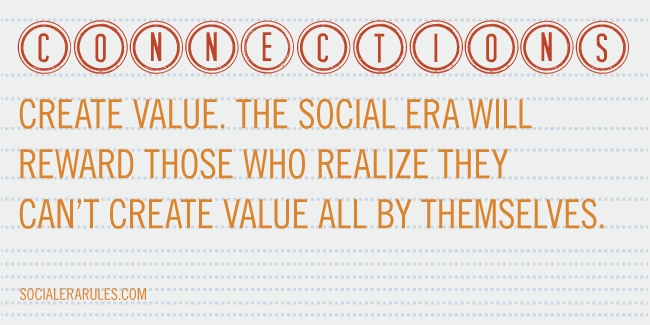
Connections create value – that is the core message of Nilofer Merchant in her book 11 Rules for Creating Value in the #SocialEra. Here is one of my favourite quotes from the book:

We want innovation, but without experiencing failure. We want to embrace the new, but without risk. We want to act fast and fluid, but to maintain tight controls. We want to empower everyone, but retain decision rights for ourselves. We want to experiment, but we also want predictability. We want to be flexible to customer input, but remain ruthlessly efficient. We want to adapt, but we fear the death of familiarity.

This is why it’s hard to go from being an 800-pound gorilla to a herd of nimble gazelles; an organization goes from being a centralized institution that competes through overpowering strength and scale to a set of relationships or interrelationships. Gazelles thrive and win by how they share power with one another. And, as a result, they can act fast, fluid, and flexible. For organizations, this is key to winning in the marketplace.

As organisations, we win through connections. The same is true for people.

Here is Shane Mac from his book Stop With the BS:

All these apps, gadgets, buildings—everything for that matter—they don’t make me smile and think about how much I love what I do. The people I know do. It is the people and my relationships with them that really matter. Done. Simple as that. All we have in life are relationships, so we better start spending more time building new ones and rebuilding old ones. Build bridges, Re-build bridges, never Burn Bridges.

It’s the relationships that matter. Hugh MacLeod nails it in his latest book Freedom is Blogging in Your Underwear:

…all the internet is, as Doc Searls said, is a bunch of protocols that “allow us to get along.” Protocols allow us to talk to each other. The stuff in the middle, the stuff that separates us, the stuff that directly makes use of these protocols – hosting companies, web sites, blogging platforms, microblogging platforms, etc. – matter far less.

You’re on one end of the wire. Just think about who’s on the other end of the wire, and what you can do for them. Worry less about the wire. Worry less about the shiny objects in the middle.

Just worry about MAKING your own stuff, and the rest of the internet will look after itself.

So there is your two-step guide to social success.

Do awesome work.

and

Connect with people.

The problem is that while these steps might sound simple, they’re not.  They take a lot of effort.  That’s what makes the shiny new objects so seductive – they look like shortcuts.

Unfortunately, there are no shortcuts.  That’s why it’s still remarkable when you do awesome work and connect with people.

I know that I still have a long way to go myself.  But now that we’ve connected, maybe we can do some of this awesome work together.

Download PDF

Tags: , , ,

| What is MyVisionRoom? > | Back to Communication >

ABOUT THE AUTHOR

Tim Kastelle

Tim Kastelle

Tim Kastelle is a Lecturer in Innovation Management in the University of Queensland Business School. He blogs about innovation at the Innovation Leadership Network.

See more articles by >

COMMENTS

What say you? Leave a comment!

Recent Comments
comment_post_ID); ?> Thank you for this information. I'm going to use this article to improve my work with the Lord.
 
— Abel Singbeh
 
comment_post_ID); ?> Thank you Ed for sharing your insights into the Church Growth Movement. I have my reservations with Church Growth models because it has done more damage than good in the Body of Christ. Over the years, western churches are more focused on results, formulas and processes with little or no emphasis on membership and church discipline. Pastors and vocational leaders are burnt out because they're overworked. I do believe that the Church Growth model is a catalyst to two destructive groups: The New Apostolic Reformation and the Emerging Church. Both groups overlap and have a very loose definition. They're both focus on contemporary worship, expansion of church brand (franchising), and mobilizing volunteering members as 'leaders' to grow their ministry. Little focus on biblical study, apologetics and genuine missional work with no agenda besides preaching of the gospel.
 
— Dave
 
comment_post_ID); ?> Thank you for sharing such a good article. It is a great lesson I learned from this article. I am one of the leaders in Emmanuel united church of Ethiopia (A denomination with more-than 780 local churches through out the country). I am preparing a presentation on succession planning for local church leaders. It will help me for preparation If you send me more resources and recommend me books to read on the topic. I hope we may collaborate in advancing leadership capacity of our church. God Bless You and Your Ministry.
 
— Argaw Alemu
 

Clarity Process

Three effective ways to start moving toward clarity right now.

New Discipleship Research: Selflessness Leads to Spiritual Maturity

Throughout the year, we have been releasing new research in support of Transformational Discipleship. This latest research is on “Serving God and Others”– one of eight attributes of discipleship that consistently show up in the lives of believers who are progressing in spiritual maturity.

Service doesn’t just happen in a church. It must be modeled and encouraged. As we look at the breakdown of attributes and correlated disciplines, the data shows that praying expectantly, getting involved in the community and discipling others fosters a posture of serving. As such, disciples are serving in, through, and beyond their churches for the cause of Christ.

Service and activism have become popular in our culture today, especially among younger adults. However, most of this benevolent activity is fairly low-level involvement that does not cost the giver much. The midrange responses on the Serving God and Others attribute reveals lots of good intentions and some occasional actions but much lower intentionality, consistency or sacrifice.

Serving clearly impacts growth, and the study shows that individuals who have positive scores for Serving God and Others have higher scores in the other seven attributes of the Transformational Discipleship study, as well.

For example, scores for Sharing Christ jump 24 percent when individuals have positive Serving God and Others’ scores and 51 percent for individuals with the highest Serving God and Others scores. Likewise, positive responses in the other seven attributes of discipleship correlate with higher scores in Serving God and Others.

Growth leads to service and serving leads to growth – it’s deeply connected. Positive scores in Bible Engagement result in a 17 percent increase in scores for Serving God and Others compared to those who do not have positive scores for Bible Engagement.

We saw most say they were serving in some way, but far too many are sitting down on the job – particularly when the Bible says everyone should ‘…use it to serve others, as good managers of the varied grace of God’ (1 Peter 4:10; HCSB). There is a huge gap between this passage and most churches’ practice.

From the release (read the full article here):

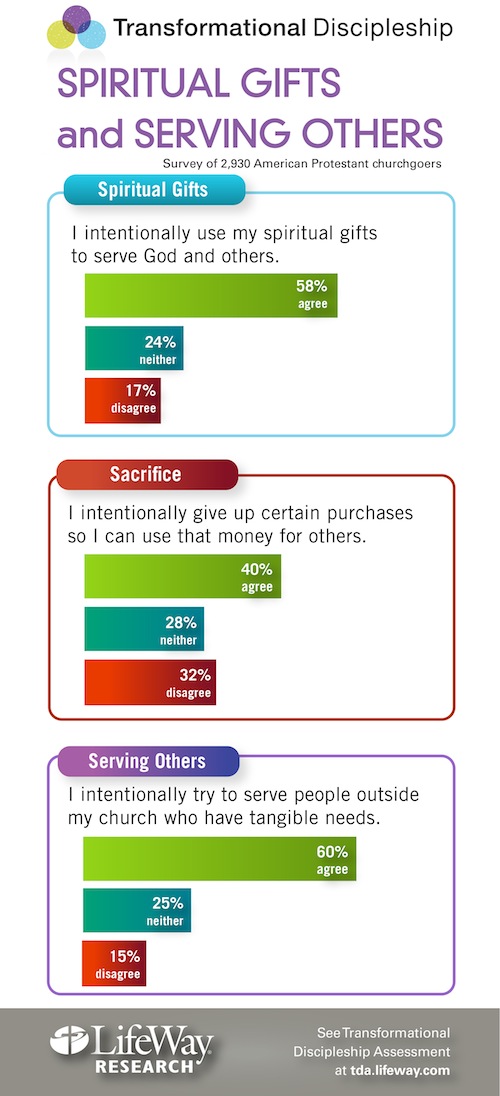
The survey shows 58 percent of Protestant churchgoers in the United States agree with the statement: “I am intentionally putting my spiritual gift(s) to use serving God and others.” Seventeen percent disagree with the statement.

A greater percentage of respondents indicate they look for opportunities to serve others in the community. Asked to respond to the statement: “I intentionally try to serve people outside my church who have tangible needs,” 60 percent agree – although only 17 percent strongly agree. Fifteen percent disagreed with the statement.

Churchgoers indicate much lower agreement related to sacrificial giving. Just 9 percent of churchgoers strongly agree with the statement: “I intentionally give up certain purchases so I can use that money for others.” Thirty percent somewhat agree and 32 percent disagree.

Approximately a quarter of respondents selected “neither agree nor disagree” as their answer for the three statements.

I shared a pre-release version of this data at the Q Conference, which was focused on serving other for the common good. Statistically, growing Christians serve and serving Christians grow. Sojourners reported on the data here. I’m encouraged to see the statistical connection, but am not surprised considering the biblical connection.

These findings on serving God and others are part of the largest discipleship study of its kind. Results from each of the eight attributes of spiritual maturity will continue to be released over the coming months.

To help pastors, churches and individuals measure spiritual development, LifeWay Research used the study’s data to develop a questionnaire for believers, called the Transformational Discipleship Assessment (TDA). This online evaluation delivers both individual and group reports on spiritual maturity using the eight factors of biblical discipleship. The TDA also provides helpful and practical suggestions on appropriate next steps for spiritual development.

Download PDF

Tags: , , , , ,

| What is MyVisionRoom? > | Back to Process >

ABOUT THE AUTHOR

Ed Stetzer

Ed Stetzer

Ed Stetzer, Ph.D., holds the Billy Graham Chair of Church, Mission, and Evangelism at Wheaton College and serves as Executive Director of the Billy Graham Center for Evangelism. He has planted, revitalized, and pastored churches, trained pastors and church planters on six continents, holds two masters degrees and two doctorates, and has written dozens of articles and books. Previously, he served as Executive Director of LifeWay Research. Stetzer is a contributing editor for Christianity Today, a columnist for Outreach Magazine, and is frequently cited or interviewed in news outlets such as USAToday and CNN. He serves as interim pastor of Moody Church in Chicago.

See more articles by >

COMMENTS

What say you? Leave a comment!

Recent Comments
comment_post_ID); ?> Thank you for this information. I'm going to use this article to improve my work with the Lord.
 
— Abel Singbeh
 
comment_post_ID); ?> Thank you Ed for sharing your insights into the Church Growth Movement. I have my reservations with Church Growth models because it has done more damage than good in the Body of Christ. Over the years, western churches are more focused on results, formulas and processes with little or no emphasis on membership and church discipline. Pastors and vocational leaders are burnt out because they're overworked. I do believe that the Church Growth model is a catalyst to two destructive groups: The New Apostolic Reformation and the Emerging Church. Both groups overlap and have a very loose definition. They're both focus on contemporary worship, expansion of church brand (franchising), and mobilizing volunteering members as 'leaders' to grow their ministry. Little focus on biblical study, apologetics and genuine missional work with no agenda besides preaching of the gospel.
 
— Dave
 
comment_post_ID); ?> Thank you for sharing such a good article. It is a great lesson I learned from this article. I am one of the leaders in Emmanuel united church of Ethiopia (A denomination with more-than 780 local churches through out the country). I am preparing a presentation on succession planning for local church leaders. It will help me for preparation If you send me more resources and recommend me books to read on the topic. I hope we may collaborate in advancing leadership capacity of our church. God Bless You and Your Ministry.
 
— Argaw Alemu
 

Clarity Process

Three effective ways to start moving toward clarity right now.

4 Questions to Consider Asking Yourself About Your Next Guest

1. Who is your next Guest? (Conceptually, not specifically. Describe his outlook, his tribe, his hopes and dreams and needs and wants…)

2. What is the story he told himself (about the world, about his situation, about his perceptions) before he met you?

3. How do you encounter him in a way that he trusts the story you tell him about what you have to offer?

4. What change are you trying to make in him, his life, or his story?

Start with these questions before you spend time on tactics, technology or scalability.

Download PDF

Tags: , ,

| What is MyVisionRoom? > | Back to Process >

ABOUT THE AUTHOR

Seth Godin

See more articles by >

COMMENTS

What say you? Leave a comment!

Recent Comments
comment_post_ID); ?> Thank you for this information. I'm going to use this article to improve my work with the Lord.
 
— Abel Singbeh
 
comment_post_ID); ?> Thank you Ed for sharing your insights into the Church Growth Movement. I have my reservations with Church Growth models because it has done more damage than good in the Body of Christ. Over the years, western churches are more focused on results, formulas and processes with little or no emphasis on membership and church discipline. Pastors and vocational leaders are burnt out because they're overworked. I do believe that the Church Growth model is a catalyst to two destructive groups: The New Apostolic Reformation and the Emerging Church. Both groups overlap and have a very loose definition. They're both focus on contemporary worship, expansion of church brand (franchising), and mobilizing volunteering members as 'leaders' to grow their ministry. Little focus on biblical study, apologetics and genuine missional work with no agenda besides preaching of the gospel.
 
— Dave
 
comment_post_ID); ?> Thank you for sharing such a good article. It is a great lesson I learned from this article. I am one of the leaders in Emmanuel united church of Ethiopia (A denomination with more-than 780 local churches through out the country). I am preparing a presentation on succession planning for local church leaders. It will help me for preparation If you send me more resources and recommend me books to read on the topic. I hope we may collaborate in advancing leadership capacity of our church. God Bless You and Your Ministry.
 
— Argaw Alemu
 

Clarity Process

Three effective ways to start moving toward clarity right now.

4 Mindset Shifts to Transformational Leadership

Leadership might be the most confused term that we use in the body of Christ. We all assume a picture of leadership when we hear the word. Normally, what we really mean when we say “leader” is a strong, no-compromise, CEO who is not afraid of anybody but God.

That leader is charging forward with a tribe of crazed followers. That leader has game show-host public charisma and a personality that makes even casual contact inspirational. That leader has a strong belief in personal leadership skills. He is always courageous and sometimes reckless.

Before we go too far, understand that some of the above qualities are positive and important to the kingdom. But the subject here is not leadership. The subject is transformational leadership.

How is it different from other approaches to leadership?

Transformational leadership is focused outside of the leader’s world. Leaders may be charismatic and inspirational, but a centrifugal (outward) influence defines their leadership. A natural leader draws people in and sends people out. A natural leader attracts and gathers other leaders. Instead of promoting self, transformational church leaders promote the mission of the church. Does a transformational church leader want more people to attend the local church? Absolutely! Leaders want more people because they want to send more people back into the community and the world. The focus of passion for a transformational church leader is for lost people not bigger churches.

So how does this transition in leadership thinking take place? The old model of leadership was to hoard and retain control. Transformational leaders seek to empower and multiply. They think in terms of movements of God versus seasons of high attendance. Patience is critical. Courage to release and trust God is indispensable. To get moving in the right direction four mindset shifts are needed.

No More Superman Leaders

The first mindset shift toward transformational leadership is from one to many leaders. The CEO “Superman” model must be replaced by assigning a higher value on every man and woman. One reason churches implode is because of the overpromise suggested by our “Superman” view of pastoral leadership. Our professional Superman pastor will be trained in exclusive places called seminaries to gain expertise in business, family therapy, communication, marketing, leadership, and theology. The pastor will be taught how to lead local teams to spectacular church growth. A congregation has incredibly high expectations of their Superman. Superman returns the favor by having incredibly high expectations of the congregation.

But when the dream is not accomplished, finger pointing begins. Both the pastor and the members contribute to the finger pointing. Angry pastors bemoan the terrible people in their congregations. The pastor demands unilateral command and control. Then the church demands a high level of customer satisfaction, fiscal stability, and numerical success. And no one gets what they want.

Transformational churches have strong leaders. Their leaders understand the importance of every man and every woman. Superman is for comic books, not for the body of Christ. I fear church leadership has devolved to a counterproductive, bishop-driven system. The result is a disengaged, underchallenged, and underutilized missionary workforce.

“We” Not “Me”

The second mindset shift toward transformational leadership is from “me” to “we.” Transformational leaders know that every person can be used to fulfill God’s mission. Leadership is the stewardship to help others exercise their gifts, not just an opportunity for me to exercise my gifts. Clearly stated in Ephesians 4, the pastor’s role is to equip. The pastor must have a vision to help others align with God’s mission.

The transformational leader thinks team first. Everybody has a purpose. No one person’s personal purpose is more important than the biblical purpose of the team. The pastor may be the coach of the team. Coaches recognize the need for people to get into the game. A football team cannot survive with a quarterback and a running back only. Linebackers, kickers, and linemen are needed. A football team cannot win with a hall of fame coaching staff but no players. Transformational churches have found a way to “win” by engaging every believer into the work God has assigned to them.

While there is significant variety in the leadership assignments I have experienced, I have seen four common themes emerge from building leadership teams: a compelling purpose, the right leader, the right team, and a conducive culture. The four characteristics I have experienced are simple but not simplistic. To the contrary, team building is certainly not an easy process. It takes significant planning, buy-in, and old-fashioned work.

Don’t Hoard Power. Empower Others.

The third mindset shift toward transformational leadership is from personal power to people empowerment. Pastors and leaders traditionally measure leadership by power. But power is overrated, particularly when it comes to deploying missionaries through a local church. Power must hold people close. When a leader has all the power, the people are demotivated to act. Powerful leaders make people skittish about making decisions.

Transformational churches decentralize decision making. Permission is given to act and to lead. This feeds a new scorecard. Service moves beyond the time block on Sunday mornings to the rest of the week. The church becomes an army of leaders advancing the gospel into the community. A transformational leader will celebrate community service as much or more than service in their local church.

Think Outside of Your Church

The fourth mindset shift toward transformational leadership is from church to the kingdom of God. While God loves and values the local assembly of people called “church,” leaders in transformational churches are as concerned with the wider work of God’s kingdom as they are with the localized work of their individual congregation. They know that the kingdom of God births the church.

In recent days much has been written about the problems with the church. We see people with chronic angst about the institutional church. Certainly, the church organized has its faults. But problems in the church began in cities like Corinth and Ephesus in the first generation of its existence, not during the twenty-first century. Buildings and programs help the mission but can also become the unnecessary focus of a congregation.

Competition, denominational worship, and sentimentality obstruct the view of the greater kingdom even further. The real significance of the assembly (people of God) is found in its place in the larger kingdom of God no matter the building or generation. People are moved toward God because of the vision for a higher purpose than mere assembly. When church is reduced to that place on the corner where we go on Sundays, we reduce the church and kingdom to something smaller than God intended.

Transformational leaders have learned to trade in the small and trivial for substantive and eternal. Are you a transformational leader?

Download PDF

Tags: , ,

| What is MyVisionRoom? > | Back to Leadership >

ABOUT THE AUTHOR

Thom Rainer

Thom Rainer

Thom S. Rainer is the founder and CEO of Church Answers, an online community and resource for church leaders. Prior to founding Church Answers, Rainer served as president and CEO of LifeWay Christian Resources. Before coming to LifeWay, he served at The Southern Baptist Theological Seminary for twelve years where he was the founding dean of the Billy Graham School of Missions and Evangelism. He is a 1977 graduate of the University of Alabama and earned his Master of Divinity and Ph.D. degrees from The Southern Baptist Theological Seminary.

See more articles by >

COMMENTS

What say you? Leave a comment!

Recent Comments
comment_post_ID); ?> Thank you for this information. I'm going to use this article to improve my work with the Lord.
 
— Abel Singbeh
 
comment_post_ID); ?> Thank you Ed for sharing your insights into the Church Growth Movement. I have my reservations with Church Growth models because it has done more damage than good in the Body of Christ. Over the years, western churches are more focused on results, formulas and processes with little or no emphasis on membership and church discipline. Pastors and vocational leaders are burnt out because they're overworked. I do believe that the Church Growth model is a catalyst to two destructive groups: The New Apostolic Reformation and the Emerging Church. Both groups overlap and have a very loose definition. They're both focus on contemporary worship, expansion of church brand (franchising), and mobilizing volunteering members as 'leaders' to grow their ministry. Little focus on biblical study, apologetics and genuine missional work with no agenda besides preaching of the gospel.
 
— Dave
 
comment_post_ID); ?> Thank you for sharing such a good article. It is a great lesson I learned from this article. I am one of the leaders in Emmanuel united church of Ethiopia (A denomination with more-than 780 local churches through out the country). I am preparing a presentation on succession planning for local church leaders. It will help me for preparation If you send me more resources and recommend me books to read on the topic. I hope we may collaborate in advancing leadership capacity of our church. God Bless You and Your Ministry.
 
— Argaw Alemu
 

Clarity Process

Three effective ways to start moving toward clarity right now.

Reducing Communication Confusion

Leaders often confuse followers by communicating imperatives as declarative statements. An imperative is a command. An imperative sentence has a grammatical structure expressing a directive. A declarative sentence is quite different; it makes a statement. In an effort to sound less forceful, leaders will often make declarative statements and expect followers to recognize them as imperatives.

Sometimes this tactic works. For instance, the garbage stinks is a declarative statement that—when spoken by my wife—becomes an obvious imperative, take out the garbage! Most of the time, however, imperatives disguised as declarative statements simply generate confusion.

I understand why leaders use declarative statements when they really want to communicate imperatives. Imperatives can sound harsh. Declarative statements have a softer tone; they are also terribly confusing. Imperatives direct an individual to a specific action (fix the leak), but declarative statements make the problem the subject without any prescribed action (the faucet leaks).

When leaders communicate imperatives as declarative statements they make two critical errors. First, they communicate a problem without a prescribed solution.  Second, they do not assign a person (the subject) to the problem or project. So everyone now realizes the faucet leaks, but no one knows who should fix it and how it should be fixed.

The confusion caused by this communication error makes a leader appear unnecessarily weak. In an attempt to be considerate, leaders just come off as confusing. We already knew the faucet leaked. Who should fix it? Sentence structure may seem like an inconsequential part of leadership, but imperatives are important because they direct people to action.

If you want followers to act on a problem, then don’t use a declarative sentence. It’s confusing and a weak form of communication. Unless, of course, you are my wife. The garbage stinks. I get it.

Download PDF

Tags: , , ,

| What is MyVisionRoom? > | Back to Communication >

ABOUT THE AUTHOR

Sam Rainer III

Sam serves as lead pastor of West Bradenton Baptist Church. He is also the president of Rainer Research, and he is the co-founder/co-owner of Rainer Publishing. His desire is to provide answers for better church health. Sam is author of the book, Obstacles in the Established Church, and the co-author of the book, Essential Church. He is an editorial advisor/contributor at Church Executive magazine. He has also served as a consulting editor at Outreach magazine. He has written over 150 articles on church health for numerous publications, and he is a frequent conference speaker. Before submitting to the call of ministry, Sam worked in a procurement consulting role for Fortune 1000 companies. Sam holds a B.S. in Finance and Marketing from the University of South Carolina, an M.A. in Missiology from Southern Seminary, and a Ph.D. in Leadership Studies at Dallas Baptist University.

See more articles by >

COMMENTS

What say you? Leave a comment!

Recent Comments
comment_post_ID); ?> Thank you for this information. I'm going to use this article to improve my work with the Lord.
 
— Abel Singbeh
 
comment_post_ID); ?> Thank you Ed for sharing your insights into the Church Growth Movement. I have my reservations with Church Growth models because it has done more damage than good in the Body of Christ. Over the years, western churches are more focused on results, formulas and processes with little or no emphasis on membership and church discipline. Pastors and vocational leaders are burnt out because they're overworked. I do believe that the Church Growth model is a catalyst to two destructive groups: The New Apostolic Reformation and the Emerging Church. Both groups overlap and have a very loose definition. They're both focus on contemporary worship, expansion of church brand (franchising), and mobilizing volunteering members as 'leaders' to grow their ministry. Little focus on biblical study, apologetics and genuine missional work with no agenda besides preaching of the gospel.
 
— Dave
 
comment_post_ID); ?> Thank you for sharing such a good article. It is a great lesson I learned from this article. I am one of the leaders in Emmanuel united church of Ethiopia (A denomination with more-than 780 local churches through out the country). I am preparing a presentation on succession planning for local church leaders. It will help me for preparation If you send me more resources and recommend me books to read on the topic. I hope we may collaborate in advancing leadership capacity of our church. God Bless You and Your Ministry.
 
— Argaw Alemu
 

Clarity Process

Three effective ways to start moving toward clarity right now.

The Importance of Values in Shaping the Culture of Your Church

Four Values and Four Principles

1) God values people. He values them so much He would leave the 99 who are safe and healthy to go after a single one who is lost.

2) Clearly, Jesus is the Father’s highest value. Sending Christ to us was His way of telling us we are valuable—so valuable that He gave us what was most valuable to Him.

3) God also values ministry. Jesus says that the Father was like a man who found a treasure in a field. Because He so valued it, He sold everything He had so He could buy the field. In the same chapter, Jesus says that the field in this parable was the world. (See Matt. 13:44.) We see how God values ministry to a lost and dying world.

4) Finally, God values the passing of each day. To Him, each day is an invitation to receive His forgiveness and mercy. His mercies are indeed new every morning. Each day is an opportunity to repent from one’s wayward ways and turn to God and become His follower.

Church leaders who are clear about what God values can then apply the following corresponding principles to make disciples.

  •  Because people are valuable, we must engage them with the intent of leading them to Christ.
  •  Because Jesus is most valuable, we must then establish the foundation of Christ in people’s hearts.
  •  Because ministry is valuable, we must equip all believers to minister.

And because every day is a valuable opportunity to reach people with the gospel, we must empower all believers to go and make disciples.

Structure Follows Culture

Knowing that creating a discipleship culture is and should be our church’s first priority, it’s vital to understand that structure follows culture. You could say that culture is the wine, and structure is the wineskin. Or that culture is the electricity and structure is the wires and cables the electricity flows through so that it functions effectively and efficiently. Structure allows the culture to be reproduced. This is where organization, systems and processes come in; they work together to achieve the values.

When I start to really examine our church and how it functions, I’m always intrigued by how we’ve managed to build a culture that led to the principles of discipleship, which in turn have become the very same process we focus on as we make disciples. Our members clearly know that 1) we must all engage our families and friends with the intent of making them followers of Christ; 2) we must establish them in the foundation of Christ; 3) we have designed training and equipping programs to make them confident and competent as ministers; 4) they are empowered as the Holy Spirit works in their lives to go and make disciples each and every day.

It is my hope and prayer that these ideas will inspire all of us to evaluate our churches, define our values and build churches based on a culture of discipleship.

Page 1

Page 2

Page 3

Download PDF

Tags: , ,

| What is MyVisionRoom? > | Back to Vision >

ABOUT THE AUTHOR

Joey Bonifacio

Joey Bonifacio

Joey Bonifacio is Director for Asia of  Every Nation Ministries. Every Nation is a worldwide family of churches and ministries that exists to Honor God by planting Christ-centered, Spirit empowered, socially responsible churches and campus ministries in every nation. He is a member of the team that oversees  Victory, a local church in Manila and a movement of churches in the Philippines and the Senior Pastor of Victory Fort at Bonifacio Global City. He is Chairman of the Real Life Foundation, a Philippine based NGO that provides educational scholarship to the underprivileged. He is happily married to Marie for 30 years now and has three adult sons, Joseph who is married to Carla, David and Joshua. And adopted a cute little dog named  Vito.

See more articles by >

COMMENTS

What say you? Leave a comment!

Recent Comments
comment_post_ID); ?> Thank you for this information. I'm going to use this article to improve my work with the Lord.
 
— Abel Singbeh
 
comment_post_ID); ?> Thank you Ed for sharing your insights into the Church Growth Movement. I have my reservations with Church Growth models because it has done more damage than good in the Body of Christ. Over the years, western churches are more focused on results, formulas and processes with little or no emphasis on membership and church discipline. Pastors and vocational leaders are burnt out because they're overworked. I do believe that the Church Growth model is a catalyst to two destructive groups: The New Apostolic Reformation and the Emerging Church. Both groups overlap and have a very loose definition. They're both focus on contemporary worship, expansion of church brand (franchising), and mobilizing volunteering members as 'leaders' to grow their ministry. Little focus on biblical study, apologetics and genuine missional work with no agenda besides preaching of the gospel.
 
— Dave
 
comment_post_ID); ?> Thank you for sharing such a good article. It is a great lesson I learned from this article. I am one of the leaders in Emmanuel united church of Ethiopia (A denomination with more-than 780 local churches through out the country). I am preparing a presentation on succession planning for local church leaders. It will help me for preparation If you send me more resources and recommend me books to read on the topic. I hope we may collaborate in advancing leadership capacity of our church. God Bless You and Your Ministry.
 
— Argaw Alemu
 

Clarity Process

Three effective ways to start moving toward clarity right now.