Leaders Communicate with Certainty

The charisma of a great speech, a powerful graphic design or a well-designed tool (and yes, a well-designed tool can have charisma) comes from certainty.

Not the arrogance of, “I am right and you are not,” but from the confidence/certainty of, “I need to say it or draw it or present it just this way and I want you to hear it.”

Graphic design that fades into the background, that recycles the safe or is merely banal does nothing for us. But the sure hand of someone who understands what she says and what she wants to communicate can’t help but touch us.

This is the difference between the mediocre abstract painting at the local crafts fair and the powerful piece at MOMA. This is the difference between 8 bullet points on a slide and a picture that moves us.

Confidence usually implies that you know it’s going to work. I’m not talking about that, because only a fool is confident all the time. No, the sure hand can be open and vulnerable and connected, but above all, at least right this moment, it is sure enough to speak up, without hiding.

Read more from Seth here.

Download PDF

Tags: , ,

| What is MyVisionRoom? > | Back to Communication >

ABOUT THE AUTHOR

Seth Godin

See more articles by >

COMMENTS

What say you? Leave a comment!

Recent Comments
comment_post_ID); ?> Thank you for this information. I'm going to use this article to improve my work with the Lord.
 
— Abel Singbeh
 
comment_post_ID); ?> Thank you Ed for sharing your insights into the Church Growth Movement. I have my reservations with Church Growth models because it has done more damage than good in the Body of Christ. Over the years, western churches are more focused on results, formulas and processes with little or no emphasis on membership and church discipline. Pastors and vocational leaders are burnt out because they're overworked. I do believe that the Church Growth model is a catalyst to two destructive groups: The New Apostolic Reformation and the Emerging Church. Both groups overlap and have a very loose definition. They're both focus on contemporary worship, expansion of church brand (franchising), and mobilizing volunteering members as 'leaders' to grow their ministry. Little focus on biblical study, apologetics and genuine missional work with no agenda besides preaching of the gospel.
 
— Dave
 
comment_post_ID); ?> Thank you for sharing such a good article. It is a great lesson I learned from this article. I am one of the leaders in Emmanuel united church of Ethiopia (A denomination with more-than 780 local churches through out the country). I am preparing a presentation on succession planning for local church leaders. It will help me for preparation If you send me more resources and recommend me books to read on the topic. I hope we may collaborate in advancing leadership capacity of our church. God Bless You and Your Ministry.
 
— Argaw Alemu
 

Clarity Process

Three effective ways to start moving toward clarity right now.

Understanding How Culture Drives Your Ministry

In organizations, it is the culture that provides the beat.  This means that the same idea will perform differently in different organizations, even if nearly everything around it appears to be the same.

In an excellent post on culture, Dave Snowden  says:

Culture arises from actions in the world, ways of doing things which may never be articulated, and which may not be capable of articulation.  In effect culture is always complex, never complicated.  So it follows that cultural change is an evolutionary process from the present, not an idealised future state design.

So the most singularly stupid meaningless thing you can ever do is to define what culture you want.  At best it’s a set of platitudes, at worst its a set of pious platitudes that trigger negative and hostile accusations of hypocrisy from your employees and customers alike.  Culture is an emergent property of interactions over time so the first and most important thing is to map your culture.

Snowden has a good system for mapping cultures, and great recommendations for trying to shift them.  When we think about the culture that supports innovation, his three recommendations will also work.  They are:

  • Focus on actions. Snowden argues that actions tell us a lot more about your organization’s culture than rhetoric.  This is true.  If we are trying to build innovation, this means that being able to experiment is much more important than including innovation in your list of corporate values.  The best way to build an innovation culture is to innovate, not to talk about it.  Do this by building the capability to test ideas quickly and cheaply, and in such a way that you learn from the outcomes.
  • Manage through constraints. Constraints are the things that determine current actions.  They also drive creativity.
  • Manage interactions and connections. In complex systems, emergent properties arise through networks of interactions.  Building an understanding of your networks is crucial to improving innovation outcomes.  Network weaving is a more effective management tool than organizational restructuring.

A common mistake that I see from organizations is taking an idea from somewhere else and trying to just bolt it on to an incompatible culture.  Google’s 20% is a great idea, but it will only work if your people are empowered to make their own decisions, their regular work is rewarding, and you have the resources and desire to implement the ideas that they develop.

If your culture doesn’t include these qualities, then 20% will end up looking more like it does in this post by Shanley:

20% of the time, or all of the time, people can work on whatever they want to

What your culture might actually be saying is… We have enough venture funding to pay people to work on non-core parts of the business. We are not under that much pressure to make money. The normal work of the business is not sufficiently rewarding so we bribe employees with pet projects. We’re not entirely sure what our business objectives and vision are, so we are trying to discover it by letting employee passions take root.

The difference between that picture of 20% time and Google’s is culture.

Culture drives your ministry.

Read more from Tim here.

Download PDF

Tags: , , ,

| What is MyVisionRoom? > | Back to Leadership >

ABOUT THE AUTHOR

Tim Kastelle

Tim Kastelle

Tim Kastelle is a Lecturer in Innovation Management in the University of Queensland Business School. He blogs about innovation at the Innovation Leadership Network.

See more articles by >

COMMENTS

What say you? Leave a comment!

Recent Comments
comment_post_ID); ?> Thank you for this information. I'm going to use this article to improve my work with the Lord.
 
— Abel Singbeh
 
comment_post_ID); ?> Thank you Ed for sharing your insights into the Church Growth Movement. I have my reservations with Church Growth models because it has done more damage than good in the Body of Christ. Over the years, western churches are more focused on results, formulas and processes with little or no emphasis on membership and church discipline. Pastors and vocational leaders are burnt out because they're overworked. I do believe that the Church Growth model is a catalyst to two destructive groups: The New Apostolic Reformation and the Emerging Church. Both groups overlap and have a very loose definition. They're both focus on contemporary worship, expansion of church brand (franchising), and mobilizing volunteering members as 'leaders' to grow their ministry. Little focus on biblical study, apologetics and genuine missional work with no agenda besides preaching of the gospel.
 
— Dave
 
comment_post_ID); ?> Thank you for sharing such a good article. It is a great lesson I learned from this article. I am one of the leaders in Emmanuel united church of Ethiopia (A denomination with more-than 780 local churches through out the country). I am preparing a presentation on succession planning for local church leaders. It will help me for preparation If you send me more resources and recommend me books to read on the topic. I hope we may collaborate in advancing leadership capacity of our church. God Bless You and Your Ministry.
 
— Argaw Alemu
 

Clarity Process

Three effective ways to start moving toward clarity right now.

Leaders Must Understand the Reality of Spiritual Transformation and Design for Growth

Church leaders must craft opportunities where people will encounter the grace of God. Simple church leaders are designers, not programmers. They excel in designing a ministry process that leads to spiritual growth and vitality.

Spiritual growth is a process. It always has been. Thus, it would make sense for church leaders to design their churches around the process of spiritual growth.

In 1 Corinthians 3, believers are called God’s children (v. 1), God’s field (v. 9), and God’s building (v. 9).

  1. We are God’s children. We begin as spiritual babies because we are born again (John 3:3). Our movement into spiritual adulthood is a process. That process is critical. Just as babies need the right environments to grow physically, people need the right environment to grow spiritually.
  2. We are God’s field. Fields do not bear fruit or crops on command. They blossom in process, and to do so properly, they need the right environment and the right nutrients.
  3. We are God’s building, God’s spiritual house. He first built us (created us). He then bought us back (redeemed us) with His own blood. Next, He moved in. He took up residence in our lives. And He is not done. He continually works on us. He is constantly redecorating. Continual transformation is the work of the Holy Spirit.

Our wives and the Holy Spirit have a lot in common. It is not enough for our wives to move into a home. That is only the beginning. Redecorating is a must. And this is not a one-time redecorating. It keeps going and going.

The same is true with the Holy Spirit. Continual work is inevitable. It is never done. It is a lifelong process.

Children, fields, and buildings grow in process. They do not mature overnight. They are not built in a day. They are constantly redecorated.

Children, fields, and buildings need the right environments to facilitate the process of growth. Children need nurturing, touch, food, and love. Fields need water, care, and farming. Buildings need workers, materials, and someone like Ty.

Simple church leaders get this.

Not only do simple church leaders understand that spiritual transformation is a process, but they also respond to this reality. They do so by implementing a ministry process to facilitate this spiritual growth in people. They design a simple process and abandon everything else. They rely on their simple process to create the environments conducive to spiritual growth.

Read more from Eric here.

Download PDF

Tags: , ,

| What is MyVisionRoom? > | Back to Process >

ABOUT THE AUTHOR

Eric Geiger

Eric Geiger

Eric Geiger is the Senior Pastor of Mariners Church in Irvine, California. Before moving to Southern California, Eric served as senior vice-president for LifeWay Christian. Eric received his doctorate in leadership and church ministry from Southern Seminary. Eric has authored or co-authored several books including the best selling church leadership book, Simple Church. Eric is married to Kaye, and they have two daughters: Eden and Evie. During his free time, Eric enjoys dating his wife, taking his daughters to the beach, and playing basketball.

See more articles by >

COMMENTS

What say you? Leave a comment!

Recent Comments
comment_post_ID); ?> Thank you for this information. I'm going to use this article to improve my work with the Lord.
 
— Abel Singbeh
 
comment_post_ID); ?> Thank you Ed for sharing your insights into the Church Growth Movement. I have my reservations with Church Growth models because it has done more damage than good in the Body of Christ. Over the years, western churches are more focused on results, formulas and processes with little or no emphasis on membership and church discipline. Pastors and vocational leaders are burnt out because they're overworked. I do believe that the Church Growth model is a catalyst to two destructive groups: The New Apostolic Reformation and the Emerging Church. Both groups overlap and have a very loose definition. They're both focus on contemporary worship, expansion of church brand (franchising), and mobilizing volunteering members as 'leaders' to grow their ministry. Little focus on biblical study, apologetics and genuine missional work with no agenda besides preaching of the gospel.
 
— Dave
 
comment_post_ID); ?> Thank you for sharing such a good article. It is a great lesson I learned from this article. I am one of the leaders in Emmanuel united church of Ethiopia (A denomination with more-than 780 local churches through out the country). I am preparing a presentation on succession planning for local church leaders. It will help me for preparation If you send me more resources and recommend me books to read on the topic. I hope we may collaborate in advancing leadership capacity of our church. God Bless You and Your Ministry.
 
— Argaw Alemu
 

Clarity Process

Three effective ways to start moving toward clarity right now.

Worship Leading Tips: 3 Questions You Must Answer in Every Worship Service

Imagine going to a new friend’s home for dinner and experiencing this:

    • your host simply opened the door and said, “Welcome! Come on in!” and then turned and walked away
    • person after person in their family walked into the room and simply started a conversation without introducing themselves
    • everyone in the host family seemed busy with tasks, but you were unsure of what you were supposed to do

You’d probably feel a little disoriented and vaguely uncomfortable. As a worship leader, you are usually the initial host for the worship service each weekend. I’m consistently astounded as I attend churches around the country that many worship leaders don’t consider these simple ways to make people feel at home in the worship service.

There are three basic questions people are subconsciously asking that you should answer within the first few minutes of worship.  They are:

    • who are you?
    • what’s going to happen?
    • why are we here?

Let’s examine these questions together.

Who are you?

Please don’t just have the band kick in and start singing the first song. I know you don’t want the service to feel like it’s focused on you, but welcoming people and introducing yourself is really a way to serve the people, to make them feel at home.

Yes, I know that many people will know who you are—the people that come regularly. But the people that are new have no idea who you are and may not even understand your role. If your church uses IMAG (stands for image magnification where a camera projects your image onto the screen), you can use this to introduce yourself. No matter how you do it, you should welcome people, tell them your name, and give them some context for your role in the service.

What’s going to happen?

Give people just a sentence or two to give them a clue as to what’s going to happen next. Many people (myself included) find it hard to engage in any experience if I don’t have some understanding of where we’re going. It’s like asking people to board a train with you when you haven’t told them where the train is going.

Something as simple as: “Join us as we sing a few songs of worship to our Creator” can be all we need to engage for the next few minutes. Just tell me what’s going to happen.

Why are we here?

This question needs to be answered for both the guest and the regular attender. The guest needs to hear from you about the “why” behind what we’re doing. Why are we singing? The regular attender needs to be reminded about the “why” as well. Otherwise, they may engage in the service only at a surface level. A surface service will never be meaningful or transformative.

Here are some sample “why” statements that can inform guests and remind regular attenders about the purpose of our gathering … and of our worship.

“As we sing together, we will be reminded of how big God is, how good God is, and how strong God is. And the best thing for us to remember today … is how close God is. He is here, with us and in us. I don’t know about you, but there are many times that I forget that. Let’s remind each other as we sing.”

“For thousands of years, followers of Jesus have spent time praising Him in song. Something happens in our hearts through music that is right and good—we are reminded of God’s goodness and His faithfulness to us—giving us renewed strength for each day.”

“We’re going to spend time singing together this morning because God is worthy of our worship. We are tempted to give our time, attention, and honor to all sorts of things, but there is only One who is truly worthy of our worship. Let’s reset our hearts toward Him as we sing together.”

This is also a chance to connect the weekly worship experience to your church’s specific strategy. (Imagine that!) You could say something like this:

“As followers of Christ, we believe that we need to engage on a regular basis in 3 key environments—a place of worship, a place of belonging, and a place of service. (I’m guessing at what your strategy might be, of course.) These three environments work together to help us experience the fullness of life that Jesus offers to us. Let’s worship God together.”

However you do it, you must answer these three questions in every worship service. Get creative!  You don’t have to answer them the same way every time, but you should answer them. When you do, you’ll make people feel at home so that they can more fully engage in the entire worship experience. And isn’t that what you really want?


Download PDF

Tags: , ,

| What is MyVisionRoom? > | Back to Environments >

ABOUT THE AUTHOR

Steve Finkill

See more articles by >

COMMENTS

What say you? Leave a comment!

Mr. Steven Finkill — 03/13/13 8:12 am

Thanks, Paul ... aka the Path Finder.

The Path Finder — 03/13/13 7:52 am

Nice article friend ...

Recent Comments
comment_post_ID); ?> Thank you for this information. I'm going to use this article to improve my work with the Lord.
 
— Abel Singbeh
 
comment_post_ID); ?> Thank you Ed for sharing your insights into the Church Growth Movement. I have my reservations with Church Growth models because it has done more damage than good in the Body of Christ. Over the years, western churches are more focused on results, formulas and processes with little or no emphasis on membership and church discipline. Pastors and vocational leaders are burnt out because they're overworked. I do believe that the Church Growth model is a catalyst to two destructive groups: The New Apostolic Reformation and the Emerging Church. Both groups overlap and have a very loose definition. They're both focus on contemporary worship, expansion of church brand (franchising), and mobilizing volunteering members as 'leaders' to grow their ministry. Little focus on biblical study, apologetics and genuine missional work with no agenda besides preaching of the gospel.
 
— Dave
 
comment_post_ID); ?> Thank you for sharing such a good article. It is a great lesson I learned from this article. I am one of the leaders in Emmanuel united church of Ethiopia (A denomination with more-than 780 local churches through out the country). I am preparing a presentation on succession planning for local church leaders. It will help me for preparation If you send me more resources and recommend me books to read on the topic. I hope we may collaborate in advancing leadership capacity of our church. God Bless You and Your Ministry.
 
— Argaw Alemu
 

Clarity Process

Three effective ways to start moving toward clarity right now.

Why Vision Casting Should be a Lifestyle for All Leaders in Your Church

The airline safety briefing card…

Doesn’t mean much to a frequent flier.

But to a first time flier…it’s gold.

Church, what can we learn from this?

Let me share a recent situation I witnessed that illustrated this principle for me.

I’ve learned my way around an airport over the years of traveling in business, government amd now ministry. So much so that I don’t listen to the directions very well. It gets me in trouble sometimes. i amost missed a flight recenlty because I didn’t hear a gate change. But, mostly, I pretty much know what they’re gonna say…or think I do.

Flight delay, right? I saw if coming.

Safety talk? I could recite it.

I’m like a steward runner up. If ever they can’t perform their duties I’m in.

“Ladies and gentleman, please take a moment to familiarize yourself with the safety features of this Boeing Dc9.There’s a safety card in the seat in front of you…”

“Federal regulations require…blah, blah, blah, right?”

If you’ve traveled much…You know the drill.

But recently I was reminded why they do that every time. The same way. Always.

On our plane was one who had never flown before. Ever. He was in his sixties I would guess, but this was his first flight.

And he paid attention to everything. Everything. I watched him read the card. He looked around to “familiarize yourself with the exit signs”. He clung to every word of the steward. He was the model passenger.

Why? It was all new to him.

You see, everyone might be accustomed to the routine, but there’s always a chance, like for this guy, where it’s someone’s very first time.

It was also a great reminder for me as a church leader.

That’s the way it is for some who come to church…every Sunday.

Some could script things. Some could preach should I not be able to fulfill my duties. Some would probably actually prefer that.

But there’s always one (hopefully) who has never been here before. Perhaps ever.

Perhaps they’ve never been to any church…ever. They don’t speak our language of church.

As a pastor, I’ve always been concerned about that one.

And as I read the Bible,that seems like a Jesus characteristic too. He encouraged leaving the 99 found to seek and assist the 1 who was lost.

That’s why it’s important that we tell our vision.

Tell it clearly. It’s why we must explain things well. Very well. It’s why we must communicate basic information. Every week. Every time.

(Even if it’s boring to the rest of us…to someone…it’s gold!)

Thanks for the reminder U. S. Air. And that random guy who was flying for the first time. I hope it was a great experience for you.

Read more from Ron here.


Download PDF

Tags: , ,

| What is MyVisionRoom? > | Back to Vision >

ABOUT THE AUTHOR

Ron Edmondson

Ron Edmondson

As pastor at Immanuel Baptist Church a church leader and the planter of two churches, I am passionate about planting churches, but also helping established churches thrive. I thrive on assisting pastors and those in ministry think through leadership, strategy and life. My specialty is organizational leadership, so in addition to my role as a pastor, as I have time, I consult with church and ministry leaders. (For more information about these services, click HERE.)

See more articles by >

COMMENTS

What say you? Leave a comment!

Recent Comments
comment_post_ID); ?> Thank you for this information. I'm going to use this article to improve my work with the Lord.
 
— Abel Singbeh
 
comment_post_ID); ?> Thank you Ed for sharing your insights into the Church Growth Movement. I have my reservations with Church Growth models because it has done more damage than good in the Body of Christ. Over the years, western churches are more focused on results, formulas and processes with little or no emphasis on membership and church discipline. Pastors and vocational leaders are burnt out because they're overworked. I do believe that the Church Growth model is a catalyst to two destructive groups: The New Apostolic Reformation and the Emerging Church. Both groups overlap and have a very loose definition. They're both focus on contemporary worship, expansion of church brand (franchising), and mobilizing volunteering members as 'leaders' to grow their ministry. Little focus on biblical study, apologetics and genuine missional work with no agenda besides preaching of the gospel.
 
— Dave
 
comment_post_ID); ?> Thank you for sharing such a good article. It is a great lesson I learned from this article. I am one of the leaders in Emmanuel united church of Ethiopia (A denomination with more-than 780 local churches through out the country). I am preparing a presentation on succession planning for local church leaders. It will help me for preparation If you send me more resources and recommend me books to read on the topic. I hope we may collaborate in advancing leadership capacity of our church. God Bless You and Your Ministry.
 
— Argaw Alemu
 

Clarity Process

Three effective ways to start moving toward clarity right now.

When Leading Change in Your Church, the First Question to Ask is “Who?”

Marketing is about change–changing people’s actions, perceptions or the conversation. Successful change is almost always specific, not general. You don’t have a chance to make mass change, but you can make focused change.

The challenge of mass media was how to run ads that would be seen by just about everyone and have those ads pay off. That problem is gone, because you can no longer run an ad that reaches everyone. What a blessing. Now, instead of yelling at the masses, the marketer has no choice but to choose her audience. Perhaps not even with an ad, but with a letter, or a website or with a product that speaks for itself. And yet, our temptation is to put on a show for everyone, to dream of bestseller lists and the big PR win.

So the first, most important question is, “who do we want to change?”

If you can’t answer this specifically, do not proceed to the rest. By who, I mean, “give me a name.” Or, if you can’t give me a name, then a persona, a tribe, a spot in the hierarchy, a set of people who share particular worldviews. People outside this group should think you’re crazy, or at the very least, ignore you.

Then, be really clear about:

  • What does he already believe?
  • What is he afraid of?
  • What does he think he wants?
  • What does he actually want?
  • What stories have resonated with him in the past?
  • Who does he follow and emulate and look up to?
  • What is his relationship with money?
  • What channel has his permission? Where do messages that resonate with him come from? Who does he trust and who does he pay attention to?
  • What is the source of his urgency—why will he change now rather than later?
  • After he has changed, what will he tell his friends?

Now that you know these things, go make a product and a service and a story that works. No fair changing the answers to the questions to match the thing you’ve already made (you can change the desired audience, but you can’t change the truth of what they want and believe).

Read more from Seth here.

Download PDF

Tags: , , ,

| What is MyVisionRoom? > | Back to Leadership >

ABOUT THE AUTHOR

Seth Godin

See more articles by >

COMMENTS

What say you? Leave a comment!

Recent Comments
comment_post_ID); ?> Thank you for this information. I'm going to use this article to improve my work with the Lord.
 
— Abel Singbeh
 
comment_post_ID); ?> Thank you Ed for sharing your insights into the Church Growth Movement. I have my reservations with Church Growth models because it has done more damage than good in the Body of Christ. Over the years, western churches are more focused on results, formulas and processes with little or no emphasis on membership and church discipline. Pastors and vocational leaders are burnt out because they're overworked. I do believe that the Church Growth model is a catalyst to two destructive groups: The New Apostolic Reformation and the Emerging Church. Both groups overlap and have a very loose definition. They're both focus on contemporary worship, expansion of church brand (franchising), and mobilizing volunteering members as 'leaders' to grow their ministry. Little focus on biblical study, apologetics and genuine missional work with no agenda besides preaching of the gospel.
 
— Dave
 
comment_post_ID); ?> Thank you for sharing such a good article. It is a great lesson I learned from this article. I am one of the leaders in Emmanuel united church of Ethiopia (A denomination with more-than 780 local churches through out the country). I am preparing a presentation on succession planning for local church leaders. It will help me for preparation If you send me more resources and recommend me books to read on the topic. I hope we may collaborate in advancing leadership capacity of our church. God Bless You and Your Ministry.
 
— Argaw Alemu
 

Clarity Process

Three effective ways to start moving toward clarity right now.

7 Questions Your Ministry’s Social Media Must be Answering

The leader who shapes culture understands that not all stories are created equal. 

The use of social media continues to rise at at a rapid rate into our world.

The combination of social media and storytelling, the term social media storytelling could be the holy grail of buzzwords. Half emerging technology that everyone said would either rule the world or totally fail, half proven method of transferring emotion and knowledge since the dawn of humanity, social media storytelling is a relatively new and an oft-misunderstood term. Nearly every digital agency claims that they’re “storytellers,” and if the client is interested in a social media activation, then they’ve magically become “social media storytellers” as well.

The combination of social media and storytelling, the term social media storytelling could be the holy grail of buzzwords. Half emerging technology that everyone said would either rule the world or totally fail, half proven method of transferring emotion and knowledge since the dawn of humanity, social media storytelling is a relatively new and an oft-misunderstood term. Nearly every digital agency claims that they’re “storytellers,” and if the client is interested in a social media activation, then they’ve magically become “social media storytellers” as well.

My mom and dad are clueless about what “social media storytelling” means, and that’s okay. But I fear there are other agencies and brands that are misunderstood, and that can be dangerous for audiences.

Effective social media storytelling starts at the beginning as does all brand storytelling on any platform or in any medium, and that’s the difference. An effective social media campaign rooted in storytelling will be united by one aspect—the brand’s Story Platform.

THE STORY PLATFORM

At its core, the Story Platform serves as the emotional heart of the brand—the enduring idea that will serve as the consistent basis for the many stories that a successful brand must tell over time. It’s developed by deeply understanding a number of elements including audience, brand and category, as well as the goals and objectives of both the brand and the business.

Not just a tagline (though sometimes it can end up being the tagline), the Story Platform is a central thought around which all communications can be built. In the case of social media, it gives direction and coherence to all subsequent marketing work.

It’s the single thought that should be apparent in everything your brand does and says—the core narrative of every story that is told about your brand.

SOCIAL MEDIA STORYTELLING FROM THE HEART

Without unearthing the brand’s core story, it’s difficult (if not impossible) for a brand to effectively tell its story across social platforms. But having done it, the brand has a starting point—something it can use to ensure that every single post, tweet and video is on-brand.

From there a brand’s social media presence has a heartbeat. That heartbeat fuels the executions while offering inherent weights and measures. It helps answer these 7 questions:

  1. Who is the audience, and how do they interact with our brand?
  2. How are they innovating our brand? What are they saying?
  3. How do we differ from similar brands, and how can we use stories to persuade customers to choose our brand over a competitor’s?
  4. How quickly should we respond to social comments (positive and negative)?
  5. Which pop-culture events should we be ready to respond to in real time?
  6. What user-generated content should we encourage? Which contributions should we share?
  7. Does this app make sense to our brand? Will our audience use it, and more important, can it add value to their lives?

HOW CAN YOU FIND YOUR STORY PLATFORM?

It’s not simple or done overnight. If you have time to spend with your brand’s stakeholders, you can take a giant step toward understanding your brand’s core story (and continue to do this every few years as things change). Start by investigating your audience, your brand and your category. Try to ensure that you’re working with some sort of core story for your brand, and map all executions back to that story. Develop a content plan with that core story in mind. 

Social media storytelling isn’t telling a number of stories about a brand. It’s unearthing the core story at the heart of your brand and telling it in meaningful ways that people enjoy, appreciate and share.  

Read more from Jon here.

Download PDF

Tags: , , , ,

| What is MyVisionRoom? > | Back to Communication >

ABOUT THE AUTHOR

Jon Thomas

See more articles by >

COMMENTS

What say you? Leave a comment!

Recent Comments
comment_post_ID); ?> Thank you for this information. I'm going to use this article to improve my work with the Lord.
 
— Abel Singbeh
 
comment_post_ID); ?> Thank you Ed for sharing your insights into the Church Growth Movement. I have my reservations with Church Growth models because it has done more damage than good in the Body of Christ. Over the years, western churches are more focused on results, formulas and processes with little or no emphasis on membership and church discipline. Pastors and vocational leaders are burnt out because they're overworked. I do believe that the Church Growth model is a catalyst to two destructive groups: The New Apostolic Reformation and the Emerging Church. Both groups overlap and have a very loose definition. They're both focus on contemporary worship, expansion of church brand (franchising), and mobilizing volunteering members as 'leaders' to grow their ministry. Little focus on biblical study, apologetics and genuine missional work with no agenda besides preaching of the gospel.
 
— Dave
 
comment_post_ID); ?> Thank you for sharing such a good article. It is a great lesson I learned from this article. I am one of the leaders in Emmanuel united church of Ethiopia (A denomination with more-than 780 local churches through out the country). I am preparing a presentation on succession planning for local church leaders. It will help me for preparation If you send me more resources and recommend me books to read on the topic. I hope we may collaborate in advancing leadership capacity of our church. God Bless You and Your Ministry.
 
— Argaw Alemu
 

Clarity Process

Three effective ways to start moving toward clarity right now.

Conquered by the Text: Make Sure God’s Voice is Heard

I don’t know how many times it’s happened. I pick a text as the basis for a sermon. I think I know what the text is going to say, but as I study I find out that the text isn’t interested in conforming to my ideas. The wrestling match begins.

There are only three outcomes to this wrestling match.

First, I can try to pin the text down and control it. This has simply never worked. The text is simply too powerful for me, and I’m always overmatched. (A lot of sermons are preached that don’t say what the text says, but never because the preacher has conquered the text. The preacher can only slither away from the fight and pose as the winner, but we all know the truth.)

Second, I can look for a new text. I’ve done this, but the new text confronts me with the same problem. I just end up in a new wrestling match, but with less time. You can spend the entire week looking for a text you can control, and still end up in the fight of your life.

Third, the text wins. I’ll wrestle the text. I’ll stick with it long enough and maybe even think I’m winning. But eventually the text will overpower me and pin me down. I’ll stand up and preach that Sunday a bit battered, as one who has been conquered by the text.

The third outcome is the only one that produces sermons worth preaching, or sermons worth hearing. We must be conquered by the text.

My prayer every week is this: Let the text win.

Read more from Darryl here.

Download PDF

Tags: , ,

| What is MyVisionRoom? > | Back to Culture >

ABOUT THE AUTHOR

Darryl Dash

See more articles by >

COMMENTS

What say you? Leave a comment!

VRcurator — 03/11/13 5:29 am

I'm glad you found them helpful!

LARRY — 03/09/13 2:39 pm

As I have just wrestled with a text all week, these words were a blessing

Recent Comments
comment_post_ID); ?> Thank you for this information. I'm going to use this article to improve my work with the Lord.
 
— Abel Singbeh
 
comment_post_ID); ?> Thank you Ed for sharing your insights into the Church Growth Movement. I have my reservations with Church Growth models because it has done more damage than good in the Body of Christ. Over the years, western churches are more focused on results, formulas and processes with little or no emphasis on membership and church discipline. Pastors and vocational leaders are burnt out because they're overworked. I do believe that the Church Growth model is a catalyst to two destructive groups: The New Apostolic Reformation and the Emerging Church. Both groups overlap and have a very loose definition. They're both focus on contemporary worship, expansion of church brand (franchising), and mobilizing volunteering members as 'leaders' to grow their ministry. Little focus on biblical study, apologetics and genuine missional work with no agenda besides preaching of the gospel.
 
— Dave
 
comment_post_ID); ?> Thank you for sharing such a good article. It is a great lesson I learned from this article. I am one of the leaders in Emmanuel united church of Ethiopia (A denomination with more-than 780 local churches through out the country). I am preparing a presentation on succession planning for local church leaders. It will help me for preparation If you send me more resources and recommend me books to read on the topic. I hope we may collaborate in advancing leadership capacity of our church. God Bless You and Your Ministry.
 
— Argaw Alemu
 

Clarity Process

Three effective ways to start moving toward clarity right now.

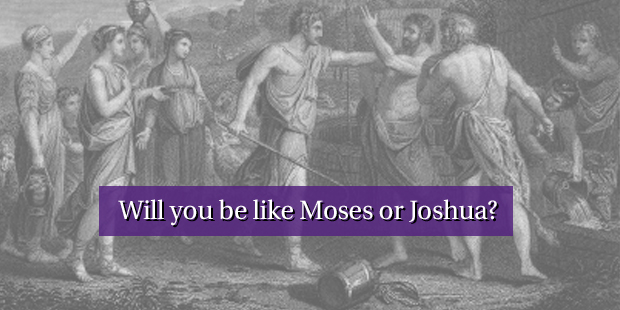
Will You be Like Moses or Joshua?

Moses and Joshua enjoyed a very special relationship. Moses poured his life into Joshua, entrusted Joshua with responsibility, and prepared him for service.

Joshua is first mentioned in the Scripture when Moses chose him to lead the Israelite army in battle against the Amalekites (Ex. 17:8-16). From that moment forward, we observe Moses intentionally developing Joshua and Joshua learning from Moses.

For example, Moses brought Joshua up the mountain to receive the Ten Commandments from God (Ex. 24:13). Joshua observed Moses’ righteous indignation when Moses smashed the two tablets (Ex. 32:17-19), and Joshua sensed the holy communion Moses shared with the Lord as Joshua guarded the tent of meeting (Ex. 33:11). As Israel scouted the land of Cannan, Moses sent Joshua as one of the spies (Num. 13:8).

Moses proactively and intentionally invested his life in Joshua. And immediately after Moses died, Joshua was given the responsibility to lead Israel. Under Joshua’s leadership, Israel enjoyed great prosperity and victory. By developing Joshua, Moses helped ensure the following generation would love and fear God. He served his people by pouring his life into another.

There is, however, no biblical record of Joshua investing his life in another person. And as we find in the Book of Judges, after Joshua’s death, Israel drifted from the Lord and lived in chaos. The generation after Joshua “did not know the Lord or the works He had done for Israel” (Judg. 2:10).

Will you be like Moses or like Joshua? Will you invest in others who will ensure the following generations know of the Lord and His gracious works?

 Read more from Eric here.
Download PDF

Tags: , , ,

| What is MyVisionRoom? > | Back to Leadership >

ABOUT THE AUTHOR

Eric Geiger

Eric Geiger

Eric Geiger is the Senior Pastor of Mariners Church in Irvine, California. Before moving to Southern California, Eric served as senior vice-president for LifeWay Christian. Eric received his doctorate in leadership and church ministry from Southern Seminary. Eric has authored or co-authored several books including the best selling church leadership book, Simple Church. Eric is married to Kaye, and they have two daughters: Eden and Evie. During his free time, Eric enjoys dating his wife, taking his daughters to the beach, and playing basketball.

See more articles by >

COMMENTS

What say you? Leave a comment!

Recent Comments
comment_post_ID); ?> Thank you for this information. I'm going to use this article to improve my work with the Lord.
 
— Abel Singbeh
 
comment_post_ID); ?> Thank you Ed for sharing your insights into the Church Growth Movement. I have my reservations with Church Growth models because it has done more damage than good in the Body of Christ. Over the years, western churches are more focused on results, formulas and processes with little or no emphasis on membership and church discipline. Pastors and vocational leaders are burnt out because they're overworked. I do believe that the Church Growth model is a catalyst to two destructive groups: The New Apostolic Reformation and the Emerging Church. Both groups overlap and have a very loose definition. They're both focus on contemporary worship, expansion of church brand (franchising), and mobilizing volunteering members as 'leaders' to grow their ministry. Little focus on biblical study, apologetics and genuine missional work with no agenda besides preaching of the gospel.
 
— Dave
 
comment_post_ID); ?> Thank you for sharing such a good article. It is a great lesson I learned from this article. I am one of the leaders in Emmanuel united church of Ethiopia (A denomination with more-than 780 local churches through out the country). I am preparing a presentation on succession planning for local church leaders. It will help me for preparation If you send me more resources and recommend me books to read on the topic. I hope we may collaborate in advancing leadership capacity of our church. God Bless You and Your Ministry.
 
— Argaw Alemu
 

Clarity Process

Three effective ways to start moving toward clarity right now.

How Churches and Grocery Stores Should Be Alike

I have plenty of reasons not to love my neighborhood grocery store: it’s not as cheap as Wal-Mart or Aldi; the fruit’s not as fresh as that big fruit market; it’s not trendy or hip at all like Trader Joe’s or Whole Foods; there’s no little cafe; there’s not an over-abundance of organic or grass-fed or free-range or hyper-local; and, when I was little, my father worked for its parent company and got laid off. So I should maybe be bitter or judgmental or snobby or a better steward or something. And yet, I can’t.

I love that store – “the Jewel,” as we call our Jewel Food and Drug store. Amid the mocking from friends who can’t believe I still shop there and in this increasingly competitive world of supermarkets clamoring to meet our every wish and to beat each other’s prices, I cheer for it. Go Jewel!

Truth be told, of course, it’s not exactly the Jewel itself I’m cheering. And I get why my friends prefer other stores – based on price, on quality, on variety, on ethical concerns. I understand why other stores have successfully chipped away at the mighty market share the Jewel once enjoyed. As grocery-store analyst David Livingston has said, when chains like the Jewel sought to become more efficient, they “lost sight of what their customers wanted from them.” And when my friends wanted cheaper or organic or larger variety, the Jewel failed them.

Beyond that, Livingston said stores like the Jewel lost customers because, in seeking efficiencies above all, they got rid of the “human experience” element of grocery shopping. “[The supermarket chains] piled it high and sold it cheap,” Livingston told the Chicago Tribune, “…got rid of all the humanity. It’s food. It’s primal. Yes, we need it to live, but we love it.”

“Folks from all walks of life, from all backgrounds, coming to a place based on a deeply primal need: to seek the sustenance of grace, the Bread of Life”


Livingston makes an interesting point. But I respectfully disagree with his definition of “human experience.” I don’t know anything about supermarket efficiencies, but I do know about the “humanity” of which Livingston speaks. And to that end, it’s because of its humanity that the Jewel has kept me as a loyal customer through the years. This neighborhood store is nothing short of a human experience – the human experience in many ways.

It’s the place where I bump into and catch up with neighbors and kids and teachers from school. It’s the place where I chat with cashiers and bakers and deli ladies and baggers who have worked there for the decades that I’ve shopped there. It’s the place where the produce guy smiles every time he sees my youngest child’s chocolate-smeared face from the donut I let him eat (and pay for via an empty bag later).

It’s probably the most racially and economically and religiously diverse place in town. And yet, it’s a place where we all come based on a need steeped in our shared, created humanity: a primal need to eat and a creative need to make what we eat interesting. I love that we meet this primal need together, locally.

In many ways, I believe every trip to the local grocery store is what every trip to local church should be. Folks from all walks of life, from all backgrounds, carrying all sorts of stress and burdens with them, coming to a place based on a deeply primal need: to seek the sustenance of grace, the Bread of Life, and to meet a creative need to make our worship interesting. Like the supermarket, sometimes the “cost” of attending a certain church is a bit higher than we’d like, sometimes the “fruit” isn’t quite as fresh or the ambience quite as trendy. Too often we’re tempted to shop around, to find something better, something more likely to meet our every last whim.

But when we look at churches or grocery stores or whatever as part of our human experience – as part of collectively meeting our primal needs – somehow those tiny whims and fancy trends seem much less important. Certainly less important than neighbors gathering with neighbors, serving, seeking, meeting those needs – creatively and collectively.

This article originally appeared on ThinkChristian.net.


Download PDF

Tags: , ,

| What is MyVisionRoom? > | Back to Environments >

ABOUT THE AUTHOR

Caryn Rivadeneria

See more articles by >

COMMENTS

What say you? Leave a comment!

Recent Comments
comment_post_ID); ?> Thank you for this information. I'm going to use this article to improve my work with the Lord.
 
— Abel Singbeh
 
comment_post_ID); ?> Thank you Ed for sharing your insights into the Church Growth Movement. I have my reservations with Church Growth models because it has done more damage than good in the Body of Christ. Over the years, western churches are more focused on results, formulas and processes with little or no emphasis on membership and church discipline. Pastors and vocational leaders are burnt out because they're overworked. I do believe that the Church Growth model is a catalyst to two destructive groups: The New Apostolic Reformation and the Emerging Church. Both groups overlap and have a very loose definition. They're both focus on contemporary worship, expansion of church brand (franchising), and mobilizing volunteering members as 'leaders' to grow their ministry. Little focus on biblical study, apologetics and genuine missional work with no agenda besides preaching of the gospel.
 
— Dave
 
comment_post_ID); ?> Thank you for sharing such a good article. It is a great lesson I learned from this article. I am one of the leaders in Emmanuel united church of Ethiopia (A denomination with more-than 780 local churches through out the country). I am preparing a presentation on succession planning for local church leaders. It will help me for preparation If you send me more resources and recommend me books to read on the topic. I hope we may collaborate in advancing leadership capacity of our church. God Bless You and Your Ministry.
 
— Argaw Alemu
 

Clarity Process

Three effective ways to start moving toward clarity right now.