A Church Communications Self-Assessment

What does your current church creative arts and communications ministry look like? To improve your situation, discover what’s going on.

By communications and creative arts, I am talking about your church’s efforts to communicate the gospel with clarity and beauty. This includes your worship and sermon series planning and development, your videos, your print material, your website, your social media – anything outside of the human voice that you use to share the story of Jesus.

In my conversations with church creatives, I find frustrated people, demoralized at a lack of appreciation for their work. But pastors are equally as frustrated. Dysfunction in the creative process is a top five complaint I hear from both church leaders and creatives. As one pastor wrote me, “My top priority right now is getting the right people in the room, with enough content and enough time to dream and accomplish the creative vision.”

MEDIOCRE OR POOR CHURCH CREATIVE ARTS AND COMMUNICATIONS IS A COMPLEX PROBLEM.

Some of the problem is tactical, like where or when to meet and who should be in the room. These decisions are important, but I think there’s something even more important. Creating an environment where creativity flourishes and creative people want to be requires more than just changing a few methods such as the day you meet or who’s in the room.

Some of the problem is strategic, like how far ahead to meet and what sorts of questions to ask in the planning process. But having a plan isn’t sufficient, either.

Some of the problem is systemic, such as the continued influence of models of knowing and being based on print culture, which has several qualities that are antithetical to creativity.

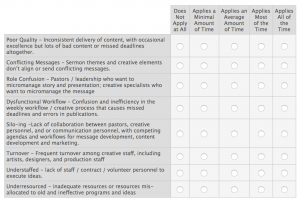
TO UNDERSTAND THE PROBLEM, TAKE THIS SELF-ASSESSMENT.

The first step to fixing your church creative arts and communications ministry is to understand what’s going on.

Take this brief survey to self-evaluate your situation.

Now, add up your total score. Give Big Problems you are having a “5”- Applies all of the time; for things that are Not an Issue give a “1” – Does not apply at all.

So the best you can get is a score of 8, and the worst is a score of 40. Are you over 15? 20? If so, you have some issues to resolve.

The answer to these problems is what would lead you to what I am calling a “church like Pixar” – a church whose creative and storytelling prowess made them appealing to people of all ages.

Read more from Len.


Connect with an Auxano Navigator to learn more about developing a vision-soaked communication culture at your church.

Download PDF

Tags: ,

| What is MyVisionRoom? > | Back to Communication >

ABOUT THE AUTHOR

Len Wilson

Len Wilson

Christ follower. Storyteller. Strategist. Writer. Creative Director at St Andrew. Tickle monster. Author, Think Like a Five Year Old (Abingdon).

See more articles by >

COMMENTS

What say you? Leave a comment!

Recent Comments
comment_post_ID); ?> Thank you for this information. I'm going to use this article to improve my work with the Lord.
 
— Abel Singbeh
 
comment_post_ID); ?> Thank you Ed for sharing your insights into the Church Growth Movement. I have my reservations with Church Growth models because it has done more damage than good in the Body of Christ. Over the years, western churches are more focused on results, formulas and processes with little or no emphasis on membership and church discipline. Pastors and vocational leaders are burnt out because they're overworked. I do believe that the Church Growth model is a catalyst to two destructive groups: The New Apostolic Reformation and the Emerging Church. Both groups overlap and have a very loose definition. They're both focus on contemporary worship, expansion of church brand (franchising), and mobilizing volunteering members as 'leaders' to grow their ministry. Little focus on biblical study, apologetics and genuine missional work with no agenda besides preaching of the gospel.
 
— Dave
 
comment_post_ID); ?> Thank you for sharing such a good article. It is a great lesson I learned from this article. I am one of the leaders in Emmanuel united church of Ethiopia (A denomination with more-than 780 local churches through out the country). I am preparing a presentation on succession planning for local church leaders. It will help me for preparation If you send me more resources and recommend me books to read on the topic. I hope we may collaborate in advancing leadership capacity of our church. God Bless You and Your Ministry.
 
— Argaw Alemu
 

Clarity Process

Three effective ways to start moving toward clarity right now.

Three Items for the Most Important List You Will Make This Year

The second law of thermodynamics revolves around entropy, the principle that things move to disorder and chaos over time. Left alone, things do not become more orderly or more effective. Your once well-ordered garage digresses to clutter. No matter how much you attempt to wish it into existence, your garage will not get more clean and organized without your intervention.

In the same way, our calendars and organizations become more cluttered without intervention. Organizational entropy is currently happening unless you are actively fighting against it. For this reason, leaders are often encouraged to develop “stop doing” lists so they may transfer time and energy and resources to what is more important. Without a “stop doing” list, unnecessary tasks will remain on job profiles and unfruitful meetings will remain on calendars.

So what items should make a “stop doing” list? Here are three:

1. The Unnecessary (no one should be doing)

An unnecessary task is something no one should be doing. Not anymore. Think of scaffolding that is used to build a building. The scaffolding, though extremely important at one point in time, does not always remain. Sadly, some unnecessary work and systems can remain if leaders don’t regularly remove the unnecessary. Peter Drucker said, “There is nothing so useless as doing efficiently that which should not be done at all.” When you eliminate unnecessary work, you are able to reallocate energy and resources to what is most important.

2. The Redundant (someone else is doing)

A redundant task is a task someone else is already doing. There are necessary tasks that are often redundant, meaning, someone else is already handling them. Instead of two people doing the same thing, two people can focus on two different important actions and add more value to the mission of the team.

3. The Less Important (other things should be done instead)

The most difficult task to stop is the less important one so that something more important can receive more resources and time and thinking and organizational focus. It takes great focus and discipline to steal energy from the less important and devote it to the most important. Johann Wolfgang von Goethe wisely said, “Things which matter most must never be at the mercy of things which matter least.”

Because of entropy, a “stop doing” list is not a one-time exercise.

> Read more from Eric.


Download PDF

Tags: , ,

| What is MyVisionRoom? > | Back to Leadership >

ABOUT THE AUTHOR

Eric Geiger

Eric Geiger

Eric Geiger is the Senior Pastor of Mariners Church in Irvine, California. Before moving to Southern California, Eric served as senior vice-president for LifeWay Christian. Eric received his doctorate in leadership and church ministry from Southern Seminary. Eric has authored or co-authored several books including the best selling church leadership book, Simple Church. Eric is married to Kaye, and they have two daughters: Eden and Evie. During his free time, Eric enjoys dating his wife, taking his daughters to the beach, and playing basketball.

See more articles by >

COMMENTS

What say you? Leave a comment!

Recent Comments
comment_post_ID); ?> Thank you for this information. I'm going to use this article to improve my work with the Lord.
 
— Abel Singbeh
 
comment_post_ID); ?> Thank you Ed for sharing your insights into the Church Growth Movement. I have my reservations with Church Growth models because it has done more damage than good in the Body of Christ. Over the years, western churches are more focused on results, formulas and processes with little or no emphasis on membership and church discipline. Pastors and vocational leaders are burnt out because they're overworked. I do believe that the Church Growth model is a catalyst to two destructive groups: The New Apostolic Reformation and the Emerging Church. Both groups overlap and have a very loose definition. They're both focus on contemporary worship, expansion of church brand (franchising), and mobilizing volunteering members as 'leaders' to grow their ministry. Little focus on biblical study, apologetics and genuine missional work with no agenda besides preaching of the gospel.
 
— Dave
 
comment_post_ID); ?> Thank you for sharing such a good article. It is a great lesson I learned from this article. I am one of the leaders in Emmanuel united church of Ethiopia (A denomination with more-than 780 local churches through out the country). I am preparing a presentation on succession planning for local church leaders. It will help me for preparation If you send me more resources and recommend me books to read on the topic. I hope we may collaborate in advancing leadership capacity of our church. God Bless You and Your Ministry.
 
— Argaw Alemu
 

Clarity Process

Three effective ways to start moving toward clarity right now.

6 Essentials of Vision Casting as Modeled by Martin Luther King

His Dream Became a Reality

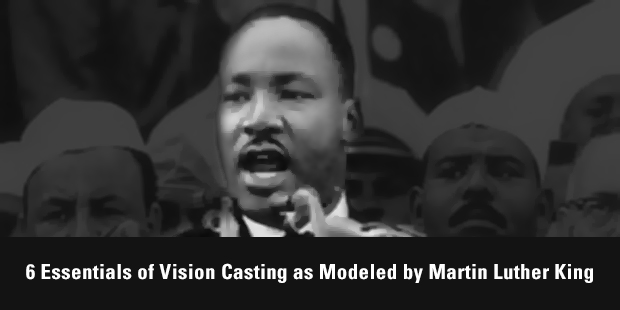
Over 50 years ago, Martin Luther King delivered his electrifying “I Have a Dream” speech from the steps of the Lincoln Memorial during the March on Washington, which became a flash point for a movement.

The legend endures beyond memory from a dwindling number of witnesses, but no one alive that day anticipated its sweetly patriotic glow.

– Taylor Branch

King’s speech is rightly remembered as one of the greatest speeches in American history. But few people remember that King stood on those same steps at the Lincoln Memorial 6 years earlier, with many of the same civil rights leaders present, and failed to rally the people.

What was the difference?

Vision.

Departing from his carefully written speech after only a few lines, King paused before continuing on with what are surely four of the most famous words uttered:

I Have a Dream…


Martin Luther King saw himself as a vision caster on that day – a connector not only to how clearly he saw current life but more importantly, how to get to the next immediate future.

As a church leader, you are a vision caster too.

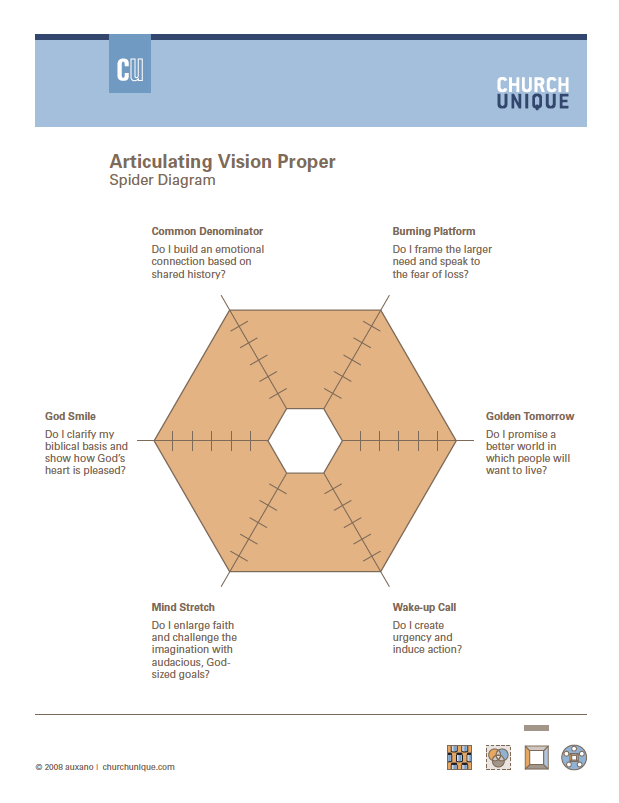
The language of vision casting employs metaphor and story, but your vision has to have a qualitative element as well. There are six essential elements leaders should include for moving people forward in achieving their vision:

> Common DenominatorDo you build an emotional connection based on shared history? Great vision casting moments start by looking back momentarily before looking forward.

> Burning PlatformDo you frame the larger need and speak to the fear of loss? The greatest mistake in vision casting is not recognizing that vision is always a solution to a prior problem.

> Golden TomorrowDo you promise a better world in which people will want to live? Stop vision casting to make the church better and show people how the church makes life better.

> Wake-Up CallDo you create urgency and induce action? The vision casting moment must remind people why action is required today.

> Mind StretchDo you enlarge faith and challenge the imagination with audacious, God-sized goals? Without a mind-blowing goal in front of them, your people will never have a reason for risk taking, collaboration, and heroic sacrifice.

> God SmileDo you clarify your biblical basis and show how God’s heart is pleased? The vision should be dripping with allusions to Scripture and the unquestionable history of God’s work among the local community.

Auxano Founder Will Mancini created a tool to help leaders like you evaluate your vision casting. Called the “Spider Diagram,” it will help you evaluate your vision casting communications on the six points listed above.

SpiderDiagramPDFFor each essential, the tool has a line to score on a scale of one to five (one being poor, toward the center; five being excellent, near the outer edge). As you measure your vision casting exercise, connecting the scores can plot the vision effectiveness. The ideal is that the vision makes a “wheel” that can roll smoothly.

In honor of Dr. King’s vision, and as an exercise in evaluating an excellent example of a vision casting speech, use the Spider Diagram tool below while listening to the “I Have a Dream” speech.


Great communicators create movements.

>> Download the Spider Diagram here.

>>Watch Dr. King’s I Have a Dream speech.


Download PDF

Tags: , , , ,

| What is MyVisionRoom? > | Back to Vision >

ABOUT THE AUTHOR

VRcurator

VRcurator

Bob Adams is Auxano's Vision Room Curator. His background includes over 23 years as an associate/executive pastor as well as 8 years as the Lead Consultant for a church design build company. He joined Auxano in 2012.

See more articles by >

COMMENTS

What say you? Leave a comment!

Recent Comments
comment_post_ID); ?> Thank you for this information. I'm going to use this article to improve my work with the Lord.
 
— Abel Singbeh
 
comment_post_ID); ?> Thank you Ed for sharing your insights into the Church Growth Movement. I have my reservations with Church Growth models because it has done more damage than good in the Body of Christ. Over the years, western churches are more focused on results, formulas and processes with little or no emphasis on membership and church discipline. Pastors and vocational leaders are burnt out because they're overworked. I do believe that the Church Growth model is a catalyst to two destructive groups: The New Apostolic Reformation and the Emerging Church. Both groups overlap and have a very loose definition. They're both focus on contemporary worship, expansion of church brand (franchising), and mobilizing volunteering members as 'leaders' to grow their ministry. Little focus on biblical study, apologetics and genuine missional work with no agenda besides preaching of the gospel.
 
— Dave
 
comment_post_ID); ?> Thank you for sharing such a good article. It is a great lesson I learned from this article. I am one of the leaders in Emmanuel united church of Ethiopia (A denomination with more-than 780 local churches through out the country). I am preparing a presentation on succession planning for local church leaders. It will help me for preparation If you send me more resources and recommend me books to read on the topic. I hope we may collaborate in advancing leadership capacity of our church. God Bless You and Your Ministry.
 
— Argaw Alemu
 

Clarity Process

Three effective ways to start moving toward clarity right now.

The Cure for Unhealthy Culture at Your Church

How can you protect and grow your church culture, without having to be negative all the time?

Either you will manage your culture, or it will manage you.

Simply defined, culture is the way people think and act.

Every organization has a culture, which either works for you or against you – and it can make the difference between success and failure. Managing the organizational culture so that leaders, managers, and team members think and act in the manner necessary to achieve desired results has never mattered more.

When most organizations try to improve their culture, they focus on the negative aspects, and try to fix them. This sounds reasonable, but the opposite approach is much more successful. You may find greater success in identifying a few positive attributes within your culture that are connected directly to your identity and mission. Focus on them and find ways to accelerate and extend them throughout the organization.

THE QUICK SUMMARY – The Culturetopia Effect, by Jason Young

What drives high performance for any company, organization, or team? How do successful companies create high fulfillment and high engagement within the employee workforce where people can do their best work?

The key to real success for any workplace lies at the very heart and soul of the organization it s culture. When business leaders understand how to measure, define and drive company culture and take action to integrate the values and behaviors consistent with an environment of care and accountability, they will witness an emerging, motivated workforce characterized by optimism, productivity, fulfillment and innovation high performance and high fulfillment. When this occurs, Culturetopia has been attained.

In The Culturetopia Effect, speaker, trainer and author Jason Young provides his valuable insights and practical ideas on how to create Culturetopia in any organization. He shares years of observations and experience with companies such as Southwest Airlines, Walt Disney, 3M, Cisco Systems and others, that have developed unique, high performance cultures and have experienced Culturetopia.

A SIMPLE SOLUTION

Every organization has values – even if they are not stated or acknowledged. Values alone do not guarantee success, because values can drive an organization toward maintaining the status quo, ignoring current realities, and even leading them to fail. The values of an organization must be ones that ultimately produce behavior throughout the organization that will help it achieve its desired results.

Values are used every day to guide every employees workplace behavior. Whenever an employee is in doubt about what to do next in any situation, then the companys values can provide guidance. In an organization that aspires to become successful by building a culture of cooperation, values provide an attitude ecosystem that works to guide employee behavior in every job, every moment of the working day.

In Culturetopia, there are no conflicts in the application of values; there is a complete and consistent values alignment.

This “values alignment” is obtained when your organizational values have the following six characteristics. 

Honesty

If the values of the company are inconsistent with the personal values of those who espouse them, employees will be unmoved by the insincerity. Values that are not based on truly held principles are merely platitudinous words and the values will not stick.

Relevance

The stated values of the company must be aligned with the needs and the aims of the company and its workforce. Irrelevant values are either ignored or cause conflicts or confusion.

Clarity

Stated values should not be fuzzy notions. The values should be aligned with reality by describing what they mean in practice.

Selectivity and Persistence

Achieving a workforce that is aligned with company values is a process that includes selecting, training, coaching, and reinforcing.

Consistency

The stated values of a company must be applied equally to all stakeholders. There cannot be a separate set of values for a specific group. You should be able to ask anybody within a company to describe the values and they should be the same.

 Reality

The actions of the company must be aligned with the company’s stated values. Stories containing actions taken by employees that reflect the core values of the company are often repeated

Jason Young, The Culturetopia Effect

A NEXT STEP

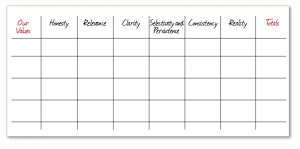
Write your existing values in rows down the left side of a 2 flip chart pages. Next, write the six characteristics in one column each across the top of the pages. Add one more column for a total score. You should have a table that looks something like this:

In your next team meeting, review your values as measured by the six characteristics, and rate them from 1 to 5, where one is “we are nowhere near the ballpark in this area” and five is “we are killing this area.” Add each value row for a total score at the end.

First, exalt any values scored from 24-30, by doing the following:

  • List 5 ways to maximize this value as a decision making filter.
  • Craft 2-3 ways this value is visibly and tangibly demonstrated in a ministry area
  • Anchor a key verse or passage of scripture to this value.

Next, evaluate any values scoring 18 or less by doing the following:

  • List 5 ways this value is holding us back organizationally.
  • Ask if there is a better way to state or restate this value for impact.
  • If needed, eliminate this value to keep culture clear.

Finally, examine any values scoring from 19 to 23 by doing the following:

  • List 5 ways this value should have more impact.
  • Ask if there is a way to define or demonstrate this value and increase it’s impact?
  • Weigh this values place in our culture with a pros and cons list. Move forward after a time of prayer. Answer the questions in section 1 above for any values that “make the grade.”

Now present your new, better-defined values set to a larger leadership team. Ask them to weigh in on what they like best and how they see these values lived out across the church. Continue to build conscious culture around these values.

Excerpt taken from SUMS Remix 58-1, January 2017


This is part of a weekly series posting content from one of the most innovative content sources in the church world: SUMS Remix Book Summaries for church leaders.

SUMS Remix takes a practical problem in the church and looks at it with three solutions; each solution is taken from a different book. As a church leader you get to scan relevant books based on practical tools and solutions to real ministry problems, not just by the cover of the book. Each post will have the edition number which shows the year and what number it is in the overall sequence. (SUMS provides 26 issues per year, delivered every other week to your inbox). 

Subscribe to SUMS Remix <<

Download PDF

Tags: , ,

| What is MyVisionRoom? > | Back to Vision >

ABOUT THE AUTHOR

VRcurator

VRcurator

Bob Adams is Auxano's Vision Room Curator. His background includes over 23 years as an associate/executive pastor as well as 8 years as the Lead Consultant for a church design build company. He joined Auxano in 2012.

See more articles by >

COMMENTS

What say you? Leave a comment!

Recent Comments
comment_post_ID); ?> Thank you for this information. I'm going to use this article to improve my work with the Lord.
 
— Abel Singbeh
 
comment_post_ID); ?> Thank you Ed for sharing your insights into the Church Growth Movement. I have my reservations with Church Growth models because it has done more damage than good in the Body of Christ. Over the years, western churches are more focused on results, formulas and processes with little or no emphasis on membership and church discipline. Pastors and vocational leaders are burnt out because they're overworked. I do believe that the Church Growth model is a catalyst to two destructive groups: The New Apostolic Reformation and the Emerging Church. Both groups overlap and have a very loose definition. They're both focus on contemporary worship, expansion of church brand (franchising), and mobilizing volunteering members as 'leaders' to grow their ministry. Little focus on biblical study, apologetics and genuine missional work with no agenda besides preaching of the gospel.
 
— Dave
 
comment_post_ID); ?> Thank you for sharing such a good article. It is a great lesson I learned from this article. I am one of the leaders in Emmanuel united church of Ethiopia (A denomination with more-than 780 local churches through out the country). I am preparing a presentation on succession planning for local church leaders. It will help me for preparation If you send me more resources and recommend me books to read on the topic. I hope we may collaborate in advancing leadership capacity of our church. God Bless You and Your Ministry.
 
— Argaw Alemu
 

Clarity Process

Three effective ways to start moving toward clarity right now.

Are You Leading Your Church or Just Managing It? Learn the Difference.

It’s been said many times by many different people that everything rises or falls on leadership. I don’t think that’s ever truer than in ministry. Charles McKay, a former professor at California Baptist College, used to say, “If you want to know the temperature of your church, put the thermometer in your mouth.”

You can’t ever take people further than you are yourself, spiritually or any other way.

I remember when I was interviewed on the ACTS television network by former SBC president, Jimmy Allen, and he asked me about starting new churches. He said, “How important is location?” I told him that location is the second most important thing. But the most important thing is not location, but leadership in a church.

You don’t have to be a charismatic leader (in the emotional sense) to be a great leader. Personality has almost nothing to do with dynamic leadership.

Vision Matters

It’s not the charisma of the leader that matters, but the vision of the leader. Whatever your assignment may be in your church, no matter what your ministry concentration may be, your number one responsibility of leadership in that area is to continually clarify and communicate the vision of that particular ministry.

You must constantly answer the question: Why are we here? If you don’t know the answer, you can’t lead.

As a senior pastor, my job is to keep us focused on the five purposes Jesus gave the church in the New Testament. That gets much more difficult as your church grows larger.

When we were very small, the only people who wanted to come were non-Christians. We didn’t have a lot of programs. We didn’t have a children’s ministry or a music ministry or a youth ministry. The people who wanted all those things went to churches that had them. Now that we’re big enough to not only have these programs but to excel at them, we have people transferring their membership to Saddleback.

Every week I meet people coming from other churches. This dynamic presents an acute problem. Often, people coming from another church carry cultural baggage and the expectation that Saddleback will be like the church they left. But the vision of the church someone just left isn’t the key issue. What matters is the vision you have as the spiritual leader of your congregation.

You must continually clarify and communicate your church’s vision to everyone who walks through the doors. You must make clear what you are doing and why you are doing it. No one can be left in the dark to the question of vision.

At Saddleback, we constantly communicate our vision through Class 101, through our website and social media, and in any other way we possibly can. Our purpose for being is always out front where everyone can see it. Everyone needs to know why we are here and catch our vision.

Vision Is the Difference Between Management and Leadership

Management consists primarily of three things: analysis, problem solving, and planning. If you go to any management course, it will be composed of those three things. But leadership consists of vision and values and the communication of those things. If you don’t clarify God’s purposes as the leader, who is going to do so?

Most churches are over-managed and under-led. Your church needs to be managed, but it also needs to be led. You have to have both.

When you only have management in the church, you get the problem of paralysis of analysis. Management without leadership results in constantly analyzing and looking, but never actually doing anything. You need managers within the church as well. Without them you end up with a church that makes decisions without direction.

Vision Is Powerful

Some people have dreams, but not vision. There is a difference. A vision is a pragmatic dream. Lots of people have great dreams. They have grand ideas of all they would like to accomplish, but they can never get their dreams in a concrete form where they can do something about it.

A vision is a dream that can be implemented. It’s specific. Nothing becomes dynamic until it becomes specific.

When you look out on a congregation filled with people who have been reached with the Good News of Jesus, whose lives have been eternally changed by God’s power, you get to witness the power of the vision God has placed in the heart of a church leader.

If you’re not sure where God wants you to be taking your congregation, get alone and spend time with him until he makes it clear.

Read more from Rick.


Connect with an Auxano Navigator to learn the difference between managing and leading your church with vision.

Download PDF

Tags: , ,

| What is MyVisionRoom? > | Back to Vision >

ABOUT THE AUTHOR

Rick Warren

Rick Warren

Rick Warren is the founding pastor of Saddleback Church in Lake Forest, Calif., one of America's largest and most influential churches. Rick is author of the New York Times bestseller The Purpose Driven Life. His book, The Purpose Driven Church, was named one of the 100 Christian books that changed the 20th century. He is also founder of Pastors.com, a global Internet community for pastors.

See more articles by >

COMMENTS

What say you? Leave a comment!

Recent Comments
comment_post_ID); ?> Thank you for this information. I'm going to use this article to improve my work with the Lord.
 
— Abel Singbeh
 
comment_post_ID); ?> Thank you Ed for sharing your insights into the Church Growth Movement. I have my reservations with Church Growth models because it has done more damage than good in the Body of Christ. Over the years, western churches are more focused on results, formulas and processes with little or no emphasis on membership and church discipline. Pastors and vocational leaders are burnt out because they're overworked. I do believe that the Church Growth model is a catalyst to two destructive groups: The New Apostolic Reformation and the Emerging Church. Both groups overlap and have a very loose definition. They're both focus on contemporary worship, expansion of church brand (franchising), and mobilizing volunteering members as 'leaders' to grow their ministry. Little focus on biblical study, apologetics and genuine missional work with no agenda besides preaching of the gospel.
 
— Dave
 
comment_post_ID); ?> Thank you for sharing such a good article. It is a great lesson I learned from this article. I am one of the leaders in Emmanuel united church of Ethiopia (A denomination with more-than 780 local churches through out the country). I am preparing a presentation on succession planning for local church leaders. It will help me for preparation If you send me more resources and recommend me books to read on the topic. I hope we may collaborate in advancing leadership capacity of our church. God Bless You and Your Ministry.
 
— Argaw Alemu
 

Clarity Process

Three effective ways to start moving toward clarity right now.

Write a Better Blog with These 21 Checkpoints

Are there elements that should pretty much always be included in every blog post? Yep. But it’s rare to find them all together in one, awesome post.

You don’t have to do all of these things every single time, but my own mental checklist that I run through as I’m writing, and before I hit “Publish” looks like this:

  1. Write a compelling title. Run it through CoSchedule’s headline analyzer?
  2. Use the first paragraph to motivate the reader to keep reading.
  3. Research some keywords to find out if anyone is actually searching for what I’m writing about.
  4. Include those keywords an appropriate number of times, especially in titles and headings.
  5. Include some bullet points.
  6. Include at least one image that looks good. Find them at Pexels.
  7. Assign a featured image and make sure it pops up in social posts. Debug if necessary.
  8. Include an average of two internal links to other posts within your blog.
  9. Include an average of two links to other relevant resources.
  10. Among those links, make one or two affiliate links.
  11. Pick an appropriate category or two.
  12. Add some relevant tags for cross-referencing purposes later on.
  13. Check the spelling.
  14. Evaluate the emotional impact of the post.
  15. Answer a question or solve a problem with the post.
  16. Be personal – use conversational language.
  17. Call the reader to act on what they’re reading in some small way.
  18. Post it to social media profiles, pages, groups, etc.
  19. Invite readers to connect and subscribe (not always within the post, but in the site design).
  20. Email your mailing list inviting them to check it out.
  21. Go back and re-evaluate the title one more time. After writing, is it still the best it can be?

As I said, this isn’t exhaustive. It’s just the list I run through as I write a post.

Read more from Brandon.


Talk with an Auxano Navigator about how your personal blogging can increase your church’s ministry influence.

Download PDF

Tags: , ,

| What is MyVisionRoom? > | Back to Communication >

ABOUT THE AUTHOR

Brandon Cox

Brandon Cox has been a Pastor for fifteen years and is currently planting a church in northwest Arkansas, a Saddleback-sponsored church. He also serves as Editor of Pastors.com and Rick Warren's Pastors' Toolbox, and authors a top 100 blog for church leaders (brandonacox.com). He's also the author of Rewired: Using Technology to Share God's Love.

See more articles by >

COMMENTS

What say you? Leave a comment!

Recent Comments
comment_post_ID); ?> Thank you for this information. I'm going to use this article to improve my work with the Lord.
 
— Abel Singbeh
 
comment_post_ID); ?> Thank you Ed for sharing your insights into the Church Growth Movement. I have my reservations with Church Growth models because it has done more damage than good in the Body of Christ. Over the years, western churches are more focused on results, formulas and processes with little or no emphasis on membership and church discipline. Pastors and vocational leaders are burnt out because they're overworked. I do believe that the Church Growth model is a catalyst to two destructive groups: The New Apostolic Reformation and the Emerging Church. Both groups overlap and have a very loose definition. They're both focus on contemporary worship, expansion of church brand (franchising), and mobilizing volunteering members as 'leaders' to grow their ministry. Little focus on biblical study, apologetics and genuine missional work with no agenda besides preaching of the gospel.
 
— Dave
 
comment_post_ID); ?> Thank you for sharing such a good article. It is a great lesson I learned from this article. I am one of the leaders in Emmanuel united church of Ethiopia (A denomination with more-than 780 local churches through out the country). I am preparing a presentation on succession planning for local church leaders. It will help me for preparation If you send me more resources and recommend me books to read on the topic. I hope we may collaborate in advancing leadership capacity of our church. God Bless You and Your Ministry.
 
— Argaw Alemu
 

Clarity Process

Three effective ways to start moving toward clarity right now.

8 Ways to Leverage Smartphones in Church

In 2011, smartphones were almost a novelty. Just 35% of American adults had one. That number has more than doubled in the past six years, and more than 9 in 10 adults under 30 have a smartphone (via Pew Research). When someone is considering a new phone, the question is no longer “will I get a smartphone?” but “which smartphone will I get?”

Now that this device has become almost attached to us 24-7 (I’ll be the first to admit, I’m tethered to mine), how is the church adapting? Or better yet, how should the church adapt and engage the smartphone? Here are eight ways.

  1. Live streaming. When the TV became prevalent in the 1950s, churches began television ministries. Many of those still exist but for most churches they are cost prohibitive and provide little return on the investment required. However, live streaming for smartphones can be implemented at a fraction of the cost and often has a greater reach than television ministries.
  2. Social media. This is an obvious inclusion. The rise of social media coincided with the rise of the smartphone. They go together like peanut butter and jelly or spaghetti and maple syrup. If your church is not active on social media, you’re missing a huge opportunity to engage your members and guests.
  3. Mobile friendly website. There is no excuse for a church not to have a good, well designed website. Not only should a website contain pertinent information, it should display well on a phone. This is also something to consider when creating graphics. Small text gets even smaller on smartphone screens.
  4. Text giving. We recently held a video call about giving trends in the church with several hundred leaders across North America. Text giving was the topic that drew the most questions from the audience. It’s the giving trend churches are inquiring about most. As we get more comfortable paying with our phones through Apple Pay, Paypal, and other techniques, text giving will only increase in its use in the church.
  5. Email newsletters. While email is readily available on a computer, the fact that we’re virtually always connected to email via our smartphones means newsletters are more likely to be seen. The more they are seen and read, the better informed your congregation will be.
  6. Online or in-app sermon notes. The proliferation of Bible apps has led to a new type of engagement of the Word during a service. My pastor even states, “open or turn on your Bibles” each week when preparing to read from Scripture. My church also posts sermon notes online and in an app, as do many others. While I personally prefer paper note-taking, my 13-year old son types his notes into his Bible app. He stays engaged in the sermon because of his smartphone.
  7. Church management. App- or cloud-based church management software allows church staff to have information about church events, members, or details at their fingertips regardless of their location. As more and more staff members office in community spaces (coffee shops, restaurants, etc.), this helps them stay connected to needed tools via their smartphones while working off-site.
  8. Event scheduling and reminders. Digital calendars have all but replaced paper day planners. Setting reminders and adding calendar events via smartphone apps allow you to stay more up-to-date on church events and happenings.

Does your church use any of these already? How else does your church engage members and guests via smartphone?

> Read more from Jonathan.


Download PDF

Tags: , , ,

| What is MyVisionRoom? > | Back to Communication >

ABOUT THE AUTHOR

Jonathan Howe

Jonathan Howe serves as vice president of communications for the Southern Baptist Convention's Executive Committee. He oversee all SBC Executive Committee communications including SBC.net, SBC LIFE, Baptist Press, social media initiatives and other media and messaging strategies. Howe was formerly the Director of Strategic Initiatives at LifeWay Christian Resources. Connect with Jonathan on Twitter at @Jonathan_Howe.

See more articles by >

COMMENTS

What say you? Leave a comment!

Recent Comments
comment_post_ID); ?> Thank you for this information. I'm going to use this article to improve my work with the Lord.
 
— Abel Singbeh
 
comment_post_ID); ?> Thank you Ed for sharing your insights into the Church Growth Movement. I have my reservations with Church Growth models because it has done more damage than good in the Body of Christ. Over the years, western churches are more focused on results, formulas and processes with little or no emphasis on membership and church discipline. Pastors and vocational leaders are burnt out because they're overworked. I do believe that the Church Growth model is a catalyst to two destructive groups: The New Apostolic Reformation and the Emerging Church. Both groups overlap and have a very loose definition. They're both focus on contemporary worship, expansion of church brand (franchising), and mobilizing volunteering members as 'leaders' to grow their ministry. Little focus on biblical study, apologetics and genuine missional work with no agenda besides preaching of the gospel.
 
— Dave
 
comment_post_ID); ?> Thank you for sharing such a good article. It is a great lesson I learned from this article. I am one of the leaders in Emmanuel united church of Ethiopia (A denomination with more-than 780 local churches through out the country). I am preparing a presentation on succession planning for local church leaders. It will help me for preparation If you send me more resources and recommend me books to read on the topic. I hope we may collaborate in advancing leadership capacity of our church. God Bless You and Your Ministry.
 
— Argaw Alemu
 

Clarity Process

Three effective ways to start moving toward clarity right now.

20 Unavoidable Requirements for Vision Breakthrough

As leaders, we are naturally praying for breakthrough in one or more areas…

  • In our family
  • In our health
  • In our relationships
  • In our congregation
  • And especially in God’s vision for our church

But vision breakthrough requires change.

And in just a few short weeks, the warm, hopeful desire for vision breakthrough will stand toe-to-toe with the cold, hard reality of the sacrifice demanded to achieve change. Only what we are truly committed-to, and convicted-of, will remain standing.

For most of us, spending another year talking about what should be different will be as effective in this year as it was in the last.

There is profit in all hard work, but endless talk leads only to poverty. Proverbs 14:23

It might seem obvious, but healthy change and Biblical growth will not “just happen” without work.

Lasting breakthrough in your church consists of at least 20 unavoidable requirements, because in the end…

…vision takes Effort – As followers of Christ, we have no model nor Biblical map for the path of least resistance.

…vision takes Money – Extending the life of a dying church costs very little, revitalizing hope for the future takes thoughtful & intentional investment.

…vision takes Time – God has gifted us with a mind to dream about “what if,” and the time to be about “what next.”

…vision takes Risk – The riverbanks are safer than the rapids, but the full beauty of the river cannot merely be observed, it must be experienced.

…vision takes Courage – Courage is not the absence of fear, it is the presence of fear and then moving forward in faith anyway.

…vision takes Recklessness – Following a Savior who gave His life will likely involve moments of leadership in which we risk ours.

…vision takes Fear – An honest appraisal of the stakes involved in pastoring a church should strike fear in the heart of any experienced leader.

…vision takes Control – A pastoral calling in the local church requires active leadership engagement, not passive membership observation.

…vision takes Prayer – Depending on prayer for breakthrough, means setting aside enough time for a season, not just enough to start a meeting.

…vision takes Truth – Understanding the current state of the church is the only start, if effectiveness and health are truly the destination.

…vision takes Reality – Communication of “what could be” apart from “what is” creates a precarious gap. Excessive aspiration breeds active cynicism.

…vision takes Collaboration – Successful leadership is not measured by what you get accomplished, but by what gets accomplished without you.

…vision takes Help – Every leader naturally thinks they can “do it themselves” when it comes to vision – if you could have, you would have by now.

…vision takes Commitment – It’s much easier to start something new than to revitalize something in existence. New isn’t always better, ask Coke.

…vision takes Humility – Owning and understanding what we presently do not know catapults the process of understanding and owning God’s preferred future.

…vision takes Understanding – Lasting leadership impact does not happen because you developed great solutions, but because you asked great questions.

…vision takes Perspective – The longer you are a part of a system or organization, the harder it becomes for you to see things as they actually are.

…vision takes Immediacy – There are as many reasons to start tomorrow as there are wishes we had started yesterday. Today is all we have.

…vision takes Patience – You cannot microwave vision, it is as healthy & nutritious for the church body as a microwave burrito is for your physical body.

…vision takes Jesus – If the Gospel of Christ is not the primary catalyst and the singular focus of our effort, let’s change the name and charge membership fees.

Visionary breakthrough will demand much, but reward much more. Will Mancini’s book God Dreams is a great place to begin. Here is a recent post from Will on the importance of breakthrough church vision.

If you are ready to start a breakthrough vision conversation with an Auxano team member, or learn more about scheduling a 2-Day Vision Retreat this year, let us know here.

In the meantime… get to work.

> Read more from Bryan.

Download PDF

Tags: , ,

| What is MyVisionRoom? > | Back to Vision >

ABOUT THE AUTHOR

Bryan Rose

Bryan Rose

As Lead Navigator for Auxano, Bryan Rose has a strong bias toward merging strategy and creativity within the vision of the local church and has had a diversity of experience in just about every ministry discipline over the last 12 years. With his experience as a multi-site strategist and campus pastor at a 3500 member multi-campus church in the Houston Metro area, Bryan has a passion to see “launch clarity” define the unique Great Commission call of developing church plants and campus, while at the same time serving established churches as they seek to clarify their individual ministry calling. Bryan has demonstrated achievement as a strategic thinker with a unique ability to infuse creativity into the visioning process while bringing a group of people to a deep sense of personal ownership and passion.

See more articles by >

COMMENTS

What say you? Leave a comment!

Recent Comments
comment_post_ID); ?> Thank you for this information. I'm going to use this article to improve my work with the Lord.
 
— Abel Singbeh
 
comment_post_ID); ?> Thank you Ed for sharing your insights into the Church Growth Movement. I have my reservations with Church Growth models because it has done more damage than good in the Body of Christ. Over the years, western churches are more focused on results, formulas and processes with little or no emphasis on membership and church discipline. Pastors and vocational leaders are burnt out because they're overworked. I do believe that the Church Growth model is a catalyst to two destructive groups: The New Apostolic Reformation and the Emerging Church. Both groups overlap and have a very loose definition. They're both focus on contemporary worship, expansion of church brand (franchising), and mobilizing volunteering members as 'leaders' to grow their ministry. Little focus on biblical study, apologetics and genuine missional work with no agenda besides preaching of the gospel.
 
— Dave
 
comment_post_ID); ?> Thank you for sharing such a good article. It is a great lesson I learned from this article. I am one of the leaders in Emmanuel united church of Ethiopia (A denomination with more-than 780 local churches through out the country). I am preparing a presentation on succession planning for local church leaders. It will help me for preparation If you send me more resources and recommend me books to read on the topic. I hope we may collaborate in advancing leadership capacity of our church. God Bless You and Your Ministry.
 
— Argaw Alemu
 

Clarity Process

Three effective ways to start moving toward clarity right now.

Seven Power Tools for Vivid Visual Communication

My team and I seem to be using more and more words, yet communicating less and less. 

Today more than ever, we live in a visual society. Especially in the online world, everyone relies on the power of photos and engagement of video.

While researching a project recently, I was struck by three surprising data points from visual communicator Dan Roam:

  • Research from IBM found that 90% of all data collected in history has been generated in the last two years.
  • Research from Cisco found that 90% of all data transmitted online today is visual.
  • Roam’s experience indicates that 90% of leaders have no idea how to effectively use visuals in their business.

90%-90%-90%. We’re generating more data than ever, that data is overwhelmingly visual, and most of us don’t know how to use images. No matter what business you’re in, the future of your business is visual.

As a church leader, it is incumbent that you get better at using visual images in your communication.

Whether drawing them, looking at them, or talking about them, visual communication adds enormously to your listener’s ability to think, to remember, and to do.

Visual imagery is, in itself, another whole language. Being fluent in that language gives us mind-boggling power to articulate thoughts, communicate those thoughts, and solve problems in ways we otherwise wouldn’t be able to.

THE QUICK SUMMARY – Visual Leaders, by David Sibbet

Visual Leaders explores how leaders can support visioning and strategy formation, planning and management, and organizational change through the application of visual meeting and visual team methodologies organization wide—literally “trans-forming” communications and people’s sense of what is possible. It describes seven essential tools for visual leaders—mental models, visual meetings, graphic templates, decision theaters, roadmaps, Storymaps, and virtual visuals—and examples of methods for implementation throughout an organization.

  • Written for all levels of leadership in organizations, from department heads through directors, heads of strategic business units, and “C” level executives
  • Explores how communications has become interactive and graphic and how these tools can be used to shape direction and align people for implementation
  • Brings tools, methods and frameworks to life with stories of real organizations modeling these practices

Visual Leaders answers the question of how design thinking and visual literacy can help to orient leaders to the complexity of contemporary organizations in the private, non-profit, and public sectors.

A SIMPLE SOLUTION

The power of an iterative, creative process that maximizes the use of visuals cannot be overstated. People learn, grow, and contribute when they “get” the dynamics of complex issues from a variety of perspectives, and they get it best when they can visually see it.

As a result, to most effectively lead, regardless of our organization’s life stage or current issues, we must consistently build skills to facilitate using different visual tools and formats.

To master a new way of thinking you will need to do a lot of visual note taking and playing around with ideas. But it is possible to “reprogram” your brain. Writing, drawing, diagramming, and visualizing are direct ways to do that. There are seven tools which can help lead to new levels of awareness and upgraded mental models, and then to more effective responses to situations.

Seven Essential Power Tools for Visual Leaders

Metaphors and Models – Connecting your vision with compelling imagery and mental models that leaders can use to keep their organizations focused on the big picture while working on the details.

Visual Meetings – Engage people and create an environment where your people feel comfortable working visually.

Graphic Templates – Providing light, intellectual scaffolding for critical planning meetings, reports, and other visual communications gives visual leaders a chance to guide the attention of the organization in productive ways without having to draw themselves.

Decision Rooms –When decisions need aligned commitment it helps to have everyone understand the big picture as well as the choices being made. Staging panoramic meetings is a direct path, online as well.

Roadmaps and Visual Plans – Visual time lines are as useful in organizational work as itineraries are on vacations. People need to know the big milestones and channels of activity.

Graphic Storymaps – Leaders who show up and communicate authentically are the drivers of effective, aligned organizations. Visual maps and murals make it much easier to do this and provide ways you can stand out from the deluge of information everyone is trying to deal with in contemporary organizations. Storymaps uniquely link plans to culture.

Video and Virtual Visuals – Video is as common as email for younger people and many organizations that are keeping pace with technology. This and other communication tools are allowing organizations to work effectively in distributed formats.

David Sibbet, Visual Leaders

A NEXT STEP

During your next leadership team meeting, identify one church-wide challenge or opportunity that has the potential to radically impact the future.

Step 1: Have team members work individually and take 15 minutes to reflect on the phrases, metaphors, and stories (include Scriptures that come to mind). Consider phrases and stories from the history, creation story, or ongoing interactions of your church that might highlight the vivid future behind this challenge or opportunity.

Step 2: Place individuals in teams for sharing of their top two entries for each of the Treasure Chest columns.

Step 3: Ask each group to put their top three vivid descriptions on a flip chart and then present to the rest of the group.

Step 4: Decide and Commit on the most powerful imagery to use in your next communication piece.

Raise your team’s awareness of metaphors by: having each member listen for metaphors used in their ministries, drawing sketches of metaphors, underlining in leadership articles, and clipping strong imagery from other magazines.

Excerpt taken from SUMS Remix 55-2, December 2016


This is part of a weekly series posting content from one of the most innovative content sources in the church world: SUMS Remix Book Summaries for church leaders.

SUMS Remix takes a practical problem in the church and looks at it with three solutions; each solution is taken from a different book. As a church leader you get to scan relevant books based on practical tools and solutions to real ministry problems, not just by the cover of the book. Each post will have the edition number which shows the year and what number it is in the overall sequence. (SUMS provides 26 issues per year, delivered every other week to your inbox). 

Subscribe to SUMS Remix <<

Download PDF

Tags: , ,

| What is MyVisionRoom? > | Back to Communication >

ABOUT THE AUTHOR

VRcurator

VRcurator

Bob Adams is Auxano's Vision Room Curator. His background includes over 23 years as an associate/executive pastor as well as 8 years as the Lead Consultant for a church design build company. He joined Auxano in 2012.

See more articles by >

COMMENTS

What say you? Leave a comment!

Recent Comments
comment_post_ID); ?> Thank you for this information. I'm going to use this article to improve my work with the Lord.
 
— Abel Singbeh
 
comment_post_ID); ?> Thank you Ed for sharing your insights into the Church Growth Movement. I have my reservations with Church Growth models because it has done more damage than good in the Body of Christ. Over the years, western churches are more focused on results, formulas and processes with little or no emphasis on membership and church discipline. Pastors and vocational leaders are burnt out because they're overworked. I do believe that the Church Growth model is a catalyst to two destructive groups: The New Apostolic Reformation and the Emerging Church. Both groups overlap and have a very loose definition. They're both focus on contemporary worship, expansion of church brand (franchising), and mobilizing volunteering members as 'leaders' to grow their ministry. Little focus on biblical study, apologetics and genuine missional work with no agenda besides preaching of the gospel.
 
— Dave
 
comment_post_ID); ?> Thank you for sharing such a good article. It is a great lesson I learned from this article. I am one of the leaders in Emmanuel united church of Ethiopia (A denomination with more-than 780 local churches through out the country). I am preparing a presentation on succession planning for local church leaders. It will help me for preparation If you send me more resources and recommend me books to read on the topic. I hope we may collaborate in advancing leadership capacity of our church. God Bless You and Your Ministry.
 
— Argaw Alemu
 

Clarity Process

Three effective ways to start moving toward clarity right now.

What 2017’s Most Popular Tweets Reveal About Our Culture

There are many ways to gain a quick snapshot into culture. One of the more revealing ways is to look at what has trended – or is trending – on Twitter. So for a crash course in all things “now,” here is a sampling of Twitter’s most popular tweets and accounts of 2017:

Most retweeted tweets:

1. The Wendy’s chicken nugget challenge
2. Barack Obama’s Charlottesville response
3. Pennsylvania State University raises money for Houston
4. Ariana Grande responds to the Manchester concert shooting
5. President Obama’s last “thankful” tweet as POTUS

Most tweeted about celebrities:

1. K-pop group @BTS_twt
2. South Korean record label @pledis_17
3. Singer @Camila_Cabello

Most tweeted about elected world leaders:

1. President Donald Trump @RealDonaldTrump
2. Narendra Modi, the prime minister of India @narendramodi
3. Venezuelan President Nicolas Maduro @NicolasMaduro

Most tweeted about TV shows (US-only):

1. Game of Thrones
2. Stranger Things
3. Big Brother
4. 13 Reasons Why
5. Saturday Night Live
6. The Walking Dead
7. Grey’s Anatomy
8. The Voice
9. Supernatural
10. Pretty Little Liars

Most tweeted about movies (US-only):

1. Wonder Woman
2. La La Land
3. Dunkirk
4. Spider-Man: Homecoming
5. Justice League
6. It
7. Beauty and the Beast
8. Thor: Ragnarok
9. Black Panther
10. Fifty Shades Darker

Most tweeted activism hashtags (US-only):

1. #Resist
2. #MAGA
3. #ImpeachTrump
4. #TrumpTrain
5. #WomensMarch
6. #NotMyPresident
7. #BlackLivesMatter
8. #NoDAPL
9. #TakeAKnee
10. #BoycottNFL

Now, ready for your homework? If any of these made you feel clueless, put Google to work and catch up.

It’s the world in which you live.

Read more from James Emery White.

Download PDF

Tags: , , ,

| What is MyVisionRoom? > | Back to Communication >
ABOUT THE AUTHOR

James Emery White

James Emery White

James Emery White is the founding and senior pastor of Mecklenburg Community Church in Charlotte, NC, and the ranked adjunctive professor of theology and culture at Gordon-Conwell Theological Seminary, which he also served as their fourth president. He is the founder of Serious Times and this blog was originally posted at his website www.churchandculture.org.

See more articles by >

COMMENTS

What say you? Leave a comment!

Recent Comments
comment_post_ID); ?> Thank you for this information. I'm going to use this article to improve my work with the Lord.
 
— Abel Singbeh
 
comment_post_ID); ?> Thank you Ed for sharing your insights into the Church Growth Movement. I have my reservations with Church Growth models because it has done more damage than good in the Body of Christ. Over the years, western churches are more focused on results, formulas and processes with little or no emphasis on membership and church discipline. Pastors and vocational leaders are burnt out because they're overworked. I do believe that the Church Growth model is a catalyst to two destructive groups: The New Apostolic Reformation and the Emerging Church. Both groups overlap and have a very loose definition. They're both focus on contemporary worship, expansion of church brand (franchising), and mobilizing volunteering members as 'leaders' to grow their ministry. Little focus on biblical study, apologetics and genuine missional work with no agenda besides preaching of the gospel.
 
— Dave
 
comment_post_ID); ?> Thank you for sharing such a good article. It is a great lesson I learned from this article. I am one of the leaders in Emmanuel united church of Ethiopia (A denomination with more-than 780 local churches through out the country). I am preparing a presentation on succession planning for local church leaders. It will help me for preparation If you send me more resources and recommend me books to read on the topic. I hope we may collaborate in advancing leadership capacity of our church. God Bless You and Your Ministry.
 
— Argaw Alemu
 

Clarity Process

Three effective ways to start moving toward clarity right now.