Closing the Back Door of Your Church: Moving from Entitlement to Servanthood

Numbers of gifted persons and organizations have studied the phenomenon of the church “back door,” the metaphorical way we describe people leaving the church. And there will always be the anticipated themes of relocation or personal crises. We should recognize those issues, though we can respond to the latter more than the former.

But all the research studies of which I am aware, including my own, return to one major theme to explain the exodus of church members: a sense of some need not being filled. In other words, these members have ideas of what a local congregation should provide for them, and they leave because those provisions have not been met.

Certainly we recognize there are many legitimate claims by church members of unfulfilled expectations. It can undoubtedly be the fault of the local congregation and its leaders.

But many times, probably more than we would like to believe, a church member leaves a local body because he or she has a sense of entitlement. I would therefore suggest that the main reason people leave a church is because they have an entitlement mentality rather than a servant mentality.

Look at some of the direct quotes from exit interviews of people who left local congregations:

  • “The worship leader refused to listen to me about the songs and music I wanted.”
  • “The pastor did not feed me.”
  • “No one from my church visited me.”
  • “I was not about to support the building program they wanted.”
  • “I was out two weeks and no one called me.”
  • “They moved the times of the worship services and it messed up my schedule.”
  • “I told my pastor to go visit my cousin and he never did.”

Please hear me clearly. Church members should expect some level of ministry and concern. But, for a myriad of reasons beyond the scope of this one blogpost, we have turned church membership into country club membership. You pay your dues and you are entitled to certain benefits.

The biblical basis of church membership is clear in Scripture. The Apostle Paul even uses the “member” metaphor to describe what every believer should be like in a local congregation. In 1 Corinthians 12:12-31, Paul describes church members not by what they should receive in a local church, but by the ministry they should give.

The solution to closing the back door, at least a major part of the solution, is therefore to move members from an entitlement mentality to a servant mentality. Of course, it is easy for me to write about it, but it is a greater challenge to effect it.

May I then offer a few steps of a more practical nature to help close the back door by changing the membership mentality? Here are five:

  1. Inform church members. Though I do not have precise numbers, I would conjecture that more than one-half of church members do not have a biblical understanding about church membership. Providing that information in a new members’ class can move an entire congregation toward a servant mentality.
  2. Raise the bar of expectations. We have dumbed down church membership in many congregations to where it has little meaning. Clarify expectations of members. Again, doing so in the context of a new members’ class is a great way to begin.
  3. Mentor members. Take two or three members and begin to mentor them to become biblical church members. After a season, ask them to mentor two or three as well. Let the process grow exponentially.
  4. Train members. Almost 100 percent of pastors agree that their role is to train and equip members. But almost three-fourths of these pastors have no plans on how they will train them (see Ephesians 4:11-13). I will address this issue more fully on my blog next Wednesday.
  5. Encourage people to be in small groups. Those in Sunday school classes and small groups are more likely to be informed and functioning church members. In others words, there is a much greater likelihood of a member with a servant mentality to be in a small group than not.

What are you doing in your church to close the back door? What are you doing to move members from an entitlement mentality to a servant mentality?

Read more from Thom here.
Download PDF

Tags: , , ,

| What is MyVisionRoom? > | Back to Process >

ABOUT THE AUTHOR

Thom Rainer

Thom Rainer

Thom S. Rainer is the founder and CEO of Church Answers, an online community and resource for church leaders. Prior to founding Church Answers, Rainer served as president and CEO of LifeWay Christian Resources. Before coming to LifeWay, he served at The Southern Baptist Theological Seminary for twelve years where he was the founding dean of the Billy Graham School of Missions and Evangelism. He is a 1977 graduate of the University of Alabama and earned his Master of Divinity and Ph.D. degrees from The Southern Baptist Theological Seminary.

See more articles by >

COMMENTS

What say you? Leave a comment!

Recent Comments
comment_post_ID); ?> Thank you for this information. I'm going to use this article to improve my work with the Lord.
 
— Abel Singbeh
 
comment_post_ID); ?> Thank you Ed for sharing your insights into the Church Growth Movement. I have my reservations with Church Growth models because it has done more damage than good in the Body of Christ. Over the years, western churches are more focused on results, formulas and processes with little or no emphasis on membership and church discipline. Pastors and vocational leaders are burnt out because they're overworked. I do believe that the Church Growth model is a catalyst to two destructive groups: The New Apostolic Reformation and the Emerging Church. Both groups overlap and have a very loose definition. They're both focus on contemporary worship, expansion of church brand (franchising), and mobilizing volunteering members as 'leaders' to grow their ministry. Little focus on biblical study, apologetics and genuine missional work with no agenda besides preaching of the gospel.
 
— Dave
 
comment_post_ID); ?> Thank you for sharing such a good article. It is a great lesson I learned from this article. I am one of the leaders in Emmanuel united church of Ethiopia (A denomination with more-than 780 local churches through out the country). I am preparing a presentation on succession planning for local church leaders. It will help me for preparation If you send me more resources and recommend me books to read on the topic. I hope we may collaborate in advancing leadership capacity of our church. God Bless You and Your Ministry.
 
— Argaw Alemu
 

Clarity Process

Three effective ways to start moving toward clarity right now.

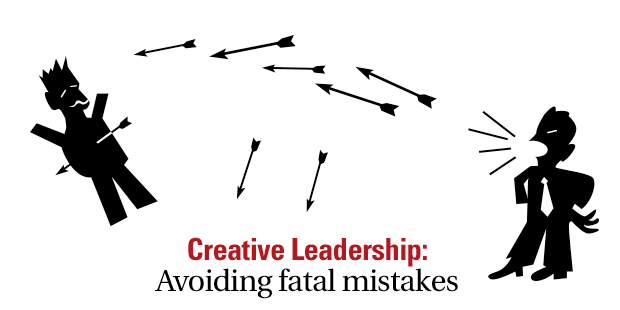
Creative Leadership: Avoiding Fatal Mistakes

Leadership is hard. It’s a lonely role, you face crushing uncertainty with elevated stakes, and you’re expected to deliver not only on your own work, but also to corral the creative minds of others and parade them into the promised land. (Oh, and did I mention that it’s often thankless?)

Todd Henry, founder of Accidental Creative, a consultancy that helps organizations generate brilliant ideas, warns of the following traps that even the most experienced leaders fall into:

Deferring

This means that you’re pushing important decisions into the future until you are more certain about the right direction. While this initially seems wise, it has a ripple effect through the organization as others wait for you to act so that they can determine their own course of action.

Blaming

When things go awry and your team comes to you for answers, it’s easy to shoot arrows at the people above you. After all, if it’s really not your fault it’s a natural instinct, and it feels like a way to maintain the trust of your team.

Bending

Creative work is highly qualitative. It’s difficult sometimes to determine whether the product fits the original objectives, and it’s often a matter of opinion.  You have to make your expectations clear to the team, and you must be diligent in demanding they hit the metrics.

Hovering

You’ve hired great people, yes? Then don’t smother them by constantly hovering over their work. It communicates a lack of trust, and it may ultimately lead to a dependence on your feedback, or worse to under-performance or under-thinking.

These are just a few of the (many) traps that creative leaders fall into. Leadership is about establishing the playing field, setting the rules, defining success, and unleashing your team to do what they’re wired to do. Avoid these common traps so that you don’t stand in the way of your team’s brilliance!

Read the full post here.

Read more from Todd here.

Download PDF

Tags: , , ,

| What is MyVisionRoom? > | Back to Leadership >

ABOUT THE AUTHOR

VRcurator

VRcurator

Bob Adams is Auxano's Vision Room Curator. His background includes over 23 years as an associate/executive pastor as well as 8 years as the Lead Consultant for a church design build company. He joined Auxano in 2012.

See more articles by >

COMMENTS

What say you? Leave a comment!

Recent Comments
comment_post_ID); ?> Thank you for this information. I'm going to use this article to improve my work with the Lord.
 
— Abel Singbeh
 
comment_post_ID); ?> Thank you Ed for sharing your insights into the Church Growth Movement. I have my reservations with Church Growth models because it has done more damage than good in the Body of Christ. Over the years, western churches are more focused on results, formulas and processes with little or no emphasis on membership and church discipline. Pastors and vocational leaders are burnt out because they're overworked. I do believe that the Church Growth model is a catalyst to two destructive groups: The New Apostolic Reformation and the Emerging Church. Both groups overlap and have a very loose definition. They're both focus on contemporary worship, expansion of church brand (franchising), and mobilizing volunteering members as 'leaders' to grow their ministry. Little focus on biblical study, apologetics and genuine missional work with no agenda besides preaching of the gospel.
 
— Dave
 
comment_post_ID); ?> Thank you for sharing such a good article. It is a great lesson I learned from this article. I am one of the leaders in Emmanuel united church of Ethiopia (A denomination with more-than 780 local churches through out the country). I am preparing a presentation on succession planning for local church leaders. It will help me for preparation If you send me more resources and recommend me books to read on the topic. I hope we may collaborate in advancing leadership capacity of our church. God Bless You and Your Ministry.
 
— Argaw Alemu
 

Clarity Process

Three effective ways to start moving toward clarity right now.

Can I Be An Effective Pastor If I Don’t Like Management?

Pastors are not managers, at least in a corporate-business-world-publicly-traded-company-sort-of-way. But pastors are shepherds. And shepherds manage sheep.

Leading a church involves management. Perhaps you’ve had the privilege of attending a meeting discussing the finer details of administering the Lord’s Supper. If so, you probably recognize the importance of the managerial role in the church.

A church hierarchy assumes management. And most churches—even congregations with smaller staffs—are not completely flat. For instance, I’ve never seen a church intentionally give the same level of authority as the senior pastor to the student pastor. Maybe some might be better if they did (of course, some might devolve into chaos.). Even at the most basic level, churches require management. Who pays the bills? When does the meeting start? Who is responsible for snow removal? Who fills the baptistery? What is our policy? Those are basic managerial questions. Most churches are more complex.

Some senior leaders in the church gravitate towards being more like a senior writer or senior analyst. These leaders are recognized for their intellectual contributions but do not have managerial oversight. Many teaching pastors have this type of role in the church. Other senior leaders prefer to manage the minutia and deal with people issues. Many executive pastors have this type of role. Most pastors, however, must both teach and execute.

The vast majority of pastoral roles include management. So, can church leaders be effective if they don’t like management? Yes, but they must compensate in these ways.

Be self-aware. One of the core problems of bad management is poor managers often do not recognize their weak managerial skills. When you’re self-aware about your weaknesses (and willing to admit them), then you’re more likely to receive help from others. No pastor can (nor should) do it all. And all pastors should be self-aware of what they can and cannot do.

Discern what to delegate. Just because you’re naturally good at doing something does not mean you are able to manage others doing the same thing. Some pastors delegate their responsibilities too quickly. Others delegate the wrong responsibilities. And some tasks should never be delegated. Delegation with discernment makes up for a lot of managerial weaknesses.

Don’t fear being the doer. Some people prefer doing tasks. Others prefer managing people who do the tasks. If you cherish a few tasks, then don’t give them up. Keep doing them. For instance, a pastor might enjoy locking the church after the evening service as an opportunity to prayer walk.  Or, if you’re an artistic type, there may be certain creative tasks that are difficult to manage. Good church leaders know what select tasks they enjoy most and keep doing them, sparing their followers the inevitable and overbearing micro-management that would accompany overseeing others doing them.

You don’t have to like management to be an effective pastor. But shepherding a congregation does involve managing sheep. All pastors should both teach and execute. Few master both. If you’re weaker at managing execution, then you can compensate through self-awareness, discernment, and doing the tasks you enjoy most.

Read more from Sam here.

Download PDF

Tags: , , ,

| What is MyVisionRoom? > | Back to Leadership >

ABOUT THE AUTHOR

Sam Rainer III

Sam serves as lead pastor of West Bradenton Baptist Church. He is also the president of Rainer Research, and he is the co-founder/co-owner of Rainer Publishing. His desire is to provide answers for better church health. Sam is author of the book, Obstacles in the Established Church, and the co-author of the book, Essential Church. He is an editorial advisor/contributor at Church Executive magazine. He has also served as a consulting editor at Outreach magazine. He has written over 150 articles on church health for numerous publications, and he is a frequent conference speaker. Before submitting to the call of ministry, Sam worked in a procurement consulting role for Fortune 1000 companies. Sam holds a B.S. in Finance and Marketing from the University of South Carolina, an M.A. in Missiology from Southern Seminary, and a Ph.D. in Leadership Studies at Dallas Baptist University.

See more articles by >

COMMENTS

What say you? Leave a comment!

Recent Comments
comment_post_ID); ?> Thank you for this information. I'm going to use this article to improve my work with the Lord.
 
— Abel Singbeh
 
comment_post_ID); ?> Thank you Ed for sharing your insights into the Church Growth Movement. I have my reservations with Church Growth models because it has done more damage than good in the Body of Christ. Over the years, western churches are more focused on results, formulas and processes with little or no emphasis on membership and church discipline. Pastors and vocational leaders are burnt out because they're overworked. I do believe that the Church Growth model is a catalyst to two destructive groups: The New Apostolic Reformation and the Emerging Church. Both groups overlap and have a very loose definition. They're both focus on contemporary worship, expansion of church brand (franchising), and mobilizing volunteering members as 'leaders' to grow their ministry. Little focus on biblical study, apologetics and genuine missional work with no agenda besides preaching of the gospel.
 
— Dave
 
comment_post_ID); ?> Thank you for sharing such a good article. It is a great lesson I learned from this article. I am one of the leaders in Emmanuel united church of Ethiopia (A denomination with more-than 780 local churches through out the country). I am preparing a presentation on succession planning for local church leaders. It will help me for preparation If you send me more resources and recommend me books to read on the topic. I hope we may collaborate in advancing leadership capacity of our church. God Bless You and Your Ministry.
 
— Argaw Alemu
 

Clarity Process

Three effective ways to start moving toward clarity right now.

10 Major Trends Coming Your Way in 2013

Here are a few trends that seem to be capturing major attention as we start 2013. I am not proposing that all of these are positive trends, but simply stating them as a picture of reality as move into 2013 and beyond.

1. Content on demand– everywhere, often and most of the time free.

2. Tech in everything– cars, kitchen, refrigerators, watches, wallets, and other devices.

3. Smart Phone as the center of your world– it is where you consume content, get info, make calls, update my status, and remote control my tv and appliances, along with basically running your life.

4. Integrated social media– social media is no longer a phenomenon. It’s here to stay. And now integrated into everything we do.

5. We are all leaders– because of social media, technology, and the digital space, anyone can create a platform and gain influence quickly. Everyone has access. Small competes with large, and there is an equal playing field for most involved.

6. Authenticity matters– more than ever, we have to be real and genuine and honest.

7. Comfortable Multi-tasking is in– Cars are now being created that drive themselves. For real. We are more than ever creatures of comfort. Comfort so I can do multiple things at once.

8. Touchscreens– experience is now about everything being a touchscreen and swipe technology.

9. Collaboration– working together is more and more becoming the norm. Shared office spaces between companies, shared staff, partnerships, etc.

10. Mergers and streamlining within industries– similar to #9, but specifically as it relates to a formal merger between companies, organizations and churches. This continues to happen with more regularity, and is now happening consistently with churches and non-profit organizations.

Read more from Brad here.

Download PDF

Tags: , , ,

| What is MyVisionRoom? > | Back to Vision >

ABOUT THE AUTHOR

Brad Lomenick

Brad Lomenick

In a nutshell, I’m an Oklahoma boy now residing in the South. I am a passionate follower of Christ, and have the privilege of leading and directing a movement of young leaders called Catalyst. We see our role as equipping, inspiring, and releasing the next generation of young Christian leaders, and do this through events, resources, consulting, content and connecting a community of like-minded Catalysts all over the world. I appreciate the chance to continually connect with and collaborate alongside leaders.

See more articles by >

COMMENTS

What say you? Leave a comment!

Recent Comments
comment_post_ID); ?> Thank you for this information. I'm going to use this article to improve my work with the Lord.
 
— Abel Singbeh
 
comment_post_ID); ?> Thank you Ed for sharing your insights into the Church Growth Movement. I have my reservations with Church Growth models because it has done more damage than good in the Body of Christ. Over the years, western churches are more focused on results, formulas and processes with little or no emphasis on membership and church discipline. Pastors and vocational leaders are burnt out because they're overworked. I do believe that the Church Growth model is a catalyst to two destructive groups: The New Apostolic Reformation and the Emerging Church. Both groups overlap and have a very loose definition. They're both focus on contemporary worship, expansion of church brand (franchising), and mobilizing volunteering members as 'leaders' to grow their ministry. Little focus on biblical study, apologetics and genuine missional work with no agenda besides preaching of the gospel.
 
— Dave
 
comment_post_ID); ?> Thank you for sharing such a good article. It is a great lesson I learned from this article. I am one of the leaders in Emmanuel united church of Ethiopia (A denomination with more-than 780 local churches through out the country). I am preparing a presentation on succession planning for local church leaders. It will help me for preparation If you send me more resources and recommend me books to read on the topic. I hope we may collaborate in advancing leadership capacity of our church. God Bless You and Your Ministry.
 
— Argaw Alemu
 

Clarity Process

Three effective ways to start moving toward clarity right now.

Facts and Trends Snapshot, Winter 2013

Expanding on their name, the Facts and Trends staff is providing a snapshot of current issues, cultural and spiritual beliefs, and church trends. It’s also a report of what churches are doing to connect with their communities.

This quarterly download is filled with bite-sized content you can read in a few seconds – and chew on for a few days.

Facts and Trends is a quarterly publication designed to assist pastors, church staff, and leaders in their ministry roles by informing them of resources and current issues in Christian ministry.

Carol Pipes is the Editorial Manager of Facts and Trends.

Download the Winter 2013 Snapshot here.

Read more from Facts and Trends here.

Download PDF

Tags: , ,

| What is MyVisionRoom? > | Back to Leadership >

ABOUT THE AUTHOR

Facts and Trends

Facts and Trends

Facts and Trends is published quarterly by LifeWay Christian Resources. Their goal is to help pastors, staff, and church leaders carry out their ministry more effectively. Carol Pipes is the Editorial Manager of F&T.

See more articles by >

COMMENTS

What say you? Leave a comment!

Recent Comments
comment_post_ID); ?> Thank you for this information. I'm going to use this article to improve my work with the Lord.
 
— Abel Singbeh
 
comment_post_ID); ?> Thank you Ed for sharing your insights into the Church Growth Movement. I have my reservations with Church Growth models because it has done more damage than good in the Body of Christ. Over the years, western churches are more focused on results, formulas and processes with little or no emphasis on membership and church discipline. Pastors and vocational leaders are burnt out because they're overworked. I do believe that the Church Growth model is a catalyst to two destructive groups: The New Apostolic Reformation and the Emerging Church. Both groups overlap and have a very loose definition. They're both focus on contemporary worship, expansion of church brand (franchising), and mobilizing volunteering members as 'leaders' to grow their ministry. Little focus on biblical study, apologetics and genuine missional work with no agenda besides preaching of the gospel.
 
— Dave
 
comment_post_ID); ?> Thank you for sharing such a good article. It is a great lesson I learned from this article. I am one of the leaders in Emmanuel united church of Ethiopia (A denomination with more-than 780 local churches through out the country). I am preparing a presentation on succession planning for local church leaders. It will help me for preparation If you send me more resources and recommend me books to read on the topic. I hope we may collaborate in advancing leadership capacity of our church. God Bless You and Your Ministry.
 
— Argaw Alemu
 

Clarity Process

Three effective ways to start moving toward clarity right now.

How (Not) to Inspire a Shared Vision

Like millions of other Americans, I tuned in to hear President Obama’s second inaugural address.  The President is rightly admired for his strong oratory skills and ability to use communication as an effective leadership skill.  That’s why I was so disappointed in the speech.  While there were parts of the speech that resonated with me, overall I thought it landed flat.  As I reflected on my disappointment, I realized that the President had not inspired a shared vision.

If you lead within a church, a ministry, a non-profit, a business or a community, you must be able to communicate in order to lead.  As part of the communication responsibility, every leader must be able to inspire a shared vision.  An inspired vision pulls people forward.  It projects a clear image of a possible future and generates energy to strive toward the destination.

I think the President’s address can help us better understand how to inspire a shared vision.  Here are five components of an inspiring vision (adapted from Kouzes and Posner’s The Leadership Challenge) along with my two cents on how the President performed on each:

  1. An inspiring vision shares an IDEAL.  An ideal is a high standard to aspire to, an ennobling purpose and greater good we are seeking.    What followers need from our leaders is not a laundry list of ideals, but a single high standard to which we want to aspire.
  2. An inspiring vision is UNIQUE, it creates healthy pride in being different by creating an identity that is extraordinary.  An inspired vision helps followers know how we are collectively unique, singular, and unequaled.
  3. An inspiring vision uses IMAGE to make concepts tangible through descriptive language.   Word pictures, stories and symbols help make the vision more memorable and compelling. When a vision lacks true focus, the use of many images prevents the vision from being memorable.
  4. An inspiring vision is FUTURE-ORIENTED, looking toward a destination.  Visions describe an exciting possibility for the future and stretch our minds out into the future and asks us to dream.
  5. An inspiring vision is built around a COMMON GOOD, a way people can come together.  Visions are about developing a shared sense of destiny.  Followers must be able to see themselves and their interests served in the vision; they must see how they are a part of the vision in order to enlist others in it.

So how well do you think the President inspired a shared vision?  What worked and what missed the mark?  And what are some examples of leaders who did a masterful job of inspiring a shared vision?

Read the full article here.

Read more from Chad here.

Download PDF

Tags: , , ,

| What is MyVisionRoom? > | Back to Vision >

ABOUT THE AUTHOR

Chad Hall

See more articles by >

COMMENTS

What say you? Leave a comment!

Recent Comments
comment_post_ID); ?> Thank you for this information. I'm going to use this article to improve my work with the Lord.
 
— Abel Singbeh
 
comment_post_ID); ?> Thank you Ed for sharing your insights into the Church Growth Movement. I have my reservations with Church Growth models because it has done more damage than good in the Body of Christ. Over the years, western churches are more focused on results, formulas and processes with little or no emphasis on membership and church discipline. Pastors and vocational leaders are burnt out because they're overworked. I do believe that the Church Growth model is a catalyst to two destructive groups: The New Apostolic Reformation and the Emerging Church. Both groups overlap and have a very loose definition. They're both focus on contemporary worship, expansion of church brand (franchising), and mobilizing volunteering members as 'leaders' to grow their ministry. Little focus on biblical study, apologetics and genuine missional work with no agenda besides preaching of the gospel.
 
— Dave
 
comment_post_ID); ?> Thank you for sharing such a good article. It is a great lesson I learned from this article. I am one of the leaders in Emmanuel united church of Ethiopia (A denomination with more-than 780 local churches through out the country). I am preparing a presentation on succession planning for local church leaders. It will help me for preparation If you send me more resources and recommend me books to read on the topic. I hope we may collaborate in advancing leadership capacity of our church. God Bless You and Your Ministry.
 
— Argaw Alemu
 

Clarity Process

Three effective ways to start moving toward clarity right now.

How to Create a Content Calendar and Engage More People in Your Church

One of the best ways to connect with your church throughout the week is with social media.  Statistically, over half of your congregation will spend some portion of their week actively engaged on Facebook, Twitter, and blogs.

But connecting with your audience through social media requires consistent and compelling content.  And not just any content. Your content must be emotional, intelligent, shareable and intentional.  But developing content that is both creative and inspiring takes dedicated time and resources, as well as a considerable amount of effort on your part.

The best way to create emotional and inspiring content is by developing a Publishing Schedule. Developing a publishing schedule helps you plan, produce and publish compelling content that clearly articulates the vision of your church.

Without one, your content quickly becomes redundant, outdated, and unnecessary, and you end up with content no one cares about.

In my research, I found a formula created by Russell Sparkman of Fusionspark Media, used to develop a publishing schedule. The formula is 1-7-30-4-2-1.

I am adapting the formula to 1-7-30 for the sake of simplicity.

Here is a breakdown of the formula:

1 = Daily, 7 = Weekly, 30 = Monthly

This formula determines what content you will publish daily, weekly, monthly, quarterly. Keep in mind that whatever content you publish must reinforce and advance a Big Idea or theme.

1 = Daily 

  • Twitter Tweets (3-5 Times)
  • Facebook Updates (2-4 Times)
  • Respond to Twitter, Facebook and Blog Comments

7 = Weekly

  • Blog Posts (2-3 Times)
  • Short Video (1 Time)
  • Update and Edit Website Pages (1 Time)

30 = Monthly

  • ENewsletter
  • Video Interview
  • EBook

This formula might appear overwhelming at first glance.  Maybe you’re thinking, “There’s no way I can accomplish all of this!”  But start where you are, keeping in mind your resources and your target audience.

Content Ideas –

  • Devotional eBook Series – Write, design and send eBooks on spiritual subject matter or a book of the Bible
  • Short Videos – Interview staff members on why they love their role or brief updates from the Senior Pastor
  • Blog Posts – Select a theme and write a series of blog posts.  Write posts on event highlights, life-change stories, sermon notes, book recommendations, devotionals, etc.
  • eNewsletter – Switch up layout and flow of eNewsletter and give the reader value with free downloads, resources, etc.

Remember, your key messages are too important not to communicate them consistently, concisely, and with incredible clarity.  Social media is a valuable tool for communicating the mission and vision of your church.

 Read more from Tim here.
Download PDF

Tags: , , , ,

| What is MyVisionRoom? > | Back to Communication >

ABOUT THE AUTHOR

Tim Peters

See more articles by >

COMMENTS

What say you? Leave a comment!

Recent Comments
comment_post_ID); ?> Thank you for this information. I'm going to use this article to improve my work with the Lord.
 
— Abel Singbeh
 
comment_post_ID); ?> Thank you Ed for sharing your insights into the Church Growth Movement. I have my reservations with Church Growth models because it has done more damage than good in the Body of Christ. Over the years, western churches are more focused on results, formulas and processes with little or no emphasis on membership and church discipline. Pastors and vocational leaders are burnt out because they're overworked. I do believe that the Church Growth model is a catalyst to two destructive groups: The New Apostolic Reformation and the Emerging Church. Both groups overlap and have a very loose definition. They're both focus on contemporary worship, expansion of church brand (franchising), and mobilizing volunteering members as 'leaders' to grow their ministry. Little focus on biblical study, apologetics and genuine missional work with no agenda besides preaching of the gospel.
 
— Dave
 
comment_post_ID); ?> Thank you for sharing such a good article. It is a great lesson I learned from this article. I am one of the leaders in Emmanuel united church of Ethiopia (A denomination with more-than 780 local churches through out the country). I am preparing a presentation on succession planning for local church leaders. It will help me for preparation If you send me more resources and recommend me books to read on the topic. I hope we may collaborate in advancing leadership capacity of our church. God Bless You and Your Ministry.
 
— Argaw Alemu
 

Clarity Process

Three effective ways to start moving toward clarity right now.

Is Innovation a Part of Your Organization’s DNA?

It’s been a brutal period for retail firms since the global financial crisis hit.  Despite this, I’ve spoken recently with the CEOs of four different retail firms (Lorna Jane, Unit, Di Bella Coffee and The Cloakroom) that have all more than doubled their sales in that time.

[Note from the Vision Room Curator: If you’ve read the first paragraph and think this doesn’t apply to your church because it’s about retail, you would be wrong. Read on for three common factors of retail stores that can also be applied in your church.]

What do they have in common?  A few things.  All four CEOs are founders, all of them are very passionate about what they do, and all four firms have innovation embedded in their DNA, as Phil Di Bella put it.

This is expressed a few different ways. The common factors among them are:

  • A strong culture of experimentation.  Experimenting is central to innovating effectively.  All four firms are great at this – having an idea, and trying it to see if it works.  If it does, they scale it.  For this to work, you also need to support the experimental approach with a strong learning culture – there’s no point in testing ideas fail if you don’t learn from the ones that fail.
  • Their passion is driven by a shared purpose.  Phil appears to be personally affronted by mediocre coffee.  Lorna and Bill are committed to helping women live healthier lives, Paul and Ian want Unit to change the sports they support, and Andrew and the Cloakroom gents are deeply committed to helping men dress well.  More importantly, this message is shared by everyone that works at these firms.  I’ve spoken with people on all four shop floors, and the message is very consistent with what I’ve heard from the top.Here is how Nilofer Merchants puts it:
    In the social era, purpose precedes scale. And as we discussed in part two of the series, shared purpose allows many communities to engage with you — without you having to invest resources in controlling their actions. When TED unleashed TEDx, they created a force multiplier. Shared purpose aligns people without coordination costs.
    Purpose is also a better motivator than money. Money, while necessary, motivates neither the best people, nor the best in people. Purpose does.
  • Their people are empowered.  This goes hand-in-hand in with the previous two points.  Even if people have a shared purpose, and the organization has a culture of learning, you can still kill innovation if there is no autonomy.  To take advantage of purpose + experiments, everyone needs to feel as though they are allowed to test out ideas as they have them.

Lorna Jane and Unit are also both exceptional at social media – I saw the social media tracking boards at Lorna Jane last week, and they are amazing.

When times get tough, it is easy to go for efficiency. Stefan Lindegaard outlines what happens when you focus on efficiency at the expense of innovation:

No one wins this battle. The employees are taken as hostages, the customers or end-users lose out on the benefits of innovation and in the long term the shareholders will suffer. The latter is true because there is actually one winner. That is the competitor that decides to become competitively unpredictable through innovation and gets this right.

These are tricky times for retail (and for many other sectors as well). In addition to widespread economic problems, Tom Fishburne’s latest post addresses one of the factors unique to retail:

Fishburne describes what happens when a retail store focuses on efficiency at the expense of innovation:

The last time I shopped at Best Buy, I ended up buying at Amazon, but not because of price. I really wanted to buy from Best Buy, particularly after I’d invested the time to travel there and preferred to have the product the same day. But the store experience was so transactional and it was so hard to find a knowledgable sales rep that I gave up. Best Buy could have won me over with a better retail experience, but they dropped the ball. They were trying so hard to be like Amazon on price, they didn’t excel at what could have made them different.

What makes the successful retail shops different?  Passion.  Purpose. Experiments.

Innovation is part of their DNA.

Read more from Tim here.

Download PDF

Tags: , ,

| What is MyVisionRoom? > | Back to Leadership >

ABOUT THE AUTHOR

Tim Kastelle

Tim Kastelle

Tim Kastelle is a Lecturer in Innovation Management in the University of Queensland Business School. He blogs about innovation at the Innovation Leadership Network.

See more articles by >

COMMENTS

What say you? Leave a comment!

Recent Comments
comment_post_ID); ?> Thank you for this information. I'm going to use this article to improve my work with the Lord.
 
— Abel Singbeh
 
comment_post_ID); ?> Thank you Ed for sharing your insights into the Church Growth Movement. I have my reservations with Church Growth models because it has done more damage than good in the Body of Christ. Over the years, western churches are more focused on results, formulas and processes with little or no emphasis on membership and church discipline. Pastors and vocational leaders are burnt out because they're overworked. I do believe that the Church Growth model is a catalyst to two destructive groups: The New Apostolic Reformation and the Emerging Church. Both groups overlap and have a very loose definition. They're both focus on contemporary worship, expansion of church brand (franchising), and mobilizing volunteering members as 'leaders' to grow their ministry. Little focus on biblical study, apologetics and genuine missional work with no agenda besides preaching of the gospel.
 
— Dave
 
comment_post_ID); ?> Thank you for sharing such a good article. It is a great lesson I learned from this article. I am one of the leaders in Emmanuel united church of Ethiopia (A denomination with more-than 780 local churches through out the country). I am preparing a presentation on succession planning for local church leaders. It will help me for preparation If you send me more resources and recommend me books to read on the topic. I hope we may collaborate in advancing leadership capacity of our church. God Bless You and Your Ministry.
 
— Argaw Alemu
 

Clarity Process

Three effective ways to start moving toward clarity right now.

The Real Competition for Your Church

One of the biggest dangers that any church faces when trying to reach people who are far from God is comparing itself to other churches.

How good your preaching is compared to them.
How good your worship experiences are compared to them.
How good your videos are compared to them.

This is dangerous. But probably not for the reasons you’re thinking. Yes, the dangers of jealousy and competition are there. But that’s not what I’m talking about.

It’s dangerous because if you want to reach other people for Christ, your competition isn’t other churches. It isn’t a matter of if you have better music than other churches. Better videos than other churches. Even better community than other churches. That’s not your standard of comparison.

Why? Because none of the people you’re trying to reach are going to those churches. When a lost person walks out your doors, their first thought probably isn’t going to be “man, that was better than that other church.” They haven’t been to that other church. Or possibly any church.

The point of comparison for lost people are things that lost people see. That lost people listen to. That lost people experience.

That’s your real competition. So for example, when we decorate for Christmas, I don’t want it to be as good or better than other churches in town. I want it to be as good or better than anything they’d see at the best mall in town. Because that is what every person who has never stepped foot inside of a church before is consciously or unconsciously comparing us to.

Now we do have something that is incomparable and unbeatable: Jesus Christ. I’m not saying we have to make Him look better because He’s not up to the job. And obviously the movement of the Holy Spirit is not dependent on how we measure up to the outside world.

However, we do have to communicate Jesus through certain mediums. I believe these mediums should actually live up to the message and person they’re communicating. And be something that people can relate to. So all of them have to be at their best.

Some people might think that this is shallow. And yes, it is shallow. But that’s where people are, and we have to meet them there. Or we might meet them nowhere.

I’d rather be considered shallow and be surrounded by people who have found life in Christ than be considered deep and be alone. Or surrounded only by people who knew Jesus long before they ever knew me. Lost people can’t become deep Christians until they first become Christians period.

And if part of making that happen means us raising our game and showing the world that the people of God can be just as creative and excellent in what they produce, why would we hesitate to do so?

Read more from Steven here.

Download PDF

Tags: , ,

| What is MyVisionRoom? > | Back to Environments >

ABOUT THE AUTHOR

Steven Furtick

Steven Furtick

Pastor Steven Furtick is the lead pastor of Elevation Church. He and his wife, Holly, founded Elevation in 2006 with seven other families. Pastor Steven holds a Master of Divinity degree from The Southern Baptist Theological Seminary. He is also the New York Times Best Selling author of Crash the Chatterbox, Greater, and Sun Stand Still. Pastor Steven and Holly live in the Charlotte area with their two sons, Elijah and Graham, and daughter, Abbey.

See more articles by >

COMMENTS

What say you? Leave a comment!

Recent Comments
comment_post_ID); ?> Thank you for this information. I'm going to use this article to improve my work with the Lord.
 
— Abel Singbeh
 
comment_post_ID); ?> Thank you Ed for sharing your insights into the Church Growth Movement. I have my reservations with Church Growth models because it has done more damage than good in the Body of Christ. Over the years, western churches are more focused on results, formulas and processes with little or no emphasis on membership and church discipline. Pastors and vocational leaders are burnt out because they're overworked. I do believe that the Church Growth model is a catalyst to two destructive groups: The New Apostolic Reformation and the Emerging Church. Both groups overlap and have a very loose definition. They're both focus on contemporary worship, expansion of church brand (franchising), and mobilizing volunteering members as 'leaders' to grow their ministry. Little focus on biblical study, apologetics and genuine missional work with no agenda besides preaching of the gospel.
 
— Dave
 
comment_post_ID); ?> Thank you for sharing such a good article. It is a great lesson I learned from this article. I am one of the leaders in Emmanuel united church of Ethiopia (A denomination with more-than 780 local churches through out the country). I am preparing a presentation on succession planning for local church leaders. It will help me for preparation If you send me more resources and recommend me books to read on the topic. I hope we may collaborate in advancing leadership capacity of our church. God Bless You and Your Ministry.
 
— Argaw Alemu
 

Clarity Process

Three effective ways to start moving toward clarity right now.

Are Groups Really Important in Your Church?

I believe groups (classes, Bible fellowships, etc) should be important to churches because God has supernaturally ordained community to sanctify His people. God, who is an eternal community of three Persons, created community for our benefit and His glory. And small groups help believers live in community with one anther.

Though most pastors say that groups are important, the research for the upcoming book Transformational Groups revealed that for many churches there’s a major discrepancy between the stated importance of groups and the actual priority. For many churches, contrary to what is articulated, groups are really not that important. At least two alarming facts were discovered:

For many churches group content is treated haphazardly.

The majority of pastors and church leaders have no clue what is being studied. In fact, almost two-thirds of pastors tell us that the person primarily responsible for selecting the curriculum for the group is the group leader, and a large number of those do so without any oversight or direction from the pastor and/or staff. In most cases not only are group leaders not given studies that are built on a particular theology and discipleship strategy, but they aren’t given anything: not a plan, not a recommended resource list, nothing.

Now if the church has a group training mechanism in place on the front end and group leaders are tested and vetted theologically, are taught to choose resources in accordance with the theology of the church, and are equipped to think strategically about a spiritual growth plan for their group, then handing the responsibility to the group leader would be empowerment. If, however, the above doesn’t exist, there is ministry negligence. A wise pastor would never treat the teaching from the pulpit with that type of haphazard planning. And group content shouldn’t be treated this way either.

As a leader, you must guard the doctrine of your church—that means caring about the content that is being studied in groups.

The majority of church attendees don’t believe groups are that important to the church.

Though pastors say that groups are important to the church, sadly the majority of church attendees don’t say the same thing. In other words, in many churches groups being important is largely an aspirational value for church leaders and not actual in the culture of the church. Church leaders should ask themselves why the people in the church don’t consider groups more important. The following questions could be helpful to consider:

  • Are the pastors and leaders in a group?
  • Do the people in the church continually hear about groups?
  • If someone wanted to join a group today, what would you tell them to do?
  • Are stories of transformation occurring in community shared with the church?
  • In comparison to the weekend services, how much energy is poured into group strategy, leader training, etc?

The reality is that most church leaders devote much more energy to the worship services than to groups. Caring less about the worship gathering isn’t the solution; caring more about groups is. In worship gatherings that are grounded in Jesus, God supernaturally uses the preaching of His word and the worship to transform hearts and affections. And in groups grounded in Jesus, God supernaturally uses the community to mature His people. Both are important. Both should be important to your church.

Read more from Eric here.

Download PDF

Tags: , , ,

| What is MyVisionRoom? > | Back to Process >

ABOUT THE AUTHOR

Eric Geiger

Eric Geiger

Eric Geiger is the Senior Pastor of Mariners Church in Irvine, California. Before moving to Southern California, Eric served as senior vice-president for LifeWay Christian. Eric received his doctorate in leadership and church ministry from Southern Seminary. Eric has authored or co-authored several books including the best selling church leadership book, Simple Church. Eric is married to Kaye, and they have two daughters: Eden and Evie. During his free time, Eric enjoys dating his wife, taking his daughters to the beach, and playing basketball.

See more articles by >

COMMENTS

What say you? Leave a comment!

Recent Comments
comment_post_ID); ?> Thank you for this information. I'm going to use this article to improve my work with the Lord.
 
— Abel Singbeh
 
comment_post_ID); ?> Thank you Ed for sharing your insights into the Church Growth Movement. I have my reservations with Church Growth models because it has done more damage than good in the Body of Christ. Over the years, western churches are more focused on results, formulas and processes with little or no emphasis on membership and church discipline. Pastors and vocational leaders are burnt out because they're overworked. I do believe that the Church Growth model is a catalyst to two destructive groups: The New Apostolic Reformation and the Emerging Church. Both groups overlap and have a very loose definition. They're both focus on contemporary worship, expansion of church brand (franchising), and mobilizing volunteering members as 'leaders' to grow their ministry. Little focus on biblical study, apologetics and genuine missional work with no agenda besides preaching of the gospel.
 
— Dave
 
comment_post_ID); ?> Thank you for sharing such a good article. It is a great lesson I learned from this article. I am one of the leaders in Emmanuel united church of Ethiopia (A denomination with more-than 780 local churches through out the country). I am preparing a presentation on succession planning for local church leaders. It will help me for preparation If you send me more resources and recommend me books to read on the topic. I hope we may collaborate in advancing leadership capacity of our church. God Bless You and Your Ministry.
 
— Argaw Alemu
 

Clarity Process

Three effective ways to start moving toward clarity right now.