Your Communication Strategy Starts at the Top: Why Senior Pastors Are to Blame for Bad Church Signs

We’ve all seen them—bulletin bloopers and bad church signs. Both provide good fodder for blog consumption. My father is an expert on corny humor, and he has posted on his blog numerous examples of this vital genre of church literature.

  • When parking on the north side of the church, please remember to park on an angel.
  • Men’s prayer breakfast. No charge, but your damnation will be gratefully accepted.
  • The class on prophecy has been cancelled due to unforeseen circumstances.
  • A bean supper will be held on Tuesday evening in the church hall. Music will follow.

For the most part, these slips are forgivable offenses. They provoke nothing more than a few chuckles from the observant. But I believe they are indicators of a greater problem within churches: poor oversight of communication.

I blame senior church leaders for bad church signs and bulletin bloopers. Here’s why.

Anything the entire community sees (signs, websites, social media, and printed materials) should have the approval and oversight of a senior leader within the church. If you’re a senior pastor, and you can’t remember the last time you checked out your church website or read the bulletin, then you are neglecting the broadest piece of your church’s communication strategy. All top church leaders should read church tweets, the worship guide, and website updates every week. If you’re not, then you will not have a clear understanding of what information the average churchgoer is digesting each week. Senior pastors should have a thorough understanding of the contents of whatever method a church uses to communicate with a broad audience, church signs included.

The communication strategy of a church is the responsibility of senior leadership. If that’s you, and you’re just as surprised as everyone else by what is on the church sign or in the worship guide on Sunday morning, then you are not leading a communication strategy. Should you write every word in the worship guide? No. But it would help if you read every word before your entire church does. It’s quite surprising to me how church leaders let one person control broad communications to the world. As a senior leader, you should know who is tweeting what. You should know why certain announcements make the bulletin and others do not. It does not mean you’re out there changing the letters on the church sign, but it does mean you should know and approve ahead of time what message is broadcast to many who drive by your church on a daily basis.

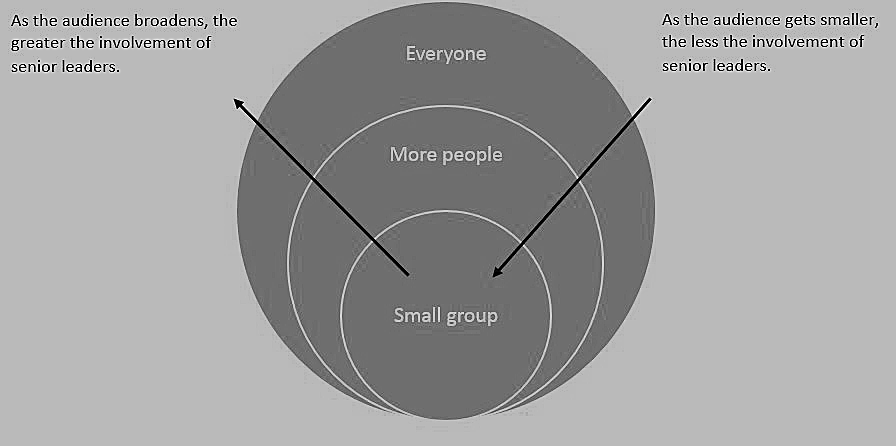
The below diagram might get you thinking about a communication strategy. It’s simple. But given the abundance of bad church signs posted in the blogosphere, I hope it is a helpful visual for church leaders.
communication diagram

I’ll call this visual the “big circle/little circle” decision for a communication strategy. A big circle of people requires the knowledge and approval of a senior church leaders. If more will see or hear the communication, then top leaders should approve and edit the message. Websites, Sunday morning announcements, bulletins, and church signs fall into the big circle. A little circle does not require the knowledge or approval of senior church leaders. Examples of little circles are small group handouts and the student ministry brochure.

Senior church leaders who want to oversee and approve small circle communication are micromanagers. Senior leaders who care little about big circle communication are negligent or apathetic. Like everything else in leadership, balance is necessary. In short, if a lot of people will see it, you should approve it. When few people will encounter the message, let others run with it. And if you’re reading this wondering what’s on your church sign, then go check it.

Read more from Sam here.

Download PDF

Tags: , ,

| What is MyVisionRoom? > | Back to Communication >

ABOUT THE AUTHOR

Sam Rainer III
Sam serves as lead pastor of West Bradenton Baptist Church. He is also the president of Rainer Research, and he is the co-founder/co-owner of Rainer Publishing. His desire is to provide answers for better church health. Sam is author of the book, Obstacles in the Established Church, and the co-author of the book, Essential Church. He is an editorial advisor/contributor at Church Executive magazine. He has also served as a consulting editor at Outreach magazine. He has written over 150 articles on church health for numerous publications, and he is a frequent conference speaker. Before submitting to the call of ministry, Sam worked in a procurement consulting role for Fortune 1000 companies. Sam holds a B.S. in Finance and Marketing from the University of South Carolina, an M.A. in Missiology from Southern Seminary, and a Ph.D. in Leadership Studies at Dallas Baptist University.
See more articles by >

COMMENTS

What say you? Leave a comment!

Recent Comments
comment_post_ID); ?> Thank you for this information. I'm going to use this article to improve my work with the Lord.
 
— Abel Singbeh
 
comment_post_ID); ?> Thank you Ed for sharing your insights into the Church Growth Movement. I have my reservations with Church Growth models because it has done more damage than good in the Body of Christ. Over the years, western churches are more focused on results, formulas and processes with little or no emphasis on membership and church discipline. Pastors and vocational leaders are burnt out because they're overworked. I do believe that the Church Growth model is a catalyst to two destructive groups: The New Apostolic Reformation and the Emerging Church. Both groups overlap and have a very loose definition. They're both focus on contemporary worship, expansion of church brand (franchising), and mobilizing volunteering members as 'leaders' to grow their ministry. Little focus on biblical study, apologetics and genuine missional work with no agenda besides preaching of the gospel.
 
— Dave
 
comment_post_ID); ?> Thank you for sharing such a good article. It is a great lesson I learned from this article. I am one of the leaders in Emmanuel united church of Ethiopia (A denomination with more-than 780 local churches through out the country). I am preparing a presentation on succession planning for local church leaders. It will help me for preparation If you send me more resources and recommend me books to read on the topic. I hope we may collaborate in advancing leadership capacity of our church. God Bless You and Your Ministry.
 
— Argaw Alemu
 

Clarity Process

Three effective ways to start moving toward clarity right now.

Measuring Ministry Progress in Your Church, Part 2: Attendance

Numbers matter to God, because people matter to God.


In a previous post I introduced the importance of measuring progress in ministry. Today we look at the measurement of attendance.

Measuring weekly attendance at church is the perhaps the easiest measurement to make, because it’s as easy as doing a head count.

From week to week, you can see if more or less people are coming to church, and compare these numbers over time.

Although there is a reluctance in some circles to talk about attendance numbers, more people coming to church and hearing the gospel is a good thing. (Perhaps this speaks more to the Australian culture than other cultures, but a church that is growing doesn’t feel to be ashamed, nor do others need to assume that a church that is growing has compromised and ceased preaching the gospel).

As Perry Noble explains:

“Every number has a name, every name has a story, every story matters to God.”

Numbers matter to God, because people matter to God. You only need to look at the parable of the lost sheep to see that individuals matter to God (and particularly those who are lost).

Of course, small attendance in and of itself doesn’t indicate a problem. Likewise, declining attending church doesn’t necessarily raise alarm bells – perhaps you’re preaching the gospel more clearly and it’s offending people and they’re leaving.

Why aren’t more people coming to church?

However, if fewer people are coming to church, it’s worth asking the question – why?

  • Has the church stopped praying for growth and for people to be saved?
  • Have people stopped inviting their friends?
  • Is the preacher getting lazy and preparing poorly?
  • Is the preaching addressing only a certain group of people (I recall a pastor at a previous church who only gave illustrations about his children – not great when the majority of the church were teenagers!).
  • Is the church building so full that people don’t think there’s room for them?.

There are good questions to ask when attendance starts to decline.

3 reasons to be cautious about increased attendance

On the flip side, increasing numbers in attendance need to be viewed with caution for at least 3 reasons:

  1. Transfer growth. Church attendance can increase as Christians migrate from another church. There are good reasons for church migration (moved to the area, no kids ministry in their church, etc.), but if this is the primary reason a church is growing, it’s not healthy. At the heart of church growth should be new people (the unchurched and the dechurched) coming to hear the good news about Jesus. An increase in attendance because of transfer growth isn’t necessarily a reason to celebrate.
  2. Back door departures. The number of people in attendance needs to be considered along with the number of people leaving. If attendance levels are high, but there is also a large number of people leaving the church, the church is obviously attracting new people, but failing to keep them (or attracting at the expense of longer-term members). In this case, an increase in attendance isn’t necessarily a reason to celebrate either, if the back door is just as wide as the front door.
  3. Frequency of attendance. Similar to the point above, attendance levels can be increasing if lots of new people are coming, but this must be considered along with the frequency with which members are attending church. On average, are members coming more regularly – 2 out of 4 Sundays, 3 out of 4 Sundays, or even 4 out of 4 Sundays? Or are they attending less frequently? High attendance from newcomers can mask a problem of members not being committed to church.

That said, attendance is a great starting measurement, and one that every pastor I have spoken with is using. I suggest breaking down this measure into the following:

  • Measurement #1. The number of adults and children at church this weekend.
  • Measurement #2.  The number of adults and children who attended church this weekend, who aren’t currently attending another church.
  • Measurement #3. The frequency of attendance of members (how many Sundays in a month the average member is at church). To measure this, you need to be using a church member database that enables you to mark the ‘roll’ each week. We use Elvanto at Church by the Bridge.
  • Measurement #4. The number of people who were attending, but aren’t any more (i.e. have been officially removed from the church roll).
  • Measurement #5. The number of unidentified regular attenders. This is helpful for putting on the agenda follow up of people who have been coming for a while, but who are unknown and not yet connected.

Reviewing these numbers over time is more helpful than comparing from week to week. Like political polls, the numbers go up and down, but its the trends over time that are worth looking at.

As Al Stewart explains:

“You don’t grow week to week, you grow year by year…comparing the same months of different years, will give you a proper picture of what is happening”.

Read Part 1 of this series here.

Read more from Steve here.

 
Download PDF

Tags: , , , ,

| What is MyVisionRoom? > | Back to Process >

ABOUT THE AUTHOR

Steve Kryger

Steve Kryger

I don’t deserve it, but I’ve been redeemed by Jesus. I can’t begin to express how thankful I am for all God has done for me, and it’s my privilege to serve Him. I am the Executive Pastor at Church by the Bridge in Kirribilli, Australia. Prior to serving at Church by the Bridge, I worked as a marketing manager in Canberra, as well as a social media specialist.

See more articles by >

COMMENTS

What say you? Leave a comment!

Faith Jackson — 12/26/22 2:38 pm

Thanks for this information. It helps me begin to look at the church in a different light.

Recent Comments
comment_post_ID); ?> Thank you for this information. I'm going to use this article to improve my work with the Lord.
 
— Abel Singbeh
 
comment_post_ID); ?> Thank you Ed for sharing your insights into the Church Growth Movement. I have my reservations with Church Growth models because it has done more damage than good in the Body of Christ. Over the years, western churches are more focused on results, formulas and processes with little or no emphasis on membership and church discipline. Pastors and vocational leaders are burnt out because they're overworked. I do believe that the Church Growth model is a catalyst to two destructive groups: The New Apostolic Reformation and the Emerging Church. Both groups overlap and have a very loose definition. They're both focus on contemporary worship, expansion of church brand (franchising), and mobilizing volunteering members as 'leaders' to grow their ministry. Little focus on biblical study, apologetics and genuine missional work with no agenda besides preaching of the gospel.
 
— Dave
 
comment_post_ID); ?> Thank you for sharing such a good article. It is a great lesson I learned from this article. I am one of the leaders in Emmanuel united church of Ethiopia (A denomination with more-than 780 local churches through out the country). I am preparing a presentation on succession planning for local church leaders. It will help me for preparation If you send me more resources and recommend me books to read on the topic. I hope we may collaborate in advancing leadership capacity of our church. God Bless You and Your Ministry.
 
— Argaw Alemu
 

Clarity Process

Three effective ways to start moving toward clarity right now.

4 Disciplines for Leading with Clarity

You must be an active subscriber to view this premium content. Subscribe or Login.

Download PDF

Tags: , , ,

| What is MyVisionRoom? > | Back to Vision >

ABOUT THE AUTHOR

Will Mancini

Will Mancini

Will Mancini wants you and your ministry to experience the benefits of stunning, God-given clarity. As a pastor turned vision coach, Will has worked with an unprecedented variety of churches from growing megachurches and missional communities, to mainline revitalization and church plants. He is the founder of Auxano, creator of VisionRoom.com and the author of God Dreams and Church Unique.

See more articles by >

COMMENTS

What say you? Leave a comment!

Nate Warren — 05/14/13 10:38 am

Pat has some great and very applicable thoughts for people within church world today.

Recent Comments
comment_post_ID); ?> Thank you for this information. I'm going to use this article to improve my work with the Lord.
 
— Abel Singbeh
 
comment_post_ID); ?> Thank you Ed for sharing your insights into the Church Growth Movement. I have my reservations with Church Growth models because it has done more damage than good in the Body of Christ. Over the years, western churches are more focused on results, formulas and processes with little or no emphasis on membership and church discipline. Pastors and vocational leaders are burnt out because they're overworked. I do believe that the Church Growth model is a catalyst to two destructive groups: The New Apostolic Reformation and the Emerging Church. Both groups overlap and have a very loose definition. They're both focus on contemporary worship, expansion of church brand (franchising), and mobilizing volunteering members as 'leaders' to grow their ministry. Little focus on biblical study, apologetics and genuine missional work with no agenda besides preaching of the gospel.
 
— Dave
 
comment_post_ID); ?> Thank you for sharing such a good article. It is a great lesson I learned from this article. I am one of the leaders in Emmanuel united church of Ethiopia (A denomination with more-than 780 local churches through out the country). I am preparing a presentation on succession planning for local church leaders. It will help me for preparation If you send me more resources and recommend me books to read on the topic. I hope we may collaborate in advancing leadership capacity of our church. God Bless You and Your Ministry.
 
— Argaw Alemu
 

Clarity Process

Three effective ways to start moving toward clarity right now.

Keeping Your Ministry Brand Top of Mind: A Lesson from Disney

Though it was founded in 2006 (which makes it older than Twitter), BuzzFeed stormed onto the social media scene in 2012, more than doubling its 2011 traffic (per Alexa).

The format is perfect for the way audiences consume and share media today. The content is easy to consume, relevant, entertaining and frequent, as the site posts dozens of times a day. Brands like HBO and Velveeta have even joined in, co-creating content with BuzzFeed. It’s a publishing model that requires lots of staffers and community contributors to keep the content fire hose pumping.

So it was quite a surprise to see that Disney has launched its own BuzzFeed-like site. Entitled “Oh My Disney” (OMD), the site features articles with Disney imagery, GIFs and other short-form Disney-related editorial built specifically to be easily consumed, enjoyed and quickly shared. Posts like “15 More Reminders That You’re Great Today” and “You Know You’re a 90′s Kid When” are organized into five categories: Awww; Oh, Snap!; Retro; Silly; and Whoa.

The page is updated quite consistently, anywhere from two to eight times a day (even if the content isn’t necessarily timely). So how is Disney doing it?

A HISTORY OF SOCIAL MEDIA SUCCESS

If any brand were going to dive headfirst into publishing, Disney might be the one best suited to it. Far and away its largest and most successful platform is Facebook, where the Disney page boasts more than 42 million fans. The pages for Pixar Studios and Walt Disney Studios aren’t shabby either, having 12.5 million fans and 6.4 million fans, respectively, and the OMD Facebook page has 11,000 fans after only a few weeks of existence. Oh My Disney is also on Twitter and Tumblr.

So the foundation is there for Disney to create its own publishing channel, where a post can expand beyond the confines of a 140-character tweet or a single-image Facebook post. But what makes this possible for Disney, and difficult (though not impossible) for most other brands, lies much deeper than social media.

A HISTORY OF STORYTELLING

Having movies and characters at its core and countless physical and digital extensions, Disney has endeared itself to many through its heartfelt storytelling. Disney has a wealth of original and beloved content and characters with messages that are relevant no matter what decade you were born in. Parents watch Disney films with their children, just as they watched them with their parents when they were their children’s age. All this content gives Disney vast amounts of ammunition for OMD. They’re not creating new content as much as curating existing content.

This inherent storytelling is what makes social media and content marketing such a fruitful endeavor for entertainment-based brands. Imagery and quotations resonate with audiences forever. I still crack a smile every time the Forrest Gump Facebook page posts an update, referring to a movie that was made nearly 20 years ago (has it really been that long?).

FINDING YOUR AUDIENCE AND DELIVERING CONTENT

Another reason OMD can work for Disney is that the brand has done a great job of finding its audience. There is certainly no shortage of social media channels, but Disney carefully chooses where it will publish content and plans appropriately. Disney isn’t just creating articles on OMD and cross-posting to Twitter, Facebook, Pinterest and Tumblr. Disney creates content specifically for each channel. Granted, the content is often very similar (photo and GIF heavy), but that creates familiarity and a unified social media voice. The key is that Disney finds its audience on the appropriate channels and uses those channels to create instead of solely promoting.

WHAT DOES THIS MEAN FOR YOUR BRAND?

As a content agency, we’re obviously big fans of creating an owned channel, like OMD. But we warn brands about biting off more than they can chew. Disney has made such a commitment to content that it’s dedicated a team (albeit small) to OMD, and that’s really the only way to pull off a channel like this.

But that doesn’t mean that brands should ignore the trail Disney has blazed. Like the first brands to create custom-published magazines, Disney has decided to move beyond native advertising and own its content channels. Even though it is an established brand that’s been around for decades, Disney remains at the forefront of brand storytelling.

It’s a bold move. Do you think this will pan out for Disney? Will more brands follow?

Read more from Jon here.

 
Download PDF

Tags: , , , ,

| What is MyVisionRoom? > | Back to Communication >

ABOUT THE AUTHOR

Jon Thomas

See more articles by >

COMMENTS

What say you? Leave a comment!

Recent Comments
comment_post_ID); ?> Thank you for this information. I'm going to use this article to improve my work with the Lord.
 
— Abel Singbeh
 
comment_post_ID); ?> Thank you Ed for sharing your insights into the Church Growth Movement. I have my reservations with Church Growth models because it has done more damage than good in the Body of Christ. Over the years, western churches are more focused on results, formulas and processes with little or no emphasis on membership and church discipline. Pastors and vocational leaders are burnt out because they're overworked. I do believe that the Church Growth model is a catalyst to two destructive groups: The New Apostolic Reformation and the Emerging Church. Both groups overlap and have a very loose definition. They're both focus on contemporary worship, expansion of church brand (franchising), and mobilizing volunteering members as 'leaders' to grow their ministry. Little focus on biblical study, apologetics and genuine missional work with no agenda besides preaching of the gospel.
 
— Dave
 
comment_post_ID); ?> Thank you for sharing such a good article. It is a great lesson I learned from this article. I am one of the leaders in Emmanuel united church of Ethiopia (A denomination with more-than 780 local churches through out the country). I am preparing a presentation on succession planning for local church leaders. It will help me for preparation If you send me more resources and recommend me books to read on the topic. I hope we may collaborate in advancing leadership capacity of our church. God Bless You and Your Ministry.
 
— Argaw Alemu
 

Clarity Process

Three effective ways to start moving toward clarity right now.

How Motivation and Implementation Strategies Define the Multisite Church: 3 Concerns

McChurch. Franchised Jesus. Theological clones. Incubator congregations. Ecclesiological buffets. From the devil.

If there is a classification of church that gets put down more than megachurches, it would have to be multisite churches. Is the critique fair? Sometimes. But not always.

As we found with megachurches recently, there is plenty of good that comes with the stereotypical bad. In the megachurch research we saw that they don’t really draw away members from other local churches as much as people think they do, they are healthier financially, and they are growing at a faster pace than smaller churches.

But what about multisite churches? Let me say that I know some really bad ones… they fit all the stereotypes. But, I know some good ones, too. I’ve preached at several that were on mission, raising up leaders, and doing great ministry.

Warren Bird and Leadership Network– the same group that did much of the megachurch research discussed here on the blog– released some research on multisite churches last fall. And wouldn’t you know that it showed several positives regarding multisite churches.

From the research:

– Multisite churches reach more people than single site churches.
– Multisite tends to spread healthy churches to more diverse communities.
– Multisite churches have more volunteers in service as a percentage than single site.
– Multisite churches baptize more people than single site.
– Multisite churches tend to activate more people into ministry than single site.

Yep– facts are our friends. And, people who hate multi-site churches will probably not like these facts. (They did not like the megachurch facts either!) The fact is there are some good statistical indicators backing up the approach.

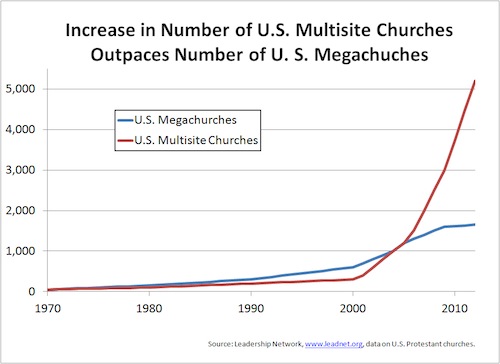
And the number of multisite churches is exploding. In fact, 62 of the 100 fastest growing churches in America are multisite. And there are now more than 5,000 multisite churches in North America:

megachurchesVSmultisite

But is this multisite explosion a good thing for churches in North America? Often yes…and sometimes no.

As I see it, the answer is rooted in the motivation and implementation of the strategy. If a church is using a multisite strategy as an alternative to spending $20 million on a centralized campus, most of us would agree that is a wise decision. If they are using it to spread only their “brand of church” or to provide the pastoral team with a “vacation campus” halfway across the country in a tropical destination, it’s probably not a wise decision.

But if a pastoral team is faithful to reaching the communities in which their campuses are located and to ministering to the campuses in an equitable fashion, I wish them all the success. Using a multisite strategy to engage a community through mission and to multiply disciples in the body is a win-win, and it’s happening all over the country.

Unfortunately, multisite churches still face their fair share of issues. The best ones overcome them, but many struggle with similar issues.

In a past article for Outreach Magazine, I discussed three concerns facing multisite churches that I see still apply today.

Pastoral Responsibility

Despite a church’s best intentions at new sites, sometimes certain pastoral duties get lost: scriptural assignments such as praying over the sick (James 5:14); watching over those placed in your care (1 Peter 5:1); discipline (1 Cor. 5); and breaking bread with the beloved (Acts 2:42). I know that those duties are supposed to be the job of the campus pastor, but we also know it sometimes does not happen. The focus is easily placed on the event more than the community. And sometimes that results in people come for the show without connecting to the community.

Christian Community

Connected to pastoral ministry is the community of faith itself. The church is not merely a gathering, but a united people who work together for the glory of God and the good of their neighbors. One of the weaknesses of event-driven multisite churches is that some tend encourage (unintentionally at times) a come-and-get mentality over a come-and-give ethos. Of course this is not only a problem for multisite churches, but the potential for the problem is significant. Don’t misunderstand me; I get that it can work, but it’s not easy. If you are going multisite, I hope it keeps you up at night, wrestling with ways to build community in a system that can easily discourage it.

Reproducing New Teachers

Perhaps my biggest concern with the multisite paradigm is that, without intentionality, it will limit reproduction. Let’s face it– it’s easier to create another extension site than it is to create another faithful pastor who is a great communicator. Our Great Commission strategy should include the reproduction of biblical communicators, not just big campuses.

Where Now?

So am I anti-multisite? Not at all.

I am not anti-multisite or anti-megachurch. I am thankful for both of them. However, I am anti-consumerism. Church is not about being the best purveyor of religious “goods and services.” And if a megachurch or a multisite thrives by appealing solely to the “come and see” mentality that is so prevalent, we will all regret it.

No matter the number of campuses your church has, reproduction is the goal–reproducing believers, ministries, groups and churches. That can be in a megachurch, multi-site church or, for that matter, in a house church.

So, if you are going multisite, make sure you stay focused on multiplying the mission of God– not just your brand of church or the reach of one person. Let’s make it more than projecting the image of a pastor on another screen.

The best churches know and do that– so learn from them.

Read more from Ed here.

Download PDF

Tags: , ,

| What is MyVisionRoom? > | Back to Vision >

ABOUT THE AUTHOR

Ed Stetzer

Ed Stetzer

Ed Stetzer, Ph.D., holds the Billy Graham Chair of Church, Mission, and Evangelism at Wheaton College and serves as Executive Director of the Billy Graham Center for Evangelism. He has planted, revitalized, and pastored churches, trained pastors and church planters on six continents, holds two masters degrees and two doctorates, and has written dozens of articles and books. Previously, he served as Executive Director of LifeWay Research. Stetzer is a contributing editor for Christianity Today, a columnist for Outreach Magazine, and is frequently cited or interviewed in news outlets such as USAToday and CNN. He serves as interim pastor of Moody Church in Chicago.

See more articles by >

COMMENTS

What say you? Leave a comment!

Recent Comments
comment_post_ID); ?> Thank you for this information. I'm going to use this article to improve my work with the Lord.
 
— Abel Singbeh
 
comment_post_ID); ?> Thank you Ed for sharing your insights into the Church Growth Movement. I have my reservations with Church Growth models because it has done more damage than good in the Body of Christ. Over the years, western churches are more focused on results, formulas and processes with little or no emphasis on membership and church discipline. Pastors and vocational leaders are burnt out because they're overworked. I do believe that the Church Growth model is a catalyst to two destructive groups: The New Apostolic Reformation and the Emerging Church. Both groups overlap and have a very loose definition. They're both focus on contemporary worship, expansion of church brand (franchising), and mobilizing volunteering members as 'leaders' to grow their ministry. Little focus on biblical study, apologetics and genuine missional work with no agenda besides preaching of the gospel.
 
— Dave
 
comment_post_ID); ?> Thank you for sharing such a good article. It is a great lesson I learned from this article. I am one of the leaders in Emmanuel united church of Ethiopia (A denomination with more-than 780 local churches through out the country). I am preparing a presentation on succession planning for local church leaders. It will help me for preparation If you send me more resources and recommend me books to read on the topic. I hope we may collaborate in advancing leadership capacity of our church. God Bless You and Your Ministry.
 
— Argaw Alemu
 

Clarity Process

Three effective ways to start moving toward clarity right now.

Midnight Lunch Team Worksheets

Sara Miller Caldicott, great grandniece of Thomas Edison and author of the new book Midnight Lunch, has translated Edison’s world-changing innovation methods for use in the 21st century. Here are some of her thoughts on collaboration:

True collaboration embraces:

  • discovery learning mindset versus a pure task orientation
  • A belief in anticipating and creating rather than merely reacting and responding
  • Presence of inspiration across multiple facets of both individual and team endeavors
  • Coherence of purpose
  • A dedication to elevating the performance of every team member
  • Connections to human and social networks of influence

Do these qualities sound different from the ones valued by your team? Do they draw upon ideas that feel new or seem broader than your current concept of what teamwork embraces?

Based on experience, the answer would be yes.

So what are you going to do about it?

Caldicott has developed a series of 12 worksheets so your team can integrate its project work with true collaboration concepts in her new book, Midnight Lunch: The 4 Phases of Team Collaboration Success, from Thomas Edison’s Lab.

Why not integrate these worksheets into a weekly learning exercise with your team?


Download all the worksheets here:

Week 1: The Roots of the 4 Phases of Collaboration

Week 2: Global Forces Impacting Collaboration

Week 3: Phase 1 – Capacity – Diversity

Week 4: Phase 2 – Capacity – Small Teams Foster Collegiality

Week 5: Phase 2 – Context – Solo Meld Expands Individual Creative Efforts

Week 6: Phase 3 – Context – The Pathway to Breakthroughs

Week 7: Phase 3 – Coherence: Deepening Bonds Through Inspiration

Week 8: Phase 3 – Coherence: Fostering Debate and Progress

Week 9: Phase 4 – Complexity: Spotting and Leveraging Complex Systems

Week 10: Phase 4 – Complexity: Social Media and Viral Networks

Week 11: Phase 4 – Complexity: Harnessing Collective Intelligence

Week 12: Facing the Future: The Long-Term Impacts of Collaboration


Read more from Sarah Miller Caldicott here.

Purchase Midnight Lunch here or as a Kindle version here.

Read our Sums book summary of Midnight Lunch here. Go here to register for our biweekly release of future Sums.

Download PDF

Tags: , , , , ,

| What is MyVisionRoom? > | Back to Leadership >

ABOUT THE AUTHOR

Sarah Miller Caldicott

Sarah Miller Caldicott

A great grandniece of Thomas Edison, Sarah Miller Caldicott has been engaged in creativity and innovation throughout her life. Inspired by a family lineage of inventors dating back five generations, Sarah spent the first 15 years of her 25-year career as an executive with Global 500 firms including Quaker Oats/Pepsi and the Helene Curtis subsidiary of Unilever. Working with global teams, Sarah spearheaded major innovation initiatives in North America, Europe, and Asia. Concerned that America risks losing its innovation edge, Sarah spent three years researching Edison’s innovation methods with experts at Rutgers University. She co-authored the first book ever written on the subject of Thomas Edison’s world-changing innovation methods. Entitled Innovate Like Edison: The Five Step System for Breakthrough Business Success, Sarah’s book has been translated into 5 languages and is used as an innovation textbook in graduate and undergraduate programs across the US. Sarah's newest book, Midnight Lunch: The 4 Phases of Team Collaboration Success, has just been released from Wiley publishing. Midnight Lunch reveals how to develop collaboration as a backbone for innovation success in the digital era.

See more articles by >

COMMENTS

What say you? Leave a comment!

Recent Comments
comment_post_ID); ?> Thank you for this information. I'm going to use this article to improve my work with the Lord.
 
— Abel Singbeh
 
comment_post_ID); ?> Thank you Ed for sharing your insights into the Church Growth Movement. I have my reservations with Church Growth models because it has done more damage than good in the Body of Christ. Over the years, western churches are more focused on results, formulas and processes with little or no emphasis on membership and church discipline. Pastors and vocational leaders are burnt out because they're overworked. I do believe that the Church Growth model is a catalyst to two destructive groups: The New Apostolic Reformation and the Emerging Church. Both groups overlap and have a very loose definition. They're both focus on contemporary worship, expansion of church brand (franchising), and mobilizing volunteering members as 'leaders' to grow their ministry. Little focus on biblical study, apologetics and genuine missional work with no agenda besides preaching of the gospel.
 
— Dave
 
comment_post_ID); ?> Thank you for sharing such a good article. It is a great lesson I learned from this article. I am one of the leaders in Emmanuel united church of Ethiopia (A denomination with more-than 780 local churches through out the country). I am preparing a presentation on succession planning for local church leaders. It will help me for preparation If you send me more resources and recommend me books to read on the topic. I hope we may collaborate in advancing leadership capacity of our church. God Bless You and Your Ministry.
 
— Argaw Alemu
 

Clarity Process

Three effective ways to start moving toward clarity right now.

Connection Trumps Conflict: 3 Exercises to Improve Your Leadership Communication Skills

I’m sure it’s happened to you: You’re in a tense team meeting trying to defend your position on a big project and start to feel yourself losing ground. Your voice gets louder. You talk over one of your colleagues and correct his point of view. He pushes back, so you go into overdrive to convince everyone you’re right. It feels like an out of body experience — and in many ways it is. In terms of its neurochemistry, your brain has been hijacked.

In situations of high stress, fear or distrust, the hormone and neurotransmitter cortisol floods the brain. Executive functions that help us with advanced thought processes like strategy, trust building, and compassion shut down. And the amygdala, our instinctive brain, takes over. So we default to one of four responses: fight (keep arguing the point), flight (revert to, and hide behind, group consensus), freeze (disengage from the argument by shutting up) or appease (make nice with your adversary by simply agreeing with him).

All are harmful because they prevent the honest and productive sharing of information and opinion. But, as a consultant who has spent decades working with executives on their communication skills, I can tell you that the fight response is by far the most damaging to work relationships. It is also, unfortunately, the most common.

That’s partly due to another neurochemical process. When you argue and win, your brain floods with different hormones: adrenaline and dopamine, which makes you feel good, dominant, even invincible. It’s a the feeling any of us would want to replicate. So the next time we’re in a tense situation, we fight again. We get addicted to being right.

Luckily, there’s another hormone that can feel just as good as adrenaline: oxytocin. It’s activated by human connection and it opens up the networks in our executive brain, or prefrontal cortex, further increasing our ability to trust and open ourselves to sharing. Your goal as a leader should be to spur the production of oxytocin in yourself and others, while avoiding (at least in the context of communication) those spikes of cortisol and adrenaline.

Here are a few exercises for you to do at work to help your (and others’) addiction to being right:

  • Set rules of engagement. If you’re heading into a meeting that could get testy, start by outlining rules of engagement.  These practices will counteract the tendency to fall into harmful conversational patterns. Afterwards, consider see how you and the group did and seek to do even better next time.
  • Listen with empathy. In one-on-one conversations, make a conscious effort to speak less and listen more. The more you learn about other peoples’ perspectives, the more likely you are to feel empathy for them. And when you do that for others, they’ll want to do it for you, creating a virtuous circle.
  • Plan who speaks. In situations when you know one person is likely to dominate a group, create an opportunity for everyone to speak. Ask all parties to identify who in the room has important information, perspectives, or ideas to share. List them and the areas they should speak about on a flip chart and use that as your agenda, opening the floor to different speakers, asking open-ended questions and taking notes.

Connecting and bonding with others trumps conflict. I’ve found that even the best fighters — the proverbial smartest guys in the room — can break their addiction to being right by getting hooked on oxytocin-inducing behavior instead.

Read the full article here.

Read more by Judith here.


Have you created a “My Vision Room” account yet? Sign up free here to get insider access to additional features and offers of the Vision Room.


Download PDF

Tags: , ,

| What is MyVisionRoom? > | Back to Communication >

ABOUT THE AUTHOR

Judith Glaser

Judith Glaser

Judith E. Glaser is the CEO of Benchmark Communications and the chairman of The Creating WE Institute. She is the author of six books, including Creating WE (Platinum Press, 2005) and Conversational Intelligence (BiblioMotion, 2013), and a consultant to Fortune 500 companies.

See more articles by >

COMMENTS

What say you? Leave a comment!

Recent Comments
comment_post_ID); ?> Thank you for this information. I'm going to use this article to improve my work with the Lord.
 
— Abel Singbeh
 
comment_post_ID); ?> Thank you Ed for sharing your insights into the Church Growth Movement. I have my reservations with Church Growth models because it has done more damage than good in the Body of Christ. Over the years, western churches are more focused on results, formulas and processes with little or no emphasis on membership and church discipline. Pastors and vocational leaders are burnt out because they're overworked. I do believe that the Church Growth model is a catalyst to two destructive groups: The New Apostolic Reformation and the Emerging Church. Both groups overlap and have a very loose definition. They're both focus on contemporary worship, expansion of church brand (franchising), and mobilizing volunteering members as 'leaders' to grow their ministry. Little focus on biblical study, apologetics and genuine missional work with no agenda besides preaching of the gospel.
 
— Dave
 
comment_post_ID); ?> Thank you for sharing such a good article. It is a great lesson I learned from this article. I am one of the leaders in Emmanuel united church of Ethiopia (A denomination with more-than 780 local churches through out the country). I am preparing a presentation on succession planning for local church leaders. It will help me for preparation If you send me more resources and recommend me books to read on the topic. I hope we may collaborate in advancing leadership capacity of our church. God Bless You and Your Ministry.
 
— Argaw Alemu
 

Clarity Process

Three effective ways to start moving toward clarity right now.

5 Hidden Axioms of Volunteer Management in Your Church

Effective church leaders are excellent volunteer managers. Managing your volunteer teams within your church is a nuanced and mysterious journey … It’s not always obvious what it takes to lead them well!  Here are 5 truths that I’ve found that weren’t obvious when I first start leading in church!

  • Volunteers are Donors // In a very real way volunteers are paying us to create a positive service environment for them. Treat volunteers well because they are the ones paying your salary!
  • Strategize for Friendship // We need volunteers to do tasks to make church happen however volunteers want to build relationships with other people. We are responsible for creating a service environment where friendship blossoms.
  • More Opportunities = More Volunteers // Effective church leaders find ways to create more “spaces” for volunteers. Rather than a scarcity mindset that focuses on not having enough people to fill roles … our job is to create more spots for people to serve.
  • Release Earlier // Give away the leadership of your volunteers to other volunteers as quickly as possible. Become a leader who leads leaders.
  • Think Outside the Weekend // There are tasks and activities that you could be leveraging volunteers throughout the week that would accelerate your ability to serve people. Pull volunteers into operation of what you do during the week!

What have you learned about managing volunteers over the years that wasn’t obvious when you started leading in a local church?

Read more from Rich here.

Download PDF

Tags: , , , ,

| What is MyVisionRoom? > | Back to Leadership >

ABOUT THE AUTHOR

Rich Birch

Rich Birch

Thanks so much for dropping by unseminary … I hope that your able to find some resources that help you lead your church better in the coming days! I’ve been involved in church leadership for over 15 years. Early on I had the privilege of leading in one of the very first multisite churches in North Amerca. I led the charge in helping The Meeting House in Toronto to become the leading multi-site church in Canada with over 4,000 people in 6 locations. (Today they are 13 locations with somewhere over 5,000 people attending.) In addition, I served on the leadership team of Connexus Community Church in Ontario, a North Point Community Church Strategic Partner. I currently serves as Operations Pastor at Liquid Church in the Manhattan facing suburbs of New Jersey. I have a dual vocational background that uniquely positions me for serving churches to multiply impact. While in the marketplace, I founded a dot-com with two partners in the late 90’s that worked to increase value for media firms and internet service providers. I’m married to Christine and we live in Scotch Plains, NJ with their two children and one dog.

See more articles by >

COMMENTS

What say you? Leave a comment!

Recent Comments
comment_post_ID); ?> Thank you for this information. I'm going to use this article to improve my work with the Lord.
 
— Abel Singbeh
 
comment_post_ID); ?> Thank you Ed for sharing your insights into the Church Growth Movement. I have my reservations with Church Growth models because it has done more damage than good in the Body of Christ. Over the years, western churches are more focused on results, formulas and processes with little or no emphasis on membership and church discipline. Pastors and vocational leaders are burnt out because they're overworked. I do believe that the Church Growth model is a catalyst to two destructive groups: The New Apostolic Reformation and the Emerging Church. Both groups overlap and have a very loose definition. They're both focus on contemporary worship, expansion of church brand (franchising), and mobilizing volunteering members as 'leaders' to grow their ministry. Little focus on biblical study, apologetics and genuine missional work with no agenda besides preaching of the gospel.
 
— Dave
 
comment_post_ID); ?> Thank you for sharing such a good article. It is a great lesson I learned from this article. I am one of the leaders in Emmanuel united church of Ethiopia (A denomination with more-than 780 local churches through out the country). I am preparing a presentation on succession planning for local church leaders. It will help me for preparation If you send me more resources and recommend me books to read on the topic. I hope we may collaborate in advancing leadership capacity of our church. God Bless You and Your Ministry.
 
— Argaw Alemu
 

Clarity Process

Three effective ways to start moving toward clarity right now.

Measuring Ministry Progress in Your Church, Part 1: Introduction

Several years ago my wife and I visited Canada, to see my sister and brother-in-law. While in Vancouver, we walked up the infamous Grouse Mountain. Here’s how the walk is described:

“The Grouse Grind is a 2.9-kilometre trail up the face of Grouse Mountain, commonly referred to as ‘Mother Nature’s Stairmaster.’   This trail is very challenging. Keep in mind that there is a wide range of mountaintop trails that might better suit the average hiker.”

As far as short hikes go, this one is indeed challenging – every step of the way is a vertical step – there’s no flat! As the fog set in and my unfit-excuses-for-legs started to strain, I remember thinking “How much longer to go? Are we making any progress?”. And just when I was doubting, we’d come across progress markers like this:

trail marker

These markers were just the encouragement we needed, and the cause for celebration as step-by-step we progressed towards the finish line.

1.5 hours later we crossed the finish line as the snow started to fall – it was a sweet feeling to have got to the end and then celebrate with lunch by the fire, as the blizzard commenced outside!

Measurements help us to see our progress towards a destination.

We make these kinds of measurements all the time:

  • Is all this effort I am putting into healthy eating and exercise helping me lose weight?
  • Is the extra study I am doing helping me to have better conversational Japanese?
  • Am I any closer to my goal of saving for a deposit for a house?

When there’s no clear destination, and/or when this is combined with a lack of progress markers along the way, it can be very frustrating – in life, and also in ministry.

As Andy Stanley explains:

It is impossible to know if you are making progress if you are not clear about your destination…If you give good people a clear goal, then most of the time they’ll work like dogs to get there. But if the goal is unclear, they’re forced to guess or, worse, decide for themselves what a win really is.

But apart from the risk of frustrating and discouraging people, there are other good reasons to measure progress in ministry. Here’s 5 – I’m sure you can think of more, and I invite you to share them in the comments and as the series progresses.

1. To evaluate if our church activities are actually helping people to mature.

Willow Creek asked this hard question:

Are all the things that we do here at Willow Creek that these people so generously support really helping them become fully devoted followers of Christ—which is our mission—or are we just giving them a nice place to go to church?

It was a question that sparked a lot of soul-searching and prompted some fascinating research.

Activity isn’t necessarily progress. Busyness isn’t necessarily fruitfulness.

But you need to know where you’re progressing in order to evaluate the activity.

Andy Stanley again:

The tendency in business, or in church work for that matter, is to mistake activity for progress. We think that just because people are busy and doing a lot of stuff that we are being successful. The fact of the matter is, if all that activity isn’t taking you where you want to go, then it’s just wasted time.

2. To evaluate how faithfully we’re stewarding the limited resources God has given us.

We don’t have endless resources, and we’re accountable to God for how we use the money, gifts, time and energy he’s given us.

To pour hundreds or thousands of dollars into a ministry may be a great demonstration of faithfulness and trust in God.

Or it could be just unwise and reckless.

Taking measurements, praying hard, and asking hard questions might bring about some realisations:

3. To clarify why we’re doing something.

It’s very easy to lose sight of the purpose of a ministry of program. Why did we start this?

Until you have an objective, every idea is a good idea. If it’s not achieving the goal you set out for it, then it’s time to rethink it.

If the playgroup was started to share the gospel with mothers from the community and this isn’t happening – something needs to change.

4. To give thanks to God for his goodness and kindness.

God is the one who gives growth, and by measuring the growth that God gives, we can give Him the glory for his work amongst us.

The measurements allow us to extend beyond a general “Thanks for the growth” to “Thank you for the 3 people who completed Christianity Explored this year”.

5. To help us pray.

Not only do measurements provide meat on the bones for our thanks to God, they help us to pray.

  • Pray for more unbelievers to come to church.
  • Pray for more members to be sharing their faith.
  • Pray for giving to increase so that more mission partners can be supported.

The purpose of this series

I’ve been asking a lot of ministers how they measure their ministry progress, and while nearly all agree that measuring is a good idea, most are still thinking through how to do it (and lots of very helpful ideas have been graciously shared).

Do we measure attendance? Giving? People in small groups? How can you measure spiritual growth (I think there are ways!).

The subsequent posts in this series will explore the measurements we might use for evaluating ministry progress in the local church.

Keeping in mind it’s not about us, and it’s all about Jesus. May many more people come to know him. May we never boast in anything but the cross of Christ.

I pray this series will be helpful for you.

Read Part 2 here.

Read more from Steve here.
Download PDF

Tags: , , ,

| What is MyVisionRoom? > | Back to Process >

ABOUT THE AUTHOR

Steve Kryger

Steve Kryger

I don’t deserve it, but I’ve been redeemed by Jesus. I can’t begin to express how thankful I am for all God has done for me, and it’s my privilege to serve Him. I am the Executive Pastor at Church by the Bridge in Kirribilli, Australia. Prior to serving at Church by the Bridge, I worked as a marketing manager in Canberra, as well as a social media specialist.

See more articles by >

COMMENTS

What say you? Leave a comment!

Valarie — 01/25/15 1:58 pm

Thanks so much Steve for your obedience in sharing your gift/knowledge! This has truly blessed me; giving me guidance , examining myself as I move foward in Ministry. May God continue to share His wisdom with you as you warn others of working their ministry in vain. Thanks again, God Bless Man of God!

Recent Comments
comment_post_ID); ?> Thank you for this information. I'm going to use this article to improve my work with the Lord.
 
— Abel Singbeh
 
comment_post_ID); ?> Thank you Ed for sharing your insights into the Church Growth Movement. I have my reservations with Church Growth models because it has done more damage than good in the Body of Christ. Over the years, western churches are more focused on results, formulas and processes with little or no emphasis on membership and church discipline. Pastors and vocational leaders are burnt out because they're overworked. I do believe that the Church Growth model is a catalyst to two destructive groups: The New Apostolic Reformation and the Emerging Church. Both groups overlap and have a very loose definition. They're both focus on contemporary worship, expansion of church brand (franchising), and mobilizing volunteering members as 'leaders' to grow their ministry. Little focus on biblical study, apologetics and genuine missional work with no agenda besides preaching of the gospel.
 
— Dave
 
comment_post_ID); ?> Thank you for sharing such a good article. It is a great lesson I learned from this article. I am one of the leaders in Emmanuel united church of Ethiopia (A denomination with more-than 780 local churches through out the country). I am preparing a presentation on succession planning for local church leaders. It will help me for preparation If you send me more resources and recommend me books to read on the topic. I hope we may collaborate in advancing leadership capacity of our church. God Bless You and Your Ministry.
 
— Argaw Alemu
 

Clarity Process

Three effective ways to start moving toward clarity right now.

Developing an Online and Offline Personal Communication Strategy

I’ve been in a situation in life here lately where it has been necessary to develop a communication strategy online and offline. In the past, I have not given much thought to how I communicate with other people. Now leading a resourcing network for church planting, a missions collective for Haiti, and pastoring a church–I have come to really appreciate effective and thoughtful communication.  Here’s basically what I’m learning to do.

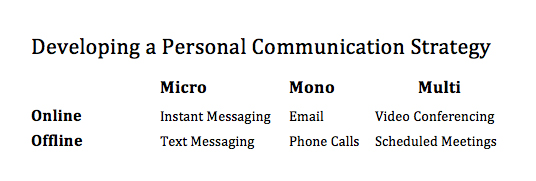
There are three levels of communication I have with people on a regular basis. The first level is the micro level. That’s the daily chatter and conversation about details, requests, etc. Typically, this level of communication does not need to be recorded or archived. Rather, it is communication for quick and immediate response in the rhythm of the workday. The second level is the mono level. That’s the one-on-one communication about actionable matters of various levels of significance. Typically, this kind of correspondence has requests that need to be filled, questions to be answered, plans to be executed, etc., and therefore archiving and retrieving such correspondence is helpful if not necessary. The third level is the multi level. That’s the communication with multiple people in the collaboration process. On this level, you are taking in feedback and interaction from several sources at one time in one setting.

These three levels are worked out through different platforms/formats whether offline and online.

Communication-Strategy

For offline communication on a micro level, I rely on text messaging. At this level, communication does not warrant a phone call or lengthy communication. It is intended for immediate feedback. On a mono level offline, I rely on telephone calls. The difference between the two levels are significant, because if something requires a phone call to be addressed is attempted to be covered via text, a lot of time is wasted in the process. However, if you care constantly calling someone about something that can be addressed over a text, that can create a frustrating work experience. You have to make judgments between the two and have operating agreements with your team. On the multi level offline, there’s scheduled meetings. These are structured times of collaborating with multiple people with a set agenda (talking points).

For online communication on a micro level, I rely on instant messaging (via Gmail) and direct messaging (via Twitter). I almost always have at least 2-3 IM tabs at the bottom of my Gmail with ongoing chatter about little matters that need immediate attention (changes, scheduling, updates, etc.). My online mono level is email. Again, like offline communication, this can be problematic. I don’t want a cluttered up inbox of emails that could have been instant messages or group emails that so often are strung around with the infamous “reply all” option on matters I’m often tangentially involved in. Emails can be a horrible medium for collaborative communication, which leads to the multi level online, namely video conferencing. If I am meeting with more than one person online, then I use Skype, Google Hangout, ooVoo, or GoToMeeting to forward projects, plan events/trips, discuss initiatives, etc.

For some time, I had been operating like this without fully recognizing it. Now that I see it, it has become all the more clear in learning to communicate better using formats/platforms appropriate to the level of correspondence. In my case, I work in a highly decentralized environment where online communication is 65% and offline communication is 35%. It may be the opposite (or some other breakdown) for you. Either way, know where you communicate most often and how you proceed to do so in the future may prove very beneficial down the road.

Have you developed a communication strategy for online or offline? What have you found that works best for you and those you work with?

Read more from Timmy here.

Download PDF

Tags: , , ,

| What is MyVisionRoom? > | Back to Communication >

ABOUT THE AUTHOR

Timmy Brister

In the “real world,” I am the founder and president of Gospel Systems, Inc, a 501(c)(3) non-profit organization focused on creating and sustaining delivery systems for the advancement of the gospel around the world. In 2010, I started a delivery system called PLNTD – a network for church planting and revitalization focusing on resourcing, relational community, residencies in local churches, and regional networks. In 2012, I started an international delivery system call The Haiti Collective which focuses on equipping indigenous churches through church partnerships in order to care for orphans, make disciples, train leaders, and plant churches in Haiti. In addition to serving as the executive director of these organizations, I have served for 12 years in pastoral ministry with churches in Alabama, Kentucky, and Florida. My passion is to see healthy, growing churches take ownership of the Great Commission to the end that disciples are making disciples, leaders are developed and deployed, and churches are planting churches here and around the world. This is the driving passion of my life and prayer that God would be so glorified in making His name great in our generation.

See more articles by >

COMMENTS

What say you? Leave a comment!

Recent Comments
comment_post_ID); ?> Thank you for this information. I'm going to use this article to improve my work with the Lord.
 
— Abel Singbeh
 
comment_post_ID); ?> Thank you Ed for sharing your insights into the Church Growth Movement. I have my reservations with Church Growth models because it has done more damage than good in the Body of Christ. Over the years, western churches are more focused on results, formulas and processes with little or no emphasis on membership and church discipline. Pastors and vocational leaders are burnt out because they're overworked. I do believe that the Church Growth model is a catalyst to two destructive groups: The New Apostolic Reformation and the Emerging Church. Both groups overlap and have a very loose definition. They're both focus on contemporary worship, expansion of church brand (franchising), and mobilizing volunteering members as 'leaders' to grow their ministry. Little focus on biblical study, apologetics and genuine missional work with no agenda besides preaching of the gospel.
 
— Dave
 
comment_post_ID); ?> Thank you for sharing such a good article. It is a great lesson I learned from this article. I am one of the leaders in Emmanuel united church of Ethiopia (A denomination with more-than 780 local churches through out the country). I am preparing a presentation on succession planning for local church leaders. It will help me for preparation If you send me more resources and recommend me books to read on the topic. I hope we may collaborate in advancing leadership capacity of our church. God Bless You and Your Ministry.
 
— Argaw Alemu
 

Clarity Process

Three effective ways to start moving toward clarity right now.